





Merlintrader trading Blog – Single-ticker deep dive
Lipocine (LPCN) – Oral brexanolone, postpartum depression and a tiny CNS pivot
Small-cap biotech focused on oral neuroactive steroids and endocrine drugs. The key near-term driver is
LPCN 1154, an oral brexanolone in Phase 3 for postpartum depression, with fresh enrollment news and a first
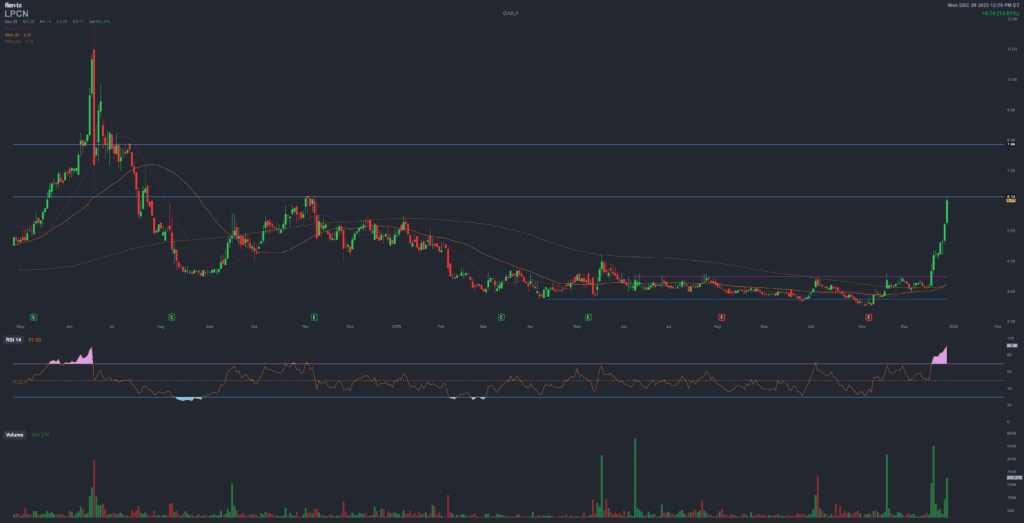
real catalyst window into mid-2026. As we write, shares are trading a little above $6.10, roughly +15–17%
on the day in reaction to the latest PPD enrollment update.
Data and prices: snapshot intraday on 29 December 2025, based on public sources. Figures can move quickly and
should be re-checked before any decision.
Ticker / exchange
LPCN – Nasdaq
Lipocine Inc., CNS / metabolic disorders
Share price (approx.)
$6.10
Intraday, about +16% vs prior $5.23 close; day range roughly $5.21 – $6.10; prior 52-week high
around $5.50, now pushed above $6.
Market cap
~$33 million
Micro-cap, limited float and liquidity
Cash (Q3 2025)
$15.1 million
Unrestricted cash and marketable securities as of 30 Sep 2025
Net loss (Q3 2025)
-$3.2 million
EPS -$0.59 in the quarter, -$1.35 over 9M 2025
Analyst target band
~$6.75 – $7.00
Average 12-month target around $6.9, small analyst group
News of the day – pipeline
16 December 2025: Lipocine reports that its Phase 3 trial of LPCN 1154 (oral brexanolone)
in postpartum depression has reached 80% enrollment (66 of 80 planned participants).
The second independent Data Safety Monitoring Board (DSMB) review is scheduled for mid-January 2026 and
topline results are still guided for the second quarter of 2026. The study is intended
to support a 505(b)(2) NDA submission referencing IV brexanolone. The stock is reacting with a sharp
intraday move, trading above $6.10 (around +16% vs the prior close).

1. Executive summary
Lipocine is a tiny CNS-focused biotech trying to recycle and repurpose known molecules through oral formulations. The story now revolves around LPCN 1154, an oral brexanolone targeting postpartum depression, plus a smaller epilepsy program (LPCN 2101) and legacy androgen projects (LPCN 1148, TLANDO royalties).
The fresh 80% enrollment milestone in the Phase 3 PPD trial confirms that the pivotal study is moving and keeps the company’s Q2 2026 topline guidance intact. As of this writing, the market is clearly paying attention: the stock is trading above $6.10, roughly +15–17% on the day, effectively repricing the probability that Lipocine will deliver data on time and keep the 505(b)(2) path alive.
Financially, Lipocine is what it looks like: a loss-making microcap with roughly $15 million in cash and a quarterly burn around $3 million. A simple extrapolation of the nine-month 2025 loss suggests roughly 18 months of runway from the end of Q3, meaning that unless something changes (partnering, non-dilutive capital, slower spend), a capital raise before or around the PPD data looks likely.
From a market-structure perspective, LPCN has become a classic retail event-driven name: a very small float, concentrated on a single late-stage trial, and now increasingly visible on Stocktwits and r/pennystocks threads that frame it as a potential “under-the-radar runner”. That combination can create powerful moves in both directions.
In short: Lipocine is a focused but fragile CNS story. The PPD Phase 3 is progressing and now firmly on the
calendar, the balance sheet is adequate but not comfortable, and the shareholder base is skewed towards
speculative traders. The reward is tied to a successful oral brexanolone launch; the risk is the usual
mix of Phase 3 failure, funding needs and microcap volatility.
2. Quick data and valuation snapshot
Micro-cap CNS / endocrine biotech
NASDAQ: LPCN
Price ref: about $6.10 (29 Dec 2025 intraday, ≈ +16% vs prior $5.23 close)
52-week range: roughly $2.52 – $6.10 (new intraday high)
2.1 Equity snapshot
- Share price: approximately $6.10 intraday while this report is being drafted.
- Market capitalisation: roughly $33 million based on current price and recent share count.
- Previous 52-week range: about $2.52 – $5.50; today’s move has pushed a new intraday high above $6.
- Average daily volume in the tens of thousands of shares; not a highly liquid name.
- Stock beta modestly below 1, but real-world volatility is high due to the tiny float.
2.2 Balance sheet and burn
- Cash, cash equivalents and marketable securities: $15.1 million as of 30 September 2025.
- Net loss Q3 2025: $3.2 million (EPS -$0.59), versus $2.2 million a year earlier.
- Net loss for the first nine months of 2025: $7.3 million (EPS -$1.35).
- Back-of-the-envelope runway: roughly 18 months from the end of Q3 if the burn rate stays similar.
The runway estimate is a simple extrapolation from reported losses and does not factor in future trial
acceleration, potential partnerships, royalty growth or financing. It is meant as a rough sanity check,
not a precise forecast.
2.3 Analyst view and trading frame
- Small analyst group with an average 12-month price target around $6.8–$6.9 per share, with a high estimate of $7.00 and low around $6.75.
- The targets still imply upside from the current low-$6 trading area, but with a narrower margin than when the stock traded in the mid-$5 range.
- Street commentary highlights the PPD Phase 3 as the main value driver, with TLANDO royalties and the broader pipeline treated as secondary optionality rather than core valuation blocks.
- Position sizing is critical: the combination of low float, binary catalyst and small cash pile makes this a high-risk instrument, regardless of analyst targets.
3. Pipeline and catalysts
3.1 LPCN 1154 – oral brexanolone for postpartum depression (PPD)
- Mechanism and positioning: LPCN 1154 is an oral formulation of brexanolone, designed to offer a less invasive alternative to the IV Zulresso regimen for postpartum depression. The program uses a 505(b)(2) regulatory pathway, leveraging existing IV data.
- Trial status: ongoing Phase 3 pivotal trial in PPD. As of 16 December 2025, enrollment has reached 80% (66 of 80 planned patients) with the next DSMB review scheduled for mid-January 2026.
- Topline timing: management guides to topline results in the second quarter of 2026. The current update does not change that window, but it increases confidence that the trial will complete on time unless safety issues emerge.
- Regulatory intent: if the Phase 3 data are positive, Lipocine plans to file a 505(b)(2) NDA in 2026, seeking approval as an oral, potentially more convenient alternative to existing options.
- Key questions: can oral brexanolone reproduce the rapid onset of action of IV therapy without triggering dose-limiting sedation or safety flags; and will payers embrace another PPD drug after the segment’s mixed commercial experience.
3.2 LPCN 2101 – oral neuroactive steroid for epilepsy
- Oral candidate targeting epilepsy, positioned as a CNS program that fits the company’s pivot away from pure endocrine indications.
- In December 2025, Lipocine presented two posters on LPCN 2101 at the American Epilepsy Society meeting, covering pharmacokinetics, tolerability and toxicokinetics.
- The near-term value is not from a binary read-out but from de-risking PK/safety and clarifying the Phase 2/3 development path once resources are available.
3.3 LPCN 1148 and LPCN 2401 – cirrhosis and obesity angles
- LPCN 1148: oral androgen receptor agonist prodrug aimed at sarcopenia and complications of liver cirrhosis. The program has Fast Track designation and has generated positive Phase 2 data, but further development will likely require either a partner or additional funding.
- LPCN 2401: myostatin-targeting agent for obesity and body composition. At ObesityWeek 2025, Lipocine showed poster data suggesting rapid improvements in body composition in men with obesity, adding an optionality layer to the story.
3.4 TLANDO and legacy testosterone programs
- TLANDO, an oral testosterone replacement therapy, is now commercialised by a partner. Lipocine books a royalty stream that reached roughly $115,000 in Q3 2025 and about $331,000 over the first nine months of 2025.
- These royalties help to offset part of the R&D burn but are far from sufficient to fund the CNS pipeline on their own.
The strategic direction is clear: TLANDO and the older androgen programs provide cash and optionality, but
the real valuation hinge is LPCN 1154 in PPD. 2101, 1148 and 2401 are meaningful but secondary for the
current time frame.
4. Financial snapshot and cash runway
4.1 Q3 2025 results in one glance
- Revenue: about $115,000 for the quarter, entirely from TLANDO royalties; modestly above consensus.
- Net loss: $3.2 million (EPS -$0.59) in Q3, versus $2.2 million (EPS -$0.44) in Q3 2024.
- Nine-month loss: $7.3 million (EPS -$1.35) for 9M 2025, compared with $1.8 million a year earlier.
- Cash and equivalents: $15.1 million at 30 September 2025, down from $21.6 million at year-end 2024.
- Operating expenses: R&D remains the main cost driver; general and administrative expenses actually decreased year-on-year.
4.2 Back-of-the-envelope runway
- 9M 2025 net loss of $7.3 million implies an annualised burn rate near $9–10 million if no major changes occur.
- With $15.1 million of cash and securities at Q3, that suggests roughly 18 months of runway from the end of September 2025, i.e. into mid-2027.
- This window does cover the planned Q2 2026 PPD topline but does not leave much room if trials expand, timelines slip or new programs are accelerated.
- The probability of an equity raise, partnering deal or structured financing sometime around or after PPD data should be considered part of the base case.
None of these numbers include any scenario for new partnerships, debt, licensing deals or major
changes in TLANDO royalties. They are merely a way to frame the order of magnitude of funding needs
relative to the Phase 3 program.
5. Street view and retail sentiment
5.1 Analysts and “official” view
- Analyst coverage is thin but broadly constructive. Recent data aggregators show an average 12-month target around $6.8–$6.9, with a band roughly $6.75–$7.00 and a consensus leaning towards “strong buy” or “accumulate”.
- The targets still imply upside versus the current low-$6 trading range, though less generous than when LPCN traded around $5.
- Street commentary highlights the PPD Phase 3 as the main value driver, with TLANDO royalties and the broader pipeline treated as secondary optionality rather than core valuation blocks.
5.2 Retail sentiment (Stocktwits, Reddit, X)
- Stocktwits: LPCN has a growing but still niche community, with market cap now around the low-$30 million area and price currently quoted near $6.10 after a +15–17% move on the PPD enrollment news. The focus is on the Q2 2026 read-out and the small float as ingredients for potential squeezes.
- Reddit: recent threads on r/pennystocks have framed LPCN as a possible “next gem” for traders looking ahead to early-2026 catalysts, with emphasis on the low market cap and CNS angle rather than detailed trial reading.
- X / Twitter: mentions cluster around the PPD and epilepsy posters, usually from small biotech accounts; there is little coverage from major sell-side voices compared to larger CNS names.
All of this sentiment is driven by non-professional traders and should be treated accordingly. It is useful
to understand who sits on the other side of the trade and how crowded the “speculative long” narrative is,
not as a validation of the investment case.
6. Scenario map (illustrative only)
Base case – cautious progression
The Phase 3 PPD study completes on schedule with a safety profile acceptable to regulators and an efficacy signal broadly consistent with prior data. A 505(b)(2) NDA is filed in 2026, but the label and commercial potential remain uncertain until the FDA position and payer reaction are fully visible. Lipocine raises additional capital around or after the data read-out, leading to dilution but keeping the pipeline alive. The share price tracks a mix of trial updates, financing overhang and CNS sector sentiment.
Bull case – clean data and de-risked path
PPD topline in Q2 2026 shows a strong and rapid response with a clean safety profile, reinforcing the convenience angle versus IV brexanolone. The FDA engages constructively and an approvable label emerges without onerous restrictions. A capable partner steps in for commercialisation, reducing funding risk and validating the platform. TLANDO royalties continue to grow modestly while 2101 and 1148 advance, giving Lipocine multiple shots on goal in CNS. In this scenario, the market may reassess both the proper multiple and the appropriate size of the company relative to its pipeline.
Bear case – data, funding or execution break
The PPD Phase 3 disappoints on efficacy and/or throws up safety issues that compromise the benefit-risk balance. The 505(b)(2) path becomes doubtful, the valuation collapses back towards cash and the company is pushed into a defensive financing or strategic review. Even without a trial failure, a prolonged delay, a negative DSMB signal or simply a very tough funding environment could force high-discount dilutions that permanently cap the upside for existing shareholders. Microcap volatility adds the risk of sharp drawdowns regardless of fundamentals.
These scenarios are illustrative and not probabilities or recommendations. They are here to frame how
different combinations of trial outcome and funding path might shape the story in 2026–2027.
7. Key risks and red flags
Single dominant catalyst
The valuation is heavily concentrated in one Phase 3 asset in a competitive and commercially under-tested segment. A negative or ambiguous PPD read-out would be difficult to absorb for a company of this size, even with other programs in the pipeline.
Funding and dilution
With about $15 million in cash at Q3 and a burn rate nearing $10 million a year, Lipocine is unlikely to reach commercialisation without additional capital. Equity raises, structured deals or partnerships will almost certainly be needed and may come at a time when sentiment is volatile.
Regulatory and 505(b)(2) uncertainty
The 505(b)(2) route can be efficient, but it also leaves Lipocine exposed to how the FDA interprets the existing IV brexanolone experience, safety concerns and any class-level issues. The agency’s appetite for another brexanolone-based PPD product is not guaranteed.
Microcap trading profile
Low float, retail-heavy ownership and increased attention on social media mean that price can overshoot in both directions. Liquidity risk is real, particularly on exits after negative news or in a risk-off tape for small biotechs.
8. Catalyst timeline (indicative)
- Mid-January 2026: planned second DSMB review for the Phase 3 LPCN 1154 PPD trial after 80% enrollment.
- Q2 2026: targeted topline data from the PPD Phase 3 study, the key binary event in the current story.
- 2026–2027: potential 505(b)(2) NDA submission and review for oral brexanolone if data support it; further development decisions for LPCN 2101, 1148 and 2401 depending on funding and partnering.
- Ongoing: TLANDO royalty updates each quarter; incremental clinical and poster data on the rest of the pipeline.
9. “My tale” – personal angle (to be filled by the author)
How this fits (or not) in a real portfolio
Space reserved for the author’s personal view on risk-reward, position sizing and practical
trading approach on LPCN. This is where you can connect the facts above with your own strategy,
constraints and experience (for example: whether it belongs in a “high-risk catalyst basket”,
whether you would only trade pre-data, or whether it is simply too small and binary to touch).
10. Sources and further reading
Key sources used for this report include:
- Official Lipocine press releases and SEC filings (Q2 and Q3 2025 results, LPCN 1154 and 2101 updates, 8-K filings).
- Nasdaq, Investing, StockAnalysis and other quote providers for price, volume and market cap data.
- TradingView, TipRanks and similar aggregators for analyst targets and basic valuation metrics.
- Sentiment snapshots from Stocktwits, Reddit (r/pennystocks) and public social-media trackers.
Selected direct links (readers should always re-check the most recent versions):
- Lipocine – Press releases and pipeline updates
- Lipocine – SEC filings (10-Q, 8-K)
- Yahoo Finance – LPCN quote and news
- Investing.com – LPCN live price and fundamentals
- Stocktwits – LPCN discussion stream


This report is an educational and editorial overview based solely on publicly available information.
It does not constitute investment advice, an offer or solicitation to buy or sell any security, or a
personalised recommendation. All numbers, dates and interpretations may contain errors or become outdated.
Readers should perform their own due diligence, cross-check primary sources (company filings, official
press releases, regulatory documents) and, where appropriate, consult regulated financial professionals
before making any decision.
Merlintrader trading Blog – Approfondimento singolo titolo
Lipocine (LPCN) – Brexanolone orale, postpartum depression e un piccolo pivot CNS
Micro-cap biotech focalizzata su steroidi neuroattivi ed endocrinologia in formulazione orale.
Il vero driver nei prossimi 18 mesi è LPCN 1154, brexanolone orale in Fase 3 per la postpartum depression,
con un aggiornamento fresco sull’arruolamento e una prima finestra catalyst chiara a metà 2026.
Nel momento in cui scriviamo il titolo scambia poco sopra 6,10 USD, circa +15–17% nella seduta
sulla scia della news PPD.
Dati e prezzi: fotografia intraday al 29 dicembre 2025, basata su fonti pubbliche. Le cifre possono muoversi
rapidamente e vanno sempre ricontrollate prima di qualsiasi decisione operativa.
Ticker / mercato
LPCN – Nasdaq
Lipocine Inc., disturbi CNS / metabolici
Prezzo azione (circa)
6,10 USD
Intraday, circa +16% vs chiusura precedente a 5,23 USD; range odierno ~5,21 – 6,10 USD;
il vecchio massimo 52 settimane intorno a 5,50 USD è stato superato intraday.
Market cap
~33 milioni USD
Micro-cap, flottante e liquidità limitati
Cassa (Q3 2025)
15,1 milioni USD
Cassa e titoli a breve al 30 settembre 2025
Perdita netta Q3
-3,2 milioni USD
EPS -0,59 USD nel trimestre, -1,35 USD nei primi 9 mesi
Target analisti
~6,75 – 7,00 USD
Target medio 12 mesi ~6,9 USD, copertura limitata
News del giorno – pipeline
16 dicembre 2025: Lipocine comunica che lo studio di Fase 3 su LPCN 1154
(brexanolone orale) nella postpartum depression ha raggiunto l’80% dell’arruolamento
(66 pazienti su 80 previsti). Il secondo Data Safety Monitoring Board indipendente è programmato
per metà gennaio 2026 e la società conferma l’obiettivo di topline nel secondo trimestre 2026.
Lo studio è pensato per supportare una richiesta NDA 505(b)(2) facendo leva sui dati di brexanolone EV.
Il mercato ha reagito con forza: il titolo è oggi in rialzo di circa il 15–17% intraday sopra 6,10 USD.
1. Executive summary
Lipocine è una micro-cap biotech che cerca di riciclare molecole note in formulazioni orali, con un focus sempre più netto sui disturbi del sistema nervoso centrale. Il baricentro della storia oggi è LPCN 1154, brexanolone orale per postpartum depression, affiancata da un programma per l’epilessia (LPCN 2101) e da progetti androgenici “legacy” (LPCN 1148, TLANDO).
Il nuovo traguardo dell’80% di arruolamento nello studio di Fase 3 PPD conferma che il trial sta avanzando e mantiene intatta la guida a topline nel Q2 2026. Nel breve, il mercato ha reagito: nella seduta in corso LPCN quota sopra 6,10 USD, con un movimento nell’ordine del +15–17% rispetto alla chiusura precedente a 5,23 USD, segnale che una parte di trader sta iniziando a prezzare il “time-to-data” PPD.
Sul fronte finanziario Lipocine è quello che appare: una micro-cap in perdita, con circa 15 milioni di cassa e un burn trimestrale nell’ordine di 3 milioni. La semplice estrapolazione dei 9M 2025 porta a una runway di circa 18 mesi dal Q3, sufficiente per arrivare ai dati PPD ma non generosa: senza partnership o altra finanza, una raccolta di capitale prima o dopo i dati sembra parte del caso base.
Dal punto di vista di mercato LPCN si sta posizionando come classico nome event-driven da retail: flottante molto piccolo, un singolo trial avanzato, esposizione crescente su Stocktwits e r/pennystocks dove viene dipinto come possibile “runner” nascosto. Una combinazione che può produrre movimenti violenti in entrambe le direzioni.
In sintesi: Lipocine è una storia CNS focalizzata ma fragile. La Fase 3 PPD sta procedendo e
ora ha una finestra catalyst definita, la struttura finanziaria è adeguata ma non comoda e
l’azionariato è orientato al trading speculativo. Il potenziale sta in un lancio riuscito
di brexanolone orale; il rischio è il mix classico di fallimento di Fase 3, bisogno di capitale
e volatilità da micro-cap.
2. Dati rapidi e fotografia di valutazione
Micro-cap biotech CNS / endocrino
NASDAQ: LPCN
Prezzo riferimento: ~6,10 USD (intraday 29 dic 2025, ≈ +16% vs chiusura 5,23 USD)
Range 52 settimane: ~2,52 – 6,10 USD (nuovo massimo intraday)
2.1 Fotografia equity
- Prezzo attuale intorno a 6,10 USD ad azione mentre scriviamo.
- Capitalizzazione nell’ordine dei 33 milioni USD, sulla base del prezzo e del flottante recenti.
- Range 52 settimane precedenti circa 2,52 – 5,50 USD; il movimento odierno ha portato a un nuovo massimo intraday sopra 6 USD.
- Volumi medi giornalieri nell’ordine di poche decine di migliaia di azioni: non è un titolo particolarmente liquido.
2.2 Cassa e burn
- Cassa, equivalenti e titoli a breve: 15,1 milioni USD al 30 settembre 2025.
- Perdita netta Q3 2025: 3,2 milioni USD (EPS -0,59), in peggioramento rispetto ai 2,2 milioni del Q3 2024.
- Perdita netta 9M 2025: 7,3 milioni USD (EPS -1,35) contro 1,8 milioni nel 2024.
- Runway stimata: circa 18 mesi dal Q3 se il burn rimanesse sugli attuali livelli.
La stima di runway è puramente meccanica e non incorpora casi di partnership, licensing,
aumento o riduzione dei costi, né scenari su TLANDO. Serve solo a fissare l’ordine di grandezza
tra cassa e fabbisogno.
2.3 Vista analisti e frame di trading
- Copertura analisti limitata, ma in media positiva: target 12 mesi compressi nell’area 6,75–7,00 USD e rating medi tra buy e strong buy.
- Ai prezzi attuali in area 6 dollari il potenziale teorico di rialzo espresso dai target si riduce, ma resta ancora presente se la traiettoria PPD resta in linea con le attese.
- In molte note la Fase 3 PPD è il vero driver, con TLANDO e il resto della pipeline trattati come optionalità.
3. Pipeline e catalyst
3.1 LPCN 1154 – brexanolone orale per postpartum depression
- Meccanismo e posizionamento: LPCN 1154 è una formulazione orale di brexanolone, pensata come alternativa meno invasiva allo schema EV di Zulresso per la postpartum depression. Il percorso regolatorio è 505(b)(2), appoggiato sui dati esistenti EV.
- Stato dello studio: studio pivotale di Fase 3 in corso. Al 16 dicembre 2025 l’arruolamento ha raggiunto l’80% (66 pazienti su 80), con trial ancora in corso secondo piano.
- Timing topline: guida aziendale a dati di topline nel secondo trimestre 2026; il nuovo aggiornamento non cambia la finestra ma dà maggiore visibilità sul fatto che il completamento sia realistico.
- Obiettivo regolatorio: in caso di esito positivo Lipocine punta a depositare una NDA 505(b)(2) nel 2026 come opzione orale con onset rapido, sperando in un posizionamento migliore rispetto alle esperienze passate di PPD.
- Domande chiave: capacità di replicare l’effetto rapido di brexanolone EV, profilo di sicurezza (sedazione, eventi avversi CNS) e reale appetito di FDA e payer per un altro prodotto PPD in una classe che non ha ancora dimostrato numeri commerciali brillanti.
3.2 LPCN 2101 – programma per epilessia
- Candidato orale per epilessia che si inserisce nel pivot strategico verso disturbi CNS.
- A dicembre 2025, all’American Epilepsy Society, Lipocine ha presentato due poster su farmacocinetica, tollerabilità e tossicocinetica orale di LPCN 2101.
- Nel breve termine il valore è soprattutto di derisking su sicurezza/PK e definizione del percorso di sviluppo, più che in un catalyst binario a data fissa.
3.3 LPCN 1148 e LPCN 2401 – cirrosi e obesità
- LPCN 1148: pro-farmaco androgenico orale mirato alla sarcopenia e ai sintomi della cirrosi epatica; programma con Fast Track e dati di Fase 2 incoraggianti, ma che probabilmente richiederà accordi o ulteriore capitale per entrare in Fase 3.
- LPCN 2401: regolatore di myostatina per obesità e composizione corporea. A ObesityWeek 2025 sono stati presentati dati che mostrano miglioramenti rapidi della composizione corporea in uomini obesi, aggiungendo un ulteriore livello di optionalità alla storia.
3.4 TLANDO e programmi androgenici legacy
- TLANDO, terapia sostitutiva orale di testosterone, è commercializzato da un partner; Lipocine incassa royalty che in Q3 2025 hanno portato a circa 115 mila USD di ricavi e ~331 mila USD sui 9M 2025.
- Le royalty aiutano a ridurre il burn ma non sono sufficienti da sole a finanziare l’intera pipeline CNS.
Strategicamente la direzione è chiara: TLANDO e gli asset androgenici servono come fonte di cassa e
optionalità, ma l’asse valutativo reale oggi è LPCN 1154. 2101, 1148 e 2401 pesano di più in uno scenario
di successo e di funding sufficiente post-PPD.
4. Situazione finanziaria e runway
4.1 Q3 2025 in sintesi
- Ricavi trimestrali intorno a 115 mila USD, interamente da royalty TLANDO, leggermente sopra le attese.
- Perdita netta: 3,2 milioni USD (EPS -0,59) nel trimestre, contro 2,2 milioni (-0,44) un anno prima.
- Perdita netta 9M 2025: 7,3 milioni USD (EPS -1,35) contro 1,8 milioni nel 2024; la dinamica riflette la fine di certi upfront e la predominanza del funding R&D.
- Cassa e titoli a breve: 15,1 milioni USD al 30 settembre 2025, in calo da 21,6 milioni fine 2024.
4.2 Runway stimata
- Con 7,3 milioni di perdita sui primi 9 mesi, il burn annuo implicito è nell’ordine di 9–10 milioni USD.
- Su 15,1 milioni di cassa questo porta a circa 18 mesi di autonomia da fine Q3, quindi all’incirca verso metà 2027.
- La finestra include la lettura PPD guidata per Q2 2026, ma lascia margine limitato per ritardi, espansioni di trial o accelerazioni di pipeline senza nuova finanza.
- Una raccolta di capitale (equity, partnership, strutture ibride) prima o dopo i dati PPD è quindi un rischio da incorporare nel caso base.
Anche qui: numeri puramente indicativi, senza scenari su nuove entrate, accordi o tagli di spesa.
Il messaggio chiave è che PPD data cade dentro la runway, ma la storia non è “funded to commercialisation”.
5. Street view e sentiment retail
5.1 Cosa dice la “via ufficiale”
- Pochi analisti ma mediamente positivi, con target compressi nell’area 6,75–7,00 USD e rating medi tra buy e strong buy.
- I commenti mettono al centro la Fase 3 PPD e trattano quasi tutto il resto come optionalità.
- Ai prezzi attuali in area 6 dollari il potenziale teorico di rialzo espresso dai target si riduce, ma resta ancora presente se la traiettoria PPD resta in linea con le attese.
5.2 Sentiment su Stocktwits, Reddit, X
- Stocktwits: community in crescita, ma ancora di nicchia, che vede in LPCN una possibile “special situation” in vista dei catalyst PPD. Dopo la news dell’80% di arruolamento il titolo viene discusso come potenziale runner, con molta enfasi su flottante ridotto e percentuali giornaliere a doppia cifra, meno su 10-Q e protocollo.
- Reddit (r/pennystocks e affini): alcuni thread recenti presentano Lipocine come “next gem” con risk/reward “insane”, tipica narrativa da micro-cap ad alto beta. Pochi riferimenti ai documenti regolatori, molta enfasi su market cap ridotta e target degli analisti.
- X: menzioni sporadiche da parte di account biotech specializzati, soprattutto in occasione di poster e meeting scientifici su 1154, 2101 e 2401.
Tutto questo sentiment proviene da trader non professionali. È utile per capire il tipo di mano
che popola il book (e quanto può essere affollato il lato long), non come conferma della bontà
del dossier clinico o della valutazione.
6. Mappa scenari (solo illustrativa)
Scenario base – progressione prudente
La Fase 3 PPD si chiude nei tempi, con profilo di sicurezza gestibile e segnale di efficacia coerente con i dati precedenti. Viene depositata una NDA 505(b)(2) nel 2026, ma label e potenziale commerciale restano da verificare. Lipocine effettua una o più raccolte di capitale (o un accordo) a ridosso dei dati, diluendo ma mantenendo viva la pipeline. Il titolo segue una traiettoria fatta di aggiornamenti PPD, sentiment biotech micro-cap e percezione del rischio diluizione.
Scenario bull – dati puliti e percorso de-risked
I dati PPD nel Q2 2026 mostrano beneficio clinico netto e profilo di sicurezza convincente; l’FDA accetta l’impostazione 505(b)(2) e si arriva a una label utilizzabile in pratica. Entra un partner forte su sviluppo e commercializzazione, riducendo il rischio di funding e validando la piattaforma. TLANDO continua a generare royalty in crescita, mentre 2101 e 1148 avanzano. In questo quadro il mercato può riconsiderare sia i multipli, sia la dimensione “corretta” dell’azienda rispetto alla pipeline.
Scenario bear – stop su dati, funding o execution
La Fase 3 PPD delude su efficacia e/o solleva problemi di sicurezza tali da rendere difficile una valutazione rischio/beneficio positiva. Il percorso 505(b)(2) si fa incerto, la valutazione scivola verso i livelli di cassa e la società è costretta a una finanza difensiva o a esplorare opzioni strategiche. Anche senza un fallimento esplicito, ritardi, DSMB negativi o un mercato del capitale ostile possono portare a raccolte molto diluitive, con impatto strutturale sul potenziale per i soci attuali.
Gli scenari non sono previsioni né suggerimenti operativi, ma semplici “cornici” per leggere come
combinazioni diverse di dati clinici e percorso finanziario possono cambiare la storia nel 2026–2027.
7. Rischi principali e red flags
Dipendenza da un singolo catalyst
Gran parte della valutazione è concentrata su un unico asset di Fase 3 in un segmento competitivo e commercialmente poco testato. Un esito negativo o ambiguo su PPD sarebbe difficile da assorbire per una società di queste dimensioni.
Rischio finanziamento e diluizione
Con 15 milioni di cassa e un burn annuo implicito vicino ai 10 milioni è difficile immaginare un percorso fino alla commercializzazione senza nuova finanza. Il timing e le condizioni di eventuali aumenti di capitale sono variabili chiave per il profilo rischio/rendimento.
Incertezza regolatoria sul 505(b)(2)
La via 505(b)(2) può essere efficiente, ma l’esito dipende dal modo in cui l’FDA interpreterà l’esperienza con brexanolone EV, i profili di sicurezza di classe e l’utilità percepita di una nuova opzione orale. Non esiste alcuna garanzia che la linea regolatoria sia lineare.
Profilo di trading da micro-cap
Flottante ridotto, forte presenza retail e maggiore visibilità social rendono il titolo esposto a movimenti estremi, gap e fasi di illiquidità, soprattutto in caso di news negative o di rotazioni violente fuori dal rischio biotech.
8. Timeline catalyst (indicativa)
- Metà gennaio 2026: secondo DSMB sulla Fase 3 LPCN 1154 dopo il traguardo dell’80% di arruolamento.
- Q2 2026: dati di topline PPD, evento binario centrale della storia.
- 2026–2027: eventuale deposito e revisione NDA 505(b)(2) per brexanolone orale se i dati lo supportano; decisioni su avanzamento di 2101, 1148 e 2401 in funzione di cassa e partnership.
- Continuo: aggiornamenti su royalty TLANDO e poster/abstract per i programmi in pipeline.
9. “My tale” – la lettura personale (spazio autore)
Come (eventualmente) inserire LPCN in un portafoglio reale
Qui entra la tua voce: livello di rischio che sei disposto a prendere su micro-cap binarie, regole
di dimensionamento posizione, orizzonte temporale (solo pre-dati, tenere anche nel post, nessuna
esposizione se il contesto macro non aiuta, ecc.). Il box serve a collegare i fatti riportati sopra
con la tua strategia RunUp e con i vincoli reali di capitale, tempo e psicologia.
10. Fonti e letture consigliate
Sintesi delle fonti principali utilizzate:
- Press release e section “Investors” di Lipocine (risultati Q2/Q3 2025, update PPD 80% enrollment, poster LPCN 2101, LPCN 2401, ecc.).
- Filings SEC (10-Q, 8-K) per dettagli su cassa, burn e royalty TLANDO.
- Provider di dati quote (Nasdaq, Yahoo Finance, Investing, StockAnalysis) per prezzo, range e market cap.
- Aggregatori (TradingView, TipRanks) per target analisti e rating medi.
- Tracker di sentiment (Stocktwits, r/pennystocks, ApeWisdom) per termometro retail.
Alcuni link diretti utili da avere a portata di mano:
- Lipocine – Press releases e update pipeline
- Lipocine – SEC filings
- Yahoo Finance – scheda LPCN
- Investing.com – dati in tempo reale su LPCN
- Stocktwits – discussioni su LPCN
Questo report ha finalità esclusivamente informative e formative. Non costituisce in alcun modo
consulenza in materia di investimenti, né offerta o sollecitazione al pubblico risparmio. Dati, date
e interpretazioni possono contenere errori o diventare rapidamente non aggiornati. Ogni decisione
operativa richiede verifiche autonome sulle fonti primarie (filing, comunicati ufficiali, documenti
regolatori) e, ove necessario, il supporto di professionisti abilitati. Il contenuto è pensato per
un pubblico misto USA/Italia e non intende sostituire gli obblighi informativi previsti da SEC,
CONSOB o altre autorità.
Biotech Catalyst Calendar
Per avere una vista di insieme su PDUFA, letture di Fase 2/3 e date chiave del settore biotech, puoi
consultare la pagina dedicata del Merlintrader trading Blog. Il calendario aggrega gli eventi più
rilevanti e viene aggiornato periodicamente; Lipocine e gli altri nomi citati nei report entrano ed
escono dalla lista in base alla vicinanza dei catalyst.
Vai al Biotech Catalyst Calendar