





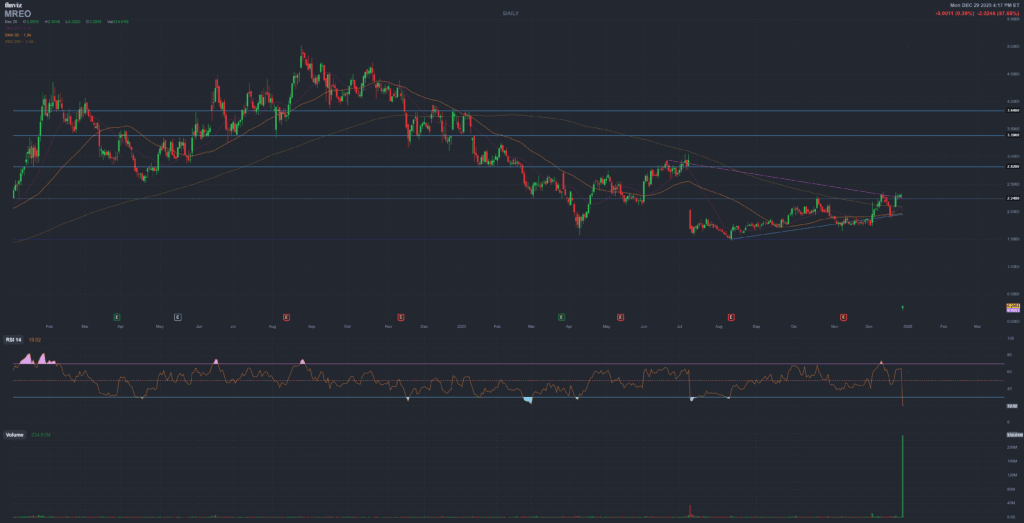
Merlintrader trading Blog – Single-ticker deep dive
Mereo BioPharma (MREO) – After the UX143 crash: alvelestat, vantictumab and the fight for a second life
A 90% one-day collapse on the back of the UX143 ORBIT and COSMIC failures in osteogenesis imperfecta
would look fatal for many small biotechs. For Mereo, however, the story is not entirely over: setrusumab
still shows strong bone mineral density gains, alvelestat is Phase 3–ready in AATD lung disease, and
vantictumab and partnered assets keep a residual platform alive – provided cash can be stretched and
partners found.
Data and prices: intraday snapshot on 29 December 2025, based on public sources. Figures can move quickly
and should always be re-checked on primary sources before any decision.
Ticker / exchange
MREO – Nasdaq
Mereo BioPharma Group plc (ADR)
Share price (approx.)
$0.23
Down about 90% on the day (from ~2.3 USD), new all-time low.
Market cap (post-crash)
~$35–40M
Micro-cap territory after trading below $0.25 per ADS.
Cash (Q3 2025)
$48.7M
Cash and equivalents at 30 Sep 2025; company guided runway into 2027.
Net loss (Q3 2025)
$7.0M
Operating loss around $10M in the quarter, modest vs many peers.
Shares / ADS
~795M shares
~159M ADS equivalents (5 ordinary shares per ADS).
News of the day – UX143 failure & 90% wipeout
On 29 December 2025, Mereo BioPharma announced Phase 3 ORBIT and COSMIC results for setrusumab
(UX143) in osteogenesis imperfecta. Neither trial met its primary endpoint of reduced annualised
clinical fracture rate versus placebo (ORBIT) or bisphosphonates (COSMIC), although both showed
statistically significant and substantial improvements in bone mineral density (BMD) at key sites
and no new safety signals. The stock fell roughly 90% in a single session, with management stating
that pre-commercial and manufacturing spend for UX143 will be sharply reduced while the company
analyses subgroups and revisits its plan.
For Mereo, unlike Ultragenyx, UX143 was not “one of many” but a centrepiece. The collapse turns a
company valued in the hundreds of millions into a micro-cap overnight. What remains is a rare-disease–
focused platform with three core programs – UX143, alvelestat and vantictumab – plus partnered
oncology and reproductive assets, sitting on roughly $50M of cash and a pledge to tighten costs.

1. Executive summary
Mereo has just lived through what many small biotechs never survive: a near-total equity wipeout on a single day. The partner-led UX143 program in osteogenesis imperfecta – its most valuable rare-disease asset – failed to meet Phase 3 fracture endpoints, and the market removed around 90% of the company’s value in a few hours.
The fail is binary on the primary endpoints but not on the biology. ORBIT and COSMIC both showed robust, statistically significant BMD improvements and a clean safety profile, yet this did not translate into a fracture risk reduction strong enough for a straightforward label. For Ultragenyx, UX143 is one pillar among several; for Mereo, it was the pillar for its own commercial ambitions in Europe.
And yet, Mereo is not a shell. As of Q3 2025 it held about $48.7M in cash and guided that, under its then-current plan, this would be enough to fund operations into 2027. On the program side, alvelestat (MPH-966) for AATD lung disease is Phase 3–ready with orphan and Fast Track designations, vantictumab has been licensed to āshibio with Mereo retaining European rights for autosomal dominant osteopetrosis, and several legacy assets (leflutrozole, etigilimab, navicixizumab) are partnered or parked.
Post-UX143, Mereo’s risk profile becomes extreme but not zero: survival and any chance of a rebound depend on three levers – how aggressively costs are cut, whether a credible niche survives for UX143, and whether alvelestat attracts a strong partner and executes a clean Phase 3.
In short: MREO has moved from “speculative rare-disease platform” to “distressed micro-cap with one major
shot left in AATD and a damaged, but not completely irrelevant, stake in OI”. The magnitude of the drop
does not automatically make it cheap; it simply changes which parts of the story still matter.
2. What happened today – MREO’s side of the UX143 story
2.1 ORBIT and COSMIC from Mereo’s viewpoint
- Mereo’s 29 December press release confirms that neither ORBIT nor COSMIC achieved statistical significance on their primary endpoint of reducing annualised clinical fracture rates versus placebo (ORBIT) or bisphosphonates (COSMIC).
- Both studies did, however, meet key secondary endpoints with strong statistical significance: improvements in BMD at the lumbar spine and other skeletal sites.
- No new safety signals were observed; the overall tolerability profile remained consistent with prior studies.
2.2 Immediate corporate reaction
- Management stated that pre-commercial and manufacturing activities for UX143 would be scaled back immediately to preserve cash while the company analyses additional endpoints and subgroups.
- They reiterated that Mereo retains EU and UK commercial rights for UX143, while Ultragenyx holds rights in the rest of the world and funds global development.
- The stock collapsed from roughly $2.30 to around $0.23, a move of about −90%, sending the company into micro-cap territory and raising existential questions in commentary pieces.
2.3 Why this hurts Mereo more than Ultragenyx
- UX143 was meant to provide Mereo with a clear commercial path in Europe, leveraging the Saturn real-world evidence program and pre-launch work in OI treatment centres.
- Milestones and royalties from Ultragenyx on UX143 were a key part of the mid-term financial model, both as direct cash and as validation of Mereo’s approach.
- Ultragenyx still has multiple marketed products and late-stage assets; Mereo’s internal rare-disease portfolio, in contrast, is much narrower (UX143, alvelestat, vantictumab) and has now lost its leading edge.
For Ultragenyx, UX143 is a serious setback but a survivable one. For Mereo, the same event is a test
of whether the rare-disease platform can pivot quickly enough towards alvelestat and partnered bone
assets to avoid being remembered purely as “the OI play that broke”.
3. From pivot to rare diseases to UX143 failure – a short timeline
- 2023: Mereo formally pivots to rare diseases, prioritising setrusumab in OI and alvelestat in AATD lung disease. End-of-Phase 2 meetings for alvelestat with FDA and EMA outline a single global Phase 3 design with dual primary endpoints (PRO and CT lung density).
- March 2025 (FY 2024 results): Mereo reports progress of the Phase 3 ORBIT study towards a second interim analysis and highlights alignment on Phase 3 endpoints for alvelestat. Cash at year end is about $69.8M; the company expects its cash to fund operations into 2027.
- May 2025 (Q1 2025): Q1 update reiterates that Mereo has two rare-disease product candidates – setrusumab and alvelestat – plus partnered oncology assets (etigilimab, navicixizumab). Cash stands at ~$62.5M.
- August 2025 (Q2 2025): Mereo reports cash of ~$56.1M and confirms that ORBIT and COSMIC data are expected around year-end 2025. The vantictumab deal with āshibio is announced, with Mereo retaining EU rights for ADO2.
- November 2025 (Q3 2025): Q3 results show cash of $48.7M, net loss of $7.0M and operational runway guidance “into 2027”. Setrusumab Phase 3 read-outs are confirmed for late 2025, and alvelestat partnering discussions are described as active.
- 29 December 2025: ORBIT and COSMIC fail to meet fracture endpoints. Mereo’s stock drops ~90% intraday, with pre-commercial UX143 spend cut and the company signalling a shift toward alvelestat partnering and strict cost control.
In less than two years Mereo went from “two rare-disease shots with a decent cash runway” to “post-fail
micro-cap” largely on the outcome of one partnered programme. That is exactly the kind of path a catalyst
trader needs to keep in mind when sizing positions in small, concentrated platforms.
4. Pipeline – what Mereo still has beyond UX143
4.1 Rare-disease core (post-UX143)
Setrusumab (UX143) – OI (with Ultragenyx)
- Partnered with Ultragenyx for global development; Mereo retains EU/UK commercial rights and is eligible to milestones (up to $245M) and royalties in Ultragenyx territories if the asset ever reaches the market.
- Phase 3 ORBIT and COSMIC failures on fracture endpoints sharply reduce the probability of broad commercialisation, but BMD and safety data keep the door slightly open for niche approaches or further negotiation with regulators.
- Mereo has already announced cuts to pre-commercial and manufacturing activities for UX143 in Europe, signalling that the base scenario now assumes no imminent launch revenue.
Alvelestat (MPH966) – AATD lung disease
- Oral neutrophil elastase inhibitor for alpha-1 antitrypsin deficiency-associated lung disease (AATD-LD), with Orphan Designation (US/EU) and Fast Track in the US.
- Phase 2 studies (ASTRAEUS, ATALANTa) showed >90% suppression of NE activity at 240mg BID and significant reductions in biomarkers like desmosine and Aα-Val360, supporting progression to Phase 3.
- Regulators have agreed on a single global Phase 3 trial with dual primary endpoints: a PRO (e.g. SGRQ Activity) and CT lung density. Design work is underway; Mereo is actively seeking a development/commercial partner.
- Post-UX143, alvelestat becomes the most important internal asset for any realistic “second life” scenario for Mereo.
4.2 Vantictumab and other partnered assets
Vantictumab – ADO2 (with āshibio)
- Antibody targeting Frizzled receptors and Wnt signalling, repurposed from oncology to autosomal dominant osteopetrosis type 2 (ADO2), a rare bone disease.
- āshibio has an exclusive license for development in ADO2 outside Europe; Mereo retained European commercial rights.
- Preclinical data in ADO2 were presented at ASBMR 2025, suggesting potential in another rare bone indication. For Mereo, this is primarily an option on milestones/royalties plus future EU commercial upside.
Other programs (leflutrozole, etigilimab, navicixizumab)
- Leflutrozole: licensed to ReproNovo for male infertility tied to low testosterone, with potential milestones and royalties to Mereo.
- Navicixizumab: partnered with Feng Biosciences for late-line ovarian cancer; Mereo is eligible to milestones and royalties but does not fund further development.
- Etigilimab: anti-TIGIT antibody with paused or deprioritised development; in the current strategy it is treated as a non-core oncology asset.
After the UX143 shock, Mereo’s value tree is simpler to draw: alvelestat is the only wholly owned,
potentially registrational asset left; UX143, vantictumab and the partnered pipeline are optionality on
top. That does not mean they are worthless – just that any recovery will likely start from alvelestat.
5. Financials – can Mereo survive long enough to try again?
5.1 Q3 2025 in numbers
- Cash and cash equivalents as of 30 September 2025: about $48.7M.
- Net loss Q3 2025: roughly $7.0M, with an operating loss of about $10M, partially offset by FX gains and interest income.
- R&D expenses: ~$4.3M in the quarter, up slightly year-on-year due to UX143 and alvelestat activities.
- G&A expenses: ~$6.0M in the quarter, slightly down versus Q3 2024.
- No meaningful product revenue yet; occasional small collaboration revenue (~$0.5M YTD) but no commercial base to offset burn.
Compared to many US biotech peers burning tens of millions per quarter, Mereo’s cost base looks
relatively lean. The problem is that the market cap has collapsed to a level not far from cash,
while UX143’s value is heavily questioned.
5.2 Runway and dilution risk
- Management previously guided that cash as of September 30, 2025 would fund operations into 2027 under then-current plans.
- The cutback in UX143 pre-commercial expenses should extend that runway modestly, but alvelestat Phase 3 and any self-funded ADO2 or oncology work would consume significant resources if taken on without partners.
- At a share price around $0.23 and nearly 800M ordinary shares outstanding (about 159M ADS), traditional equity raises are highly punitive unless the price recovers first.
- In practice, the most realistic near- to mid-term funding sources beyond current cash are non-dilutive or mildly dilutive deals: alvelestat partnerships, milestone payments from partners, or royalty monetisation of future streams.
6. Market and social sentiment
6.1 Tape and analysts
- MREO has suffered one of the steepest single-day declines among Nasdaq small-cap biotechs in recent memory, with the price essentially collapsing towards cash value.
- Commentary describes the move as “existential” for the equity, but notes that the company remains technically solvent with a decent cash balance and no immediate need to raise capital.
- Analyst coverage is thin compared to larger names; for those who do cover it, the focus now shifts from OI to alvelestat and the ability to secure a high-quality partner.
6.2 Retail mood on Stocktwits, Reddit, X
- Typical sequence on social feeds:
- Phase 3 expectation based on promising Phase 2 data and rare-disease designations.
- shock at the primary endpoint failure and the magnitude of the drop,
- rapid emergence of “lottery ticket” narratives around the new $0.20–0.30 share price.
- Many posts focus on:
- cash vs market cap (“trades below cash, must be a bargain”),
- potential for a UX143 salvage path,
- and alvelestat as “the next big thing”.
- As usual, there is little discussion of the practical difficulties of running a global Phase 3, negotiating partnerships from a position of weakness, or restructuring expenses without damaging core programmes.
For an event-driven trader, the main lesson is not that social sentiment is “wrong”, but that it tends
to compress timelines: the same feeds that hyped the OI read-out now immediately search for the next
miracle. The company’s reality (multi-year alvelestat trial, partnering cycles, cost discipline) will
move at a very different speed.
7. Scenario map (illustrative)
Base case – survival and slow repositioning
Mereo uses cost cuts and the existing $48.7M cash to extend runway while: (a) completing UX143 data analyses, and (b) advancing alvelestat’s Phase 3 design and partner search. UX143 does not become a broad commercial success, but some residual value may survive in niche settings or through a revised plan with Ultragenyx. The equity trades as a distressed optionality play on alvelestat plus milestones/royalties from partnered assets.
Bull case – strong alvelestat deal + UX143 salvage
Mereo signs a high-quality partnership for alvelestat with upfront and development funding sufficient to cover a large part of future cash needs. The Phase 3 AATD study delivers positive clinical results, positioning alvelestat as a first-in-class oral disease-modifying therapy. Simultaneously, a narrower UX143 path (for example pediatric subsets) re-emerges after further analyses, providing some combination of milestones and EU opportunity. In this scenario, the current micro-cap valuation would look like an overreaction.
Bear case – UX143 write-off and alvelestat stalled
UX143 is effectively written off, with regulators unconvinced and Ultragenyx scaling back interest. Alvelestat fails to secure a partner on attractive terms or faces setbacks in Phase 3 design or execution. Cash runway proves shorter than hoped once all costs are properly accounted for, and the company is forced into highly dilutive financings or strategic alternatives from a weak position. In this case, the 90% collapse is not a “bottom”, just a stop on the way to a drawn-out unwind.
As always, these scenarios are frames, not probabilities or recommendations. The real path is likely to
land somewhere in between and will depend heavily on execution in 2026–2027.
8. Key risks and red flags
Single-asset dependence (now shifted)
Prior to the OI read-out, UX143 was the main value driver; now that role effectively shifts towards alvelestat. A failure or delay in alvelestat Phase 3 would dramatically reduce any remaining equity value.
Funding and negotiating from weakness
Post-crash, Mereo’s bargaining power in partnerships is impaired. Potential partners know that the company needs non-dilutive capital; deal terms may be less favourable than they would have been pre-UX143 data.
Execution risk on cost cuts
Cutting UX143 pre-commercial spend is logical, but if cost reductions hit the wrong parts of the organisation, they can also slow alvelestat and other residual programmes, compromising long-term value to save short-term runway.
Takeover / strategic outcome risk
At very low valuations, the company becomes a potential target for strategic buyers or financial players looking to acquire assets on the cheap. Depending on timing and price, such outcomes may crystallise value far below prior expectations.
9. Outlook – what “recovery” would realistically look like
A 90% drawdown on a Phase 3 failure is not something a company simply “bounces back” from. For Mereo, any recovery would likely be measured in years, not weeks, and would require multiple things to go right:
- a disciplined, credible expense reduction plan that preserves the core of alvelestat and key partnered assets,
- a clear Phase 3 design and timeline for alvelestat, ideally with a committed, well-capitalised partner,
- some residual value from UX143 – whether via niche indications, data re-analysis or royalty streams in select markets – rather than a total write-off,
- and, perhaps most importantly, time for the shareholder base to reset from “speculative OI bet” to “distressed, but focused, rare-disease micro-platform”.
From a RunUp/catalyst trading perspective, MREO has moved out of the “pre-data run-up” category into the much rarer “post-failure restructuring” category. The catalysts worth tracking now are less about single binary events and more about sequences: deal announcements, trial initiations, cost actions and incremental data in AATD and ADO2.
10. “My tale” – personal angle (to be filled by the author)
How (if at all) MREO fits in a real trading / investing plan
Space for your personal view on whether MREO belongs in any real portfolio or watchlist after the UX143
failure. For example:
– whether it deserves a spot in a “distressed biotech recovery” watchlist,
– whether you would only consider it as a tiny position in a basket of rare-disease names,
– or whether, given your experience con tonfi biotech, ritieni che il rischio residuo sia troppo alto rispetto ad altre storie con catalyst più chiari.
Qui puoi collegare la narrativa di Mereo con la tua strategia RunUp, i tuoi criteri di size e le regole che usi dopo grossi fallimenti di Fase 3.
– whether it deserves a spot in a “distressed biotech recovery” watchlist,
– whether you would only consider it as a tiny position in a basket of rare-disease names,
– or whether, given your experience con tonfi biotech, ritieni che il rischio residuo sia troppo alto rispetto ad altre storie con catalyst più chiari.
Qui puoi collegare la narrativa di Mereo con la tua strategia RunUp, i tuoi criteri di size e le regole che usi dopo grossi fallimenti di Fase 3.
11. Sources and further reading
This report is based on Mereo’s official press releases and SEC filings (FY 2024, Q1–Q3 2025 results, ORBIT/COSMIC read-outs) plus independent coverage from major financial and biotech news outlets. Readers should always verify numbers and timelines directly in the latest company documents.


This report is an educational and editorial overview based solely on publicly available information.
It does not constitute investment advice, an offer or solicitation to buy or sell any security, or a
personalised recommendation. Data, dates and interpretations may contain errors or become outdated.
Readers should perform their own due diligence, cross-check primary sources (company filings, official
press releases, regulatory documents) and, where appropriate, consult regulated financial professionals
before making any decision.
Merlintrader trading Blog – Approfondimento singolo titolo
Mereo BioPharma (MREO) – Dopo il crollo UX143: alvelestat, vantictumab e la lotta per una seconda vita
Un crollo del 90% in una sola seduta sul fallimento ORBIT/COSMIC di UX143 in osteogenesi imperfetta
sarebbe fatale per molte small cap. Per Mereo la storia è pesantissima, ma non totalmente chiusa:
setrusumab resta con un segnale forte su BMD, alvelestat è pronto per la Fase 3 in AATD-lung disease
e vantictumab più gli asset in partnership mantengono un minimo di piattaforma viva – a patto di
saper tirare la cinghia e trovare partner.
Dati e prezzi: fotografia intraday al 29 dicembre 2025, basata su fonti pubbliche. Le cifre possono
muoversi rapidamente e vanno sempre ricontrollate sulle fonti primarie prima di qualsiasi decisione.
Ticker / mercato
MREO – Nasdaq
Mereo BioPharma Group plc (ADR)
Prezzo azione (circa)
0,23 USD
Circa −90% nella seduta (da ~2,3 USD), nuovo minimo assoluto.
Market cap post-crash
~35–40 mln USD
Micro-cap piena dopo il tonfo in area 0,20–0,25 USD per ADS.
Cassa (Q3 2025)
48,7 mln USD
Cassa ed equivalenti al 30 settembre 2025; runway guidata “fino al 2027”.
Perdita netta Q3
7,0 mln USD
Operating loss intorno ai 10M, relativamente contenuto rispetto a molte biotech USA.
Azioni / ADS
~795M azioni
Circa 159M ADS (5 azioni ordinarie per ogni ADS).
News del giorno – fallimento UX143 & wipeout al 90%
Il 29 dicembre 2025 Mereo BioPharma ha comunicato i risultati ORBIT e COSMIC su setrusumab
(UX143) nell’osteogenesi imperfetta. Nessuno dei due studi ha raggiunto gli endpoint primari di
riduzione del tasso annualizzato di fratture rispetto a placebo (ORBIT) o bisfosfonati (COSMIC),
anche se in entrambi si è vista una crescita della densità minerale ossea (BMD) statisticamente
significativa e nessun nuovo segnale di safety. Il titolo ha perso circa il 90% in una sola seduta
e il management ha annunciato il taglio immediato delle spese pre-commerciali e produttive su UX143
mentre prosegue l’analisi dei dati per sottogruppi e opzioni future.
Per Ultragenyx UX143 è uno dei pilastri; per Mereo era quasi tutto. Il crollo trasforma una società
valorizzata centinaia di milioni in una micro-cap nell’arco di qualche ora. Rimane però una
piattaforma rare-disease con tre asset core (UX143, alvelestat, vantictumab) più vari programmi
partnerizzati, seduta su circa 50M di cassa e con l’impegno dichiarato a controllare duramente i costi.
1. Executive summary
Mereo ha appena vissuto quello che molte biotech piccole non sopravvivono: quasi tutto l’equity vaporizzato in un solo giorno. Il programma OI UX143/UX-Setrusumab – asset rare-disease più visibile della casa – ha fallito gli endpoint primari di Fase 3 e il mercato ha tolto all’incirca il 90% di capitalizzazione in poche ore.
Il fallimento è binario sugli endpoint primari ma non sulla biologia: ORBIT e COSMIC mostrano un segnale robusto su BMD con safety gestibile, ma non abbastanza effetto sulle fratture per un’etichetta lineare. Per Ultragenyx è un colpo, per Mereo era la “carta” principale per una presenza diretta in Europa.
Eppure Mereo non è un guscio vuoto. A fine Q3 2025 aveva circa 48,7M USD di cassa ed equivalenti e guidava una runway fino al 2027 sulla base dei piani di allora. Sul fronte pipeline, alvelestat per AATD-lung disease è pronto per una singola Fase 3 globale con design già allineato con FDA/EMA, vantictumab è licenziato ad āshibio con diritti EU trattenuti, e altri asset (leflutrozole, navicixizumab, etigilimab) restano come optionalità partnerizzata.
Dopo UX143, il profilo di rischio diventa estremo ma non nullo: sopravvivenza e possibile “seconda vita” dipendono da tre leve – quanto sono reali e profondi i tagli ai costi, se si salva qualche valore residuo su UX143 e soprattutto se alvelestat trova un partner forte e porta a casa una Fase 3 decente.
In sintesi: MREO è passata da “piattaforma rare-disease speculativa” a “micro-cap distressed con un colpo
grosso rimasto (alvelestat) e una partecipazione danneggiata, ma non azzerata, in OI”. Il fatto che il
titolo abbia perso il 90% non lo rende automaticamente “a sconto”; semplicemente cambia quali pezzi della
storia contano ancora.
2. Cosa è successo oggi – la versione Mereo di UX143
2.1 ORBIT e COSMIC viste dal lato MREO
- Nel comunicato del 29 dicembre Mereo conferma che né ORBIT né COSMIC hanno centrato la significatività statistica sugli endpoint primari di riduzione del tasso annualizzato di fratture vs placebo (ORBIT) o vs bisfosfonati (COSMIC).
- Entrambi gli studi hanno però raggiunto gli endpoint secondari chiave con forte significatività: aumenti della densità minerale ossea in siti scheletrici importanti.
- Nessun nuovo segnale di sicurezza, profilo di tollerabilità allineato alle fasi precedenti.
2.2 Reazione immediata della società
- Il management dichiara che le attività pre-commerciali e di manufacturing per UX143 in Europa saranno ridotte in modo sostanziale per preservare cassa, mentre si approfondiscono analisi su endpoint aggiuntivi e sottogruppi.
- Mereo ricorda di mantenere i diritti commerciali per UX143 in UE/UK, con Ultragenyx che finanziava lo sviluppo globale e detiene i diritti nel resto del mondo.
- Il titolo passa da circa 2,3 USD a intorno 0,23 USD, trasformando la società in una micro-cap e sollevando, nei commenti di giornata, la parola “esistenziale”.
2.3 Perché fa più male a Mereo che a Ultragenyx
- UX143 era la carta principale per un lancio diretto di Mereo nei mercati europei OI, con il programma SATURN e altre iniziative real-world impostate proprio in questa ottica.
- Milestone e royalty da Ultragenyx su UX143 erano una parte importante del modello finanziario di medio termine.
- Ultragenyx ha più pilastri (Crysvita, Dojolvi, Evkeeza, gene therapy, CNS); Mereo ha un core rare-disease molto più stretto, ora senza il suo asse principale.
Per Ultragenyx UX143 è un “colpo duro ma assorbibile”. Per Mereo è un crash-test sulla capacità di
trasformare una storia OI in una storia AATD + partner, senza finire solo come “quella che ha sbagliato
il trial sulle ossa”.
3. Dalla pivot rare-disease al fallimento UX143 – timeline rapida
- 2023: Mereo consolida il pivot verso le malattie rare, mettendo al centro setrusumab in OI e alvelestat in AATD-lung. I meeting end-of-Phase 2 su alvelestat con FDA/EMA definiscono un disegno di singola Fase 3 globale con doppio endpoint primario (PRO + CT lung density).
- Marzo 2025: risultati 2024: ORBIT prosegue verso il secondo interim e viene ribadito l’allineamento regolatorio su Fase 3 alvelestat. Cassa a fine anno ~69,8M USD, runway stimata fino al 2027.
- Maggio 2025 (Q1): Mereo ricorda di avere due programmi rare-disease core (setrusumab, alvelestat) e più asset oncologici partnerizzati; cassa ~62,5M USD.
- Agosto 2025 (Q2): cassa ~56,1M USD, conferma OI read-out per fine 2025. Annunciata la partnership su vantictumab con āshibio, con diritti commerciali europei mantenuti da Mereo.
- Novembre 2025 (Q3): risultati Q3: cassa 48,7M USD, perdita netta 7M USD, runway guidata ancora “fino al 2027”. ORBIT/COSMIC attesi “around end of 2025”, partnering discussions su alvelestat in corso.
- 29 dicembre 2025: ORBIT e COSMIC non centrano le fratture, si vede solo il benefit su BMD. Tagli annunciati su UX143, tonfo del 90% e nuova fase per l’azienda, che si ritrova improvvisamente in micro-cap land.
In meno di due anni Mereo passa da “due colpi rare-disease con runway decente” a “post-fail micro-cap”.
È il tipo di traiettoria che un trader sui catalyst deve tenere a mente quando decide quanto capitale
mettere su piattaforme così concentrate.
4. Pipeline – cosa resta davvero dopo UX143
4.1 Core rare-disease (dopo UX143)
Setrusumab (UX143) – OI (partner Ultragenyx)
- Programma in co-sviluppo con Ultragenyx; Mereo mantiene i diritti commerciali in UE/UK ed è potenzialmente eleggibile a milestone (fino a 245M USD) e royalty nei territori Ultragenyx.
- Il fallimento degli endpoint primari in ORBIT/COSMIC riduce drasticamente le probabilità di successo commerciale ampio, ma il segnale su BMD e la safety mantengono aperta, almeno teoricamente, una via più stretta (subset, regioni o percorsi regolatori alternativi).
- Mereo ha già annunciato il ridimensionamento delle attività pre-commerciali e di produzione su UX143 in Europa, segnale che il base case non contempla più un lancio imminente.
Alvelestat (MPH966) – AATD-lung disease
- Inibitore orale dell’elastasi neutrofila per la malattia polmonare da deficit di alfa-1 antitripsina (AATD-LD), con Orphan Designation (USA/UE) e Fast Track negli USA.
- Gli studi di Fase 2 (ASTRAEUS, ATALANTa) hanno mostrato soppressione >90% dell’attività NE a 240mg BID e riduzioni significative di biomarcatori come desmosina e Aα-Val360, supportando il passaggio a Fase 3.
- FDA ed EMA hanno accettato un disegno di singola Fase 3 globale con doppio endpoint primario (PRO e densità polmonare su CT). Lo studio è in preparazione; Mereo è attiva nel cercare un partner per sviluppo/commercializzazione.
- Dopo UX143, alvelestat diventa il vero asset interno chiave per qualsiasi scenario di “rimonta”.
4.2 Vantictumab e asset partnerizzati
Vantictumab – ADO2 (partner āshibio)
- Anticorpo contro alcuni recettori Frizzled e pathway Wnt, riposizionato dall’oncologia a una malattia rara dell’osso (osteopetrosi autosomica dominante tipo 2, ADO2).
- Mereo ha licenziato vantictumab ad āshibio per sviluppo globale in ADO2, mantenendo i diritti commerciali europei; il resto del mondo spetta al partner.
- Dati preclinici ADO2 presentati all’ASBMR 2025 suggeriscono un potenziale interessante; per Mereo questo si tradurrà in milestone/royalty + eventuale upside EU se si arriverà al mercato.
Altri programmi (leflutrozole, etigilimab, navicixizumab)
- Leflutrozole: in licenza a ReproNovo per infertilità maschile legata a ipogonadismo; Mereo può beneficiare di milestone e royalty.
- Navicixizumab: in partnership con Feng Biosciences per l’uso in tumore ovarico avanzato; anche qui Mereo vede solo il lato milestone/royalty, non finanzia più sviluppo.
- Etigilimab: anti-TIGIT oncologico, di fatto in stand-by o comunque non più centrale nella strategia rare-disease.
Dopo lo shock UX143, l’albero del valore Mereo è molto più chiaro: alvelestat è il solo asset interno
potenzialmente registrativo, mentre UX143, vantictumab e il resto del portafoglio partnerizzato sono
optionalità aggiuntive. La rimonta, se ci sarà, partirà probabilmente da lì.
5. Situazione finanziaria – Mereo può resistere abbastanza a lungo?
5.1 Q3 2025 in numeri
- Cassa ed equivalenti al 30 settembre 2025: circa 48,7M USD.
- Perdita netta Q3 2025: circa 7,0M USD, con operating loss intorno ai 10M USD, parzialmente compensato da FX positivo e interessi.
- R&D: ~4,3M USD nel trimestre, in lieve aumento Y/Y per spese su UX143 e alvelestat.
- G&A: ~6,0M USD, leggermente in calo rispetto al Q3 2024.
- Nessun flusso di ricavi prodotti rilevante; qualche entrata marginale da collaborazioni, ma niente base commerciale a compensare il burn.
Rispetto a molte biotech USA, la struttura costi Mereo non è gigantesca; il problema è che ora la
capitalizzazione è scesa in area “valore cassa” (o meno) mentre UX143 passa da asset centrale a
optionalità pesante.
5.2 Runway e rischio diluizione
- La guidance pre-fallimento indicava runway “fino al 2027” con la cassa al 30/09/2025, su piani operativi allora in vigore.
- Il taglio delle spese pre-commerciali su UX143 dovrebbe allungare un po’ la runway, ma una Fase 3 globale per alvelestat e qualsiasi attività aggiuntiva su ADO2/oncologia consumerebbero molta cassa se non supportate da partner.
- Con il titolo in area 0,20–0,30 USD e quasi 800M di azioni in circolazione, un aumento di capitale classico sarebbe estremamente diluitivo, a meno di un recupero di prezzo.
- Realisticamente, le fonti di finanza extra-cassa meno distruttive sono: deal su alvelestat, milestone provenienti dai partner e, se mai ci saranno flussi importanti, eventuale monetizzazione di royalty future.
6. Reazione del mercato e sentiment
6.1 Nastro e analisti
- MREO ha subito uno dei peggiori drawdown giornalieri recenti sul Nasdaq biotech, scendendo di fatto a livelli vicini (o inferiori) alla cassa.
- Nei commenti si parla di colpo “esistenziale” per l’equity, ma si nota anche che l’azienda, ad oggi, è ancora tecnicamente solvente e non obbligata a raccogliere immediatamente.
- La copertura analisti è limitata; chi la segue ora sposta il focus da OI ad alvelestat e alla capacità di chiudere una partnership solida.
6.2 Umore retail (Stocktwits, Reddit, X)
- La sequenza classica:
- attese di Fase 3 basate su buoni dati di Fase 2 e designazioni rare-disease,
- shock sul fallimento degli endpoint primari e sulla dimensione del crollo,
- immediata rinarrativa del titolo come “lottery ticket” a 0,20–0,30 USD.
- Molti post si concentrano su:
- rapporto cassa/market cap (“tratta sotto cassa, quindi è regalo”),
- possibile “salvataggio” di UX143,
- e alvelestat raccontato come nuovo pilastro garantito.
- Poca discussione, invece, su:
- difficoltà pratiche di condurre una Fase 3 globale in AATD-LD,
- negoziare partnership da una posizione così indebolita,
- e tagliare costi senza compromettere i programmi che ti dovrebbero “salvare”.
Per un trader sui catalyst il punto non è che “il social ha torto”, ma che tende a comprimere i tempi:
la stessa folla che pompava il read-out OI ora salta subito sul “recovery play”. La realtà aziendale
(deal, Fase 3, tagli di struttura) viaggia su orizzonti molto più lunghi.
7. Mappa scenari (solo illustrativa)
Scenario base – sopravvivenza e lenta riposizionatura
Mereo usa tagli di spesa e la cassa disponibile per allungare la runway mentre: (a) completa le analisi UX143, e (b) porta avanti design e partnering di Fase 3 alvelestat. UX143 non diventa un successo commerciale ampio, ma rimane qualche valore residuo (per subset o come optionalità regolatoria). L’equity tratta come scommessa distressed legata soprattutto ad alvelestat e alle milestone/royalty dai programmi in partnership.
Scenario bull – deal forte su alvelestat + salvataggio UX143
Mereo chiude una partnership di qualità su alvelestat con upfront e funding sufficiente a coprire gran parte dei bisogni futuri. La Fase 3 su AATD-LD produce dati convincenti e alvelestat si posiziona come terapia orale potenzialmente disease-modifying. In parallelo, dalle analisi OI e dal confronto con le agenzie emerge un percorso ristretto ma praticabile per UX143 (per esempio pediatric OI severa), che porta a milestone e, magari, ricavi europei. In questo scenario, l’attuale micro-cap potrebbe apparire come un overshoot di panico.
Scenario bear – write-off UX143 + intoppi alvelestat
UX143 viene di fatto archiviato come asset commerciale; i regolatori non vedono un percorso chiaro e l’interesse di Ultragenyx scema. Alvelestat fatica a trovare partner o incontra problemi in design/ esecuzione della Fase 3. La runway si accorcia più del previsto e la società è costretta a fare finanza altamente diluitiva o a valutare opzioni strategiche (vendita/asset deal) da posizione debole.
Anche qui, gli scenari non sono probabilità ma “cornici” per leggere i prossimi stegni: decisioni su UX143,
Fase 3 alvelestat, struttura costi, eventuali deal.
8. Rischi principali e red flags
Dipendenza concentrata (ora su alvelestat)
Prima del read-out OI il driver era UX143; ora di fatto è alvelestat. Un intoppo serio su questo programma (design, dati, safety, partner) ridurrebbe in modo drammatico il valore residuo.
Finanza e negoziazione da posizione debole
Con il titolo a micro-cap, la leva negoziale su partnership e deal è inferiore a quella che Mereo avrebbe avuto pre-UX143. I partner potenziali sanno che l’azienda ha bisogno di capitale non diluitivo e potrebbero imporre condizioni più dure.
Esecuzione sui tagli
Tagliare UX143 pre-commercial è logico, ma se il coltello passa anche su funzioni critiche per alvelestat (o altri programmi core), il risparmio di breve può erodere la capacità di creare valore nel medio.
Rischio M&A / esiti strategici
A queste valutazioni, Mereo diventa anche appetibile per chi vuole comprare asset a sconto. Un eventuale takeover o asset deal potrebbe cristallizzare valore ben sotto le aspettative degli attuali azionisti, soprattutto se arrivasse in una fase di ulteriore debolezza.
9. Outlook – che cosa vorrebbe dire, davvero, “rimonta”
Un -90% su un fallimento di Fase 3 non è la classica situazione dove “si rimbalza e via”. Per Mereo, qualsiasi vera rimonta sarà lenta e dipenderà da più incastri che vanno a segno, non da un singolo PR magico.
- un piano credibile di taglio costi che preservi il cuore di alvelestat e gli asset partnerizzati,
- un disegno chiaro e un partner forte su Fase 3 alvelestat, con impegni concreti di funding,
- un minimo di valore residuo su UX143 (subset, regioni, accordi rinegoziati) invece di uno “zero” secco,
- il tempo perché il book passi da “scommessa OI” a “micro-cap rare-disease in ristrutturazione”, con un azionariato più allineato a orizzonti lunghi.
In logica RunUp, MREO è uscita dalla categoria “pre-dati” per entrare in quella – molto più rara – dei “post-fail restructuring”. I catalyst da guardare ora non sono solo date singole, ma sequenze: news su alvelestat, tagli strutturali, deal, eventuali segnali di vita da UX143 e ADO2.
10. “My tale” – la lettura personale (spazio autore)
Come (eventualmente) MREO entra nella strategia, dopo il 90%
Qui puoi scrivere, in modo diretto, se e come Mereo può avere un ruolo nella tua operatività:
– solo come caso di studio “tonfo estremo” da raccontare sul sito,
– come possibile idea da tenere nel radar recovery, ma con size minima in un basket,
– oppure come storia archiviata, dove il trade è più il racconto che la posizione.
Il box serve a chiudere il cerchio tra fatti (pipeline, cassa, rischio) e pratica (quando entrare, quando stare fuori, che peso avere rispetto ad altri titoli più solidi).
– solo come caso di studio “tonfo estremo” da raccontare sul sito,
– come possibile idea da tenere nel radar recovery, ma con size minima in un basket,
– oppure come storia archiviata, dove il trade è più il racconto che la posizione.
Il box serve a chiudere il cerchio tra fatti (pipeline, cassa, rischio) e pratica (quando entrare, quando stare fuori, che peso avere rispetto ad altri titoli più solidi).
11. Fonti e letture consigliate
Fonti principali: comunicati ufficiali Mereo (risultati FY 2024, Q1–Q3 2025, ORBIT/COSMIC), SEC filings e articoli di sintesi di testate specializzate su biotech e rare-disease. Prima di qualsiasi decisione operativa va sempre fatto riferimento ai documenti originali più aggiornati.
Questo report ha finalità esclusivamente informative e formative. Non costituisce in alcun modo
consulenza in materia di investimenti, né offerta o sollecitazione al pubblico risparmio. Dati, date
e interpretazioni possono contenere errori o diventare rapidamente non aggiornati. Ogni decisione
operativa richiede verifiche autonome sulle fonti primarie (filing, comunicati ufficiali, documenti
regolatori) e, ove necessario, il supporto di professionisti abilitati.
Biotech Catalyst Calendar
If you want a structured view of upcoming PDUFA dates, Phase 2/3 read-outs and other key biotech events,
you can check the dedicated Biotech Catalyst Calendar on Merlintrader trading Blog.
Per una vista d’insieme su PDUFA, letture di Fase 2/3 e date chiave del settore biotech, puoi consultare
la pagina dedicata sul sito Merlintrader. Il calendario aggrega gli eventi più rilevanti e viene aggiornato
periodicamente.
Vai al Biotech Catalyst Calendar
Mereo BioPharma (MREO) – Report IT | Mereo BioPharma (MREO) – Report EN