





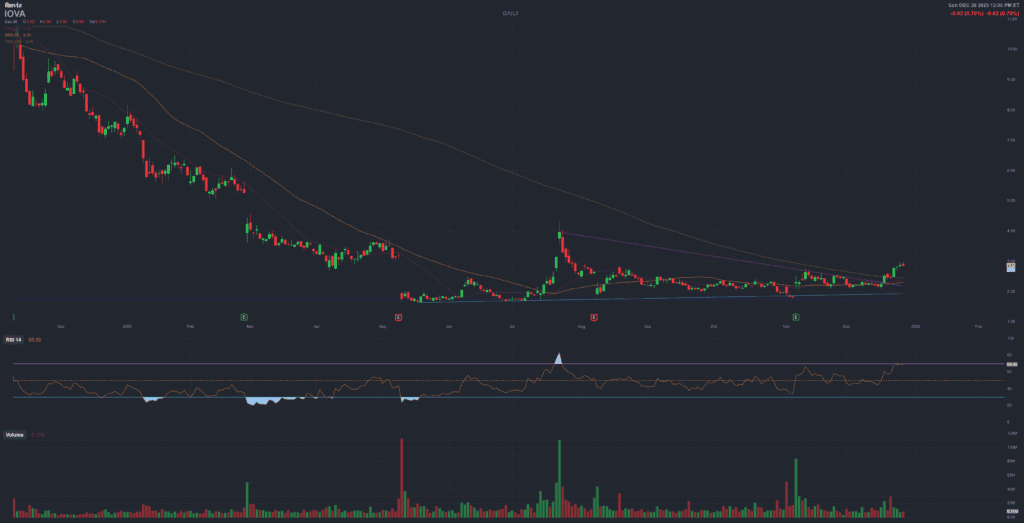
Iovance (IOVA) – Amtagvi, TILs and the 2025 Reality Check
In February 2024 the FDA granted accelerated approval to lifileucel, branded as Amtagvi – the first tumor-derived T-cell therapy for a solid tumor. Less than two years later, Iovance has withdrawn its EU filing, cut 19% of staff and is still burning close to $100M per quarter despite fast-growing sales. This report reconstructs what went right scientifically, what went wrong commercially, and where the TIL story might go from here.
News of the day
6 November 2025 – Iovance reports Q3 2025 revenue of about $68 million, up 13% sequentially,
with Amtagvi driving the growth. Gross margin improves to 43%, but the company still posts a
net loss of over $90 million and burns cash. Management reaffirms 2025 total product revenue guidance
of $250–300 million after a mid-year cut from a much more aggressive $450–475 million range,
following an earlier EMA filing withdrawal and a 19% workforce reduction.
For catalyst traders, Iovance has gone from “first-ever TIL approval, multi-billion TAM” to “show-me story with execution and financing risk” in less than 18 months. The science behind Amtagvi is impressive; the commercial and regulatory path has proved messier than the early slide decks suggested.
1. Reality snapshot – from “first-in-class” to “prove-it”
On the scientific side, Amtagvi is a milestone. The FDA approved lifileucel via the accelerated pathway in February 2024 for adults with unresectable or metastatic melanoma previously treated with PD-1 blockade and, if BRAF V600 positive, a BRAF inhibitor with or without a MEK inhibitor. It is the first tumor-derived autologous T cell therapy cleared for a solid tumor, with durable responses in heavily pretreated patients.
On the business side, the story is less clean. By mid-2025:
- Iovance had raised guidance early in the year toward $450–475M 2025 revenue and talked openly about global expansion (EU, UK, Canada, Australia).
- In July 2025 it withdrew its EU filing for Amtagvi after EMA feedback indicated that available data were unlikely to support a positive opinion.
- In August 2025 it announced a 19% workforce reduction (around 230 roles) to save ≈$100M per year and extend its cash runway into late 2026/early 2027.
- Q2 2025 revenue (~$60M, about $54M from Amtagvi) missed high expectations; Q3 revenue (~$68M) showed growth, but net losses and cash burn remain heavy.
The result is a mismatch between a technically successful launch – high-priced, clinically meaningful cell therapy adopted at major centers – and the “hyper-growth” expectations that had been priced into a company once worth over $4B.
In short: Amtagvi works and is selling, but not fast enough (yet) to fully justify earlier valuations.
The 2025 reality check is less about the basic science and more about commercial speed, global regulatory friction and capital discipline.
2. Timeline – how we got here
Below is a condensed timeline from early TIL work to the 2025 restructuring and EMA issues.
2.1 Scientific and clinical milestones
Pre-2015
TIL concept at the NCI
Tumor-infiltrating lymphocyte (TIL) therapy is pioneered at the U.S. National Cancer Institute as a bespoke,
labor-intensive academic protocol: harvest tumor, expand autologous TIL ex vivo, reinfuse after lymphodepletion plus IL-2.
2015–2020
C-144-01 and early lifileucel data
Iovance runs C-144-01, a multi-cohort Phase 2 study of lifileucel in advanced melanoma after failure of PD-1 and targeted therapy.
Early data show an objective response rate (ORR) around 32–36%, with responses often durable beyond two years
and manageable toxicity tied mainly to lymphodepletion and IL-2 rather than the cells themselves.
2022–2023
Pooled analyses and long-term follow-up
Publications and conference updates confirm that lifileucel’s ORR is roughly 31.4% in 153 patients,
with a median duration of response around 36.5 months and about 20% of patients alive at 5 years –
remarkable for heavily pretreated melanoma, but still based on single-arm data.
Feb 2024
FDA accelerated approval
The FDA grants accelerated approval to Amtagvi (lifileucel) as a one-time TIL therapy for unresectable or metastatic melanoma
after PD-1 and targeted therapy, the first approval of its kind in solid tumors.
2.2 Commercial, financial and regulatory milestones
2024
US launch and global ambition
Iovance builds an extensive network of authorized treatment centers, positions Amtagvi at a list price
>$500k for a one-time infusion and prepares regulatory submissions for the EU, UK, Canada, Australia and other markets.
Q2 2025
EMA withdrawal and guidance cut
In July 2025, Iovance withdraws its EU marketing authorization application
after CHMP indicates misalignment on clinical data and expresses a provisional negative view.
On the same day as Q2 earnings (~$60M product revenue, mostly Amtagvi),
management cuts 2025 revenue guidance from $450–475M to $250–300M. Shares drop nearly 30% on the news.
Aug 2025
19% workforce reduction
Iovance announces a restructuring with layoffs affecting roughly 19% of staff (≈230 roles),
targeting more than $100M in annual cost savings and extending the cash runway to at least late 2026.
Net loss for the quarter is over $110M despite strong Amtagvi growth.
Aug 2025
Health Canada approval
Health Canada becomes the first regulator outside the U.S. to approve Amtagvi,
giving Iovance a second commercial market even as the EU path stalls.
Q3 2025
Q3 results and guidance reaffirmation
Q3 2025 revenue comes in at roughly $68M, driven by ~58M in Amtagvi sales; gross margin improves to 43%.
Net loss remains heavy (~$91M), but the company reaffirms its lowered 2025 revenue guidance of $250–300M
and reiterates that cash and investments (~$307M) should fund operations into 2027 after restructuring.
3. Disease and mechanism – advanced melanoma and TIL therapy
3.1 Advanced melanoma after PD-1 – still a grim setting
Checkpoint inhibitors (PD-1/PD-L1 and CTLA-4) and BRAF/MEK inhibitors have transformed melanoma care, but a substantial fraction of patients still progress:
- Primary or acquired resistance to PD-1 is common; many patients relapse after combination immunotherapy.
- For BRAF-mutant disease, targeted therapy often leads to responses that are impressive but not always durable.
- Second-line options after PD-1 and BRAF±MEK often have modest response rates and limited durability.
This is the niche where Amtagvi is positioned: patients who have already used up the standard systemic options, often with high tumor burden and visceral metastases, including the liver.
3.2 How TIL therapy works in practice
Lifileucel is an autologous tumor-infiltrating lymphocyte (TIL) product. The process looks roughly like this:
- A resectable tumor lesion is removed, and TILs are expanded ex vivo under GMP conditions for several weeks.
- Patients receive nonmyeloablative lymphodepleting chemotherapy (cyclophosphamide + fludarabine) to create “space” in the immune system.
- A single infusion of lifileucel (a large TIL batch) is given, followed by a short course (up to 6 doses) of high-dose IL-2.
- The infused TILs, already primed against the patient’s tumor, expand and ideally mediate durable tumor control.
Clinically, this translates into a one-time, very intensive treatment episode rather than chronic therapy. That is attractive for some patients and payers, but the complexity and toxicity of lymphodepletion + IL-2 limit uptake to centers with strong cell therapy infrastructure.
4. Clinical data – what Amtagvi actually delivers
Amtagvi’s approval and label are based on the pivotal C-144-01 study plus pooled analyses that now extend to 5-year follow-up.
4.1 C-144-01 in numbers (late-line melanoma)
| Endpoint | Result (C-144-01 pooled cohorts) |
|---|---|
| Objective response rate (ORR) | ≈31.4% (CR ~6%, PR ~25%) |
| Tumor burden reduction | ~79% of patients see some shrinkage |
| Median duration of response | ~36.5 months |
| Five-year overall survival | ≈19–20% of patients alive at 5 years |
| Safety | AEs consistent with lymphodepletion + IL-2; most grade 3/4 cytopenias resolve by day 30 |
Responses tend to be deep and, in many patients, delayed: some partial responses deepen to complete responses over 1–3 years, and there are patients with ongoing benefit at five years after a single treatment.
4.2 Strengths and limitations of the data package
- Strengths – long duration of response, clinically meaningful OS in a desperate population, consistency across multiple sub-analyses, and a plausible mechanistic rationale.
- Limitations – single-arm design, no randomized comparator, heavy selection (patients fit enough for surgery and TIL manufacturing), and challenging attribution of benefit vs lymphodepletion/IL-2 alone.
- These limitations are acceptable for accelerated approval in the U.S. but are part of why EMA was unconvinced, especially in the absence of randomized data versus current immunotherapy combinations.
Confirmatory evidence will need to come from ongoing trials such as TILVANCE-301 (lifileucel + pembrolizumab vs pembrolizumab alone in first-line melanoma) and from real-world datasets.
5. Financials – fast growth, heavy burn
Iovance is now in the unusual position of having both a rapidly growing high-margin product and very large ongoing losses.
5.1 Top-line growth
| Period | Total product revenue | Amtagvi contribution | Key notes |
|---|---|---|---|
| Q2 2024 | ≈$31M | Early launch | First quarters after US approval |
| Q2 2025 | ≈$60M | ≈$54M Amtagvi | 93% YoY growth vs Q2 2024 |
| Q3 2025 | ≈$67–68M | ≈$58M Amtagvi | 13% sequential growth; Proleukin adds a small base |
| 2025 guidance | $250–300M | First full year of Amtagvi | Down from prior $450–475M guidance |
On a pure revenue curve, Amtagvi is growing strongly; the problem is that both the market and Iovance initially expected a much steeper adoption curve, especially in Europe.
5.2 Losses, cash and restructuring
- Q3 2025 net loss of about $91M, with R&D ≈$75M, SG&A ≈$35M and restructuring charges around $5M.
- Cash, cash equivalents, investments and restricted cash of ≈$307M as of September 30, 2025.
- Restructuring is expected to save about $100M per year and extend runway to late 2026/early 2027 at current burn.
- Guidance for 2025 emphasises improving gross margin (low-40s% in Q3) and a stepwise move toward cash-flow breakeven but does not promise profitability.
For equity holders, the key debate is whether Iovance can reach a sustainable margin structure and leverage Amtagvi (plus new indications) before either dilution or debt become necessary again. The 19% headcount reduction is a sign that management is listening to that concern.
6. Regulatory map – US, Canada, EU and beyond
6.1 Where Amtagvi is approved
- United States – FDA accelerated approval (Feb 2024) for unresectable or metastatic melanoma after PD-1 and, if BRAF V600 positive, BRAF±MEK therapy.
- Canada – Health Canada approval (Aug 2025), the first ex-US regulatory green light.
In both markets, Amtagvi is positioned as a tertiary-line, high-touch cell therapy delivered in specialized centers, often after multiple prior systemic regimens.
6.2 Where it is not (yet) approved – the EMA saga
In Europe, the story has been much rougher:
- Iovance filed a marketing authorization application (MAA) for lifileucel (Amtagvi) with the EMA, seeking a melanoma label similar to the US one.
- On 22 July 2025, the company withdrew the MAA after EMA indicated substantial concerns about the data package and a provisional negative opinion.
- Public summaries mention misalignment on clinical evidence requirements and unresolved questions around single-arm data, endpoints and comparators.
- Iovance has floated the idea of using “virtual control arms” and real-world data to support a future resubmission, but that process will take time and is not guaranteed to succeed.
The EMA withdrawal not only delays access to the EU melanoma market (estimated at several billion dollars), it also dampens investor confidence in the viability of single-arm cell therapy submissions outside the US.
7. Pipeline beyond post-PD-1 melanoma
Iovance’s long-term bull case rests less on the current US melanoma label and more on expanding TIL therapy into new lines and new tumors.
7.1 Lifileucel in other tumors and lines
- TILVANCE-301 – Phase 3 trial of lifileucel + pembrolizumab vs pembrolizumab alone in untreated unresectable/metastatic melanoma. A positive result could support full approval and move TILs into earlier lines.
- IOV-COM-202 – Phase 2 “basket” study of TIL therapies (lifileucel, LN-145, LN-144) in recurrent or metastatic NSCLC, HNSCC and other solid tumors.
- Endometrial, cervical and NSCLC programs – additional studies exploring lifileucel in PD-1–refractory endometrial cancers, cervical carcinoma and non-small cell lung cancer.
The company frequently highlights emerging NSCLC data suggesting a “best-in-class” clinical profile in previously treated advanced disease – a far larger market than post-PD-1 melanoma if the data hold up in larger trials.
7.2 Next-generation TILs: IOV-4001 and beyond
Iovance is also working on gene-edited TILs:
- IOV-4001 (IOV-GM1-201) – a TALEN-mediated PD-1–knockout TIL product for advanced melanoma and NSCLC. The idea is to inactivate PDCD-1 in the infused T cells, potentially improving persistence and activity in PD-L1-rich tumor microenvironments.
- Early Phase 1/2 work is exploring safety and feasibility; dose-finding and persistence data will shape whether IOV-4001 becomes a distinct product or an incremental upgrade folded into future lifileucel generations.
If Iovance can convert its scientific lead in TIL manufacturing into a portfolio of products across melanoma, lung, head and neck and gynecologic cancers, the valuation debate looks very different from a narrow “Amtagvi in post-PD-1 melanoma only” view.
8. Sentiment and social chatter – between “TIL revolution” and “value trap”
This section summarizes non-professional trader sentiment from Reddit, Stocktwits and similar sources. It is included only as a sentiment barometer and is not investment advice.
8.1 Bullish narratives
- Multiple Reddit threads and blog posts describe IOVA as a potential “multi-bagger” rooted in the idea that TIL technology is still in its early innings and that Amtagvi validates the platform.
- Bulls emphasize the 5-year C-144-01 data (ORR ~31%, long median DOR) as proof that Iovance has a clinically meaningful asset with high barriers to entry in manufacturing.
- Some retail bulls and even a few institutional theses on social platforms float long-term targets back in the multi-billion market-cap range if NSCLC and other larger indications pan out.
- QuiverQuant and Stocktwits metrics show surges in mention volume around earnings and regulatory news, with sentiment often flipping from deeply negative to strongly positive within days as short squeezes and technical setups play out.
In short, the bull case in social channels leans heavily on the scientific moat and the idea that today’s valuation reflects only the early US melanoma niche.
8.2 Bearish and sceptical narratives
- Critics highlight the scale of net losses and the risk that Iovance will need further equity raises before TIL revenues cover cash burn.
- Several posts frame the EMA withdrawal as a red flag for future ex-US approvals and for the broader single-arm cell therapy strategy.
- On r/biotech_stocks and similar forums, some long-form posts describe Iovance’s financing strategy as a “believer strategy” – management choosing to endure dilution rather than partner or sell the company at current prices.
- Short-interest oriented conversations focus on IOVA’s volatile trading history, the high historical short interest and the company’s past use of ATMs and secondaries.
Overall sentiment is bimodal: for some it is the flagship of TIL innovation; for others,
it is the poster child for how difficult and expensive it is to commercialize complex cell therapies in solid tumors.
9. Value vs value trap – how might a fundamental investor look at IOVA?
This section is purely educational and does not express a recommendation. It outlines how a value-oriented or fundamental investor might frame the debate.
9.1 Arguments for “undervalued TIL platform”
- The company has a first-in-class, FDA-approved TIL therapy with durable efficacy data that few competitors can match.
- Product revenue is already substantial (run-rate >$250M/year) and growing at double-digit sequential rates.
- Gross margins are improving and should expand as manufacturing scales and centers ramp up.
- Cash and investments (~$300M) combined with restructuring savings are projected to fund operations into at least late 2026/2027.
- If even one of the larger indications (NSCLC, first-line melanoma, gynecologic cancers) delivers positive late-stage data, today’s valuation could look conservative in hindsight.
9.2 Arguments for “value trap / financing risk”
- The company still loses close to $100M per quarter and has a history of dilution via offerings and ATMs.
- EMA withdrawal shows that not all regulators are comfortable with the current data package; future resubmissions may require costly and time-consuming additional trials.
- Commercial expansion is operationally complex: TIL manufacturing, logistics and center training are less scalable than pills or antibodies.
- Competition in melanoma and other tumors is intense, with IO combinations and next-generation modalities (bispecifics, other cell therapies) coming.
- Investors who buy before clearer visibility on cash-flow breakeven are essentially betting that Iovance will not need another major equity raise.
This tension – genuine scientific value versus heavy ongoing cash needs – is exactly what makes IOVA volatile.
It is not a “steady compounder”; it is a high-beta, event-driven name where capital discipline matters as much as clinical data.
10. Scenarios from here – educational, not predictive
The future could still go in several directions. These scenarios are sketches, not forecasts, and definitely not investment recommendations.
Scenario A – Execution turnaround, TILs scale beyond melanoma
- Amtagvi growth continues at a strong pace, support programs and center onboarding smooth out bottlenecks, and 2025–2027 revenues track near the high end of guidance trajectories.
- TILVANCE-301 reads out positively, allowing lifileucel to move into earlier-line melanoma and perhaps supporting a stronger EU/UK re-filing.
- NSCLC and other programs show clear efficacy, unlocking much larger addressable markets.
- Iovance manages to reach cash-flow breakeven without another large equity raise, making the 2025 drawdown look like a painful but temporary mispricing.
Scenario B – Slow grind, selective successes
- Amtagvi grows but at a moderate pace; revenue lands near the middle of guidance ranges.
- Some expansion indications succeed, others disappoint, leading to a patchwork of approvals rather than a clear blockbuster path.
- Iovance uses a mix of partnerships, regional deals and selective equity raises to fund development.
- The stock remains volatile but gradually tracks the fundamental trajectory rather than huge hype cycles.
Scenario C – Regulatory or commercial setbacks, deeper restructuring
- Key pivotal trials (e.g. TILVANCE-301 or NSCLC programs) disappoint or raise new safety concerns.
- EMA and other regulators remain unconvinced, limiting ex-US expansion.
- Amtagvi adoption plateaus below expectations, and Iovance is forced into further cost cuts, asset sales or a sale of the company.
In such a downside case, the 2025 restructuring and EMA withdrawal might be seen as early warnings that commercialization of complex cell therapies in solid tumors is far from a guaranteed path to large, profitable franchises.
Whatever scenario one finds more plausible, the key for readers is to treat IOVA as a
high-risk, high-reward platform story, not as a stable income stock.
Position sizing, diversification and a clear understanding of clinical and regulatory timelines are crucial.
11. Sources and further reading
Selected primary and secondary sources used for this overview. Only high-quality, verifiable sources (FDA, EMA, SEC filings, company materials, major news outlets and peer-reviewed journals) are included.
- FDA accelerated approval notice for lifileucel (Amtagvi) in advanced melanoma.
- Amtagvi FDA approval history (Drugs.com) and FDA approval summary in Clinical Cancer Research.
- Iovance clinical pipeline page and TIL clinical trial overview (IOV-COM-202, TILVANCE-301, etc.).
- Five-year C-144-01 lifileucel analysis in Journal of Clinical Oncology and related ASCO 2025 presentations.
- Iovance Q3 2025 results press release, plus Q2 2025 results and restructuring updates on the Iovance IR site.
- EMA page on Amtagvi MAA withdrawal and CHMP meeting highlights.
- SFGATE coverage of Iovance layoffs and valuation drop.
- Yahoo Finance articles on Q2/Q3 2025 results and guidance changes.
- Real-world Amtagvi response rate update (company presentation).
- Stocktwits IOVA page, QuiverQuant IOVA data and assorted Reddit/Stocktwits threads for retail sentiment.
12. Disclaimer – educational only
This article is for educational and informational purposes only. It is not, and must not be interpreted as, investment advice, investment research, a recommendation to buy, sell or hold any financial instrument, or a solicitation to engage in any investment activity.
The information is based on publicly available sources believed to be reliable at the time of writing, but no representation or warranty is given as to its accuracy or completeness. Biotech and small-cap securities are highly volatile and speculative; investors can lose all or a substantial portion of their capital. Past performance and past clinical data are not indicative of future results.
Readers remain solely responsible for their own investment decisions and should consult qualified, independent financial and legal advisers before taking any action. The author and Merlintrader trading Blog accept no liability for any direct or indirect loss arising from the use of this material.
For full legal and risk disclosures, including privacy and terms of use, please refer to: Merlintrader – Disclaimer and Terms of use & privacy information.
Iovance (IOVA) – Amtagvi, TIL e la realtà del 2025
Nel febbraio 2024 la FDA approva in via accelerata lifileucel (Amtagvi), prima terapia a base di linfociti infiltranti il tumore per un tumore solido. A fine 2025, però, Iovance ha ritirato il filing europeo, tagliato il 19% del personale e continua a bruciare quasi 100 milioni di dollari a trimestre, nonostante una crescita forte dei ricavi. Questo report ricostruisce cosa ha funzionato a livello scientifico, cosa si è inceppato su vendite e regolatorio, e quali scenari restano aperti.
News del giorno
6 novembre 2025 – Iovance pubblica i risultati del Q3 2025: circa 68 milioni di dollari di ricavi (+13% sequenziale),
trainati da Amtagvi, margine lordo al 43%, ma ancora una perdita netta di oltre 90 milioni.
La società conferma la guidance 2025 di 250–300 milioni di ricavi da prodotti, guidata da Amtagvi,
dopo il taglio di metà anno (dai precedenti 450–475 milioni) seguito al ritiro del filing EMA e alla riduzione del personale.
Per chi segue i catalyst, Iovance è passata in meno di due anni da “prima TIL approvata, potenziale multi-miliardario” a “storia high-risk che deve dimostrare execution e disciplina sul capitale”. La scienza di Amtagvi è robusta; il go-to-market nei solid tumor è, come spesso accade, molto meno lineare.
1. Reality snapshot – prima TIL approvata, ma percorso accidentato
Sul piano clinico, Amtagvi è un passo avanti importante: approvazione accelerata FDA nel 2024, dati prospettici con ORR intorno al 31%, durata della risposta superiore ai 3 anni in mediana e circa il 20% dei pazienti vivi a 5 anni.
Sul piano business, però:
- Nel 2025 la società aveva inizialmente indicato una forchetta di ricavi 450–475 M$ per il primo anno pieno di Amtagvi.
- A luglio 2025 ha ritirato la domanda EMA per Amtagvi, dopo un feedback negativo preliminare del CHMP.
- Nello stesso periodo ha tagliato la guidance a 250–300 M$ e annunciato un taglio del 19% della forza lavoro, per risparmiare circa 100 M$/anno e allungare la runway.
- I ricavi crescono molto (da 31 M$ Q2 2024 a circa 60 M$ Q2 2025 e 68 M$ Q3 2025), ma le perdite restano pesanti.
I numeri, insomma, raccontano una storia diversa dal “home run immediato”: Amtagvi funziona e genera fatturato, ma la traiettoria non è lineare come alcuni investitori speravano.
La lezione per chi osserva: una therapy innovativa e first-in-class non si traduce automaticamente in ramp perfetto.
La scalabilità reale delle TIL nei tumori solidi è ancora tutta da dimostrare sul campo.
2. Timeline – dai laboratori NCI alla ristrutturazione 2025
Sintesi delle tappe principali scientifiche, regolatorie e finanziarie.
2.1 Tappe scientifiche e cliniche
Pre-2015
Le TIL nascono al NCI
Il concetto di terapia con linfociti infiltranti il tumore viene sviluppato al National Cancer Institute:
procedura artigianale, complessa, con resezione di lesione tumorale, espansione ex vivo e reinfusione dopo linfodeplezione e IL-2.
2015–2020
Studio C-144-01 e prime evidenze
Iovance avvia C-144-01, fase 2 multi-coorte in melanoma avanzato refrattario a PD-1 e targeted therapy.
I dati iniziali mostrano ORR intorno al 32–36%, risposte spesso durature e tossicità associata soprattutto a linfodeplezione e IL-2.
2022–2023
Analisi pooled e follow-up a lungo termine
Pubblicazioni e poster confermano ORR 31,4%, durata mediana della risposta ~36,5 mesi e sopravvivenza a 5 anni ~20%,
con beneficio particolarmente evidente in chi risponde alla terapia.
Feb 2024
Approvazione accelerata FDA
La FDA approva Amtagvi per melanoma non resecabile/metastatico dopo PD-1 e, se BRAF V600+, BRAF±MEK,
come prima terapia TIL approvata per un tumore solido.
2.2 Tappe regolatorie e finanziarie
2024
Launch USA e ambizioni globali
Iovance costruisce una rete di centri autorizzati, posiziona Amtagvi a oltre 500k $ a trattamento
e prepara filing regolatori in Europa, UK, Canada, Australia e altri mercati.
Q2 2025
Ritiro filing EMA e taglio guidance
A luglio 2025 la società ritira la MAA per Amtagvi in Europa, dopo un parere preliminare sfavorevole del CHMP.
Nello stesso contesto, la guidance 2025 viene ridotta da 450–475 M$ a 250–300 M$; il titolo perde circa il 30% in una seduta.
Agosto 2025
Ristrutturazione e licenziamenti
Annuncio di taglio del 19% della forza lavoro (circa 230 persone), con risparmi attesi oltre 100 M$ l’anno e runway estesa verso fine 2026/inizio 2027.
Il trimestre mostra comunque una perdita netta a tre cifre (oltre 110 M$).
Agosto 2025
Approvazione Health Canada
Health Canada approva Amtagvi, prima autorizzazione fuori dagli Stati Uniti,
mentre in Europa il percorso viene rimandato.
Q3 2025
Q3 e conferma della nuova guidance
Ricavi Q3 intorno a 68 M$, con Amtagvi intorno a 58 M$ e Proleukin a completare.
Margine lordo al 43%, perdita netta ~91 M$, cassa e investimenti ~307 M$.
La società conferma la nuova guidance 250–300 M$ per il 2025.
3. Malattia e meccanismo – melanoma avanzato e TIL
3.1 Melanoma avanzato post-PD-1
Immunoterapia e targeted hanno cambiato la storia del melanoma, ma:
- Molti pazienti non rispondono mai ai checkpoint (resistenza primaria).
- Altri rispondono ma poi progrediscono (resistenza acquisita).
- Dopo PD-1 e, se indicato, BRAF±MEK, le opzioni standard hanno tassi di risposta e durate piuttosto modeste.
Proprio qui si inserisce Amtagvi: pazienti già passati dalle terapie “standard of care”, con poche alternative e spesso carico tumorale elevato.
3.2 Come funziona una terapia TIL
Lifileucel è una terapia cellulare autologa basata sui linfociti infiltranti il tumore:
- Si reseca una lesione tumorale, da cui si isolano e espandono le TIL in laboratorio.
- Il paziente riceve una linfodeplezione non mieloablativa (ciclofosfamide + fludarabina).
- Segue una singola infusione di lifileucel e un breve ciclo di IL-2 ad alte dosi.
A differenza di molte terapie continuative, qui parliamo di un intervento “one shot” molto impegnativo, concentrato in poche settimane, che richiede centri esperti e un’organizzazione da trapianto/terapia avanzata.
4. Dati clinici – cosa offre davvero Amtagvi
L’approvazione si basa soprattutto sullo studio C-144-01 e sulle sue analisi a lungo termine.
4.1 C-144-01 in sintesi
| Endpoint | Risultato |
|---|---|
| ORR | ≈31,4% (CR ~6%, PR ~25%) |
| Riduzione carico tumorale | ≈79% dei pazienti |
| Durata mediana della risposta | ~36,5 mesi |
| OS a 5 anni | ≈19–20% dei pazienti vivi |
| Sicurezza | Tossicità coerente con linfodeplezione e IL-2; citopenie 3/4 per lo più risolte entro 30 giorni |
Le risposte spesso si approfondiscono nel tempo (PR che diventano CR) e una quota di pazienti mantiene beneficio a 5 anni da un’unica infusione.
4.2 Punti di forza e limiti
- Punti di forza – durata della risposta, beneficio in un setting ad altissimo bisogno, coerenza dei dati nel lungo periodo.
- Limiti – studio single-arm, assenza di confronto diretto vs standard attuali, selezione di pazienti “fit” e idonei a resezione e TIL manufacturing.
- Questi limiti pesano meno nel contesto FDA (accelerated approval), molto di più in contesti come EMA.
La “prova definitiva” dovrà arrivare da studi randomizzati (TILVANCE-301) e da dataset real-world ben costruiti.
5. Dati finanziari – crescita forte, burn elevato
Iovance è una via di mezzo tra biotech classica e azienda in fase di scaling: ha ricavi importanti, margini lordi alti, ma anche costi pesantissimi.
5.1 Crescita del fatturato
| Periodo | Ricavi prodotti | Amtagvi | Note |
|---|---|---|---|
| Q2 2024 | ≈31 M$ | Early launch | Primi mesi post-approvazione |
| Q2 2025 | ≈60 M$ | ≈54 M$ | +93% YoY vs Q2 2024 |
| Q3 2025 | ≈67–68 M$ | ≈58 M$ | +13% QoQ; Proleukin in coda |
| Guidance 2025 | 250–300 M$ | Anno pieno Amtagvi | Guidance ridotta da 450–475 M$ |
5.2 Perdite, cassa e ristrutturazione
- Perdita netta Q3 ~91 M$, con R&D ~75 M$ e SG&A ~35 M$.
- Cassa + investimenti + restricted cash ~307 M$ a fine settembre 2025.
- Ristrutturazione e tagli al personale dovrebbero generare oltre 100 M$ di risparmi annui e spingere la runway verso il 2027.
- L’azienda punta a migliorare margini e cashflow, ma non promette profittabilità nel brevissimo termine.
Per chi guarda ai fondamentali, la domanda chiave è se Amtagvi e la pipeline riusciranno a coprire il burn prima di dover tornare sul mercato con nuova equity.
6. Mappa regolatoria – USA, Canada, Europa e oltre
6.1 Dove Amtagvi è approvato
- USA – approvazione accelerata FDA nel 2024 per melanoma avanzato post-PD-1 e BRAF±MEK.
- Canada – approvazione Health Canada nel 2025.
In entrambi i casi, posizione di nicchia ma con pricing elevato e forte peso sui centri specialistici.
6.2 Dove non è approvato – il caso EMA
- Filing EMA ritirato il 22 luglio 2025 dopo feedback critico sul pacchetto dati.
- Il CHMP aveva espresso preoccupazioni sulla robustezza dei dati single-arm e sulla mancanza di confronto diretto.
- Iovance sta valutando l’uso di virtual control arm e real-world data per una futura ripresentazione, ma i tempi sono lunghi e l’esito incerto.
L’Europa, quindi, non è fuori gioco per sempre, ma sicuramente non è più nel conto per i numeri 2025–2026.
7. Pipeline – oltre il melanoma post-PD-1
Il vero upside potenziale è l’espansione delle TIL in altre linee e in tumori diversi.
7.1 Lifileucel in altre indicazioni
- TILVANCE-301 – fase 3 lifileucel + pembrolizumab vs pembro solo in prima linea melanoma.
- IOV-COM-202 – fase 2 “basket” in NSCLC, HNSCC e altre neoplasie solide.
- Programmi dedicati in tumori endometriali, cervicali e altre popolazioni PD-1-refrattarie.
Se lifileucel dimostrasse beneficio anche in NSCLC o in prima linea melanoma, il TAM diventerebbe molto più ampio rispetto all’attuale nicchia post-PD-1.
7.2 IOV-4001 e TIL “next-gen”
- IOV-4001 – TIL con PD-1 inattivato tramite editing TALEN, in studio IOV-GM1-201 (melanoma e NSCLC avanzati).
- Obiettivo: aumentare la persistenza e l’attività anti-tumorale delle TIL in microambienti ricchi di PD-L1.
Se queste TIL di nuova generazione confermassero un vantaggio netto rispetto a lifileucel “classica”, Iovance potrebbe consolidare la propria leadership tecnologica oltre il solo Amtagvi.
8. Sentiment e chatter social – tra “revolution” e “value trap”
Questa sezione riassume commenti da Reddit, Stocktwits e X. Si tratta di trader non professionisti e di sentiment, non di raccomandazioni.
8.1 Narrativa rialzista
- Numerosi thread presentano IOVA come potenziale multi-bagger basato su una tecnologia TIL considerata “anni avanti” rispetto ai concorrenti.
- I dati a 5 anni di C-144-01 sono spesso citati come prova di solidità clinica.
- C’è chi immagina scenari di “short squeeze” prolungati, complice lo storico di short interest elevato e volatilità estrema.
8.2 Narrativa ribassista / scettica
- Altri utenti sottolineano la dimensione delle perdite, il rischio di ulteriori aumenti di capitale e l’incertezza regolatoria in Europa.
- Alcune analisi parlano di “believer strategy”: management convinto del valore di lungo termine, disposto ad accettare diluizione pur di non cedere l’asset a prezzi depressi.
- Si teme che la complessità logistica delle TIL renda difficile scalare oltre i grossi centri accademici.
Il quadro che emerge è polarizzato:
per alcuni IOVA è la storia simbolo della nuova oncologia cellulare; per altri è il caso scuola dei rischi economici delle terapie avanzate.
9. Value vs value trap – come può leggerla un investitore fondamentale
Anche qui, solo spunti didattici: nessuna indicazione operativa.
9.1 Argomenti “pro value”
- Asset first-in-class approvato, con dati di lunga durata rari in questo setting.
- Ricavi già nell’ordine di centinaia di milioni, con crescita doppia cifra.
- Margini lordi elevati e in miglioramento.
- Cassa significativa e runway estesa dopo ristrutturazione.
- Potenziale enorme se NSCLC e altre indicazioni confermassero il segnale clinico.
9.2 Argomenti “value trap”
- Burn ancora molto alto, con rischio di ulteriori aumenti di capitale nel medio periodo.
- Incertezza regolatoria fuori dagli USA (EMA in primis).
- Execution complessa (manufacturing, logistica, centri, reimburse).
- Competizione crescente in immuno-oncologia e terapie avanzate.
Il rischio è che, pur con un prodotto valido, il mix tra costi, complessità e concorrenza
impedisca di arrivare a un equilibrio sostenibile senza altra diluizione.
10. Scenari possibili – solo a scopo didattico
Gli scenari seguenti non sono previsioni, ma mappe mentali per ragionare sulla storia.
Scenario A – Esecuzione forte, TIL che scalano
- Ramp di Amtagvi che accelera e conferma la fascia alta della guidance.
- Dati positivi da TILVANCE-301 e da NSCLC che espandono in modo sostanziale il target di mercato.
- Nessun grande intoppo regolatorio addizionale; eventuale ri-filing EMA di successo.
Scenario B – Crescita graduale, luci e ombre sulla pipeline
- Amtagvi cresce, ma non esplode; i nuovi trial danno risultati misti.
- Iovance ricorre in modo selettivo a partnership ed equity, senza eccessi né miracoli.
- Il titolo resta volatile, ma progressivamente si allinea ai fondamentali.
Scenario C – Intoppi clinici/regolatori, ristrutturazione più profonda
- Studi chiave non raggiungono gli endpoint o sollevano nuove criticità di safety.
- I regolatori europei restano freddi; altri mercati rallentano.
- L’azienda è costretta a ulteriori tagli, a vendere asset o a valutare una cessione complessiva.
In questo scenario, Iovance diventerebbe il case study di quanto sia difficile trasformare una innovation “first-in-class” in una storia di business profittevole nel mondo reale.
Per chi legge questo report come approfondimento, il punto non è indovinare lo scenario “giusto”,
ma capire la gamma di esiti possibili e il livello di rischio che una storia come IOVA porta intrinsecamente con sé.
11. Fonti e approfondimenti
Selezione di fonti primarie e secondarie utilizzate (FDA, EMA, comunicati ufficiali, articoli scientifici e testate di qualità).
- Comunicato FDA sull’approvazione accelerata di lifileucel.
- Pagina pipeline clinica Iovance e pubblicazioni e poster ufficiali.
- Analisi a 5 anni di C-144-01 (Journal of Clinical Oncology).
- Risultati Q3 2025 e highlight pipeline, oltre ai risultati Q2 2025 e ai comunicati sulla ristrutturazione.
- Pagina EMA su Amtagvi e ritiro della MAA.
- Articolo SFGATE sui licenziamenti e la caduta di valutazione.
- Articoli Reuters su EMA withdrawal, guidances e dinamica del titolo.
- Stocktwits IOVA e QuiverQuant per dati su sentiment e insider.
12. Disclaimer – solo a scopo informativo
Questo articolo ha esclusivamente finalità informative e didattiche. Non costituisce e non deve essere interpretato come consulenza in materia di investimenti, raccomandazione personalizzata, ricerca in materia di investimenti, sollecitazione al pubblico risparmio o offerta di strumenti finanziari.
Le informazioni sono basate su fonti ritenute affidabili al momento della redazione, ma non se ne garantisce accuratezza o completezza. I titoli biotech e le small cap sono per loro natura altamente speculativi e volatili; è possibile perdere una parte rilevante o la totalità del capitale investito. Rendimenti e dati clinici passati non sono indicativi di risultati futuri.
Ogni decisione di investimento rimane a esclusivo carico del lettore, che dovrebbe rivolgersi a consulenti finanziari e legali abilitati prima di assumere qualunque decisione. L’autore e Merlintrader trading Blog declinano ogni responsabilità per eventuali perdite dirette o indirette derivanti dall’uso di questo materiale.
Per testi completi su rischi, responsabilità, privacy e trattamento dati si vedano: Disclaimer Merlintrader e Condizioni d’uso e info privacy.
Biotech Catalyst Calendar
Anche per storie complesse come Iovance, è fondamentale contestualizzare sempre le singole news
dentro una visione ampia di PDUFA, letture di trial e altri eventi sul comparto biotech.
Apri il Biotech Catalyst Calendar