SMALL CAPS FOCUS · 0–15 FRAMEWORK
TMC the metals company – Deep-sea mining small cap on the edge
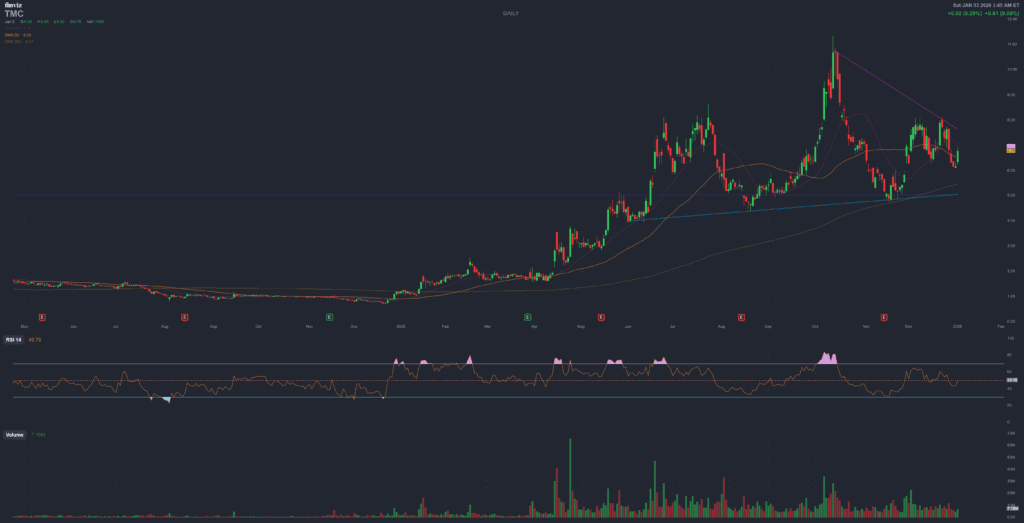
Chart source: Finviz (referral link active only on click). Data may be delayed and are for illustration only.
Business
Deep-sea polymetallic nodules (Ni, Cu, Co, Mn) in the Clarion-Clipperton Zone (CCZ).
Stage
Pre-revenue, development stage – PFS for NORI-D, permits and funding as main bottlenecks.
Cash & liquidity
About 115–165 M USD total liquidity (Q3 2025), with operating cash burn around 40–45 M USD per year.
Ownership
Strong insider/strategic block (Allseas, ERAS, management, Korea Zinc), double-digit % each and high retail float.
1-year move
Roughly +400–500% in 12 months, with 52-week range ~1.02–11.35 USD.
Key driver
Regulatory path (ISA vs U.S. DSHMRA), ESG debate, funding and offtake deals for NORI-D and future areas.
TMC is not a traditional small biotech or junior miner. It is a high-beta small/mid cap trying to open an entirely
new segment: harvesting polymetallic nodules on the ocean floor in the Clarion-Clipperton Zone, with the idea of feeding
the electric-vehicle and strategic metals supply chain.
In 2025 the stock moved from just above 1 USD to a peak above 11 USD, closing the year still several hundred percent above
the starting point. That kind of move puts TMC firmly on any “small caps of the moment” radar: strong narrative, strong retail
interest, highly directional.
It is on the list because the upside, if deep-sea mining becomes a real, licensed industry, is huge – but the downside
in case of regulatory or political failure is equally brutal. It is a textbook high-risk/high-reward story driven by
catalysts rather than slow compounding.
The Metals Company is headquartered in Canada and listed on Nasdaq under ticker TMC. Its core business is developing
a system to collect polymetallic nodules lying on the deep-sea floor (4,000–4,500 meters) in the CCZ. These nodules
contain nickel, copper, cobalt and manganese – metals that are central to batteries and strategic infrastructure.
TMC controls three key contract areas via subsidiaries (NORI, TOML and MARAWA) and has already published a
Pre-Feasibility Study for the NORI-D area, with very large NPV estimates under their chosen assumptions.
At this stage TMC is still pre-revenue. The story is essentially:
you fund the development, you secure permits and environmental clearance, you sign processing/offtake agreements – and only
then does the model switch from “R&D project” to an actual mining business.
Using Q3 2025 information, TMC had roughly 115 M USD of cash and equivalents, with some sources quoting up to
~165 M USD when you include other available liquidity. Operating cash burn has been in the 40–45 M USD yearly range,
with Q3 alone using around 11–12 M USD.
On paper this gives you something in the ballpark of two years of runway at current levels, but that estimate is
conservative for at least two reasons:
- Scaling the project (engineering, vessels, on-shore facilities) will likely push operating and capital needs higher.
- The shift from pre-revenue to initial production normally requires fresh equity or structured financing.
Market cap at current prices sits in the low- to mid-single-digit billions of USD. Classic valuation metrics like P/E
or EV/EBITDA are not useful here – this is a project-style equity where the question is whether the future cash flows
behind the PFS are ever realized.
The cap table is one of the strongest points of the story:
- ERAS Capital and related entities holding a mid-teens percent stake.
- Allseas, the offshore engineering group, with a low- to mid-teens position.
- The CEO and management team with a meaningful stake themselves.
- Korea Zinc coming in with roughly a 5% stake through an ~85 M USD investment in 2025.
Put together, insiders and strategic partners control a very material part of the equity – often quoted around the
35–45% range – while conventional institutions hold a modest but growing slice, and the rest is in the hands of
retail investors and trading accounts.
In practice this means:
- Strong alignment between management, industrial partners and the equity story.
-
A very visible and vocal retail base, which amplifies both good and bad news and adds fuel to big daily swings.
Over the last 12 months TMC has traded between roughly 1.02 USD and 11.35 USD. The share price has multiplied several
times, driven by a combination of:
-
Narrative around the U.S.–China race for critical minerals and the idea of a “Trump trade” on domestic control of
strategic resources.
-
Publication of a very bullish Pre-Feasibility Study for NORI-D, with a multi-billion USD NPV and high IRR
under the company’s metrics.
-
Speculation about new permitting channels in the U.S. that could bypass or at least complement the ISA route.
On the downside, whenever quarterly results expose higher-than-expected accounting losses, or critical articles on
environmental and legal risk gain traction, the stock has shown it can correct very quickly.
This is not “slow money”. Price action is that of a momentum/law-driven name, not of a steady cash-flow business.
Average daily volume runs in the millions of shares, with huge spikes on key news days. Bid/ask spreads are reasonably
tight for a small cap, which makes it possible to scale in and out – as long as you accept the volatility.
Beta sits well above 1.5 according to most data providers. Double-digit percentage moves on headlines are common. For
traders this is attractive; for investors with strict drawdown limits, it is a red flag.
Street estimates on TMC cluster in a fairly wide range:
- Average 12-month target often quoted around the high-single digits.
- Low end in the mid-single digits, high end around 11–12+ USD.
Ratings vary from Strong Buy to Sell, with some aggregators summarizing it as a net “Hold” once you average
the whole set. Crucially, all these targets are scenario-based: they hinge on permits being obtained and
the PFS economics being at least partially realized.
As always, these are opinions from professional and independent analysts, not a roadmap you can rely on mechanically.
Base case, roughly how bulls see it:
-
Geopolitical pressure to secure Western supply of nickel, copper and cobalt makes alternative sources attractive.
-
TMC manages to get some form of commercial license – either via the ISA, or via a U.S. path under DSHMRA and NOAA.
-
Environmental impact is framed as manageable thanks to monitoring and process design, at least in the key project areas.
-
Additional industrial partners and offtake deals (after Korea Zinc) further de-risk the plan.
Bull case: deep-sea mining actually takes off as a recognized sector, TMC consolidates its position as
first mover in CCZ, and equity valuation re-prices more on project NPV and future cash flows than on current cash burn.
Bear case: regulatory delays or outright moratorium, strong ESG backlash, litigation and political risk
lead to repeated funding rounds, heavy dilution and a much weaker equity story. The stock becomes a long-term warning
on how hard it is to commercialize controversial technologies.
2025 – milestones already in the books:
-
Filing of an application with the ISA framework in mind for NORI-D, amid intense political debate about a potential
pause or moratorium on deep-sea mining.
-
Publication of the NORI-D PFS with large NPV and Probable Reserves figures on polymetallic nodules.
-
Public discussion of a U.S. regulatory route under DSHMRA and NOAA, which could partially bypass the ISA bottleneck.
2026 and beyond – indicative windows, not fixed dates:
-
U.S. regulatory steps: pre-application meetings, possible EIS drafts, consultations and, at some point, a decision
on whether the project is licensable.
-
Further ISA sessions and negotiations on the mining code and on how to treat early applications like the Nauru/TMC one.
-
Potential new offtake agreements, engineering contracts and funding packages for vessels and processing facilities.
Unlike a PDUFA date or a clinical readout, these are windows rather than sharp catalysts: the market will react to each
incremental headline on permitting and geopolitics.
In a “run-up” approach, the main triggers to track are:
-
U.S. permitting steps under DSHMRA/NOAA (2026–2027 window): any confirmation that a commercial path is open
can be a major sentiment driver.
-
ISA mining code developments: a clearer, implementation-ready code is bullish; a de facto moratorium, not so much.
-
New industrial or offtake deals after Korea Zinc, especially from non-Chinese players in the EV or defence space.
-
Technical and environmental updates from at-sea tests and monitoring programmes, which can either calm or fuel ESG concerns.
-
Equity or hybrid financings: these are “negative catalysts” in the short term (dilution) but sometimes necessary
for the long-term plan.
Main channels monitored (non-professional traders):

The Reddit side includes a dedicated community (and occasional WallStreetBets-style write-ups) with
extremely bullish takes on the value of CCZ nodules and the NPV math. On Stocktwits, sentiment oscillates
sharply: euphoria around positive headlines and very negative threads when environmental or legal risks
are back in the news.
On X, the company pushes the narrative of responsible, monitored harvesting and of a massive marine
environmental dataset, while NGOs and investigative outlets frame TMC as a case study in high-risk
exploitation of poorly understood ecosystems.
Overall, sentiment is highly polarized – the ideal recipe for volatility, but not something you want
to ignore if you dislike crowded trades.
Note: these channels reflect the views of non-professional traders and commentators. They should be treated as
raw sentiment, not as research or advice.
There is no clean, listed “clone” of TMC. Comparisons are mostly thematic:
-
Traditional copper/nickel miners (large diversified groups) – useful to understand metal price sensitivity,
but radically different in risk and diversification.
-
Critical metals and rare-earths juniors – similar high-risk/high-reward pattern, but mostly on-shore and with
more conventional permitting paths.
-
Historical deep-sea attempts (like Nautilus Minerals) – more as a cautionary tale on how execution and
politics can derail a project, than as direct peers.
In a “small caps of the moment” basket, TMC sits at the very speculative end of the spectrum: unique asset,
unique narrative, but also unique ways in which things can go wrong.
- Am I comfortable with a story where the main risk is political and regulatory, not just technical?
-
How realistic do I think it is that U.S. or international regulators grant commercial licences in a
timeframe that matters for my horizon?
-
Where do I stand on ESG risk here? Do I believe the environmental cost is manageable – and more importantly,
will regulators and courts see it that way?
-
How sensitive is my thesis to the assumptions inside the NORI-D PFS (metal prices, CAPEX, OPEX, discount rates)?
-
What happens to my portfolio if there are multiple dilutive raises before any commercial production starts?
The main risk buckets are:
-
Regulatory risk – ISA and national regulators may delay, restrict or effectively block deep-sea
mining, either temporarily or permanently.
-
Environmental and legal risk – ongoing scientific uncertainty about deep-sea ecosystems could
translate into lawsuits, injunctions and political pressure.
-
Financing risk – as a pre-revenue company with a project-style plan, TMC depends on external
capital; delays usually mean more dilution.
-
Execution risk – nobody has yet proven a large-scale, fully commercial polymetallic-nodule
harvesting operation at this depth.
-
Valuation risk – after a huge move, any disappointment can trigger sharp re-rating, regardless
of the long-term story.
TMC is a pure “edge of the map” small cap. If deep-sea mining becomes an accepted, regulated industry and
TMC keeps its current position, the equity story has multi-bagger potential. If regulators, courts or politics
slam the brakes, the same leverage works in the opposite direction.
The shareholder structure (insiders + strategic partners + retail) and the PFS economics make it a serious
project, not a meme in the usual sense. At the same time, the degree of uncertainty around permits, ESG and
long-term funding is extremely high.
For a small-caps list, it fits the profile of a name to track for catalysts and windows – not something to
treat as a low-volatility core position.
Disclaimer and legal notice
This report is for informational and educational purposes only and is based on publicly available information
(company filings, official press releases, regulatory and institutional sources, and major financial news outlets).
While care has been taken to cross-check figures and dates, data can change and may be updated, corrected or
restated by the issuers or regulators.
Nothing in this page constitutes or should be interpreted as investment advice, a solicitation, an offer or a
recommendation to buy or sell any financial instrument, nor as personalized financial advice. The author of the
site and this analysis is not a licensed investment advisor. Any investment decision based on this content is made
entirely at your own risk.
The report may mention or link to affiliate partners (for example tools like Finviz, Seeking Alpha, Stocktwits
or others). Any potential commissions help keep the Merlintrader trading Blog online at no extra cost to you.
Such links do not alter the independence of the analysis.
For full legal information, risk warnings and privacy terms, please refer to:
Disclaimer and
Condizioni d’uso & Info privacy.
Biotech Catalyst Calendar
If you follow small caps and event-driven trades, don’t miss the Catalyst Calendar: a curated overview of upcoming
biotech catalysts (PDUFA, clinical readouts, regulatory decisions) with windows and basic context, updated regularly.
You can find it here:
Biotech Catalyst Calendar – Merlintrader trading Blog
SMALL CAPS DEL MOMENTO · STRUTTURA 0–15
TMC the metals company – Small cap estrema sul deep-sea mining
Grafico fornito da Finviz (referral attivo solo al click). Dati potenzialmente ritardati e puramente illustrativi.
Business
Raccolta di noduli polimetallici (Ni, Cu, Co, Mn) sul fondo oceanico nella Clarion-Clipperton Zone (CCZ).
Stadio
Pre-ricavi, fase di sviluppo – PFS su NORI-D, permessi e funding come colli di bottiglia principali.
Cassa & runway
Circa 115–165 M USD di liquidità totale (Q3 2025), con burn operativo intorno a 40–45 M USD annui.
Azionariato
Blocchi forti di insider e partner industriali (Allseas, ERAS, management, Korea Zinc) più base retail molto attiva.
Movimento 12 mesi
Circa +400–500% in un anno, con range ~1,02–11,35 USD.
Driver chiave
Percorso regolatorio (ISA vs DSHMRA USA), discussione ESG, accordi industriali e finanziamenti per NORI-D.
TMC non è la classica small cap biotech o la junior miner tradizionale. È una small/mid cap ad altissima
leva che punta ad aprire un settore praticamente nuovo: raccogliere noduli polimetallici sul fondo
oceanico nella CCZ per alimentare la filiera dei metalli critici (batterie, infrastrutture strategiche).
Nel 2025 il titolo è passato da poco sopra 1 USD a oltre 11 USD nel massimo, e comunque ha chiuso l’anno
con una performance di qualche centinaio di punti percentuali. È il tipico movimento che rende un ticker
“small cap del momento”: narrativa forte, retail molto presente, e movimenti direzionali violenti.
Entra in lista perché il potenziale, se il deep-sea mining diventerà un’industria regolata e autorizzata, è
enorme; allo stesso tempo il rischio, se regolatori e politica dovessero bloccare o frenare il progetto, è
altrettanto elevato. È una storia da trattare come high-risk/high-reward e non come “titolo tranquillo”.
The Metals Company ha sede in Canada ed è quotata al Nasdaq con ticker TMC. Il core business è sviluppare
un sistema per raccogliere noduli polimetallici depositati sul fondale oceanico a 4.000–4.500 metri di
profondità nella Clarion-Clipperton Zone. Questi noduli contengono nichel, rame, cobalto e manganese.
TMC controlla tre aree contrattuali chiave tramite le controllate NORI, TOML e MARAWA, e ha pubblicato
una Pre-Feasibility Study sul progetto NORI-D con NPV molto elevato secondo le ipotesi inserite nei
documenti aziendali.
Ad oggi l’azienda è ancora pre-ricavi: dipende totalmente da capitali esterni, permessi regolatori
e partnership per trasformare un progetto “sulla carta” in un’attività estrattiva vera e propria.
Dai dati Q3 2025 emerge una cassa di circa 115 M USD (con alcune fonti che indicano fino a 165 M USD
considerando tutta la liquidità disponibile). Il burn operativo è nell’ordine di 40–45 M USD annui,
con circa 11–12 M USD consumati nel solo Q3.
A spanne questo darebbe un paio d’anni di runway, ma è una stima prudente:
-
il progetto deve scalare (ingegneria, navi, impianti a terra), quindi i fabbisogni possono salire;
-
il passaggio alla produzione richiederà con ogni probabilità nuovi round di equity o strumenti ibridi.
La market cap, ai prezzi recenti, è nell’ordine dei miliardi di USD; essendo una società pre-ricavi,
i multipli classici (P/E, EV/EBITDA) non dicono molto. È un equity “da progetto”: il vero tema è se
i flussi di cassa ipotizzati nel PFS si materializzeranno o meno.
Un elemento interessante è la struttura dell’azionariato:
- ERAS Capital e veicoli collegati con una quota intorno alla mid-teens.
- Allseas, gruppo di ingegneria offshore, con una quota a doppia cifra.
- Il CEO e il management con partecipazioni dirette significative.
-
Korea Zinc, che è entrata con circa il 5% del capitale tramite un investimento da ~85 M USD nel 2025.
Complessivamente insider e partner industriali controllano una fetta molto consistente del capitale – spesso
indicata nella fascia 35–45% – mentre gli istituzionali classici hanno posizioni più piccole ma in crescita,
e il resto è in mano alla base retail.
In pratica:
- l’allineamento fra management, partner e equity è buono;
- la presenza retail è elevata e rende il titolo molto sensibile a news flow e narrativa.
Negli ultimi 12 mesi TMC ha scambiato in un range approssimativo 1,02–11,35 USD. La rivalutazione complessiva
è stata nell’ordine del +400–500%, trainata da:
-
narrativa sulla “guerra” USA-Cina per i metalli critici e sul bisogno di fornitori alternativi;
-
pubblicazione del PFS su NORI-D con NPV molto elevato e IRR importanti secondo le metriche aziendali;
-
discussione su possibili percorsi regolatori alternativi negli Stati Uniti (DSHMRA, NOAA).
Al contrario, trimestrali con perdite contabili molto elevate o articoli fortemente critici su temi
ambientali e legali hanno mostrato quanto velocemente il titolo possa correggere.
È un nome da trattare come momentum/regulatory play, non come “piano pensionistico”.
I volumi medi giornalieri sono nell’ordine di milioni di azioni, con picchi enormi sulle notizie. Lo spread
bid/ask è accettabile per una small cap, quindi in generale entrare e uscire non è un problema tecnico, a
patto di accettare la volatilità intraday.
Il beta stimato supera comodamente 1,5. Movimenti giornalieri a doppia cifra sono parte del pacchetto: interessante
per chi cerca swing e run-up, meno per chi non tollera drawdown forti.
I target di consenso a 12 mesi su TMC si muovono in una forchetta piuttosto ampia:
- media a cavallo della fascia high-single digits;
- parte bassa su mid-single digits, parte alta intorno a 11–12+ USD.
I rating spaziano da Strong Buy a Sell, con alcuni aggregatori che sintetizzano il tutto in un “Hold”
complessivo. Il punto chiave è che quasi tutti questi target assumono che i permessi vengano concessi e
che almeno una parte dell’economia del PFS si materializzi nei prossimi anni.
Come sempre, sono opinioni di analisti, non istruzioni operative.
Scenario base (ottica bullish “ragionata”):
-
la pressione geopolitica per assicurarsi forniture di metalli critici rende appetibili fonti alternative;
-
TMC ottiene, via ISA o via percorso USA (DSHMRA/NOAA), una forma di licenza commerciale per NORI-D;
-
l’impatto ambientale viene giudicato gestibile attraverso monitoraggio e design del processo;
-
ulteriori accordi industriali/offtake dopo Korea Zinc contribuiscono a de-rischiare il piano.
Scenario bull: il deep-sea mining viene accettato come nuovo settore, TMC diventa first mover
riconosciuto nella CCZ e il mercato ricalibra la valutazione più su NPV di progetto e flussi futuri che su cassa
e burn attuali.
Scenario bear: moratoria de facto o regole estremamente restrittive, contenziosi, pressione
ESG, ritardi continui e necessità ricorrente di nuovi aumenti di capitale. L’equity rischia di trasformarsi in
un warning su quanto possa essere difficile monetizzare tecnologie controverse.
2025 – punti principali:
-
avanzamento del dossier NORI-D nel contesto ISA, con discussione molto accesa tra paesi favorevoli e
contrari al deep-sea mining;
-
pubblicazione del PFS su NORI-D con NPV elevato e prime Probable Reserves sui noduli;
-
emersione di un possibile canale regolatorio statunitense (DSHMRA/NOAA) come alternativa o complemento al percorso ISA.
2026 e oltre – finestre indicative:
-
passi successivi nel percorso USA (incontri, EIS, consultazioni, eventuale decisione su permessi);
-
ulteriori sessioni ISA sul mining code e sulla gestione delle prime domande di sfruttamento;
-
nuovi accordi industriali, contratti di ingegneria e pacchetti di finanziamento per navi e impianti.
Qui non parliamo di date “tipo PDUFA”, ma di finestre che possono aprirsi con news progressive. Il mercato
reagirà probabilmente a ogni step materiale sul fronte permessi/geopolitica.
In ottica “run-up” gli elementi da monitorare sono:
-
passi concreti nel percorso autorizzativo USA (DSHMRA/NOAA) nel 2026–2027;
-
evoluzione del mining code ISA (apertura vs moratoria/restrizioni forti);
-
nuovi accordi industriali/offtake dopo Korea Zinc, in particolare da parte di player EV o difesa non cinesi;
-
aggiornamenti tecnici e ambientali dai test in mare e dai programmi di monitoraggio;
-
eventuali aumenti di capitale o strumenti ibridi (diluitivi nel breve, ma spesso inevitabili).
Canali di sentiment monitorati (trader non professionali):
Su Reddit esiste una community dedicata e ogni tanto compaiono DD in stile WallStreetBets con toni
estremamente ottimistici sui numeri di NPV e sui “trillions” di risorse nel fondale CCZ. Su Stocktwits
il sentiment oscilla: fasi di euforia nelle giornate di news positive e fasi di pessimismo quando tornano
al centro i rischi ambientali/regolatori.
Su X l’account ufficiale di TMC spinge molto sulla narrativa di “harvesting responsabile” e sul valore
del dataset ambientale raccolto, mentre ONG e media investigativi la descrivono come una scommessa ad alto
rischio sugli ecosistemi poco conosciuti delle profondità marine.
Nota: questi canali riflettono opinioni di trader retail e commentatori non professionisti; vanno letti come
indicazioni di sentiment, non come ricerca o consigli operativi.
Non esistono veri “cloni” quotati di TMC. I confronti sono per tema:
-
grandi miner di rame/nichel (Freeport, Vale, ecc.) – servono per capire la sensibilità ai prezzi dei metalli,
ma hanno profili di rischio molto diversi;
-
small cap legate a metalli critici/terre rare – simile logica high-risk/high-reward, ma in contesti estrattivi
più tradizionali;
-
progetti storici di deep-sea mining (come Nautilus) – più come case study su cosa può andare storto che come
peer diretto.
In un paniere “small caps del momento”, TMC finisce nella fascia più speculativa: unicità dell’asset e della
narrativa, ma anche dei possibili punti di rottura.
- Mi sento a mio agio con una storia dove il rischio principale è politico/regolatorio?
-
Quanto reputo realistico che USA o organismi internazionali concedano licenze commerciali in una finestra
temporale che per me ha senso?
-
Che peso attribuisco al rischio ESG? Come potrebbero reagire opinione pubblica, tribunali e regolatori?
-
Quanto è sensibile la mia tesi alle ipotesi inserite nel PFS di NORI-D (prezzi metalli, CAPEX, OPEX, tassi di sconto)?
-
Cosa succede al mio portafoglio se ci sono più aumenti di capitale diluitivi prima che inizi una produzione commerciale?
I blocchi di rischio principali sono:
-
Rischio regolatorio: ISA e regolatori nazionali possono ritardare, limitare o bloccare
il deep-sea mining.
-
Rischio ambientale/legale: l’incertezza scientifica sugli ecosistemi di profondità può
tradursi in cause, ricorsi e forti pressioni politiche.
-
Rischio finanziario: società pre-ricavi, ad alto fabbisogno di capitale; ritardi o shock
regolatori spesso significano ulteriore diluizione.
-
Rischio execution: nessuno ha ancora dimostrato un’operazione su larga scala di questo tipo
a 4.000–4.500 m di profondità.
-
Rischio di valutazione: dopo un rally forte, ogni delusione può generare re-rating violento.
TMC è una small cap “da bordo mappa”: se il deep-sea mining diventerà realtà regolata e TMC manterrà
la posizione attuale, il potenziale è da multi-bagger; se invece regolatori, tribunali o politica
bloccheranno la strada, la leva funziona al contrario.
L’allineamento tra insider, partner industriali e progetto, insieme ai numeri del PFS, rende la storia
più strutturata di un semplice meme. Dall’altra parte il grado di incertezza su permessi, ESG e funding
è molto alto.
All’interno di una lista “small caps del momento” ha senso vederla come nome da monitorare per catalyst
e finestre, non come tassello difensivo di portafoglio.
Disclaimer e note legali
Questo report ha finalità esclusivamente informative ed educative ed è basato su informazioni pubbliche
(documenti societari, comunicati ufficiali, fonti regolatorie e istituzionali, principali testate di news
finanziarie). Nonostante l’attenzione nella verifica dei dati, numeri e date possono cambiare nel tempo e
venire aggiornati, corretti o rettificati dagli emittenti o dalle autorità.
Nulla in questa pagina costituisce o deve essere interpretato come consulenza in materia di investimenti,
sollecitazione, offerta o raccomandazione all’acquisto o alla vendita di strumenti finanziari, né come
consulenza personalizzata. L’autore del sito e di questa analisi non è un consulente finanziario abilitato
all’esercizio professionale. Ogni decisione di investimento basata su questi contenuti è assunta in piena
autonomia e sotto la propria esclusiva responsabilità.
Nel testo possono essere presenti riferimenti o link a partner in affiliazione (ad esempio strumenti come
Finviz, Seeking Alpha, Stocktwits o altri). Eventuali commissioni contribuiscono a sostenere il
funzionamento di Merlintrader trading Blog senza alcun costo aggiuntivo per il lettore e non alterano
l’indipendenza dell’analisi.
Per le informazioni legali complete, gli avvisi di rischio e le condizioni d’uso si rinvia a:
Disclaimer e
Condizioni d’uso & Info privacy.
Biotech Catalyst Calendar
Se segui le small caps e le strategie basate su eventi, può esserti utile avere una panoramica aggiornata
delle principali scadenze biotech (PDUFA, readout clinici, decisioni regolatorie) con finestre temporali
e contesto sintetico.
Puoi consultare il calendario qui:
Biotech Catalyst Calendar – Merlintrader trading Blog
 Umbria