AI transparency: articles and reports are produced with the help of artificial intelligence and checked through a process that does not constitute specialist validation. They may contain errors: verify relevant information with independent sources. Read the full disclaimer.
Merlintrader · Educational
$POET$COHR$LITE$AAOI
After ECOC, what evidence matters for $POET, $COHR, $LITE and $AAOI?
From demonstrations to paying customers: how to read PhotonLink, new lasers and AI optics orders without confusing technological promise with commercial results.
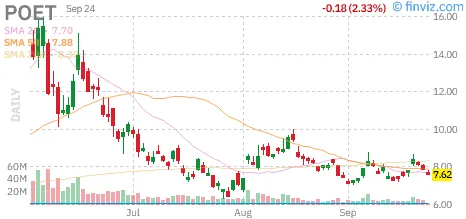
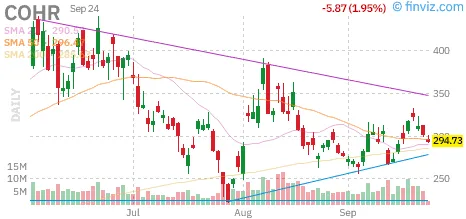
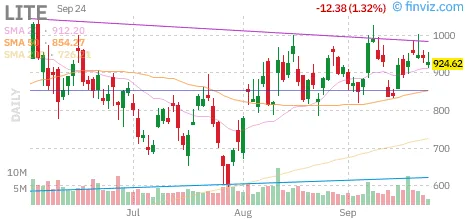
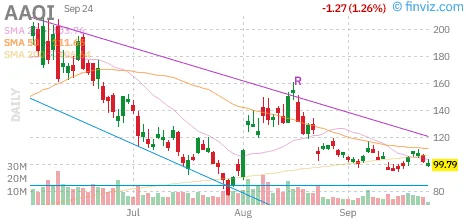
Source: Finviz. Static snapshots captured September 24, 2026 at 17:55 CEST during the trading session. Prices and indicators remain fixed at that observation and do not represent the final close. Finviz links include an affiliate referral.
The next commercial evidence
$COHR · PhotonLink
Q4 2026: the first checkpoint
Expected window for CPO scale-out revenue. Scale-up, NPO and chip-to-chip follow different timetables.
EOI/Lumilens engineering samples expected in late 2026; Lumentum’s new DWDM ELSFP expected in the first half of 2027. AOI’s 1.6T order needs shipment confirmation beyond the announced timetable.
Engineering samples expected; production ramp expected in 2027 Official source
$COHR · PhotonLink scale-out
Q4 2026
Expected window for the start of the revenue ramp Official source
$LITE · new DWDM ELSFP
First half 2027
Expected initial availability; not revenue already secured Official source
$AAOI · 1.6T order
Over $200 M
Announced Mar. 9, 2026; shipments after qualification Official source
US dollars in millions (M) and billions (B). Revenue covers different company portfolios; future dates are company statements subject to change. Sources reviewed September 24, 2026.
Favorable scenario
More AI connections, qualified products and repeat orders: the technical advantage becomes revenue at sustainable margins.
Unfavorable scenario
Delays, competing architectures, scrap and new capital requirements constrain per-share results.
The crucial distinction
Introduction → qualification → order → revenue
Each step answers a different question. Their order can change: a development contract may generate revenue before serial production.
How to read this comparison
Four companies, different supply-chain positions
Coherent combines components and integrated solutions; POET develops integration platforms and engines; Lumentum supplies lasers and optical solutions; AOI makes components and transceivers. Total revenue is not the shared market.
Four disclosures to follow
September 21, 2026
PhotonLink
Coherent’s platform has separate commercial windows for CPO scale-out, scale-up, NPO and chip-to-chip.
The comparison starts with products and moves through customers, qualification and production. Applications do not all follow the same timetable.
The full research covers use cases, markets, countries, financial statements and a matrix of commercial evidence.
A new product works on a trade-show bench. A major customer agrees to test it. An order arrives. The factory increases production. Revenue rises. For investors following photonics stocks, these steps may sound like parts of the same positive story. In reality, each answers a different question and leaves different risks unresolved.
That distinction matters after the ECOC exhibition, held in Málaga on September 21–23, 2026. The industry is demonstrating new ways to connect artificial intelligence systems with light. Investors need to understand which possibilities have become products that customers buy, and which still require development, testing and investment. Official ECOC Exhibition calendar.
Coherent’s PhotonLink launch offers a concrete starting point. To compare it with POET Technologies, Lumentum and Applied Optoelectronics, however, we must move from the company name to the individual program: which product, for which customer, at what qualification stage, with what order and what revenue?
01AI photonics, explained through the problem it needs to solve
An AI data center contains many processors that must work together. Fast calculations inside each processor are not enough: the processors also need to exchange data. Imagine a team of exceptionally fast workers forced to pass information through a narrow corridor.
Optical connections use light to carry that data. Electronics still plays an essential role: an electrical signal must be converted into light and converted back at its destination. The economic objective is to move more information using less energy per bit and less space, while maintaining acceptable reliability and cost.
Four distinctions are enough to start reading announcements. The laser generates light. The optical engine integrates some of the functions needed to transmit or receive the signal. The transceiver combines transmission and reception in a product that can be used in a system. The fiber carries the signal between the connected points.
The design also changes with the position of the optics. A pluggable module fits into an equipment port. Near-packaged optics, or NPO, brings conversion close to the chip package. Co-packaged optics, or CPO, integrates it into the same packaging assembly as the chip. An external laser can supply light while keeping the source away from the hottest area and making replacement easier. These are architectural choices with different trade-offs, rather than three automatic levels of superiority. Lumentum’s technical description of CPO/NPO and external light sources.
The terms 800G and 1.6T also have a limited meaning: they indicate nominal transmission capacity, respectively 800 gigabits and 1.6 terabits per second. They do not, by themselves, tell us what a connection costs, how much power it uses, its operating distance or whether two products are interchangeable. Before comparing announcements, investors need to know what was measured and where in the system.
02PhotonLink: integration is the new proposition, but the timetable is not uniform
On September 21, Coherent introduced PhotonLink as a platform combining photonic technologies, assembly and testing for CPO, NPO and connections between chips. Customers can purchase components or integrated optical assemblies.
Coherent reports more than ten customer engagements for CPO, more than ten for NPO and more than five emerging chip-to-chip programs. It also reports anchor customers and long-term agreements for CPO and NPO. The release expects the PhotonLink revenue ramp to begin in the fourth quarter of calendar 2026. These are more specific commercial disclosures than a demonstration alone, but they do not provide a count of distinct customers or binding orders, or a backlog value. Official PhotonLink announcement.
The launch presentation makes the forecast more precise. On slide 14, Coherent separates the following revenue windows:
On small screens, scroll the table horizontally.
PhotonLink application
Timing indicated by Coherent
CPO for connecting systems across the network, or scale-out
Fourth quarter of calendar 2026
CPO for more tightly connecting computing resources, or scale-up
Second half of 2027
NPO
Second half of 2027
Chip-to-chip connections
2029–2030
These are management forecasts, not revenue already secured. Applying “starts in the fourth quarter” to the entire platform would bring some opportunities forward by years. Here, scale-out and scale-up describe different uses of connectivity. The technical boundaries depend on the system, but the commercial point is that they follow different timetables. PhotonLink presentation, slide 14.
The potential value of integration is understandable: customers may reduce the work required to combine parts from different suppliers. The economic evidence will emerge if that simplification supports adoption and sales at adequate margins. This is an interpretation of the business model, not a guarantee in the launch announcement.
03The four companies overlap only partly
Merlintrader analysis of the product descriptions cited in the text · September 24, 2026. Not a ranking or a market-share allocation.
Treating these businesses as four manufacturers of the same object leads to poor comparisons. One may supply a component, another integrate it, and a third sell a complete module. Some do more than one of these things.
On small screens, scroll the table horizontally.
Company
Position relevant to the comparison
Main commercial question
Coherent — $COHR
Broad component and solutions portfolio; PhotonLink adds an integrated offering for architectures close to chips.
How much of the new program reaches shipments and revenue within the stated windows?
POET Technologies — $POET
Integration through the Optical Interposer, optical engines, light sources and module development with partners.
Do individual programs complete qualification and achieve repeatable production?
Lumentum — $LITE
Lasers, components, modules and optical systems; its ECOC offerings include new external sources and short-reach connections.
Which products are already commercial, and which new configurations still need to get there?
Applied Optoelectronics — $AAOI
Components and transceivers, with exposure to data centers and broadband networks.
Do rising 800G and 1.6T volumes generate revenue, margins and returns on investment?
One possible confusion should be removed immediately: LITEON, POET’s development partner, is a different company from Lumentum, ticker $LITE. The POET–LITEON agreement does not establish a POET–Lumentum partnership. Similarly, when a customer or supplier is described only as a major industry participant, assigning a name based on its size or product remains speculation. POET–LITEON agreement, March 16, 2026.
04The favorable and unfavorable scenarios, before the details
Favorable scenario. Large operators expand computing capacity and need to connect more processors, racks and sites. A growing share of those connections requires more efficient optical solutions. Suppliers that pass customer tests, deliver consistently and keep costs competitive may gain volume or sell higher-value products. Documented commercial agreements and the first CPO platforms described as being in production make this prospect more concrete than a trade-show promise. Adoption speed still differs from program to program.
Unfavorable scenario. Data center construction slows, a customer changes architecture or purchasing shifts to other suppliers. Factory costs rise ahead of revenue, qualification takes longer and competition pushes prices down. Even with growing industry demand, an individual company can lose a project, produce too many defective units or need to issue new shares. The technology advantage must therefore withstand the tests of total cost and industrial execution.
These are analytical scenarios, not share-price forecasts. Distinguishing between the paths requires evidence from products, customers and financial statements. The following sections explain where to look and which conclusions that evidence actually supports.
Extended analysis
From light to revenue: read the evidence.
Use cases, markets, customers and leading countries. The complete $POET, $COHR, $LITE and $AAOI comparison, with the commercial matrix and risks.
05What it does in practice: six uses for photonics
Someone using an AI assistant does not normally buy a laser or transceiver. They buy a service; behind that service, someone else builds and operates the infrastructure. Interest in photonics arises from the need to move data between increasingly powerful machines without spending an excessive share of available energy on moving it.
Three recurring terms help explain the setting. GPUs are processors used as accelerators to perform large amounts of computation. Racks are the cabinets housing equipment. Switches route data between network connections. A hyperscaler operates cloud infrastructure on an enormous scale. An optical supplier may sell a small component inside a system that eventually occupies one of those racks.
Training a model means having many processors handle huge amounts of data and exchange intermediate results. Using the model, or inference, means generating a response, image or action. Inference can also require intensive communication when a model is distributed across processors. Services differ in size and networking needs, however: an AI function running on a phone does not necessarily require new optical connections in a data center.
On small screens, scroll the table horizontally.
Use case
Practical problem
Relevant optical solution
Relevance to this comparison
Connecting servers and racks during training or distributed inference
Processors need to exchange data without sitting idle
Transceivers, optical engines, lasers and switches with integrated optics
Core market for the four companies’ data center products, at different supply-chain positions
Connecting a system’s accelerators very tightly
Short connections must carry more data at higher density
NPO, CPO and optical chip-to-chip interconnects
Some platforms are commercial; others remain demonstrations or roadmaps. Architecture names are insufficient
Connecting two data centers or multiple campus sites
Data must travel longer distances
Coherent optics, data center interconnect transceivers and transport systems
A distinct opportunity from intra-rack optics; not every 800G product serves both
Connecting telecommunications and broadband access networks
Operators and users need more transmission capacity
Optical components and equipment for transport, access and cable networks
Existing markets for some suppliers; they should not all be counted as AI
Bringing computing and services closer to factories, mobile networks or robots
Response time and distance from processors matter
Optical connections between distributed computing resources
Evaluate project by project; a network demonstration does not establish a supply contract for these four stocks
Sensing, diagnostics, space and quantum systems
Measuring or transmitting information using specific properties of light
Dedicated photonic circuits and devices
Broader photonics markets with their own products and qualification requirements
An example helps separate the last two use cases. NTT and DOCOMO demonstrated AI video analysis using remote GPU resources connected through the IOWN optical network, an experiment relevant to distributed processing and robot control. NTT and MBRYONICS instead signed a memorandum to study modules for space optical communications. Both developments are documented, but their status and intended users differ. Neither establishes orders for $POET, $COHR, $LITE or $AAOI. NTT–DOCOMO demonstration, March 2, 2026; NTT–MBRYONICS memorandum, June 4, 2026.
Dedicated photonic platforms also exist for sensing, LiDAR and medical applications, such as those described by foundry SMART Photonics. The shared word is “photonics”; materials, processes, customers and sales cycles can differ substantially. Adding all these markets to an AI optics estimate would enlarge an opportunity that an individual business might not be equipped to serve. SMART Photonics, integrated photonics applications.
06How large could the market be, and how much can become revenue?
Source: IEA, Key Questions on Energy and AI, April 2026. The 2030 figure is a central scenario. This chart does not measure optical component sales or forecast revenue for the four stocks.
The first layer is infrastructure demand. In its April 2026 update, the International Energy Agency estimates data center electricity consumption rising from roughly 485 TWh in 2025 to 950 TWh in 2030, under its central scenario. TWh means terawatt-hours, a measure of energy. These are energy consumption figures, not optical component sales. They help explain why efficiency, density and power availability are real economic problems; they cannot be used to calculate the four companies’ future revenue. IEA, Key Questions on Energy and AI, 2026 executive summary.
The second layer is networking expenditure. A new data center requires land, buildings, power, cooling, processors, memory and connections. Only part of that spending goes to optics. Within optics, lasers, photonic circuits, modules, fibers, connectors and equipment must be distinguished. A module’s value includes its components: adding laser sales and module sales as though they were independent end markets can double-count the same value chain.
The third layer is the market a business can actually serve. Start with an application and product generation, identify compatible connections and assess which portion the company can address. Technology suited to a particular module does not automatically capture every 800G port worldwide. Qualification, capacity, pricing, support and competing suppliers narrow the opportunity.
A purely illustrative numerical example: if a program required 100,000 modules and a supplier delivered 20% at $400 each, sales would be $8 million. Doubling the total number of connections would not guarantee doubled revenue: the supplier’s share might change and unit prices could fall. These quantities and prices are not estimates for any of the four companies.
The useful question becomes: how many units can this company sell, to whom, when and at what margin? The total market describes the potential space. Revenue depends on programs won; shareholder value also depends on the capital required and the price paid for the shares.
07Who actually pays: end customer, system manufacturer and partner are different roles
A large cloud operator may define network requirements, buy complete systems or purchase some modules directly. A system manufacturer assembles equipment and integrates components. A transceiver manufacturer may buy lasers and optical engines from another supplier. A foundry manufactures chips for their designers; a packaging company assembles and tests them.
The customer generating a company’s revenue can therefore differ from the data center’s end user. A famous name in a presentation might denote a customer, investor, technical partner or simply another participant in the ecosystem. These relationships have different value and must be traced individually.
NVIDIA provides a documented example for $COHR and $LITE. On March 2, 2026, it announced non-exclusive multiyear agreements with both. The Coherent arrangement includes multibillion-dollar purchase commitments and access rights to future capacity for advanced lasers and optical networking products; separately, NVIDIA announced a $2 billion equity investment. The Lumentum arrangement covers advanced laser components, multibillion-dollar purchase commitments and future capacity, with another, separate $2 billion equity investment. NVIDIA–Coherent agreement; NVIDIA–Lumentum agreement.
Here, the buyer also confirms the commercial relationship. The $2 billion invested in each company is not product sales revenue. Nor does the general March announcement automatically allocate commitments to the new PhotonLink platform, September’s DWDM ELSFP module or a particular application. The agreements improve visibility into the industrial relationship, but individual supply schedules still require verification. Coherent’s 10-K documents the shares issued for the investment; Lumentum also publishes the agreement on its own site. Coherent, 2026 Form 10-K, equity note; Lumentum’s March 2 announcement.
$AAOI has a public relationship with Amazon. The agreement filed in March 2025 refers to manufacturing and development relationships and a warrant granted to an Amazon subsidiary. The relationship and warrant are still described in the June 30, 2026 10-Q. The $4 billion purchasing threshold over ten years tied to vesting of part of the warrant is an incentive condition: by itself, it is not a guaranteed order of that size. Nor does it automatically identify Amazon as the unnamed customer behind the more-than-$200 million 1.6T order. AOI–Amazon agreement and exhibits; AOI, Q2 2026 10-Q, Customer Warrant.
For $POET, public names must be attached to the correct program. Lumilens is the counterparty to the commercial agreement discussed here; LITEON is a module development partner. Neither relationship proves that a particular hyperscaler has qualified and purchased the final product. When the buyer remains unnamed, the analysis must keep it unnamed.
There is also the end-user layer: NVIDIA lists CoreWeave, Lambda, Meta, Microsoft and Oracle Cloud Infrastructure among early adopters of Spectrum-X Photonics. This provides concrete evidence of end demand for NVIDIA’s platform. It is not a list of direct customers for each of the four suppliers, nor does it prove shipments of an identical configuration to every operator. NVIDIA, official Silicon Photonics page.
Commercial confidentiality is common. An unnamed customer is not necessarily a poor customer; it simply leaves the market with less verifiable information. Conversely, a prestigious name does not remove concentration risk, buyer bargaining power or the possibility of qualifying a second supplier.
08Which countries are ahead? A map of capabilities
There is no single meaningful league table for all of photonics. Strength in materials research differs from high-volume transceiver production or influence over which components enter data centers. This map selects centers with documented activity. It does not assign national market shares or claim to cover every country.
On small screens, scroll the table horizontally.
Country or center
Documented strength
Why it matters to investors
United States
AI platform and network design, large buyers and suppliers such as NVIDIA, Broadcom, Coherent and Lumentum
System choices and capacity commitments can shape supply-chain demand
Taiwan
Fabrication, packaging and system integration: TSMC, SPIL and Foxconn appear in NVIDIA’s described optical supply chain
A design must be manufactured, assembled and tested in volume
China
Transceiver manufacturers such as InnoLight, with an advertised portfolio up to 1.6T, and a large digital infrastructure market
Competition, regional supply chains and customer access make a four-stock comparison incomplete
Japan
NTT and NTT Innovative Devices develop photonics–electronics convergence and IOWN networks
Operator-led and networking-led adoption paths exist alongside US platforms
Belgium and the Netherlands
Imec research and processes; dedicated foundries and platforms such as SMART Photonics and New Origin
New materials, processes and manufacturing capacity can enable suppliers across countries
Spain and the European network
ICFO coordinates PIXEurope, a distributed design, fabrication, packaging and testing initiative
A pilot line helps the move from laboratory to industry but is not already large-scale sales
Italy
Politecnico di Milano and Fondazione Bruno Kessler participate in PIXEurope, contributing to circuit platforms, control and testing
Italian research has a specific role; project membership does not establish revenue for the stocks discussed
Singapore
A*STAR and IME, advanced photonics and packaging programs, and industrial transfer infrastructure
A development and integration center, distinct from its domestic data center market alone
The evidence gives substance to the map. In April 2026, TSMC indicated a 2026 production start for its on-substrate COUPE solution; NVIDIA separately describes TSMC, SPIL and Foxconn’s contributions to its platform. These support Taiwan’s role, without certifying that every project using that supply chain is already in mass production. TSMC, 2026 Technology Symposium; NVIDIA, Spectrum-X production ecosystem, May 2026.
In Europe, PIXEurope involves 20 institutions in 11 countries and a €400 million budget. This is investment in shared industrial infrastructure, not a component manufacturer’s revenue. Imec contributes platforms, integration and packaging; its New Origin collaboration concerns transferring and industrializing a silicon nitride platform. Italy participates through Politecnico di Milano and FBK. Imec, PIXEurope, June 2026; New Origin–imec, March 2026; Politecnico di Milano, Italian contribution.
In March 2026, Singapore announced an S$800 million program to strengthen semiconductors, including advanced photonics and packaging. Currency and scope matter: this is not US$800 million allocated solely to optical components. A*STAR, Committee of Supply 2026.
For investors, a company’s legal domicile or listing market does not fully describe geographic exposure. Production locations, critical suppliers, customers, alternative capacity and the time required to transfer a process must be mapped. Diversifying plants can reduce some dependencies, but requires capital and new qualifications. That economic consequence of geography is more useful than a generic national ranking.
09Why copper does not disappear, and better technology can take years
The choice depends on distance, speed, power use, cost and maintenance. A short electrical connection can be simple and inexpensive; converting a signal into light still requires devices, power and assembly. Optics becomes attractive when the system-level benefit outweighs those costs. There is no universal replacement threshold for every network.
Broadcom provides a concrete example: the Tomahawk 6 family offers both copper connectivity and CPO options. In October 2025, it announced shipments of the Davisson CPO version. These alternatives show why an optical future does not imply the immediate replacement of every electrical connection. Broadcom, Tomahawk 6, June 2025; Broadcom, Davisson, October 2025.
Reliability also involves more than making a prototype work. A customer wants to know how to replace a failed source, cool the system, identify a fault and use alternative suppliers. Shared interfaces help, but meeting a specification does not automatically mean passing the customer’s tests. This is one reason Lumentum’s new module refers to an OCI MSA interface and distinguishes the underlying laser from the complete configuration.
Finally, a constraint exists outside photonics: a data center must be built and supplied with electricity. In its 2026 update, the IEA identifies bottlenecks in transformers, turbines, advanced components and grid connections. An order can therefore shift in time without any defect in the optical product. IEA, demand and physical constraints update, April 16, 2026.
10From demonstration to revenue: what changes at each step
The following sequence is an analytical tool, not an obligatory path shared by every program. An order may precede final qualification; a sample may be paid for; a development contract may generate revenue before serial production.
1. Product introduction or demonstration. This shows what a supplier intends to offer and, when supported by appropriate measurements, some of its performance. It does not necessarily establish manufacturing cost, long-term reliability or volume availability.
2. Sampling. The customer receives units to evaluate. It matters whether they represent the final product and the factory process that will be used. A sample built with extensive manual work may function without demonstrating sustainable costs at high volumes.
3. Qualification. The product undergoes checks required for a particular use: performance, compatibility, reliability and the supplier’s ability to sustain them. The useful question is “qualified by whom, for which product and which application?” Component qualification does not automatically certify a complete module; module qualification at one customer does not automatically apply to every other customer.
4. Order. There is a more concrete commercial request. Investors still need to read conditions, timing, any modification or cancellation rights, and outstanding steps. A trial order also serves learning purposes; a production order has a different objective. The headline value does not remove contractual conditions.
5. Delivery and revenue. The business must satisfy the conditions for recognizing a sale. In simplified terms, product revenue depends on transfer of control; some development services can generate revenue over time. Cash collection may come before or after revenue recognition: sales and money entering a bank account are not synonyms. POET explicitly distinguishes engineering services recognized over time from product sales recognized at a point in time. POET financial statements, Note 3 on revenue.
6. Repeat orders and repeatable production. The customer returns, shipments recur and the supplier sustains quality and costs. This is richer evidence than a single announcement, especially if margins improve and the customer base broadens.
The practical distinction is substantial. An order reduces uncertainty about customer interest. Completed qualification reduces part of the technical risk. Recurring revenue with sound economics reduces part of the industrial risk. None of these steps eliminates all the others.
11$POET: follow separate programs without adding them up as cash
At least three disclosures should be separated for POET.
The first concerns Infinity 800G. The company’s July 14 FAQ refers to an order exceeding $5 million, announced in October 2025, with shipments expected in the second half of 2026. Useful confirmation would concern execution of that program: quantities shipped, qualification status and revenue contribution. The announced delivery window does not establish that deliveries have already occurred. POET’s official commercial FAQ.
The second is Lumilens. The program uses the Electrical-Optical Interposer, or EOI, a platform integrating electrical and optical functions. Its roadmap starts with 800G and 1.6T pluggable transceivers and extends toward NPO and CPO. The agreement announced in May includes a $50 million initial order within a potential purchasing opportunity exceeding $500 million over five years: not a guaranteed $550 million. Fulfillment and revenue depend on successful development, qualification and manufacturing scale-up. Engineering samples are expected in late 2026 and the production ramp in 2027. Official POET–Lumilens agreement.
Overlap with other suppliers therefore concerns some end applications. A POET engine may form part of a module developed with Lumilens; AOI’s transceiver is a product at another level of integration, while PhotonLink encompasses components and complete assemblies. Sharing an application does not prove technical equivalence, common customers or matching adoption schedules.
The agreement also includes a warrant: the right to purchase up to 22,921,408 shares at $8.25, partly linked to customer payments. The maximum does not represent shares already issued; potential exercise can dilute existing shareholders. POET financial statements, customer-related warrants.
The third disclosure is the August 13 quarterly update: POET reports a new $2.4 million order from an existing customer, received after June 30. This commercial fact belongs in the comparison without naming the customer or arbitrarily allocating it to Infinity or Lumilens. In the same update, expectations for the remaining 2026 quarters concern production units to be sent for qualification. That wording does not state that final qualification has already been completed. POET results and commercial update.
The quarter ended June 30 recorded $569,925 in combined engineering and product revenue and approximately $796.3 million in cash and short-term investments. Liquidity provides resources to execute programs; it does not demonstrate product adoption. Nor can all reported revenue be labeled sales of mass-produced optical engines. Interim financial statements filed with the SEC.
The post-ECOC test is therefore concrete: identify the next step actually completed for each program. A presentation adds visibility; delivery of a conforming batch adds a different piece of information. Company details are covered in the dedicated $POET Stock Hub.
12$LITE: one company can have mature products and demonstration projects
Lumentum’s September 21 announcements illustrate the distinction clearly.
The first concerns an eight-wavelength external laser source in a pluggable ELSFP format. In plain language, it uses several “colors” of light to feed compact optical connections. The underlying laser platform is already in production; initial availability of the new DWDM ELSFP configuration with an OCI MSA optical interface is expected in the first half of calendar 2027. A mature core technology can therefore coexist with a new module yet to be introduced. Lumentum DWDM ELSFP announcement.
The second announcement presents a demonstration with Qualcomm and Corning for short-reach optical connections between chips, called D2D (die-to-die), based on small 1060-nanometer VCSEL lasers. The company describes it as a proof of concept. It is evidence of technical collaboration, not an announcement of orders from Qualcomm or Corning. Participating in a demonstration does not automatically make the partners customers of the finished product. Joint ECOC demonstration announcement.
The ECOC Exhibition Industry Awards add another reference point, and show the limits of this kind of recognition. In the Optical Component Innovation (Package/OSA/Fibre) category, the 2026 award went to Lumentum’s VCSEL-based FOWLP optical engine for AI scale-up networks; POET Blazar was among the shortlisted nominees in the same category. An industry panel’s award signals technical recognition. For either company, it is not a customer qualification, an order or revenue. ECOC Exhibition Industry Awards 2026.
The August update had already mentioned a first order for ELS modules. It would nevertheless be incorrect to assign that order to the specific DWDM configuration introduced in September without a disclosure linking them. This is the same mistake as assigning company revenue to its newest product. Lumentum results, August 11, 2026.
The confirmations to watch for $LITE differ by program: actual availability and qualification of the new module, any specific orders, and progression of the chip-to-chip demonstration into a customer product. The company’s industrial experience matters, but does not replace these checks.
13$AAOI: orders exist, but capacity must become saleable output
Applied Optoelectronics provides a useful comparison because commercial growth is already visible. For the quarter ended June 30, 2026, it reports $191.9 million in revenue, including roughly $107.7 million from data centers. The remainder is primarily CATV business associated with cable networks. Total revenue is therefore not a measure solely of AI optics sales. AOI Form 10-Q, revenue breakdown.
On March 9, the company announced a first volume order for 1.6T transceivers exceeding $200 million, from an unnamed long-standing hyperscale customer. Shipments were expected from the beginning of the third quarter through the fourth quarter of 2026, after product qualification. An expected date must be distinguished from subsequent shipment confirmation: the March release alone does not establish how much was delivered by September. Official 1.6T order announcement.
In August, AOI reported that 800G volumes more than doubled sequentially. It indicated capacity approaching 200,000 units per month and a target of roughly 650,000 combined 800G/1.6T units per month by the end of 2026. The second figure remains a target, not production already achieved; neither automatically means units sold. Operating update, August 6.
There is also recent evidence of industrial commitments: September 8-K filings describe additional properties and leases for manufacturing, assembly and logistics. These transactions document investment and obligations; they do not directly establish how many transceivers have left the production lines. September 1 filing, property purchase disclosed September 10, lease disclosed September 15.
Financial risk accompanies production risk. On August 21, AOI entered into a program allowing market sales of new shares up to $600 million. The authorized ceiling is not money already raised and does not establish that all shares have been issued, but it signals a potential financing and dilution channel. Form 8-K on the equity program.
For investors, the question becomes how much announced capacity turns into conforming, delivered and profitable products, and how much capital is required to achieve that result.
The matrix must be completed program by program. “Not specified” means the cited documents do not provide that detail; it does not mean the contract or technical work does not exist.
On small screens, scroll the table horizontally.
Company and product
Public customer or partner
Qualification
Disclosed order or commitment
Revenue: what can be stated
$COHR — PhotonLink
Anchor customers unnamed in the launch
Individual program status not detailed
CPO/NPO long-term agreements; value unspecified
Forward-looking timetable differs by application; do not treat total company revenue as PhotonLink sales
$COHR — broader NVIDIA relationship
NVIDIA, named counterparty
Does not describe qualification of every product
Non-exclusive multibillion-dollar commitment; separate equity investment
Commitments and investment are not revenue already recognized and do not identify all PhotonLink programs
$POET — Infinity 800G
Unnamed systems integrator
FAQ connects the production path with qualification
Order exceeding $5 million
Shipments expected in the second half of 2026; conversion needs verification
$POET — EOI/Lumilens program
Lumilens
Development, qualification and capacity expansion are explicit conditions
$50 million initial order; broader potential exceeding $500 million over five years
Samples and production have future timetables; agreement amounts are not automatically recognized as revenue
$LITE — new DWDM ELSFP
End customer not identified in launch
Underlying laser in production; new configuration being demonstrated
No specific order value in the launch
Initial availability expected in the first half of 2027
$LITE — optical D2D connection
Qualcomm and Corning, demonstration partners
Proof of concept
No commercial order announced in that release
No specific revenue attributable on the basis of the announcement
$LITE — broader NVIDIA relationship
NVIDIA, named counterparty
Status of individual configurations needs verification
Multibillion-dollar commitment for advanced laser components; separate equity investment
No automatic allocation to the new DWDM ELSFP or D2D demonstration
$AAOI — 800G
Customers not broken down by product in quarterly release
Commercial production described; does not certify every variant at every customer
Existing commercial activity
Volume growth documented; 800G revenue not separately identified in the cited aggregate
$AAOI — 1.6T
Unnamed long-standing hyperscale customer in the order
Qualification expected before shipments
Announced order exceeding $200 million
Delivery timetable expected in 2026; conversion of this particular order needs confirmation
Matrix sources: official releases and documents linked in the four company sections and the customer section, including the March 2, 2026 NVIDIA agreements. The cells summarize the cited public evidence and its limits; they do not assign undisclosed technical or contractual status.
15Revenue helps explain maturity, but the figures measure different businesses
Sources: POET · AOI · Lumentum · Coherent. Periods ended June 30, 2026; Lumentum June 27. Coherent and Lumentum rounded. Linear scale: POET’s bar is nearly invisible. Different company portfolios; not just ECOC product revenue or market shares.
These figures help explain company scale. They cannot assign each company a market share in the same niche because their product scope differs. Nor do they show which stock offers a more attractive valuation.
Revenue, gross margin and net income must also be distinguished. GAAP refers here to US accounting principles. Non-GAAP measures are company adjustments excluding particular items and must be read alongside their reconciliation. In the second quarter, AOI reported a $22.8 million GAAP net loss and $5.5 million in non-GAAP net income. These are not interchangeable ways of saying the company is profitable. AOI reconciliation.
Lumentum also illustrates why the distinction matters: in the June fiscal quarter, it recorded a GAAP loss of approximately $7.2 billion, affected by a $7.8 billion non-cash charge related to convertible debt extinguishment, while non-GAAP net income was $326.3 million. Those figures do not describe an equivalent cash outflow in the quarter and cannot simply be replaced by the adjusted number. Lumentum release and reconciliations; Form 10-K, debt extinguishment explanation.
16High production is not enough: the units must be saleable
Merlintrader arithmetic example · September 24, 2026. Cost per conforming unit = batch cost / conforming units. Teaching figures, not company data or estimates.
Manufacturing yield is the proportion of units passing inspection. A fast line with high scrap rates may be less useful than a slower, stable one. Testing time, rework, component availability and customer acceptance also matter.
A purely illustrative example helps. A factory starts 100,000 units per month and 80% pass inspection. That produces 80,000 conforming units before other delivery constraints. If the batch costs $8 million, the cost is $100 per conforming unit. With the same cost and a 60% yield, it rises to approximately $133. These are teaching numbers, not data from the four companies.
That is why “we have room to triple production” requires further answers. Have machines been ordered or installed? Is the process qualified? Does capacity refer to an optical engine, laser source or complete module? Under which shifts and product mix? Are there orders to absorb the output?
Inventory growth does not resolve the question either: it may prepare for future deliveries or indicate products awaiting testing or customers. Explanations and corroboration in sales, margins and cash flow are needed. The interpretation depends on context, rather than a positive change in one line item.
17When a competitor’s news matters for the others
A competitor’s success may confirm that customers care about a technical problem. Turning that into a conclusion about another company requires an additional connection.
Shared demand. If customers invest more in connectivity, opportunities may expand for several suppliers. That does not yet establish which product will be selected.
Supply relationship. One company’s success can benefit another if the latter actually sells a component to the winner. Evidence is needed about the relationship, the product generation and its economic relevance. Technical similarity cannot identify that relationship.
Competition. A complete solution may reduce customers’ need to integrate parts from other suppliers. Alternatively, a customer may prefer multiple sources to limit dependence on a single business. These are plausible scenarios to verify, not automatic consequences of the PhotonLink launch.
Substitution between architectures. A connection designed for a particular distance, fiber or system position may not replace another. Equal nominal speed does not eliminate differences in power, cooling, maintenance and total cost.
For $POET, growth at $COHR or $LITE may therefore support the relevance of the problem being addressed. It does not demonstrate adoption of the Optical Interposer. For $AAOI, CPO development does not prove that pluggable transceivers immediately disappear: investors must see which networks and customer programs actually change.
18The updates that could change the comparison
Events do not all carry the same information. A practical way to read upcoming releases is to identify the fact that resolves an outstanding question.
On small screens, scroll the table horizontally.
Company or program
Update that would add evidence
Information that leaves the question open by itself
$POET
Completed qualification for an identifiable program; accepted deliveries; product revenue and repeat orders
Trade-show attendance, awards or a generic number of contacts
$COHR PhotonLink
Revenue beginning within the specific application’s window; order and economic contribution details
Assigning consolidated revenue to the entire new platform
New $LITE programs
Product availability, qualified customer or program, order for the exact configuration
Treating production of the underlying laser as proof of production of the new module
$AAOI 800G/1.6T
Program shipment evidence, utilized capacity, sustainable yield and margin
New buildings or nominal capacity without documented commercial output
Company timelines must remain attached to their subject: late 2026 for Lumilens engineering samples does not mean late 2026 for all agreement revenue; first-half 2027 availability of the new ELSFP is not already-qualified volume production; a PhotonLink revenue forecast does not apply equally to every architecture.
The same applies to missed windows. If a window passes without public confirmation, the appropriate status is “outcome not confirmed in the available sources.” Silence proves neither success nor failure. An explicit schedule revision or loss of an order would provide different and stronger information.
19Other questions investors ask
Does AI photonics mean quantum computing?
No. In this article, light’s main function is to carry data between elements of computing infrastructure. Photonic computing and photonic quantum computing are distinct fields with their own devices and requirements. A data center transceiver order does not establish a commercial position in quantum computing. NTT itself presents networking, photonics–electronics convergence and quantum systems as distinct areas. NTT, functions of photonics–electronics convergence; NTT, 2026 strategy.
Does 1.6T mean an AI service is twice as fast as 800G?
It means twice the nominal transmission capacity of the connection concerned, using the same definition. The speed experienced by users also depends on processors, memory, software, congestion and network utilization. Widening a road helps most when that road was the bottleneck; it does not automatically double the speed of the entire journey.
Does halving optics power use halve the data center’s electricity bill?
No. If, in a purely arithmetic example, the affected part represented 10% of total consumption, halving it would reduce the total by 5%, with everything else unchanged. The benefit can still matter, including by freeing power for other tasks. Read the boundary of the comparison: laser, module, network and entire facility consumption are different measurements. The example’s 10% is not an estimate of a real data center’s consumption mix.
Can these companies work together and compete?
Yes. A supplier may sell components to a module manufacturer while competing with it in another product line. The supply chain should therefore not be presented as four separate teams always offering the same product. Any particular relationship must nevertheless be documented: the technical possibility of collaboration does not prove an agreement between companies.
Does a large cash balance solve industrial risk?
It funds development, staff, equipment and waiting time. It does not replace customer acceptance. Conversely, a major order without enough capital to fulfill it can create financial strain. Analysis must connect demand, liquidity, investment and potential dilution.
Does a small company automatically have more upside than a large one?
A new contract can have a large impact on a small revenue base, but the same sensitivity applies to delays or lost programs. A larger business may have more resources and customers, without making any share price attractive. Commercial comparison does not replace valuation analysis or assessment of per-share risk.
What is the most useful check after an announcement?
Identify what changed since the previous disclosure: a completed test, available product, accepted order, shipment, payment or repeat order. Then ask whether that fact changes timing, quantities, margins or required capital. The connection between industrial progress and economic results gives the announcement substance.
20The role of social media and the investor’s final question
The September 23 POET discussion thread includes expectations linked to ECOC and possible further announcements. The accessible portion illustrates community attention; it is neither a representative sentiment measure nor verification of orders or customers. These are retail users’ comments, not institutional analysis. September 23 Reddit discussion.
That attention can move expectations ahead of results. Even good news can be followed by a negative share-price reaction if investors expected more, or expected it sooner. Conversely, a positive reaction does not certify the industrial quality of an announcement.
Commercial analysis makes assumptions more precise. Share valuation requires another step: how much future success is already priced in, at which margins, with how much capital and how many shares? A business can sell more products without generating an adequate return for someone buying its shares at any price.
After ECOC, the useful question is which concrete step each program has completed since its last update. Coherent needs to make execution of the PhotonLink timetable visible. POET needs to demonstrate conversion of programs into qualified products and recurring revenue. Lumentum needs to distinguish established operations from the maturation of new configurations. AOI needs to turn expansion and orders into saleable output with sustainable economics.
The matrix remains open: a qualification, accepted delivery or repeat order can change it. Their value lies in the question they answer, not how often an announcement uses the words “AI” or “photonics.”
Sources and reading method
Source note. Financial figures refer to the stated periods. Orders, timetables and technical status are attributed to the cited official documents; much of the information on individual programs comes exclusively from the companies concerned. A release and presentation from the same issuer can clarify its disclosure but do not constitute two independent customer confirmations. The NVIDIA agreements cited here are also disclosed by the counterparty; other programs retain the level of confirmation actually available. The geographic map selects documented centers and is not a quantitative ranking. Undisclosed cells remain undisclosed. Interpretations, examples and comparison criteria are Merlintrader analysis.
Sources are also linked beside the claims. Documentary review: September 24, 2026, updated September 25, 2026. Arithmetic examples are illustrative; no share-price targets are estimated.
Disclaimer. This content is for information and education. It is not financial advice, a recommendation to buy or sell, or a solicitation to invest. Investing and trading involve the risk of losing capital. Verify information independently and consult an authorized adviser when appropriate. Full Merlintrader disclaimer.
New technologies involve technical, commercial, manufacturing and financial risks. An agreement, demonstration or equity investment does not automatically equal product revenue. Merlintrader may hold positions in the securities mentioned.
Merlintrader · AI photonics after ECOC · September 24, 2026
Biotech Catalyst Calendar
PDUFA dates, AdCom meetings, clinical readouts and trial completions in one free, filterable calendar. Free FDA and PDUFA Calendar →
 Umbria