AI transparency: articles and reports are produced with the help of artificial intelligence and checked through a process that does not constitute specialist validation. They may contain errors: verify relevant information with independent sources. Read the full disclaimer.
MERLINTRADER · BIOTECH RADAR
$ARWR$ARVN$LPCN$MAIA$RNXT
Biotech Radar, October 7: regulatory progress, Parkinson’s data and oncology milestones
Five companies, different milestones: what changes today, what remains unproven and what to follow next.
News date: October 7, 2026By MerlintraderPrimary-source research
Conceptual editorial illustration generated with AI. No clinical or market data are depicted.
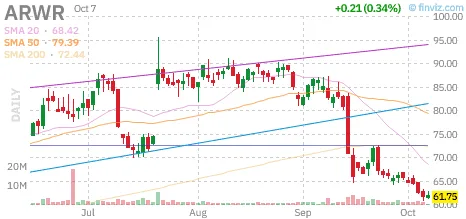
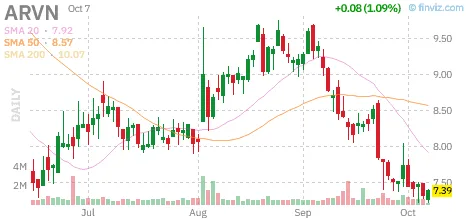
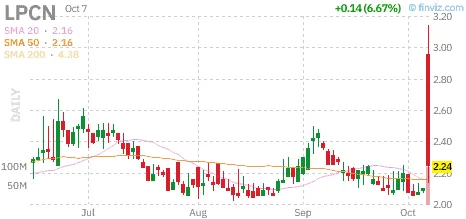
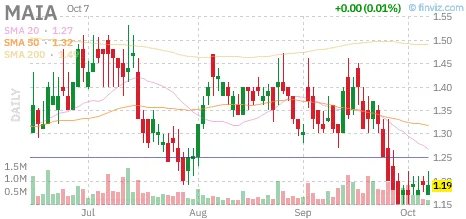
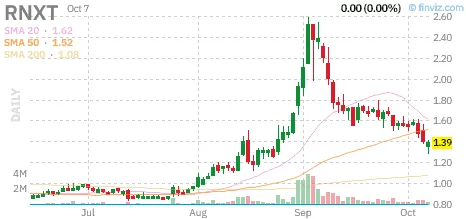
$ARWR · Static daily chart · Captured Oct 7, 12:20 p.m. ET · View on Finviz$ARVN · Static daily chart · Captured Oct 7, 12:20 p.m. ET · View on Finviz$LPCN · Static daily chart · Captured Oct 7, 12:20 p.m. ET · View on Finviz$MAIA · Static daily chart · Captured Oct 7, 12:20 p.m. ET · View on Finviz$RNXT · Static daily chart · Captured Oct 7, 12:20 p.m. ET · View on Finviz
Static Finviz images captured October 7, 2026 at approximately 12:20 p.m. ET (18:20 CEST), during the regular session. Capture time is not an exchange quote timestamp; provider data may be delayed. These are intraday snapshots, not closing-price records or evidence of what caused a market move.
Five announcements put different kinds of progress on the biotech research agenda today. Arrowhead has a new route for reviewing a proposed label expansion. Arvinas has additional early human data. Lipocine has announced an approval in Canada. MAIA and RenovoRx have reported steps in clinical enrollment. The useful question is what each announcement resolves—and which investment questions remain open.
This edition separates regulatory process, exploratory evidence, commercial execution and recruitment. All five company releases are dated October 7. That is the announcement date, not necessarily the date on which an agency made its decision or a patient entered a trial. Price charts provide separate market context; this article does not claim that a particular intraday move was caused by one announcement.
Executive summary
$ARWR — Arrowhead: plozasiran has entered the FDA’s STAR pilot for a planned supplemental application in severe hypertriglyceridemia. The next task is submitting the application; the expanded indication is not approved by this announcement.
$ARVN — Arvinas: ARV-102 data connect exploratory eye-movement observations with biomarker changes in a small Parkinson’s study. They justify closer research attention without establishing clinical efficacy.
$LPCN — Lipocine: Health Canada approval of TLANDO shifts the immediate follow-up toward the partner’s intended launch and commercial execution.
$MAIA — MAIA Biotechnology: recruitment milestones advance the oncology program, while the important efficacy and survival questions remain for subsequent analyses.
$RNXT — RenovoRx: first enrollment in an investigator-led study broadens the clinical evaluation of its delivery platform. The small study is distinct from the company’s larger Phase 3 program.
Our editorial emphasis is on the difference between a milestone and its eventual economic value. A development update can be meaningful without settling benefit, timing, uptake or funding. None of these five announcements supports treating all of those uncertainties as resolved.
01 · $ARWR: STAR entry changes the regulatory path
What Arrowhead announced
Arrowhead said the FDA granted plozasiran entry into the Split Real Time Application Review, or STAR, pilot for its forthcoming supplemental new drug application in severe hypertriglyceridemia. The company continues to target submission by the end of 2026. Its existing REDEMPLO approval for familial chylomicronemia syndrome is a separate indication from the expansion discussed here. Arrowhead release.
The regulatory distinction is central. STAR permits an eligible application to arrive in two parts so that review can begin earlier. The FDA says the formal PDUFA clock begins with receipt of the second part, representing the complete application. Entry guarantees neither an expedited decision nor approval. Counting forward from today’s press release to invent a decision date would therefore be incorrect. FDA STAR program.
According to Arrowhead, a supplemental application accepted into STAR qualifies for a 6-month Priority Review instead of a 10-month standard review, and the FDA will generally target an “expedited review” for efficacy supplements in the program, meaning an action at least one month before the Priority Review goal date is possible. The FDA notes that acceptance into STAR does not guarantee an expedited review, although the agency will make every effort to provide one. Because Priority Review comes with STAR entry, Arrowhead does not need its voucher for this filing. Arrowhead release, FDA STAR program.
Why it matters—and what it leaves unresolved
Merlintrader interpretation: the immediate benefit is a potentially more efficient review pathway. The useful progression to monitor is now submission, completeness of the package, a communicated review timetable and the eventual regulatory outcome. Treating these as separate steps makes it easier to assess whether later news actually changes the schedule.
Arrowhead also said it retains the priority review voucher purchased in August because it does not need to use that voucher for STAR. That preserves a choice; it does not establish a voucher sale, a sale price or a cash inflow. Arrowhead release.
For the investment narrative, the encouraging interpretation is that there is a defined process for pursuing the expansion. The counterweight is that review mechanics and the commercial value of an indication are different questions. A faster potential path does not answer what the final label will permit, how prescribing will develop or what net revenue will follow.
Next checkpoint: the targeted year-end submission and subsequent company or FDA communication about review timing. Main risk: reading program entry as a completed filing, a fixed deadline or an approval.
02 · $ARVN: a Parkinson’s signal that needs the right scale
What the Phase 1 study adds
Arvinas reported additional ARV-102 findings from a Phase 1 study in 24 patients with Parkinson’s disease. Participants received oral study drug or placebo over 28 days. The announcement describes exploratory changes in eye movements and associations with cerebrospinal-fluid biomarkers, including LRRK2 protein reductions. ARV-102 is being investigated as a degrader of LRRK2. The company explicitly says the study was not designed to assess clinical efficacy. Arvinas release.
The October 7 update adds observations to data presented earlier in the year. It should not be described as proof that treatment slows Parkinson’s progression, reverses disability or provides a durable benefit. Those conclusions go beyond what this announcement establishes.
A research advance rather than a finished clinical answer
Merlintrader interpretation: this is the most useful scientific discussion in today’s selection. It invites two separate questions: is the proposed mechanism doing something measurable in humans, and will that activity eventually translate into a benefit that matters to patients? A short early study can inform the first question while leaving the second largely unresolved.
The distinction also protects against overreading an association. If a biomarker and a functional observation move together, that can motivate a hypothesis. It does not, by itself, show that changing the biomarker causes durable clinical improvement. Larger and longer studies would need to establish whether the signal persists and how it relates to relevant outcomes.
The constructive case is therefore continued evaluation of a coherent biological signal. The contrary case is that an interesting early observation may not reproduce, may not be large enough to matter or may come with limitations that become apparent only with more exposure. This article assigns neither a probability of success nor a valuation to that uncertainty.
Next checkpoint: a disclosed development plan, subsequent study design and longer follow-up when available; no exact future readout date is assigned here. Main risk: turning exploratory findings from a small trial into an efficacy claim.
03 · $LPCN: Canadian approval puts the focus on execution
The approval and the planned launch
Lipocine announced that Health Canada approved TLANDO, its oral testosterone undecanoate product, for testosterone replacement in adult men with conditions associated with deficient or absent endogenous testosterone. The company’s partner, Verity Pharmaceuticals, plans a Canadian launch by the end of 2026. That is a planned commercial milestone, not evidence that the product has already launched or generated Canadian sales. Lipocine release.
The announcement concerns Canada. It should not be framed as a new FDA approval, a general treatment for aging or an endorsement for athletic use. The product information included with the release limits the indication and sets out contraindications, precautions and monitoring requirements.
Separating authorization from financial contribution
Merlintrader interpretation: this story is further along the regulatory sequence than an enrollment update. The research emphasis can move toward launch readiness, access, actual prescribing and the economics attributable to Lipocine under its partnership. A regulatory authorization is meaningful, but revenue forecasts still require evidence about execution.
For a partnered product, country-level sales and the originating company’s recognized revenue should not be treated as interchangeable. Before assigning a financial contribution, an analysis would need the applicable licensing terms and subsequent financial disclosure. This article does not infer a new milestone payment or insert an unsupported royalty forecast.
The favorable case is an additional market in which the partner can work toward commercialization. The counterweight is that availability, reimbursement and uptake may not follow the preferred timetable. An approval also does not remove product-specific safety requirements or guarantee that physicians and patients will choose the product over existing options.
Next checkpoint: confirmation of Canadian commercial availability against Verity’s stated year-end target, followed by operating disclosures. Main risk: recognizing planned launch activity as current sales or assuming a particular financial payment from the approval announcement.
04 · $MAIA: enrollment progress without confusing the denominator
Two studies, two different milestones
MAIA announced completion of enrollment in Part C of its Phase 2 THIO-101 study, which evaluates ateganosine followed by cemiplimab in non-small cell lung cancer. It also reported 65 patients enrolled in Phase 3 THIO-104, against a goal of 100 enrolled and dosed by year-end 2026. An interim analysis remains targeted for 2027. MAIA release.
The denominator matters. The 100-patient goal is a year-end milestone, not the entire Phase 3 study population. The ClinicalTrials.gov entry lists estimated total enrollment of 300 for THIO-104. Its randomized comparison evaluates overall survival as the primary outcome. Finishing Part C enrollment in THIO-101 likewise does not mean all follow-up is complete. THIO-104 registry, THIO-101 registry.
What recruitment can—and cannot—tell us
Merlintrader interpretation: recruitment is evidence of execution. It tells readers that a program is progressing toward collecting the observations it needs. It cannot substitute for those observations. The investment question is whether operational progress will eventually be followed by interpretable comparative evidence, with adequate follow-up and an acceptable safety profile.
The October 7 release also cites a previously announced interim disease control rate of 90.5% in the THIO-101 efficacy-evaluable population, and states that 150 patients have been treated across the Phase 2 and Phase 3 studies. That figure is not a fresh efficacy readout today, and disease control is not the same measure as overall survival, the primary outcome of THIO-104. We do not use a historical comparison with another study to claim superiority over chemotherapy; the patient populations, definitions and follow-up would need to support such an inference.
The constructive case is continued movement toward the stated recruitment goal and future analysis. The counterweight is that a target year does not establish a guaranteed public release date or a favorable outcome. A meaningful future update should explain both the amount of information available and the analysis being performed, rather than rely on a headline percentage alone.
Next checkpoint: the 100-patient year-end enrollment-and-dosing target and subsequent clarification of the planned 2027 interim analysis. Main risk: presenting 65% of an intermediate target as 65% completion of the entire pivotal program.
05 · $RNXT: a new clinical setting, with a registry caveat
What PRISM-TAMP is testing
RenovoRx announced first enrollment in PRISM-TAMP, an investigator-initiated study sponsored by the University of Vermont. It plans approximately 10 patients with borderline resectable pancreatic cancer, evaluating locally delivered gemcitabine through the TAMP platform before surgery. The study examines tumor regression, surgical margins, safety and tolerability. The release is dated October 7; it does not establish that the first enrollment itself occurred that day. RenovoRx release.
At our October 7 check, ClinicalTrials.gov still listed PRISM-TAMP as “Not yet recruiting,” with a March 17 record update. We attribute the enrollment milestone to the newer company announcement and retain the registry discrepancy explicitly. The record describes a small, single-group, open-label Phase 1/2 study. PRISM-TAMP registry.
Keeping the device, regimen and trials separate
RenovoCath is FDA-cleared as a delivery device; that clearance should not be presented as approval of the investigational intra-arterial gemcitabine cancer regimen. PRISM-TAMP is also separate from Phase 3 TIGeR-PaC in locally advanced pancreatic cancer, for which RenovoRx continues to expect topline data in the second half of 2027. RenovoRx release.
Merlintrader interpretation: the new study extends the questions being asked about the delivery platform into a presurgical setting. First enrollment demonstrates a reported step into clinical execution. It does not establish better surgical outcomes, survival or tolerability.
The favorable case is that investigator-led work may generate useful observations for a future development decision. The counterweight is the limited evidence that a very small, uncontrolled study can provide. Even encouraging findings would need to be judged against patient selection, surgical assessment, follow-up and the absence of a randomized comparison.
Next checkpoint: updated registry information, further clinical progress and eventual study results when disclosed. Main risk: merging PRISM-TAMP with TIGeR-PaC or treating the device’s clearance as proof that a particular cancer regimen works.
What to watch next
Company
Next disclosed milestone or research checkpoint
Timing status
$ARWR
Planned plozasiran sNDA submission in severe hypertriglyceridemia
Company target: by end of 2026; no exact decision date
$ARVN
Further ARV-102 development details and follow-up
No exact future readout date assigned in this article
$LPCN
Verity’s planned Canadian TLANDO launch
Partner target: by end of 2026
$MAIA
THIO-104 target of 100 patients enrolled and dosed; planned interim analysis
Year-end 2026 target; interim analysis targeted for 2027
$RNXT
PRISM-TAMP updates; separate TIGeR-PaC topline
PRISM-TAMP readout undated here; TIGeR-PaC company guidance: second half of 2027
These are deliberately different types of checkpoints. A filing target, a commercial launch and a clinical analysis do not carry the same evidence or risks. Broad windows remain broad windows: “year-end” is not a confirmed December 31 event, and “2027” is not a promised quarter.
The cross-company question: what uncertainty has actually changed?
Today’s selection offers a practical way to read biotech news. Ask whether an announcement changes the regulatory route, the clinical evidence, the ability to commercialize, or the execution of a trial. Then ask what remains dependent on a later event. This avoids giving every positive-sounding milestone the same weight.
For valuation work, a useful second pass would examine the funding needed to reach the next milestone, the relevant commercial rights and the information still missing from the clinical package. Those questions belong alongside the science. A productive program can still face financing risk, while a completed operational milestone can leave the core efficacy question unanswered.
We have not supplied an aggregate score, a cross-company efficacy ranking or a price target. The studies address different diseases and stages of development. A recruitment count cannot be ranked directly against a biomarker result, and neither is interchangeable with an approval. The comparison here is about the meaning of the news, not a league table of investment attractiveness.
The five releases justify a substantive Radar today because each creates a specific follow-up task. Arrowhead requires application tracking; Arvinas requires disciplined reading of early evidence; Lipocine requires launch monitoring; MAIA requires correct interpretation of recruitment and analysis timing; RenovoRx requires separation of its study settings and regulatory categories. Subsequent evidence, rather than the enthusiasm of a headline, should determine how each story develops.
Sources and editorial method
Company announcements were checked on their investor-relations websites. The regulatory discussion was cross-checked against the FDA’s STAR description, and the relevant oncology trial designs and registry status against ClinicalTrials.gov. Reproductions of the same company release are corroboration of wording, not independent clinical evidence.
Data discipline: October 7 is the news and verification date. Company forecasts remain forecasts. Static Finviz charts were captured at approximately 12:20 p.m. ET on October 7, during the regular session. That is the capture time, not an exchange quote timestamp; provider data may be delayed. The chart figures are intraday observations, not official closing prices. No daily percentage moves are asserted in the editorial text, and no unverified current cash balances or implied financing proceeds are used. Sections labeled “Merlintrader interpretation” are editorial analysis, separated from the reported facts.
Use the Biotech Stocks Hub to navigate Merlintrader’s company research, and follow the English-language Telegram channel for new Radar posts and catalyst updates.
This article is for informational and educational purposes only. It is not financial or medical advice, an investment recommendation, or an invitation to buy or sell securities. Clinical failure, regulatory delays, commercialization difficulties, financing and dilution can lead to substantial losses. Readers should conduct their own research and consult a licensed financial adviser where appropriate. Treatment decisions belong with qualified healthcare professionals. See the Merlintrader disclaimer and terms of use and privacy.
Track the next biotech catalyst
Follow upcoming PDUFA decisions, AdCom meetings, clinical readouts and trial milestones in the free Merlintrader Biotech Catalyst Calendar.
 Umbria