AI transparency: articles and reports are produced with the help of artificial intelligence and checked through a process that does not constitute specialist validation. They may contain errors: verify relevant information with independent sources. Read the full disclaimer.
Space policy · Sector analysis
$SPCX, $RKLB, $FLY, $LUNR: Who Is Most Exposed to America’s 1,000-Launch Space Policy?
By Merlintrader · August 21, 2026 · Primary-source cutoff: 2:33 p.m. CEST
Reading time: about 13 minutes · Informational content, not financial advice
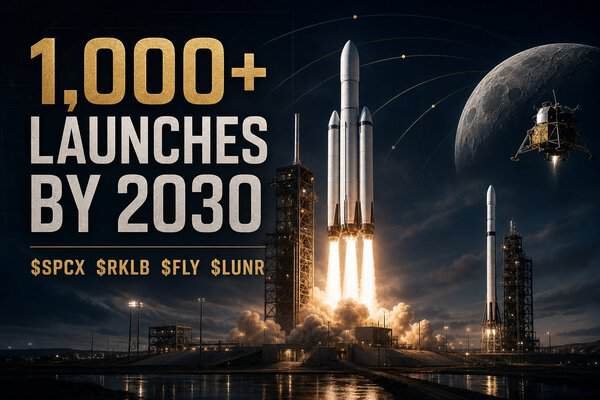
U.S. space-transportation policy and the market exposures in $SPCX, $RKLB, $FLY and $LUNR. Editorial illustration by Merlintrader.
Washington wants U.S. ranges to support more than 1,000 launches and reentries every year by 2030. The headline points first to launch operators, but the memorandum reaches much further: Federal ranges, airspace, spectrum, reentry sites, responsive launch, domestic supply chains, on-orbit services and commercial lunar logistics. The clearest exposures in the Merlintrader universe are SpaceX ($SPCX), Rocket Lab ($RKLB), Firefly Aerospace ($FLY) and Intuitive Machines ($LUNR). The key caveat is equally important: the policy is not an appropriation, an award or booked revenue.
1,000+annual launches and reentries targeted by 2030
48hresponsive-access scenario to be evaluated
90 daysto identify an additional Federal land reentry site
240 daysto produce that site’s development plan
The sentence investors should not skip
The memorandum says implementation remains subject to the availability of appropriations. It directs agencies to build plans, remove bottlenecks and favor commercial capacity; it does not itself place an order with any company named in this article.
What the new policy actually changes
On August 20, 2026, the White House issued National Security Presidential Memorandum 17, replacing the national space transportation policy adopted in 2013. The document defines access to, from and within space as a national and economic security interest, then sets the 2030 capacity objective.
The target is not merely a political aspiration with no clock attached. The memorandum assigns a sequence of deadlines:
Within 90 days: identify Federal land that could host an additional designated reentry site.
Within 120 days: review export policy and export controls affecting U.S. space transportation capabilities and allied market access.
Within 180 days: establish Federal range-scheduling criteria, integrate launch and reentry into air-traffic modernization, designate priority launch corridors, address spectrum access, prepare an industrial-base strategy and assess barriers to launch within 48 hours of need.
Within 240 days: prepare a development plan for the new Federal land reentry site, including commercial access and co-development opportunities.
For government missions, the policy favors commercial transportation services, asks for multiple ways to deploy U.S. payloads, seeks greater consistency in certifying new entrants and calls for standardized interfaces that could let payloads move from one launcher to another more quickly. It also directs NASA to develop a commercial lunar-logistics architecture and tells the defense establishment to consider on-orbit servicing, in-space logistics, spaceplanes and relocatable launch equipment.
That breadth explains why the impact map extends beyond rocket manufacturers. It also explains why putting every “space stock” in the same basket would be a mistake.
Launch and reentry
$SPCX · $RKLB · $FLY Range access, higher cadence, reentry capacity, responsive missions and new-entrant certification.
Lunar logistics
$LUNR · $FLY Commercial transport to and from the lunar surface, where both companies already have NASA task orders.
$SPCE Spaceplanes are named, but the memorandum does not solve Virgin Galactic’s execution, cash-burn or financing risks.
SpaceX ($SPCX): the most direct operating exposure — and the incumbent Washington wants challenged
Within the Merlintrader Hub universe, SpaceX ($SPCX) is the clearest first-order exposure. It already operates across launch, recovery, reusable hardware, satellite deployment and large-scale ground infrastructure. Starship adds an even tighter link to reentry rules and rapid reuse: SpaceX describes Starship and Super Heavy as a fully reusable system designed to return to the launch site and fly again with rapid turnaround.
More predictable range schedules, priority air corridors, greater reentry capacity and reliable access to spectrum are all operationally relevant to a company trying to increase launch frequency. A new Federal land reentry site could also broaden the national infrastructure available to future systems.
But the policy has a second edge. It explicitly asks agencies to maintain a competitive industry, preserve multiple avenues for government payloads and make new-entrant certification more consistent. SpaceX may benefit most from a bigger market today, while facing a more deliberate effort to fund credible alternatives tomorrow.
Editorial verdict on $SPCX
Highest direct exposure to volume and infrastructure. The policy improves the operating environment, but it does not guarantee that every incremental mission goes to the incumbent.
Rocket Lab ($RKLB): the policy speaks directly to the Neutron thesis
Rocket Lab ($RKLB) sits at the intersection of an established small launcher and a medium-lift vehicle that has not yet completed its inaugural flight. Electron and HASTE already provide launch and responsive-mission exposure. Neutron is the larger strategic bet.
Rocket Lab’s Launch Complex 3 at Wallops Island, Virginia, is a dedicated test, launch and landing site for Neutron. The company presents it as a U.S.-based, rapid-response-capable facility for commercial, civil and national-security missions. In its August 10 update, Rocket Lab said first-flight hardware remained in assembly, integration and testing, with Stage 1 tank production currently aligned with the target delivery of Neutron to the launch pad in the fourth quarter of 2026.
The new policy’s emphasis on Federal infrastructure, responsive access, multiple launch providers and consistent new-entrant certification therefore maps closely onto Neutron’s opportunity. What it cannot do is remove engineering risk. Until Neutron flies and earns the required certifications, the policy is a tailwind to the addressable market, not proof that Rocket Lab has captured it.
Editorial verdict on $RKLB
The strongest public-market read-through to launch competition. It may gain disproportionately if policy becomes funded procurement, but Neutron execution remains the conversion gate.
Firefly Aerospace ($FLY): responsive launch plus a second route through the Moon
The first is launch. Firefly says Alpha is an operational U.S. one-ton launcher and cites the VICTUS NOX mission as the first commercial orbital launch completed with roughly 24 hours’ notice. The memorandum instructs agencies to evaluate access to space within 48 hours of need and specifically mentions expeditionary locations and relocatable equipment. That is an unusually close policy-to-capability match.
The second connection is lunar logistics. Firefly’s Blue Ghost business already operates inside NASA’s Commercial Lunar Payload Services framework. On June 30, 2026, NASA awarded Firefly a $144.2 million mission for a 2028 lunar delivery. The policy’s call for a commercial architecture to move cargo to and from the lunar surface supports the direction of that market.
Neither link guarantees a higher backlog. Alpha still has to execute repeatedly, and Blue Ghost economics depend on funded task orders and mission performance. Firefly nevertheless has one of the broadest direct exposures because it can participate on both sides of the policy: launch cadence and lunar delivery.
Editorial verdict on $FLY
The most balanced dual exposure. Alpha matches the responsive-launch language; Blue Ghost matches the commercial lunar-logistics language.
Intuitive Machines ($LUNR): the lunar clause matters more than the 1,000-launch headline
Intuitive Machines ($LUNR) is not a conventional launch operator. Its relevance comes from the instruction to NASA to develop a lunar-logistics architecture that facilitates commercial transportation to and from the surface.
That language reinforces a procurement model that already exists. On March 27, 2026, NASA awarded Intuitive Machines $180.4 million for an end-to-end CLPS delivery targeted for the lunar south-pole region in 2030. On June 30, the company announced another firm-fixed-price award valued at up to $148.3 million for a production-line-qualified Nova-C lander to be delivered no later than 2028; NASA’s own release lists the same award.
The policy does not create either contract — both predate it. What it does is place commercial lunar transportation inside the national architecture rather than treating it as a series of isolated demonstrations. For LUNR, the investment question is whether that political continuity leads to a repeatable cadence of funded missions, reliable execution and cash conversion.
Editorial verdict on $LUNR
The cleanest lunar-logistics exposure. The policy supports continuity of the model; future awards and mission performance determine the economics.
The second ring: Redwire ($RDW), Karman ($KRMN) and the picks-and-shovels trade
The memorandum also tells agencies to evaluate on-orbit servicing, debris removal, in-space logistics, standardized payload interfaces and a stronger domestic industrial base. That creates a second ring of potential beneficiaries.
Redwire ($RDW) is exposed to spacecraft infrastructure, components, robotics and on-orbit capabilities. Karman Holdings ($KRMN) represents the supplier layer across propulsion, structures, fairings, separation systems and reentry-related hardware.
If launch and reentry cadence actually rises, some value may accrue to qualified suppliers serving several prime contractors rather than to a single rocket platform. The trade-off is attribution: the policy names capabilities, not vendors. Investors will need program-level evidence showing that RDW or KRMN is attached to the platforms that win funded work.
Virgin Galactic ($SPCE): a spaceplane mention is not a balance-sheet repair
The memorandum explicitly includes spaceplanes in the desired diversity of transportation types. That gives Virgin Galactic ($SPCE) a legitimate thematic link, particularly around airspace integration and runway-based operations.
It does not de-risk the company’s current financial and execution profile. Virgin Galactic’s August 12 results moved the first commercial flight of its new vehicle to February 2027. Q2 revenue was $134,000, free cash flow was negative $90.7 million and the company generated $134 million by issuing 41 million shares through its at-the-market program.
The policy may help the category. It does not fund Virgin Galactic’s vehicles, eliminate delays or remove the risk of further capital needs.
Satellite operators: lower friction is useful, but it does not create demand
A larger and more predictable launch market can indirectly help operators that must place hardware in orbit. In the Merlintrader Space, Defense & AI Stocks Hub, that second-order group includes AST SpaceMobile ($ASTS), Planet Labs ($PL), BlackSky ($BKSY), Satellogic ($SATL), Sidus Space ($SIDU) and MDA Space ($MDA).
More slots, rideshares and remanifesting flexibility may reduce schedule risk or the cost of deploying constellations. But launch supply does not create paying customers for connectivity, imagery or analytics. For these companies, the policy improves an input. It does not validate the business model.
Who is not automatically affected
Merlintrader’s sector Hub also contains drone, counter-drone, AI software, data-center and semiconductor names. Their presence in the same directory does not make them beneficiaries of a transportation policy.
AeroVironment, Red Cat, Unusual Machines, Ondas, C3.ai, BigBear.ai, SoundHound, Rezolve AI, IREN and POET would need a named space program, a relevant contract or a verified supply-chain role before the policy could be treated as company-specific.
Exposure
Stocks
What the policy can improve
What still has to happen
Direct
$SPCX, $RKLB, $FLY
Range capacity, reentry access, responsive launch, certification and government competition
Funded missions, certifications and repeatable operations
Lunar
$LUNR, $FLY
Commercial lunar-transport architecture and continuity of CLPS-style procurement
Task orders, successful landings, backlog conversion and cash
Supply chain
$RDW, $KRMN
On-orbit services, industrial-base capacity, interfaces, components and reentry hardware
Evidence of content on winning programs
Speculative
$SPCE
Recognition of spaceplanes and improved airspace integration
Vehicle execution, commercial restart and financing
Indirect
$ASTS, $PL, $BKSY, $SATL, $SIDU, $MDA
More launch options, rideshares and potentially lower deployment friction
Customer demand and sustainable unit economics
The conversion chain: where the market can get ahead of the facts
POLICY → IMPLEMENTATION PLAN → APPROPRIATION → PROCUREMENT → AWARD → BACKLOG → MISSION → REVENUE → CASH
NSPM-17 is structurally constructive because it gives multiple agencies a common direction and measurable deadlines. The first investable evidence will not be a sector-wide price spike. It will be the publication of range plans, the selection of the reentry site, changes to certification and export rules, funded solicitations and company-specific awards.
The most important milestones now fall into three windows:
By November 2026: identification of the additional Federal land reentry site.
By December 2026: the first export-policy review.
By February-April 2027: range, airspace, spectrum, industrial-base and reentry-development plans, subject to agency execution.
Those deliverables will show whether the 1,000-event target is turning into investable infrastructure or remaining a strategic aspiration.
Bottom line
The new National Space Transportation Policy is a meaningful tailwind for the U.S. commercial-space ecosystem, but the benefit is not uniform.
$SPCX has the greatest immediate operating exposure. $RKLB offers the clearest public-market read-through to launch competition, with Neutron execution as the critical gate. $FLY combines responsive launch and lunar delivery. $LUNR is the purest read-through to the policy’s commercial lunar-logistics clause.
Redwire and Karman occupy the second supplier ring. Virgin Galactic has a genuine thematic connection but remains dominated by company-specific execution and financing risk. Satellite operators may benefit from easier access to orbit, but the policy cannot manufacture end demand.
The political signal is strong. The economic proof will arrive only when plans, appropriations, contracts and successful missions move in the same direction.
Nature of this content. This article is for informational, general-interest and educational purposes only. It is not financial advice, investment research or a recommendation to buy, sell or hold any security.
Sources and cutoff. Factual statements were checked against government publications, company releases and regulatory filings available by 2:33 p.m. CEST on August 21, 2026. Forward-looking company statements are not guarantees. Later events may change the analysis.
Private and public exposure. $SPCX is used as the ticker associated with the Merlintrader SpaceX Hub. Readers should verify listing status, instrument structure, liquidity and eligibility with their broker before trading any security.
Risk. Space companies face elevated technical, regulatory, budget, customer-concentration, financing and dilution risks. Policy support does not eliminate the possibility of delays, mission failures or loss of capital.