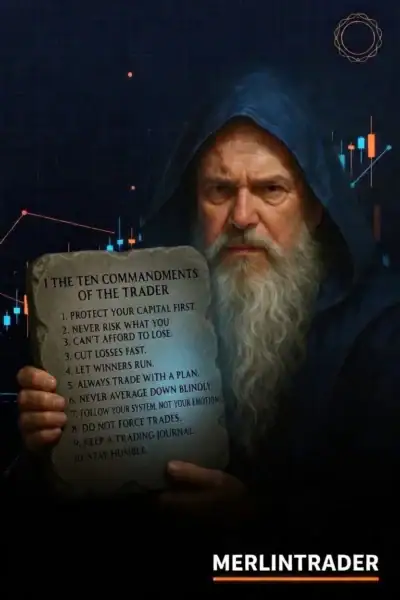
Why these commandments matter
Many people think trading is mainly about finding the right stock, the right indicator, or the right catalyst. In reality, the hardest part is not the entry itself. The hardest part is making repeated decisions under uncertainty without letting emotion, urgency, ego, or frustration take control.
That is why these commandments matter. They are not magic rules and they do not guarantee profits. What they do is far more useful: they help traders avoid some of the most common and expensive mistakes, especially in volatile environments where speed and pressure can easily lead to poor judgment.
This page is designed as educational content for readers who want a stronger foundation. Before strategy comes discipline. Before conviction comes risk management. Before confidence comes process.
1
Never risk money you cannot afford to lose
Capital used for trading must be risk capital, not money needed for rent, bills, family, or emergencies. Once you enter the market with money you truly need, emotional pressure rises fast and decision quality usually falls.
When financial stress enters the trade, even small price moves can feel overwhelming. Traders then tend to panic, force exits, revenge trade, or refuse to accept losses because the money feels too important.
- Pressure destroys clarity.
- Fear distorts decisions.
- Necessary money leads to stressed trading.
Key idea: trading should not destabilize your life.
2
Protect capital first, seek profit second
Your capital is your working tool. If you protect it, you can keep operating, improve over time, and benefit from future opportunities. If you destroy it, the game ends early no matter how strong your conviction was on one trade.
This mindset changes everything. Instead of asking only how much upside a trade may have, disciplined traders also ask how much damage it can do if they are wrong.
- Think downside first.
- Longevity matters.
- Position sizing matters.
Key idea: staying in the game matters more than quick wins.
3
Cut losses without arguing with the market
No trader is right all the time. The real damage usually does not come from being wrong once. It comes from refusing to accept that the trade is no longer working and trying to negotiate with price action.
The market does not care about your average price, your hopes, or how much work you put into the setup. A small controlled loss is often the cost of doing business. A large uncontrolled loss is often the result of delay.
- Small losses are normal.
- Big losses often start small.
- Hope can get expensive.
Key idea: a controlled loss hurts less than a hope trade.
4
Let winners run, but with discipline
Many traders do the opposite of what they should: they cut winners too early for emotional relief and hold losers too long because they want to avoid admitting the loss. Over time, that habit destroys the reward-to-risk profile of the whole process.
Letting winners run does not mean becoming greedy or refusing to take profits. It means giving a valid setup enough room to work while managing the position with structure.
- Manage winners well.
- Use targets or trailing stops.
- Running winners is not greed.
Key idea: an edge needs room to develop.
5
Never enter a trade without a plan
Before entering, you should know why you are taking the trade, where the thesis fails, how much size makes sense, and where profits may reasonably be taken. If you only decide these things after entering, emotion will likely take over.
A plan does not guarantee success. What it does is reduce confusion in fast-moving moments, when traders are most vulnerable to impulsive choices.
- A plan reduces chaos.
- Improvisation is expensive.
- Clear levels matter.
Key idea: if the plan comes after the entry, you are late.
6
Do not add just because you are down
Averaging down can look smart because it lowers the average cost, but in practice it often becomes a psychological trap. Many traders add not because the setup improved, but because they want emotional relief and a faster return to breakeven.
Without strict rules, adding to a losing position increases exposure exactly when the market is already telling you that your current read may be wrong.
- More size means more risk.
- Emotion is not analysis.
- Stubbornness is costly.
Key idea: adding to a bad trade is often ego in disguise.
7
Follow your method, not your emotions
Fear, greed, FOMO, revenge, and overconfidence can all damage judgment. That is why method matters. A real process gives you structure, repeatability, and a way to judge whether a trade fits your framework or is simply an emotional reaction.
Emotions never disappear entirely, but a solid method keeps them from becoming the decision-maker.
- Methods create structure.
- Rules filter noise.
- Mood is not a strategy.
Key idea: process keeps emotions from driving the car.
8
Accept that you do not need to trade all the time
Not every day offers clean opportunities. Some sessions are messy, some are low quality, and some simply do not match your setup. In those moments, staying out is not weakness. It is discipline.
Many unnecessary losses come from boredom, impatience, or the need to always feel active. Professional behavior often means doing less, not more.
- Boredom triggers bad trades.
- Overtrading kills discipline.
- Selectivity protects capital.
Key idea: staying out is also a decision.
9
Keep a journal and learn from mistakes
If you do not review your behavior, you will keep repeating it. A trading journal helps turn vague impressions into observable patterns: poor entries, oversized positions, weak exits, emotional mistakes, or repeated errors after a losing streak.
Over time, honest review becomes one of the most valuable tools for improvement because it exposes what memory alone tends to hide.
- Track setups and outcomes.
- Review errors honestly.
- Patterns emerge over time.
Key idea: improvement without review is unlikely.
10
Humility is more valuable than ego
The market rewards adaptability more than stubbornness. Traders who need to prove they are right often stay too long, size too aggressively, or refuse to change their view when evidence shifts.
Humility does not mean weakness. It means respecting uncertainty, adjusting when necessary, and understanding that survival matters more than defending an opinion.
- Ego defends opinions.
- Humility defends capital.
- Adapt fast when needed.
Key idea: survival and adaptation beat needing to be right.
Final takeaway
These ten commandments do not replace study, screen time, or experience. What they do is provide a stronger framework for thinking clearly, acting with discipline, and avoiding the kind of avoidable damage that keeps many traders from improving.
Before strategy comes risk management, discipline, patience, and respect for capital. Everything else comes after that. A trader who understands this already has a stronger foundation than someone who only chases setups without controlling behavior.
Discipline beats impulse
Risk management beats conviction
Consistency beats hurry
Humility beats ego
 Umbria