AI transparency: articles and reports are produced with the help of artificial intelligence and checked through a process that does not constitute specialist validation. They may contain errors: verify relevant information with independent sources. Read the full disclaimer.
Merlintrader · Educational
$CCCC$KYMR$NRIX$RIGL
Can removing a protein change treatment? $CCCC, $KYMR, $NRIX, $RIGL
C4 Therapeutics, Kymera, Nurix and Rigel reveal different paths from eliminating a protein to improving a patient’s outcome. Mechanism, tissue, evidence and retained rights determine the opportunity.
MerlintraderResearch cut-off: September 26, 2026Financial figures in USD; reporting dates and definitions identified
Removing a protein changes the biological question.
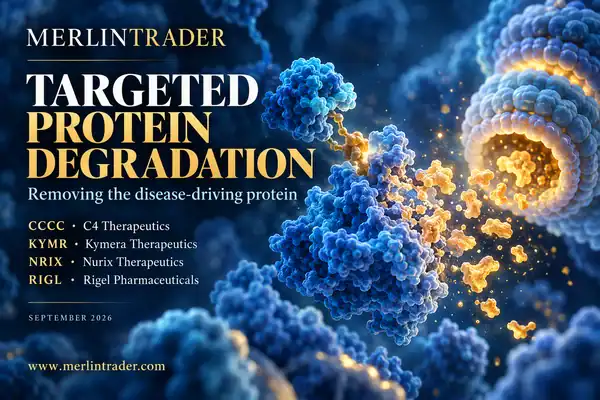
Conceptual illustration of targeted protein degradation. Molecular interactions are illustrative, not an experimental structure.
CCCC · Mechanism
IKZF1/3
Cemsidomide: investigational molecular glue; September 25 update. Source.
KYMR · KT-621
STAT6
Phase 2b in dermatitis and asthma; August 5 update. Source.
NRIX · DAYBreak
Phase 3
First patient August 4; BTK degrader versus pirtobrutinib. No result yet. Source.
RIGL · VEPPANU
FDA · 1 May
2026 approval: ER+/HER2−, ESR1-mutated advanced/metastatic breast cancer after endocrine therapy. Source.
CCCC · Liquidity
$300.4m
Cash, equivalents and securities; June 30, 2026. Source.
KYMR · Resources
$1.5bn
Cash, equivalents and investments; June 30, 2026. Source.
NRIX · Reported balance
$443.5m
Cash, equivalents and securities at May 31; before the Roche upfront payment. Source.
RIGL · Q2 product sales
$67.0m
Quarter ended June 30; existing products, before VEPPANU launch. Source.
The essential answer
The protein can disappear before the clinical uncertainty does.
Targeted degradation recruits cellular machinery to remove selected proteins. C4’s cemsidomide is a molecular glue; Kymera studies oral degraders in inflammation; Nurix is testing BTK degradation against pirtobrutinib; Rigel commercializes the licensed PROTAC VEPPANU in a defined ESR1-mutated breast cancer population.
A convincing mechanism needs the right tissue exposure, a tolerable regimen and patient benefit. Two exploratory biomarker patients, a randomized trial and a regulatory approval establish different things. Royalties, cost sharing, financing and launch execution determine how the scientific progress reaches shareholders.
How the opportunity can strengthen
Selective removal may address protein functions that inhibition leaves intact. The case strengthens when tissue engagement connects to meaningful clinical benefit, a practical regimen and adequate tolerability. C4 needs larger combination evidence, Kymera needs disease-specific outcomes, Nurix needs comparative proof, and Rigel needs sustained adoption after approval. Financing and retained rights must support that path.
Where biological promise can fail to become value
Protein reduction may not improve disease, the needed exposure may be intolerable, or resistance may involve the target or degradation machinery. Small biomarker samples cannot establish broad safety or clinical benefit. Additional studies, royalties, shared development costs and financing can reduce the economics retained per share. A platform milestone does not validate every candidate or indication.
Four dated developments
September 25, 2026
C4: biomarkers and a distinct safety cohort
Elranatamab-combination biomarkers involved two patients; the initial safety review involved six. Further cohorts remain necessary.
Kymera expects KT-621 dermatitis data by year-end 2026 and KT-579 phase 1 data in Q4. C4 guides combination data to mid-2027 and an initial MOMENTUM update to H2 2027. Nurix’s randomized comparison and Rigel’s launch require their own clinical and commercial evidence.
Affiliate links to the individual securities. Market data update independently; the accounts below retain their stated reporting dates.
Extended analysis
Continue with the extended analysis of $CCCC, $KYMR, $NRIX and $RIGL.
Twenty-four sections explain molecular glues, PROTACs, tissue selectivity, clinical evidence and business economics, with two financial charts and practical comparison tables.
How protein degradation works
PROTACs versus molecular glues
Rigel and the precise VEPPANU indication
C4 biomarkers and combination development
Kymera and chronic inflammatory diseases
Nurix and randomized BTK evidence
Resistance, exposure and dosing
Costs, licenses, cash and value per share
Free access.
Targeted protein degradation: from mechanism to clinical and economic proof
A protein can contribute to disease without behaving like a switch that a conventional medicine can simply turn off. It may help assemble a signaling complex, control the reading of genes, or support a cancer cell even when one of its enzymatic activities has been blocked. Targeted protein degradation asks a different therapeutic question: what happens if the cell removes the protein itself? The distinction opens possibilities, but also changes the experiments needed to establish that a medicine is useful.
The opportunity is easiest to understand by separating a protein’s presence from its activity. An inhibitor usually interferes with a particular function while leaving the protein in place. A degrader can reduce the amount available to perform several functions. That can be attractive when a disease depends on a structural role or when resistance makes inhibition less effective. It can also be disadvantageous when healthy tissues need functions that a more selective inhibitor would preserve. Removal is a biological intervention, not an automatic improvement.
Four businesses make the range tangible. C4 Therapeutics is studying cemsidomide in multiple myeloma. Kymera Therapeutics is taking oral degraders into inflammatory diseases. Nurix Therapeutics is testing BTK degradation against an established BTK inhibitor in leukemia. Rigel Pharmaceuticals has licensed and launched VEPPANU, a PROTAC developed by Arvinas and Pfizer for a defined breast cancer population. These are different mechanisms, disease settings, stages of evidence and financial arrangements under a broad scientific umbrella.
The useful comparison therefore begins below the company name. Which protein is removed, in which cells, by what molecular machinery, and with what consequence? Then come clinical benefit, tolerability, dosing and retained commercial rights. A promising laboratory result answers only part of that sequence. An approved product answers considerably more, but only within its evidence and indication. Understanding the sequence makes it possible to appreciate the technology’s potential without treating every degrader as the next version of a successful predecessor.
Ticker
Drug
Mechanism
Evidence as of September 26, 2026
CCCC
Cemsidomide
IKZF1/3 molecular glue
Myeloma; phase 2 and phase 1b combinations
KYMR
KT-621
STAT6 degrader
Dermatitis/asthma; phase 2b
NRIX
Bexobrutideg
BTK degrader
CLL/SLL; randomized phase 3 initiated
RIGL
VEPPANU
Estrogen receptor PROTAC
FDA-approved defined ESR1-mutated breast cancer population
02Recruiting the cell’s disposal machinery
Cells continuously make, modify and dispose of proteins. One major disposal route uses ubiquitin, a small protein that can be attached to other proteins in chains. Appropriate chains can mark a substrate for processing by the proteasome, the cellular machinery that breaks proteins into smaller pieces. E3 ubiquitin ligases help determine which proteins receive these marks. A targeted degrader changes the encounter between that machinery and a chosen protein rather than inventing an entirely new disposal system.
An influential experimental study by Bondeson and colleagues demonstrated targeted protein knockdown with small-molecule PROTACs in cellular and animal systems. The study helped establish that a compound could induce degradation through recruitment of an E3 ligase. Its importance was mechanistic; it was not a demonstration that every target could be removed safely in patients. The journey from an experimental system to a medicine requires usable exposure, adequate selectivity and evidence that removing the protein improves a disease outcome.
The frequently used word catalytic needs careful interpretation. A degrader may participate in successive productive encounters instead of permanently occupying every target protein. That creates a possibility of effects that outlast a particular binding event. It does not mean the drug can be given once for every disease, that exposure becomes irrelevant, or that no additional protein is synthesized. The cell remains an active system, and the balance between removal and replacement can change across tissues and over time.
The machinery also places conditions on success. The relevant ligase must be present and functional, the protein must be accessible, and the encounter must produce useful ubiquitination rather than merely binding. These requirements create additional design choices beyond target affinity. A compound that binds tightly may degrade poorly; another with less striking binding measurements may form a more productive complex. Drug discovery must therefore connect molecular interaction, protein reduction and functional consequence instead of optimizing one attractive laboratory number in isolation.
03PROTACs and molecular glues are related, not identical
A heterobifunctional PROTAC contains two binding elements connected by a linker. One engages the protein of interest and the other an E3 ligase. The resulting assembly brings the proteins close enough, in an appropriate orientation, to support the degradation process. The linker is not an inert piece of string: its length, flexibility and chemical properties can influence geometry, permeability and the stability of the productive complex. Changing it can change the whole medicine’s behavior.
A molecular glue follows another architectural route. Instead of visibly linking two separately designed binding elements, it promotes or stabilizes a protein interaction that enables degradation. The distinction matters for how compounds are discovered and optimized. C4 describes cemsidomide as a cereblon-modulating molecular glue that degrades IKZF1 and IKZF3. Its cemsidomide program description should not be translated into a claim that the molecule is a conventional two-ended PROTAC. Both approaches use induced interactions, but they do not have identical structures.
The broader history also matters. Medicines that induce protein degradation existed before the first heterobifunctional PROTAC approval. Immunomodulatory drugs and selective estrogen receptor degraders already demonstrated clinically useful ways of changing protein abundance. VEPPANU’s milestone is therefore meaningful without rewriting that history. The accurate distinction concerns a specific drug architecture and its regulatory achievement, not the discovery that cells can be encouraged to remove disease-related proteins.
For an investor, the category is a starting point for questions about chemistry and evidence. A platform capable of producing molecular glues may have different discovery bottlenecks from a platform built around bifunctional molecules. Neither label reveals the success rate of the resulting portfolio. The important work is identifying reproducible design capabilities and showing that they produce differentiated drugs. A technological name becomes economically valuable when it repeatedly solves specific biological and development problems, rather than when it appears in a growing number of pipeline descriptions.
04Selectivity has several layers
Selectivity does not mean only that a molecule recognizes one protein better than another in a purified laboratory assay. It also concerns which proteins disappear in living cells, which tissues receive enough drug, which cells express the recruited ligase and how long the effect persists. A useful degrader must assemble a tolerable pattern across these layers. A narrow binding profile can coexist with unwanted degradation, while a broader binding profile may produce more restricted degradation because only certain complexes are productive.
One practical implication is that a percentage of target reduction needs a location and a time. A result in circulating blood cells cannot automatically describe the skin, bone marrow, lung or brain. Even a tissue sample may contain several cell types, so an average can conceal different effects in the cells that drive disease and those that protect normal function. The assay’s lower limit and the starting level of the protein also affect what a near-complete reduction means.
Selectivity can be useful precisely because removal changes several functions at once. It can also create toxicity through the intended target. An adverse effect need not reflect an off-target mistake: eliminating a protein that supports a healthy cell can be a direct consequence of the desired mechanism. The relevant therapeutic window is the separation between exposure that helps the patient and exposure that creates unacceptable harm, not a claim that the molecule has only one binding partner.
The development question is consequently broader than whether a compound is potent. Can the needed effect be achieved in the relevant tissue while preserving sufficient normal biology elsewhere? Does that balance survive repeated dosing and combination treatment? These questions explain why the same target may be attractive in a heavily treated cancer population but require a different dose, formulation or molecule in a chronic inflammatory disease. Context changes the acceptable intervention even when the protein and the laboratory assay remain the same.
05Oral delivery still has to reach the right cells
An oral degrader can offer practical advantages, including avoiding an infusion or injection. Oral administration does not prove easy delivery to every tissue. A compound must dissolve, survive absorption, reach sufficient circulating exposure, enter relevant cells and remain available long enough to create productive complexes. Larger bifunctional molecules can face demanding chemistry tradeoffs. Improving one property, such as binding, can worsen another, such as permeability or clearance, so optimization is necessarily a balancing exercise.
The tissue question becomes especially important outside diseases with easily sampled circulating cells. Demonstrating protein reduction in blood is informative, but a lung or neurological indication requires a credible connection to its own target compartment. A statement that a candidate can enter the brain must also be separated from proof of neurological benefit. Exposure, target engagement and improvement in a clinical endpoint are distinct achievements. One cannot be inferred from the name of a platform or the size of a partnership.
Formulation changes introduce another layer. A tablet intended for broader use may differ from the formulation used in an early oncology trial. The new formulation needs its own pharmacokinetic characterization, and comparisons must account for dose and exposure. A lower milligram dose does not necessarily mean lower biological activity. Likewise, a more convenient formulation can improve the development proposition without establishing that it has greater clinical efficacy.
These issues affect economics as well as science. Reliable oral manufacturing and distribution may allow treatment in more settings, but monitoring, testing and follow-up can still create substantial costs. Adherence matters when patients take a medicine outside the clinic. Food requirements, interacting medicines and tolerability can influence real use. The commercial advantage of a pill therefore depends on the entire regimen and its outcomes. Convenience can strengthen a useful therapy; it cannot compensate for inadequate benefit or an unfavorable safety profile.
06From protein reduction to patient benefit
A degrader development program can produce several encouraging signals before it has established a clinically useful treatment. Binding shows a molecular interaction. Protein reduction demonstrates a pharmacodynamic effect. A downstream biomarker suggests that a pathway has changed. Improvement in a symptom, response measure or disease event concerns the patient. A randomized comparison then helps determine how much of that improvement can be attributed to the treatment rather than other differences. These observations belong on a connected evidence ladder.
The ladder is useful because a mechanistic result can be strong even when clinical benefit remains uncertain. Deep target degradation may establish that the drug reaches the intended machinery at a tolerable early dose. The disease may nevertheless depend on another pathway, or the selected endpoint may require more time. Conversely, a clinical improvement without a clear pharmacodynamic relationship may leave uncertainty about which dose to advance. The best development decisions connect the layers instead of letting one substitute for the others.
Biomarker interpretation also depends on who was measured. Paired samples before and after treatment can reveal changes within an individual, but a small selected subset may not represent the full trial. Samples can be missing for reasons associated with response or tolerability. Analyses of surviving or continuing patients can become more optimistic than the experience of everyone enrolled. Reporting the biomarker denominator separately from the safety and efficacy populations is therefore essential.
For C4, Kymera, Nurix and Rigel, the next informative evidence lies on different rungs. A new molecular signal in two patients is exploratory. A randomized phase 2 study can guide dose and efficacy decisions. A phase 3 head-to-head comparison can address comparative benefit. An approved label reflects a completed regulatory assessment for a defined use. Treating these milestones as equivalent would conceal the uncertainty that determines both the scientific opportunity and the capital still required to realize it.
Observation
What it supports
What it does not establish
Binding
Molecular interaction
Patient benefit
Degradation
Reduction in measured protein
Same effect in every tissue
Biomarker
Change in a defined biological measurement
Clinical efficacy of a combination
Randomized outcome
Comparison in the specified population
Benefit in other indications
Approval
Authorized use under the label
Worldwide approval or guaranteed adoption
07Rigel brings an approved PROTAC into commercial practice
On May 1, 2026, the FDA approved vepdegestrant, marketed as VEPPANU, for adults with ER-positive, HER2-negative, ESR1-mutated advanced or metastatic breast cancer after progression following at least one line of endocrine therapy. Mutation status must be established with an FDA-authorized test. The FDA approval notice identifies a specific population; it does not authorize use across all breast cancers or establish efficacy in every endocrine-resistant setting.
The medicine is a heterobifunctional degrader of the estrogen receptor. Arvinas and Pfizer developed it, while Rigel subsequently obtained an exclusive global license to develop, manufacture and commercialize it. That distinction assigns the scientific and commercial roles correctly. Rigel is not the inventor of Arvinas’s platform, and its existing business contains products that are not PROTACs. The new license creates exposure to the technology through a particular asset and contractual arrangement.
Commercial availability in the United States and Puerto Rico was announced in August. The company’s availability announcement marks a different step from approval: physicians and eligible patients can begin to encounter the product through a functioning supply and access system. It still does not establish the eventual adoption rate, reimbursement experience or durable competitive position. Those become observable as a launch develops.
The distinction is important for the sector. Approval demonstrates that this architecture can become a medicine with an acceptable benefit-risk profile in a defined setting. It does not validate every degrader target, every ligase choice or every proposed chronic indication. The strongest consequence is narrower and more useful: a previously experimental drug design now has a concrete clinical and regulatory example. Future programs can learn from that example while still having to establish their own case.
08The VEPPANU result belongs to its population and comparator
VERITAC-2 compared vepdegestrant with fulvestrant in advanced breast cancer after prior endocrine treatment. The published study included 624 patients, including 270 with ESR1 mutations. In that mutation-defined population, median progression-free survival was approximately five months with vepdegestrant and 2.1 months with fulvestrant. The peer-reviewed report also reported that the overall population did not meet statistical significance for progression-free survival. The biomarker boundary is therefore central to understanding the result.
Median progression-free survival describes a distribution of outcomes, not a promise that each patient receives the same additional time. The difference between two medians is not the benefit experienced by every treated person. It also does not establish an overall-survival improvement. At the FDA assessment, survival data in the ESR1-mutated population were immature. The result should remain a finding about the measured endpoint and studied population rather than becoming a generalized claim about life extension.
The comparator also prevents a simplistic technology narrative. Fulvestrant itself is an estrogen receptor-directed therapy with degradation activity. The comparison was not between a sophisticated degrader and a medicine with no relevant biological action. It evaluated a particular new compound against an established treatment within a defined sequence. Subsequent commercial success will depend on the broader evolving therapeutic landscape, including alternatives that were not randomized against vepdegestrant in that study.
Safety remains part of the approved proposition. The FDA notice includes warnings about QTc prolongation and embryo-fetal toxicity. Oral administration does not remove those responsibilities. For investment analysis, the useful question is whether the magnitude and consistency of benefit, testing requirements, tolerability and practical administration support a valuable place in care. A first approval can attract attention; a sustained franchise requires repeatable clinical usefulness, access and competitive economics after the initial milestone has passed.
09A worldwide license is not worldwide approval
Rigel’s agreement became effective on June 11, 2026, and the company paid a $70 million upfront amount during the second quarter. The quarterly filing describes additional obligations and royalties that range from the mid-teens to the mid-twenties. These terms mean that worldwide commercial rights and worldwide product sales would not be economically equivalent to revenue retained without contractual claims. The value to Rigel depends on what remains after the costs of supplying, developing and commercializing the medicine.
An exclusive global license also does not mean a product is approved in every territory. Regulatory submissions, local authorization, pricing and reimbursement can differ. Expansion may create additional value while requiring further spending and time. A model that multiplies a worldwide patient estimate by a US price would skip both the clinical eligibility restrictions and the country-specific path to actual sales. Rights make expansion possible; they do not complete it.
The upfront payment is a completed cash commitment. Future milestones are conditional, while royalties generally move with the relevant sales base. Combining them into one headline amount can hide the shape of the obligation. An attractive launch scenario may also be the scenario in which additional payments become due. Those payments are not necessarily a problem, but they belong in the same scenario as the revenue that triggers them.
The existing Rigel Stock Hub provides a continuing company-level context for that transition. The essential distinction is between ownership of a commercial right and the economics attributable to an existing share. A license can broaden a company’s opportunities, concentrate execution risk or do both. Assessing it requires a bridge from eligible patients to realized net sales, then to retained contribution, development obligations and capital needs. The scientific milestone is one input into that bridge.
10C4 targets transcription factors in multiple myeloma
Cemsidomide is an investigational oral molecular glue that modifies cereblon-mediated degradation of IKZF1 and IKZF3, also known as Ikaros and Aiolos. These transcription factors are relevant to myeloma biology and immune-cell function. C4’s therapeutic hypothesis combines activity against the malignancy with effects on immune responses. That is more specific than a general claim that protein degradation kills cancer, and it creates a clear set of experiments concerning both tumor and immune compartments.
The dual biological proposition makes combinations interesting. A medicine that changes the state of immune cells could potentially complement an immune-based myeloma treatment. The added component must nevertheless demonstrate that it improves the total regimen. Greater immune activation is not synonymous with a better clinical outcome, and a combination can add toxicity or complicate dosing. A mechanistic fit helps justify testing; it does not establish the incremental benefit before the comparison is made.
The company’s platform description distinguishes molecular glues from its bifunctional degrader approach. The distinction prevents a common analytical error: assuming that a company’s entire pipeline shares the architecture of whichever program currently attracts attention. Different candidates can use different ways to recruit degradation machinery, with different discovery and development demands. The clinical evidence should be attached to the individual molecule, not transferred to a platform label.
Multiple myeloma also creates a demanding treatment-sequence problem. Patients may arrive with different prior therapies, resistance patterns and remaining options. Activity in a heavily treated group is informative, but it cannot be compared directly with an earlier-line population simply because both report response rates. The relevance of cemsidomide will depend on the regimen, the population and the durability and tolerability demonstrated there. A possible role as a combination component needs to be earned across those dimensions rather than assumed from immunological activity alone.
11Two biomarker patients and six safety patients answer different questions
C4’s September 25 IMS presentation reported immune biomarker findings from its cemsidomide program. The combination with elranatamab included preliminary biomarker observations from the first two patients. Separately, a safety review of the initial dose cohort involved six patients and allowed further study. The SEC-filed announcement makes those denominators distinguishable. Combining them would misstate both the amount of mechanistic evidence and the scope of the safety assessment.
In two patients, changes in immune-cell markers can be consistent with the proposed biological mechanism. They cannot establish how frequently that pattern occurs, whether it persists, or how much it contributes to response duration. A marker associated with T-cell activation or exhaustion is part of a broader cellular state, not a direct measurement of future survival. The observation is useful because it can refine the hypothesis and the next measurements, not because it completes the efficacy argument.
The safety committee’s decision also has a precise role. It permits development to continue under the trial’s monitoring and rules. Six patients cannot exclude uncommon serious events or characterize the safety of longer treatment in a broader population. The practical questions include adverse-event severity, interruptions, supportive care and whether the combination remains deliverable as exposure accumulates. A favorable early review should be read as permission to learn more, not as a general declaration that the combination is safe.
Data from the evaluated phase 1b cohorts were expected around mid-2027 in that announcement. Between the early mechanistic signal and that planned update, enrollment and observation must do substantial work. Investors should look for clear denominators, exposure and treatment discontinuations alongside any future efficacy headline. The particularly valuable finding would be a coherent relationship among the biological effect, a practical regimen and patient outcomes. A larger set of biomarker measurements alone would still leave the clinical contribution of the combination unresolved.
12MOMENTUM tests a development path, not a guaranteed registration
C4’s phase 2 MOMENTUM program evaluates cemsidomide with dexamethasone in relapsed or refractory multiple myeloma. The August quarterly update describes a single-arm study with approximately 100 planned patients and an initial investigator-assessed response update expected in the second half of 2027. Its main response assessment uses independent review. Investigator and independent assessments should remain identified rather than being silently treated as the same dataset.
A single-arm study can characterize activity in a population with important unmet need. Its limitations concern attribution and comparison. Prior treatments, disease aggressiveness, eligibility and supportive care can make historical response rates a poor control. The development value therefore depends on the magnitude and consistency of the observed effect, durability, safety and the regulatory context. The word pivotal describes an intended role in development; it does not guarantee that the evidence will support an approval.
Combination development adds another investment choice. Advancing several regimens may increase the chance of finding a useful role, but each trial consumes money, patients and operational attention. Data from one partner regimen cannot automatically establish the optimum dose with another. Toxicity overlap and the sequence of administration can change the balance. A coherent program uses the early studies to decide which combinations deserve larger and more decisive tests.
Portfolio decisions can also reduce the number of attractive-looking programs on a slide while improving capital allocation. C4’s first-quarter update disclosed that it would not advance CFT8919 into its next development stage outside Greater China. That should not be described as continuing broad Western expansion. The important question is what resources and evidence remain behind the active programs. A focused portfolio can be sensible, but concentration increases the consequence of the lead program’s outcome. Both sides belong in an assessment of the company’s future flexibility.
13Kymera moves the question into type 2 inflammation
Kymera’s KT-621 is an investigational oral degrader of STAT6, a transcription factor involved in IL-4 and IL-13 signaling. The development hypothesis is that reducing this intracellular node can change type 2 inflammatory activity. That differs from neutralizing a circulating signal or blocking a receptor from outside the cell. It creates a potential route to an oral treatment, while requiring evidence that the resulting biological intervention is effective and tolerable in the diseases being studied.
The phase 2b BROADEN2 study in atopic dermatitis had completed enrollment, with topline data expected by year-end 2026. The BREADTH study in eosinophilic asthma was continuing enrollment, with data expected in late 2027. These timelines come from the August company update. They describe two separate clinical programs. A positive dermatitis result would not automatically establish benefit in asthma, even though the diseases share relevant inflammatory biology.
Earlier observations of STAT6 reduction in blood and skin support pharmacodynamic activity. The next question is whether that activity produces sufficiently consistent improvement in disease-specific outcomes at an acceptable regimen. In dermatitis, skin findings, itch and the patient’s lived burden can provide complementary information. In asthma, exacerbations, respiratory function and background treatment create a different clinical problem. A broad pathway can justify several trials without turning their results into substitutes for one another.
The commercial attraction is also disease-specific. An oral alternative could expand choice for some patients, but it would compete in settings with established therapies and expectations. Convenience must be evaluated alongside the quality of control, monitoring needs, tolerability and access. The relevant opportunity is not all people who have a type 2 inflammatory condition. It is the group whose clinical needs, treatment history and eventual approved indication support use of a particular medicine. That narrower definition produces a more credible development and financial model.
14Chronic disease changes the acceptable benefit-risk balance
The same molecular innovation faces different practical tests in cancer and long-duration inflammatory disease. A patient with limited options for advanced cancer may reasonably encounter a treatment burden that would be difficult to justify for years of management in a larger chronic population. That does not mean chronic disease is trivial. Severe dermatitis or asthma can impose substantial harm. It means the expected duration of exposure and available alternatives change how safety and convenience must be evaluated.
Repeated use raises questions that a brief pharmacodynamic study cannot settle. Does protein suppression remain consistent? Do adverse effects accumulate? Does the necessary monitoring fit ordinary care? What happens after interruption or during an intercurrent illness? Trials and longer observation are needed to answer these questions in the intended population. A reassuring small healthy-volunteer study can support the next stage while remaining insufficient to characterize years of treatment in patients with other conditions and medicines.
The route of administration can influence preferences without deciding them. Some patients may value a daily oral therapy; others may prefer a less frequent injection if it offers predictable control. The total burden includes laboratory testing, interactions, adherence and the consequences of missed doses. Commercial assumptions should therefore avoid turning the word oral into an automatic market-share forecast. The product must earn its place through the complete benefit-risk and use profile.
For Kymera, the most informative future evidence would connect selected exposure to durable disease control with a tolerability profile suited to chronic treatment. Dose selection matters because maximal degradation may not be the regimen that produces the best balance. An adequate effect at lower exposure could be more useful than a deeper laboratory signal accompanied by greater burden. That possibility is a reason to value careful dose-ranging studies, not to regard them as merely an administrative step before a larger trial.
15IRF5 and IRAK4 show why a platform needs several distinct proofs
Kymera’s KT-579 targets IRF5 and was being evaluated in a phase 1 healthy-volunteer study, with data expected in the fourth quarter of 2026. A patient proof-of-concept study in lupus was planned afterward. The sequence separates initial safety and pharmacology from evidence in the disease itself. Preclinical lupus or inflammatory bowel disease findings can support a development rationale; they do not establish that people with those conditions benefit from the candidate.
The partnered IRAK4 program also needs its current identity. Sanofi initiated phase 1 testing of KT-485, also called SAR447971, as a second-generation degrader. It should not be described using the status of the earlier KT-474 program. Changing molecules can preserve a target strategy while altering pharmacology, tolerability and development plans. The relevant evidence belongs to the actual candidate, and a partner’s decision to advance it is an operational milestone rather than a substitute for clinical results.
These programs illustrate different ways to influence immune signaling. STAT6, IRF5 and IRAK4 are not interchangeable switches for all inflammatory diseases. Their biological roles, tissue context and potential consequences of removal differ. A company can reuse chemistry knowledge and assay capabilities across them while still facing a new target-validation problem. The value of the platform lies partly in how efficiently it generates those separate proofs, rather than in assuming that success with one target validates all the others.
Partnerships change the financing as well as the work allocation. An option payment can fund research, and a partner may assume significant development or commercialization responsibilities. In return, the originating company may share future economics or control. Comparing a partnered program with a wholly owned one requires both the retained claim and the obligations avoided. A milestone earned today is concrete progress, but the largest future payments remain conditional on later scientific, regulatory or commercial events.
16Nurix tests removal of BTK after inhibitor treatment
BTK is a signaling protein relevant to B-cell biology. Inhibitors have established an important role in diseases such as chronic lymphocytic leukemia, but resistance and treatment limitations create a rationale for alternative approaches. Nurix’s bexobrutideg, previously NX-5948, is an investigational oral BTK degrader. Removing the protein could alter both enzymatic and other functions, including settings where a mutation makes a particular inhibitor less effective. That is a testable rationale rather than a universal solution to resistance.
Early clinical cohorts reported activity in patients with relapsed or refractory disease, including difficult treatment histories. Such observations help justify advancement, but their interpretation depends on the population and response assessment. An impressive response rate among evaluable patients cannot be compared casually with a randomized trial in a different line of treatment. Prior exposure to covalent BTK inhibitors, noncovalent inhibitors and BCL2-directed therapy can define meaningfully different groups.
The Nurix quarterly update described continued development across those settings. Its phase 2 DAYBreak CLL-201 program and the subsequent phase 3 comparison have different roles and populations. A potential accelerated-approval strategy is a development plan, not an accepted application or an authorization. The strength of the case will depend on the resulting clinical evidence and regulatory assessment, including the requirements for verification of benefit.
The molecule’s selectivity also matters. Bexobrutideg should not be conflated with Nurix’s separate zelebrudomide program, which is designed to degrade BTK together with cereblon neosubstrates IKZF1 and IKZF3. Nor is NX-1607 a degrader: it is an investigational CBL-B inhibitor. A company’s expertise around ubiquitin biology can produce several drug types. Keeping their mechanisms separate is necessary to understand both the scientific diversification and the risks that remain concentrated around a lead clinical asset.
17DAYBreak creates a direct comparative test
Nurix announced the first patient enrolled in phase 3 DAYBreak CLL-306 on August 4, 2026. The trial compares bexobrutideg with pirtobrutinib in relapsed or refractory CLL/SLL after a covalent BTK inhibitor. Approximately 620 patients are planned, with objective response rate and progression-free survival assessed by independent review as dual primary endpoints. The trial announcement describes a study designed to test superiority, not a result that has already established it.
That distinction makes the program particularly informative for the technology. A direct randomized comparison can test whether the different way of acting on BTK translates into a useful clinical difference in the selected setting. It does not isolate every possible molecular explanation, and it does not automatically apply to untreated disease or other malignancies. The value of the comparison comes from a defined patient group, a relevant active treatment and prospectively specified assessments.
Response and progression-free survival provide related but different information. A higher response rate may be valuable, but the duration and depth of disease control remain important. Tolerability, discontinuation and practical dosing can change how an efficacy result is used. An analysis that considers only the more favorable endpoint risks missing a tradeoff that physicians and patients would regard as central. The whole clinical profile must determine the eventual place in care.
The study also changes the capital requirement. A large comparative program needs sites, supplies, data management and time for outcomes to accumulate. Partnership support can make that development more feasible, but it does not remove the scientific risk. For investors, enrollment is evidence of execution; completed comparative outcomes are evidence about benefit. Those are both meaningful developments with different implications. A phase 3 designation should increase attention to the question being tested, rather than invite assumptions about the answer.
18Expansion into immunology and neurology needs new evidence
Bexobrutideg’s development ambitions extend beyond malignant B cells. The Nurix–Roche collaboration includes work intended to explore immune-mediated and neurological disease. There is a plausible connection through BTK biology, but changing the indication changes the burden of proof. Evidence of activity in leukemia cannot demonstrate benefit in chronic spontaneous urticaria or multiple sclerosis. Patient populations, relevant tissues, clinical endpoints and acceptable long-term tolerability all differ.
The Roche collaboration announcement sets out a broad development ambition. It should be read as the allocation of resources to test additional possibilities. A planned phase 2 study is not an indication expansion already achieved. The distinction is particularly important when a broad platform narrative makes multiple markets appear simultaneously available, even though each requires a separate clinical and regulatory path.
Tissue pharmacology can support those paths. Measuring drug exposure and protein reduction in relevant compartments helps establish whether a hypothesis is technically plausible. It remains a bridge toward clinical testing. In neurological disease, access to the central nervous system is only one condition; the intervention must influence the right biology without unacceptable consequences. In inflammatory skin disease, target engagement must connect to symptoms and disease control that matter to patients.
Economic diversification should be evaluated at the same level of care. A candidate with several indications may offer multiple opportunities, yet all can share molecule-specific liabilities and exposure constraints. Development spending may rise well before any diversification of revenue occurs. The useful scenario model separates a successful oncology program from the additional value and costs of other indications. Giving each future market a full commercial contribution simply because it appears in a collaboration announcement would count scientific possibilities as established assets.
19Degradation can overcome some resistance and create other vulnerabilities
One attraction of targeted degradation is that a protein may remain removable even when a mutation reduces the effectiveness of an inhibitor. Whether that happens depends on the mutation, the degrader’s binding requirements and the productivity of the complex. It is not enough to say that degradation bypasses resistance. The particular resistant variants and cellular contexts must be tested, and a successful laboratory result must eventually connect to outcomes in patients carrying those features.
Resistance can also arise in the machinery being recruited. In Zhang and colleagues’ experimental study, cancer cells exposed to BET-directed PROTACs developed resistance associated with genomic changes affecting components of the relevant E3 ligase complexes. This was a model-system finding, not a measured clinical resistance rate for the four companies’ drugs. It demonstrates a plausible escape route that the technology’s mechanism itself makes important.
Other possibilities concern the target or the wider disease network. The cell may alter protein abundance, change the binding interface or become less dependent on the removed protein. A pathway can sometimes be rerouted around a vulnerable point. These possibilities motivate longitudinal sampling and careful investigation of progression. They do not justify assuming that every patient will develop the same resistance mechanism or that switching ligases necessarily solves the problem in clinical practice.
The investment implication is that a durable franchise needs more than a powerful initial effect. Understanding resistance can guide next-generation chemistry, combination choices and treatment sequencing. It can also reveal that a program’s opportunity is narrower than originally imagined. A company that learns systematically from progression may make better development decisions, but that capability must be observed in its work. A generic claim that the platform can rapidly replace failed molecules is not equivalent to a demonstrated clinical solution.
20Protein recovery helps determine the regimen
After degradation, a cell may synthesize new protein. The speed of recovery depends on the target, the tissue and the biological state. That makes drug concentration and protein abundance related but nonidentical time courses. A medicine can decline in the bloodstream while a pharmacodynamic effect persists, or the protein can recover sufficiently between doses to change the biological effect. Designing the regimen requires measuring these relationships rather than assuming them from the word degrader.
This is why dose, interval and exposure should be interpreted together. More drug may not produce a proportionately better result once the relevant effect approaches a useful plateau. Additional exposure can still increase adverse effects or affect other proteins. Conversely, an intermittent regimen might allow recovery that reduces benefit in a disease requiring continuous suppression. The appropriate pattern must be established for the molecule and indication through pharmacology and clinical outcomes.
Combinations add timing questions. A degrader that changes immune-cell function may interact with a partner differently depending on when each medicine is administered and how long the biological effects last. A schedule that is workable in an early specialized center may need simplification before broader use. Treatment holds and reductions should therefore be viewed as part of the evidence about the regimen, not merely as footnotes to an efficacy percentage.
For commercial analysis, the meaningful unit is the complete course of care. That includes tablets or other administration, monitoring, supportive treatments, testing and management of adverse effects. A low dose measured in micrograms is not proof of low total cost, just as a high milligram dose is not proof of inefficiency. The relationship among molecular potency, clinical utility and delivered cost is indirect. A strong development program turns that relationship into an observable regimen with reproducible outcomes.
21C4’s expense mix separates research effort from cash runway
C4 reported second-quarter research and development expense of $24.471 million and general and administrative expense of $8.593 million. Together they formed $33.064 million of operating expenses. The accompanying composition chart represents those two accounting categories for the quarter ended June 30, 2026. It is company-wide spending, not a statement that every dollar financed cemsidomide and not a measure of cash consumed during the quarter.
Research and development accounts for approximately 74% of that total. The ratio is descriptive rather than a score for scientific quality. Trial operations, manufacturing, employees and discovery work can all sit within research expense, while administration supports activities needed to operate and finance the business. A higher research share does not demonstrate superior productivity. The useful question is what decisions the spending enables and whether the resulting evidence supports the next commitment.
The reported liquidity balance was $300.449 million in cash, equivalents and marketable securities. The quarter also included $33.5 million of net proceeds from an at-the-market share program and a $20 million Roche upfront payment. Those sources have different economics: issuing shares changes ownership, while collaboration funding comes with contractual rights and obligations. Neither should be relabeled as sales of an approved cemsidomide product. The balance reflects a financing and operating history, not clinical validation.
Management’s runway estimate extended to the end of 2028 under its operating plan. That is conditional on the spending and development assumptions behind the plan. A delay, additional study or more ambitious program can change the requirement. The most useful assessment asks whether available resources support meaningful decisions and leave flexibility afterward. Dividing the latest liquidity balance by one quarter’s accounting loss produces a neat number, but can miss financing timing, noncash items and changes in the work being funded.
USD millions; quarter ended June 30, 2026. Merlintrader calculates shares from the reported $33.064m total. Company-wide accounting expense, not cash burn or cemsidomide-only spending. C4 · Q2 2026.
Category
USD millions
Share
Research and development
24.471
74.0%
General and administrative
8.593
26.0%
Total
33.064
100%
22Rigel’s existing revenue is a base for launch, not VEPPANU demand
Rigel’s second-quarter net product sales totaled approximately $67.0 million: $47.4 million from TAVALISSE, $10.7 million from GAVRETO and $8.9 million from REZLIDHIA. The accompanying chart shows those existing products. VEPPANU became commercially available afterward, so the quarter cannot be used as evidence of its initial demand. The SEC-filed results make the chronology and revenue categories clear.
Total quarterly revenue was $78.7 million after including collaboration revenue. The difference matters because sales to customers, royalties, milestones and other contractual revenue can have different recurrence and margin characteristics. An established commercial organization may provide capabilities for a new launch, but its current product revenue is not automatically transferable to a new indication or prescriber group. Launch execution still needs to be measured on its own terms.
The $70 million upfront license payment also helps explain why an income statement is not a complete picture of available resources. Cash, equivalents and short-term investments stood at $95.3 million at June 30, after that payment. Profitability and cash deployment can move differently when a company purchases rights and prepares a launch. A positive quarterly result does not mean every new investment can be funded without further tradeoffs.
For VEPPANU, useful commercial evidence will include access, prescriptions or other reliable demand measures when disclosed, net realized sales and the cost of supporting adoption. Early channel inventory should be distinguished from sustained patient use. Contractual royalties and development obligations also affect the retained contribution. The existing portfolio creates a different risk profile from a company with no marketed products, but it does not eliminate the need to establish that the acquired opportunity earns an attractive return after its full costs.
USD millions; quarter ended June 30, 2026. Rounded net product sales total $67.0m, excluding collaboration revenue. These are existing products, not VEPPANU sales; its commercial availability began in August. Rigel · Q2 2026.
Product
Net sales, USD millions
TAVALISSE
47.4
GAVRETO
10.7
REZLIDHIA
8.9
Total
67.0
23Capital and partnerships change the path to value per share
The four companies sit at different points in the funding cycle. Kymera reported roughly $1.5 billion in cash, equivalents and investments at June 30, with a company-estimated runway into 2029. Nurix’s May 31 balance was $443.5 million before the announced Roche upfront payment, while its July release separately presented a pro forma figure including that expected payment. These reporting dates and definitions must not be collapsed into a supposedly current cash ranking.
Partnership economics also differ. The Nurix–Roche terms allocate development costs 40% to Nurix and 60% to Roche, with equal US profit and loss sharing and ex-US royalties. That structure can support a broader program while leaving substantial commitments with Nurix. The maximum announced deal value includes contingent milestones. It is neither a current bank balance nor revenue assured by signing. The development plan and the contractual sharing determine how much of a successful asset eventually reaches shareholders.
Kymera’s quarter supplies another useful distinction: $65 million of collaboration revenue included a $45 million option fee and a $20 million milestone, with the latter cash received in the following quarter. Revenue recognition and collection did not occur on the same schedule for every component. Such details can matter more than a simple year-over-year revenue growth rate in a research company. A large milestone is valuable, but extrapolating it as a recurring quarterly business would misdescribe the model.
Value per share ultimately depends on clinical probability, timing, retained rights, spending and the number of shares outstanding. New capital can dilute ownership while preserving the ability to complete a decisive study. A partnership can surrender economics while reducing financing risk. Neither is inherently good or bad without the terms and alternatives. The disciplined comparison follows the resources needed to reach the next evidence, then asks what remains for existing investors under favorable, mixed and unfavorable outcomes.
24A practical way to read the next degrader announcement
Start by identifying the exact target and drug architecture. A molecular glue, a heterobifunctional PROTAC and an inhibitor of a ubiquitin-system enzyme are not synonyms. Then identify the tissue and the relevant cell population. A result in a purified assay, blood sample or animal model has a different meaning from a patient endpoint. The first task is to locate the claim on that map before deciding how much new information the announcement contains.
Next, follow the evidence from exposure to protein reduction, pathway change and clinical outcome. Preserve the denominators and distinguish exploratory subsets from the full safety and efficacy populations. For a combination, ask which component’s contribution has actually been established. For a randomized trial, preserve the comparator and endpoint. For an approval, read the exact indication, biomarker requirements and safety conditions. These details define what a result can support and prevent a scientific milestone from becoming an unsupported commercial forecast.
Then examine the business claim. Separate present cash from conditional funding, product sales from collaboration revenue and global rights from global approval. Identify royalties, cost sharing, remaining development work and the effect of financing on ownership. A platform may create several opportunities, but its economic value depends on converting enough of them into useful medicines at a sustainable cost. The number of targets in a presentation is a poor substitute for that record.
C4’s molecular-glue combinations, Kymera’s inflammatory programs, Nurix’s randomized BTK comparison and Rigel’s licensed commercial PROTAC show why targeted degradation is now a field of concrete decisions. Its promise lies in changing disease biology in ways that conventional inhibition may not achieve. Its limits lie in delivery, selectivity, resistance, tolerability and the work required to prove benefit. The most informative progress connects those scientific questions to a practical regimen and a clearly defined share of the resulting economics.
Clinical and financial statements retain their stated dates. Regulatory approval refers to the United States. Company development targets are conditional. Research cut-off: September 26, 2026.
Disclaimer. This content is published by Merlintrader for educational and informational purposes only. It is independent journalism and research. It does not constitute investment advice, an investment recommendation, an offer or a solicitation to buy or sell any security, and it is not a research report within the meaning of applicable United States securities regulation. Nothing here should be read as a recommendation to buy, sell or hold $CCCC, $KYMR, $NRIX, $RIGL or any other security.
Figures are taken from public filings with the U.S. Securities and Exchange Commission, company press releases and market-data providers, and are stated with their reference dates. Data can change without notice, and figures published before a results release become outdated the moment that release is issued. Merlintrader makes no representation that the information is complete or current at the time of reading. Readers should verify every figure against the primary source before acting on it.
Biotechnology and healthcare companies carry binary risk. Clinical trials fail, regulatory decisions go against the applicant, approval does not guarantee commercial uptake, and development-stage companies frequently raise equity at whatever price the market will bear. A single readout can change the value of the business overnight in either direction, and companies at this stage can lose all of their value. Every reader is responsible for their own decisions and should consult a licensed financial adviser where appropriate.
Merlintrader may hold positions in securities mentioned. Some links on this page are affiliate or referral links, including those to Finviz and Stocktwits, which may generate a commission at no cost to the reader. Full legal information is available on the disclaimer and terms of use and privacy pages.
Merlintrader · Protein degradation · Clinical evidence and business economics · Educational research
Biotech Catalyst Calendar
PDUFA dates, AdCom meetings, clinical readouts and trial completions in one free, filterable calendar. Free FDA and PDUFA Calendar →
 Umbria