AI transparency: articles and reports are produced with the help of artificial intelligence and checked through a process that does not constitute specialist validation. They may contain errors: verify relevant information with independent sources. Read the full disclaimer.
Merlintrader · Educational
$ATNM$CATX$CNSY$DRTS
Inside the tumor: Alpha Tau and the delivery challenge | $ATNM, $CATX, $CNSY, $DRTS
A powerful isotope must reach the right tissue. Alpha DaRT’s implants, Perspective’s molecular targeting, Cerenome’s catheter delivery and Actinium’s antibodies reveal different routes from radiation physics to useful cancer care.
MerlintraderResearch cut-off: September 26, 2026Financial data in USD; reporting dates specified; investigational programs distinguished
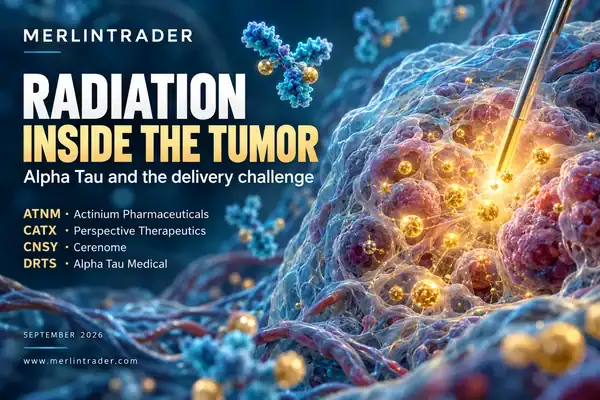
Conceptual illustration of four delivery approaches. It does not depict a measured dose distribution, clinical response or an approved use for every program.
DRTS · ReSTART
88 patients
Enrollment completed May 2026; pivotal cSCC study. Source.
DRTS · IMPACT
48 patients
August 31, 2026: enrollment complete; pancreatic pilot. Source.
DRTS · REGAIN
2 of 3 CRs
May 3 cutoff; one associated grade 3 serious adverse event. Source.
DRTS · Resources
$104.772m
June 30, 2026; cash, deposits and restricted deposits. Source.
DRTS · Japan
H&N authorization
February 2026; defined indication and postmarketing study. Source.
CATX · VMT-α-NET
76 NET patients
July 31, 2026 cutoff; four cohorts, investigational. Source.
CNSY · REYOBIQ
GBM phase 2
August update: data expected Q1 2027; investigational. Source.
ATNM · ATNM-400
Preclinical
August 2026 disclosure; human solid-tumor benefit unproven. Source.
The essential answer
Radiation creates clinical value when delivery, coverage and durability work together.
Alpha Tau has completed enrollment in its 88-patient pivotal skin-cancer study and its separate 48-patient pancreatic pilot. Its early U.S. glioblastoma report involves only three patients. Those evidence levels remain distinct from its geographic authorizations and pending U.S. PMA pathway.
Perspective, Cerenome and Actinium explore other ways to place radioactive energy where it is useful. The comparison follows tumor access, dosimetry, clinical safety, manufacturing and funding rather than ranking response rates from unrelated studies.
How useful delivery could become a durable business
Alpha Tau reproduces clinically meaningful local control across centers, while longer follow-up supports a tolerable procedure and a clear regulatory path. Better planning and reliable manufacturing make source placement repeatable in defined indications. Perspective demonstrates a useful systemic therapeutic window; Cerenome standardizes coverage through its selected catheter regimens; Actinium translates targeting into indication-specific human evidence. Capital and partnerships finance these steps on terms that leave an attractive operating model. The opportunity depends on evidence connecting dose distribution with patient benefit, not on isotope potency alone.
Where physical promise can fail to translate
Incomplete coverage, heterogeneous uptake, local injury, neurologic complications or insufficient durability can limit benefit. Small uncontrolled cohorts may not predict larger studies, and combination results may not isolate the new therapy’s contribution. Manufacturing, site training and reimbursement can slow adoption even after a favorable result. Restricted resources, conditional funding, equity issuance and transferred commercial rights affect the economics; a favorable accounting cash-flow period may reflect advance receipts. ATNM’s listing extension remains conditional, while its solid-tumor program still needs to establish a human development path.
Four dated developments
August 31, 2026
Alpha Tau completes IMPACT at 48 patients
The pancreatic study remains a pilot added to first-line chemotherapy; initial results are expected in early 2027.
ReSTART topline data are expected in late 2026 or early 2027; initial IMPACT data are targeted for early 2027. Perspective’s autumn updates and Cerenome’s expected Q1 2027 GBM data address different questions. Company windows are forecasts, and neither a presentation nor an investigational clearance is a marketing approval.
Affiliate links to individual securities. CNSY is Cerenome’s current ticker; PSTV was replaced on August 3, 2026. Market data update independently of the dated financial analysis.
Extended analysis
Continue with the extended analysis of $ATNM, $CATX, $CNSY and $DRTS.
Twenty-four chapters follow radiation from source to tumor, then from clinical evidence to sustainable execution. Two financial charts and dated comparison tables explain Alpha Tau’s liquidity, cash flows and the distinct delivery approaches.
Alpha DaRT physics and tumor coverage
Skin evidence and the ReSTART pivotal pathway
Pancreatic cohorts and the 48-patient IMPACT pilot
Early REGAIN brain-tumor data and safety
Perspective’s systemic molecular targeting
Cerenome’s catheter delivery and Actinium’s antibodies
Alpha Tau liquidity composition and cash flows
Manufacturing, regulatory boundaries and upcoming evidence
Free access.
A detailed guide to radiation delivery, evidence and economics
01A powerful isotope still needs a route into the cancer
The most important question in a radiation company is often surprisingly practical: where will the energy be deposited? A radioactive payload can damage cancer cells only after it reaches a useful location, remains there long enough and delivers a tolerable dose. A compelling isotope does not answer those questions by itself. The route into the patient, the distribution inside the tumor and the exposure of healthy tissues are part of the treatment, rather than engineering details added after the biology works.
Alpha Tau Medical makes that problem unusually visible. Its Alpha DaRT technology places radium-bearing sources inside tumors and uses the movement of radioactive daughter atoms to extend the treated region around each source. The procedure attempts to combine intense local radiation with a relatively confined field. That creates an opportunity in accessible, difficult-to-treat lesions, including tumors that have already received radiation. It also creates a demanding question: can the planned sources cover the clinically important tissue without leaving gaps or damaging a critical neighboring structure?
Three other companies illuminate different answers. Perspective Therapeutics uses molecular targeting to carry radiation through the body. Cerenome delivers a radioactive liposomal formulation through routes designed for the central nervous system. Actinium Pharmaceuticals attaches radioactive payloads to antibodies, with human experience in myeloid malignancies and an earlier solid-tumor program. These are not interchangeable competitors, and their response percentages cannot be arranged into a meaningful performance table.
The useful comparison follows a sequence: access, distribution, absorbed dose, clinical benefit, reproducibility and economics. A platform becomes more persuasive when evidence connects those steps. A dramatic scan without durable benefit leaves a clinical gap; durable benefit delivered only by a few expert operators leaves an implementation gap. The information available through September 26, 2026 supports a detailed examination of those gaps, with Alpha Tau as the central case. Its August corporate update describes programs at substantially different stages, not a single platform-wide regulatory verdict.
02Four delivery systems, four different constraints
With a local implant, the physician chooses where to place the radiation source. With a circulating radiopharmaceutical, a targeting molecule influences where the payload accumulates. With a catheter, pressure, anatomy and fluid movement help determine distribution. An antibody adds its own binding characteristics and pharmacokinetics. These distinctions matter before discussing whether an alpha or beta particle has attractive physical properties.
Alpha Tau's principal challenge is geometric and procedural: getting an appropriate configuration of sources into an appropriate lesion. Perspective's challenge includes biological selection, uptake and retention across lesions that may express different amounts of the target. Cerenome must achieve useful coverage in brain tissue or cerebrospinal-fluid compartments without treating those spaces as if they were uniform containers. Actinium must connect antibody recognition, isotope attachment and tolerable exposure with activity in the intended disease.
Local and systemic approaches therefore address different patterns of failure. A patient can have a troublesome local mass and distant disease simultaneously. Controlling the first may reduce symptoms or avert a local complication while systemic treatment remains necessary. Conversely, a circulating therapy may reach multiple deposits but deliver an inadequate dose to a lesion with low uptake. Neither route automatically makes the other unnecessary.
This framework also clarifies the commercial questions. A locally implanted product depends on trained procedural teams and scheduling capacity. A systemic product still needs isotope supply, qualified preparation, radiation handling and a suitable treatment center. A catheter-based therapy may require specialized neurosurgical or neuro-oncology infrastructure. The cost of the vial or source is only one component of the encounter. The Perspective pipeline update and the Cerenome clinical update make these different development and infrastructure requirements concrete. The investment question begins with whether each route can solve its own problem consistently.
Ticker
Delivery route
Evidence stage
Key question
ATNM
Antibody radioconjugates
Actimab-A: human myeloid studies; ATNM-400: preclinical
Target accessibility, exposure and tolerability
CATX
Systemic molecular targeting
VMT-α-NET: phase 1/2a; phase 3 preparation
Uptake, retention and repeat-dose therapeutic window
CNSY
Local catheter delivery
REYOBIQ: CNS clinical studies; investigational
Tissue/CSF distribution and neurologic safety
DRTS
Intratumoral source implantation
ReSTART pivotal; pancreas pilot; early GBM study
Source placement, daughter diffusion and tumor coverage
03Alpha DaRT: the atoms move farther than the alpha particles
An essential distinction prevents a common misunderstanding of Alpha DaRT. An individual alpha particle has a very short track in tissue; the radioactive atoms that later emit particles can move farther. Describing a millimeter-scale treatment region does not mean that each alpha particle travels several millimeters. The extension comes from the distribution and decay of daughter radionuclides around an implanted source.
Alpha DaRT uses sources carrying radium-224. Radium remains associated with the source while daughter species released from it spread into surrounding tissue and decay. The resulting radiation field depends on how those atoms move, how quickly they disappear through decay or clearance, and where the sources were placed. The parent isotope's approximately 3.7-day half-life also means that activity changes over the course of treatment. This is a time-dependent system rather than a static ring drawn around a seed.
The scientific foundation includes the diffusion-leakage model and subsequent work on more realistic geometries. Heger and colleagues' 2022 lattice-modeling study examined how source arrangements, tissue diffusion and positioning uncertainty influence coverage. It is a physics study, not a clinical demonstration that one spacing guarantees success in every cancer. Its value is explaining why source configuration and tumor characteristics belong in the evidence package.
High local energy deposition can be attractive when conventional treatment has left resistant disease. It does not abolish the need to measure toxicity, define margins or understand where radioactive daughters go. Nor does physical potency establish a commercial advantage by itself. A treatment must create a usable difference between tumor injury and normal-tissue injury in the actual population being treated. The company's technical presentation provides the platform description; the modeling literature explains why that description still needs tumor-specific validation.
04Coverage is a biological variable as well as a geometric one
Imagine a lesion whose outline looks simple on a scan but contains regions with different density, vascularity and viability. A source arrangement that appears uniform in three dimensions need not generate a perfectly uniform absorbed dose. The atoms must move through real tissue, and the tissue can change after implantation. This is why a photograph of neatly spaced sources cannot substitute for dosimetry.
Zhang and colleagues' 2025 modeling study examined swelling and shrinkage using a model informed by serial images from seven treated patients. Their simulations showed that changing tissue volume could materially alter calculated dose. That does not establish a clinical failure rate. It establishes that a static planning assumption can differ from a treatment delivered in changing tissue, which is a useful question for subsequent validation and software development.
A 2026 orthotopic mouse study by Cyr and colleagues adds another boundary. It found variation in daughter-isotope distribution and escape from the treated tissue. These were colorectal tumor models in mice, not human pancreatic or brain dosimetry results. Their relevance is mechanistic: diffusion and clearance should be measured and modeled rather than assumed identical across organs. The study does not justify transferring its numerical escape fractions directly to human patients.
The business implication is more specific than saying that implementation is difficult. A credible platform needs treatment-planning rules that remain useful when the operator, organ and tumor shape change. Better planning can become an asset if it reduces variability and training demands. Conversely, an expanding indication list can increase the number of delivery problems that must be solved. A skin lesion, a pancreatic mass and a recurrent brain tumor share radioactive physics, but they do not share access, surrounding anatomy or tolerance for positioning error.
05Superficial tumors provide the longest clinical foundation
Alpha Tau's more mature human evidence comes from skin and head-and-neck lesions. Those settings offer a practical starting point because investigators can place sources directly into visible or accessible disease and follow the treated region. They also include patients with limited options after prior surgery or radiation, where local control can matter even without proving a survival advantage.
The 2023 JAMA Network Open prospective cohort enrolled ten patients. All had a complete response at the specified 12-week assessment, with nine confirmed by CT, and no device-related grade 3 adverse events were reported. This was an encouraging feasibility result in a small selected group. It was not a randomized comparison, and its response rate should not become a platform-wide expectation for larger or deeper tumors.
Longer observation helps separate early disappearance from durable control. A 2024 pooled analysis in Cancers covered 81 lesions in 71 patients from four prospective studies. Median follow-up was 14.1 months; the estimated two-year local recurrence-free survival was 77%, with a 95% confidence interval of 63%–87%. The lesion and patient denominators are different, and an actuarial estimate is not equivalent to every patient being observed for two years.
This foundation matters because it contains an actual durability question rather than only an early scan. It also shows what should remain visible as development expands: local recurrence, healing, pain, functional consequences and the need for subsequent treatment. A favorable local response is valuable when it produces a sustained improvement in the patient's clinical course. The right next question is whether that result can be reproduced in a larger, clearly defined population with consistent assessment and an acceptable procedure, rather than whether a small study's highest percentage can be repeated in a headline.
06ReSTART is pivotal; the rest of the platform does not inherit that status
The U.S. ReSTART study addresses recurrent cutaneous squamous cell carcinoma. Alpha Tau reported completed enrollment of 88 patients in May 2026. It is the pivotal program supporting the company's U.S. premarket-approval strategy. Calling ReSTART pivotal describes its intended regulatory role; it does not mean that its results are already known or that a favorable decision has occurred.
The trial registry, NCT05323253, describes a single-arm, open-label study with response and response-duration assessments. The current registry record available for this review retained an estimated enrollment of 86, whereas the company's subsequent completed-enrollment account gives 88 actual participants. Estimates and completed counts should remain distinguishable. The same principle applies to dates: a database's estimated primary-completion date and management's expected topline announcement can refer to different operational milestones.
Without a randomized control group, evaluation depends heavily on the prespecified population, the clinical context, the rigor of response assessment and durability. That is not a reason to dismiss the study. It is a reason to read the eventual dataset according to the question the study was designed to answer. Baseline lesion characteristics, prior treatments, evaluability, withdrawals and the handling of missing assessments will influence the meaning of the results.
Alpha Tau's May enrollment announcement and August regulatory discussion placed the anticipated topline window in late 2026 or early 2027. The meaningful catalyst is the evidence package emerging from follow-up, not the mere passage of that calendar window. A convincing result could strengthen the first substantial U.S. commercial pathway. It would still leave pancreatic and brain indications with their own clinical questions. Platform development can reuse manufacturing knowledge and procedural experience, but it cannot reuse a disease-specific efficacy conclusion as if every tumor had been tested.
07Japan, Israel and the United States have different regulatory facts
Alpha DaRT's regulatory status requires a geographic and indication-specific sentence. The company received Israeli marketing authorization in August 2020 for squamous cell carcinoma of the skin or oral cavity. In February 2026, Japan's Ministry of Health, Labour and Welfare granted shonin approval for unresectable locally advanced or locally recurrent head-and-neck cancer. Neither authorization establishes a U.S. approval or a general permission to treat all solid tumors.
The Japanese authorization includes a required postmarketing-surveillance study of 66 patients across five centers, according to the company's regulatory filing. Postmarketing requirements matter operationally: approved status and unrestricted commercial execution are not identical. The same filing states that the existing Israeli authorization had not yet produced commercialization and describes Japan's surveillance obligations as a current priority.
In the United States, Alpha Tau submitted the first module of its modular PMA application in January 2026. A module is part of a dossier. It is not a completed approval, and Breakthrough Device designation does not change that distinction. Similarly, permission to conduct or expand an investigational-device study authorizes that research activity; it does not authorize routine commercial use for the investigational indication.
For an investor, this creates several different kinds of progress. An authorization can reduce a particular regulatory uncertainty while leaving reimbursement, physician adoption and manufacturing readiness unresolved. A PMA submission can move the process forward while leaving clinical review incomplete. A new trial site can improve enrollment without proving that the therapy works. These developments should be valued for what they actually change. The February Japanese approval announcement and the U.S. registry provide more useful boundaries than a single label such as “approved technology.”
08Pancreatic cancer tests whether local access can become useful coverage
Moving from a superficial lesion to the pancreas changes the problem considerably. The physician must reach a deep organ, place sources near important structures and obtain a distribution that can plausibly affect a clinically meaningful portion of the tumor. Endoscopic ultrasound provides a route for source placement, but successful access is only the beginning of the treatment question.
Miller and colleagues' 2024 preliminary clinical paper reported the first five treated patients with advanced pancreatic cancer. Placement was technically successful in all five. The reported gross-tumor-volume coverage ranged from 8% to 44%. At the initial assessment, three patients had stable disease and two had progression; a later partial response was observed in one patient. The paper supports feasibility, while the coverage figures show why technical success and comprehensive irradiation cannot be treated as synonyms.
Partial coverage might still have clinical relevance, but the reason must be demonstrated. Reducing a strategically important part of a mass could affect pain, obstruction or local progression. A proposed immune contribution could create effects beyond directly irradiated tissue, but that remains a separate evidentiary question. It cannot simply fill the gap between the volume treated and the benefit hoped for.
The distinction also matters for subsequent studies. More experienced operators, refined devices, different lesion selection and improved planning might change achievable coverage. That is a testable development path, not a result established by the initial series. A useful pancreatic dataset should therefore connect placement success with actual dosimetry, local disease behavior, systemic progression and the patient's ongoing treatment. In a disease where chemotherapy remains central, a local procedure should be assessed for its incremental contribution, including whether scheduling and recovery allow the planned systemic regimen to continue without clinically important disruption.
09The pancreatic pooled data require careful denominators and clocks
The 2026 ASCO abstract on three pancreatic studies describes 58 subjects across prospective studies in Canada and Israel. It reported an objective response rate of 27% and disease control of 87% among response-evaluable patients, alongside treatment-related adverse events in 36% and grade 3 or higher events in 9%. The abstract reported no treatment-related deaths. These are pooled early-study findings, not a randomized demonstration of added survival.
The response-evaluable denominator must remain separate from the entire enrolled population. Likewise, the later corporate discussion refers to 55 patients receiving a full intended treatment with measured outcomes. That does not justify silently replacing every denominator with 55 or 58. A patient-level disposition table is the best way to understand exclusions and different analysis sets. Until then, the wording should preserve the actual population attached to each result.
Survival introduces another clock. The abstract reports overall survival measured from Alpha DaRT treatment. The company's June 1 release discusses selected subgroups using enrollment and, separately, the start of earlier chemotherapy. A longer median measured from an earlier starting point is not automatically a treatment improvement. Patients who live long enough to receive an additional procedure also constitute a selected population.
The constructive interpretation is that these studies provide a rationale for more controlled development and help identify which populations might be suitable. Locally advanced disease and metastatic disease should remain separate because the relative importance of local control differs. Prior treatment, performance status and subsequent care also matter. Historical comparisons can guide a hypothesis, but they cannot isolate the contribution of Alpha DaRT when the comparison groups were assembled differently. The next evidence should narrow that uncertainty instead of presenting a different survival starting point as a new therapeutic effect.
10IMPACT has finished enrollment, but it remains a pilot study
The clearest recent pancreatic development is operational. On August 31, 2026, Alpha Tau announced that IMPACT had completed enrollment with 48 patients after several expansions. The study is a prospective, multicenter, open-label pilot evaluating Alpha DaRT with first-line chemotherapy in newly diagnosed unresectable locally advanced or metastatic pancreatic adenocarcinoma. Initial data are now targeted for early 2027, according to that completed-enrollment release.
The treatment is added to mFOLFIRINOX or gemcitabine with nab-paclitaxel. It is not being tested as a replacement for those systemic regimens. The primary objective concerns safety, while secondary assessments include survival, progression, pain and, for locally advanced disease, possible conversion to surgery. Calling the study pivotal would overstate its current role. The company describes it as informing the design of a future pivotal program.
The IMPACT registry retained an estimated target of 50 and a recruiting status in its available record, updated before the August 31 completion announcement. The newer actual count is 48. This is a straightforward example of why a live corporate development can supersede a registry's estimate without making the entire registry unusable. Its protocol remains useful for understanding design and endpoints.
The most informative initial readout will show more than a pooled percentage. It should explain chemotherapy exposure, the locally advanced and metastatic cohorts separately, treatment timing, procedural safety and how many patients reached each assessment. A larger pilot can improve confidence in feasibility and reveal patterns that were invisible in five patients. It does not create the counterfactual that randomization supplies. The central question remains whether adding local radiation improves a defined aspect of care enough to justify the procedure and support a more definitive test.
11REGAIN's first three brain-tumor patients are a signal, not a population estimate
In recurrent glioblastoma, Alpha DaRT's attraction is direct delivery into a tumor that has already received substantial treatment. The brain also makes the safety question unusually consequential. Local swelling, injury or an adverse event in a sensitive location can have major functional effects even when systemic exposure is limited.
Alpha Tau's May 11 REGAIN update described three patients, with a May 3, 2026 cutoff. Two had complete responses under RANO criteria and the third had stable disease. The frequently quoted 67% therefore means two of three, with different individual follow-up durations. The same report described one associated grade 3 serious adverse event, a seizure with temporary paralysis that resolved with steroid treatment. “No unexpected related serious adverse events” must not be shortened to “no serious adverse events.”
The REGAIN registry, NCT06910306, identifies a small, single-arm feasibility and safety study in recurrent disease unsuitable for resection. Planned enrollment is ten. Stereotactic placement through a burr hole can avoid an open tumor resection, but it is still an invasive brain procedure. The FDA's subsequent clearance to enroll the remaining seven participants after interim safety review permits the study to continue; it is not commercial approval.
A durable interpretation will require serial imaging, neurologic function, steroid exposure, local and distant progression, and survival. Imaging response after radiation can be complicated by treatment-related changes, so the assessment method matters. The first three cases justify scientific attention because they demonstrate an early human possibility in a difficult setting. They do not establish a 67% expected response rate for the next hundred patients, nor do they prove superiority to another experimental brain-tumor treatment. The appropriate ambition is a reproducible benefit whose clinical significance survives longer follow-up.
12Local radiation and systemic immunity need separate evidence
Local treatment can be investigated alongside immunotherapy because radiation may influence the tumor environment and antigen exposure. That biological rationale is different from proving that an implanted source controls untreated metastases. A response in distant disease during combination treatment has several possible explanations, including the systemic drug's activity and the interaction of both interventions.
In its July 2026 head-and-neck update, Alpha Tau described eleven recruited patients, with nine evaluable for response, receiving Alpha DaRT plus pembrolizumab. All nine evaluable patients responded, including four complete responses. Two recruited patients died before response evaluation, and one of them had not received Alpha DaRT. Those details belong beside the response figure because they explain the denominator. The company's July data release is a small combination-study report, not a head-to-head comparison with pembrolizumab alone.
The relevant next experiment would distinguish the contribution of the implant from the background regimen in an appropriate population. That could involve controlled comparisons, prespecified analyses of treated and untreated lesions, and an immune or imaging program able to connect mechanism with clinical behavior. A biomarker change by itself would still not establish longer survival or better quality of life.
This matters financially because systemic benefit would broaden the potential role of a local platform, but it also raises the evidentiary bar. A business case built around local control can be tested with local outcomes and a clearly defined care pathway. A business case built around changing metastatic disease needs evidence at that broader level. The distinction helps preserve a promising hypothesis without prematurely capitalizing it as an established property. Alpha Tau's existing Stock Hub follows the company's programs; each indication still needs to earn its own clinical conclusion.
13A source factory is only one part of a reproducible procedure
Manufacturing a radioactive implant requires consistent source activity, appropriate release characteristics, quality controls and delivery within the useful radioactive lifetime. The hospital must then translate that product into a procedure. Planning, placement, radiation protection, documentation and follow-up need to function together. Scaling production does not automatically scale the number of patients who can receive treatment competently.
For Alpha Tau, the delivery problem changes as deeper indications expand. A surface-tumor procedure and endoscopic pancreatic placement draw on different clinical teams. Brain implantation requires another skill set. Training can transfer principles, but it cannot remove the anatomy-specific learning curve. A multicenter trial is therefore useful partly because it tests whether a result can travel beyond the first expert institution.
A practical commercialization model should distinguish manufactured sources, shipped sources, completed procedures and treated patients. The number of sources per treatment can vary with tumor geometry. Nominal annual source capacity therefore should not be converted into patient capacity without an explicit assumption about utilization, dose planning, cancellations and wastage. Nor is the number of sources a simple measure of clinical intensity across different indications.
The company's financial and operating discussion identifies manufacturing expansion and commercialization as future funding needs. The analytical implication is that clinical success can increase spending before it produces durable revenue. More sites need support, supply must become dependable, and an approved indication may still require a reimbursement pathway. The most useful evidence of scalability would connect site activation with repeat procedures, predictable scheduling and consistent treatment quality. A factory milestone is valuable, but the unit of commercial adoption is the completed clinical encounter.
14Perspective: molecular targeting replaces the implant's geographic selection
Perspective Therapeutics' leading program, bamzireotide navoxetan, also known as VMT-α-NET, uses an SSTR2-directed targeting approach for neuroendocrine tumors. The radioactive component is lead-212, described appropriately as alpha-generating because the decay chain supplies the relevant alpha radiation. A circulating molecule can potentially address multiple target-positive lesions, a different objective from placing sources directly into one selected tumor.
This shifts the uncertainty. The clinician needs confidence that the relevant lesions express and retain the target sufficiently, while normal-organ exposure remains acceptable. A positive target test is not a guarantee that every lesion receives an effective absorbed dose. Uptake can differ between patients and between lesions in the same patient. The full therapeutic window depends on distribution, clearance, repeat dosing and cumulative effects.
Perspective's platform also links imaging and therapy through related targeting molecules. Imaging can help describe the biological distribution that a local implant largely bypasses through direct placement. It should still be understood as a measurement with its own limitations, rather than a perfect prediction of therapeutic response. A lesion can be visible on a scan without receiving the desired therapeutic exposure under a particular treatment regimen.
The manufacturing comparison with Alpha Tau is instructive. Both involve radium-224 somewhere in the production or treatment system, but the roles differ. Perspective describes a radium-224/lead-212 generator platform used to manufacture finished radiopharmaceutical candidates; Alpha Tau places radium-bearing sources into the patient. The September VMT-α-NET announcement makes the systemic targeting and ongoing trial context clear. Sharing a decay-chain connection does not make the treatments operationally or clinically equivalent.
15Perspective's next datasets should resolve dose, duration and selection
As of the July 31 cutoff cited in Perspective's August update, 76 neuroendocrine-tumor patients had been treated across four VMT-α-NET cohorts, with an additional meningioma patient. The company was preparing for a phase 3 study, subject to regulatory alignment and protocol finalization. That is a development plan, not an announcement that a randomized phase 3 trial has already demonstrated benefit.
The planned data sequence matters. An updated VMT-α-NET presentation was scheduled for ESMO on October 23, while a further presentation was accepted for the EORTC-NCI-AACR meeting in November. The September 11 release points to longer observation and additional cohorts. Acceptance of a presentation tells the reader when information may arrive; it does not disclose the eventual result in advance.
For this platform, longer follow-up can clarify whether deeper responses persist, whether later toxicity appears and which cumulative regimen deserves definitive testing. Dose escalation is not simply a contest to administer more radioactivity. A useful regimen must balance exposure, recovery, repeatability and organ safety. The relationship between administered activity and absorbed dose also deserves attention: the same administered activity need not produce identical tumor or normal-organ exposure in every patient.
Perspective's September 14 Merck collaboration adds a separate development question through PSV359 and pembrolizumab in FAP-α-positive solid tumors. A clinical collaboration and drug-supply agreement support investigation; they do not constitute proof of combination efficacy. The company-wide platform becomes more credible if targeting, supply and clinical execution work across programs, but each target and combination still introduces distinct biological and safety uncertainties. Its eventual phase 3 design will therefore be more informative than treating the size of the pipeline as a count of already validated opportunities.
16Cerenome: the delivery route is central to the brain-tumor hypothesis
Cerenome is the current company name for the former Plus Therapeutics, and CNSY replaced PSTV as its Nasdaq ticker on August 3, 2026. Its investigational REYOBIQ formulation, rhenium Re186 obisbemeda, packages a radioactive payload in nanoliposomes. In recurrent glioma, convection-enhanced delivery uses catheters to distribute the formulation within tissue. This is a beta-emitting approach with a different spatial and procedural profile from Alpha DaRT's implanted alpha-generating sources.
The 2025 Nature Communications phase 1 publication reported 21 patients across six dose cohorts. Its central contribution was feasibility, safety and dosimetry. Exploratory analyses associated higher absorbed tumor dose and greater treated volume with longer survival. Those associations support the importance of delivery, but they do not prove that crossing a selected dose threshold causes the observed survival difference. Tumor size, placement, patient characteristics and other factors can influence both achievable coverage and outcome.
Safety also needs the complete development history. The initial published cohorts did not reach a maximum tolerated dose. A later 2025 conference abstract described the expanded phase 1 program, including a grade 4 hemiplegia dose-limiting toxicity in the highest cohort and selection of the lower cohort-six dose for phase 2. The earlier “no dose-limiting toxicity” account should not erase that later observation.
This is exactly where comparison with Alpha Tau is useful. Both approaches must demonstrate that local delivery produces useful coverage in the brain, and both require neurologic safety and meaningful follow-up. Their radiation fields, hardware, formulations and study populations differ. Comparing a two-of-three complete-response result with an exploratory survival subgroup from another program would conceal those differences. The stronger question is whether each developer can standardize distribution, explain failures of coverage and produce consistent patient benefit at the selected regimen.
17Cerenome's fluid-compartment program and financing have different denominators
Leptomeningeal metastases involve a different anatomical problem from a solid brain mass. Cerenome's program uses an intraventricular route to expose the cerebrospinal-fluid compartment. Catheter access does not make that compartment perfectly uniform: distribution, clearance and disease location remain relevant. A pharmacokinetic finding of broad distribution is useful evidence about delivery, but it is not interchangeable with a controlled survival result.
The company's August SNO/ASCO update reported pharmacokinetic and dosimetry observations from the single-dose study. Its August financial update described ongoing multidose work and expected selection of an optimal regimen. ReSPECT-GBM phase 2 enrollment completion was targeted for 2026, with data expected in the first quarter of 2027. These programs remain investigational. CNSide, the company's commercial diagnostic platform, should not be mistaken for an approval of REYOBIQ.
Financially, the June 30 cash, equivalents and investment balance of approximately $8.6 million is a dated starting point. The September 10 financing announcement described a senior secured facility of up to $20 million with royalty-based repayment, an initial funded tranche and later milestone-dependent tranches. The maximum facility is not the same as cash already received. Management's runway forecast into 2028 also incorporates other facilities and expected diagnostic sales and cash flow.
This introduces a specific business dependency. Diagnostic commercialization can support an integrated oncology model, but forecasted collections, financing availability and therapeutic development expenses must all be evaluated separately. A royalty arrangement changes future economics even if it limits immediate share issuance. For readers assessing the therapeutic platform, the relevant question is whether the organization can fund the next study and manufacturing steps under realistic collection and spending assumptions. A new name, ticker or platform narrative does not remove those cash-flow dependencies.
18Actinium: an antibody must deliver radiation to the right biological target
Actinium Pharmaceuticals illustrates a fourth route. Actimab-A links an actinium-225 payload to the CD33-directed antibody lintuzumab. Its clinical experience concerns myeloid malignancies, including relapsed or refractory acute myeloid leukemia. ATNM-400 is a separate, earlier antibody radioconjugate program for solid tumors. The company should not be described as having established human solid-tumor efficacy merely because another antibody program has treated patients with leukemia.
The Actimab-A publication announcement concerns a phase 1 combination with CLAG-M chemotherapy. A combination study can identify a practicable regimen and generate an activity signal, but the chemotherapy component and patient selection remain part of the interpretation. The evidence belongs to that regimen and population; it does not validate every proposed use of CD33 targeting.
For antibody delivery, the target's location and accessibility matter alongside its presence. Binding, internalization, circulating exposure and payload attachment influence what reaches the tumor and what remains elsewhere. The company's June 2026 radiochemistry presentation emphasized optimization of radioconjugate properties. Such work is scientifically relevant because changing the construct can change distribution. Preclinical optimization still needs to translate into a tolerable human regimen.
Actinium also describes an interest in tumor-associated myeloid cells, extending the targeting question beyond cancer cells themselves. That hypothesis is biologically different from implanting a source inside a visible lesion. It asks whether irradiating a particular cellular compartment can contribute to the desired therapeutic effect. The appropriate evidence would include target characterization, biodistribution, safety and clinical activity in the intended setting. An antibody's selectivity is a mechanism to test, not a guarantee that all important disease sites receive sufficient radiation or that normal tissues are spared under every dosing condition.
19ATNM-400 remains preclinical, and the listing issue is a separate risk
ATNM-400's solid-tumor work remains preclinical in the company's current disclosures. The target has been described as novel without public identification in the reviewed material. Mouse-model activity can establish a reason to continue development, but it cannot establish a human therapeutic window, a feasible clinical dose or a response rate. Claims involving multiple tumor models should therefore remain attached to the species and experimental setting in which they were observed.
The June-quarter SEC filing provides the program boundaries and financial context. At June 30, Actinium reported approximately $36.5 million in cash and cash equivalents, separate from restricted cash. Those resources support a company-wide development plan; they are not an isolated budget for ATNM-400. Clinical manufacturing, regulatory preparation and eventual trial operations can change the spending profile as a preclinical asset advances.
The August 14 update also states that NYSE American accepted the company's compliance plan, with a period extending to November 27, 2027. ATNM continued trading subject to the applicable conditions. It would be incorrect either to describe the company as already delisted or to imply that acceptance of the plan permanently resolves exchange compliance.
These issues affect different parts of the thesis. Scientific progress can reduce uncertainty around a construct. Clinical authorization can permit a first human test. A financing can increase the resources available to run that test. Exchange compliance concerns the company's continued listing, not whether its molecule works. Keeping those layers separate prevents an attractive preclinical result from being used to dismiss a corporate risk, or a corporate risk from being used as a substitute for evaluating the science. The next meaningful solid-tumor transition would be evidence supporting human development, not a reinterpretation of animal results as clinical proof.
20Alpha Tau's liquidity is larger than its cash account
At June 30, 2026, Alpha Tau reported $104.772 million across cash and cash equivalents, short-term deposits and restricted deposits. The composition was $22.993 million, $77.646 million and $4.133 million, respectively. The adjacent chart uses those exact categories from the interim financial statements. Restricted deposits remain visible because money with restrictions should not be casually relabeled as freely deployable cash.
This distinction matters when comparing balances or discussing runway. A company may hold a substantial portion of its liquid resources in deposits rather than in the accounting line called cash and equivalents. Moving money between those categories can change the cash-flow statement without representing the same thing as spending it on research. Conversely, a large total does not mean every dollar is available for any purpose at any moment.
Management said the reported resources were expected to support operating expenses and capital expenditures for at least two years. That is a company forecast based on its plans and assumptions, not an independently guaranteed end date. Expanding a pivotal program, preparing a launch, opening additional manufacturing capacity or encountering a delay can alter the amount and timing of required spending.
The right analytical use of the balance is to ask which decisions it can finance. Can the company reach the ReSTART dataset, interpret the next pancreatic and brain results, and support the necessary regulatory and manufacturing work? Those milestones consume different amounts of money and may overlap. A balance-sheet cushion has strategic value because it can preserve choices, but it does not make every indication equally fundable. The composition chart therefore describes available financial resources at a reporting date, rather than a valuation measure or a forecast of how many patients can eventually be treated.
Reported balance-sheet categories at June 30, 2026. Percentages calculated from USD104.772m; restricted deposits are not unrestricted cash. This is a composition, not a runway forecast. Alpha Tau · SEC interim statements.
Category
USD millions
Share
Cash and equivalents
22.993
21.9%
Short-term deposits
77.646
74.1%
Restricted deposits
4.133
3.9%
Total
104.772
100%
21A large accounting loss can coexist with a small operating cash outflow
Alpha Tau's first-half 2026 net loss was approximately $68.8 million, while net cash used in operating activities was $0.745 million. Those figures measure different things. The cash-flow statement includes a $42.183 million warrant fair-value adjustment and an $18.878 million increase in deferred revenue among its reconciliation items. Noncash remeasurement and the timing of collaboration receipts help explain why reported loss and cash movement diverge so sharply.
Neither extreme is a useful standalone spending rate. Treating the net loss as cash burn overstates the cash implication of noncash items. Annualizing the small operating outflow assumes that the period's receipt pattern will recur. That would obscure the ongoing cost of clinical development and the obligations associated with money received in advance. The operating result, cash reconciliation and collaboration terms should be read together.
The second chart isolates actual first-half cash-flow categories: operating outflow, investing outflow, financing inflow and the exchange-rate effect. Financing supplied $29.008 million, while investing used $17.374 million. Cash and equivalents rose from $12.202 million to $22.993 million. Investing flows include movements involving deposits, so they are not synonymous with capital expenditure or clinical spending. The chart shows period totals, not the chronological order in which transactions occurred.
This is a particularly useful example of how biotech financing can change the appearance of operating cash flow. An upfront commercial arrangement may support operations before product sales exist, while equity financing affects the ownership claim on future success. A reader who separates those mechanisms can understand both why near-term liquidity improved and why further development still requires economic discipline. The question is whether the resources were obtained on terms that support the next useful evidence while leaving a viable business afterward.
H1 2026 period totals, not transaction order. Investing includes deposit movements, not only capital expenditure. Opening cash and equivalents USD12.202m plus net change USD10.791m equals closing USD22.993m. Operating flows include the effect of collaboration receipts. Alpha Tau · SEC cash-flow statement.
Flow / balance
USD millions
Operating
-0.745
Investing
-17.374
Financing
29.008
FX effect
-0.098
Net change
10.791
Opening cash and equivalents
12.202
Closing cash and equivalents
22.993
22Capital can buy development time, but retained economics still matter
Alpha Tau's June Tolmar arrangements illustrate the difference between funding categories. The disclosed transaction included a $20 million equity investment and a $15 million initial manufacturing payment, with additional milestone payments contingent on future events. The agreement discussion describes U.S. prostate-cancer commercial rights and a bladder-cancer option. Those future conditional payments should not be added to current cash, and the partnership should not be generalized to every Alpha Tau indication.
The central financial tradeoff is understandable without assigning an unsupported product price. A partner can fund infrastructure, contribute commercial capabilities and reduce the developer's immediate burden. In exchange, the developer grants rights or shares future economics. The useful comparison is the value of the capabilities and funding obtained against the obligations and upside transferred. A headline milestone total cannot answer that question alone.
Perspective's approximately $237 million in cash, equivalents and short-term investments at June 30 supported a different plan, including regional manufacturing and preparation for later-stage development. Its August outlook projected resources into late 2027. That should not be turned into a direct runway ranking against Alpha Tau because the programs, capital requirements and management assumptions differ. Cerenome's conditional financing and diagnostic collections create another funding structure again.
Across the four companies, success can increase the need for capital. A promising cohort can justify a larger trial; a larger trial can require more isotope capacity and clinical sites; approval can require commercial investment. The favorable scenario is not zero spending. It is spending that converts uncertain hypotheses into sufficiently valuable evidence and operational capability. Dilution, secured obligations and surrendered commercial rights are different ways of funding that conversion, each with consequences for the claim retained by existing shareholders.
23The next catalysts should be read as answers to specific questions
For Alpha Tau, ReSTART's anticipated late-2026 or early-2027 topline results address the leading U.S. pivotal pathway. IMPACT's initial data, now expected in early 2027, address the feasibility and safety of adding local treatment to first-line pancreatic chemotherapy. Additional REGAIN follow-up addresses whether the first brain-tumor signal persists in a larger group with acceptable neurologic safety. The three events differ in maturity and potential consequences.
For Perspective, the scheduled autumn VMT-α-NET presentations should add information about follow-up, cohorts and the regimen being considered for phase 3. For Cerenome, the selected multidose strategy in leptomeningeal disease and the expected first-quarter 2027 GBM data concern distinct delivery settings. For Actinium, manufacturing and clinical progress in Actimab-A should remain separate from the preclinical transition required for ATNM-400. None of these schedules guarantees a favorable outcome or the precise day on which a complete dataset becomes available.
A useful readout begins with the denominator and follows the patient through treatment and observation. How many were enrolled, treated and evaluated? How long were they followed? Did the endpoint concern the implanted lesion, all measurable disease, symptoms or survival? Were adverse events procedural, product-related or unrelated, and how were those attributions made? These questions often explain more than a percentage in the headline.
The financial follow-through matters as well. A result can support a larger program while extending the time before revenue. A regulatory interaction can narrow an indication, change a comparator or require more manufacturing work. Conference attendance, such as a company booth, is not a promised clinical readout. The Alpha Tau newsroom and the companies' dated trial disclosures provide a calendar of evidence; the value of an event depends on which uncertainty the new information actually resolves.
24A reusable framework: follow the dose, then follow the consequence
Begin with the disease pattern. A local mass, distributed metastases, malignant cells in cerebrospinal fluid and a marrow malignancy create different delivery requirements. Then identify the route and ask what must be true for it to work: physical access, receptor expression, catheter distribution or antibody targeting. This avoids treating “radiation therapy” as a single clinical product category.
Next, distinguish administered activity from absorbed dose and absorbed dose from benefit. A technically completed procedure may leave incomplete coverage. A well-covered lesion may shrink without changing systemic progression. A response may be brief, while a modest imaging change may still accompany worthwhile symptom control. The appropriate endpoint depends on the treatment's intended role, and the evidence must connect the route to that endpoint.
Safety belongs inside the mechanism. Confining radiation can reduce one kind of exposure while leaving another risk, such as local tissue injury or a procedural complication. The important question is the observed therapeutic window in the intended population, including later events and repeat treatment. Financial analysis should then follow the same specificity: which study, which manufacturing commitment, which liquid resources and which economic rights fund the next step?
Alpha Tau's opportunity is to show that source placement and daughter-isotope diffusion can deliver a reproducible clinical advantage across carefully defined settings. Perspective, Cerenome and Actinium expose alternative ways of solving the delivery problem and different ways it can fail. The strongest future evidence will join physics, patient selection, clinical durability and practical execution. A successful isotope is only the beginning; a useful treatment must survive the entire journey.
The primary materials below distinguish published human studies, mechanistic modeling, early animal research, trial protocols, company announcements and financial statements. Each source answers a different part of that journey. They support an assessment of investigational technologies and business execution, without turning early activity into an approval, a cross-trial ranking or an investment recommendation.
Scientific records distinguish human cohorts, conference abstracts, modeling and mouse experiments. The cited datasets have different dates, populations and denominators; they do not constitute a cross-trial efficacy comparison.
Disclaimer. This content is published by Merlintrader for educational and informational purposes only. It is independent journalism and research. It does not constitute investment advice, an investment recommendation, an offer or a solicitation to buy or sell any security, and it is not a research report within the meaning of applicable United States securities regulation. Nothing here should be read as a recommendation to buy, sell or hold $ATNM, $CATX, $CNSY, $DRTS or any other security.
Figures are taken from public filings with the U.S. Securities and Exchange Commission, company press releases and market-data providers, and are stated with their reference dates. Data can change without notice, and figures published before a results release become outdated the moment that release is issued. Merlintrader makes no representation that the information is complete or current at the time of reading. Readers should verify every figure against the primary source before acting on it.
Biotechnology and healthcare companies carry binary risk. Clinical trials fail, regulatory decisions go against the applicant, approval does not guarantee commercial uptake, and development-stage companies frequently raise equity at whatever price the market will bear. A single readout can change the value of the business overnight in either direction, and companies at this stage can lose all of their value. Every reader is responsible for their own decisions and should consult a licensed financial adviser where appropriate.
Merlintrader may hold positions in securities mentioned. Some links on this page are affiliate or referral links, including those to Finviz and Stocktwits, which may generate a commission at no cost to the reader. Full legal information is available on the disclaimer and terms of use and privacy pages.
Merlintrader · Radiotherapy delivery, clinical evidence and financial execution · Educational research
Biotech Catalyst Calendar
PDUFA dates, AdCom meetings, clinical readouts and trial completions in one free, filterable calendar. Free FDA and PDUFA Calendar →
 Umbria