Merlintrader Trading Pub
Biotech catalyst, news and analysis PDUFA tracker
Merlintrader Trading Pub
Biotech catalyst, news and analysis PDUFA tracker
AI transparency: articles and reports are produced with the help of artificial intelligence and checked through a process that does not constitute specialist validation. They may contain errors: verify relevant information with independent sources. Read the full disclaimer.
Golden Dome Missile Defense: Contracts, Budget, Satellites and the Stocks Involved
Merlintrader research summary · Program facts verified through July 24, 2026, with later developments noted below
Golden Dome began as a presidential order and a market narrative. It has since become a funded program with named contracts, congressional reporting rules and a budget fight. What is real today is the sensing and tracking layer. What is still unproven is the most ambitious part: destroying missiles from orbit.
This page brings together everything Merlintrader has published on Golden Dome since February 2026: what the program is, where the money is going, who holds the contracts, what it might cost, and how to tell real exposure from narrative.

108Tranche 3 missile-warning and tracking satellites awarded by the Space Development Agency (Dec 2025 + Jul 2026)
~$5.25BTotal potential value of the six disclosed Tranche 3 agreements
$185BProgram director’s stated estimate for the objective architecture over about a decade
$1.191TCBO 20-year estimate for a broader notional architecture (May 2026), not the classified DoD design
>$17BAdministration’s FY2027 request for Golden Dome, through a dedicated fund
What Golden Dome is
The legal starting point is Executive Order 14186, “The Iron Dome for America,” signed on January 27, 2025. It directs the deployment of a next-generation homeland shield against ballistic, hypersonic and advanced cruise missiles and other aerial attacks. The order lists the pieces it wants: faster deployment of hypersonic and ballistic tracking sensors (HBTSS), proliferated space-based interceptors capable of boost-phase intercept, terminal and underlayer defenses, a custody layer, pre-launch defeat options, secure supply chains and non-kinetic effects.
An executive order can set the mission, but it cannot appropriate money. Everything that turns the vision into hardware depends on Congress: the funding, the accounts it flows through, and the reporting and restrictions attached to it.

Where the first real money goes: the data spine
Since our March analysis, one idea has held up: before any interceptor can work, the shield needs a nervous system. A target has to be detected, kept in custody through complex flight paths, and turned into a fire-control-quality track that reaches the right weapon in seconds. That is why the first large awards went to sensing and tracking, not to space-based weapons.
1. TrackingInfrared satellites that detect launches and follow missiles, including hypersonic glide vehicles.
2. Data transportOptical and radio links that move tracks between orbits, ground stations and weapons.
3. Sensor fusionCombining space, ground, airborne and allied sensors into one picture.
4. Command and controlThe software that picks the right defensive effect. The program director has called it the program’s “secret sauce”.
Lockheed Martin, RTX ($RTX) and Northrop Grumman joined a contractor consortium around the C2 architecture. Reuters reported in March 2026 that Palantir ($PLTR) and privately held Anduril were developing software together for the shield, with Aalyria, Scale AI and Swoop Technologies also reported as participants. AI can help with data fusion, but trusted command authority, cyber resilience and human control over the use of force remain requirements. In a nuclear-warning context, a fast wrong answer is more dangerous than a slow correct one.
Timeline: from executive order to funded program
| Date | What happened | What it does not mean |
|---|---|---|
| Jan 27, 2025 | Executive Order 14186 sets the mission and architecture requirements. | No money by itself. |
| 2025 | Reconciliation provides about $25B described by congressional committees as a Golden Dome down payment. | Not awarded company backlog. |
| Dec 18, 2025 | FY2026 NDAA (Public Law 119-60), Section 1652, requires annual Golden Dome reports to Congress. | Authorization, not budget authority. |
| Dec 19, 2025 | SDA awards 72 Tranche 3 Tracking Layer satellites to Lockheed Martin, Rocket Lab, Northrop Grumman and L3Harris. | Launches planned for FY2029. |
| Jan 2026 | GAO warns SDA overstated technology readiness and lacked an integrated schedule for its missile-warning constellation. | An execution warning, not a cancellation. |
| FY2026 | Defense appropriations identify about $13.4B supporting Golden Dome ($9.6B MDA, $3.8B Space Force). | Not all of it is exclusive to Golden Dome. |
| May 2026 | CBO estimates $1.191T over 20 years for a notional nationwide architecture. | Not the Pentagon’s own estimate. |
| Jul 13, 2026 | SDA awards 36 accelerated satellites (~$1.75B): L3Harris up to ~$955M, Sierra Space up to $798M. Launch availability by end-2028. | Potential value, not cash received. |
| Jul 22, 2026 | House passes its $1.15T FY2027 NDAA; the Senate bill (S.4784) stalls after a failed cloture vote on July 14. | Not final law. |
Who holds the named satellite awards
| Contractor | Potential value | Satellites | Role and timing |
|---|---|---|---|
| Lockheed Martin ($LMT) | Up to $1.1B | 18 | Warning, tracking and missile-defense spacecraft; launch planned FY2029 |
| Rocket Lab ($RKLB) | Up to $805M | 18 | Warning, tracking and missile-defense spacecraft; launch planned FY2029 |
| Northrop Grumman ($NOC) | Up to $764M | 18 | Warning and tracking spacecraft; launch planned FY2029 |
| L3Harris ($LHX) | Up to $843M | 18 | Warning and tracking spacecraft; launch planned FY2029 |
| L3Harris ($LHX) | Up to ~$955M | 18 | Accelerated HBTSS-like missile-defense variant; available by end-2028 |
| Sierra Space (private) | Up to $798M | 18 | Accelerated warning and tracking variant; available by end-2028 |
The July awards are firm-fixed-price Other Transaction Authority (OTA) prototype agreements. OTAs give the Pentagon more flexibility than standard contracts and, if statutory conditions are met, a successful prototype can lead to follow-on production without a new open competition. Fixed prices shift cost-overrun risk to the contractor: if hardware or schedules slip, margins can suffer while the government still waits for capability. For Rocket Lab, the award matters because it validates the company as a satellite prime, not only a launch provider.
How much will it cost? Two numbers, two questions
The program director has described a $185 billion objective architecture over roughly a decade. In May 2026 the Congressional Budget Office estimated $1.191 trillion over 20 years for a notional system built to the executive order’s broad goals. Both figures are accurate, but they answer different questions: the Pentagon has not released enough detail for outsiders to reproduce its number, so the CBO built its own illustrative design.
In the CBO model, space-based interceptors alone account for about $743 billion and space tracking for about $90 billion. Without the interceptor layer the total drops to about $448 billion, but that would drop a capability the executive order explicitly asks for.
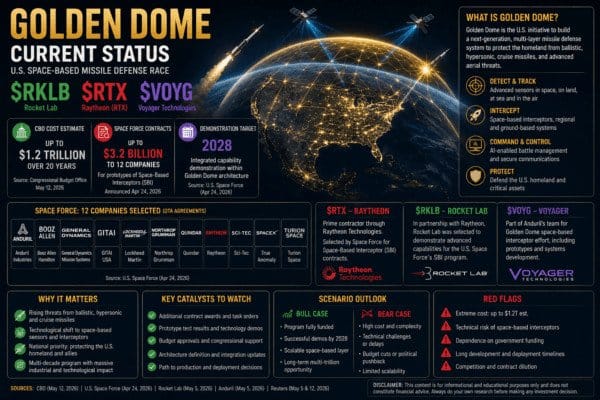
The FY2027 budget fight shows the same gap. The Administration requests more than $17 billion for Golden Dome, with a five-year path averaging about $15 billion a year through a dedicated fund, much of it inside a mandatory-funding request tied to a partisan budget process. The House Appropriations Committee’s FY2027 defense bill lists $397.9 million specifically for Golden Dome, alongside $12.5 billion for Missile Defense Agency programs and $13 billion for Space Force missile warning and tracking, which committee leaders describe as more than $25 billion supporting the initiative. A small central line surrounded by much larger shared portfolios is the program’s real budget shape.
The hardest layer: interception from space
Tracking a missile from orbit is hard; destroying it from orbit is harder. A boost-phase interceptor has a very short window and needs the right satellite in the right place at the right moment, enough interceptors in orbit to handle a raid, reliable communications and a way to replace satellites lost to normal attrition or attack. A broader space-based interceptor pool was announced at up to $3.2 billion across 20 agreements and 12 companies, with a 2028 demonstration objective. Firefly Aerospace ($FLY), through its SciTec subsidiary, holds one of those agreements; the pool is not Firefly revenue and a demonstration is not a production award.
The Senate Armed Services Committee’s FY2027 proposal would withhold some research funds until an independent report on space-based missile defense is delivered. That is not a rejection, but it shows that Congress wants proof on feasibility and cost before the most ambitious layer moves ahead.
Execution risk is synchronization. SDA’s wider architecture is expected to include at least 300–500 satellites costing nearly $35 billion through FY2029, with low-orbit satellites lasting about five years. Even if each contractor delivers, sensors, networks, ground systems, launches and interceptors must all work together under attack, deception and cyber pressure.
Space law and strategy
The 1967 Outer Space Treaty bans nuclear weapons and other weapons of mass destruction in orbit, but it does not ban every conventional weapon in Earth orbit, so a conventionally armed interceptor is not automatically prohibited. Liability, debris, interference with other satellites and the line between defense and offensive counterspace capability still raise legal and diplomatic questions. Strategically, Russia and China may read a large U.S. interceptor constellation as a threat to their retaliatory forces and respond with more missiles, decoys, anti-satellite weapons and cyberattacks, which can change their behavior before the shield is even operational.
Developments since July 2026
- DefenseScoop reported on August 27 that the first large-scale Golden Dome tests focused on validating the command-and-control and software architecture.
- According to the Arms Control Association, the program director said on September 17 that Golden Dome is prioritizing defense against “a coercive decapitation or rogue nation attack against the homeland”.
- Colorado Politics reported in September that the program director expects an early version of the system to be in place by 2028, while The War Zone reported his warning that a budget impasse could stall the program.
These are reported statements, not new contract awards. The awards table above reflects the agreements disclosed by the Space Development Agency.
How to classify stock exposure
| Evidence tier | Companies | What is confirmed | Common mistake |
|---|---|---|---|
| Named satellite awards | L3Harris, Rocket Lab, Lockheed Martin, Northrop Grumman; Sierra Space (private) | Specific SDA agreements, satellite counts, values and delivery windows | Treating potential value as immediate revenue or profit |
| Architecture and C2 roles | Lockheed Martin, RTX, Northrop Grumman; reported software work by Palantir and Anduril (private) | A program role or credible reporting of active work | Assuming a role becomes a dominant production share |
| Prototype and demonstration | Firefly/SciTec and other space-based interceptor participants | Development or demonstration activity | Calling an aggregate pool company backlog |
| Contract-vehicle optionality | Redwire ($RDW) and many SHIELD IDIQ awardees | Eligibility to compete for task orders | Treating the $151B SHIELD ceiling as guaranteed orders |
| Adjacent space and intelligence | BlackSky ($BKSY), Planet Labs ($PL), Satellogic ($SATL), Voyager ($VOYG) | Capabilities relevant to a defense-spending and space-awareness cycle | Calling thematic relevance a direct Golden Dome award |

Where the small caps fit
Our first Golden Dome piece in February looked at Planet Labs, BlackSky and Satellogic. Their imagery and geospatial intelligence matter in a world that values persistent awareness and fast tasking, but they are not missile-warning infrared sensing or fire-control tracking. Unless a Golden Dome-specific award is disclosed, they remain adjacent exposure. The same discipline applies to Voyager Technologies, which we followed in May alongside RTX and Rocket Lab as the speculative defense-tech angle.
Scenarios
Bull case: a durable architectureCongress keeps funding the enabling layers across administrations, SDA proves several suppliers can deliver interoperable satellites at cadence, and the program scales through regular refresh cycles.
Middle path: sensors advance, the dome stays incompleteCurrently the most plausible path. Tracking, data transport, radars, ground interceptors and software keep getting funded because they are useful beyond Golden Dome, while space-based interceptors stay in prototype and 2029 becomes a milestone for partial capability.
Bear case: cost and oversight fracture itMandatory funding is cut, continuing resolutions delay new starts, interceptor tests disappoint and schedules slip. Golden Dome becomes a label on programs that would have existed anyway, while stocks trade on headlines.
These scenarios are editorial interpretations, not forecasts or recommendations.
Key dates to watch
- Annual Section 1652 reports: should gradually reveal more about threats, architecture, schedule and funding.
- FY2027 NDAA and appropriations: which oversight rules, funding lines and restrictions survive.
- By 2028: space-based interceptor demonstrations, the program’s main credibility test.
- End of 2028: the 36 accelerated Tranche 3 satellites should be available for launch.
- FY2029: launch of the original 72 Tranche 3 tracking satellites.
Related research on Merlintrader
Company-level coverage: Rocket Lab · Firefly Aerospace · Redwire · BlackSky · Planet Labs · Palantir ·Space, Defense and AI research reports · Space, Defense & AI Event Calendar · The Government-Spending Supercycle · All stock hubs
Primary sources
White House: Executive Order 14186 · Space Development Agency: Tranche 3 and AMDT3 award announcements · Congressional Budget Office: national missile defense cost analysis (May 2026) · GAO: SDA missile-warning review (January 2026) · GovInfo: Public Law 119-60 (FY2026 NDAA) · House Appropriations Committee: FY2026 and FY2027 defense summaries · Senate Armed Services Committee: FY2027 NDAA summary · UNOOSA: Outer Space Treaty · DefenseScoop (Aug 27, 2026) · Arms Control Association (Oct 2026) · Colorado Politics (Sep 2026) · The War Zone
Educational and informational content only. It is not investment advice, personalized financial advice, an offer, a solicitation or a recommendation to buy or sell any security. Defense and space companies face government-budget changes, classified-program uncertainty, contract modification or cancellation, procurement delays, technical and launch failure, cost overruns, political change, dilution and high volatility. Contract ceilings, maximum potential values, IDIQ vehicles and prototype pools are not guaranteed revenue. Verify all material information through primary sources and consult a licensed advisor before making investment decisions.