

DISCLAIMER — Not financial advice. Educational content only, not an offer or solicitation to buy or sell any security. Biotech and small/mid-cap stocks are highly speculative and volatile and can result in a partial or total loss of capital. Do your own research and consult a licensed advisor where appropriate.

Merlintrader Trading Pub
Biotech catalyst news and analysis. FDA PDUFA tracker

Merlintrader Trading Pub
Biotech catalyst news and analysis. FDA PDUFA tracker
Category Reports Biotech
Tickers reports and analysis
Cue Biopharma ( $CUE ) — updated deep dive after the CUE-401 push, CEO transition, and fresh Boehringer milestone
Cue Biopharma is trying to turn a once messy, multi-angle small-cap biotech story into a more focused autoimmune thesis. The company now has a clearer lead asset in CUE-401, a meaningful external validation point through CUE-501 and Boehringer Ingelheim, a recent CEO transition, and a balance sheet that is improved versus the most stressed phase of 2025 but still fragile enough that financing risk cannot be pushed into the background.
Lexicon Pharmaceuticals ( $LXRX ): can Zynquista come back?
A full bilingual deep dive built around the real moving parts of the Lexicon story in April 2026: the Zynquista resubmission path after the 2024 complete response letter, the mid-2026 enrollment target for SONATA-HCM, the cash and dilution picture after the January-February 2026 financing, the economics of the Novo Nordisk LX9851 deal, and the structural risks that still make this name a high-volatility small-cap biotech setup.
Adagio Medical Holdings( $ADGM ) Deep Dive April 2026
Adagio Medical is a very small-cap, pre-commercial medtech name trying to carve out a meaningful niche in ventricular tachycardia ablation with its proprietary ultra-low temperature cryoablation platform. What makes the story relevant now is not revenue momentum, because there really is not much of that yet, but the combination of a pivotal study that has already completed enrollment, encouraging acute data, and a fresh FDA IDE expansion that lets the company clinically evaluate its next-generation ventricular catheter while the broader regulatory path remains open.
Outlook Therapeutics ( $OTLK ) after the new FDA dispute-resolution meeting. What this April review is.
After three Complete Response Letters and a long fight over what counts as sufficient evidence for ONS-5010 / LYTENAVA in wet AMD, Outlook Therapeutics has now moved into a formal FDA dispute-resolution process. This article walks through the CRL history, the new April 2026 meeting, and the real powers of the FDA deciding official — without hype, but also without pretending the door is already shut.
CorMedix ($CRMD): the real second chapter after commercialization
DefenCath is no longer just a launch story, and CorMedix is no longer easy to reduce to a one-drug binary. The company now has real revenue, positive adjusted EBITDA, a broader anti-infective platform after the Melinta transaction, and an approaching Phase 3 readout for REZZAYO. But it also has one very specific pressure point that still dominates the equity story: the July 1, 2026 reimbursement transition for DefenCath. This report is built to cover every major angle ahead of the ReSPECT topline update and to explain, from first principles, why the reimbursement framework matters so much.
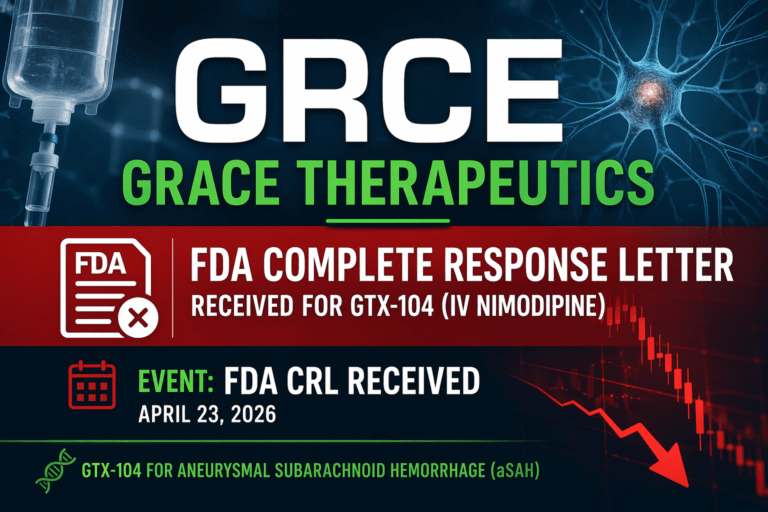
REPL, TVTX, GRCE: three April 2026 PDUFA decisions that matter
A full editorial deep dive on the three most interesting April biotech FDA setups still ahead: Replimune, Travere Therapeutics and Grace Therapeutics. Each story carries a different kind of risk. Replimune is the credibility test after a prior CRL. Travere is the commercial expansion test for a product that already sells. Grace is the classic small-cap binary setup where one approval could change the company’s profile very quickly.
Atea Pharmaceuticals ( $AVIR ) Deep Dive
Atea Pharmaceuticals is now best understood as a concentrated, late-stage antiviral bet built around a single core opportunity: the fixed-dose combination of bemnifosbuvir and ruzasvir for chronic hepatitis C. The company is not being valued today for a sprawling platform with multiple near-term revenue paths. It is being judged mainly on whether its HCV regimen can validate in Phase 3, differentiate clinically and commercially, and then support a credible regulatory path into 2027.
Viridian Therapeutics (VRDN): after the crash, what still matters now?
Why this follow-up exists
REVEAL-1 did not kill the TED thesis, but it changed the bar. The debate has moved from “does the drug work?” to “can Viridian still build a differentiated TED franchise that deserves premium valuation?”
Wall Street weekly recap and next-week setup: why March 30–April 3 became a relief week
Executive summary
The week that ended on Friday, April 3, was not a clean return to bullish calm. It was a relief week inside an unresolved macro problem. U.S. markets were closed on Good Friday, so the real trading week ended on Thursday, April 2. By then, the S&P 500 had posted a weekly gain and broken its five-week losing streak, while Wall Street had spent the entire week bouncing between fear of an extended energy shock and hope that the war-driven disruption around Iran and the Strait of Hormuz might not become a permanent economic wound.
Soligenix ( $SNGX ): HyBryte vs. Valchlor, the full story from the first comparison to today
Soligenix is a micro-cap biotech whose current equity story lives or dies largely on the fate of HyBryte in early-stage cutaneous T-cell lymphoma. The April 2, 2026 press release is real and meaningful, but not because it introduces the HyBryte-versus-Valchlor numbers for the first time. Those numbers were already disclosed in 2024. What is genuinely new is that the dataset has now been republished and reframed in a scientific setting, giving more external legitimacy to the claim that HyBryte may be clinically differentiated.
Lipocine ($LPCN) — after the 78% collapse: what is left, what broke, and what management can realistically do now
Lipocine entered April 2 as a micro-cap biotech still largely defined by one late-stage binary event. It exits the day as a radically repriced company. The reason is simple: LPCN 1154 failed its Phase 3 primary endpoint in postpartum depression. In the full study population of 90 patients, the company said the drug did not show a statistically significant reduction versus placebo in HAM-D17 at hour 60. That single fact destroyed the old near-term bull case and triggered a collapse of roughly 78% in the stock. What the market is doing is not subtle. It is saying that the company’s main value-driving asset just lost most of its immediate strategic and regulatory premium.
AbCellera Biologics ( $ABCL ) — deep dive on platform, pipeline, cash, insiders, institutions, and the road ahead
There is an old way to describe AbCellera and a newer, more accurate way. The old way is to call it a technology platform for antibody discovery that collaborates with larger pharmaceutical companies and occasionally captures royalties or milestone economics downstream. That is still partly true, but it no longer captures the real center of gravity. The company says explicitly that it has evolved from using the platform primarily for partner programs toward building its own internal pipeline of AbCellera-owned assets, and by 2025 that strategic transition had effectively reached the clinic.
Foundayo gets there first, and it is a pill: why this approval really changes the competitive setup for Altimmune and Viking
The FDA approval of Foundayo, Eli Lilly’s oral small-molecule GLP-1, does not automatically destroy the cases for Altimmune or Viking Therapeutics. But it does make the field more selective and far less forgiving. Lilly is not just early. Lilly is early with an approved product, near-term availability, an already powerful weight-management brand, a pill format that lowers the psychological barrier to starting therapy, and a commercial message built around access and simplicity. From this point forward, it is no longer enough to say that an obesity candidate has promising data. The real question is why the market should wait for it when the category leader has already put a real pill, ready for launch and ready for normalization inside the treatment pathway, on the table.
Eli Lilly ( $LLY ) — Foundayo’s FDA approval may be more than a product launch
The FDA approval of Foundayo, the brand name for oral small-molecule GLP-1 orforglipron, matters well beyond the usual “new drug approved” headline. Lilly already had one of the most powerful obesity franchises in the world through Zepbound. What it lacked was a simpler oral front door into the same therapeutic universe. Foundayo changes that. It adds a once-daily pill, no food restrictions, no water restrictions and an immediate commercial launch path. More importantly, it gives Lilly a second format that could widen the patient funnel, reduce psychological barriers to treatment initiation and deepen control over the obesity journey from entry-level adoption to higher-intensity therapy.
Omeros ( $OMER ): the post-approval story is finally turning, early commercial momentum is here, and the next upside chapter may be starting
The new March 31, 2026 press release did not simply deliver an earnings update. It effectively marked the first real post-approval checkpoint for Omeros. The company is no longer only a regulatory event story. After the December 23, 2025 FDA approval of YARTEMLEA for TA-TMA and the January 2026 U.S. launch, the central question has changed. The market is now asking whether the company can convert medical need, regulatory exclusivity and first-mover status into a durable commercial franchise.
Aquestive Therapeutics After the CRL ( $AQST ): what changed, what still matters, and how much balance-sheet room is left
Where the story stands today is more nuanced than the tape action around the January disappointment made it look. The FDA did not throw out the Anaphylm package because the drug failed on efficacy, because the core clinical bridge broke, or because major chemistry, manufacturing, and controls issues surfaced. The company’s February disclosure said the Complete Response Letter was focused on administration, labeling guidance, human factors deficiencies, and one supportive pharmacokinetic study tied to the packaging and labeling changes. In plain English, this was bad news, but it was not the same thing as a fundamental collapse of the program.
The market then needed a second question answered: would management actually get the FDA onto a defined remediation path, or would this turn into a vague, open-ended delay? The March 30 Type A meeting update is important because it is the first sign that the post-CRL process is becoming more concrete. AQST said the FDA gave clarifying feedback on both the PK and human factors study designs, acknowledged the changes to the pouch opening mechanism, and aligned on the concept of using labeling language to manage potential chewing of the film rather than demanding additional clinical data. That does not mean approval is in the bag. It does mean the company has moved from uncertainty to a more actionable playbook.
Axsome Therapeutics ( $AXSM ) — April 24 update, 2026 deep dive: setup to the April 30 PDUFA
A full follow-up report built from the January 2, 2026 setup and updated through March 31, 2026, focused on the Alzheimer’s disease agitation PDUFA, commercial momentum, management depth, cash and dilution risk, ownership, sell-side posture, retail sentiment, forward catalysts, scenarios, red flags and bottom line.
Agios Pharmaceuticals ( $AGIO ): the story did not end with the sickle-cell disappointment
Agios is not the same story it was one year ago, and it is not even the same story it was right after the market reacted badly to the November 2025 RISE UP data. The cleanest way to frame the company today is not as a single-product binary biotech and not as a fully de-risked rare-disease compounder either. It sits somewhere in the middle. There is now a real commercial base, a very strong balance sheet by biotech standards, a broader geographic footprint for mitapivat in thalassemia, and a reopened regulatory path in sickle cell disease that most investors had at least partially discounted after the mixed Phase 3 readout.
Sangamo Therapeutics ( $SGMO ) — Q4 2025 earnings, rolling BLA progress, cash pressure and dilution risk
Sangamo’s March 30, 2026 earnings release did not break the SGMO story. It clarified it. The company still has one asset that can genuinely change perception — ST-920 in Fabry disease — and one problem that can still overwhelm everything else — money. The clinical and regulatory side remains credible enough to keep the name alive. The balance sheet remains weak enough to keep common shareholders on a short leash.
Summit Therapeutics (SMMT): ELCC 2026 posters, stronger cash, and why retail is trying to rebuild the ivonescimab story
The latest Summit update does not magically erase the old debate around overall survival, but it does add new material that retail traders and long-form biotech readers can use to reframe the case: deeper intracranial data, quality-of-life support, a visible FDA date, and a balance sheet that gives the company room to keep pushing an unusually broad ivonescimab program.