Merlintrader Trading Pub
Biotech catalyst, news and analysis PDUFA tracker
Merlintrader Trading Pub
Biotech catalyst, news and analysis PDUFA tracker
Category Travel
AI transparency: articles and reports are produced with the help of artificial intelligence and checked through a process that does not constitute specialist validation. They may contain errors: verify relevant information with independent sources. Read the full disclaimer.
Late-Summer 2026 Cruises: Carnival, Royal Caribbean and Norwegian ($CCL $RCL $NCLH)

Carnival, Royal Caribbean and Norwegian at the end of summer 2026: Q2 results, bookings, yields, fuel and fall/winter scenarios.
Late-Summer 2026 Rental Cars & Mobility: Avis, Hertz and Uber ($CAR $HTZ $UBER)

Avis, Hertz and Uber at the end of summer 2026: fleet utilization, pricing, bookings, cash generation and fall/winter scenarios.
Late-Summer 2026 Hotels: Hilton, Marriott and Hyatt ($HLT $MAR $H)

Hilton, Marriott and Hyatt at the end of summer 2026: RevPAR, pipelines, fee growth, openings and the next-season investment setup.
Late-Summer 2026 Airlines: American, Delta and United ($AAL $DAL $UAL)
A late-summer 2026 operating scorecard for American, Delta and United: Q2 results, fuel risk, demand quality and the fall/winter outlook.
Airlines and Travel Stocks Rebound as Peace Deal Hopes Drag Oil Lower: Why $AAL, $UAL, $DAL and $CCL Are Back on the Radar
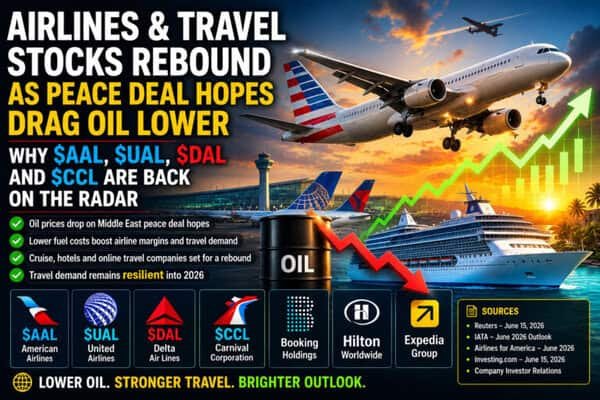
The travel trade is suddenly alive again. A preliminary U.S.-Iran agreement has pushed crude prices sharply lower, lifted risk appetite and brought airlines, cruise lines and tourism-linked stocks back into focus. The setup is not risk-free: the deal still has political loose ends, jet fuel remains volatile, and the airline industry is still working through one of the harshest cost shocks since the pandemic era. But the market has a simple reason to pay attention: lower oil can quickly change the narrative for every company that moves people.
Hilton, Marriott and Wyndham: Hotel Sector Deep Dive for the 2026 Summer Travel Season $HLT $MAR $WH

A long-form look at the lodging cycle before the peak vacation season: RevPAR, occupancy, ADR, loyalty ecosystems, bookings, destinations, pipelines, balance sheets and the different risk/reward profiles behind three major publicly traded hotel companies.
American Airlines, Delta Air Lines and United Airlines: Summer 2026 Sector Deep Dive ($AAL $DAL $UAL)
A complete bilingual sector report on the three U.S. listed airline majors ahead of the vacation season: demand, load factor, bookings, destinations, fuel, margins, balance sheet quality and the difference between full aircraft and profitable aircraft.
Top 5 Cruise Lines Watchlist April 2026: Pricing Power, Geopolitics and the Outlook for the Year
The global cruise industry enters the year with resilient leisure demand, continued focus on onboard spending, and growing investor attention on balance sheet quality, deployment flexibility and pricing discipline. Five listed names stand out for scale, brand relevance and strategic positioning: Carnival, Royal Caribbean, Norwegian, Viking and Lindblad.
Top 5 U.S. Airlines Watchlist April 2026
The U.S. airline industry remains one of the most closely watched corners of the transportation market because it compresses several themes into a single sector: consumer resilience, premium spending, corporate travel, fuel sensitivity, labor discipline, network strategy, loyalty economics, and capital market sentiment. Airlines are never just airlines. They are moving indicators of confidence, pricing power, operational quality, and macro fragility all at once.
This watchlist focuses on five listed carriers that matter most from a market and competitive perspective: Delta Air Lines, United Airlines, American Airlines, Southwest Airlines, and Alaska Air Group. The aim is not to assign explicit recommendations, but to map the current landscape in a way that helps readers immediately grasp which names stand out for quality, which rely more heavily on cyclical momentum, which are in operational or financial transition, and which deserve extra attention because the narrative surrounding them may not yet be fully settled.
US Airline Sector 2026
The U.S. airline sector in early 2026 is the product of two overlapping cycles. The first is the post-COVID recovery wave: a violent rebound in demand, especially leisure and international, that allowed the big carriers to refill their cash tanks, repair balance sheets and renegotiate labor. The second is the return of classic airline constraints: high capital intensity, structurally volatile fuel costs, periodic labor shocks and the need to keep debt under control without sacrificing network relevance.