Merlintrader Trading Pub
Biotech catalyst, news and analysis PDUFA tracker
Merlintrader Trading Pub
Biotech catalyst, news and analysis PDUFA tracker
AI transparency: articles and reports are produced with the help of artificial intelligence and checked through a process that does not constitute specialist validation. They may contain errors: verify relevant information with independent sources. Read the full disclaimer.
Stock Hub 2026 · Biotech
Nasdaq: $FDMT
Premiumreportfree with an ad
FDMT Stock Hub: 4D Molecular Therapeutics News, 4FRONT and 4SIGHT
Retinal genetic medicine: 4D-150 is in Phase 3 for wet AMD and DME. The two wet AMD studies have randomized 523 and 531 patients; first topline data are expected in Q2 2027.
Get every Merlintrader report in real time on Telegram: join @merlintraderpub_com.
Daily chart
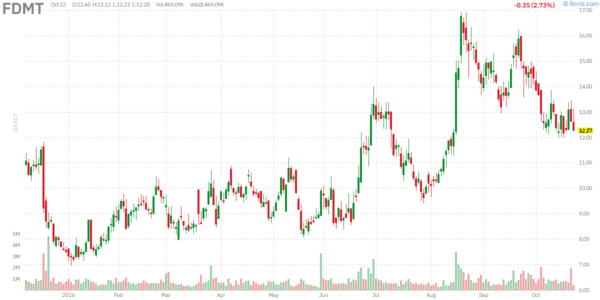
Daily chart $FDMT · October 22, 2026 · Intraday, delayedOpen chart (affiliate link) · For information only.
Next catalyst
Q2 2027 · Company expectation
4FRONT-1 wet AMD Phase 3 topline results
The company expects 4FRONT-1 topline results in Q2 2027 and 4FRONT-2 results in H2 2027. Both wet AMD Phase 3 studies have completed enrollment, with 523 and 531 patients randomized. Controlled vision outcomes, treatment burden and safety are the central tests. Source
Key data
Runway guidance
Into H2 2028
Management estimate; Oct. 21, 2026; expected Otsuka payments included Source
Latest announcementOctober 21, 2026 — Investor Day: 523 and 531 patients randomized in 4FRONT-1 and 4FRONT-2, readouts still expected in 2027 Source
Dates of the figuresFinancial statements: Quarter and six months ended June 30, 2026. Financing and operating events carry their own dates. Source
The constructive case
4D-150 could preserve vision while sharply reducing repeated anti-VEGF treatment. Two fully randomized wet AMD Phase 3 studies, a second Phase 3 indication in DME, multi-year early observations and the Otsuka partnership give the program a substantial clinical and operating foundation.
The case against
The decisive controlled results remain ahead. Early injection reductions used projected comparators, rare safety risks remain uncertain, established therapies are improving, and material cash burn, secured debt and a large pre-funded-warrant base leave financing and dilution exposure.
Operating and financial position
Late-stage, pre-commercial development company focused on 4D-150. June 30 cash and securities were $430.6M against H1 operating cash use of $138.1M and $20M principal debt. Management expects funding into H2 2028, including expected Otsuka payments. Common shares and pre-funded-warrant equivalents totaled about 72.18M on August 10, 2026. Source
Executive summary
4D Molecular Therapeutics is testing a sustained retinal therapy with a clear medical objective: protect vision with fewer repeated injections. 4D-150 remains experimental; all product candidates are unapproved. At the October 21, 2026 Investor Day, the company reported 523 randomized patients in 4FRONT-1 and 531 in 4FRONT-2. Wet AMD topline results remain expected in Q2 2027 and H2 2027. The DME Phase 3 study 4SIGHT began enrolling in September. Its planned 514 patients and separate clinical questions broaden the opportunity while adding cost and a longer timeline. The clinical case rests on controlled vision outcomes, supplemental-injection burden and safety. The stock case also depends on operating cash use, funding terms, manufacturing readiness and dilution.
Latest news
October 21, 2026 — Investor Day: 523 and 531 patients randomized in 4FRONT-1 and 4FRONT-2, readouts still expected in 2027
4DMT reported 523 randomized patients in 4FRONT-1 and 531 in 4FRONT-2. It retained expected topline windows of Q2 2027 and H2 2027 and outlined the clinical and commercial case for 4D-150. The presentation retained June cash and securities of approximately $431M and runway guidance into H2 2028. Source
September 28, 2026 — 4SIGHT begins Phase 3 development in diabetic macular edema
The first patients enrolled in the planned 514-patient DME trial. The accompanying SPECTRA update reported two-year observations through March 12, 2026, including nine patients at the Phase 3 dose. The observed 61% injection-burden reduction used a projected aflibercept schedule; a separate 75% estimate retrospectively applied future trial criteria. Source
August 13, 2026 — Q2 results: $430.6M June cash and securities, with substantial development spending
4DMT reported a $72.9M second-quarter net loss, $138.1M first-half operating cash use and $3.8M quarterly collaboration revenue. Management estimated funding into H2 2028 under its operating plan, including expected Otsuka payments. Source
July 18, 2026 — PRISM two-year wet AMD update supports durability hypothesis
At the Phase 3 dose, the broad Phase 2b cohort had a mean 2.7 supplemental injections over two years versus 12.0 projected with labeled aflibercept dosing. The recently diagnosed subgroup had a mean 1.6. The company reported no new inflammation cases after the first 28 weeks through extended follow-up. Source
Extended analysis
Does $FDMT deserve a place in your portfolio?
The full deep dive has the answer’s building blocks: cash, dilution, catalysts and risks, every figure sourced.
Free. No signup. You decide, we don’t recommend.
Using an ad blocker? The free “watch an ad” option is hidden automatically. Pause it on merlintrader.com and reload the page to see the free option.
01 What 4D Molecular Therapeutics does: the FDMT stock story
4D Molecular Therapeutics is a late-stage biotechnology company based in Emeryville, California. Its central business proposition is to turn a treatment that has to be repeated into a treatment that continues working inside the target tissue. For the lead program, 4D-150, the target is the retina and the therapeutic objective is sustained control of the abnormal blood-vessel activity behind wet age-related macular degeneration, or wet AMD, and diabetic macular edema, or DME. All of the company’s product candidates remain experimental. 4DMT has no approved product generating commercial drug sales. Company overview and development status
That distinction matters for the stock. FDMT represents a claim on future clinical, regulatory and commercial outcomes, backed by a substantial but finite balance sheet. It has reached a stage where large controlled studies can answer questions that encouraging early studies cannot. At the October 21, 2026 Investor Day, the company reported 523 randomized patients in 4FRONT-1 and 531 in 4FRONT-2. Both are Phase 3 studies in wet AMD. A separate Phase 3 study, 4SIGHT, has started in DME. The business is therefore moving from finding an appropriate dose and identifying activity toward demonstrating a reproducible benefit in a registrational setting. Investor Day presentation, pages 25 and 70
Conventional anti-VEGF injections can protect vision but require repeated care over years. A durable therapy could reduce that burden for patients, caregivers and capacity-constrained practices while preserving the clinical benefit of an established treatment approach.
Established medicines work, and newer products permit longer intervals for some patients. Prolonged genetic treatment must justify its additional uncertainty about inflammation, visual outcomes and supplemental care.
Merlintrader’s assessment is that FDMT combines a substantial medical need with a relatively mature clinical test. The company has narrowed its main operating focus around 4D-150 while supporting other programs through strategic funding alternatives. That makes the story easier to follow, but also increases its dependence on one lead product. Success in both retinal indications would expand the opportunity; a problem with the product’s safety, manufacturing or clinical effectiveness could affect both. The most useful organizing question is whether 4D-150 can preserve the quality of vision achieved with established therapy while producing a durable, meaningful reduction in treatment burden.
02 4D-150: sustained anti-VEGF treatment and its medical value
4D-150 is an investigational genetic medicine administered by an intravitreal injection, the same general route used for many current retinal treatments. It is designed to enable sustained production of aflibercept together with an RNA-interference component directed at VEGF-C. The company describes a potential backbone therapy that could be supplemented with additional injections when needed. Lifelong benefit remains a development ambition; the clinical observations available so far extend over years, not a lifetime. 4D-150 description
A December 2024 original study provides a preclinical foundation for the approach. Experiments in human retinal cells and nonhuman primates evaluated production of the intended therapeutic components and their biological activity. The findings supported the rationale for sustained aflibercept activity combined with suppression of VEGF-C, including activity in an animal model of choroidal neovascularization. This evidence concerns biological plausibility and activity in preclinical systems. The magnitude and durability of a visual benefit in patients, the frequency of supplemental treatment and the human safety profile require clinical evidence. The ongoing controlled trials address that separate question. Original preclinical study
Wet AMD involves abnormal blood vessels growing and leaking in the area responsible for central vision. Fluid, bleeding and subsequent damage can interfere with reading, recognizing faces and other daily activities. DME arises in the setting of diabetes, where damaged retinal blood vessels can cause fluid accumulation in the macula. Both diseases create a strong rationale for controlling VEGF-related vascular leakage. They are distinct populations, however, with different histories, associated illnesses and treatment patterns. A successful result in one indication adds useful evidence without replacing the clinical test required in the other. Approved anti-VEGF indications and trial context
Durability has medical value only when the underlying disease remains adequately controlled. A reduced injection count paired with worse visual outcomes would create a very different product profile from a reduced count paired with preserved vision. For that reason, visual acuity is central to the Phase 3 program, and treatment burden is assessed alongside it. Retinal thickness and fluid measurements contribute another view of disease activity, but patients ultimately care about how well they can see and function.
The concept also carries a practical distinction between fewer injections and fewer appointments. A patient receiving a durable therapy still needs monitoring, particularly when the disease is active or safety is being assessed. Long-term drug activity may reduce repeated administration without eliminating the need for eye examinations. The commercial benefit to a clinic will depend on the eventual monitoring requirements and how supplemental care fits into normal practice.
Another consideration is flexibility. A conventional medicine can be withheld or changed at the next scheduled injection. A treatment intended to remain active for years requires a different level of confidence before administration. This is why a reassuring safety record in small early cohorts is valuable but insufficient on its own. The large studies need to support a benefit that physicians can explain to patients with an acceptable level of uncertainty. For FDMT, the value of the medicine and the value of the stock connect through that evidence: durable biological activity becomes commercially meaningful only when it translates into an acceptable clinical and practical treatment profile.
Preserving useful sight and preventing further decline can have medical value even when structural damage limits recovery. Expectations should match baseline disease and the clinical endpoints.
03 PRISM results: what the wet AMD evidence actually shows
The most important early clinical support for 4D-150 comes from PRISM. On July 18, 2026, 4DMT reported two-year Phase 2b results using observations through May 18, 2026. The Phase 2b cohort included 45 patients across two dose levels. Thirty received the dose selected for Phase 3, and a 15-patient recently diagnosed subgroup within that group was considered more comparable to the Phase 3 population. The company reported maintenance of visual acuity and retinal anatomy with substantial reductions in supplemental treatment. PRISM two-year results
At the Phase 3 dose, the broad cohort received a mean 2.7 supplemental injections over two years, compared with 12.0 projected under the labeled aflibercept schedule used in the analysis. The company expressed that as a 78% reduction. The recently diagnosed subgroup received a mean 1.6 supplemental injections, equivalent to an 87% reduction against the same projected schedule. These comparisons use a projected treatment schedule. They are different from a randomized demonstration of superiority against a concurrent group receiving aflibercept. Clinical data reported in the July filing
The distinction is more than statistical terminology. A projected schedule assumes patients receive treatment at a specified frequency. Actual treatment in a randomized comparator group depends on the protocol, adherence, disease activity and supplemental-treatment rules. Patient characteristics may also affect the number of injections required. An attractive reduction against a fixed projection gives a reason to continue development; the controlled Phase 3 studies determine how that promise performs against a defined active treatment.
Safety reporting also deserves precise language. Across 71 PRISM patients receiving the Phase 3 dose, the company reported two cases of mild treatment-related intraocular inflammation during the first 28 weeks. It reported no new inflammation cases after that period through follow-up extending from two to more than four years. The observed rate of early mild inflammation was 2.8%. The same disclosure reported no treatment-related hypotony, endophthalmitis, retinal vasculitis or choroidal effusions. Those are encouraging observations, while the small population leaves uncertainty about uncommon events. PRISM safety follow-up
The October Investor Day reused the May 18 clinical observations in its two-year PRISM discussion. The event added a broader presentation of the clinical and commercial strategy; its date is separate from the date of the underlying patient data. The safety slide also places the results in the context of prophylactic corticosteroid treatment. That context belongs in an assessment of the complete treatment experience. Investor Day, pages 20–22
Merlintrader’s interpretation is that PRISM supports the central durability hypothesis strongly enough to make Phase 3 meaningful. It leaves open the questions that matter most for a broad market: consistent visual outcomes in a much larger population, the distribution of supplemental-treatment needs, long-term safety and a practical administration pathway. The recently diagnosed subgroup is relevant, but its 15 patients are a small foundation for forecasting the outcome of hundreds of patients in a controlled study.
04 FDMT stock catalysts: 4FRONT-1 and 4FRONT-2
The main clinical catalysts are the two wet AMD Phase 3 readouts. At the October 21 Investor Day, 4DMT continued to expect topline results from 4FRONT-1 in the second quarter of 2027 and from 4FRONT-2 in the second half of 2027. These are company expectations, with the usual uncertainty around trial conduct, follow-up, data cleaning and analysis. The randomized totals were 523 and 531, respectively; the 4FRONT-2 registry lists the primary global cohort as complete, with Japanese sites still enrolling a separate Japan cohort (4FRONT-2 registry). Enrollment progress is an execution milestone; the outcome remains unknown until the controlled results are available. Investor Day, pages 25 and 70
Both studies compare 4D-150 with aflibercept 2 mg on an every-eight-week schedule following three loading doses (Investor Day, page 25). The primary objective is noninferiority in the mean change in best-corrected visual acuity from baseline at Week 52. Noninferiority asks whether the experimental treatment preserves efficacy within a prespecified acceptable margin relative to the control. It is a different question from proving better vision. The clinical case for 4D-150 would combine an acceptable visual result with less supplemental treatment and a suitable safety profile. 4FRONT-1 registration
The studies complement each other through their populations and geography. 4FRONT-1 focuses on treatment-naïve patients in North America. The global 4FRONT-2 study includes treatment-naïve patients and recently diagnosed patients with a limited history of previous injections. The company’s Investor Day presentation described at least 60% treatment-naïve participants in the second study and up to 40% previously treated participants meeting the specified recent-diagnosis criteria (Investor Day, page 25). Both studies use an initial assessment of response to aflibercept before randomization. 4FRONT-2 registration
The confidence interval around the visual difference, missing observations, withdrawals and supplemental-treatment handling will shape interpretation. Consistency across planned analyses matters. Enrollment completion still leaves the need for adequate follow-up and retention before the studies can deliver a credible answer.
Selecting responders helps answer a focused question: can sustained treatment maintain control in patients known to respond to anti-VEGF therapy? It also affects how broadly the results can be generalized. Patients with different anatomy, longstanding disease or limited response to conventional therapy may have a different experience. Trial eligibility defines the evidence base, and the eventual regulatory label would determine the approved population if development succeeds.
Supplemental aflibercept remains part of the design. Its use protects patients when prespecified disease-activity criteria are met and allows the studies to measure the degree of treatment burden that remains. A high injection-free proportion could be attractive, but the average, median and distribution of supplemental injections all help explain the result. A favorable mean can coexist with a subgroup requiring frequent treatment.
Two studies create an opportunity for replication, as well as the risk of discordance. Consistent visual, anatomical and safety findings would strengthen the package. A positive first study followed by a weaker second study would raise questions about population differences, chance, implementation or reproducibility. The stock may react sharply to the first topline result while important uncertainty remains unresolved. For the medicine’s eventual role, the full program and the detail behind the headlines will carry more weight than a single percentage in the initial release.
05 4SIGHT and SPECTRA: the second retinal indication
On September 28, 2026, 4DMT announced that the first patients had enrolled in 4SIGHT, a global Phase 3 study in treatment-naïve DME. The planned enrollment is 514. The study compares 4D-150 with aflibercept 2 mg every eight weeks and uses five aflibercept loading doses. Its primary endpoint is noninferiority in visual-acuity change at Week 52. Important secondary measures include supplemental-treatment burden and improvement in diabetic-retinopathy severity. 4SIGHT initiation and design
The early support comes from SPECTRA. In the September update, the company reported two-year results based on March 12, 2026 observations. Safety data covered 22 patients. The nine patients receiving the selected Phase 3 dose had a mean gain of 10.8 visual-acuity letters and a mean reduction of 176 micrometers in central subfield thickness. After loading, they received a mean 5.2 supplemental injections, compared with 13.0 projected under the aflibercept schedule used for the analysis. That corresponded to a 61% treatment-burden reduction. Two of the nine patients remained free of supplemental injections. SPECTRA two-year clinical results
The company separately estimated a 75% reduction by retrospectively applying 4SIGHT supplemental-treatment criteria to the earlier observations, equivalent to 3.2 estimated mean supplemental injections against the same 13.0 projection (Form 8-K, September 28, 2026). That figure is a modeled analysis, rather than the actual injection experience in the nine-patient cohort. The difference shows how retreatment rules can change the apparent treatment-burden result. The prospective Phase 3 study will provide the relevant controlled answer under its own rules. The observed 61% comparison and the retrospective 75% estimate come from different analyses. September clinical update
Safety was favorable in the reported SPECTRA population: the company disclosed no intraocular inflammation or ocular serious adverse events at any time point through the reported follow-up. Twenty-two patients, however, provide limited power to characterize rare complications. The dose-specific efficacy group is smaller still. A single patient’s course can materially affect an average when only nine patients contribute to it.
The company reported alignment with U.S. and European regulators on a possible DME filing based on one Phase 3 DME study together with supporting clinical evidence, including the wet AMD program. That gives 4SIGHT strategic importance. Regulatory alignment on an intended evidence package still leaves the requirements for adequate results, safety follow-up and manufacturing quality in place.
The registry lists January 2029 as the estimated primary completion for 4SIGHT and January 2030 as estimated final completion. Those dates describe the planned trial timeline; they are not promised disclosure dates. 4SIGHT registry
For FDMT, DME broadens the potential application of 4D-150 while extending the development horizon. It could spread the value of a successful product across two retinal diseases and support a wider commercial organization. It also adds cost and operating complexity. The nearer stock catalysts remain the wet AMD readouts, while DME provides a longer program whose value depends on subsequent recruitment, follow-up and controlled evidence.
06 Competition: a moving standard of care
4D-150 enters a field with established effective therapies. Aflibercept and faricimab are central commercial reference points, and longer treatment intervals already address part of the burden problem. The current U.S. EYLEA HD label allows selected patients with wet AMD or DME to extend to every 20 weeks after one year of successful response based on visual and anatomical outcomes. That option is conditional on the patient’s course. It still illustrates how quickly the practical comparison can change while a new product progresses through development. EYLEA HD prescribing information
VABYSMO provides another important benchmark because it combines proven efficacy with the possibility of extended dosing for suitable patients. Its label describes individualized regimens and safety precautions. The relevant commercial question for a new durable therapy includes the available alternatives at the time of launch, the patients who continue to require intensive care, and the level of evidence needed to justify switching someone whose disease is controlled. VABYSMO prescribing information
This creates an important distinction between the trial comparator and the future market. Aflibercept 2 mg every eight weeks is the defined active control in the 4FRONT studies. A successful comparison would answer the regulatory study question. It would leave physicians and payers to assess 4D-150 against a wider set of treatments, including therapies with longer dosing intervals. A product can meet its pivotal endpoint and still face a demanding commercial launch.
The October Investor Day included comparisons of injection burden across different studies. Such comparisons can illustrate the general treatment landscape, but differences in patient populations, dosing, follow-up and retreatment criteria limit their precision. A smaller number of injections in an early 4D-150 cohort cannot be converted directly into a proven advantage over another product tested in a separate study. A direct comparison requires an appropriate common trial design and analysis. Investor Day competitive discussion, pages 29–30
Established distribution, reimbursement and physician experience create additional barriers, while lower-cost alternatives influence payer expectations. Other experimental durable approaches may eventually offer different balances of duration, repeatability and safety.
Merlintrader’s view is that the most defensible initial commercial argument would center on patients with a clear ongoing treatment burden and evidence that they respond to anti-VEGF therapy. In that group, reducing repeated administration while preserving vision could produce a tangible benefit. Broader adoption would likely require growing confidence in durability, safety and reimbursement. The size of the retinal market makes the opportunity attractive, but market size alone says little about the share that an individual product can capture. The development program has to establish a differentiated clinical profile before the commercial organization can turn that profile into sustained demand.
07 FDMT earnings, cash and operating burn
At June 30, 2026, 4DMT reported $430.629 million in cash, cash equivalents and marketable securities. The balance comprised $70.372 million in cash and equivalents, $290.962 million in current marketable securities and $69.295 million in long-term marketable securities. The total is the relevant liquidity pool for a broad balance-sheet assessment. It is a historical quarter-end amount, not an October bank balance. The company reported $514.034 million at December 31, 2025. June 2026 balance sheet
The first half of 2026 consumed $138.124 million in operating cash, compared with $91.135 million in the first half of 2025. That equates to approximately $23.0 million a month for the 2026 period, calculated by dividing six-month operating cash use by six. This is a backward-looking average. Payments for trials, manufacturing and other development activities can make quarterly spending uneven, so the average is useful for scale rather than as a fixed forecast.
Second-quarter net loss was $72.936 million, and first-half net loss was $141.696 million. Research and development spending reached $68.282 million in the quarter and $133.262 million over six months. The rise reflected the late-stage development effort, with 4D-150 direct research costs accounting for a large part of the increase. General and administrative spending was $12.524 million in the quarter. Second-quarter earnings release
Those figures explain why a substantial cash balance can still coexist with financing risk. Running multiple Phase 3 studies, preparing regulatory submissions and building manufacturing readiness require sustained spending. If the lead product succeeds, commercial preparation introduces another funding need before product revenue becomes established. If development takes longer, the cost of maintaining the organization continues while the cash-generating event moves farther away.
The company generated $3.781 million in second-quarter collaboration and license revenue, largely associated with Otsuka cost sharing and reimbursement. This differs from sales of an approved medicine. Collaboration revenue can reduce the net burden of development, but its timing and size depend on contractual activities. The business remains predominantly a development-stage cash user.
Cash movement also needs to be separated from operating burn. The decline in cash and securities over a period includes the effects of financing, investment maturities, receipts and valuation changes. Simply subtracting two quarter-end balances can understate operating cash use when the company raises money during the interval. The first-half cash-flow statement records net financing inflows of $53.823 million, including equity sales and the initial loan borrowing. The operating cash-flow figure provides the cleaner starting point for assessing development spending. Cash-flow statement
The financial picture is therefore one of meaningful resources and meaningful consumption. Funding quality will depend on keeping the program on schedule, receiving expected collaboration payments and preserving access to capital on acceptable terms as the major readouts approach.
08 Runway, Otsuka economics and the Hercules facility
4DMT’s August financial release estimated that existing cash, cash equivalents and marketable securities, together with expected Otsuka payments, would fund its operating plan into the second half of 2028. The October 21 Investor Day retained that runway expectation. It is management guidance based on an operating plan and expected receipts. Changes in trial cost, timing, manufacturing needs or commercial preparation could alter it. Runway guidance
A simple liquidity-to-burn calculation provides a separate perspective. Dividing the June $430.629 million balance by the first-half monthly operating-cash average gives approximately 18.7 months from June 30. That calculation assumes a constant burn, excludes future collaboration receipts and other financing, and leaves spending unchanged. It is an illustrative sensitivity, rather than a replacement for the company’s 2028 guidance. The gap emphasizes how much the funding picture depends on the future spending pattern and incoming contractual payments.
Otsuka is the main strategic partner for 4D-150. The October 2025 agreement provided an $85 million upfront payment and expected development cost sharing of at least $50 million over the following three years. It grants rights in specified Asia-Pacific markets, including Japan, Korea, China and Australia. 4DMT retained rights outside the licensed territory, including the United States, Europe and Latin America. The agreement also includes potential regulatory and commercial milestones of up to $335.5 million and tiered double-digit royalties, subject to its terms. Collaboration agreement filing; licensed territory and economics
The upfront payment is historical cash already reflected in earlier financial results. Future milestones are contingent. They cannot all be treated as cash available today. The deal brings development sharing and a regional commercialization partner while allocating part of the eventual economics to that partner. Retaining major-market rights preserves potential upside and leaves FDMT responsible for substantial future execution outside the licensed territory.
The Form 10-Q for the quarter ended June 30, 2026 adds two accounting details. At June 30, 2026, Otsuka owed $4.6 million for estimated cost sharing and reimbursement, recorded as a collaboration receivable. About $33.4 million of the transaction price was allocated to performance obligations not yet satisfied or only partly satisfied, expected to be recognized as revenue from 2026 through 2032 as clinical trials and other studies continue; obligations that had not started at that date are excluded. Revenue recognized under the agreement follows the progress of the work and does not by itself show when cash arrives. Form 10-Q, collaboration note.
Hercules adds another source of flexibility. The June 24, 2026 secured loan agreement permits up to $200 million in total borrowing, but only $20 million had been drawn at closing. The initial borrowing has an interest-rate floor of 8.75%; later borrowings have a 9.25% floor, with floating-rate terms. A further $30 million was available at the company’s election through June 15, 2027, while additional amounts depend on milestones or lender discretion. The facility matures in June 2031. Loan terms
The quarterly filing shows the cost of the borrowing in more detail. At June 30, 2026, the $20 million outstanding carried an 8.75% interest rate and a 10.64% effective interest rate, and its carrying value was $19.587 million after unamortized discount and issuance costs. The agreement includes an end-of-term charge of 3.70% to 6.50% of the aggregate principal and prepayment premiums of 1.0% to 3.0%, both depending on the timing of repayment. Minimum-cash and performance-based financial covenants were not yet effective or subject to testing at June 30; upon certain events, they may apply beginning no earlier than January 1, 2028. Form 10-Q, debt note.
Credit capacity and cash are different resources. Undrawn amounts add optionality but introduce interest, fees, covenants and repayment obligations when used. The collateral includes substantially all company assets, including intellectual property. Debt can reduce the immediate need for equity financing, yet a clinical setback can make servicing and refinancing obligations more difficult. The constructive funding case depends on a useful sequencing of clinical results and financing decisions. The adverse case is spending ahead of a delay or disappointing result, when access to fresh equity and milestone-dependent debt could both become less favorable.
09 FDMT share dilution, pre-funded warrants and ownership
The August 10, 2026 share count was 55,244,211 common shares outstanding. The same filing separately disclosed pre-funded warrants representing 16,935,665 shares, immediately exercisable at a nominal $0.0001 per share, subject to ownership limits. Adding those two categories gives approximately 72.18 million common shares and pre-funded-warrant equivalents at that date. This is a dated economic reference point. It excludes other potentially dilutive securities and subsequent changes. Share count and pre-funded warrants
Pre-funded warrants matter because most of their purchase price has already been paid. Exercising them produces very little new cash. A calculation based only on legally outstanding common shares can understate the economic equity base when a large pre-funded-warrant balance is present. Conversely, treating their exercise as a fresh financing at the prevailing share price would overstate the cash available to the business. Investors need to understand what denominator a market data service uses before comparing headline market values or per-share cash figures.
The history of common shares alone can also be misleading. The filing describes exchanges of common stock for pre-funded warrants. Such an exchange can reduce the reported common-share count while preserving an economically similar exposure through the warrants. A lower common-share total therefore needs to be read together with the warrant balance and the transaction notes.
New equity issuance is already part of the funding model. During the first half of 2026, the company sold 3,518,472 common shares through its at-the-market program for net proceeds of $31.6 million. The program runs under a June 2024 sales agreement with Leerink Partners that allows sales with aggregate gross proceeds of up to $250.0 million; that ceiling describes capacity under the agreement, not cash already raised. An earlier November 2025 offering raised approximately $93.3 million net through a combination of common stock and pre-funded warrants. These transactions supported development while increasing the economic claims on any eventual success. Equity financing disclosures
Dilution is best assessed together with the use of proceeds. Raising capital before a large trial can be sensible if it creates enough time to generate meaningful evidence. The burden becomes greater when repeated fundraising merely offsets delays or when weak market conditions force the company to issue many more shares for the same amount of cash. A favorable clinical result may improve financing terms, although it may also bring forward spending on regulatory work and commercialization.
Insider selling is part of the same ownership picture. Form 4 filings show that the President and Chief Executive Officer sold shares on several dates between August and October 2026 under a Rule 10b5-1 trading plan adopted on January 9, 2026: 12,415 shares on August 3 and 26,842 on August 4 at weighted average prices of about $10.05 and $10.23; 69,076 shares on August 19, after exercising options on 50,000 shares, at weighted average prices of about $15.36 and $16.42; 58,333 shares on September 14 at about $13.90; and 58,333 shares on October 5 at weighted average prices of about $12.92 and $13.61. After the October 5 sales, the filing reported 709,153 shares held directly. The Chief Legal Officer also sold small amounts, equal to the shares received from same-day option exercises, on August 13 and 17, September 1 and 16, and October 16, 2026, under a 10b5-1 plan. Prearranged plans are set up in advance and the sales do not by themselves describe a view on clinical results, but they add a steady supply of shares and belong in the ownership record. Form 4, August 4, 2026 · Form 4, August 5, 2026 · Form 4, August 17, 2026 · Form 4, August 21, 2026 · Form 4, September 3, 2026 · Form 4, September 16, 2026 · Form 4, September 22, 2026 · Form 4, October 7, 2026 · Form 4, October 20, 2026.
Ownership data require the same care. A large institutional position can signal engagement with the scientific story, but portfolio managers have different entry prices, time horizons and risk controls. Reported holdings also arrive with reporting delays and can include structures that differ from common stock held outright. The presence of specialist investors leaves clinical risk intact. For FDMT, the practical monitoring priority is the total economic share base, new issuance, equity compensation, financing terms and how much clinical progress each additional dollar of capital supports. The numerator and denominator can both improve while the benefit to an individual existing share remains less dramatic than the headline financing or clinical news suggests.
10 Commercial adoption, manufacturing and regulatory execution
The October Investor Day placed substantial emphasis on the path from clinical success to routine retinal practice. The proposed commercial model combines an in-office administration with the familiar buy-and-bill framework used by retina practices. The presentation discussed physician interest, patient burden, payer considerations and the possibility that fewer injections could free clinic capacity. These are commercial objectives and research-based expectations, rather than evidence of actual approved-product uptake. Investor Day commercial sections
For a practice, a durable therapy can offer an attractive clinical benefit while creating a new operating challenge. Drug acquisition, reimbursement timing, inventory exposure and authorization work must fit normal office processes. A larger payment associated with an infrequently administered therapy can change working-capital needs. Confidence in coverage and payment can be as important to initial adoption as a compelling clinical presentation.
For a payer, the economic question links the upfront treatment cost with a credible reduction in future care and sustained clinical value. The time horizon matters. Patients may change insurance, their disease may evolve, and supplemental treatment may remain necessary. Long duration can support a value argument, but the claim needs evidence. Any eventual pricing would have to be assessed with the approved label, durability findings, available alternatives and reimbursement conditions. FDMT has not established an approved commercial price for 4D-150.
Manufacturing introduces another set of requirements. A registrational clinical result supports only part of a marketing application. Regulators also assess product quality, manufacturing consistency, testing, facilities and the relationship between the material used in trials and the material intended for commercial supply. Late-stage genetic medicines can encounter delays even when a clinical endpoint is met. The consequence for FDMT would include additional cash use and a longer interval before potential sales. Development and manufacturing risks
The same is true for safety follow-up. A durable therapy may require extended observation and a careful description of risks in the eventual prescribing information. A clean initial readout is valuable, while longer follow-up helps determine how the product behaves after the principal endpoint. Physicians will want to know how often patients need supplemental treatment, how inflammation is managed and whether the response remains consistent as time passes.
Merlintrader’s assessment is that execution risk changes form as the program advances. Earlier work asked whether sustained retinal treatment was feasible and showed activity. The next stage asks whether a controlled program can support approval. A later stage would ask whether manufacturing, reimbursement and clinical confidence can support a commercially viable launch. Completing one stage creates the opportunity to confront the next. The stock’s valuation may incorporate several stages at once, making it particularly sensitive when clinical enthusiasm moves ahead of evidence about the practical business model.
11 Other programs: 4D-710, 4D-175 and 4D-725
Although 4D-150 dominates the current story, the company retains other programs. The Form 10-Q for the quarter ended June 30, 2026 described 4D-710 for cystic-fibrosis lung disease, 4D-175 for geographic atrophy and 4D-725 for alpha-1-antitrypsin-deficiency lung disease. It said these programs were being advanced primarily through strategic funding alternatives. That wording describes a funding and prioritization strategy. It leaves the development stage and evidence for each program distinct from the Phase 3 retinal lead. Pipeline and funding priorities
4D-710 is being studied as a genetic medicine for cystic-fibrosis lung disease. The AEROW program has moved into Phase 2, following earlier studies that assessed safety, expression of the intended therapeutic protein and clinical activity. The July 2026 registry update identifies it as a Phase 2 study. Earlier Phase 1 findings remain part of the development history, but a signal in a small initial cohort is different from controlled confirmation of clinical benefit. AEROW registration
With its second-quarter results on August 13, 2026, the company said it expected an AEROW Phase 1/2 clinical trial and program update in the fourth quarter of 2026. As of October 22, 2026, that update had not been released, and the catalyst timeline presented at the October 21 Investor Day focused on 4D-150. The update is the next dated event for the cystic-fibrosis program; its content and timing remain company expectations. Second-quarter 2026 results.
The Cystic Fibrosis Foundation provided additional support under an October 2025 arrangement. The disclosed package contemplated up to $11 million, including an initial $7.5 million equity investment completed in October 2025. The company said that support enabled Phase 2 work, redosing and Phase 3 readiness activities. The medical objective is significant because some people with cystic fibrosis are ineligible for, intolerant of or inadequately served by existing approaches. Development must still show that the experimental treatment produces a durable benefit at an acceptable risk. Program development and foundation support
4D-175 targets geographic atrophy, a different retinal disease from wet AMD. The company reported maintaining an active investigational-new-drug application while evaluating strategic funding to move the program into clinical development. Its rationale concerns complement regulation rather than the vascular-leakage target of 4D-150. A shared area of clinical practice can create operating knowledge, but the mechanism and evidentiary requirements remain separate.
4D-725 is aimed at alpha-1-antitrypsin-deficiency lung disease. The filing disclosed a roughly $5.9 million award supporting early development, payable through milestones and subject to conditions. Grant support can offset selected expenses and support continuity, while the absolute funding need and clinical risk remain substantial for a program early in development. Grant and early-program disclosures
These assets provide scientific breadth and possible future business-development options. They offer less immediate diversification than a collection of late-stage, independently validated products. Partnerships may share costs and responsibilities, but they can also allocate future economics to other parties. A valuation that gives full success credit to every program would accumulate several layers of clinical and financing uncertainty. A more disciplined interpretation treats 4D-150 as the main near-term driver, with the remaining pipeline providing additional opportunities whose contribution depends on dedicated funding, clinical progression and evidence specific to each disease.
12 Risk scenarios and the evidence that would change the FDMT case
The constructive scenario begins with both 4FRONT studies meeting the visual-acuity objective while showing a substantial reduction in supplemental treatment and a manageable safety profile. Replication would support confidence that sustained activity can translate into a practical therapy for an appropriate patient population. A successful manufacturing and regulatory package would then become the next value-creating step. Progress in DME could broaden the opportunity further. This sequence is possible, but every stage introduces requirements beyond the previous one. Wet AMD study objectives
An intermediate scenario is more complicated than a simple clinical win or loss. One study could be positive while the other creates uncertainty. Visual outcomes might meet the primary requirement, but the reduction in supplemental injections could be less impressive than early cohorts suggested. A result could be statistically acceptable with a practical treatment profile that physicians consider useful for a narrower group. A favorable clinical outcome could also coexist with a financing need before the product reaches the market. In that setting, medical value and per-share stock value could develop at different speeds.
The adverse scenario includes missing the visual-acuity endpoint, an emerging safety problem or an effect that weakens over time. Because wet AMD and DME use the same lead product, a product-wide concern could affect both programs. A disappointing result could reduce access to capital, delay milestone-dependent funding and increase pressure to prioritize resources. Cash provides room to respond, but ongoing development expenses and secured debt reduce the freedom to wait indefinitely. Principal operating and financial risks
The most informative evidence will be the detail around the topline findings. For vision, that includes the treatment difference, confidence interval, analysis populations, missing-data handling and consistency across important subgroups. For burden, it includes the full distribution of injections and time to supplemental treatment. For safety, it includes severity, timing, treatment required and the course after steroid prophylaxis ends. The clinical value of a prolonged therapy depends on the total patient experience, rather than on a single favorable average.
On finances, the meaningful questions are whether cash consumption tracks the operating plan, how much collaboration support arrives, which credit tranches become available and how the economic share count changes. On commercialization, the useful signals are concrete manufacturing readiness, regulatory interactions and a credible reimbursement path, rather than survey enthusiasm alone.
Merlintrader’s overall view is that FDMT has earned attention through a clear medical rationale, multi-year early observations and strong enrollment execution. Its remaining uncertainty is substantial because the decisive controlled evidence lies ahead. The near-term case rests on 4D-150 in wet AMD; DME and the broader pipeline extend the opportunity over a longer horizon. The company is best understood as a funded late-stage development story with concentrated clinical exposure, rather than as an established retinal drug business. This analysis is informational and educational, and is not a recommendation to buy or sell securities. Investment decisions require independent assessment of financial circumstances, risks and, where appropriate, advice from a qualified professional.
FDMT Stock FAQ: 4D Molecular Therapeutics Questions Answered
What is 4D Molecular Therapeutics developing?
Its main program is 4D-150, an experimental genetic medicine intended to provide sustained anti-VEGF activity in the retina. It is in Phase 3 development for wet AMD and DME. Other programs include 4D-710 in cystic-fibrosis lung disease, 4D-175 in geographic atrophy and 4D-725 in alpha-1-antitrypsin-deficiency lung disease. These programs have different development stages and funding arrangements. Company pipeline discussion
Is 4D-150 an approved medicine?
No. It remains investigational. Regulatory designations and discussions about a potential filing support development and interaction with agencies, while marketing requires an acceptable clinical, safety and manufacturing package. The treatment is intended to preserve vision with fewer repeated injections; the pivotal studies are testing that proposition. Current development status
What are the next major FDMT stock catalysts?
The company expects 4FRONT-1 wet AMD topline data in the second quarter of 2027 and 4FRONT-2 in the second half of 2027. It repeated those windows at its October 21, 2026 Investor Day. They are expected reporting periods, rather than exact guaranteed dates. The DME study follows a longer timeline. Catalyst schedule, page 70
What does noninferiority mean in the Phase 3 program?
The studies ask whether the average change in vision with 4D-150 stays within a prespecified acceptable margin of the aflibercept control. A successful noninferiority result would address visual efficacy relative to that comparator. The broader clinical argument also depends on treatment-burden reduction, anatomy and safety. It is different from proving that 4D-150 produces better vision than the control. Primary study objective
Did PRISM prove that patients never need another injection?
No. Supplemental injections were used, and their frequency varied. The July 2026 report described means of 2.7 over two years in the broad Phase 3-dose cohort and 1.6 in the recently diagnosed subgroup. The reported percentage reductions used a projected aflibercept schedule. The Phase 3 studies provide the prospective active-control test, and continued monitoring remains important even when supplemental treatment is infrequent. PRISM results
How much cash does FDMT have, and how long is its runway?
At June 30, 2026, cash, equivalents and current and long-term marketable securities totaled $430.629 million. First-half operating cash use was $138.124 million. Management estimated funding into the second half of 2028 based on its operating plan and expected Otsuka payments, and retained that expectation in October. The quarter-end cash figure, historical burn and prospective runway describe different aspects of the funding position. Financial results
Is the entire $200 million credit facility already in cash?
No. The June agreement included an initial $20 million draw. Other tranches have availability windows, milestone conditions or lender discretion. Borrowing also creates interest, fees, collateral and repayment obligations. Treating the entire headline facility as unrestricted cash would overstate immediately available resources. Credit agreement summary
Why do pre-funded warrants matter for FDMT shares?
The August 10 count included 55.244 million common shares and 16.936 million shares underlying pre-funded warrants. The latter are exercisable for a nominal amount because their funding was largely received earlier. Including them gives about 72.18 million common and pre-funded-warrant equivalents at that date, before other securities or later changes. This is useful for understanding economic ownership and dilution. Share and warrant disclosure
What is the main risk to the investment case?
The business depends heavily on 4D-150 achieving an acceptable balance of visual outcomes, durability and safety in large controlled studies. A setback could affect both retinal indications and the company’s financing options. A positive result would still leave regulatory, manufacturing, reimbursement and launch work ahead. The cash balance reduces immediate financial pressure, while continued burn and potential dilution remain material.
Sources and further reading
- October 21, 2026 Investor Day presentation: randomized totals, trial design, clinical context, commercial strategy and catalyst windows.
- June 30, 2026 Form 10-Q: balance sheet, cash flow, debt, common shares, pre-funded warrants, collaboration economics and risks.
- August 13, 2026 financial results: operating highlights and runway guidance.
- September 28, 2026 DME update: 4SIGHT initiation and SPECTRA two-year observations.
- July 18, 2026 PRISM results: two-year efficacy and extended safety follow-up.
- June 2026 credit agreement filing: conditional borrowing capacity, interest, collateral and maturity.
- Otsuka collaboration filing: regional rights, upfront payment, cost sharing and contingent economics.
- 4FRONT-1, 4FRONT-2, 4SIGHT, PRISM, SPECTRA and AEROW: study identities, objectives and registered timelines.
- EYLEA HD prescribing information and VABYSMO prescribing information: approved treatment context and safety information.
- Original preclinical study, December 2024: human retinal-cell and nonhuman-primate evidence supporting the biological rationale; DOI 10.1167/iovs.65.14.1.
Join the Merlintrader community: follow the discussion and get more deep dives on our subreddit — r/MerlintraderPub — and on the Telegram channel @merlintraderpub_com.
Get these reports in real time
Every Merlintrader stock hub, catalyst update and market brief is published to Telegram the moment it goes live. No paywall, no spam, just the research.
Disclaimer. This content is published by Merlintrader for educational and informational purposes only. It is independent journalism and research. It does not constitute investment advice, an investment recommendation, an offer or a solicitation to buy or sell any security, and it is not a research report within the meaning of applicable United States securities regulation. Nothing here should be read as a recommendation to buy, sell or hold $FDMT or any other security.
Figures are taken from public filings with the U.S. Securities and Exchange Commission, company press releases and market-data providers, and are stated with their reference dates. Data can change without notice, and figures published before a results release become outdated the moment that release is issued. Merlintrader makes no representation that the information is complete or current at the time of reading. Readers should verify every figure against the primary source before acting on it.
Biotechnology companies face clinical, safety, regulatory, manufacturing, commercial and financing risks. Trials can fail, adverse effects can limit use, regulatory applications can be delayed or rejected, and an approved medicine may not achieve commercial expectations. Additional borrowing or equity issuance can increase obligations or dilute existing shareholders. Investors can lose part or all of their capital. Every reader is responsible for their own decisions and should consult a licensed financial adviser where appropriate.
Merlintrader may hold positions in securities mentioned. Some links on this page are affiliate or referral links, which may generate a commission at no cost to the reader. Full legal information is available on the disclaimer and terms of use and privacy pages.
FDMT Stock Hub: 4D Molecular Therapeutics News, 4FRONT and 4SIGHT · Merlintrader
Biotech catalysts and company research
Clinical milestones, regulatory events and independent company analysis.
Open the biotech catalyst calendar → · Top Ten Biotech →