AI transparency: articles and reports are produced with the help of artificial intelligence and checked through a process that does not constitute specialist validation. They may contain errors: verify relevant information with independent sources. Read the full disclaimer.
Merlintrader · Comparative Research
$ALT$VKTX$IVA$MDGL
MASH beyond weight loss: what $ALT, $VKTX, $IVA and $MDGL actually have to prove
Four liver programs, different stages of evidence, and no shortcut from a lighter body to a healthier liver.
MerlintraderResearch cutoff: October 9, 2026Evidence dates remain those of the cited sources
Four liver programs, different stages of evidence, and no shortcut from a lighter body to a healthier liver.
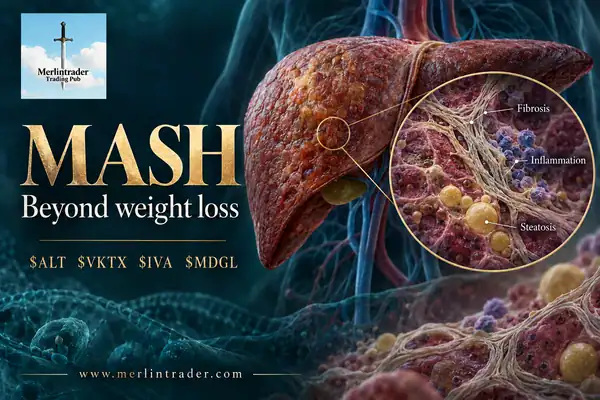
Illustrative cover, not a clinical image or a photograph of an identified commercial product.
$ALT | Pemvidutide
Resolution is not fibrosis
IMPACT's 24-week MASH-resolution result did not make its conventional fibrosis comparison statistically significant. Primary source
$VKTX | VK2809
The liver program
VOYAGE studied VK2809. Results from Viking's obesity candidate VK2735 are not evidence for this molecule. Primary source
$IVA | Lanifibranor
An approaching readout
Inventiva reported the last NATiV3 patient visit and retained Q4 2026 topline guidance; results were not yet established by that announcement. Primary source
$MDGL | Rezdiffra
Approved, with conditions
The FDA label covers adults with noncirrhotic MASH and F2-F3 fibrosis under accelerated approval. Confirming clinical benefit still matters. Primary source
The central question
MASH: beyond weight loss
Weight loss, lower liver fat, MASH resolution and fibrosis improvement are not interchangeable results. The useful comparison asks which endpoint each program has demonstrated, in which population, over what period, and what remains unproven.
What could work
A broader set of mechanisms could create more ways to treat a heterogeneous disease. Stronger histology, durable outcomes and workable access would make that possibility more meaningful than a race for the largest weight-loss percentage.
What could go wrong
Impressive metabolic changes can coexist with uncertain fibrosis effects. Trial design, tolerability, diagnosis, reimbursement and the need to confirm clinical benefit all stand between a positive headline and a durable treatment position.
Inventiva guided to NATiV3 results in Q4 2026 after the last patient's final visit. Altimmune announced initiation of PERFORMA in August 2026. These are different milestones: an approaching readout versus the start of a longer phase 3 evidence program, not comparable promises of imminent approval.
External market data may update after this research. Finviz links are affiliate links.
Extended analysis
Continue with the extended analysis: $ALT $VKTX $IVA $MDGL
The full comparison, evidence limits, execution risks and the next verifiable milestones. Sources and reporting dates accompany the analysis.
Free. No signup. You decide, we don’t recommend.
01. Start With the Liver, Not the Scale
An obesity headline usually has an intuitive unit: the percentage of body weight lost. MASH is harder to compress. Metabolic dysfunction-associated steatohepatitis involves more than the amount of fat stored in the liver. Inflammation, cellular injury and fibrosis introduce different questions, different measurements and different time horizons. A favorable change in one measurement does not automatically establish a favorable change in every other one.
That distinction is the starting point for comparing Altimmune, Viking Therapeutics, Inventiva and Madrigal Pharmaceuticals. They are not four interchangeable contestants in a weight-loss competition. Their relevant programs differ in mechanism, development stage and the evidence available to a clinician or investor. The comparison is useful precisely because those differences prevent a simple league table.
This article uses an evidence ladder: metabolic change; liver-fat change; histologic disease activity; fibrosis; and, ultimately, outcomes that patients experience. It is a framework for interpreting studies, not a claim that every patient moves through those steps in a fixed order. A drug can affect several dimensions simultaneously. What it cannot do is inherit proof for an endpoint that the trial did not establish.
The commercial question therefore comes later. Before asking which company might capture the largest market, ask what has actually been demonstrated and what kind of evidence remains necessary. An approved product and an investigational program may address the same disease while carrying very different unresolved risks.
02. Five Measurements That Should Not Be Merged
Weight change describes a whole-body result. Liver-fat change, often measured with MRI-based methods, describes a particular component of the liver disease. MASH resolution and fibrosis improvement are histologic assessments with protocol-specific definitions. Clinical outcomes concern events such as progression to serious liver complications. Each answers a different question; a press release containing several favorable percentages does not make them interchangeable.
The FDA’s current Rezdiffra label makes the separation concrete. It authorizes treatment of adults with noncirrhotic MASH and moderate-to-advanced fibrosis, consistent with stages F2-F3, in conjunction with diet and exercise. It also states that the indication received accelerated approval based on improvement in MASH and fibrosis, and that continued approval may depend on verification of clinical benefit. The approval is real. So is the remaining obligation. FDA prescribing information.
For a reader, the first practical habit is to write the endpoint in words before writing its percentage. Was it resolution without worsening fibrosis? Improvement in fibrosis without worsening disease activity? A combined endpoint requiring both changes in the same patient? A change in an imaging measure? Those formulations are not cosmetic variations.
The second habit is to preserve the time point and the analysis population. A 24-week result cannot simply be placed beside a 52- or 72-week result as though treatment duration were irrelevant. Nor should a result among patients with available follow-up be silently treated as a result among everybody randomized.
The third is to distinguish supportive evidence from the prespecified test that determined success. Supportive analyses can deepen understanding and help design the next study. They cannot retroactively change what the original primary endpoint was.
03. Altimmune: A Strong Signal Can Still Leave a Specific Gap
Pemvidutide makes the endpoint problem especially visible. The peer-reviewed 24-week IMPACT report described a favorable MASH-resolution result. However, the conventional fibrosis-improvement comparison did not reach statistical significance. Those two statements can both be true, and a fair account has to retain both. Treating the entire study as a single undifferentiated success would hide the very issue the next stage needs to clarify. IMPACT publication announcement.
Later information requires another distinction. Altimmune reported 48-week noninvasive-marker results and subsequently discussed quantitative fibrosis analyses. Those are additional pieces of evidence, not permission to relabel the 24-week conventional histology comparison. A later noninvasive result is not a later biopsy result merely because both relate to liver health. 48-week update, quantitative fibrosis update.
Altimmune announced initiation of the phase 3 PERFORMA program in August 2026. That moves the program into a larger confirmatory development setting; it does not itself establish phase 3 efficacy. Investors should separate the operational achievement of starting a trial from the eventual answer the trial is designed to produce. August 3 announcement.
The constructive interpretation is that pemvidutide has a clinically relevant signal worth testing further. The cautious interpretation is not that the signal disappears, but that its strength must be described endpoint by endpoint. The key future evidence is whether the larger program establishes the intended histologic benefits, with an acceptable safety and tolerability profile, under its own prespecified design.
For the full company context, including the broader development and financing picture, see the Altimmune Stock Hub. A thematic article should not turn a single clinical observation into a complete valuation of the company.
04. Viking: Keep VK2809 Separate From VK2735
Viking’s relevant liver candidate in this comparison is VK2809, its thyroid hormone receptor-beta agonist. The company’s VOYAGE phase 2b program used a liver-fat endpoint at week 12 and included later histologic assessments. That structure makes the distinction between early imaging evidence and later tissue evidence particularly important. Viking’s VK2809 program.
VK2735 is a different candidate. Its obesity results do not become VK2809 results because both programs sit inside Viking. This is a common analytical error in multi-program companies: evidence, excitement and implied commercial value drift from one molecule to another without an explicit bridge.
Even where two mechanisms might eventually have a rationale for use together, that rationale is not proof of a particular combination’s efficacy, safety or commercial positioning. A comparative article should not manufacture a combination strategy out of corporate ownership. Such a strategy would need its own evidence and development decisions.
For VK2809, the useful sequence is narrower: what did the liver-fat measurement show, what did the later histology add, and what further program is required to support an approval application? This article does not infer that a pivotal MASH program is underway merely from the completion of VOYAGE. A completed phase 2b trial and an initiated phase 3 trial are different facts.
The Viking Therapeutics Stock Hub provides the company-level context. Within this comparison, the discipline is to keep the liver program attached to the liver evidence and the obesity program attached to its own evidence.
05. Inventiva: A Different Mechanism Tests the Weight-Loss Shortcut
Lanifibranor offers a useful counterexample to the assumption that every credible MASH program should be understood principally through weight loss. In the phase 2b NATIVE study, the primary endpoint concerned improvement in a disease-activity score without worsening fibrosis. The published report also described histologic secondary endpoints and adverse effects including weight gain and peripheral edema. Those features make a scale-only interpretation inadequate. NATIVE, New England Journal of Medicine.
The lesson is not that weight gain is irrelevant, nor that liver histology cancels tolerability concerns. It is that the trade-off must be assessed directly. A treatment can have liver-directed evidence while raising separate questions about how patients feel, how long they remain on therapy, and which patients are suitable candidates. Efficacy and tolerability are parallel requirements rather than points that automatically offset each other.
Inventiva reported in September that the last patient had completed the final 72-week visit in the main NATiV3 phase 3 cohort and retained guidance for topline results in the fourth quarter of 2026. Completing visits is an execution milestone, not a positive result. September 2 NATiV3 update. The registered Part A primary endpoint requires MASH resolution and fibrosis improvement of at least one stage in the same patient at week 72. NATiV3 trial registry, NCT04849728.
That upcoming evidence should be read according to the phase 3 design, not as an automatic repetition of NATIVE. Differences in sample size, duration and endpoint construction matter. The clinically interesting question is whether lanifibranor can demonstrate the required combined benefit with a usable safety and tolerability profile.
The Inventiva Stock Hub supplies the broader corporate background. Here, the relevant boundary is simple: an approaching readout is not yet a demonstrated phase 3 outcome.
06. Madrigal: Approval Changes the Question, Not the Need for Evidence
Madrigal starts from a different position because Rezdiffra is an approved medicine. The current label defines its population; it is not an authorization for every person with fatty liver, every fibrosis stage or cirrhosis. The label also contains safety precautions and drug-interaction information. Commercial discussions that count everybody with metabolic liver disease as immediately eligible overstate what the authorization says. Current FDA label.
The pivotal MAESTRO-NASH publication provides the trial context for interpreting the histologic evidence. It should be read as evidence from a defined study population and follow-up period, not as proof that all long-term liver outcomes have already been resolved. MAESTRO-NASH, New England Journal of Medicine.
For Madrigal, the analytical emphasis shifts toward implementation as well as further evidence: identification of suitable patients, treatment persistence, monitoring, access and the confirmation of clinical benefit. These are not claims about a particular current prescription trend. They are the questions that logically follow when a program moves from development into use.
It is also no longer accurate to frame Rezdiffra as the only FDA-approved MASH treatment. The FDA subsequently approved Wegovy for a defined MASH population. That authorization belongs to a specific medicine and indication; it is not approval of the entire GLP-1 category for MASH. FDA announcement on Wegovy.
The Madrigal Pharmaceuticals Stock Hub is the fourth company reference for this article. Its inclusion does not imply that an approved therapy and the three investigational programs carry equal regulatory or commercial risk.
07. Why a Head-to-Head Ranking Would Be Misleading
A table can be useful without becoming a scoreboard. The meaningful columns are candidate, mechanism, study stage, population, endpoint, assessment time and unresolved question. A column headed simply “response rate” would discard too much information to support a reliable comparison.
Placebo outcomes also matter. A large percentage in one study may reflect a different population, background care, analysis method or endpoint from the percentage in another. Even subtracting the placebo percentage does not eliminate all differences between trials. It can help describe an individual randomized comparison without creating a valid indirect ranking across unrelated programs.
Another trap is to select each company’s most flattering endpoint and compare those winners. One program’s weight reduction, another’s liver-fat reduction and a third’s histologic composite are not a common currency. That exercise measures the flexibility of the presentation more than the relative strength of the medicines.
Combination treatment is similarly a hypothesis to investigate, not a conclusion to announce. Different mechanisms can be scientifically interesting together while creating unanswered questions about incremental benefit, tolerability, interactions, cost and adherence. Nothing in this four-company comparison establishes a preferred sequence or combination for an individual patient.
08. The Commercial Filter Comes After the Clinical Filter
The potential business opportunity is constrained first by who can appropriately receive the medicine. Diagnostic pathways, disease stage and label restrictions determine the relevant population. Access arrangements and treatment persistence then influence how much of that population can become sustained use. A large disease-prevalence estimate should not be substituted for an immediately serviceable market.
Development stage changes the financial question too. An investigational program must finance the remaining evidence before it can seek a commercial return. An approved product must convert access and adoption into a sustainable operation while supporting its continuing obligations. Neither task is captured by the size of a single clinical percentage.
For this reason, the article deliberately avoids a valuation ranking based on mixed clinical endpoints. A responsible company comparison would need current financial statements, economic rights, financing obligations and product-specific assumptions alongside the scientific work. The linked hubs provide a place to examine those issues without pretending that a thematic clinical framework is a complete investment model.
The practical watchlist is therefore evidence-based: the actual NATiV3 readout and its full design; PERFORMA execution and eventual results; the next verified development decision for VK2809; and the continuing clinical and commercial evidence around approved treatment. Dates supplied by companies remain guidance until the relevant event occurs.
09. The Question to Keep
The strongest question is not “Which company produces the most weight loss?” It is: what liver benefit has this specific medicine established, for which patients, with what trade-offs, and what still needs to be demonstrated?
That question leaves room for more than one useful mechanism without assuming every mechanism will succeed. It also prevents an early metabolic signal from being promoted into a clinical outcome and prevents an approval from being interpreted as the end of evidence collection.
Altimmune illustrates the separation between resolution and fibrosis. Viking illustrates the need to keep molecules and programs distinct. Inventiva tests a broader histologic proposition that is not reducible to the scale. Madrigal shows how approval changes the operating questions while preserving the need for further evidence. Together, they make a more informative comparison than a single percentage ever could.
Sources and Scope
Research cutoff: October 9, 2026. Links throughout the article lead to FDA materials, original clinical publications and company announcements. Company timelines are attributed guidance, not independently guaranteed dates. The comparison contains no head-to-head efficacy claim and no patient-specific treatment advice.
The company hubs are complementary research resources: ALT, VKTX, IVA and MDGL. Clinical and regulatory statements in this article are tied to their cited primary sources rather than inferred from share-price behavior.
Disclaimer. This article is published by Merlintrader for educational and informational purposes. It is independent analysis, not investment advice, an investment recommendation, or an offer or solicitation to buy or sell securities. It is not a regulated investment research report. No buy, sell or hold recommendation is made. Readers should conduct their own research and consult a licensed financial adviser before making investment decisions.
Information is tied to the stated research cutoff and the dates of the cited sources. Company guidance, investigational results, approved indications and editorial interpretation are different kinds of information. Plans may change and the article may not reflect subsequent events. Verify primary sources before making decisions.
Securities discussed can lose value, including all of an investment. Development, regulation, competition, financing and execution can change a company’s prospects. Medical discussion is not individual medical advice; treatment decisions belong with qualified healthcare professionals.
Merlintrader may hold positions in securities mentioned. Finviz links are affiliate links and may generate a commission at no additional cost to the reader. See the full disclaimer and terms of use and privacy.
Merlintrader · MASH: beyond weight loss · Comparative Research
 Umbria