01 Three scenarios: a better financing route, an unfinished turnaround
Constructive scenario: the financing closes and the factories earn it
Wolfspeed’s most constructive path now has two separate requirements. The company must turn the October 7 conditional government commitment into executable financing, and it must turn its manufacturing capabilities into a healthier operating business. The first could give management a longer financial horizon; the second determines whether shareholders ultimately benefit. A large loan can replace expensive obligations, but it cannot make an unprofitable shipment profitable. The investment debate therefore needs both a capital-structure timetable and an operating timetable. [1] [2]
In this scenario, definitive documents preserve attractive financing economics, the initial refinancing occurs, and later funding supports projects with credible customer demand. Conversion of existing debt reduces future financing pressure without overwhelming the value created for each remaining share. Meanwhile, stronger power-device sales, better manufacturing performance and a more favorable product mix move gross margins toward sustainable positive territory. This is an analytical scenario, not company guidance or a prediction of the transaction’s completion.
Middle scenario: strategic progress precedes financial recovery
A more mixed outcome is entirely possible. Wolfspeed could sign financing documents and advance its technology roadmap while its income statement remains weak. The August 19 outlook for fiscal Q1 2027 still anticipated negative non-GAAP gross margin. That creates a useful discipline: government recognition, product qualifications and revenue growth are not interchangeable measures of success. A business can improve strategically before it improves financially, and the share count can expand during that interval. [3]
The middle scenario would involve uneven customer ramps, continued operating cash consumption and a financing process that takes longer than a headline reader expects. Some milestones could be achieved while others remain contingent. In that situation, the relevant question is whether each quarter brings more durable commercial evidence at an acceptable capital cost. A rising headline facility amount or another product announcement would be insufficient evidence on its own.
Adverse scenario: conditions, dilution and operating losses reinforce each other
The adverse path combines difficulty closing the financing with an operating recovery that fails to materialize. Required government approvals, private capital, commercial agreements or lender consents might not arrive on workable terms. Weak gross margins could consume liquidity while additional equity or debt conversions increase the number of claims on future earnings. The company’s October filing explicitly says the anticipated financing might not occur at all. There is no sound basis for treating the announced maximum facility as a balance-sheet asset today. [2]
02 What Wolfspeed sells and why the manufacturing model matters
Wolfspeed is a semiconductor business focused on silicon carbide materials and power products. It supplies the starting material used to manufacture devices as well as power semiconductors that manage electrical energy in end systems. Its disclosed product families include silicon carbide material, power modules, discrete devices and power die. The business therefore participates at several points in the supply chain rather than depending on a single finished consumer product. Its common stock trades on the New York Stock Exchange as WOLF, and its principal executive offices are in Durham, North Carolina. [1] [2]
The latest quarter illustrates that mix. Power Products generated $106.3 million and Materials Products generated $43.3 million in the three months ended June 28, 2026. Together these equal the reported $149.6 million consolidated revenue. The distinction matters because materials customers can face different inventory and qualification cycles from buyers of finished power devices. A stronger result in one product line does not automatically demonstrate a recovery in the other. [3]
This business requires a different analytical approach from a software company that can expand with relatively little manufacturing investment. Semiconductor facilities, equipment, process development, quality assurance and customer qualification create commitments before the full commercial return is visible. The operating question is whether the company can spread those commitments over enough accepted products at adequate prices. Revenue without a workable gross margin can leave the company consuming cash even when demand improves.
The manufacturing platform also explains the policy interest. The October announcement identifies a domestic footprint in North Carolina, New York and Arkansas and links the proposed financing to a broader American wide-bandgap semiconductor supply chain. That is a strategic context, not proof that every facility is fully utilized or that every planned capability already exists. The distinction between established infrastructure, production capability and future investment remains essential throughout this hub. [1]
For readers following WOLF, a useful business map has three layers: what the company can manufacture, what customers have qualified, and what has actually been shipped and paid for. A technology announcement belongs primarily to the first layer. A customer qualification advances the second. Revenue, gross margin and cash collection provide the third. The strongest evidence is a sequence connecting all three, rather than repeated announcements at only one layer.
03 The October 7 commitment: maximum size is not available cash
On October 7, 2026, Wolfspeed announced a conditional commitment from the U.S. Department of War, acting through its Office of Strategic Capital. The proposed facility is a senior secured delayed-draw term loan with an aggregate principal ceiling of $1.5 billion. The contemplated maturity is 30 years, and the commitment period during which eligible tranches could be drawn is 36 months. These terms describe a proposed transaction subject to definitive documentation and substantial conditions. They do not describe cash already credited to Wolfspeed’s accounts. [1] [2]
The SEC filing divides the proposed facility into an initial $600 million tranche and as much as $900 million across the remaining tranches. There could be up to four tranches overall, with the later individual tranches ranging from $200 million to $400 million. That structure makes the sequence important. The first closing and later disbursements are separate events, and a successful initial closing would not eliminate the conditions attached to subsequent funding. [2]
The initial proceeds are intended to refinance the outstanding first-lien senior secured notes due in 2030 in full and pay transaction fees and expenses. Later proceeds would fund expenditures supporting the defined project. Consequently, adding $1.5 billion mechanically to the June cash balance would produce a misleading picture. Some proceeds would replace existing financing, later amounts might never be drawn, and both timing and final terms remain unsettled. [2]
The economic appeal is understandable. A company rebuilding its finances can benefit from a maturity profile that better matches long-lived manufacturing assets. Refinancing expensive debt can also reduce the cash burden associated with financing those assets. However, maturity extension is different from debt forgiveness, and a secured loan remains a senior claim on the business. Its value to ordinary shareholders depends on the full combination of pricing, conditions, dilution and operating returns.
The next meaningful announcement would be evidence that moves the transaction to a more definite stage: executed agreements, confirmed approvals, satisfied closing conditions or an actual funded draw. Until then, the correct language is conditional commitment, proposed facility and anticipated terms. A target closing date is not supplied in the October 7 announcement or its accompanying filing. [1] [2]
04 What must happen before the financing can be used
The proposed financing requires more than an agreement between a borrower and a lender. The October 7 filing identifies government authorizations or reauthorizations, appropriations, Office of Management and Budget concurrence, required third-party consents and satisfactory due diligence. Several of those decisions sit outside Wolfspeed’s direct control. The existence of a commitment letter is meaningful progress, but it cannot substitute for the later decisions that make a transaction executable. [2]
The commercial conditions are also substantial. Wolfspeed would need a definitive budget covering the company, relevant guarantors and the project; acceptable financing documents; and letters of intent or definitive offtake arrangements acceptable to OSC. Existing debt agreements may require amendments or waivers. These are not merely administrative labels: they connect the financing to a credible industrial plan and to the rights of parties already financing the company. [2]
The project undertaking spans domestic silicon carbide wafer and power-device production, domestic low-voltage and/or high-voltage gallium nitride production or onshoring, GaN-on-SiC radio-frequency epitaxial technology, and domestic radiation-hardening capabilities. This is wider than financing a single piece of equipment. The eventual budget, deliverables and contractual obligations will matter in assessing whether the company can execute the program without stretching its operating resources too far. [2]
Later tranches carry additional tests. The filing describes further diligence, acceptable commercial arrangements, qualifying contributions and compliance with financial covenants, including a loan-to-value covenant. That means future borrowing capacity would depend partly on the company’s condition at the time of each draw. The proposed maximum should therefore be analyzed as a staged opportunity, not an unconditional source of liquidity available whenever management chooses.
The practical monitoring framework is sequential: first definitive documents, then closing and initial funding, then evidence that later conditions are being met. A disclosure should be matched to the stage it actually confirms. An offtake letter is not the same as delivered revenue; an authorization is not the same as a loan draw; and a funded tranche is not the same as completing the industrial project. This sequence will help separate genuine progress from repeated references to the original announcement.
05 The required contribution and why dilution is broader than 7.5%
The October filing contemplates at least $750 million of qualifying contributions from the company, or another amount determined through OSC’s diligence. The contribution can be made in stages: $150 million associated with the initial tranche and a further $600 million associated with later tranches. The sources, timing and permitted instruments matter more than simply adding the contribution requirement to the government loan ceiling. These are different financing components with different consequences for shareholders. [2]
For the first $150 million, the filing requires proceeds from qualifying equity issued to third parties unaffiliated with the U.S. government. Of that amount, $50 million must be raised before the facility becomes effective, while $100 million may be raised afterward but before the second tranche is funded. This timing distinction avoids an incorrect reading that all $150 million must necessarily be raised before the first effective date. [2]
The remaining $600 million has a broader set of potential sources. Subject to the specified conditions and OSC discretion, these can include qualifying equity, equity used in acquisition consideration, excess cash, the face value of convertible debt converted or otherwise equitized, and other acceptable items. Qualifying sources received after June 28, 2026 are expected to count. It would therefore be inaccurate to describe the entire $750 million as a mandatory new cash common-stock offering. [2]
Nevertheless, the shareholder implications are significant. New common equity increases the share count. Preferred equity or equity-linked instruments can create other economic claims. Converting debt removes or changes a creditor claim but typically creates equity participation. The company may be financially stronger after such changes while each existing share represents a smaller percentage of the enterprise. Both sides of that trade-off belong in the analysis.
The filing also calls for commercially reasonable efforts to equitize a substantial majority of the relevant convertible-note principal, with additional conditions applying to later funding if the target has not already been achieved. Final amounts and exchange terms are not yet known. A definitive post-transaction share count therefore cannot yet be calculated. Any model claiming precision before the capital-raising terms, conversion terms and final documents exist would be projecting assumptions rather than reporting a disclosed outcome. [2]
06 Government warrants, loan pricing and the interest-only period
The contemplated government equity participation is through warrants issued proportionately as financing tranches are funded. The company release summarizes these as warrants covering up to 7.5% of fully diluted equity. The filing describes two components, 5% and 2.5%, with exercise prices based on a mutually agreed volume-weighted average price. The percentages use a specified fully diluted basis at the facility’s effective date, including warrant exercise but excluding common shares issued to satisfy the minimum contribution requirement. Final documentation can change the details. [1] [2]
This is not a disclosed immediate transfer of 7.5% of the company on October 7. Nor is 7.5% a ceiling on every source of dilution connected with the broader transaction. Warrants, private equity issuance and conversion of existing debt have different mechanics. They must be modeled together once their terms are known, using a consistent share-count denominator. Simply adding percentages from different instruments would be misleading.
The loan’s interest rate is expected to reference the U.S. Treasury rate for a similar maturity plus a risk premium. The filing provisionally places that premium between 1.25% and 1.75%, subject to diligence and negotiation. Those percentages are the spread, not the entire borrowing rate. A valid cost comparison would require the eventual Treasury reference, final premium, fees, amortization terms and the debt actually refinanced. [2]
For the first five years, interest may be capitalized into principal so long as the relevant conditions are met and no default has occurred. After that interest-only period, the anticipated structure calls for quarterly cash payments of interest and principal, with principal amortizing over 25 years on a straight-line basis. Capitalizing interest can conserve current cash, but it increases the amount owed. It is neither free financing nor a five-year disappearance of financing costs. [2]
The proposed warrants would have a ten-year term and customary provisions that include cashless exercise and structural dilution protection. These details matter for ownership and future capital decisions, but the decisive point remains the same: the transaction could materially improve financing flexibility while imposing a long-lived package of obligations and equity participation. The final agreement, rather than the headline, will define that package. [2]
07 The latest quarter: meaningful revenue, deeply negative margins
Wolfspeed reported fiscal Q4 2026 results on August 19 for the three months ended June 28. Consolidated revenue was $149.6 million. GAAP cost of revenue was $186.4 million, producing a $36.8 million gross loss and a gross margin reported at negative 25%. The distinction between revenue and gross profit is fundamental: the reported cost of producing that quarter’s revenue exceeded the revenue itself before operating expenses and financing costs were considered. [3]
Operating loss was $115.4 million, and net loss was $145.4 million. Research and development expense was $27.9 million; sales, general and administrative expense was $37.3 million. The company also reported restructuring and other expenses of $15.9 million. These figures help locate the operational problem. A reduction in interest costs could improve the result below operating income, but it would not by itself repair a negative gross margin or eliminate operating expenses. [3]
The non-GAAP view is useful but does not turn the quarter into a profitable one. The company highlighted approximately negative 20% non-GAAP gross margin and approximately negative $62 million adjusted EBITDA. Those are supplemental measures with exclusions described in the release. They complement GAAP results rather than replace them. In this case, both views show a business that still needs substantial improvement in its economics. [3]
The quarter’s operating cash outflow was approximately $54 million. Cash consumption differs from net loss because accounting charges, working capital and other adjustments intervene. That distinction is especially important after a restructuring and under fresh-start accounting. Readers should not treat net loss, adjusted EBITDA and operating cash flow as three interchangeable measures of cash burned.
The practical operating questions are whether device growth broadens, whether production costs decline relative to sales, and whether improvements persist without unusual working-capital help. A stronger quarter would show movement in several of these indicators together. A financing announcement can reduce near-term pressure, but the income statement will still provide the evidence needed to assess the underlying turnaround.
08 Cash, debt and the limits of a simple runway calculation
At June 28, 2026, Wolfspeed reported $1,088.6 million of cash, cash equivalents and short-term investments. The supporting cash-flow statement separates $576.3 million of cash and equivalents from $512.3 million of short-term investments. This is a dated liquidity snapshot, not a claim about the balance available on October 8. Operations, financing transactions and investment activity after the reporting date can change that amount. [3]
The same balance sheet reported $931.0 million of long-term debt and $756.5 million of convertible notes, net. Adding these two carrying-value lines gives $1,687.5 million. Subtracting the reported cash and short-term investments gives a simple calculated difference of $598.9 million. This is a limited balance-sheet bridge; it is not a comprehensive enterprise-value calculation, a covenant definition of net debt or a statement of contractual principal due. Lease liabilities and other obligations are separate. [3]
The presence of more than a billion dollars in liquid resources materially changes the immediate funding picture compared with a company holding only a small cash reserve. However, the money supports an operating business that remains loss-making and has investment commitments. Liquidity is a resource to execute a plan, not proof that the plan will succeed. It also cannot be counted a second time as if using existing cash for a required contribution leaves the original cash balance untouched.
For that reason, a mechanical cash-divided-by-one-quarter-burn figure is not a reliable runway forecast. The latest quarter’s operating outflow is not the whole investment program, and the proposed government transaction would alter both sources and uses of capital. Historical spending also includes working-capital effects that may not repeat. A credible forward liquidity assessment requires a budget that links operations, capital expenditure, debt service, equity proceeds and financing conditions.
Key items to watch in the next financial release are the date-specific cash balance, changes in debt carrying values and principal, operating cash use, capital expenditure and any completed financing. Cash can increase because of financing or reimbursements even while operations consume it. The source of a balance-sheet improvement is therefore as important as the balance itself.
09 Separating operating consumption from financing and reimbursements
The fiscal 2026 release divides cash flows between the successor and predecessor periods. For September 30, 2025 through June 28, 2026, the successor used $180.8 million in operating activities. It purchased $72.9 million of property and equipment and $3.6 million of patent and licensing rights. These figures cover that specific post-emergence period; they are not a single quarter and cannot be casually annualized without explaining the period and assumptions. [3]
The same period recorded $733.2 million of reimbursements of capital expenditures from incentives and investment credits. Financing proceeds included $379.0 million from new convertible notes and $96.9 million from new common stock and pre-funded warrants. The cash-flow statement also shows $716.6 million of payments on long-term borrowings, including finance lease obligations. Together these lines show why a larger cash balance cannot be read as evidence of operating self-funding. [3]
This distinction matters in assessing the October financing proposal. Capital raised through debt or equity may strengthen financial flexibility, and reimbursements may return previously invested capital. Neither category is recurring customer revenue. Likewise, repaying one borrowing with proceeds from another changes the structure of financing but does not create operating profit. A sound analysis keeps cash generation, capital recycling and new financing visible as separate mechanisms.
Working capital is another source of variation. Inventory reductions or changes in receivables and payables can improve a period’s cash flow even while the underlying manufacturing margin remains weak. Such improvements may be valuable and reflect better management, but they are not always repeatable at the same rate. Over time, the stronger outcome is cash generation supported by profitable deliveries and a sustainable working-capital cycle.
The most informative future bridge would begin with the prior cash balance and reconcile customer-related cash flow, investment spending, reimbursements, borrowing, debt repayment and share issuance to the new balance. That presentation would make the financing story easier to evaluate without confusing liquidity preservation with earnings recovery. Until the new transaction is finalized, its possible proceeds and required contributions remain scenario inputs rather than completed cash movements.
10 The 2025 restructuring changed both the company and the comparison
Wolfspeed emerged from Chapter 11 on September 29, 2025. Its announcement said the restructuring reduced total debt by approximately 70%, extended maturities to 2030 and lowered annual cash interest expense by roughly 60%. These are historical claims about the restructuring at that time. They should not be reused as estimates of the incremental benefit from the separate October 2026 financing proposal. Each transaction needs its own starting point and completed terms. [7]
The financial reporting consequence is equally important. Wolfspeed adopted fresh-start accounting at emergence, remeasuring assets and liabilities to estimated fair values. The fiscal 2026 earnings release states that the financial statements after the effective date are not comparable with those on or before that date. Its tables therefore distinguish successor and predecessor periods. A reader who ignores those labels can draw incorrect conclusions from changes in assets, depreciation, losses or per-share figures. [3]
For example, the release shows $468.3 million of successor revenue from September 30, 2025 through June 28, 2026 and $196.8 million in the preceding June 30 through September 29 period. Adding them produces a calculated $665.1 million across the two fiscal-year periods. That arithmetic is straightforward, but the sum does not erase the accounting discontinuity. Not every associated profitability metric forms a clean, directly comparable annual series. [3]
The stock’s historical record also requires care. A restructuring can profoundly change ownership and the economic claims represented by a share even if the trading symbol remains familiar. Investors should consult the emergence documents and later equity disclosures before comparing old share prices, historical per-share losses or market capitalization figures with the current security. A pre-restructuring price is not a meaningful valuation anchor.
The business now being analyzed has survived a major financial reset, but survival and attractive economics are different achievements. The relevant operating test is what the successor company can earn and generate in cash using its current assets and capital structure. The next financing package may improve those conditions again; it will still need to be judged alongside the resulting ownership and operating performance.
11 March 2026 provides a completed example of the financing trade-off
The March 26, 2026 refinancing is a useful completed transaction to contrast with the conditional October proposal. Wolfspeed issued $379 million principal amount of new 3.5% convertible 1.5-lien senior secured notes due in 2031 and approximately $96.9 million of common stock and pre-funded warrants. The company said approximately $475.9 million of gross proceeds reduced the existing senior secured note balance by about 43%, reducing total debt by approximately $97 million. [8]
Management expected that transaction to reduce annual interest expense by approximately $62 million. That was the company’s forward estimate associated with the March financing. It is not a measured full-year saving already demonstrated in the June quarter, and it should not be automatically added to an assumed October saving. The baseline changes after each refinancing, conversion and repayment. Comparing debt costs requires reconciling those steps in chronological order. [8]
The transaction shows the mechanism that makes the broader WOLF story complicated. Replacing expensive debt with lower-coupon convertible debt can reduce cash interest while retaining a future equity claim. Raising equity can reduce debt further but increases equity participation. A lower financing burden and additional dilution can occur in the same transaction. Describing only one side would leave the reader with an incomplete view.
The June-quarter release also reported that holders voluntarily converted $46 million of convertible notes into equity during the quarter. This is a completed historical conversion, distinct from the substantially broader equitization efforts contemplated in the October filing. It demonstrates that the capital structure was already changing before the latest announcement. It does not establish the final exchange terms or participation level for any future conversion process. [3]
The appropriate question is therefore not whether dilution exists in isolation. It is whether the financing relief and operating value created exceed the economic cost of the new claims, assessed per share. That cannot be answered by quoting a facility ceiling or an interest-saving estimate alone. It requires the final securities issued, the debt retired, the remaining obligations and a credible view of the business those securities will own.
12 The 200 mm platform: quality and utilization must become economics
On September 27, 2026, Wolfspeed announced commercial availability of a new Premium 200 mm n-type silicon carbide substrate. The company presented the product as a higher-quality starting material designed to reduce defects, improve wafer-shape consistency and support customer yields. The announcement is a concrete product-development milestone. It does not disclose the revenue that the new substrate will generate or establish a company-wide manufacturing margin. [4]
The distinction between a substrate specification and factory economics is important. Better starting material can improve the probability of making usable devices, but the eventual financial outcome also depends on qualification, process performance, selling prices, volume and cost. A favorable technical claim should therefore be followed by commercial evidence rather than immediately converted into an earnings forecast. The company’s product release explains its intended advantages; financial statements measure the aggregate business outcome.
The 200 mm platform also appears in the LITEON collaboration, where Wolfspeed emphasizes scalable production and supply-chain resilience. That connection is potentially useful because technology development has more economic relevance when it can support identifiable customer platforms. However, a manufacturing capability and a customer’s potential deployment schedule are not identical to a guaranteed production order at a disclosed price. Qualification reduces one uncertainty without eliminating all the others. [5]
For investors, the most informative manufacturing evidence would combine rising accepted shipments, improving gross margin and a disciplined investment requirement. A larger production footprint with weak utilization can weigh on profitability; more output with poor yield can also disappoint. The company must achieve the combination, not just increase one operating metric. This is an analytical framework rather than a claim that Wolfspeed has disclosed any particular current utilization or yield percentage.
The latest negative margins make that framework especially relevant. Financing could provide time and resources to improve production, but a longer maturity does not eliminate the need for profitable unit economics. Future disclosures will show whether the platform is converting technical progress into a repeatable commercial advantage. Until that evidence is visible, the manufacturing opportunity remains paired with substantial execution risk.
13 AI data centers and LITEON: customer qualification is a real milestone
The August 6, 2026 LITEON announcement goes beyond a generic statement of interest in artificial intelligence. The companies announced a strategic partnership and successful qualification of Wolfspeed silicon carbide technology for LITEON’s 800 VDC power sidecar and compute-rack power-supply platforms. The intended applications are next-generation AI data centers, with potential broader adoption across cloud-service-provider platforms and future deployments. Those distinctions should be preserved: qualification was announced; the breadth and timing of future deployment remained prospective. [5]
Wolfspeed’s exposure is to power delivery infrastructure, not the sale of AI accelerators themselves. Its technology is intended to help power-system designers address efficiency, density and reliability requirements. That creates an industrial route into data-center spending, but it does not justify applying the economics or valuation assumptions of an unrelated compute-chip business. The product role and the customer purchasing process are different.
The fiscal Q4 release reported that AI data-center revenue more than doubled year over year during fiscal 2026 and increased approximately 20% sequentially in the fourth quarter. Management nevertheless characterized the opportunity as moderate but growing. The release does not provide a separate absolute AI revenue figure. None can be inferred from the growth percentages, and there is no basis to claim that AI already dominates consolidated revenue. [3]
The comparison that matters is between the encouraging application-level growth and the company’s aggregate results. Power Products represented $106.3 million of quarterly sales, but consolidated gross margin remained negative. A successful end market can grow before it becomes large enough to change the overall income statement. The financial contribution will depend on scale, mix and the profitability of the actual devices shipped.
The next useful evidence would be repeat production demand, expansion across customer platforms and an identifiable contribution to revenue quality. More customer names can strengthen the commercial story, but the strongest confirmation would connect those relationships to improving margins and cash generation. The LITEON qualification is therefore an important milestone to monitor, with its significance tied to subsequent deployment rather than to the breadth of the AI narrative.
14 SiC, GaN and national-security applications: separate the roadmap from orders
The October proposal broadens the strategic discussion beyond the existing silicon carbide business. Wolfspeed identifies gallium nitride epitaxy for communications infrastructure and electronic-warfare applications, along with radiation-hardening capabilities for current SiC and future GaN products. The related filing describes a project covering both power devices and radio-frequency technology. These are planned directions for investment under a financing arrangement that has not yet closed. [1] [2]
That language does not mean that every capability is already in production. The announcement itself distinguishes current SiC products from future GaN products and uses prospective language for the program. Nor does the financing announcement disclose a $1.5 billion product order from the government. A loan funds eligible activity and must be repaid under its terms; an order purchases goods or services. The revenue consequences are different.
The strategic appeal is that domestic manufacturing capability may matter to customers whose priorities include supply assurance and national security. Such priorities can support a long investment horizon. However, technical qualification, procurement, budget processes and actual purchasing commitments still determine commercial outcomes. Government involvement does not guarantee factory utilization, margins or the market value of the common stock.
The proposed financing also has governance implications. The filing describes requirements concerning U.S. headquarters, board citizenship, permitted management nationality and certain changes of control, as well as an OSC right to designate a non-voting board observer. It also contemplates government rights relating to project products or services. These terms remain subject to definitive agreements, but they illustrate that strategic capital arrives with obligations as well as potential benefits. [2]
A balanced reading treats the government commitment as evidence of strategic interest in the platform while reserving judgment on the economics of the final transaction. The next documents should clarify deliverables, eligible expenditures, commercial arrangements and governance restrictions. Those details will help establish how much flexibility management retains and how the proposed program interacts with its existing commercial priorities.
15 Reading the stock, ownership and valuation after a capital reset
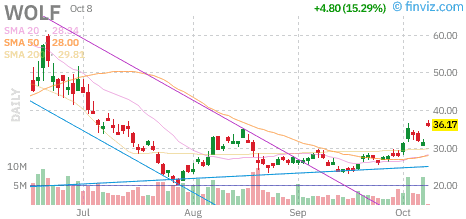
The reference closing price used in this hub is $31.37 for October 7, 2026, as displayed by Finviz. It is a dated reference, not a live quote or a target. The embedded daily chart is a separate Finviz chart as of October 8, 2026; its displayed price can therefore differ from the October 7 reference close. It is an intraday image, not an October 8 official closing price. The chart, closing reference and financial statements have different dates. [6]
For WOLF, the ownership denominator deserves unusual attention. Convertible securities, pre-funded warrants, new equity and potential government warrants can all affect the relationship between enterprise progress and value per common share. The March financing and October proposed contribution structure make this a central issue rather than a footnote. A valuation that assumes an unchanged share count through the financing process would need to justify that assumption explicitly. [2] [8]
Merlintrader has found no primary-source verification for a current short-interest percentage, institutional-ownership percentage or consensus price target. Such measures can use different reporting dates and definitions, and a capital restructuring makes inconsistent denominators particularly consequential. Without reconciling the source dates and security definitions, a striking percentage can create a false sense of precision. A number that cannot be reconciled is better left out than used as the basis of a thesis.
The same caution applies to headline market capitalization and enterprise value. A robust calculation should identify the price date, actual share count, treatment of potentially dilutive securities, cash date and debt definition. Balance-sheet carrying values, contractual principal and market values are different inputs. A transaction involving both refinancing and equity conversion can change several of them simultaneously.
The analytical focus here is therefore operating and financial evidence, not a target price. Readers can use the disclosed milestones to evaluate how the investment case changes, but the existence of a government financing route does not determine what the equity is worth. A strategically important semiconductor manufacturer can still carry substantial financing, execution and valuation risk. The price paid remains a separate question from the importance of the technology.
16 The next evidence that would strengthen or weaken the case
The financing milestone to watch is an executed agreement with final pricing, covenants, contribution requirements and warrant terms. After that, an actual funded initial tranche and confirmation of the first-lien refinancing would be more informative than another restatement of the maximum commitment. For later draws, the relevant evidence would include satisfied contribution tests, acceptable commercial arrangements and compliance with the agreed financial conditions. The October 7 documents establish the proposed sequence, not its completion. [2]
The operating milestone is a sustained improvement in the relationship between revenue and manufacturing cost. Fiscal Q1 2027 guidance issued on August 19 called for revenue between $140 million and $160 million, negative non-GAAP gross margin, and non-GAAP operating expenses between $62 million and $66 million. These are dated management expectations, not reported results. Subsequent results should be compared with that original outlook while also examining cash consumption and the quality of any margin improvement. [3]
The commercial milestone is evidence that qualifications and product introductions become repeat shipments. LITEON’s 800 VDC platforms and the new Premium 200 mm substrate are identifiable areas to follow. The strongest disclosures would provide information on deployment, customer adoption or financial contribution. A further technology announcement may matter, but it answers a different question from whether the current platform can support profitable volume. [4] [5]
What would falsify this reading
The cautious elements of this analysis would need to be reconsidered if definitive financing and subsequent operating reports demonstrated durable positive margins, lower cash consumption and manageable dilution. Conversely, the constructive elements would weaken if the company abandoned the financing, accepted materially less favorable terms, failed to secure required contributions or commercial agreements, or continued to consume resources without evidence of improving unit economics. These are analytical conditions, not forecasts that any particular outcome will occur.
The resulting assessment is deliberately two-sided. Wolfspeed has an identifiable industrial platform, a qualified AI power relationship and a potentially important new financing route. It also has negative margins, a recent restructuring history and a capital structure that may change substantially again. The next stage of the story will be measured by the terms actually signed, the cash actually funded, the shares actually issued and the products actually sold at a sustainable return.
Primary sources and reference links
Company statements are distinguished from completed results and Merlintrader analysis. Financial figures use their original reporting dates. SEC transaction details control where the press release is abbreviated.
[1] October 7, 2026 company announcement[2] October 7, 2026 Form 8-K, Items 7.01 and 8.01[3] Fiscal Q4 2026 results, August 19, 2026[4] Premium 200 mm substrates, September 27, 2026[5] LITEON qualification and partnership, August 6, 2026[6] Finviz WOLF: dated market-data reference[7] Chapter 11 emergence, September 29, 2025[8] Completed refinancing, March 26, 2026[9] Fiscal 2026 Form 10-K, year ended June 28, 2026Frequently asked questions about Wolfspeed
Has Wolfspeed already received $1.5 billion from the government?
No. The October 7, 2026 announcement describes a conditional commitment for a proposed facility of up to that amount. The company must negotiate definitive agreements and satisfy substantial conditions. The initial and later funding stages also have separate requirements. The announcement is not proof of a completed loan draw, and the undrawn maximum is not added to cash in this hub. [1] [2]
Is the proposed government financing a grant or a defense order?
It is described as a senior secured delayed-draw term loan. The initial proceeds would refinance existing first-lien notes and pay fees, while later proceeds would support the project. It is neither a disclosed product purchase order for the same amount nor an unconditional grant. The final documents would determine the actual obligations and economics. [2]
Does the transaction require $750 million of new common-stock cash?
That is not what the filing says. The proposed minimum contribution is at least $750 million, subject to diligence, but qualifying sources differ by stage. The initial $150 million must use qualifying equity proceeds, with $50 million before effectiveness and $100 million before the second tranche. The later $600 million can include other qualifying sources under the stated conditions, including eligible debt equitization. [2]
Is total dilution limited to the government’s 7.5% warrants?
No. The contemplated government warrants are only one component. Private equity issuance, equity-linked securities and conversion of outstanding debt can create additional equity claims. The filing also specifies a particular fully diluted denominator for the government warrants that excludes common shares issued for the minimum contribution. A final combined dilution calculation is not yet available. [2]
What were the latest reported cash balance and quarterly revenue?
At June 28, 2026, cash, cash equivalents and short-term investments totaled $1,088.6 million. Revenue for the three months ended on that date was $149.6 million. Those are historical reporting figures released on August 19. They are neither the company’s current October cash balance nor a forecast of the next quarter. [3]
Does growth in AI data centers mean Wolfspeed is profitable?
No. Management reported strong growth in that application while describing it as moderate but growing. The same quarterly release reported negative GAAP and non-GAAP gross margins, an operating loss and operating cash outflow. A promising end market can expand before it becomes large or profitable enough to change the economics of the whole company. [3]
Why are older financial and share-price comparisons difficult?
The company emerged from Chapter 11 on September 29, 2025 and adopted fresh-start accounting. The release explicitly distinguishes successor from predecessor periods and warns that the financial statements are not comparable across that boundary. Financing and ownership also changed. Historical per-share metrics and old stock prices therefore require careful reconciliation before being used in a current valuation. [3] [7]
What does the Merlintrader Health Score mean here?
It is an editorial assessment of financial and operational robustness over the next twelve to eighteen months. The five pillars and weights are shown in the free section. It is not a credit rating, a probability of closing the loan, a price target or a buy/sell signal. The assessment can change as final financing terms and subsequent operating results become available.
 Umbria