AI transparency: articles and reports are produced with the help of artificial intelligence and checked through a process that does not constitute specialist validation. They may contain errors: verify relevant information with independent sources. Read the full disclaimer.
Merlintrader · Comparative Research
$PCVX$MRK$PFE$SNY
Vaccine Catalysts: $PCVX vs $MRK $PFE $SNY
The pivotal headline is already out. The next comparison concerns the remaining evidence, manufacturing and financing, with adult and pediatric programs kept separate.
MerlintraderResearch cutoff: October 11, 2026Evidence dates remain those of the cited sources
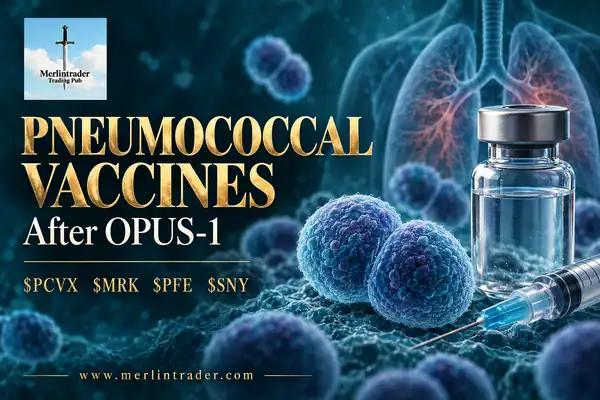
Pneumococcal vaccine comparison: Vaxcyte, Merck, Pfizer and Sanofi. Conceptual illustration, not clinical evidence.
Vaxcyte / Nasdaq PCVX
VAX-31
Investigational PCV31
Merck / NYSE MRK
Capvaxive
Approved adult PCV21
Pfizer / NYSE PFE
Prevnar 20
Approved adult/pediatric PCV20
Sanofi / Nasdaq SNY
SP0202 / GBP410
Pediatric phase 3 with SK
The central question
Vaccine Catalysts: $PCVX vs $MRK $PFE $SNY
VAX-31's adult comparison is with Merck's Capvaxive and Pfizer's Prevnar 20. Sanofi and SK bioscience belong on the pediatric development map, not in a table of three approved adult competitors.
Constructive scenario
A consistent broader package could support Vaxcyte's planned filing and clarify the clinical relevance of additional serotype coverage.
Risks and evidence limits
Immunogenicity success does not equal demonstrated superiority on clinical disease outcomes, an approved product, or a completed manufacturing package.
OPUS-1 was announced October 5, 2026. Company guidance points to OPUS-2/3 in H1 2027 and a planned BLA in H1 2028; these are neither a near-term FDA decision nor guaranteed dates.
Market context, not a live trading signal
Finviz last-session snapshot for October 9, 2026, retrieved October 11: $PCVX price $71.38; reported session volume 4,381,740 shares. These are historical vendor observations, not real-time quotes or evidence of a future run-up. Finviz source.
Market links can update after the research cutoff. OTC and overseas securities are identified separately in the comparison; no US ticker is substituted for them.
Extended analysis
Continue with the extended analysis: $PCVX / $MRK / $PFE / $SNY
The full comparison, evidence limits, execution risks and the next verifiable milestones. Sources and reporting dates accompany the analysis.
Free. No signup. You decide, we don’t recommend.
01. PCVX Is Now a Post-Readout Development Case
The central PCVX event has already happened. Vaxcyte announced OPUS-1 results on October 5, 2026. An article written as though investors are still waiting for that first pivotal adult disclosure would be analyzing the wrong setup. The relevant questions now concern the exact result, the remaining clinical and manufacturing package, the competitive position and the capital required to reach a possible launch.
The comparison is with Merck’s Capvaxive, Pfizer’s Prevnar 20 and the Sanofi/SK bioscience pediatric program SP0202, also called GBP410. These are not three identical competitors. Two are approved adult vaccines directly used as OPUS-1 comparators. The third is an investigational pediatric program relevant to Vaxcyte’s separate infant opportunity. The population distinction is fundamental, not a footnote.
Vaxcyte reported success on all prespecified OPUS-1 primary endpoints. It also reported that individual comparisons against PCV21 passed the stricter noninferiority criterion for 17 of 19 shared serotypes, not all 19; the two remaining comparisons passed the historical threshold. Both statements belong in the account. The prespecified primary analysis and the individual comparator analyses were not the same statistical test. October 5 topline release.
For a run-up-oriented reader, that is the starting point for a more nuanced thesis. The program has cleared a major disclosed test, but VAX-31 remains investigational. Supporting studies, manufacturing consistency, regulatory review and commercial implementation remain separate work. A successful trial can improve the opportunity without settling all those questions.
The article therefore examines the transition from a single prominent data event to a sequence of execution milestones. It does not assume that a positive headline guarantees approval, a particular market share or another rally. It asks what evidence would make the next stage of the thesis stronger or weaker.
02. The Four Tickers and the Actual Competitive Map
Security
Company
Vaccine or program
Relevant competitive role
PCVX
Vaxcyte, Nasdaq
VAX-31, 31-valent candidate
Investigational adult Phase 3 and infant Phase 2 programs
MRK
Merck, NYSE
Capvaxive, PCV21
Approved adult OPUS-1 comparator; current label also includes selected high-risk children
PFE
Pfizer, NYSE
Prevnar 20, PCV20
Approved adult and pediatric vaccine; OPUS-1 comparator
SNY
Sanofi, Nasdaq ADS
SP0202 / GBP410 with SK bioscience
Investigational pediatric Phase 3 competitor
The four title tickers are available on major US exchanges, although SNY represents an ADS in a foreign company. Sanofi’s partner SK bioscience is separately listed as 302440 on South Korea’s KOSPI, not a US exchange. Buying SNY does not mean buying a pure-play interest in that Korean company’s program. Sanofi share and ADS information, SK bioscience company and listing information.
The drug-code distinction is equally important. The term PCV21 describes valency, not one unique product across all sponsors. Merck’s approved vaccine and Sanofi/SK’s investigational pediatric candidate must not be merged because both contain 21 serotypes. Their compositions, development packages and intended populations differ. Sanofi collaboration announcement, SK program identification.
Corporate exposure also differs greatly. Vaxcyte’s value is closely tied to development and commercialization of its vaccine platform. Pneumococcal vaccines are one part of the diversified operations of the other sponsors. A product-level advance can matter substantially to competition without producing an equivalent percentage reaction in each stock.
This is consequently a clinical and business comparison, not a four-stock hedge. A reader should follow each peer for the information it contributes to the PCVX thesis while keeping the actual instrument and the sponsor’s broader earnings exposure separate.
03. Valency Counts Serotypes, Not Prevented Cases
A 31-valent vaccine includes more targeted serotypes than a 20-valent or 21-valent product, but the numerical difference is not a direct measure of additional clinical benefit. Serotypes contribute unequally to disease, and their distribution differs by age, geography, time and type of illness. A vaccine’s composition has to be matched to the burden it is intended to address.
An original epidemiological analysis by King and colleagues combined surveillance and study data to estimate the serotype distribution of invasive disease and respiratory infections. It assessed invasive pneumococcal disease separately from conditions such as nonbacteremic pneumonia and childhood otitis media. That separation is important because a coverage percentage for one outcome cannot simply be transferred to another. King et al., Journal of Infectious Diseases, 2025.
The investment consequence is that a market-size argument needs more than a valency ratio. Dividing 31 by 20 does not estimate relative effectiveness, relative revenue or relative market share. The added serotypes may address a meaningful residual burden, but the extent of that burden and the vaccine’s performance against it require evidence.
There is also a denominator issue. Coverage can refer to the proportion of typed isolates, the proportion of all pneumococcal cases, or a modeled disease burden after specified exclusions and assumptions. Missing serotype data and assumptions about cross-protection affect interpretation. A percentage without its population and method may look more definitive than the underlying estimate.
For PCVX, the central proposition is broader useful coverage while retaining adequate immune responses to important shared serotypes. That is stronger and more testable than the slogan that more serotypes must always be better. It links composition to epidemiology, immunogenicity and the eventual benefit-risk assessment rather than treating the label number as the entire scientific case.
04. The Carrier-Sparing Platform: Why the Engineering Matters
Vaxcyte describes its approach as using a modified protein carrier with predetermined conjugation sites. The goal is to attach polysaccharides while preserving access to regions important for immune help, permitting less carrier per conjugate and the inclusion of additional serotypes. The company presents this as a way to limit carrier-related interference while maintaining immunogenicity. These are the platform’s engineering rationale and development claims. Vaxcyte May 2026 investor presentation.
The practical challenge in a higher-valency product is not merely adding more ingredients. The finished formulation must generate an acceptable profile across its components and be reproducibly manufactured. A strong response to several added serotypes would not compensate automatically for an important weakness elsewhere. That is why the serotype-level tables are more informative than a single average immune-response number.
Platform validation also has degrees. Demonstrating that one formulation can meet its trial objectives supports the technology in that use. It does not prove that every future higher-valency formulation, every age group or every bacterial target will succeed. Changes in composition, dose and population can create new development questions.
The company has other programs, but the near-term comparison here remains VAX-31. Treating the whole pipeline as independently de-risked by one adult readout would overstate what the experiment tested. Conversely, the result can reasonably increase confidence that the underlying manufacturing and conjugation approach is clinically usable in the evaluated setting.
For valuation, the platform contributes potential future opportunities and possible execution advantages. Those should be modeled as contingent opportunities with their own costs and evidence requirements, not added as fully earned franchises. The current lead-product analysis must still stand on its own clinical, manufacturing and commercial merits.
05. OPUS-1: Who Was Studied and What Was Measured
The OPUS-1 registry describes a randomized, blinded, active-controlled trial in adults who had not previously received a pneumococcal vaccine. Older participants were assigned to VAX-31, PCV20 or PCV21; the younger cohort compared VAX-31 with PCV20. Immune-response assessments were made one month after vaccination, with longer safety follow-up. The study excluded several immunocompromising conditions. OPUS-1, NCT07284654.
The October disclosure reported 4,047 dosed participants: 3,572 aged 50 or older and 475 aged 18-49. The older group used 1:1:1 allocation; the younger group used 3:1 allocation, with PCV20 serving as its safety comparator. October results presentation filed with the SEC.
These details delimit the evidence. The trial is not a completed outcomes study counting comparative reductions in hospitalizations or deaths. It is a pivotal safety and immunogenicity test, with direct vaccine comparators and an age-bridging component. That is a substantive achievement if successful, but its claim should match its measurements.
The population also explains why additional studies matter. Previously vaccinated adults have a different immune history from vaccine-naive participants. Concomitant vaccination introduces another practical question. Infants have their own dosing series and developmental context. OPUS-1 cannot answer all of these by virtue of being large or pivotal.
A dated source difference should be retained: the May registry and August company update listed 4,049, whereas the October results materials report 4,047 dosed. This article uses the later result denominator for OPUS-1 and does not invent a reason for the two-person difference. Registry counts and earlier enrollment updates are not substitutes for the final analysis population used in a disclosed result.
06. The Primary Statistical Architecture Explains the Headline
The reported primary immunogenicity structure separated shared serotypes from those unique to VAX-31 and included prespecified multiplicity handling. For serotypes shared across both licensed comparators, success could be established against one or both under the specified procedure. The analysis was not equivalent to requiring every individual comparison against each vaccine to exceed the stricter threshold. OPUS-1 primary-analysis description.
That distinction allows the overall primary-endpoint statement and the more qualified comparator-specific result to coexist. It is not appropriate to erase the missed individual thresholds. It is equally inappropriate to declare the prespecified primary analysis failed by substituting a different success rule after seeing the data.
Noninferiority evaluates whether the confidence interval excludes a prespecified degree of disadvantage on the measured endpoint. It does not prove the two vaccines are identical. Nor does a successful noninferiority test automatically establish superiority. The margin, assay, analysis population and statistical procedure are part of the result.
The lower confidence bound is especially important. A point estimate may appear favorable while its interval remains too wide to satisfy the criterion. Conversely, an estimate below one can still meet a noninferiority margin. Reading only the direction of a plotted point would miss what the trial actually tested.
For an event-driven investor, the statistical architecture affects the quality of the evidence and the questions likely to remain in review. It should not be used as a rhetorical device to make the result wholly clean or wholly invalid. The defensible interpretation preserves both the planned success definition and the specific places where the comparison was less robust.
07. Serotypes 3 and 12F Deserve Explicit Attention
In the individual comparisons, VAX-31 met the greater-than-0.667 lower-bound criterion for all 20 shared serotypes against PCV20 and 17 of 19 against PCV21. Serotypes 3 and 12F missed that stricter threshold against PCV21 but passed the historical greater-than-0.5 threshold. The October presentation also cautioned that the PCV21 comparison may receive particular regulatory attention because of adult disease coverage. Comparator-specific results, October presentation.
The immediate analytical task is to understand the size and precision of those differences and their place in the complete evidence package. The mere word “miss” does not quantify a clinical consequence. The phrase “historical threshold” does not make the stricter test disappear. Both shortcuts prevent a reader from evaluating the actual uncertainty.
A sponsor’s explanation of anticipated regulatory focus is also not an FDA decision. It can identify a plausible review issue, but the agency’s eventual judgment will concern the submitted data and proposed indication. The article does not infer a deficiency letter, an approval commitment or a required additional trial that has not been disclosed.
The comparison has to remain serotype-specific. A broad coverage advantage and an individual immune-response limitation can coexist. Assessing that trade-off requires the epidemiological importance of the relevant serotypes, the response distributions, the total safety package and the applicable regulatory framework. It is not settled by counting how many rows are green in a slide.
For the next stage of the thesis, fuller disclosure and regulatory feedback can reduce uncertainty. Until then, a constructive case should acknowledge these two comparisons rather than omit them. A skeptical case should explain why they could materially alter the product proposition rather than treating any missed threshold as automatic proof of commercial failure.
08. Immunobridging and Safety Add Evidence, With Limits
Vaxcyte reported successful primary immunobridging across 32 assessments in younger versus older adults. That count includes 31 vaccine serotypes plus cross-reactive 20B; it does not make VAX-31 a 32-valent formulation. The topline release reported no serious adverse events considered vaccine-related and no study discontinuations due to adverse events. OPUS-1 age-bridging and safety disclosure.
Immunobridging supports an inference across specified age groups using the measured responses. It is not a direct demonstration that every subgroup has identical clinical protection or identical duration of benefit. The age bands, assay and comparison criteria need to remain attached to the claim.
Safety interpretation also requires more than the absence of a vaccine-related serious event. Local and systemic reactions, their severity, their duration and differences across age groups contribute to the practical benefit-risk profile. Rare events may not be fully characterized by a trial of this size, even when the observed findings are reassuring.
The proper comparison is between complete safety datasets collected under defined methods. A solicited symptom diary over one period cannot be casually compared with spontaneous reports over another. Differences in follow-up, attribution and population can change the apparent rate. The article therefore does not invent precise OPUS-1 reaction percentages where they were not available in the reviewed topline account.
For commercial analysis, tolerability can influence acceptance and implementation, but it is one component of the proposition. A vaccine with broader coverage still needs an acceptable experience and a clear recommendation pathway. A reassuring early safety profile improves that prospect without eliminating the need for the remaining program and continued surveillance after any eventual approval.
09. Merck’s Capvaxive: Read the Current Label, Not an Old Summary
Capvaxive is a 21-valent conjugate vaccine with adult invasive-disease and pneumonia indications for specified serotypes. Its current June 2026 label also includes invasive-disease prevention in children aged 2-17 at increased risk for pneumococcal disease. That is not a routine infant-series approval. The adult pneumonia indication uses accelerated approval based on OPA immune responses, with continued approval potentially contingent on confirmatory benefit. Current Capvaxive prescribing information.
The updated pediatric scope is important because describing the product as exclusively adult would now be incomplete. At the same time, expanding that fact into a claim that Capvaxive competes across the entire infant schedule would be wrong. Approved age and risk groups define the actual market position.
Merck’s adult strategy illustrates why serotype selection matters more than a simple count. A product can focus on residual disease in an adult population rather than replicate the composition of an infant vaccine. That creates a meaningful benchmark for VAX-31’s broader-composition thesis: additional coverage must be considered alongside performance on the serotypes already prioritized by the adult comparator.
The label also demonstrates that immunogenicity can support specific regulatory pathways without becoming a direct outcomes-superiority claim. An investor should not demand that a new entrant already possess a head-to-head clinical-outcomes study merely because it uses immune-response endpoints, then simultaneously describe an incumbent’s immunogenicity result as if it were such a study.
For PCVX, Capvaxive is therefore both a direct trial comparator and a commercial standard to understand. Its current indication, evidence and practical use matter. Merck’s broad corporate portfolio does not dilute the scientific relevance of that competition, even though it changes the sensitivity of MRK shares to any one vaccine development.
10. STRIDE-3 Provides a Useful Historical Standard
STRIDE-3 randomized 2,663 adults and compared V116, subsequently marketed as Capvaxive, with PCV20. It met noninferiority criteria for the ten shared serotypes and superiority criteria for ten of eleven unique serotypes; 15C did not meet the unique-serotype superiority tests. Younger-adult immune responses successfully bridged to the older comparison group. No vaccine-related serious adverse events were reported. Platt et al., STRIDE-3 primary publication.
This history is relevant because it shows the importance of reading a vaccine package at the level of its actual tests rather than imposing a retrospective rule that every serotype must exceed every possible comparison. It does not mean a missed criterion in one program guarantees acceptance of a different miss in another. The products, margins and supporting evidence are distinct.
The study also provides context for the historical noninferiority margin. A lower-bound threshold used in a prior development program is an identifiable statistical standard, not a synonym for regulatory sufficiency in every later trial. A more stringent test can generate additional uncertainty without nullifying the information obtained under the broader package.
For a fair comparison, the analyst should retain both the shared-serotype and unique-serotype questions. Shared-serotype noninferiority asks about preserving responses relative to an existing vaccine. Unique-serotype superiority asks a different question where the comparator lacks the same component. Combining them into one average score would obscure the intended balance of retained and added coverage.
The useful lesson for the PCVX read-through is methodological. Examine the trial’s planned structure, each material exception and the total evidence available. Do not infer the FDA’s next decision by analogy alone. Historical precedent can frame questions and reduce confusion, but it cannot substitute for the future review of VAX-31’s own submission.
11. Pfizer’s Prevnar 20 Competes in Two Distinct Age Markets
Prevnar 20 is approved for invasive-disease prevention from six weeks of age, with an adult pneumonia indication and a narrower serotype-specific childhood otitis-media indication. Its infant schedule is a four-dose series, whereas adults receive a single dose. The adult pneumonia indication for the seven added serotypes uses an accelerated-approval basis. Prevnar 20 US prescribing information.
Those distinctions create two competitive relationships with VAX-31. In adults, PCV20 is a directly studied OPUS-1 comparator. In infants, it is the active comparator in Vaxcyte’s separate dose-finding trial and an established vaccination option. Success in the adult study does not answer the pediatric comparison, even though the sponsor and candidate name are the same.
The label’s outcome-specific scope also prevents overclaiming. An indication for invasive disease across a serotype set is not automatically an indication for every form of noninvasive illness across that same set. A broad statement that a vaccine prevents all pneumococcal disease would be less precise than the actual authorization.
For a business comparison, an incumbent spanning adult and pediatric use may have several sources of experience and infrastructure. That does not make a new entrant impossible. It does mean that product differentiation must be translated into recommendations, access and dependable supply, not merely a favorable scientific presentation.
The practical PCVX question is where the incremental proposition is strongest. Broader composition may be attractive in both branches, but the evidence, schedule and commercial route differ. A model that assumes one launch date, one uptake curve and one patient-level economics for both would disguise those differences. Each branch needs its own probability, timing and resource assumptions, stated as assumptions rather than observed facts.
12. PCV20’s Adult Trial Shows Why Individual Results Need Context
The pivotal adult PCV20 study tested immune responses against PCV13 for shared serotypes and PPSV23 for the seven additional serotypes. It met the reported primary objectives, with noninferiority for all thirteen PCV13-matched serotypes and six of the seven additional PPSV23 comparisons. Serotype 8 missed the statistical noninferiority criterion. The analysis used a lower 95% confidence bound greater than 0.5. Essink et al., pivotal adult PCV20 trial.
That record helps distinguish a study’s overall development interpretation from an oversimplified perfect-score narrative. It also underscores that comparator choice matters. A conjugate vaccine compared with a polysaccharide vaccine for selected components is not the same experimental setting as VAX-31 compared directly with two conjugate vaccines.
The historical result should not be used to dismiss any current concern automatically. Regulatory packages develop in a changing context, and the available alternatives matter. A later sponsor may need to explain the totality of its evidence against contemporary products, not merely point to a prior approval and assume the same conclusion.
For readers comparing immune-response magnitude across publications, assay and population differences create another limitation. A geometric mean titer from one study cannot be treated as directly interchangeable with a value generated under a different assay or protocol without suitable validation. Within-trial ratios to the specified comparator are generally more interpretable than an unadjusted ranking of published titers.
The conclusion is not that vaccine data are too complicated to analyze. It is that the analysis must be done at the right level. The exact endpoint, margin, comparator and exception provide far more decision-useful information than a headline saying that one product has more serotypes or a higher number somewhere in a table.
13. The Infant PCV20 Evidence Sets a Separate Benchmark
In the published four-dose infant PCV20 trial, 1,991 children were vaccinated, with 1,001 receiving PCV20 and 990 PCV13. All twenty serotypes met noninferiority criteria for IgG geometric mean concentrations after doses three and four. The percentage-above-threshold endpoint after dose three had a different pattern, with some serotypes missing that criterion. Functional responses and booster responses contributed additional evidence. Senders et al., infant Phase 3 study.
The distinction between concentration and the proportion exceeding a threshold is important. An average can be satisfactory while a distribution-based endpoint tells a more qualified story. Conversely, a threshold measure alone may not capture the full pattern of functional response. The complete package should be read rather than selecting only the most favorable endpoint type.
The dosing series adds another dimension. Responses after the primary series and after the booster answer related but different questions. A later booster result can be informative without making an earlier measurement irrelevant. The timing of protection and the consistency of responses across the schedule matter to the intended use.
For VAX-31, the implication is that pediatric evidence cannot be summarized as an adult result reproduced at a smaller body size. The infant program has its own dose selection, safety observations, concomitant vaccines and immunogenicity measures. A favorable Phase 2 result could justify advancement while leaving substantial pivotal work ahead.
From a catalyst perspective, this creates potential for informative data beyond the adult program. It also creates the risk of overvaluing a dose-finding announcement as though it were a complete pediatric registration package. The correct interpretation will depend on the tested formulation, population, endpoints and next development step, not simply whether the sponsor describes the result as positive.
14. Sanofi and SK Bioscience: A Genuine Pediatric Rival
Sanofi announced initiation of its pediatric PCV21 Phase 3 program with SK bioscience in December 2024. The planned program included more than 7,700 participants across infant, toddler, child and adolescent studies in multiple regions. The partners also expanded their collaboration for future pediatric and adult vaccines. The announced commercial arrangement gives Sanofi rights outside South Korea, with SK retaining Korean exclusivity and receiving royalties elsewhere. Sanofi partnership and Phase 3 announcement.
The current Sanofi pipeline continues to identify SP0202 as a Phase 3 pneumococcal program. The program code GBP410 used by SK refers to this partnered candidate, not Merck’s Capvaxive. Sanofi pipeline, SK program identification.
This competitor belongs in the comparison because VAX-31 has a separate infant development branch. It does not belong in a table of approved adult OPUS-1 comparators. Keeping those maps separate prevents the false impression that Vaxcyte has already tested its adult product head-to-head against the Sanofi/SK candidate.
The partnership also matters economically. Product success would be shared under licensing and commercial arrangements rather than accruing identically to each sponsor. An investor considering SNY or the Korean partner must understand which rights and obligations are represented by the selected security. The four-ticker title is a practical editorial choice, not a claim of equal ownership exposure.
The competitive question for the pediatric branch is how the eventual evidence packages compare in the relevant schedules and populations. Valency is one feature; immune-response consistency, safety, routine-vaccine compatibility, supply and recommendations are others. None of the reviewed sources establishes that either investigational program has already won that future comparison.
15. Infant Phase 2: Optimized Dosing and a VAX-24/VAX-31 Decision
The infant VAX-31 registry lists 900 enrolled participants and four dose/formulation groups, including a high-dose prefilled-syringe group, against PCV20. Vaccinations occur at two, four, six and twelve-to-fifteen months, alongside routine pediatric vaccines. Entry is restricted to healthy full-term infants within the specified early-age window. Safety is primary; serotype-specific IgG measurements after the primary series and booster are listed as secondary outcomes. NCT06720038, registry updated May 15, 2026.
The June-quarter 10-Q supplies an important evolution not captured by those registry labels: the September 2025 protocol modification added an Optimized Dose, with most serotypes at 4.4 mcg and the remainder at 3.3 mcg, and stopped further Low Dose enrollment while retaining Middle and High Dose arms. The 900 participants include 100 previously enrolled in Low Dose. The filing does not equate its Optimized Dose terminology with the registry’s High-PFS label. Crucially, the future infant phase 3 program could use an Optimized Dose formulation of VAX-24 or VAX-31, depending on the VAX-31 phase 2 results. Product selection, not just selection among VAX-31 doses, remains open. Vaxcyte June-quarter 10-Q, pediatric program.
The registry’s estimated completion date should not be converted into a corporate topline appointment. Company guidance anticipates primary-series and booster data, sequentially or together, by the end of the first half of 2027. That is a dated disclosure window for specified analyses, not a claim that every follow-up activity ends then. Current Vaxcyte pipeline guidance.
For an investor, a constructive result would provide a clear rationale for the selected formulation and the next trial, with enough serotype-level and safety detail to assess the trade-offs. A mixed result could show useful breadth but uneven responses or uncertainty about the preferred dose. An adverse result could change the pediatric development plan without necessarily reversing the adult OPUS-1 finding.
The two branches share technology and some operational dependencies, but they are not the same clinical experiment. A valuation can recognize shared learning while retaining separate development risk. Treating them as fully independent successes would overstate diversification; treating one branch’s result as the automatic answer for the other would overstate read-through.
16. OPUS-2 Tests a Practical Vaccination Question
OPUS-2 evaluates VAX-31 given with a licensed seasonal influenza vaccine versus administration one month after it in pneumococcal-naive adults aged at least fifty. The August update reported 1,390 dosed participants and described the study as descriptive, intended to provide supportive evidence and inform a possible later outcomes study of concomitant use. Vaxcyte second-quarter development update.
This is not a repeat of OPUS-1 under a different name. The question is whether the vaccination workflow produces an acceptable immune-response and safety profile when two vaccines are given together. That can matter to real-world implementation because separate visits and same-visit administration have different practical implications.
The descriptive designation should shape expectations. Unless the final report specifies formal tested hypotheses, the article should not invent a binary statistical hurdle or describe every numerical difference as a significant interaction. Confidence intervals, consistency across serotypes and the pattern of responses to the concomitant vaccine will matter more than an unsupported pass/fail scorecard.
A favorable result could strengthen the practical launch proposition, while an unfavorable or ambiguous result could require more study or a more limited administration strategy. Neither outcome should automatically be translated into total adult-program success or failure. The effect depends on how the evidence changes the proposed use and remaining requirements.
For a run-up calendar, OPUS-2 is therefore an implementation-relevant clinical milestone, not an FDA approval decision. The useful preparation is to identify the populations, timing and outcome categories in advance, then compare the actual disclosure with those expectations. A familiar product name does not make the event identical to the pivotal noninferiority trial already reported.
17. OPUS-3 Addresses Previously Vaccinated Adults
OPUS-3 is the separate descriptive study in adults aged at least fifty who have already received pneumococcal vaccination. The August update reported 752 dosed participants. It examines whether VAX-31 can broaden responses and boost responses to serotypes included in earlier lower-valency vaccines. OPUS-3 program description.
Prior vaccination changes the baseline immune context. A response after another pneumococcal product cannot be assumed to match the response in a vaccine-naive participant. The particular prior product, interval and sequence matter to interpreting the result and any eventual use recommendation.
Merck’s STRIDE-6 provides a relevant historical example of studying vaccine-experienced adults separately. It enrolled 717 participants across cohorts defined by previous pneumococcal regimens and assessed immune responses after V116. The study reported immunogenicity across those cohorts, with descriptive comparisons appropriate to each prior-vaccine group. STRIDE-6 original research record.
The business importance is that an adult market includes both newly eligible and previously vaccinated people. Yet positive immunogenicity in the latter group does not automatically authorize immediate revaccination of everyone who received an incumbent product. Approval scope and public-health recommendations remain separate determinants of the addressable population.
A careful model should therefore avoid counting the entire adult population as a one-time conversion opportunity at launch. Some people may not yet be eligible, some may have completed a recommended schedule, and some may face different timing rules. OPUS-3 can inform an important part of that pathway, but it does not establish the entire commercial opportunity in isolation.
The next result should be read by prior-vaccine cohort rather than only through an overall average. That is where useful differentiation or limitations may become visible.
18. Manufacturing Consistency Is Part of the Product, Not Paperwork
Vaxcyte plans a manufacturing-consistency study before the proposed BLA submission. A lot-to-lot study asks whether separate production lots yield sufficiently consistent immune responses under the defined test. It addresses a different risk from showing that one clinical formulation performs well against a competitor. Vaxcyte adult-program plan.
Merck’s STRIDE-4 illustrates the type of evidence involved. Adults were randomized among three V116 manufacturing lots or PPSV23; all three lots met the reported equivalence criteria for OPA responses across the twenty-one serotypes. That was evidence of consistency for Merck’s product and process, not proof that Vaxcyte’s future lots will do the same. Scott et al., STRIDE-4.
The investment relevance is direct. A commercial vaccine must be reproducibly supplied, not merely demonstrated in an earlier trial. Manufacturing readiness encompasses more than the existence of a building or an announced partner. It includes validated processes, quality systems, material availability and the evidence required for the submission.
Clinical and manufacturing risks can also interact. A change needed to scale production may require comparability work; a delay in the manufacturing package can move the filing even when the efficacy narrative is unchanged. This article does not assert that such a problem has occurred. It identifies why the remaining work has independent value and uncertainty.
The strongest post-OPUS-1 thesis therefore follows concrete manufacturing milestones alongside clinical results. A broad statement that the program is now de-risked would be incomplete. The major clinical disclosure has improved the evidence base, while reproducible production and regulatory acceptance of the whole package still need to be established.
19. Supply Agreements Create Capacity and Long-Term Costs
Vaxcyte’s June-quarter filing reported that its dedicated Lonza suite was handed over to operations on August 1, 2026 after construction and certification for commercial operation. The agreement includes facility, service and other costs and extends to 2038, subject to its terms. This is an operational milestone, not an FDA approval of VAX-31. Manufacturing disclosures in the June-quarter 10-Q.
The January program update also described a long-term commitment of up to $1 billion in US manufacturing and services and planned a custom fill-finish line. The amount describes a multi-year commitment framework, not a single immediate expense or a new cash balance. January 22 manufacturing update.
Capacity investment can improve launch preparedness and protect future supply. It also commits resources before commercial demand is proven. A successful clinical result may make that investment more valuable, but it does not turn the associated costs into free infrastructure. The economic assessment must include both readiness and the risk of timing or utilization falling short of plan.
This creates a different risk profile from a small proof-of-concept biotech with little manufacturing investment. The lead program may have more mature evidence, while the operational commitments become larger and more consequential. A delay can affect not only the present value of future sales but also the period during which capacity and organizational costs are carried before revenue.
The appropriate investor questions are specific: what capacity is available, which activities are still required, what costs are fixed or volume-sensitive, and how the plan changes under different launch scenarios. The reviewed disclosures do not support a precise unit-cost forecast, so this article does not invent one from the headline commitment.
20. Approval, Recommendations and Uptake Are Three Different Steps
Current CDC guidance recommends pneumococcal conjugate vaccination for adults aged fifty or older who have not received a PCV, and for younger adults with specified risk conditions. Available options include PCV15, PCV20 and PCV21, with different follow-on requirements depending on the product and history. Previously vaccinated adults require their own schedule assessment. CDC adult pneumococcal guidance, February 25, 2026.
That existing framework is important commercial context, not a recommendation for an investigational vaccine. VAX-31 would need its own regulatory and implementation path. A successful BLA review would not by itself establish every subsequent public-health recommendation or the speed at which providers and payers adopt the product.
The distinction prevents a common valuation shortcut. The number of people within an age band is not the number who will receive a new product in its first year. Prior vaccination, recommendation status, access, awareness, provider workflows and supply all affect uptake. A realistic model separates newly eligible cohorts from catch-up or revaccination opportunities.
The epidemiology also has local implications. CDC’s published discussion identifies settings where serotype 4 remains particularly important and notes the relevance of vaccine composition. That is a reminder that a national average coverage estimate does not describe every community equally. CDC expanded adult-recommendation analysis.
For a future VAX-31 launch, the broader composition thesis could be useful if supported by the final evidence and recommendations. Its commercial value would then depend on converting that proposition into actual vaccination practice. The article does not assume that scientific breadth alone ensures preferred status, immediate switching or a particular reimbursement outcome.
21. The Balance Sheet Before the October Raise
Vaxcyte reported $2,507.7 million in cash, equivalents and investments at June 30, 2026. Second-quarter R&D expense was $267.9 million and net loss was $284.3 million. The release linked higher R&D spending to development and manufacturing activity. These figures describe the June quarter, not the company’s cash position after the October financing. August financial results.
For the first six months, the cash-flow statement reported $513.096 million used in operations, compared with a $604.924 million net loss. The same filing records $601.846 million of net proceeds from the earlier equity offering during that period. The June balance already incorporates those earlier financing proceeds; they must not be added again. June-quarter SEC filing.
The distinction between cash flow and accounting loss matters because manufacturing accruals, noncash compensation and payment timing affect the bridge. A single quarterly loss divided into cash does not create a reliable runway estimate. Future spending also depends on clinical work, capacity commitments and commercialization preparation.
A large balance sheet is valuable in a capital-intensive development plan. It can reduce the pressure to finance at a particular moment and support work that would otherwise be difficult to fund. It does not remove execution risk or mean every dollar is surplus cash available to shareholders.
The correct post-financing analysis begins with the dated balance, adds actual net proceeds, subtracts subsequent cash use and accounts for new debt and other changes. Without the intervening reconciliation, the result is a pro forma illustration rather than verified current liquidity. This article keeps that boundary visible instead of presenting an impressive but unreconciled cash headline.
22. The October Equity Raise: Count the Shares and Warrants
The October 9 closing filing confirms the concurrent offerings closed with the underwriters’ options fully exercised. The equity component comprised 7,412,500 initial common shares plus 1,171,875 option shares, together with pre-funded warrants for 400,000 shares. Approximate equity net proceeds were $544.3 million. The public common-share price was $64, while the warrants carried a nominal remaining exercise price. October closing Form 8-K.
The common-share addition is therefore 8,584,375, with another 400,000 share equivalents represented by the pre-funded warrants. That arithmetic does not establish the entire current fully diluted count, because existing options and other securities must also be considered. It does identify the incremental ownership claims created by this transaction.
Pre-funded warrants should not be ignored merely because they are not yet common shares in a basic share count. Much of their economic purchase price has already been paid, and their nominal exercise price makes them relevant to an ownership analysis. At the same time, one must avoid double-counting them after exercise if they have entered the common-share total.
The financing price is a transaction term, not a guaranteed valuation floor. It reflects a particular capital raise at a particular time. Future clinical, regulatory and market developments can move the value of the business above or below that reference. The article does not use it as a technical support level or an investment recommendation.
The economic trade-off is straightforward but often omitted: the company gains resources and existing holders own a smaller fraction of the enlarged equity base. Whether the transaction improves value per share depends on what the added capital enables and on the terms, not merely on whether the gross amount sounds large.
23. Convertible Notes Add Capital, Debt and Conditional Dilution
The completed debt offering totaled $575 million principal of 1.50% convertible senior notes due October 15, 2032, with approximately $558.7 million net proceeds. The initial conversion rate is 11.1607 shares per $1,000 principal, equivalent to approximately $89.60 per share. The company can settle conversions in cash, shares or a combination under the terms. Final closing and note terms.
The initial pricing document had described $500 million plus an option; the completed amount is the later figure after that option was exercised. October pricing term sheet. Repeating only the initial number would understate the debt actually issued.
At the initial rate, full conversion of $575 million corresponds to approximately 6.42 million shares before contractual adjustments. This is an illustrative conversion calculation, not a statement that those shares have already been issued. Settlement elections, conversion conditions and future adjustments affect the actual outcome.
The coupon implies approximately $8.625 million of annual interest at the stated principal and rate. The principal remains a debt claim unless settled or converted under the agreement. Consequently, adding the note proceeds to cash while omitting the corresponding obligation would overstate net financial resources. Convertible financing is not free equity simply because its coupon is relatively low.
A favorable long-term equity outcome can make conversion relevant, while an unfavorable outcome can leave repayment and refinancing questions more prominent. That asymmetry belongs in the per-share analysis. The financing supports the development and launch plan, but it also changes the capital structure that will participate in any future success.
24. Valuation Should Follow the Remaining Decision Tree
The post-OPUS-1 valuation problem is not identical to the pre-readout one. A major disclosed clinical uncertainty has narrowed, while attention shifts toward supporting evidence, manufacturing, the regulatory package and implementation. A model should change the assumptions affected by the result, not automatically remove all remaining risk.
A useful structure separates adult and infant opportunities. Each needs an eligible population, uptake trajectory, net revenue per administered dose, schedule, supply costs, commercial expenses and timing. The infant branch additionally depends on its own dose selection and later development. Combining both into one peak-sales number can hide where the uncertainty and spending are concentrated.
The financing bridge then translates enterprise outcomes into shareholder outcomes. Cash resources are offset by future development and operating costs; debt has its own claim; new common shares and warrants enlarge the denominator. An attractive product opportunity can coexist with less dramatic per-share upside than a simplified market-size comparison suggests.
Competition should enter through specific assumptions. Capvaxive affects the adult clinical and commercial benchmark. Prevnar 20 affects both adult and pediatric pathways. Sanofi/SK adds a separate pediatric development competitor. An advance by one can change a segment’s expected positioning without invalidating every other branch of Vaxcyte’s strategy.
No unverified peak-sales estimate or target price is assigned here. The purpose is to make the argument falsifiable. If supporting data are favorable but filing timing moves, the timing and cost assumptions change. If the pediatric profile is weaker than hoped, that branch changes. If recommendations or access differ from expectations after a potential approval, uptake changes. These are distinct revisions, not reasons to keep or discard an entire valuation model as one indivisible story.
25. Secondary Opinion, Market Data and the Next Catalyst Calendar
An October 6 Seeking Alpha article by Terry Chrisomalis presents a bullish view of OPUS-1 and the additional 2027 readouts. Its accessible summary emphasizes broader coverage and financial resources. The rating is the author’s opinion, not a primary-source conclusion or a verified forecast. The full paywalled analysis is not represented as independently inspected. Seeking Alpha public summary.
The useful response is to test that thesis against the details: the comparator-specific exceptions, descriptive nature of the supporting studies, manufacturing consistency, current labels and the final capital structure. A bullish interpretation becomes more credible when it survives those checks, not when the checks are omitted.
The opening panel retains the earlier Finviz snapshot of $71.38 associated with October 9 market data, acquired during the original October 11 research. It is not a newly retrieved live quote in this extended rewrite. No current short-interest statistic, options-implied move or price-reaction attribution is asserted. Finviz PCVX screen.
The forward calendar is company guidance: OPUS-2 and OPUS-3 in the first half of 2027; infant primary-series and booster results by the end of that half, together or sequentially; and a planned adult BLA submission in the first half of 2028. The BLA target is a submission objective, not an FDA action date. October program guidance.
A run-up thesis must now be tied to those actual remaining events. Reusing a pre-OPUS-1 calendar would mistake a completed disclosure for future information. The next stage is potentially important, but its opportunities and risks are different from the event already behind the company.
26. Conclusions: What Would Strengthen or Weaken the Case
A constructive sequence would combine supportive additional adult data, a coherent infant dose-selection result, reproducible manufacturing and a credible filing package. It would strengthen the argument that VAX-31 can translate broader composition into a practical product opportunity. It would still leave the eventual label, recommendations and commercial uptake to be established.
A mixed sequence could preserve the main adult scientific proposition while revealing limitations in concomitant use, previous-vaccine cohorts, pediatric formulation or timing. Such a result would require revising the affected assumptions rather than forcing every development into a universal success or failure narrative.
An adverse sequence could involve a material safety inconsistency, an important manufacturing problem, an unfavorable regulatory requirement or a delay that changes the cost and timing of commercialization. These are scenarios, not claims that such problems have occurred. Their relevance is to define what would challenge the current thesis before the next disclosure arrives.
Is VAX-31 approved? No. OPUS-1 is a reported pivotal result, not a license. Did every individual comparison pass the stricter threshold? No; the PCV21 comparisons for serotypes 3 and 12F require the qualification explained above. Is Sanofi/SK an approved adult comparator? No; it belongs to the pediatric development map. Is Capvaxive still exclusively adult? No; its current label includes specified high-risk children aged 2-17, which is different from routine infant use.
Research cutoff: October 11, 2026. The factual base uses primary company disclosures, SEC filings, current labels, CDC materials, trial registries and original research. Consensus was used to retrieve clinical literature, with abstract access distinguished from full-paper review. The analysis connects evidence, competition and financing without treating valency as proven outcomes superiority, a filing plan as an approval date, or a successful readout as a guaranteed stock-market return.
Disclaimer. This article is published by Merlintrader for educational and informational purposes. It is independent analysis, not investment advice, an investment recommendation, or an offer or solicitation to buy or sell securities. It is not a regulated investment research report. No buy, sell or hold recommendation is made. Readers should conduct their own research and consult a licensed financial adviser before making investment decisions.
Information is tied to the stated research cutoff and the dates of the cited sources. Company guidance, investigational results, approved indications and editorial interpretation are different kinds of information. Plans may change and the article may not reflect subsequent events. Verify primary sources before making decisions.
Securities discussed can lose value, including all of an investment. Development, regulation, competition, financing and execution can change a company’s prospects. Medical discussion is not individual medical advice; treatment decisions belong with qualified healthcare professionals.
Merlintrader may hold positions in securities mentioned. Finviz links are affiliate links and may generate a commission at no additional cost to the reader. See the full disclaimer and terms of use and privacy.
Merlintrader · Comparative biotech catalyst research · October 2026
 Umbria