01 Opus Genetics stock: two sources of potential value
Opus Genetics brings together two very different investment questions. The first is whether a partnered eye drop can earn an expanded FDA indication and generate economic returns for its licensor. The second is whether a portfolio of gene therapies can produce durable, clinically meaningful improvements in inherited retinal disease. They share an ophthalmology focus, but they do not share the same regulatory submission, development timetable, revenue model or risk profile. Treating the October presbyopia decision as a verdict on the entire gene therapy platform would obscure what investors actually own. [1] [2]
The near-term event is the October 17, 2026 PDUFA goal date for phentolamine ophthalmic solution 0.75%, called MR-141 by Viatris, in presbyopia. That is a target date for regulatory action, not a scheduled product launch and not an assurance of approval. Opus has milestone and royalty interests under its partner agreement. Viatris has commercialization responsibilities under the license. A positive decision could therefore have value for Opus without Opus recognizing the partner’s entire product sales as its own revenue. [1] [4]
The longer-term story is led by OPGx-LCA5 and OPGx-BEST1. Those programs target genetically defined retinal diseases using AAV-based approaches. Their evidence must be judged individually: a registrational study enrolling its last participant is not the same as completing treatment, and an early cohort showing improvements is not the same as a controlled pivotal trial demonstrating benefit. Different mutations, disease stages, retinal structures and outcome measures prevent a simple transfer of one program’s result to another. [2] [3] [5]
Merlintrader’s constructive scenario is that partnered economics help support a pipeline whose clinical evidence becomes progressively stronger. The opposing scenario is that commercial receipts disappoint while trial costs, debt obligations and equity claims increase. Neither scenario requires every program to succeed or fail together. The most informative developments are those that change the expected amount, timing or certainty of cash reaching Opus, or change the evidence supporting an eventual gene therapy approval.
02 What Opus Genetics does and how the business is organized
The legacy BioSense agreement concerns RX-3117, rather than an Opus retinal gene therapy. Its territory covers Singapore, China, Hong Kong, Macau and Taiwan. The June 2026 filing lists up to $84.5 million in contingent development, regulatory and commercial milestones plus tiered low double-digit royalties. No milestone was considered probable of payment at June 30, and no milestone revenue was recognized. Any receipts are subject to the legacy contingent value rights agreement. These conditional economics therefore cannot simply be added to cash or treated as value retained entirely by current common shareholders. SEC filing 1.
Opus Genetics, Inc. is a Delaware corporation with principal executive offices in Durham, North Carolina, and common shares listed on Nasdaq under IRD. The public company was formerly known as Ocuphire Pharma. Its current positioning emphasizes one-time gene therapies for inherited retinal diseases, while the phentolamine partnership remains an important economic asset. The distinction between the company’s history and its current portfolio matters because some third-party profiles retain older development descriptions. The latest filings and company updates control this hub’s pipeline inventory. [4]
The portfolio reported in the August corporate update comprises seven AAV programs associated with LCA5, BEST1, RDH12, MERTK, RHO, CNGB1 and NMNAT1. A list of seven programs does not mean seven equally advanced assets. LCA5 has progressed into a registrational study, BEST1 has early clinical evidence and discussions about pivotal development, and other programs are earlier in the development sequence. Their requirements for capital, trial recruitment, manufacturing and regulatory interaction will differ substantially. [2]
The phentolamine arrangement introduces a different business model. Opus does not need to build every element of a broad commercial eye-care franchise to retain economic participation. It can receive agreed development reimbursements and, if contractual conditions are met, milestones and royalties. That can reduce the need for a large internal sales organization, while creating dependence on the partner’s execution, prioritization, contracting and product uptake. The same partnership that provides scale also places part of the commercial outcome outside Opus’s direct control. [4]
Readers should also distinguish active programs from assets transferred or discontinued. The June-quarter filing describes the APX3330-related asset transaction with Apexian and its closing in the third quarter. It also records termination of the Processa RX-3117 license effective in October 2025. Those items do not count as unchanged development opportunities within the current core gene therapy pipeline. Portfolio changes can simplify a company’s focus, but they can also change what historical valuation comparisons represent. [4]
03 October 17 PDUFA: what the presbyopia decision could change
Viatris announced FDA acceptance of the presbyopia supplemental application on February 25, 2026, with an October 17 PDUFA goal date. The requested indication is an expansion for phentolamine ophthalmic solution 0.75%. Ryzumvi already has a U.S. approval for reversal of pharmacologically induced mydriasis, a different clinical use. Existing approval of a formulation can provide relevant experience, but it does not automatically authorize use for another indication, dosing regimen or patient population. [1]
Viatris states that VEGA-2 and VEGA-3 met their primary and all key secondary endpoints and reported no treatment-related serious adverse events. These are the sponsor’s reported pivotal-program results. FDA review includes its own assessment of the submitted evidence, the proposed labeling and other applicable requirements. Absence of treatment-related serious events in trials is not equivalent to absence of side effects or proof that a rare event cannot occur after broader exposure. [1]
An approval would resolve a major regulatory uncertainty for this indication. It would not answer every commercial question. The eventual label, practical use, availability, pricing, patient acceptance and repeat use would still influence the economic opportunity. A treatment can be clinically useful without immediately reaching a large share of everyone with presbyopia. People already use glasses, contact lenses and other correction options; an eye drop competes within those real-world choices rather than in an empty market.
A complete response letter would require analysis of the stated deficiencies and the remediation plan. Clinical, manufacturing, labeling or other issues have different implications for cost and timing. A review extension would create a different information set again: a changed date is not, by itself, a final rejection. Investors should read the official communication before reducing any outcome to a binary headline. At the time of writing, the cited evidence establishes a pending target date rather than a completed presbyopia decision.
04 Phentolamine science: pupil modulation is not retinal gene therapy
The scientific rationale for phentolamine differs from the rationale behind the AAV portfolio. Viatris describes the drug’s approach as relaxing the iris dilator muscle to improve near vision without engaging the ciliary muscle. This is a pharmacological strategy affecting the eye’s optical behavior. It does not replace a defective retinal gene, regenerate lost photoreceptors or establish efficacy for inherited retinal disease. Keeping the mechanism separate helps prevent the company’s two ophthalmology narratives from becoming clinically misleading. [1]
The ORION-1 publication by Pepose and colleagues in Clinical Ophthalmology in 2021 studied 39 participants with elevated intraocular pressure in a randomized, masked Phase 2b trial. The paper describes 1% phentolamine mesylate: that salt concentration corresponds to 0.75% phentolamine free base, so the two percentage labels alone do not establish a different formulation. The primary intraocular-pressure outcome was not statistically significant; pupil and near-vision findings supported further investigation. The population and endpoints differ from VEGA, making this historical context rather than substitute registrational evidence. [8] [12] [13]
That distinction matters for interpreting favorable scientific language. A study can fail its primary endpoint while still generating a useful hypothesis for a different indication. But the hypothesis must subsequently be tested in a design appropriate to the intended claim. Population selection, dose, endpoint, measurement conditions and follow-up can all change the meaning of an observed effect. A publication about glaucoma patients cannot simply be presented as the registrational presbyopia result.
Near vision also has several dimensions. A change in a standardized acuity test may not fully describe comfort during prolonged reading, performance in variable lighting, duration of effect or willingness to use a medicine repeatedly. Regulatory endpoints and patient experience overlap, but they are not identical. From an investment perspective, this creates a sequence: establish sufficient evidence for approval, demonstrate a practical benefit for suitable patients, and convert that benefit into sustained use on commercially viable terms.
The existing Ryzumvi safety information in the Viatris announcement includes instillation-site discomfort, conjunctival hyperemia and dysgeusia among reported adverse reactions. These data belong to the existing product information and are not the event rates of a future presbyopia label. The final approved prescribing information, if an expansion is granted, will be the appropriate reference for that indication. An investor-facing research hub can explain evidence boundaries without making treatment recommendations. [1]
05 Viatris royalties, milestones and the difference between sales and revenue
The Viatris agreement runs royalties country by country from first commercial sale through December 31, 2040. Development-cost reimbursements totaled $41.2 million from Q4 2022 through June 2026; that cumulative amount is not recurring quarterly royalty income. Opus Genetics Form 10-Q, SEC filing.
The Viatris license is central to understanding how a successful phentolamine product could benefit IRD shareholders. The June 2026 filing describes the November 2022 agreement, a $35 million upfront payment and an aggregate potential milestone envelope of up to $130 million. The first $10 million milestone was earned following the 2023 mydriasis approval. The full $130 million should therefore not be described as an unpaid presbyopia approval check. It is an aggregate contractual envelope spanning specified conditions. [4]
The disclosed royalty structure includes U.S. tiered rates ranging from the low double digits to the low twenties and lower double-digit rates for sales outside the United States, subject to the agreement’s terms. Exact receipts depend on the relevant sales base, tiers, territory and contractual adjustments. Applying the highest disclosed rate to an assumed global market size would overstate what the public contract summary establishes. The agreement’s territorial exclusions and product definitions also matter when comparing potential global demand with Opus’s actual rights. [4]
For illustration only, $100 million of eligible net sales multiplied by a hypothetical 10% royalty would produce $10 million before considering other terms. This is arithmetic, not a sales forecast or a representation of the exact effective contractual rate. The useful lesson is proportionality: the partner’s sales and Opus’s revenue are different numbers. A royalty stream can be valuable precisely because it may require less commercial infrastructure, but it remains a fraction of the underlying eligible sales.
Development reimbursement is another separate category. The Q2 update attributes most of the quarter’s $0.8 million revenue to Viatris research-and-development reimbursements. Such receipts help offset agreed work, but they are not evidence of a mature, recurring commercial royalty franchise. Milestones can also make revenue uneven between periods. A quarter with a large payment may not establish a sustainable annual run rate; a quarter without a milestone may not imply that the long-term contract has lost value. [2]
The partner relationship should be monitored through actual disclosures: regulatory outcomes, launch information, recognized royalties, eligible sales commentary and changes to development obligations. A favorable approval can improve the probability of future receipts without revealing their exact magnitude. Commercial assumptions remain explicit until reported data replace them. This approach gives the PDUFA its proper importance while avoiding the common mistake of valuing a licensing company as though it retained every dollar of its partner’s product revenue.
06 OPGx-LCA5: registrational enrollment and the remaining clinical work
Opus announced completion of enrollment in the registrational LCA5 study on August 3, 2026. The study evaluates a one-time subretinal administration in genetically confirmed LCA5-associated inherited retinal disease. The company describes a six-month run-in period in which participants serve as their own controls, with dosing expected to begin in the fourth quarter of 2026 and topline results expected by the end of 2027. Enrollment completion is thus an operational milestone within a longer evidence-generation process. [5]
The August financial update identifies eight participants in the registrational study. In an ultra-rare disease, a small enrollment target can still involve difficult recruitment, genetic confirmation, travel, baseline testing and specialized surgical coordination. A fully enrolled trial removes one uncertainty, but does not remove dosing, follow-up, data quality or manufacturing risk. The distinction is particularly important when a calendar lists enrollment, first dosing and topline results as if they were interchangeable events. [2]
LCA5 encodes lebercilin. The program uses an AAV8 vector to deliver a functional gene to the outer retina. The clinical rationale depends in part on the possibility that surviving retinal structures can support functional improvement even when measured vision is severely impaired. That creates a potential therapeutic opportunity, but patient selection and disease stage remain important. Gene augmentation cannot be assumed to restore tissue that no longer exists or to benefit every person with the broader diagnosis of Leber congenital amaurosis. [5]
The company reports alignment through the FDA’s Rare Disease Evidence Principles program and describes a possible BLA submission using six-month efficacy data, with twelve-month durability data supplied during review. This is a development pathway described by the sponsor, not an approval commitment. The eventual application must still provide evidence acceptable to regulators. Designations and regulatory discussions can facilitate development while leaving the central efficacy, safety and manufacturing questions to be resolved by the submitted package. [5]
For investors, the next useful updates should establish whether dosing begins on schedule, whether the intended manufacturing process is used as planned and whether follow-up proceeds without material interruptions. The key point for later disclosures is the outcome measures and the magnitude of improvement, beyond a simple description of the study as positive. The most valuable result would connect a reproducible functional change to a meaningful patient benefit with sufficient durability and an acceptable safety profile. Until then, the end-2027 timetable remains company guidance.
07 What the published LCA5 evidence can and cannot establish
Consensus identified a 2025 Molecular Therapy paper by Aleman and colleagues reporting one-year results after LCA5 gene augmentation. The publication concerns three adults treated in one eye with OPGx-001, the earlier program designation. It describes recovery of cone-mediated visual function after treatment in this small early-phase cohort. The paper is an important scientific reference because it moves the discussion beyond a purely preclinical rationale. It is not the completed result of the later registrational study. [9] [11]
The distinction between proof of concept and confirmatory evidence is practical. An early study can show that an intervention reaches a biologically relevant target and produces a promising functional signal. A registrational program must provide a persuasive overall benefit-risk package for a defined population and product. The first result informs the second; it does not replace it. A larger or differently structured dataset may change the apparent magnitude of benefit, reveal variability or identify additional safety considerations.
Retinal studies may measure visual acuity, light sensitivity, visual fields, mobility or other aspects of function. These endpoints ask different questions. A patient can improve in one dimension without recovering normal vision or improving equally across every test. The endpoint actually reported is what counts; favorable measurements do not amount to a broad claim that blindness has been cured. That is especially important when severe baseline impairment makes conventional visual-acuity measures an incomplete description of function.
Durability matters for both patients and economics. A one-time procedure is attractive if its effect persists, but the duration of benefit must be observed rather than inferred from the delivery method. Follow-up also contributes to understanding surgical complications, inflammation and other risks. A small cohort with encouraging follow-up supports continued development; it cannot precisely estimate rare-event rates or establish identical outcomes in children and adults, different disease stages or every eligible genotype.
The relevant valuation consequence is therefore a reduction in some scientific uncertainty, not elimination of development risk. As evidence accumulates, investors can reassess the plausible treatment population, required follow-up and confidence in a registrational outcome. Those changes may be economically substantial even without immediate revenue. The disciplined comparison is between the evidence available before and after a result, rather than between an enthusiastic headline and an assumed commercial success.
08 OPGx-BEST1: interpreting the September 2026 cohort results
The September 9 company update reported low-dose BIRD-1 results in five participants: three with Best vitelliform macular dystrophy and two with autosomal recessive bestrophinopathy. Follow-up differed between the groups, at three months and six months respectively. All five improved on at least one visual-function measure, according to Opus. That statement does not mean that every participant improved on every endpoint or that all patients had the same follow-up duration. [3]
The September 9 press-release breakdown was three of five for best-corrected visual acuity, two of five for low-luminance acuity, two of five for contrast sensitivity and three of four evaluable participants for microperimetry. Structural improvements were reported in four of five. These are the release’s reported categories, with different follow-up periods and an evaluable subset for microperimetry; they are not interchangeable with the individual three-month letter changes subsequently furnished. [3] [14]
On September 11, Opus furnished a revised presentation correcting the conversion of logMAR visual acuity to ETDRS letters on slide 15. The company called the error immaterial. Corrected three-month treated-eye changes for participants 101-101, 101-104, 102-101, 102-102 and 101-106 were respectively +12, +1, −10, +2 and +6 letters. The corresponding fellow-eye changes were +4, −7, −8, −5 and +2. This correction matters when interpreting individual acuity results; the original slide is superseded for those figures. It also illustrates why improvement on at least one endpoint does not mean uniform improvement in visual acuity. [14]
Opus reported no serious adverse events, dose-limiting toxicities or intraocular inflammation in this cohort, with treatment-related events characterized as mild or moderate. That is encouraging within the observed sample and follow-up. It does not establish that a larger population will experience no serious risk. Safety interpretation remains tied to exposure, procedure, dose and duration. An early signal can justify further investigation while still leaving substantial uncertainty about the ultimate benefit-risk profile. [3]
The study is open-label. Expectations, measurement variability, disease heterogeneity and repeated testing can complicate interpretation when there is no randomized concurrent control group. Multiple endpoints add another reason for care: improvement on at least one measure is informative but less specific than success on a prespecified confirmatory endpoint. The next stage should test whether the signal remains consistent under the design and endpoint requirements needed for registration.
The September update also said the second cohort had eight participants rather than the initially planned five, using a higher vector dose. Completion of dosing was expected in Q4 2026 and three-month topline data in Q2 2027. Those future results can provide additional evidence about consistency and dose selection, but they are still prospective milestones. A higher dose is not automatically better; the relevant comparison includes efficacy, tolerability, procedure and whether the chosen regimen supports a viable pivotal strategy. [3]
09 BEST1 pivotal planning, endpoints and the potential patient population
Opus’s September announcement described a constructive FDA Type C interaction held in August. The company discussed a possible pivotal approach involving improvement of at least three decibels at at least five prespecified microperimetry loci, together with a patient-reported outcome, in a randomized controlled study. It also described other possible endpoints. These details are evidence of progress in defining a development path; they are not a finalized approval decision or a guarantee that the study will meet its objectives. [3]
Microperimetry measures localized retinal sensitivity while accounting for fixation. A threshold expressed across prespecified loci aims to define a change at particular retinal locations, rather than relying only on a global impression of vision. The choice of locations, reproducibility of testing and relevance to daily function are consequently important. Adding a patient-reported outcome can help connect measured change to lived experience, but the instrument and analysis still need to be suitable for the intended population and regulatory claim.
Manufacturing is another part of pivotal readiness. The September update said Opus and the FDA had aligned on Phase 3 and commercial manufacturing requirements, with the company expecting to complete those requirements in early 2027 and potentially begin Phase 3 dosing during 2027. These are separate dependencies. A trial can have an attractive clinical concept while process work remains unfinished. Investors should look for completion of the agreed manufacturing work alongside the clinical design, rather than equating a favorable meeting with an immediately executable pivotal trial. [3]
The company commissioned a physician-based market assessment estimating 23,600 symptomatic U.S. BEST1 patients and 45,400 globally. These figures are estimates from a commissioned exercise, not a registry of confirmed eligible patients and not a revenue forecast. Diagnosis, genetic testing, disease stage, remaining retinal tissue, treatment access and future labeling could all affect the actual eligible population. A broad prevalence estimate can identify an opportunity while still requiring substantial refinement before it supports a commercial model. [3]
A responsible market assessment would separately consider diagnosed patients, potentially diagnosable patients, medically eligible patients and those who could realistically reach treatment centers. It would then examine uptake over time rather than assume every eligible patient is treated immediately. A one-time therapy can generate a different revenue pattern from a chronic drug: initial prevalent-patient demand and later incident-patient demand may differ. Without an approved label, price or mature clinical evidence, any numerical sales estimate remains highly assumption-sensitive.
10 RDH12, MERTK and the rest of the inherited retinal disease pipeline
The May 27, 2025 letter agreement with Foundation Fighting Blindness and the Jaeb Center for Health Research replaced the 2022 agreement for a study of retinal dystrophies associated with RDH12 or BEST1 mutations. FFB and JCHR retain responsibility for designing and conducting the study, with company input. Opus paid the first $0.3 million installment; a further $0.3 million is due by January 31, 2027 upon receipt of the specified progress reports. The older agreement had received $0.4 million and carried no further payments after replacement. This is an obligation supporting access to research materials and datasets, distinct from funding received for MERTK. SEC filing 1.
Beyond the two lead programs, Opus’s August update laid out expected clinical entry for RDH12 in the fourth quarter of 2026, MERTK in the first quarter of 2027 and RHO in the second half of 2027. These dates are sponsor guidance, not evidence that dosing has already occurred. CNGB1 and NMNAT1 also appear in the reported seven-program portfolio, without the same near-term clinical milestones in that update. Preserving these distinctions prevents a pipeline table from exaggerating overall maturity. [2]
RDH12 development includes support from the RDH12 Alliance. MERTK development has funding arrangements involving the Foundation Fighting Blindness Retinal Degeneration Fund and a planned clinical route involving Cleveland Clinic Abu Dhabi. External support can help an ultra-rare disease program advance, but its terms and scope matter. Funding tied to defined work or milestones is different from unrestricted cash available for any corporate purpose. A collaborator’s participation is also distinct from proof of clinical benefit. [2] [4]
The opportunity in a multi-program portfolio is that knowledge about trial operations and retinal delivery may become reusable. The financial challenge is that several programs can demand resources at the same time. Regulatory submissions, process work, site activation and early patient dosing can create a cluster of spending before any commercial inflow appears. A broad pipeline is therefore both a source of potential value and a capital-allocation problem. Management must decide which programs deserve priority as evidence and funding evolve.
Investors should avoid assigning the same probability or market multiple to every asset simply because they use AAV. The underlying disease mechanism, target cell, construct, route, patient selection and endpoint strategy determine what needs to be demonstrated. Even an apparently related disease may require a different clinical approach. Platform language is most useful when it explains concrete shared capabilities; it becomes less useful when it substitutes for program-by-program evidence.
11 Cash, quarterly results and the limits of headline earnings
At June 30, 2026, Opus reported $88.8 million of cash and cash equivalents. Second-quarter revenue was $0.8 million, research-and-development expense was $11.2 million and general-and-administrative expense was $6.0 million. The quarter’s net loss was approximately $8.1 million. These numbers describe different parts of the financial picture: the balance-sheet cash position, the period’s operating activity and an accounting result affected by noncash items. None is a current October cash balance. [2]
The six-month cash-flow statement is particularly useful because it records $24.677 million of operating cash use. Over the same period, the reported net loss was $73.633 million. The difference includes a large noncash fair-value adjustment associated with financial instruments, alongside stock compensation and working-capital movements. An earnings headline can therefore make the cash burden appear very different from the actual period’s operating cash outflow. The filing’s reconciliation is the appropriate bridge between them. [4]
A simple calculation divides June cash by the first-half average monthly operating outflow: $88.8 million divided by approximately $4.11 million per month is roughly 21.6 months. This is a static illustration, not management guidance and not a forecast of the date cash runs out. It excludes future changes in spending, financing, receipts, interest and working capital. It is useful mainly as a check on claims that a historical cash balance alone establishes a multi-year funding horizon.
Management’s stated runway into 2029 includes potential additional funding under the Oberland arrangement and excludes possible callable-warrant proceeds and future milestone payments. The qualification is essential. It describes a financing-supported plan, not a statement that June cash alone covers every planned expense through 2029. Readers should monitor both the operating plan and availability of the assumed funding. If either changes, the runway assessment can change even without a dramatic quarterly earnings surprise. [2]
The key operating question is whether growing clinical activity produces evidence commensurate with its cost. Spending more on a registrational study may be rational if it advances a valuable program. Spending less because a program is delayed is not necessarily an improvement. Cash discipline should therefore be evaluated together with achieved milestones, trial quality and future obligations. The objective is not simply a lower quarterly burn, but efficient use of capital to reduce the uncertainties that prevent assets from becoming commercial products.
12 Oberland financing: available capital, funded debt and obligations
The $25 million third tranche depends on FDA acceptance of the OPGx-LCA5 application by March 31, 2028. The $10 million fourth tranche is available by that date at Opus’ option after approval, or at the purchaser agent’s option if tranche three remains unfunded. Customary funding conditions apply. Opus Genetics Form 10-Q, SEC filing.
The Oberland arrangement provides for up to $155 million of senior secured notes, of which $105 million was committed under specified terms and $50 million was uncommitted. The initial $35 million was funded on April 21, 2026. A further $35 million tranche was available at the company’s option through April 2, 2027, subject to customary funding conditions, with additional committed funding linked to milestones and conditions. The maximum facility size is not the same as cash already received. [4]
The notes mature in April 2033. The filing describes interest based on three-month Term SOFR, subject to a 3.68% floor, plus the applicable margin. Half of interest on the first eight payment dates is payable in kind and half in cash; thereafter the interest is payable in cash. Paid-in-kind interest reduces immediate cash payments but increases the amount owed. A long maturity can improve near-term flexibility without making the financing costless or eliminating future claims on enterprise value. [4]
The agreement also requires repayment of half the outstanding principal on the sixth anniversary of the initial purchase date, with the remainder due at maturity. Voluntary prepayment is subject to contractual premiums, and the financing contains other terms that affect the cost of repayment. An investor should therefore resist comparing only a headline coupon with another loan. Timing, accrued obligations, premiums, security and conversion provisions can all influence the effective economic burden.
Oberland also made a $5 million equity investment at $4.48 per share in connection with the financing. The filing describes a right to convert a limited portion of note principal into common shares under specified terms. Calling the entire package non-dilutive would obscure these equity elements. Debt may reduce the amount of equity a company needs to issue immediately, but it can coexist with direct issuance, conversion rights and other future dilution channels. [4]
The favorable interpretation is that staged financing gives Opus time to advance clinical programs before seeking additional capital under pressure. The adverse interpretation is that delays or weaker outcomes leave a company with spending needs and senior claims but less negotiating flexibility. Both are plausible financing dynamics, not predictions. The evidence to watch is actual drawdown, satisfaction of conditions, updated obligations and management’s explanation of how each tranche supports the development plan. Capacity should become a balance-sheet fact only when it is funded.
13 IRD share count, warrants and why market capitalization is incomplete
The September–October ownership filings separate several different transactions. Robert Gagnon’s September 3 Form 144 proposed selling 28,000 shares; his subsequent Form 4, filed September 8, confirms the September 3 sale at a weighted average $4.5433, leaving 556,375 directly held shares. The execution filing attributes part to required tax withholding and the remainder to the April 30 Rule 10b5-1 plan. Cam Gallagher’s September 8 filing reports exercise of 784,314 warrants at $1.15, together with a lock-up covering the 180 days after issuance, subject to its exceptions. George Magrath’s September 11 filing reports a September 9 cashless warrant exercise for 392,157 shares at $1.15: 75,541 shares were withheld to pay the exercise price and 316,616 issued. That withholding was not a market sale. Finally, the RDF/FFB Form 4 filed October 2 reports a September 30 sale of 556,000 shares at a weighted average $4.9568, leaving 3,236,171 directly held by RDF. FFB’s deemed ownership covers the same shares, not additional ones. These are dated filing balances, not a current aggregate insider position. SEC filing 1; SEC filing 2; SEC filing 3; SEC filing 4; SEC filing 5.
The January 2025 Leerink ATM authorized up to $40 million. During H1 2026, one million shares raised $2.3 million gross, with $0.1 million issuance costs. The 10-Q also discloses potential Rule 10b5-1 sales of up to 1,053,586 shares for CEO George Magrath, 536,589 for CFO Rob Gagnon and 232,869 for CMO Sally Tucker. Plan limits are not executed sales; subsequent Form 4 transactions require separate checking. Opus Genetics Form 10-Q, SEC filing.
The June filing reports 82,647,946 common shares outstanding at June 30 and 83,195,823 as of August 3, 2026. Those are dated basic-share figures. They are not a fully diluted share count and are not necessarily unchanged through October. The Finviz snapshot’s approximately $371.05 million market capitalization is consistent with a basic-equity market measure at its reference price, but it does not by itself resolve the value of every warrant, option or conversion right. [4] [6]
At June 30, the filing listed 19,616,292 outstanding exercisable warrants, primarily at $0.95 and $1.15 exercise prices, and separately identified 16,009,928 pre-funded warrants excluded from that warrant table. Pre-funded warrants generally require only nominal additional consideration for exercise. They are economically different from high-strike options that might never be exercised. An accurate capitalization picture neither omits these instruments nor double-counts them in a denominator that already includes them. [4]
Diluted earnings-per-share rules do not solve the valuation problem automatically. Accounting treatment can exclude instruments as antidilutive in a loss period even when they remain economically relevant to common shareholders. Some pre-funded instruments may be included in weighted-average shares because little further consideration is required. Weighted-average shares also describe a period, while a balance-sheet-date count describes a point in time. Mixing these denominators can produce misleading per-share calculations even if every input was copied correctly.
Exercise proceeds can offset part of dilution, but the amount depends on the instrument. A cash exercise at a meaningful strike adds funds; a nominal-strike pre-funded warrant largely reflects cash already received. Conversions can reduce debt while increasing common shares. These transactions change both sides of a valuation bridge. Dividing an unchanged enterprise value by a larger share count without considering proceeds or debt reduction is incomplete, just as ignoring dilution entirely is incomplete.
This hub consequently does not publish a precise fully diluted price target. Such a target would require a reconciled current capitalization table, assumptions about future financings and a defensible asset valuation. The practical monitoring framework is more robust: compare basic shares, pre-funded warrants, conventional warrants, employee awards and convertible claims at each filing, then identify subsequent events. A clinical success may create substantial enterprise value while the eventual gain per common share depends on how much capital was required to reach it.
14 IRD price action, Finviz data and outside research views
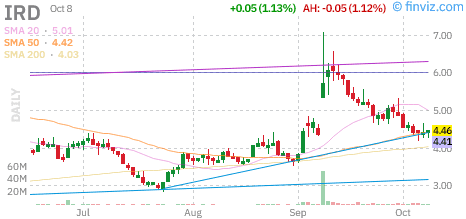
The Finviz API snapshot used here records an October 8, 2026 regular-session close of $4.46, up 1.13%, with volume of 1,345,784 shares. The day’s range was $4.245 to $4.48. These are dated market observations, not a live October 9 quote. The approximate $371.05 million market capitalization comes from that third-party snapshot. The daily chart is supplied as a visual market reference; it is not a forecast and does not establish the cause of any individual price move. [6]
A short run of daily data showed closes of $4.58 on October 2, $4.38 on October 5 and 6, and $4.41 on October 7 before the October 8 close. Such observations can describe recent fluctuation, but they do not justify a confident support level, an imminent breakout or a claim that informed investors are accumulating. Price patterns near a binary event can reflect many motives, including speculation, hedging, liquidity needs and changes in the broader market. The data alone do not identify the motive.
The company’s investor-relations analyst roster confirms that multiple firms cover the stock. A roster, however, does not establish every firm’s latest rating, target, publication date or current model assumptions. No average target is calculated from a list of names. Where a current, dated consensus dataset is unavailable in the evidence used, leaving out a numerical consensus is more accurate than combining stale or incomplete figures. A target is also an opinion about a horizon, not a scheduled future market price.
For event sensitivity, the most useful distinction is between importance to the company and surprise to the market. A significant regulatory event may cause a modest reaction if expectations were already aligned with the outcome. A less prominent update can cause a larger reaction if it changes assumptions unexpectedly. Positioning and liquidity may amplify either response. The PDUFA belongs in a catalyst framework, but the daily chart cannot determine its eventual percentage impact on IRD shares.
15 A practical valuation framework without an invented price target
Opus can be analyzed as a combination of partnered product economics, development-stage gene therapy assets, financial resources and financing claims. These components have different evidence requirements. Royalties depend on commercial sales and contractual rates; development assets depend on clinical, regulatory and manufacturing success; cash has a dated reported value; debt and equity instruments create claims that have to be accounted for. Adding them together requires consistent treatment of timing and risk rather than a collection of optimistic headline numbers.
For phentolamine, a useful model would distinguish approval probability, launch timing, eligible net sales, the effective royalty rate and milestone conditions. A high prevalence figure is not a substitute for annual treated patients, duration of use, net pricing and persistence. Commercial uptake can be slow even for a useful product. Conversely, a lower initial sales figure can still support meaningful royalty economics if use persists and the licensor’s incremental costs are limited. The model needs those operating assumptions to be explicit.
For gene therapy, the valuation problem is different. A potential one-time treatment requires assumptions about eligible patients, diagnosis, treatment-center capacity, reimbursement, uptake and durability. Earlier programs warrant different risk treatment from a registrational asset. Shared infrastructure can create efficiencies, but assigning full standalone value to every program while counting no shared costs would overstate the portfolio. Correlated risks also matter: manufacturing or financing problems can affect several assets at once even when their biological targets differ.
Three scenarios help organize the uncertainty without pretending to quantify it precisely. In a constructive scenario, presbyopia approval supports commercial economics while LCA5 and BEST1 progress on credible schedules. In an intermediate scenario, clinical progress continues but commercial receipts arrive more slowly and capital needs remain significant. In an adverse scenario, regulatory or clinical setbacks coincide with higher funding requirements. These are analytical cases, not probabilities, and the realized path can combine elements from more than one case.
The evidence that would justify revising a valuation is correspondingly specific: an actual FDA decision and label; reported royalties; a confirmed trial start; a durable clinical result; a clarified pivotal design; or a financing that changes claims per share. By contrast, a repetition of the same market-size estimate or a new presentation using unchanged data may add little. Investors benefit from asking what has changed in the underlying cash-flow or risk assumptions, rather than treating every corporate communication as an equal catalyst.
16 Catalyst calendar, downside risks and the next evidence to monitor
The nearest fixed regulatory date in the verified company evidence is October 17, 2026 for the presbyopia sNDA. Separate Q4 windows include expected LCA5 registrational dosing, RDH12 clinical entry and completion of BEST1 second-cohort dosing. The 2027 sequence includes planned MERTK clinical entry, BEST1 follow-up data and potential pivotal dosing, RHO clinical entry and LCA5 topline results by year-end. These are different event types with different levels of timing precision, and the company may revise them. [1] [2] [3] [5]
The first risk category is clinical evidence: whether improvements are reproducible, meaningful and durable, and whether safety remains acceptable as exposure grows. The second is regulatory execution: whether study designs, endpoints, manufacturing and submitted packages satisfy the relevant requirements. The third is commercial execution: whether an approved partnered product generates receipts consistent with the investment thesis. These risks interact, but a setback in one category should be analyzed on its own facts before drawing conclusions about all the others.
Financial risk is the connecting constraint. Trial delays can increase the period that must be funded before value-defining data arrive. Accelerating several programs can also raise spending even when progress is favorable. Additional debt may support development while increasing senior obligations; additional equity may extend runway while reducing ownership percentages. The health of the company and the economic outcome for a particular common share are related, but not identical, questions.
The official outcome of the nearest catalyst will be the starting point for revisiting the affected assumptions. An approval would prompt examination of the label and commercial plan; a delay would require a revised timetable; a negative decision would require the stated reasons and remediation path. Clinical and financing developments should be handled with the same discipline. The goal is an auditable company record in which readers can distinguish what happened, what management expects and what remains Merlintrader’s analysis.
Sources and research references
Primary disclosures control company facts. Finviz supplies dated market data. Scientific papers are cited with their study populations and limitations stated explicitly.
[1] Viatris: presbyopia sNDA acceptance and October 17 PDUFA, February 25, 2026[2] Opus Genetics: second-quarter results and corporate update, August 6, 2026[3] Opus Genetics: BEST1 cohort and FDA meeting, September 9, 2026[4] Opus Genetics Form 10-Q: quarter ended June 30, filed August 6, 2026[5] Opus Genetics: LCA5 registrational enrollment, August 3, 2026[6] Finviz: IRD market reference; API data, October 8, 2026 close[8] Pepose et al. (2021), Clinical Ophthalmology 15:79–91; ORION-1; Consensus record, 6 citations at retrieval[9] Aleman et al. (2025), Molecular Therapy 33:4784–4798; one-year LCA5 trial; DOI 10.1016/j.ymthe.2025.06.035; Consensus record, 6 citations at retrieval[10] Opus Genetics: current analyst coverage roster[11] LCA5 peer-reviewed paper: PubMed record and abstract[12] FDA phentolamine review: salt versus free-base concentration[13] Pepose et al.: ORION-1 full peer-reviewed publication[14] Opus Genetics Form 8-K: corrected BEST1 presentation, September 11, 2026Opus Genetics stock and PDUFA: frequently asked questions
What is the ticker for Opus Genetics?
Opus Genetics, Inc. trades on Nasdaq under IRD. The company was formerly known as Ocuphire Pharma. The company is described under its current corporate identity, and the active gene therapy portfolio is separated from historical assets that have been transferred or discontinued. [4]
When is the Opus Genetics presbyopia PDUFA date?
The disclosed FDA goal date is October 17, 2026 for the supplemental application for phentolamine ophthalmic solution 0.75% in presbyopia. A PDUFA date is a review target, not a guarantee of approval or the date commercial sales begin. [1]
Is phentolamine already approved for presbyopia?
As of October 9, the public record shows an application under review. Ryzumvi has an existing approval for reversal of pharmacologically induced mydriasis. That existing indication is distinct from the requested presbyopia expansion. [1]
Why can the same catalyst matter to both IRD and VTRS?
Viatris has commercialization rights under the partnership, while Opus retains contractual economic participation. The absolute opportunity and its importance relative to each company’s overall business differ. Neither company’s stock reaction can be inferred solely from the shared regulatory date. [1] [4]
Does the $130 million milestone figure represent the next payment?
No. It is an aggregate potential milestone envelope described in the license, with an initial $10 million milestone already paid after the 2023 approval. It is not a single pending presbyopia payment. [4]
Does Opus have enough cash to operate into 2029?
Management’s runway statement includes potential future Oberland funding. June 30 cash was $88.8 million. The funding assumptions and future spending matter, so the guidance should not be restated as a cash-only guarantee through 2029. [2]
Are LCA5 and BEST1 approved gene therapies?
Merlintrader has found no public announcement of an approval. LCA5 is in registrational development and BEST1 has early clinical evidence with a potential pivotal path. Regulatory designations and meetings facilitate development but do not replace an approval decision. [3] [5]
Can the PDUFA move the IRD share price?
Yes, it can change expectations about an economically relevant asset. The direction and magnitude depend on the outcome, labeling, commercial implications and expectations already reflected in the price. Nothing here implies a guaranteed reaction or constitutes a trading recommendation.
 Umbria