01 The ANAB thesis: royalties, timing and enforceable rights
AnaptysBio now represents a concentrated royalty business. Following the April 20, 2026 separation of First Tracks Biotherapeutics, its central economic interests are the Jemperli collaboration with GSK and Tesaro and the Quimilza collaboration with Vanda. The old picture of a company spending heavily on its own immunology pipeline is no longer the correct starting point for ANAB. Research assets transferred to the separate company do not belong in the same valuation simply because older presentations carry the Anaptys name. [1] [3]
The constructive thesis is that increasing partner sales can generate increasingly valuable royalty streams while a relatively small organization limits ongoing overhead. Jemperli already produces commercial sales, and its contractual royalty schedule rises across annual sales bands. A second product, Quimilza, could begin contributing if regulatory approval is obtained and Vanda executes commercially. This combination offers potential operating leverage, but the amount and timing of cash retained by Anaptys depend on contracts, the Sagard monetization arrangement, expenses and taxes. Revenue recognized in the accounts is not automatically cash available to shareholders.
The December 12 PDUFA for Quimilza is a real, dated event. Its relevance to ANAB comes through the retained royalty on net sales, not ownership of Vanda’s entire product revenue. A particularly important consequence of the separation is that Vanda milestone-payment rights were allocated to First Tracks. An investor who adds the old approval milestone to ANAB’s prospective cash would be using the pre-separation structure. The same clinical decision can therefore have different financial consequences for the sponsor, the royalty owner and the recipient of contractual milestones. [1] [2] [8]
Jemperli provides the larger existing commercial foundation, but several uncertainties remain concentrated around it. Partner development, competitive positioning, sales growth, royalty collection and litigation all affect one underlying asset. These are separate transmission channels, yet they are not independent sources of diversification. If the product’s commercial trajectory weakens, both the timing of the Sagard threshold and the eventual retained royalty stream can deteriorate together. A valuation should reflect that linkage instead of treating each attractive feature as a separate source of upside.
The cautious thesis emphasizes concentration, delayed access to the main royalty stream, uncertain legal remedies and the possibility that market expectations already anticipate substantial growth. The constructive and cautious cases can both acknowledge good clinical evidence. Their disagreement may concern commercial adoption, the cost of capital or the time until shareholders receive cash. Regulatory events are therefore evaluated in their economic context. A favorable decision can improve expected value, but neither the date itself nor a positive clinical headline determines the direction or magnitude of the share-price reaction.
02 What remained after the First Tracks separation
Zejula’s 0.5% royalty was monetized with DRI for $35 million in September 2022. First-half 2026 Zejula revenue of $1.6 million was non-cash. Vanda milestones assigned to First Tracks comprise $5 million for U.S. approval of the first licensed product for active GPP flares, $5 million for its EU approval and $25 million after sales exceed $100 million; these conditional payments are not retained ANAB revenue. Anaptys SEC filing (period ended June 30, 2026).
AnaptysBio, Inc. is the Delaware-incorporated issuer trading on Nasdaq as ANAB, with principal executive offices in San Diego. Daniel Faga remains president and chief executive officer, and Chris Murphy is chief financial officer in the current disclosures. The company describes a virtual operating model supported by contractors and limited staffing. Its strategy is to manage the financial collaborations and protect and return their value to shareholders. Those objectives are management’s stated strategy; they do not establish a guaranteed distribution schedule. [1] [2]
The separation was completed on April 20 rather than remaining a proposal for the end of 2026. Eligible holders received one First Tracks share for each Anaptys share held on the April 6 record date. The separation agreement allocated assets, contractual rights and liabilities between the entities, including $100 million in cash and equivalents for First Tracks. The research business appears as discontinued operations in the financial statements. Historical consolidated results consequently need to be read through the continuing-versus-discontinued distinction before being used to forecast the current company. [1] [3]
A shareholder who owned both securities after the distribution had exposure to two businesses. A buyer of ANAB after the separation does not automatically acquire the distributed research assets. This matters for discussions of rosnilimab and other legacy pipeline programs. Scientific progress at a former subsidiary may be interesting, but it does not count as an ANAB-owned development program without a current contractual basis. The hub focuses on rights supported by the present issuer’s disclosures and identifies historical information as historical when it is relevant.
The company also changed its fiscal year end from December 31 to June 30. The September 21 filing is a transition report covering January through June 2026. A six-month transition period is not a full twelve-month fiscal year, and a June quarter is not automatically comparable with a full-year number shown beside it by a financial aggregator. Period labels matter when comparing revenue, earnings, cash flow and share counts. The next quarterly reporting cycle begins with the period ending September 30 under the revised fiscal calendar. [1]
The virtual model can lower the cost of maintaining the business, but it shifts attention toward contractual oversight, finance, governance and partner relationships. A small staff still needs to review royalty statements, protect intellectual property, manage litigation and maintain public-company controls. Management targets annualized operating expenses below $10 million and an EBIT margin above 95%; these are targets rather than the actual margin of the June quarter. Legal and separation costs make that distinction especially relevant. Efficiency should ultimately be demonstrated through subsequent results and retained cash, not assumed from the organizational description alone.
03 Jemperli: an established commercial asset with expansion opportunities
The filing identifies Keytruda as Jemperli’s principal competitor. Keytruda is expected to face biosimilar competition in 2028–2029 and lose European exclusivity in 2031. Potential patent protection extends through June 2038 for dostarlimab and May 2042 for Quimilza, without guaranteed enforceability. Jemperli sales milestones recognized in 2025 totaled $125 million: ANAB retained $75 million and Sagard received $50 million. Anaptys SEC filing (period ended June 30, 2026).
Jemperli is dostarlimab, a PD-1 antagonist discovered by Anaptys and developed and commercialized through the Tesaro/GSK collaboration. Current approvals and ongoing development create several possible sources of demand, but the royalty owner does not directly control the partner’s sales organization or clinical priorities. GSK’s execution therefore matters to Anaptys even when the latter’s own operating expenses are limited. The relevant economic measure is qualifying net sales under the agreement, followed by the applicable royalty calculation and the contractual destination of the resulting payments. [1]
GSK reported approximately $331 million of global Jemperli sales in the June quarter and $644 million for the first half of 2026, corresponding to year-over-year growth of 26% and 34% in the dollar figures cited by Anaptys. The underlying pound amounts were £248 million and £480 million. Currency translation can affect dollar comparisons, so the units and reporting period need to stay attached to the numbers. Quarterly growth is evidence of commercial progress; annualizing one quarter remains a scenario rather than a disclosed full-year result. [2]
The existing market is supported by approved uses, including endometrial-cancer settings described in the filing. Expansion into untreated locally advanced rectal cancer would represent a different treatment setting and an additional regulatory decision. It is not already included in current approved use merely because dostarlimab is an approved medicine elsewhere. Likewise, an application for a molecularly defined population is not an application for every patient with rectal cancer. The dMMR/MSI-H selection criterion is central to both the clinical evidence and the potential addressable population. [1] [4]
The commercial significance of a new indication depends on more than the size of the cancer category. Testing, clinical eligibility, referral pathways, treatment duration, payer coverage and physician confidence all influence adoption. For a royalty owner, net pricing matters alongside prescription volume. A higher number of patients can coexist with slower revenue growth if discounts, regional mix or duration differ from assumptions. These variables are reasons to monitor the partner’s actual sales disclosures after a launch rather than convert an incidence estimate directly into a royalty forecast.
The current revenue base reduces dependence on a first-ever product launch, but it does not remove product concentration. Competition among checkpoint inhibitors is substantial, and future competitive pricing can affect the economics of branded medicines. Anaptys itself identifies competitive and reimbursement risks in its filing. The analytical question is whether Jemperli can sustain attractive net-sales growth across its authorized and potential indications while contractual rights remain enforceable. Clinical differentiation, commercial execution and legal economics must be assessed together, without treating any one of them as a complete substitute for the others.
04 How the Jemperli royalty schedule changes the economics
The disclosed Jemperli royalty schedule is progressive: 8% of annual net sales below $1 billion, 12% on the portion from $1 billion to $1.5 billion, 20% on the portion from $1.5 billion to $2.5 billion and 25% above $2.5 billion. These are marginal bands. Reaching the top band does not mean that every dollar of sales is retrospectively paid at 25%. Applying the highest rate to all sales would materially overstate the royalty stream. Contract definitions, adjustments and duration provisions still govern the actual amounts payable. [1]
Simple arithmetic illustrates the structure before Sagard, expenses and taxes. Annual net sales of $1 billion would produce $80 million under these bands. At $1.5 billion, the result would be $140 million: $80 million on the first billion and $60 million on the next half billion. At $2 billion it would be $240 million; at $2.5 billion, $340 million; and at $2.7 billion, $390 million. These are illustrative calculations, not sales forecasts, price targets or promises of cash distributions. They show how higher marginal rates can amplify the effect of incremental sales.
The schedule also creates downside sensitivity. If a valuation assumes sales comfortably above $2.5 billion but the product remains below that level, the missing revenue would have been earning the highest marginal royalty rate. The resulting shortfall in royalties can therefore be proportionally larger than the shortfall in sales. Conversely, a successful expansion that moves sales through a higher band can improve economics more rapidly than a constant-rate model would suggest. This asymmetry is contractual operating leverage, not evidence that the higher sales level will actually occur.
Management has discussed more than $390 million in annualized Jemperli royalties as early as 2029 at the partner’s cited peak monotherapy sales ambition above approximately $2.7 billion. Both the sales level and the timing are forward-looking. The calculation is neither a current earnings run rate nor an unconditional 2029 cash balance. A sound model would show multiple sales paths, collection timing, overhead, taxes and discount rates. It would also distinguish whether modeled royalties are still being directed to Sagard or have reverted to Anaptys under the monetization agreement. [2]
Contract duration is another boundary. The filing describes a term linked to the later of a specified anniversary of first commercial sale and expiration of relevant patents, subject to contractual termination provisions. That is not a perpetual annuity. Patent coverage, challenges, competition and country-specific conditions can influence the duration and value of a royalty interest. A terminal value that assumes indefinite high growth would need justification beyond the existence of a successful product today. The economic attraction of royalties lies in retained future cash over an enforceable period, measured against the price paid for that claim.
05 Sagard: accrued royalties, actual receipts and the accounting liability
Anaptys previously monetized portions of the Jemperli economics through arrangements with Sagard. The original transaction provided $250 million, followed by another $50 million under the 2024 amendment. Under the current disclosed threshold structure, the arrangement ends after Sagard receives an aggregate $600 million by March 31, 2031, or $675 million if the applicable threshold is reached afterward. The end of that arrangement would return subsequent covered royalties and milestones to Anaptys. Timing is therefore a major part of the equity thesis, alongside the eventual size of the stream. [1]
The September business update estimated approximately $301 million accrued through the second quarter and roughly $299 million remaining against the earlier $600 million threshold. Management’s expected paydown timing was the second half of 2027. That is later than some earlier commentary referring to mid-2027 or the end of the second quarter. The current estimate should control the forward-looking discussion, while the older estimate remains useful only as evidence that the schedule can move. Faster or slower sales, payment timing and contractual events can change the date again. [2]
Three different measurements are involved, and they are not interchangeable. The release’s accrued amount is not the same as cash already received by Sagard. Note 5 of the filing reports $275.9 million actually received through June 30. The balance-sheet liability for the sale of future royalties was $256.5 million, an accounting carrying amount affected by the effective-interest method. None of these figures can simply replace the others in a threshold calculation. A reader should ask whether a number represents earned royalties, collected payments or the book value of the financing obligation before subtracting it from a contractual cap. [1]
There is also a disclosure inconsistency worth preserving rather than concealing: different narrative passages in the transition filing refer to approximately $302.5 million and $300.8 million earned. Management guidance is described using the dated release’s rounded accrued estimate, and collections using the note’s explicitly identified receipt figure. The filing does not reconcile the two narrative earned figures. The inconsistency is small relative to the overall arrangement, but precision requires keeping the labels and acknowledging the unresolved difference.
The accounting structure can produce royalty revenue and noncash interest expense while related cash is directed to Sagard. This explains why an income-statement measure does not equal distributable cash. It also cautions against subtracting the carrying liability from a valuation that has already excluded all royalty cash diverted before the threshold: doing both without a consistent framework can double-count the same economic burden. A model can value the post-threshold stream directly or explicitly model the financing flows, but it must use one coherent approach. The nonrecourse description does not make the monetized cash flows economically available to ordinary shareholders today.
06 Quimilza and the December 12 FDA target
The FDA and Japan’s MHLW had already granted orphan designation for imsidolimab in GPP. Designation is distinct from marketing approval. Anaptys SEC filing (period ended June 30, 2026).
Quimilza is the name used in current company disclosures for imsidolimab, an investigational antibody directed at the interleukin-36 receptor. Vanda holds the exclusive global development and commercialization license. The FDA accepted its biologics application for generalized pustular psoriasis, with a target action date of December 12, 2026. The target is a regulatory review milestone, not a statement that approval has already occurred. Anaptys’ exposure is through its retained contractual economics rather than responsibility for the entire launch operation. [1] [8]
Generalized pustular psoriasis is a rare inflammatory disease that can involve widespread pustules and systemic illness. It is not interchangeable with the much larger category of common plaque psoriasis when discussing market size. The disease’s rarity affects diagnosis, trial recruitment and commercial access. It also means that a meaningful clinical benefit can be important to patients while the ultimate royalty stream remains dependent on a relatively small treated population. Clinical significance and market size are related but distinct questions.
The December review can change expected value by resolving part of the regulatory uncertainty. Approval would provide a basis for commercialization under the authorized label, but it would still leave launch timing, access and adoption to be demonstrated. A narrower-than-expected label could reduce the commercial opportunity even if the application is approved. A complete response, an extension or additional requirements would alter timing and potentially development costs. The accessible evidence does not justify numerical probabilities or a precise approval model for those outcomes.
The current separation agreement is essential to interpreting a favorable decision. Anaptys retains a 10% royalty on net sales, while milestone-payment rights under the Vanda agreement were allocated to First Tracks. The pre-spin documents described an approval milestone and other potential milestone payments, but those historical terms are not part of ANAB’s prospective cash after the allocation. A favorable FDA decision could support the retained royalty’s value without generating that old milestone payment for ANAB. This is a concrete example of why a catalyst calendar needs to be matched to ownership and contract rights. [1]
For illustration only, $100 million of qualifying annual net sales would correspond to $10 million at a 10% royalty, before considering the agreement’s detailed terms, taxes and corporate expenses. The calculation is not a forecast of sales, and gross billed revenue would not necessarily equal contractual net sales. An investor should look for actual launch disclosures, payer access and subsequent royalty statements before replacing scenario amounts with reported revenue. The opportunity adds a second product to the royalty portfolio, but its contribution must be earned through commercial results after regulatory authorization.
07 GEMINI evidence: what the pivotal study showed
The scientific evidence was checked through a fetched Consensus record for the 2026 NEJM Evidence publication on imsidolimab. GEMINI-1 randomized 45 adults experiencing a generalized pustular psoriasis flare across three groups: a single intravenous 300 mg dose, a 750 mg dose or placebo, with 15 participants per group. The primary outcome was a physician global assessment of clear or almost clear disease at week four. Reporting the endpoint, timing and denominator together is more informative than quoting an isolated response percentage. [5] [6]
Eight of fifteen participants in each active-dose group reached the primary endpoint, compared with two of fifteen assigned placebo. The publication reports approximately 53% versus 13%, with p=0.023 for each active-dose comparison. In absolute terms, the difference in the observed proportions was about forty percentage points. That does not mean every treated patient responded, nor does it establish that the higher dose was superior to the lower dose. Both active groups had the same observed count in this small trial. The sample size also limits how precisely subgroup effects can be estimated.
The controlled comparison supports evidence of activity during a flare. It does not by itself answer every question about long-term prevention, uncommon adverse events, different patient populations or comparative effectiveness against another approved biologic. Those distinctions are important in a rare disease, where a small study can be clinically useful but still leave substantial uncertainty. A statistically significant result is evidence against the specified null hypothesis within the trial design; it is not a guarantee of regulatory approval, commercial success or universal individual benefit.
GEMINI-2 followed participants into a relapse-prevention and longer-term treatment setting. Responders were randomized to monthly subcutaneous imsidolimab or placebo, while partial responders received open-label active treatment. Its primary objective included safety evaluation through 104 weeks. The publication reports that no serious adverse events led to discontinuation of imsidolimab. That specific statement does not mean that no serious adverse events occurred, that no infections occurred or that the drug has no safety risks. The reason for discontinuation, the occurrence of an event and its causal attribution are different measurements. [5]
The follow-on design is also different from randomizing a completely new unselected population. Entry and treatment pathways depended on earlier response, and part of the study was open label. Long-term observations add useful information, but they reflect that selection and treatment structure. The evidence supports a discussion of benefit and tolerability under the studied conditions. It does not support a claim of superiority over Spevigo without a direct comparative study, nor a claim that all forms of psoriasis have been shown to respond. The studies are discussed to assess the clinical foundation of the pending application, not to make therapeutic recommendations.
08 GPP commercialization and the existing competitive standard
An approved targeted treatment already exists in generalized pustular psoriasis. The current U.S. Spevigo label identifies an interleukin-36 receptor antagonist indicated for adults and patients aged at least twelve years who weigh at least forty kilograms. Consequently, imsidolimab is not the first available GPP therapy. The commercial question is how a potential new product would fit within an existing treatment landscape, subject to its own eventual label, evidence, administration requirements and payer decisions. [7]
Comparisons between separate clinical studies require restraint. Differences in population, flare severity, assessment timing, rescue treatment and endpoint definition can change response percentages. A week-four global assessment in one trial and a different endpoint at week one in another do not make a head-to-head ranking. The same applies to adverse-event percentages from studies with different follow-up and participant selection. The purpose of comparing the programs is to understand the market context and questions for adoption, not to manufacture an unsupported winner.
Commercial access in a rare inflammatory disease involves more than obtaining regulatory authorization. Patients must be identified and referred, specialists need confidence in diagnosis and treatment pathways, and payers must determine coverage. Hospital treatment of acute flares can involve different logistics from maintenance administration. A potential product’s dosing, supply chain and service requirements influence how it is used, while net price and reimbursement influence revenue. These are analytical considerations for the launch, not claims that Vanda has already achieved a particular access level for an unapproved indication.
A royalty structure insulates Anaptys from directly funding every commercial activity, but it also limits control. The partner decides how to staff, position and support the product within contractual obligations. If the launch is slower than expected, Anaptys may have lower expenses than a fully integrated developer while still receiving less revenue than investors anticipated. A capital-light model can therefore carry substantial commercial risk. Low direct selling costs do not eliminate dependence on another company’s execution or on the underlying medical need being translated into treated patients.
European orphan-designation developments provide regulatory context, but designation is distinct from a marketing authorization. It does not establish that the product can already be sold throughout Europe or that a particular revenue level will follow. The U.S. PDUFA and any future European authorization are separate processes with their own requirements. For shareholders, the useful evidence after a decision will include the actual label, launch status, coverage, treatment uptake and royalty recognition. A broad addressable-market estimate remains a scenario until those operational links are demonstrated. The economic value of the new royalty depends on its duration and realized net sales, not only on the existence of a favorable designation. [8] [9]
09 AZUR-1 and the separate Jemperli regulatory calendar
GSK announced acceptance for priority review of a supplemental application for Jemperli in previously untreated stage II and III dMMR/MSI-H locally advanced rectal cancer. The stated PDUFA month is February 2027. Eligibility for an expedited process through the Commissioner’s National Priority Voucher program could allow an earlier decision, but it does not create a confirmed December 2026 PDUFA. The distinction matters in a report assembled from a calendar running through year end: the Quimilza date belongs in December, while Jemperli’s separately stated target remains February unless a verified update changes it. [4]
The AZUR-1 interim result announced in July concerned a sustained clinical complete response for at least twelve months. A clinical complete response means no detectable signs of cancer under the study’s assessment framework; it is not a guarantee that recurrence can never occur. Longer follow-up remains relevant. The potential to avoid chemotherapy, radiation or surgery for selected patients is clinically important, but an investigational strategy and a regulatory submission are not the same as an unrestricted approved treatment pathway. Patient selection remains central to interpreting the evidence.
The September company update scheduled the first AZUR-1 results for presentation at ESMO on October 25. As of October 9, that presentation was upcoming, and Merlintrader has found no public release of its detailed results. A subsequent update should assess the full denominator, follow-up, response durability, rescue interventions and safety information presented. The announcement of a positive primary objective is a useful milestone, but the detail can influence how clinicians, regulators and investors interpret the strength and breadth of the opportunity. [2]
Other Jemperli development programs occupy different positions in the calendar. Anaptys listed AZUR-2 and JADE data expectations in 2028 and an AZUR-4 primary completion date in the fourth quarter of 2026. A primary completion date is not automatically a public data-release date, and an expected readout is not an approval. These distinctions prevent a pipeline table from overstating how many near-term catalysts have firm dates. They also help readers distinguish a company’s guidance from a registry milestone or a scheduled scientific presentation.
For valuation, a successful new indication can influence both future sales and the timing of royalty collections. It may accelerate progress toward higher royalty bands and toward the Sagard threshold, but those effects depend on actual adoption. A model should not assume the same new sales twice, once as immediate cash and again as an independent threshold benefit. The two consequences arise from the same underlying product revenue. This is why a coherent cash-flow model is more useful than simply counting positive catalyst headlines. The commercial base, new indication and financing arrangement are connected components of one economic interest.
10 Litigation: the requested remedy is not a completed outcome
Both parties filed on November 20, 2025. Tesaro sought a declaration of no breach and an injunction against termination; these requests do not establish the outcome. Anaptys SEC filing (period ended June 30, 2026).
Anaptys and GSK/Tesaro remain involved in litigation concerning the collaboration. The company reported a July 14–17 trial and an October 20 post-trial hearing, with judgment expected by management in the fourth quarter of 2026 or first quarter of 2027. Anaptys is seeking reversion of Jemperli rights as a remedy. A request in a brief does not establish that the court has granted that remedy, and management’s expected timing is not a guaranteed decision date. The legal outcome remains unresolved. [1] [2]
The filing states that Tesaro’s claim that Anaptys materially breached its duties was dismissed on April 24. That development extends only to the scope stated in the filing. It does not mean every claim in the broader dispute has been resolved, that all future royalty risks have disappeared or that ownership of the medicine has already returned to Anaptys. Public commentary can compress an interim ruling into a much broader victory narrative. The actual procedural development is distinct from the economic outcome still being sought.
The practical implications of a favorable legal result would depend on the exact order, any further proceedings and the obligations associated with the resulting rights. Reversion, if ordered and implemented, would not necessarily be equivalent to receiving an immediately distributable cash payment. Rights can bring opportunities, responsibilities and transition questions. There is no basis for speculating about a settlement amount, a sale price for the asset or an automatic takeover. Those possibilities require evidence beyond the existence of litigation and should not be embedded in the central valuation as completed events.
An unfavorable result could affect contractual rights, negotiation leverage, expenses or the market’s assessment of future royalty security. The filing expressly identifies potential adverse consequences. The equity can therefore react sharply to an outcome even if the underlying drug continues to sell well. Clinical success and enforceable economic participation are different assets in the investment case. A royalty owner needs both a commercially valuable product and a reliable entitlement to the relevant payments.
Legal costs also affect near-term financial results. General and administrative expenses increased materially in the June quarter, with the company citing separation-related legal work, the GSK/Tesaro lawsuit and noncash compensation. A long-term low-overhead target does not erase those actual costs. For subsequent updates, the most useful evidence will be the court’s published decision or a company filing that describes its terms, followed by any changes to the contract, operations or financial guidance. This is an investment-research discussion of disclosed uncertainty, not a legal prediction or an assessment of which party deserves to prevail.
11 Earnings quality: the tax benefit changes the headline
Second-quarter collaboration revenue was $27.5 million, compared with $22.3 million in the prior-year quarter. First-half collaboration revenue was $53.0 million, compared with $50.0 million. The comparison includes changing composition: growing Jemperli royalties were partly offset by prior-year Vanda license revenue that did not recur in the same way. It is therefore useful to follow the underlying royalty source as well as total reported revenue. A small increase in the aggregate can conceal faster growth in the recurring component when a prior comparison includes a one-time item. [1] [2]
June-quarter general and administrative expense was $16.0 million. Research and development expense from continuing operations was negative $2.7 million, reflecting contract-closeout adjustments. A negative expense is a credit, not a new product generating research revenue. It should not be extrapolated as a permanent source of quarterly profit. After these items, operating income was $14.1 million. Noncash interest expense related to the royalty monetization was $20.3 million, and the company reported a continuing-operation pretax loss of $4.2 million for the quarter. [1]
The dramatic bottom-line result arose primarily below the pretax line. A tax benefit of $181.5 million drove continuing-operation net income to $177.3 million. The company explained that the benefit largely reflected release of a valuation allowance on deferred tax assets following the separation and expectations about future utilization. This was not a $181.5 million cash payment from a customer or an equivalent amount of new royalty collections. A tax asset can have economic value, but the accounting recognition and its future cash realization are different events. [1] [2]
The same issue affects valuation ratios based on trailing earnings. Finviz displayed a low single-digit-to-high-single-digit earnings multiple in the dated snapshot, but the underlying earnings include a major tax effect and a changing corporate perimeter. Treating that ratio as a normalized royalty-business multiple would be misleading. The analytical priority is to estimate recurring retained cash after the monetization arrangement, normal overhead and taxes. A cheap-looking ratio cannot substitute for understanding what generated the denominator.
For the six-month transition period, continuing-operation income was $176.4 million and total net income was $131.0 million after discontinued operations. These should not be mixed with the quarter’s $177.3 million continuing income or $183.9 million total income. The period and perimeter need to remain explicit. The company may become more straightforward to analyze as post-separation reporting develops, but the transition statements are unusually sensitive to classification, one-time adjustments and noncash effects. The headline profit is therefore presented alongside the pretax result and the tax explanation, so that the largest number does not dominate the investment narrative.
12 Liquidity and cash flow after the separation
At June 30, cash and equivalents were $133.8 million and short-term investments were $30.3 million, producing a combined balance of $164.1 million. That figure is a dated balance-sheet resource measure. It is separate from an earlier pre-separation cash balance and from the $100 million allocated to First Tracks; not all of those funds remain available to ANAB. The issuer’s current resources must be assessed after the distribution and alongside the liabilities and operating obligations it retained. [1]
The cash-flow statement separates continuing and discontinued operations. During the first half, continuing operations used approximately $1.4 million of operating cash, while discontinued operations used approximately $51.2 million. Continuing investing activities supplied $42.5 million, largely associated with investments, and continuing financing activities supplied $5.6 million. Financing activities of discontinued operations included the $100 million cash allocation. These categories explain why a consolidated change in cash cannot be used as a clean recurring burn rate for the new royalty business. [1]
Likewise, the $176.4 million continuing-operation net income for the half did not translate into a similar operating-cash inflow. Noncash tax effects, royalty-related accounting and working-capital movements create a large bridge between earnings and cash. For future reporting, a useful assessment will reconcile royalties earned, payments directed to Sagard, cash retained by Anaptys and the cost of operating the issuer. Each measure answers a different question. Without that reconciliation, even accurately quoted financial numbers can produce an inaccurate impression of the company’s capacity to return cash.
The $256.5 million liability associated with the sale of future royalties is economically important, but it differs from an ordinary bank loan funded from unrestricted corporate cash on a fixed repayment schedule. The arrangement is described as nonrecourse and tied to the assigned royalty economics. That distinction does not mean that ANAB has no obligations, no financing burden or unrestricted access to the Jemperli stream. The burden is expressed through the contractual diversion of cash and the delay before subsequent payments become available to the company.
Liquidity provides flexibility to cover overhead and legal costs while the royalty arrangement runs its course. It also gives management capital-allocation choices. However, a cash balance is not a promise that an equal amount will be distributed. Taxes, contractual needs, litigation and board decisions can affect the amount retained. An investor evaluating the balance sheet should compare resources with realistic near-term costs and potential contingencies, then value the future royalty stream separately. This avoids both overstating cash available today and overlooking the potential economic change when the Sagard threshold is actually satisfied.
13 Shares, capital allocation and the dated market reference
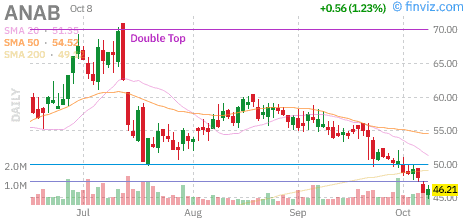
The Finviz API reference for October 8, 2026 shows a regular-session close of $46.21, a daily gain of 1.23% and volume of 554,155 shares. Its indicated market capitalization was approximately $1.38 billion. These are dated market observations, not a live quote or a statement about the next session. Anaptys reported 29,895,244 shares outstanding as of September 16, while the June balance-sheet count was approximately 29.73 million. Using the newer count with the dated price is consistent with the approximate equity value. [1] [10]
The difference between a period-end share count, a later actual count and weighted-average diluted shares matters when calculating value per share. Earnings per share uses a weighted-average denominator and can include dilution rules that differ from a simple outstanding-share count. A valuation of future cash should specify which denominator it uses and allow for relevant awards or additional issuance. The fact that the company no longer runs the separated clinical pipeline does not eliminate dilution from compensation or future capital-allocation decisions.
The company had a $100 million share-repurchase authorization that had not been used as of June 30 and was scheduled to expire on December 31. An authorization permits purchases within its terms; it does not prove they have occurred or obligate management to spend the full amount. The subsequent quarter could contain activity not yet reflected in the June report, so it cannot be stated that no purchases occurred after that date. Future updates should rely on the next filing’s actual share-repurchase table and share count. [2]
A repurchase can increase each remaining share’s participation in future cash if executed at an attractive price and without impairing necessary resources. It can also consume liquidity needed for contingencies. The relevant assessment is the price paid relative to conservative intrinsic assumptions, not merely the existence of authorization. Similarly, a stated intention to return value does not establish a dividend yield. A prospective distribution counts as declared only once it appears in a corporate announcement.
The market-data snapshot also indicates meaningful short interest and a trading history affected by the changing corporate structure. Such statistics can help describe positioning but do not establish a coming squeeze, a price floor or an explanation for a particular trading day. Older price comparisons need to account for the spin-off and any data-service adjustment methodology. The chart provides market context rather than proof of fundamental value. The main valuation work remains contractual rights, product sales, collection timing, costs and the fully considered share denominator.
14 Valuation scenarios
A constructive scenario would combine continued Jemperli growth, successful regulatory expansion, timely satisfaction of the Sagard threshold and controlled corporate expenses. Quimilza could add a separate stream after approval and commercial uptake. The value in that scenario is not simply the sum of peak sales multiplied by royalty rates. It depends on when the sales occur, the period during which the company retains payments, taxes, contractual duration and the amount of equity outstanding. A discounted stream earned over years differs from the same nominal amount received immediately.
A middle scenario could include continued Jemperli growth with slower expansion, later paydown and a modest initial Quimilza contribution. Such an outcome might still produce a viable royalty business while disappointing a valuation built around rapid growth and early cash returns. The share-price effect would depend on what the market had already expected. This is why approval alone does not specify an upside percentage: a widely anticipated decision can be followed by limited appreciation or a decline if the label, launch plans or economics fall short of expectations.
A cautious scenario would include weaker net-sales growth, litigation outcomes that impair expected rights or delay resolution, additional costs and a slower Quimilza launch or regulatory setback. Product concentration can magnify the effect because the main royalty and Sagard timing rely on the same commercial asset. The cash balance offers resources but does not immunize the equity from a lower present value of future royalties. Nor does a potentially favorable legal remedy remove uncertainty before the court’s actual decision and its consequences are known.
No price target is given; the inputs that move a valuation are annual qualifying sales, progressive royalty bands, actual Sagard receipts, anticipated threshold date, retained overhead, taxes, duration and shares. Sensitivity testing should change one assumption at a time and then test combinations, especially slower sales together with later paydown. A price can look attractive under one internally consistent set of assumptions and expensive under another. Making those assumptions visible is more informative than assigning a precise target whose apparent accuracy exceeds the evidence available.
15 What to monitor from October through the royalty transition
The nearest scheduled legal checkpoint is the October 20 post-trial hearing disclosed by Anaptys. It should be followed through actual court or company records, without assuming that the hearing itself will deliver a final judgment. Management’s stated judgment window extends from the fourth quarter of 2026 into the first quarter of 2027. Any update should identify whether it is a procedural development, a decision on a specific claim, a final remedy or a settlement. Those events have different implications for economic rights and for the uncertainty attached to the stock. [2]
October 25 is the announced ESMO presentation date for the first AZUR-1 results. The clinical review should focus on the selected population, durability and the detail behind the previously announced primary objective. The regulatory calendar for that Jemperli indication remains February 2027, with the possibility of an earlier decision under the expedited process. Neither the conference presentation nor eligibility for expedited review points to an exact earlier FDA date. An update belongs in the calendar only at the level of precision supported by the source. [2] [4]
December 12 is the current Quimilza PDUFA target. After the decision, the key distinctions will be approval terms, any additional requirements and Vanda’s actual commercial plans. For ANAB, the economic follow-through is the retained royalty on qualifying net sales. The old Vanda milestone rights allocated to First Tracks are outside ANAB’s cash forecast. If a regulator extends the review or requests more work, the calendar and economic assumptions should change together rather than leaving the old date displayed as if it were still prospective.
Financial items to monitor include the first quarterly report under the new June fiscal year end, actual repurchases if any, the updated share count, legal costs and continuing-operation cash flow. Jemperli’s next sales report will inform both royalty growth and progress toward the monetization threshold. The distinction between accrued and received amounts remains important as new figures appear. A future report that resolves the inconsistent earned figures in the current filing would improve the precision of the tracking; until then, no reconciliation can be assumed.
The central longer-term checkpoint is actual satisfaction of the Sagard arrangement, not merely reaching a date in management guidance. Investors should look for confirmation of the contractual threshold and the resulting payment flow. Afterward, the quality of retained cash, capital allocation and the durability of the underlying medicines become even more directly visible. Until then, ANAB is best understood as a concentrated claim on future royalty economics with regulatory, legal, timing and valuation uncertainty. Each new disclosure updates those specific components; it does not turn an event calendar into an automatic trading signal.
Frequently asked questions about AnaptysBio stock
What is the December 2026 PDUFA connected to ANAB?
Vanda’s Quimilza, or imsidolimab, application for generalized pustular psoriasis has a December 12, 2026 target action date. Anaptys retains a 10% royalty on net sales under the current structure. Approval is not assured, and the eventual commercial contribution depends on the label and actual launch performance. [1] [8]
Does ANAB receive the old imsidolimab approval milestone?
The current transition filing states that milestone-payment rights under the Vanda agreement were allocated to First Tracks in the separation. They are not part of ANAB’s post-spin cash forecast. The retained royalty and the transferred milestone rights are different economic interests. [1]
Does ANAB still own the former immunology research pipeline?
The biopharma operations were separated into First Tracks on April 20, 2026. ANAB now manages the disclosed financial collaborations. Historical pipeline presentations do not assign the transferred research programs to the current royalty company. [1] [3]
When will the Jemperli royalty stream become available after Sagard?
Management’s September estimate was the second half of 2027, but the arrangement ends according to contractual receipt thresholds, not simply on that calendar date. Future sales and collections can change the timing. Accrued royalties, actual receipts and the accounting liability are distinct measures. [1] [2]
Why is the June-quarter profit much larger than operating cash flow?
Continuing-operation earnings included a large noncash tax benefit associated with deferred tax assets. Royalty-monetization accounting and working-capital movements also affect the conversion from earnings to cash. The headline profit is therefore not a measure of cash available for distribution. [1]
Can a positive catalyst move ANAB’s share price?
Yes, an outcome can change expectations about future retained cash, but the reaction depends on the surprise relative to expectations, the economic rights involved and the prevailing valuation. A favorable FDA decision does not imply a predetermined gain, and a legal claim or company forecast is not a completed outcome.
 Umbria