AI transparency: articles and reports are produced with the help of artificial intelligence and checked through a process that does not constitute specialist validation. They may contain errors: verify relevant information with independent sources. Read the full disclaimer.
Merlintrader · Comparative Research
$AGIO$CRSP$BEAM$NVO
Sickle cell: what progress means for $AGIO, $CRSP, $BEAM and $NVO
Higher hemoglobin, fewer crises and sustained benefit are related goals, not interchangeable trial results.
MerlintraderResearch cutoff: October 9, 2026Evidence dates remain those of the cited sources
Higher hemoglobin, fewer crises and sustained benefit are related goals, not interchangeable trial results.
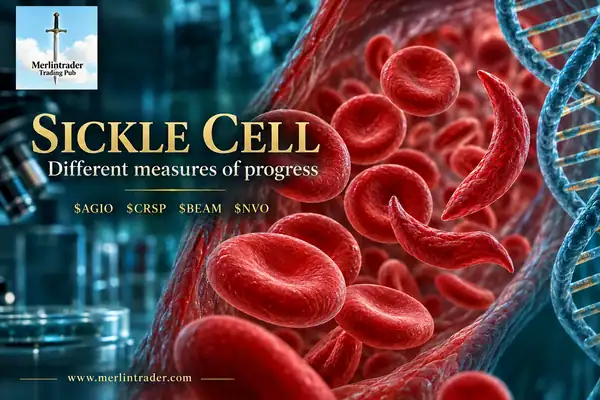
Illustrative cover, not a clinical image or a photograph of an identified commercial product.
$AGIO | Mitapivat
Two endpoints, two answers
RISE UP met its hemoglobin-response endpoint, but its annualized pain-crisis primary endpoint was not statistically significant. Primary source
$CRSP | CASGEVY
Approved, with a treatment burden
The current FDA label includes patients aged two and older with SCD and recurrent vaso-occlusive crises; full myeloablative conditioning remains required. Primary source
$BEAM | Risto-cel
Early evidence, still investigational
The published BEACON interim analysis is encouraging but has limited follow-up and must be read together with serious adverse events. Primary source
$NVO | Etavopivat
Both co-primary endpoints
Novo reported that phase 3 HIBISCUS met its crisis-rate and hemoglobin endpoints. This is a company topline report, not an approval. Primary source
The central question
Sickle cell: different measures of progress
The useful comparison is not oral medicine versus gene editing in the abstract. It is the benefit each program has actually demonstrated, the denominator behind that result, the burden of treatment and the evidence still needed over time.
What could work
Different approaches may address different patient needs. Better anemia control, fewer acute crises and durable freedom from severe events would each matter, provided the evidence supports the particular claim being made.
What could go wrong
A successful laboratory endpoint may not establish fewer crises. Small, selected gene-editing cohorts cannot settle lifetime durability, and an intensive treatment process brings risks that must remain visible alongside efficacy.
Agios reported a November 1, 2026 FDA target date for its sickle-cell application. Novo's Q2 presentation anticipated a first etavopivat filing in Q4 2026. Beam's August update targeted a risto-cel BLA submission as early as year-end. A decision date, a planned filing and an approval are different events.
External market data may update after this research. Finviz links are affiliate links.
Extended analysis
Continue with the extended analysis: $AGIO $CRSP $BEAM $NVO
The full comparison, evidence limits, execution risks and the next verifiable milestones. Sources and reporting dates accompany the analysis.
Free. No signup. You decide, we don’t recommend.
01. A Disease Cannot Be Reduced to One Number
For a person with sickle cell disease, improvement can mean several things: less anemia, fewer acute painful events, less time receiving transfusions, fewer hospital visits or a durable change in the course of illness. A development program may generate evidence for one of those goals without establishing every other one.
That is why Agios, CRISPR Therapeutics, Beam Therapeutics and Novo Nordisk make an informative comparison. Their programs bring different mechanisms and treatment burdens to overlapping problems. The result is not a four-way contest with a single response-rate column. It is a test of whether the reported endpoint matches the benefit being claimed.
This article focuses on that match. It does not attempt to select a treatment for an individual patient, and it does not rank medicines across unrelated trials. Current approved indications, investigational results and company plans remain separate throughout.
The simplest reading discipline is to complete this sentence before accepting a headline: “Among these patients, over this period, using this definition, the study found this result.” If any part is missing, the percentage alone cannot do the work.
02. Hemoglobin, Crises and Transfusions Answer Different Questions
Hemoglobin is an important measure, but a change in its concentration is not itself a count of painful crises or hospitalizations. A crisis endpoint measures events under a specific trial definition. A transfusion endpoint measures a different aspect of disease burden and clinical management. Patient-reported fatigue or function adds another dimension rather than duplicating the laboratory measurement.
Agios’s RISE UP results illustrate the separation: the hemoglobin-response endpoint was statistically significant, while the primary endpoint for annualized sickle cell pain crises was not. The company also reported no overall difference on the key fatigue endpoint. These are not mutually inconsistent results. They show why a single label such as “positive trial” is insufficient. Agios’s EHA 2026 report.
Another distinction concerns the denominator. A response among patients with enough follow-up is not automatically a response among all treated patients. A result within a responder subgroup is not the same as the randomized comparison. Neither distinction discredits the data; both are necessary to describe what the data can support.
Time matters just as much. Freedom from severe events over a defined interval is an important observation. It is not evidence of lifelong freedom from every symptom or complication. The right response to a strong result is to preserve its strength and its boundaries together.
03. Agios: Read the Hemoglobin Result Without Rewriting the Crisis Result
In RISE UP, 40.6% of mitapivat-treated participants achieved the hemoglobin-response definition, compared with 2.9% on placebo. The definition was at least a 1 g/dL increase in average hemoglobin from weeks 24 through 52. That is not a measurement taken only at week 24, and the averaging period should not disappear when the result is summarized. RISE UP presentation.
Agios presented exploratory transfusion findings and a post-hoc comparison of hemoglobin responders with nonresponders. Those observations can help develop hypotheses about which patients may benefit and what a subsequent study should measure. They do not replace the original randomized crisis-rate analysis. Selecting people according to a response that occurred after treatment changes the comparison.
The editorial conclusion is deliberately narrower than either a promotional or dismissive reading. There is evidence of a hematologic effect. There is also an unresolved question about the scope of clinically demonstrated benefit in sickle cell disease. Both belong in the same paragraph, rather than one appearing in the headline and the other disappearing into a footnote.
Agios’s July update reported priority review of the sickle-cell application, with a November 1, 2026 PDUFA target date, and initiation of the REIGNITE confirmatory study addressing transfusion burden. The application seeks an accelerated-approval pathway; mitapivat’s authorization in another condition must not be presented as approval for sickle cell disease. A target date does not predict the FDA’s decision. Agios Q2 2026 update.
The Agios Pharmaceuticals Stock Hub provides the broader company context. In this comparison, the central issue is the connection between improved anemia and a specifically established clinical benefit, not the existence of a favorable laboratory result alone.
04. Novo Nordisk: Two Positive Endpoints, Still a Defined Evidence Package
Novo reported in April that etavopivat met both co-primary endpoints in the phase 3 HIBISCUS trial. Its topline report described a 27% relative reduction in the annualized rate of vaso-occlusive crises versus placebo and a hemoglobin increase greater than 1 g/dL at week 24 in 48.7% of treated participants versus 7.2% on placebo. The main phase 3 comparison involved 385 participants aged 12 or older over 52 weeks, with standard care permitted. Novo’s HIBISCUS announcement.
That is a different pattern of evidence from RISE UP. It is not, however, a head-to-head demonstration that one medicine is superior to the other. The hemoglobin definitions, observation periods and study populations are not identical. Putting 48.7% beside 40.6% without those qualifications would create a precision the comparison does not possess.
A relative reduction also needs careful language. Twenty-seven percent fewer events in the annualized rate is not a claim that 27% of participants became crisis-free, nor that every participant experienced a 27% reduction. Rate-based and patient-based outcomes answer different questions.
The company’s topline safety description is useful but should remain attributed. It is not an independent comparative safety verdict. Detailed results and continuing follow-up matter, especially when evaluating how an oral treatment performs alongside existing care over time.
Novo’s Q2 investor presentation anticipated the first etavopivat filing in Q4 2026. This article treats that as guidance, not as a verified completed submission or authorization. Q2 2026 presentation. The Novo Nordisk Stock Hub places this program within a much larger company, an important distinction when interpreting its potential effect on the equity.
05. CRISPR Therapeutics: A Strong Clinical Endpoint With a Precise Denominator
The 2024 pivotal publication for exagamglogene autotemcel, marketed as CASGEVY, reported that 29 of 30 patients with sufficient follow-up met the endpoint of freedom from severe vaso-occlusive crises for at least 12 consecutive months. Forty-four patients had received treatment at the reported cutoff. The widely cited 97% therefore belongs to the evaluable group and the specified endpoint; it is not 97% of all treated patients followed indefinitely. Pivotal NEJM publication.
This was a single-group study, not a randomized comparison against mitapivat, etavopivat or risto-cel. Its striking result should not be weakened by careless reporting, but it should not be expanded into a comparison the study never performed. In particular, freedom from protocol-defined severe crises is not synonymous with the disappearance of every chronic disease consequence.
The current FDA label, checked for this article, includes patients aged two years and older with sickle cell disease and recurrent vaso-occlusive crises. Older material describing a 12-and-older indication does not represent the current U.S. label. At the same time, the treatment still requires collection of the patient’s cells and full myeloablative conditioning, with specified risks and monitoring. Current CASGEVY prescribing information.
These are separate dimensions of access. A broader labeled age range does not mean every person in that range is an appropriate candidate or can readily complete the process. The label itself requires assessment of suitability for the treatment pathway. It is the entire intervention, not only the edited cells, that must be considered when evaluating benefit and burden.
See the CRISPR Therapeutics Stock Hub for the corporate context. This article’s focus is the endpoint and its interpretation, not a new estimate of treatment-center capacity or product sales.
06. Beam: Promising Base-Editing Data Are Not a Risk-Free Shortcut
Risto-cel, formerly BEAM-101, uses base editing of the HBG1 and HBG2 promoter regions to promote fetal hemoglobin production. The published BEACON report was an unplanned interim analysis of 31 treated patients, with mean follow-up of 6.6 months. No investigator-reported severe vaso-occlusive crises occurred after the specified post-transfusion assessment window, but the follow-up was short and uneven. BEACON NEJM report.
The same publication reported grade 3 or higher adverse events in 27 patients, serious adverse events in 12, and one death from idiopathic pneumonia syndrome. Those findings must accompany the efficacy discussion. They do not by themselves prove that the editor caused each event, but they rule out a presentation in which the treatment process is described as risk-free.
Base editing and the approach used in CASGEVY are technically distinct. That distinction does not establish a clinical safety ranking across small, separate studies. Nor does a next-generation label remove the need to evaluate conditioning, recovery, durability and long-term surveillance.
The publication date is also not the data cutoff. Beam’s April announcement identified an August 2025 cutoff for the published analysis. A paper appearing in 2026 does not automatically provide follow-up through 2026. Beam’s publication announcement.
In August, Beam reported completion of dosing for adult and adolescent BEACON participants and targeted updated data and a BLA submission as early as year-end 2026. Those were forward-looking milestones, not a statement that risto-cel was approved. August corporate update. The Beam Therapeutics Stock Hub covers the broader portfolio separately.
07. Why Oral Therapy and Gene Editing Do Not Form One Simple Ranking
An oral therapy and an ex vivo cell therapy ask different things of a patient and of the healthcare system. The comparison therefore cannot be reduced to the largest efficacy percentage. It must consider how the benefit is measured, how the treatment is delivered, what risks accompany it and which patients can realistically use it.
A hypothetical patient who seeks fewer acute events while continuing outpatient care presents a different decision context from a patient being evaluated for an intensive, potentially durable cellular intervention. That is an illustration of the analytical distinction, not a recommendation that either path is suitable for a specific person.
The word “durable” also needs a time unit. Months of follow-up can establish months of observation. Longer follow-up can strengthen confidence, identify late problems and test persistence of benefit. Neither a powerful mechanism nor an early event-free interval allows the calendar to be skipped.
There is no need to declare the approaches mutually exclusive at the level of the entire disease population. There is equally no basis here to assume a particular combination or sequence is proven. Clinical eligibility, evidence and medical judgment determine those questions, not the desire to make a four-ticker narrative fit a single market model.
08. A Better Way to Read the Next Update
For each new report, record the endpoint before recording the result. If the announcement concerns hemoglobin, look for the threshold, timing and analysis population. If it concerns crises, ask whether the measure is an annualized rate, time to first event or the proportion remaining event-free. If it concerns transfusions, preserve the distinction between fewer units and fewer people requiring any transfusion.
Then record the comparator. A randomized placebo comparison, a post-hoc subgroup, a single-arm study and an external natural-history comparison carry different inferential weight. A favorable result in one cannot silently stand in for a missing result in another.
Next record safety over the same period, including the treatment process. An efficacy denominator and a safety denominator may differ. Omitting people who have not yet reached an efficacy time point must not make their safety experience disappear.
Finally, record the regulatory verb: planned, submitted, accepted, reviewed or approved. These are successive but nonautomatic steps. A PDUFA date identifies a target for agency action, not a promise of approval. An application accepted for review has crossed an administrative threshold, not the final benefit-risk threshold.
This framework is intentionally more demanding than a headline. It gives the reader a consistent way to compare updates without forcing noncomparable studies into a false ranking.
09. What the Four Companies Teach Together
Agios makes the separation between hematologic improvement and the original crisis endpoint impossible to ignore. Novo adds a reported phase 3 result on both dimensions, while still requiring full interpretation and regulatory review. CRISPR Therapeutics provides an approved gene-edited treatment with a strong clinical endpoint and an intensive treatment pathway. Beam adds encouraging investigational base-editing evidence that remains limited by the size, timing and safety experience of the reported dataset.
The economic implications will differ across the four companies. A program can be central to one company’s prospects and a much smaller component of another’s. Clinical importance alone does not measure the program’s contribution to consolidated revenue, development costs or shareholder value. Those questions require their own financial work.
The conclusion is not that only one definition of progress matters. It is that each definition must be earned by the evidence that measures it. Better hemoglobin, fewer painful crises, reduced transfusion burden and durable clinical benefit are all meaningful goals. The mistake is to report one as proof of all the others.
Sources and Scope
Research cutoff: October 9, 2026. The analysis distinguishes current FDA labeling, peer-reviewed trial publications and company-reported data or plans. It does not establish cross-trial superiority or provide individual treatment advice.
Further company research: AGIO, CRSP, BEAM and NVO. The linked primary sources, rather than the hubs themselves, support the central clinical and regulatory claims above.
Disclaimer. This article is published by Merlintrader for educational and informational purposes. It is independent analysis, not investment advice, an investment recommendation, or an offer or solicitation to buy or sell securities. It is not a regulated investment research report. No buy, sell or hold recommendation is made. Readers should conduct their own research and consult a licensed financial adviser before making investment decisions.
Information is tied to the stated research cutoff and the dates of the cited sources. Company guidance, investigational results, approved indications and editorial interpretation are different kinds of information. Plans may change and the article may not reflect subsequent events. Verify primary sources before making decisions.
Securities discussed can lose value, including all of an investment. Development, regulation, competition, financing and execution can change a company’s prospects. Medical discussion is not individual medical advice; treatment decisions belong with qualified healthcare professionals.
Merlintrader may hold positions in securities mentioned. Finviz links are affiliate links and may generate a commission at no additional cost to the reader. See the full disclaimer and terms of use and privacy.
Merlintrader · Sickle cell: different measures of progress · Comparative Research
 Umbria