AI transparency: articles and reports are produced with the help of artificial intelligence and checked through a process that does not constitute specialist validation. They may contain errors: verify relevant information with independent sources. Read the full disclaimer.
Merlintrader · Comparative Research
$KTOS$KOPN$AVAV$CAE
Before the mission: the military training businesses behind $KTOS, $KOPN, $AVAV and $CAE
A display, a simulator, an instructor and a long-term training service occupy different places in the defense economy.
MerlintraderResearch cutoff: October 9, 2026Evidence dates remain those of the cited sources
Before the mission: the military training business
A display, a simulator, an instructor and a long-term training service occupy different places in the defense economy.
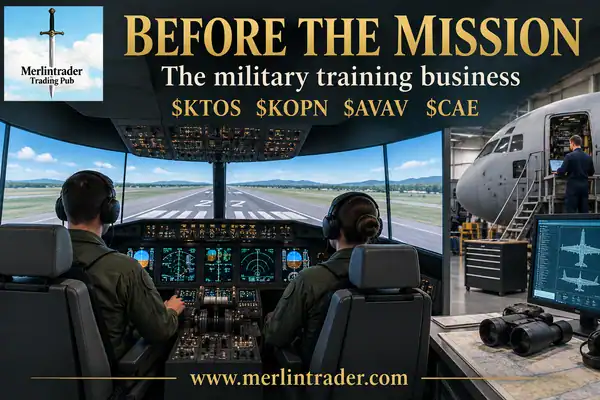
Illustrative cover, not a clinical image or a photograph of an identified commercial product.
$KTOS | Training systems
The maintenance classroom
A February 2026 announcement described awards with about $65 million in total potential value, including aviation training and maintenance-training devices; not all one product. Primary source
$KOPN | Simulated binoculars
A component-level position
Kopin announced a wireless, head-tracked simulated-binocular prototype for I/ITSEC 2025. A prototype unveiling is not a 2026 production contract. Primary source
$AVAV | Training and support
Support around the platform
AeroVironment describes operator training, OEM-certified personnel, field support and simulation. The service page does not disclose a separate training-revenue figure. Primary source
$CAE | C-130H aircrew
A long-term service role
CAE USA announced a $300 million recompete extending the U.S. Air Force C-130H training relationship through December 2035, not $300 million of annual sales. Primary source
The central question
Before the mission: the military training business
The training opportunity is not a second copy of the weapons market. It is the work of preparing people to operate and maintain equipment reliably, with different suppliers paid for components, integrated devices, instruction and continuing support.
What could work
New equipment, changing software and the need to maintain proficiency can create repeated training requirements. Suppliers that fit into a durable training system may contribute beyond the initial delivery of a platform.
What could go wrong
A visually impressive demonstrator is not a production order, and an established training requirement does not guarantee a supplier's margins. Integration, curriculum changes, staffing, maintenance and contract terms determine the real economics.
For CAE, follow execution of the C-130H recompete rather than treating its full value as one year's revenue. For Kratos, distinguish funded work from total potential awards. For Kopin, look for evidence that the 2025 simulated-binocular prototype becomes an adopted product. For AeroVironment, separate the availability of training services from disclosed revenue attributable to them.
External market data may update after this research. Finviz links are affiliate links.
Extended analysis
Continue with the extended analysis: $KTOS $KOPN $AVAV $CAE
The full comparison, evidence limits, execution risks and the next verifiable milestones. Sources and reporting dates accompany the analysis.
Free. No signup. You decide, we don’t recommend.
01. The Business Before the Equipment Is Used
Buying a platform does not by itself create a trained operator, a qualified maintainer or a functioning training organization. Those capabilities require equipment, instruction, realistic practice and continuing support. They form a defense business that is easy to overlook when attention concentrates on the aircraft, vehicle or system being purchased.
Kratos, Kopin, AeroVironment and CAE offer four different views of that business. The comparison is not a claim that they compete for every contract or supply one another in a single documented chain. It is a way to distinguish the economic roles around a common need: preparing people to use and maintain complex equipment.
A display supplier may contribute one specialized element. A training-device company may integrate several elements into a working system. A platform manufacturer may provide instruction and field support around its own products. A training-services prime may sustain a program over many years. Their exposure to the training requirement is real in different ways, but it is not the same exposure.
The central question is therefore more precise than whether defense budgets rise. What exactly is the customer buying from each supplier, how is successful delivery demonstrated, and what continues after the first installation?
02. Four Layers of a Training System
At the component layer, the product must perform within a larger system. Image quality or tracking capability may matter, but a component has to work with the host platform, interfaces and software. A technically strong device does not automatically own the customer relationship or the training curriculum.
At the integrated-device layer, the supplier must make hardware, software and the represented equipment work together. The relevant outcome is not simply that a screen turns on. The device must support the intended learning activity reliably and remain usable as the underlying platform changes.
At the instruction and support layer, people and processes become central. A customer can own excellent equipment yet still need instructors, maintainers, course materials and assistance. The availability and quality of those services cannot be inferred from the number of devices delivered.
At the program level, responsibility may include several of those elements over an extended period. That creates a different operating challenge: coordination, staffing, updates, availability and contractual performance across time. Long duration can create continuity, but it also extends the period over which costs and requirements can change.
These layers are an analytical map, not an asserted organizational chart for the four companies. A company may participate in more than one layer. The point is to identify the deliverable before comparing the revenue opportunity.
03. CAE: The Product Is Also the Continuing Training Operation
CAE USA’s September 2026 C-130H announcement describes a clear example of a long-term program role. The company reported a US$300 million recompete for the U.S. Air Force aircrew training system, extending the relationship through December 2035. The scope included instruction, device maintenance and logistics, cybersecurity and simulator upgrades. CAE’s September 21 announcement.
Two words in that description matter. “Recompete” means the award continues a relationship; it should not be presented as though all of the associated business is a completely new activity. “Through” describes a period, not a rate of annual revenue.
Dividing the headline value evenly by the number of years would not establish the actual revenue schedule. That would require the contract’s funding, delivery and accounting details. The release supports the existence and scope of the award, not an analyst-created annual run rate.
The wider business insight is that the customer is purchasing an operating capability, not merely a simulator sitting in a building. Even when a device is already installed, instruction, maintenance and adaptation can remain necessary. The quality of execution is therefore measured over time, rather than only at initial acceptance.
For investors, this creates questions about the actual work mix, cost structure and performance obligations. A long relationship can support continuity, but duration is not a synonym for high margin or immunity from execution problems. The CAE Stock Hub provides the full company context; this example concerns the military training role, not the economics of every CAE segment.
04. Kratos: Training the Maintainer Is a Different Requirement
Kratos’s February announcement described aviation-system and related awards with approximately $65 million in total potential value. The work included aviation training activities and maintenance-training devices, including the company’s Maintenance Blended Reconfigurable Aviation Trainer. The total was associated with multiple awards, not solely with one device or one training product. Kratos announcement.
This shifts the comparison away from the familiar image of a pilot in a cockpit simulator. Maintaining equipment requires a different learning environment from operating it. The commercial question is what a training device allows the customer to teach and practice, and how well that environment follows the equipment the customer actually maintains.
Reconfigurability can be an attractive design proposition, but its economic benefit must be demonstrated in the implementation. A reader should ask what can be changed, who performs the change, whether new content requires additional work, and how the customer validates the updated environment. The product name alone does not answer those questions.
The same caution applies to the award value. “Total potential” is not a statement that the entire amount has already been recognized as revenue or received as cash. It also does not identify a standalone annual revenue line for Kratos’s training business.
The useful exposure here is to the infrastructure of learning and maintenance, not a direct proxy for every part of Kratos’s defense portfolio. The Kratos Defense Stock Hub gives the broader context. A comparative training article should not assign the company’s entire valuation to this one operational role.
05. Kopin: A Small Device Can Matter Without Owning the Whole System
Kopin announced that it would show a wireless, head-tracked simulated-binocular prototype at I/ITSEC in late 2025. The announcement placed the prototype within the company’s simulation-display work. This is evidence of a specific product-development direction, not evidence of a newly awarded 2026 production contract. Kopin’s November 24, 2025 announcement.
The example is useful because a training system does not consist only of a large screen and a seat. Specialized viewing devices can be part of the interaction a customer wants to reproduce. A supplier of such a device occupies a narrower but potentially important position inside the overall system.
Narrower scope cuts both ways. The supplier may solve a difficult technical problem without carrying responsibility for the whole training program. It may also depend on another company’s integration choices, procurement schedule and product architecture. The training requirement can be large while the supplier’s actual content per system remains a separate question.
A prototype creates a sequence of questions rather than a completed commercial answer: does the customer evaluate it, does the design become suitable for production, does an integration program adopt it, and does that adoption produce repeat orders? This article does not assume that those steps have already occurred.
Nor does it infer a direct Kopin relationship with every other company in the comparison. Similar exposure to simulation does not establish a shared contract. The Kopin Stock Hub supplies company-level research, while the article keeps the specific product claim at its documented stage.
06. AeroVironment: Training Around an Installed Platform
AeroVironment’s current services material describes operator training, the provision of OEM-certified operators, instructors and maintainers, field support and simulation-related resources. That is a different position from supplying a generic training component: the services are associated with knowledge of the company’s systems and their use and upkeep. Training and support services.
The page establishes that the offering exists. It does not provide a separately reported training-revenue figure, a margin or a contracted growth rate. Turning a list of available services into a financial forecast would require evidence that the page does not supply.
The analytical attraction is the relationship between a delivered platform and the continuing need to support the people around it. A new user may need initial instruction. An established customer may need refresher activity, maintenance support or help adapting to changes. These are examples of possible customer requirements, not assertions that every AeroVironment customer purchases every service.
The business questions are correspondingly specific. Is training bundled with a platform or sold separately? Who performs it? What is the duration of support? Does the customer build an internal instructor capability? How much follow-on work remains with the original supplier? Without those answers, a platform order does not reveal the lifetime economics of the associated training.
The AeroVironment Stock Hub places the company in its broader context. In this comparison, training and support are a defined business role, not a basis for treating all company revenue as recurring training revenue.
07. What the Customer Needs to Verify
A procurement team evaluating a training system needs evidence that the system supports its intended learning task. Visual realism can contribute to that objective, but it is not a complete measure of instructional usefulness. A polished demonstration can still leave questions about reliability, integration, assessment and the ability to keep the content current.
An illustrative evaluation might ask whether the equipment is available when scheduled, whether instructors can run and review the required exercises, and whether maintainers can restore service when something fails. Those are general operating questions, not a description of a classified training procedure or a claim about a particular customer’s test results.
The same logic applies to measurement. Device utilization, completed sessions, instructor availability and verified learning outcomes are different measures. A supplier can deliver more hardware without establishing that the customer has more usable training capacity. A high utilization figure can likewise coexist with a bottleneck elsewhere in the process.
For an outside investor, public disclosure will rarely answer every operational question. That is a reason to limit the conclusion, not to fill the gaps with a confident estimate. The four companies provide evidence at different levels of detail, from a named long-term program to a product prototype and a service description.
08. The Update Problem Creates Work and Risk
A training environment is useful only in relation to what it is meant to teach. When the represented platform, software or procedures change, the training environment may also need attention. That creates a plausible source of continuing work, but it creates obligations as well.
The commercial value depends on who owns the update responsibility and how it is priced. An update included in an existing contract has different economics from separately funded new work. A component refresh has different integration implications from a new curriculum or a broad simulator modification.
This is why the phrase “recurring opportunity” should be used carefully. A repeated customer need does not automatically produce recurring revenue for the same supplier on attractive terms. Contract scope, competitive alternatives and the customer’s internal capabilities influence who receives the work.
The comparison therefore rewards specificity. CAE’s named program scope, Kratos’s awarded training work, Kopin’s prototype status and AeroVironment’s services offering are four different starting points. None should be translated into a common revenue multiple without understanding what the company is actually obliged and entitled to deliver.
09. A Training-Business Checklist, Not a Stock Ranking
For each announcement, identify the deliverable first: component, device, course, service or integrated program. Then identify its status: concept, prototype, evaluation, award, delivery or continuing operation. Those two labels already remove much of the ambiguity from a defense headline.
Next, preserve the financial unit. A contract ceiling, a total potential award, funded work, backlog and recognized revenue are not synonyms. A multiyear recompete also needs to be distinguished from entirely incremental business. This matters here only because the financial label must match the training activity, not because every training story should become another generic backlog article.
Finally, ask what evidence would demonstrate the next step. A prototype needs adoption evidence. An award needs execution. An installed device needs support and currency. A service offering needs evidence of actual commercial use before its value can be quantified.
That produces a more useful watchlist than a prediction of which ticker will benefit most from the next defense-budget headline. It also explains why four companies can participate in the same broad requirement without being interchangeable competitors.
10. The Business Is the Preparation
The unifying idea is straightforward: equipment does not arrive with trained people attached. The work of preparing and sustaining those people creates distinct commercial roles before and after the platform is delivered.
CAE shows the long-term training-operation role. Kratos shows the integrated training-device and maintenance-learning role. Kopin shows how a specialized interface can sit inside a larger system. AeroVironment shows training and support around a platform relationship.
The opportunity is credible only at the level the evidence supports. A contract is stronger commercial evidence than a prototype, but even a contract does not reveal every margin or revenue-timing question. A service page establishes an offering, not a financial segment. Keeping those distinctions intact is what makes this a comparison of businesses rather than a collection of defense-themed headlines.
Sources and Scope
Research cutoff: October 9, 2026. The cited company materials support the specific awards, product announcement and service offering described. The operating framework is Merlintrader’s analysis, not an assertion of undisclosed contracts, supplier relationships or customer performance data.
Company research: KTOS, KOPN, AVAV and CAE. No military training instructions or operational recommendations are provided.
Disclaimer. This article is published by Merlintrader for educational and informational purposes. It is independent analysis, not investment advice, an investment recommendation, or an offer or solicitation to buy or sell securities. It is not a regulated investment research report. No buy, sell or hold recommendation is made. Readers should conduct their own research and consult a licensed financial adviser before making investment decisions.
Information is tied to the stated research cutoff and the dates of the cited sources. Company guidance, investigational results, approved indications and editorial interpretation are different kinds of information. Plans may change and the article may not reflect subsequent events. Verify primary sources before making decisions.
Securities discussed can lose value, including all of an investment. Development, regulation, competition, financing and execution can change a company’s prospects. Medical discussion is not individual medical advice; treatment decisions belong with qualified healthcare professionals.
Merlintrader may hold positions in securities mentioned. Finviz links are affiliate links and may generate a commission at no additional cost to the reader. See the full disclaimer and terms of use and privacy.
Merlintrader · Before the mission: the military training business · Comparative Research
 Umbria