Merlintrader Trading Pub
Biotech catalyst, news and analysis PDUFA tracker
Merlintrader Trading Pub
Biotech catalyst, news and analysis PDUFA tracker
AI transparency: articles and reports are produced with the help of artificial intelligence and checked through a process that does not constitute specialist validation. They may contain errors: verify relevant information with independent sources. Read the full disclaimer.
The Cost of a Setback: Four Biotechs, Four Futures to Reprice — $EYPT, $OMER, $VNDA, $BNTX
EyePoint, Omeros, Vanda and BioNTech face four different setbacks. Evidence, cash, timing and dilution determine how much each event can change the future.
Follow Merlintrader on Telegram: merlintraderpub_com.

$OMER
European expansion
CHMP confirmed the negative opinion; the U.S. launch continues.
Company / regulator$VNDA
Program on hold
VQW-765 missed the reported endpoints; other products and programs remain.
Company / regulator$BNTX
An incomplete verdict
BNT113 missed PFS; the OS primary endpoint remains under evaluation.
Company / regulatorWhen a biotech announces a negative result, the market immediately presents a bill. The share price changes, trading volume can increase, and earlier valuations lose their authority. Understanding exactly what has been charged takes longer. Sometimes a clinical path that appeared close to an approval application falls away. Sometimes a commercial territory becomes harder to enter, a secondary project is put on hold, or a trial loses one of the statistical opportunities built into a study that is still running. The consequences for shareholders’ capital can be dramatically different.
EyePoint, Omeros, Vanda and BioNTech provide examples of all four situations. Each has announced unfavorable news, but the structure of the company determines its significance. A central project inside a concentrated business puts different pressure on the balance sheet than a suspended program within a commercial portfolio. A missed European authorization changes expansion prospects, while a missed oncology endpoint can leave another primary analysis open. Comparing the share-price declines becomes useful only after those differences have been established. The word setback describes the starting point of the analysis rather than its conclusion.
The decisive distance is between what a company owns today and what it still needs to demonstrate. Across that distance are patients to follow, suppliers to pay, employees, manufacturing, regulatory discussions and the passage of time. A substantial financial reserve can support the journey; a commercial business can reduce external funding needs; a partner can share some costs. None of these resources changes a negative clinical result into a positive one. They determine how many decisions remain available after disappointment, and how much freedom management has to make those decisions on reasonable terms.
This comparison follows the approach developed in the EyePoint, Omeros and Vanda company hubs: connect the evidence, financial position and next meaningful step. For BioNTech, the comparison of different approaches to prostate cancer also provides useful context because it separates antibody-drug conjugate development from mRNA programs. That distinction becomes essential when one headline threatens to dominate the assessment of an entire company. A shared ticker does not make every asset the same scientific or financial proposition.
| Company | What has been hit | What still needs to be assessed |
|---|---|---|
| EyePoint | Two pivotal wet AMD trials missed their primary endpoints; restructuring follows | DURAVYU in DME and funding through results expected in the fourth quarter of 2027 |
| Omeros | The CHMP confirmed its negative European opinion on narsoplimab | The U.S. YARTEMLEA launch, collections and liquidity after note repurchases |
| Vanda | VQW-765 missed the reported endpoints and was placed on hold pending full analysis | Commercial products, other programs and the ability to reduce operating cash use |
| BioNTech | BNT113 missed the progression-free survival primary endpoint | The other primary analysis, overall survival, and a broader oncology portfolio |
What could strengthen the case
A credible financing plan, repeatable commercial cash generation and new clinical evidence could preserve value. Each company needs a different next proof.
What could weaken it further
Additional costs, weak uptake, financing on unfavorable terms or further clinical disappointment could reduce value per share. A larger cash balance does not remove these risks.
October 19, 2026
$EYPT · Clinical path
LUCIA also missed; DME Phase 3 data expected in Q4 2027.
Read the announcementOctober 16, 2026
$OMER · European expansion
CHMP confirmed the negative opinion; the U.S. launch continues.
Read the announcementOctober 14, 2026
$VNDA · Program on hold
VQW-765 missed the reported endpoints; other products and programs remain.
Read the announcementOctober 13, 2026
$BNTX · An incomplete verdict
BNT113 missed PFS; the OS primary endpoint remains under evaluation.
Read the announcementThe next evidence
Imsidolimab FDA target action date: December 12, 2026. ESMO: October 23–27. EyePoint expects DME Phase 3 data in Q4 2027. BNT113 OS remains pending.
Follow the four market charts
$EYPT · Finviz · $OMER · Finviz · $VNDA · Finviz · $BNTX · Finviz
Extended analysis
Continue with the full analysis of $EYPT, $OMER, $VNDA and $BNTX.
Seven sections connect the four setbacks with financial resources, event-window performance, dilution and the next evidence that could change the outlook.
- EyePoint
- Omeros
- Vanda
- BioNTech
- Market and cash
- Scenarios
Free access.
The extended analysis
- EyePoint: the second negative result changes the corporate plan
- Omeros: a lost territory and a business that must carry more weight
- Vanda: losing an option while the portfolio still needs to pay its way
- BioNTech: a missed test and a verdict that remains incomplete
- The market’s bill: four reactions with four different starting points
- Cash buys time: how much remains after the next decision?
- Four paths that could change the assessment
01 EyePoint: the second negative result changes the corporate plan
For EyePoint, the defining feature of October 19 was the repetition of the problem. On August 17, LUGANO had missed its prespecified primary endpoint of visual noninferiority against aflibercept. The result left room for discussion about the distribution of outcomes and exploratory analyses. LUCIA offered an opportunity to add independent evidence. The second trial also missed its primary objective. The next decision therefore concerns the allocation of resources across the company, with consequences that extend beyond interpretation of a single dataset. LUGANO announcement and LUCIA announcement.
DURAVYU is a sustained-release intravitreal insert containing vorolanib. Its proposition is to maintain control of retinal disease while reducing the need for additional administrations. The wet AMD program compared treatment with aflibercept 2 mg under the protocol’s specified regimen. The central question concerned best corrected visual acuity, or BCVA. A less demanding treatment can have clinical appeal, but fewer interventions must be accompanied by evidence that visual function meets the specified standard. Under this design, convenience and the burden of treatment have to be considered alongside the primary visual result.
LUCIA enrolled 475 patients. EyePoint reported a 38% reduction in treatment burden, with a nominal p value below 0.0001; 52% of eyes remained supplement-free through week 56, and 71% received zero or one supplement. These are favorable observations about the treatment profile. The primary noninferiority result remains negative. LUGANO’s figures were different: a 42% reduction in burden, 54% supplement-free, and 79% receiving zero or one supplement. Keeping the trials separate prevents the construction of an artificial profile by choosing the most favorable figure for each line. LUCIA results.
The discussion around LUGANO had already demonstrated how much interpretation can change when the analysis population changes. The company presented nominal noninferiority after excluding nine DURAVYU patients whose substantial vision losses were judged unrelated to wet AMD. That reasoning can generate useful hypotheses and questions. The financial problem arises when an explanatory hypothesis is treated as confirmatory evidence for registration: the path ahead then looks shorter and less expensive than it really is. A second primary-endpoint miss makes it considerably harder to assign the wet AMD package the value it had before the results arrived.
This assessment concerns the value of the path demonstrated so far. Failure to establish noninferiority does not show that the drug has no activity at all, or allow a conclusion that no patient could benefit. It means that the main evidence required by the protocol was not obtained. For a biotech, the distinction has practical significance. Biological activity, clinical usefulness and evidence sufficient for a regulatory decision are separate steps. Every unresolved step requires time, resources and someone willing to finance the remaining uncertainty. Positive observations can justify further investigation while leaving that financial burden intact.
The corporate response makes the scale of the change visible. The board approved a workforce reduction of approximately 53% and early conclusion of the pivotal wet AMD studies without fully completing their second year. The operating focus moves to diabetic macular edema, or DME. EyePoint estimates approximately $30 million in annualized savings and approximately $9 million in one-time charges. Most workforce reductions are expected in the fourth quarter of 2026, with completion in the first half of 2027. These are company estimates and objectives, with implementation still ahead. October 19 strategic plan.
Restructuring can lower future expenses while reducing organizational capacity. A smaller team must continue following trials, maintaining data quality and meeting obligations to patients and study sites. The operational purpose is to preserve the capabilities needed for the priority program while giving up part of the infrastructure built for a broader outcome. Cost reduction should therefore be assessed together with continuity of clinical execution. An expense line can improve while the resources available to handle delays or additional work become thinner. The quality of implementation matters alongside the stated savings target.
DME provides a separate development path with an unresolved risk of its own. In its October communication, EyePoint identified 551 patients across the phase 3 COMO and CAPRI studies, with topline results expected in the fourth quarter of 2027. The studies seek to evaluate BCVA noninferiority at the blended weeks 52 and 56. Completed enrollment reduces uncertainty about recruitment, while follow-up, the quality of the comparison and the final result remain ahead. The enrollment announcement and the October update describe different milestones along the same development path.
Favorable phase 2 VERONA findings provide a reason to continue. They do not cancel the wet AMD outcomes. The population and clinical setting change, while some elements of the platform and administration remain shared. A constructive interpretation is that DME could provide different conditions in which a benefit can be confirmed. A cautious interpretation is that two negative primary results make direct evidence even more important. Automatically transferring the disappointment to every indication would be excessive; automatically transferring phase 2 success into phase 3 would be equally fragile. The remaining thesis needs its own confirmatory result.
The financing calendar has become at least as important as the clinical calendar. EyePoint estimated approximately $118 million of cash, cash equivalents and short-term investments at September 30, 2026. The earlier financial statements reported $180.5 million at June 30 and $142.9 million of operating cash use in the first half. These are different dates and measures. A change between liquidity balances also incorporates financing and other movements, whereas a cash-flow statement measures a particular flow. The newer balance does not support projecting the earlier operating pace unchanged into the restructured business. September estimate; June Form 10-Q.
An explicit exercise helps illustrate the size of the financing bridge. Suppose, conservatively, that the entire $9 million in charges represents additional cash outflows and is set aside against the estimated $118 million balance. That would leave $109 million. Spread across roughly twelve to fifteen months between the end of September 2026 and the quarter expected to contain results, it would correspond to average monthly cash use of approximately $9.1 million to $7.3 million. This is an arithmetic sensitivity with no ending reserve, no new financing proceeds and no other extraordinary cash outflows. It is not EyePoint’s forecast of its financing requirements.
The value of the exercise lies in the margin it exposes. Reaching a clinical result with almost no resources left provides little room to prepare an application, respond to regulatory requests or absorb a delay. Capital needed to cross the next event and capital needed to take advantage of a favorable event are separate requirements. An earlier financing could protect execution while reducing existing owners’ percentage interest. Waiting could avoid immediate dilution while making later negotiations more difficult. The new operating plan should be evaluated across the entire sequence rather than only through the anticipated day of the readout.
The estimated $30 million in annualized savings is not cash already available. Realization depends on the timing and scope of the reductions, and charges can arrive before some benefits. The old operating cash-use figure is likewise not a budget for the smaller plan. The useful question becomes what it will cost, quarter by quarter, to support COMO and CAPRI with adequate capabilities and a credible financial cushion. A persuasive answer needs to appear in the accounts and updated management guidance, as well as in the announced intentions. Savings and sufficient financing are related propositions, but they require separate evidence.
EyePoint’s damage is therefore compounded. Less value can be assigned to the wet AMD path; the next central clinical test is farther away; the company must reorganize and finance a substantial wait. An advanced candidate in another indication remains, but confidence must be rebuilt. The first evidence capable of improving the financial picture will be an operating plan supported by sustainable numbers. The decisive clinical evidence remains the DME result. Confusing those two tests would make it easy to interpret a cost reduction as a reduction in scientific risk, or an encouraging financial update as proof that the treatment will succeed.
02 Omeros: a lost territory and a business that must carry more weight
Omeros starts from a different position: YARTEMLEA is already approved and commercially available in the United States. The setback announced on October 16 concerns the European application for narsoplimab in stem cell transplant-associated thrombotic microangiopathy, or TA-TMA. Following re-examination, the CHMP confirmed its earlier negative opinion. The EMA describes a recommendation to refuse European marketing authorization. The event does not revoke the U.S. approval received in December 2025. This separation between territories is the first requirement for assessing the impact on the business. EMA, October 12–15 meeting; Omeros announcement.
The European issue concerns whether the evidence adequately establishes benefit. In its explanation of the refusal, the EMA discusses limitations in the evidence and the failure to satisfy criteria for conditional marketing authorization. The application included a main study without a concurrent control group involving 28 adults. Severe disease and substantial unmet need can make difficult-to-obtain evidence valuable, but they do not remove the problem of attributing an outcome to treatment. One regulator can find a package insufficient even when another authority has accepted it. EMA explanation of the re-examination.
Omeros disputes the process and supports the value of its data. Its announcement describes the expert group’s role and the handling of individual patient information. These are elements of the company’s position and deserve to be read with that attribution. For shareholders, the operating fact remains the confirmed negative opinion. A procedural dispute may raise further questions, but it is not already a new authorization, a launch date or European revenue. A careful interpretation can recognize the controversy without assigning it an economic outcome in advance. The next viable commercial path would need substance beyond disagreement with the decision.
The immediate effect on a valuation model is the loss of an expansion opportunity. Before re-examination, an assessment could assign an appropriately risk-adjusted weight to a European market and a commercial agreement. After the negative result, that component needs a new, documented path before it can regain credibility. Losing an option can be costly even when no recorded sales disappear. A potential source of revenue diversification falls away, and the possibility of obtaining capital from a partner may narrow. An opportunity can matter to a company before it becomes a product line in the financial statements.
The plan to license European commercial rights to a third party depended on authorization. Without it, those rights cannot easily be assigned the same negotiating value. Omeros said it intends to end the compassionate-use program while providing enough drug for patients already receiving treatment to complete their courses, and to work toward reimbursed named-patient access where permitted. Access on a case-by-case basis can matter greatly to the patients involved. It does not automatically reproduce the scale, predictability or economics of ordinary European commercialization. Company position on October 16.
The U.S. launch remains, and it already has a numerical foundation. In the second quarter, YARTEMLEA generated $28.529 million in net sales, compared with $9.893 million in the first quarter. Quarterly operating income was positive by $74,000, and company-wide operating cash flow was positive by approximately $4.1 million. The quarter demonstrates significant commercial progress from the launch’s beginning. Repeatability nevertheless remains a question: durability will depend on subsequent quarters and the development of a consistent revenue base. A stronger starting point changes the discussion without resolving every question about the franchise. Second-quarter results.
Judging launch quality requires information about repeat orders, receivables, sales concentration and cost behavior. For a hospital medicine, ordering, treatment and cash collection can occur at different times. Revenue growth can be accompanied by more capital tied up in working capital. In Omeros’ case, early margins are also affected by the accounting for inventory whose costs were incurred before approval. Reported product cost should therefore not be extrapolated without adjustment into the margin on every future sale. The Form 10-Q makes these financial-statement considerations visible.
Reimbursement can facilitate adoption, but its timing must be assigned to the correct quarter. Permanent code J1289 became effective on July 1. New Technology Add-on Payment status, which permits additional Medicare payments to hospitals for eligible cases, took effect on October 1, 2026. The third quarter ends in September: it can show sales and liquidity after July’s transactions, while commercial effects following NTAP implementation belong to the fourth quarter and later periods. Reimbursement support is provided to hospitals under applicable rules; it is not an amount automatically collected by Omeros for every treatment. NTAP announcement.
The most sensitive financial issue is the capital remaining after the summer’s decisions. Cash and short-term investments were $132 million at June 30. In July, Omeros paid approximately $60.2 million, plus accrued interest, to repurchase $30.5 million of principal on its 2029 convertible notes. Remaining note principal fell to approximately $40.3 million. The transaction reduced shares potentially issuable on conversion from approximately 11.4 million to 6.5 million, and removed approximately $8.6 million of future interest payments. These benefits came with a substantial use of liquidity after the balance-sheet date. Q2 results and subsequent transactions.
Two legitimate perspectives apply to that choice. Reducing obligations linked to the share price removes a source of dilution and some future debt service. Using a large portion of liquidity during a young commercial launch reduces flexibility. A repurchase price above principal does not, by itself, settle the quality of the transaction: a convertible also incorporates economic rights linked to the equity. The assessment needs to connect the price paid for those rights with the value of the liquidity surrendered and the business’s future ability to generate replacement cash. Retiring debt and conserving cash can both be valuable objectives, with a tradeoff between them.
The European setback affects that tradeoff beyond geography alone. If the U.S. launch produces strong, repeatable collections, deploying capital to reduce debt can prove sustainable. If growth disappoints, the absence of European expansion or a related agreement becomes more consequential. The retired obligations then represent a greater opportunity cost because the cash spent is no longer available to finance the business. The outcome of the decision depends on the commercial path that follows, alongside the amount of principal removed. Financial flexibility has a different value when another source of potential funding becomes harder to realize.
Simply subtracting July’s payments from June’s $132 million does not produce a complete estimate of current liquidity. Sales, collections, expenses, working capital and other items change in the intervening period. The next financial statements must reconcile those movements. The first half used $10.357 million in operating activities, while the second quarter was already positive. A simple historical average would flatten precisely the change under examination. The Omeros hub emphasizes this distance between the historical balance and resources after the repurchases. A mechanical subtraction can illustrate one outflow without becoming the company’s actual subsequent cash balance.
Accounting profit also needs a separate reading. The second quarter benefited from substantial noncash changes in financial instruments. To establish whether the launch can support the company, the central variables are operating contribution, collections and recurring funding requirements. A change in the accounting value of a component of the convertibles can move net income without adding spendable resources. Following an adverse regulatory event, looking only at earnings per share can therefore provide reassurance or alarm disconnected from the actual financing question. The business needs cash generation that can support its obligations and development priorities over time.
The pipeline and agreements add opportunities on their own timelines. Economic rights associated with zaltenibart and later programs can contribute to corporate value, but future milestones remain conditional on contractual events. A maximum potential figure does not pay today’s expenses. For this comparison, the relevant point is that Omeros retains other activities and resources while increasingly needing the approved product to support the enterprise. Diversification has financial value when it can become evidence or cash within a useful period. Its timing matters as much as the number of assets or the size of a transaction’s headline figure.
Omeros’ setback is therefore less immediately destructive to existing operations than EyePoint’s, but it is substantial. The European path narrows and dependence on U.S. execution rises. Evidence capable of changing the picture will combine repeatable sales, conversion into cash collections and adequate liquidity after July. A new European path would become relevant when its requirements, substance and timing could be recognized. In the meantime, the most useful unit of measurement is the authorized business’s ability to carry the balance sheet. An approved product provides a foundation; sustained commercial economics will determine how much weight that foundation can bear.
03 Vanda: losing an option while the portfolio still needs to pay its way
Vanda demonstrates the danger of assessing an event only through the words phase 3. On October 14, the company announced that VQW-765 had missed its primary endpoint for the on-demand treatment of acute anxiety in adults with social anxiety disorder. It then placed the program on hold pending analysis of the complete dataset. The wording matters: the program is paused, while any definitive decision requires further communication. For the pipeline’s value, the evidence obtained is nevertheless unfavorable. A temporary administrative status does not soften the result of the comparison already reported. VQW-765 update.
The study randomized 546 adults to a single oral dose of the candidate or placebo and used the Trier Social Stress Test. The primary endpoint measured distress during the performance phase in the female population, using the zero-to-one-hundred SUDS scale. Reported values were 65.6 with treatment and 66.0 with placebo, with a p value of 0.8899. The key secondary endpoint in the combined male and female population was also missed, with a p value of 0.6605. These figures describe a particular test; they do not measure the proportion of patients cured. Study 3201 results.
The closeness of the reported mean results and the lack of statistical significance in both comparisons weaken the development case. Favorable tolerability preserves useful information, but does not independently justify the expense of another major program. Further examination of the data would need to produce a hypothesis sufficiently plausible to warrant a new test. Finding a promising segment after the fact can help determine where to investigate further. It does not recreate the confirmatory result that was missed in the population specified by the protocol. The economic value of additional analysis depends on the decisions it can improve.
Vanda must decide whether incremental capital has a better use elsewhere. That is a different decision from defending money already invested at any cost. Historical spending has been incurred; today’s choice concerns future expense, the prospect of obtaining useful evidence and alternative opportunities. A pause can reduce some subsequent funding needs, although analysis, operational closeout and existing commitments can continue. Without company quantification, converting a suspended program into a precise savings estimate would be premature. Capital discipline requires recognizing both the value of stopping and the expenses that do not disappear as soon as a study result is announced.
The portfolio makes that choice possible, while adding responsibility for resource allocation. Fanapt, HETLIOZ, PONVORY and NEREUS already contribute revenue. BYSANTI was approved in the first quarter of 2026, with an expected second-half launch in the August communication. Quimilza, the planned name for imsidolimab, has an application under FDA review. These activities have distinct development paths and risks. VQW-765 does not carry the entire company, but the number of products does not guarantee that their contribution covers investment. A broad business can absorb a single disappointment while still facing a difficult financial transition. Q2 commercial and financial overview.
Second-quarter total net product sales were $50.5 million. Fanapt generated $36 million, an increase of 23% from the prior year. The $5.6 million HETLIOZ figure was also affected by approximately $7 million in orders shipped in late June and received in July, with recognition in the following quarter. That timing difference helps explain the comparison without resolving competitive pressure on the product. NEREUS recorded approximately $1 million in its first commercial quarter: a concrete starting point, but still insufficient to establish a durable adoption curve. Early revenue confirms an activity has started rather than demonstrating its eventual scale.
The commercial challenge intersects with costs. During the quarter, Vanda reported approximately $37 million in research and development and approximately $71.8 million in selling, general and administrative expenses. Their relationship to revenue explains why a company with marketed products can still consume substantial capital. A portfolio reduces absolute dependence on a single outcome but requires sales capabilities, personnel, manufacturing and development on several fronts. Poorly financed diversification can become a collection of obligations before it becomes a collection of profits. The ability to pursue several opportunities has value only when the company can support their competing demands on resources. June 30 Form 10-Q.
At June 30, Vanda held $170 million in cash, cash equivalents and marketable securities. Operating activities used $81.288 million during the first half. The company guided to sufficient resources through at least the end of 2027, based on liquidity and anticipated revenue, alongside expense moderation expected to begin by late 2026. That forecast is management’s assessment of an evolving plan. It is different from simply dividing the balance by the historical rate of spending. Revenue performance and the timing of lower expenses are therefore central assumptions in assessing the forecast. First-half financial statements; management guidance.
Arithmetic clarifies the distinction. First-half operating cash use averaged approximately $13.55 million per month; $170 million would cover approximately 12.55 months at that historical pace, measured from the end of June. Spreading the same resources over the eighteen months through the end of 2027 would instead require average monthly net cash use of approximately $9.44 million, before allowing for further transactions and an ending reserve. These are sensitivities using historical information. They show why company guidance requires an improvement in the relationship between receipts and payments, without establishing when Vanda will actually exhaust its resources.
VQW-765’s pause affects this picture as a loss of optionality and a possible change in future spending. If the program had a limited weight in market expectations, the incremental effect on the stock can be contained. If some prospective value depended on the idea that a broad portfolio would produce repeated successes, failure can also affect confidence in capital allocation. Neither channel can be measured by counting remaining lines in a pipeline diagram. They require an understanding of the cost, timing and quality of evidence associated with each activity, together with the economic interest that Vanda retains.
There are sufficiently concrete next steps to keep the Vanda case from being dominated by VQW-765 alone. For imsidolimab in generalized pustular psoriasis, the FDA accepted the application with a target action date of December 12, 2026. This is a review deadline rather than a promise of approval. The target and disease differ from those of the anxiety program: the VQW-765 outcome does not determine the imsidolimab review. Regulatory success, in turn, would require commercial execution and dedicated resources. A favorable decision can add an opportunity while increasing the need to invest before the opportunity produces meaningful receipts. Application acceptance.
HETLIOZ provides another example of why each announcement needs its own boundaries. On September 29, Vanda announced a positive phase 3 result in delayed sleep-wake phase disorder. The reported difference in earlier sleep onset was 37.1 minutes versus placebo, with a p value of 0.022, in the 40 patients in the primary analysis. The company intends to submit a supplemental application. The result is favorable; the small sample and the regulatory step still ahead remain part of the interpretation. A successful study and an approved new indication occupy different places in the commercial sequence. HETLIOZ announcement.
The coexistence of positive and negative news does not create an accounting offset. The programs may have different markets, costs, rights and timelines. The task is to evaluate how much useful evidence is added to or removed from the portfolio, and how much cash is required to convert it into a business. That is the thread in the Vanda hub: commercial expansion must move fast enough to support the investment cycle while available capital is being consumed. A suspended project does not settle that question, but changes the allocation of resources with which it will be addressed.
Vanda’s damage is therefore specific at the program level and broader at the level of discipline. The company retains products, regulatory paths and an opportunity to rationalize spending. Improving the assessment requires data demonstrating the portfolio’s conversion into economic contribution, alongside a credible reduction in operating cash use. Any return of VQW-765 would need a new, verifiable rationale. In the meantime, remaining value should be reconstructed from actual activities and future commitments, without assigning every candidate the same weight. The surviving portfolio matters most when its contribution can be connected to the cost of maintaining it.
04 BioNTech: a missed test and a verdict that remains incomplete
BioNTech’s case needs a different qualification from the outset. On October 13, the company announced that AHEAD-MERIT had missed the first of two primary endpoints, progression-free survival, or PFS. The study evaluates the mRNA cancer immunotherapy BNT113 with pembrolizumab against pembrolizumab alone. Its population includes patients with unresectable recurrent or metastatic HPV16-positive head and neck squamous cell carcinoma expressing PD-L1 under the study’s criteria. The result concerns that regimen in that population. It is a defined clinical comparison rather than a test of every part of the company’s oncology business. BNT113 update.
The other primary endpoint is overall survival, or OS, and evaluation continues. Under the prespecified statistical design described by the company, a statistically significant improvement in OS could establish a positive trial outcome despite the PFS miss. The independent monitoring committee recommended continuing as planned, and BioNTech remains blinded to ongoing data. That path was already part of the study design, rather than a new criterion chosen after disappointment. A remaining predefined analysis has a different evidentiary standing from an exploratory subgroup selected after a failed result. AHEAD-MERIT design and status.
The distinction does not reduce the importance of the negative finding. Before the analysis, there was an opportunity to obtain favorable PFS evidence; after the announcement, that opportunity was lost for the reported analysis. Another planned path remains, with an unknown outcome. It would therefore be excessive to describe the program as definitively failed, but equally excessive to treat the missed endpoint as a formality. The available evidence is less favorable than it would have been with a positive PFS result. The market can assign it a lower value while continuing to wait for the overall-survival assessment.
PFS and OS measure different dimensions. The former considers time to progression or death under protocol definitions; the latter measures time to death from any cause. Disease course and subsequent treatments can affect the curves differently. The hypothesis of a later immune-mediated benefit can provide a reason to wait, but the rationale remains distinct from the observation. The actual result, its magnitude, precision and clinical relevance must support the program’s value. An explanation of how a benefit might emerge helps frame a question; it does not answer that question in advance of the data.
The independent committee’s recommendation should likewise be read in terms of what it permits: continued evaluation. It does not publicly predict a survival benefit. Investors cannot infer a reliable probability of success or the size of a possible effect from continuation alone. As of October 20, the October 13 announcement had not published a numerical PFS hazard ratio or a conclusive OS result. Assigning numbers to the missing information would provide an appearance of precision rather than a stronger assessment. Keeping that uncertainty explicit is particularly important when the trial’s remaining primary analysis carries substantial interpretive weight.
The scientific damage is specific, while the effect on the investment narrative can spread. BioNTech’s COVID vaccine success created capital and public recognition; oncology must demonstrate different applications in different diseases. An unfavorable result for an mRNA candidate can affect investors’ confidence in that pillar of the strategy. Generalization needs to stop at the diversity of the programs. BNT113 does not encompass all of BioNTech’s oncology activities and is not a clinical test of every mRNA product or immunotherapy combination. Portfolio-level confidence can change without making the evidence on unrelated candidates identical.
That distinction also applies to earlier comparisons. In the prostate-cancer article, BioNTech’s exposure is BNT324, a B7-H3-targeting antibody-drug conjugate studied with DualityBio. BNT113 is an mRNA immunotherapy directed toward HPV16 antigens in another disease. Technology, target, population and comparator change. A shared ticker does not justify transferring one program’s result automatically to the other. The four-approach prostate-cancer comparison separates these bodies of evidence. The same separation should apply when unfavorable news, rather than promising early data, attracts attention to the company.
On October 19, BioNTech outlined presentations for ESMO, scheduled for October 23–27, and described a pipeline containing 13 ongoing phase 3 trials. Highlighted activities include pumitamig, a bispecific immunomodulator developed with Bristol Myers Squibb, and combinations with antibody-drug conjugates. These research paths have questions of their own. The congress can add portfolio evidence; it is not a substitute answer to BNT113’s OS analysis. Even a favorable presentation on another candidate needs to be assessed within its own design and development stage, and on the strength of the comparison it actually makes. October 19 ESMO program.
The balance sheet makes BioNTech very different from the other cases. At June 30, 2026, it reported €16.6342 billion of cash, cash equivalents and security investments: €9.741 billion in cash and equivalents, €5.0351 billion in current investments and €1.8581 billion in non-current investments. This is a substantial reserve made up of assets with different classifications. Its reporting currency is the euro, while the other three companies in the comparison report in dollars. June’s balance describes financial capacity at that date, rather than today’s immediately available cash. BioNTech Q2 results.
That reserve allows the company to finance more attempts and wait for lengthy analyses. It provides a strategic advantage: decisions on the merits of evidence can be made under a different degree of immediate financial pressure from that facing a concentrated small biotech. Relative capital abundance does not remove capital’s cost. Investing in a program reduces resources available for alternatives, acquisitions or shareholder distributions. Management still needs to choose which evidence is worth funding and when a line of research no longer warrants further commitments. A strong balance sheet improves the ability to make those choices; subsequent allocation decisions and results reveal their quality.
The accounts also help avoid a common error. Second-quarter IFRS net loss was €820.8 million, while the cash-flow statement reported positive quarterly operating cash flow of €10.5 million. Operating activities used €410.5 million during the first half. Net loss and cash flow answer different questions and can diverge substantially. Dividing the reserve by quarterly accounting loss and calling the result financial runway would be misleading. Noncash items, working capital, collaboration receipts and other movements need to be examined. The relevant financing question concerns resources actually available and the flows that will change them. Quarterly and first-half cash-flow statements.
The cost of the oncology transition also appears in research spending. BioNTech reported more than €1 billion in first-half research and development expense and, in August, guided to full-year adjusted R&D of €2 billion to €2.3 billion. Adjusted expense is different from a cash flow, but describes the scale of the industrial program. The group’s valuation therefore depends on its ability to convert some of that investment into useful, marketable products, alongside conserving financial resources. The spending program needs productive outcomes over time, even when one trial does not determine near-term financial survival. August financial update.
For shareholders, the setback can affect two components: the candidate’s value and confidence in future research productivity. The first relates to a specific clinical path; the second is more diffuse and can move the value assigned to the broader portfolio. Separating them is difficult but useful. The amount of an absolute share-price decline attributable to BNT113 requires a separate program-level assessment. In the same session, sector performance, expectations for other assets and the premium investors require to support the corporate transition can all change. Price movement combines those influences rather than producing a program-level valuation.
The evidence that can resolve BNT113’s case remains OS, together with the complete efficacy and safety assessment. Other programs’ updates will help investors judge diversification. Here, cash primarily buys freedom of choice and time for observation. Deploying it must produce knowledge and, for part of the pipeline, clinical benefit and commercial value. The verdict remains incomplete, but the economic cost of waiting continues to accrue. Capital can support uncertainty without eliminating it, and a large reserve makes the question of productive allocation more consequential rather than less relevant to the eventual result per share.
05 The market’s bill: four reactions with four different starting points
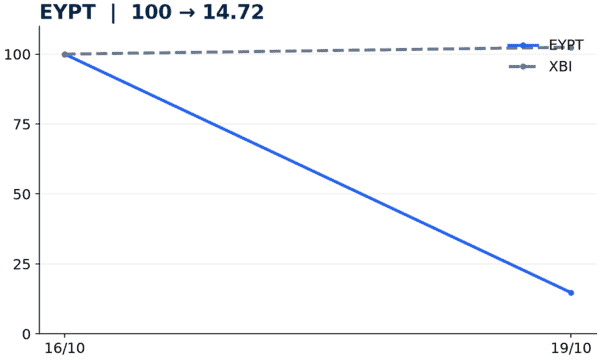
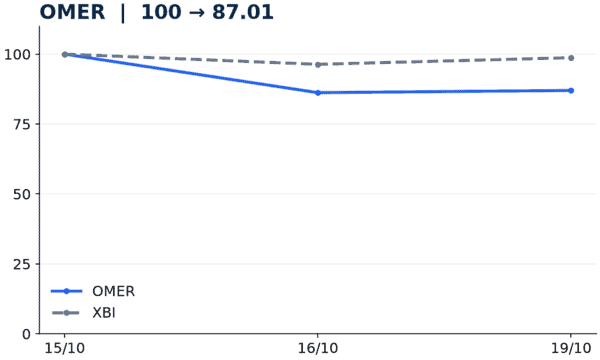
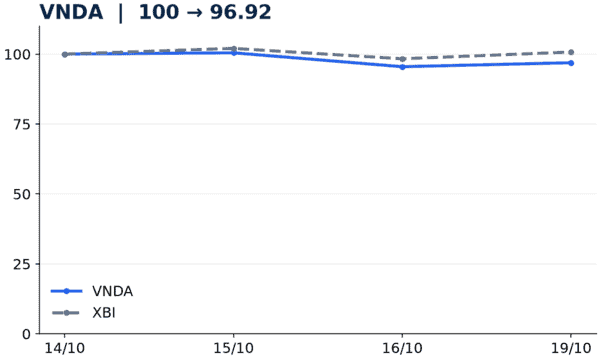
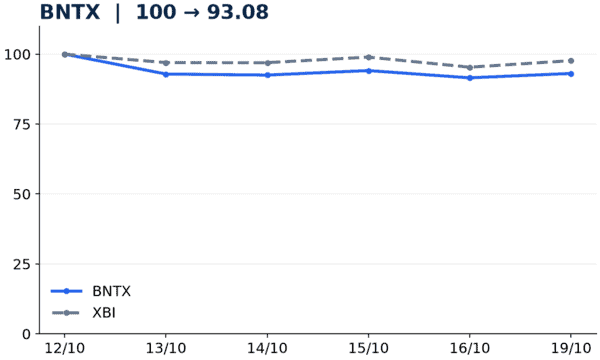
Separate event windows, the same vertical scale. Closing prices through October 19, 2026; the lines do not isolate causation.
Closing prices show a dispersion consistent with the events’ different character, without allowing every movement to be attributed to one announcement. Each comparison starts at the last close before the release and ends with the first subsequent trading session. Vanda’s communication came after the October 14 close, making October 15 the reaction session used here. EyePoint requires a comparison between Friday, October 16 and Monday, October 19. Omeros and BioNTech have different windows again. Mixing these starting points would produce an uninformative ranking.
| Stock | Closing prices compared | First-session reaction | XBI in the same session | Arithmetic difference |
|---|---|---|---|---|
| EYPT | October 16 → 19: $2.99 → $0.44 | −85.28% | +2.45% | −87.74 percentage points |
| OMER | October 15 → 16: $18.79 → $16.20 | −13.78% | −3.65% | −10.14 percentage points |
| VNDA | October 14 → 15: $4.22 → $4.24 | +0.47% | +2.05% | −1.58 percentage points |
| BNTX | October 12 → 13: $95.84 → $89.01 | −7.13% | −3.04% | −4.09 percentage points |
Calculations on closing prices: EYPT, OMER, VNDA, BNTX and XBI. Differences are simple subtractions, without adjustment for risk, composition or sensitivity to the sector.
EyePoint undergoes an almost complete repricing of its equity story on the day the result and restructuring are announced. XBI rises in the same session. Those opposite directions make the significance of the company-specific news particularly apparent, without statistically isolating every component. The closing price does not automatically assign zero value to DME. It can incorporate doubts about the candidate, financing, time and the ownership percentage existing shareholders will retain along the path.
Omeros records a significant decline in a session that is also negative for the sector. BioNTech falls less in percentage terms, but its XBI comparison likewise shows underperformance. Those different gaps help describe the reactions without measuring fundamental damage by themselves. Company size, financial structure and portfolio differ. One percentage point of BioNTech’s value represents a very different amount from the same percentage point in a small biotech. Percentage returns compare equity performance rather than the economic loss associated with individual programs.
Vanda provides the most instructive observation: it gains 0.47% in the first session considered, while underperforming the sector. A negative clinical result and a slightly positive stock reaction can coexist. The program may have carried limited weight in expectations; investors may have considered other news or future spending. Prices alone cannot establish which explanation dominates. The observation does prevent an account of these cases as four equivalent collapses. A rigorous assessment of the scientific result does not require inventing a corresponding market decline.
Extending the comparison through October 19 preserves the differences. Against their respective pre-announcement closes, Omeros is down 12.99%, Vanda 3.08% and BioNTech 6.92%. For EyePoint, October 19 is already the first session, so its result remains −85.28%. These windows have different lengths and include other market information. They help describe subsequent paths rather than determine which company recovered better over equal periods. Answering that question would require a uniform window that the newest case has not yet completed.
Language about market capitalization also requires precision. Multiplying Omeros’ $2.59 decline by the 72,388,316 shares reported at August 7 produces a theoretical change of approximately $187.5 million. Applying BioNTech’s $6.83 decline to its 251,204,366 shares at June 30 produces approximately $1.716 billion. These calculations use historical share counts rather than exact October capitalizations. They are neither corporate cash outflows nor isolated valuations of the affected programs. Omeros shares; BioNTech shares.
06 Cash buys time: how much remains after the next decision?
Comparing financial balances is useful when dates and composition are preserved. EyePoint provides a September estimate; the other three cases use June financial statements. BioNTech reports in euros and includes non-current securities. Omeros completed a material financing transaction after quarter-end. A table can bring those facts together, but the meaning of each row depends on its context. An equity’s attraction depends on the assets, obligations and price alongside the size of its cash reserve.
| Company | Reported resources | Date and composition | Central financial question |
|---|---|---|---|
| EyePoint | Approximately $118 million | September 30 estimate; cash, equivalents and short-term investments | Restructuring and funding through DME results and subsequent steps |
| Omeros | $132 million | June 30; cash and short-term investments, before July payments | Launch collections and liquidity after convertible-note repurchases |
| Vanda | $170 million | June 30; cash, equivalents and marketable securities | Improving the relationship between revenue, commercial costs and development |
| BioNTech | €16.6342 billion | June 30; cash, equivalents and current and non-current security investments | Productivity of capital deployed across the oncology portfolio |
Sources: EyePoint, October 19, Omeros Q2, Vanda Q2, BioNTech Q2.
The first criterion is the distance to the next genuinely decisive evidence. EyePoint faces a long wait for DME data while reorganizing and clarifying funding needs. Vanda has a nearer regulatory date, but a favorable outcome would introduce another commercial investment. Omeros can generate useful information with its next financial statements because its business is already operating. BioNTech can wait for an endpoint to mature while evaluating other programs. Time has a different cost when revenue or evidence from other assets can accompany it.
The second criterion is cash after the event. A biotech reaching positive data without adequate resources may need to raise capital before beginning the next step. Better evidence can make financing more accessible, but does not guarantee favorable terms or eliminate dilution. Program value and the interest represented by each share follow connected but distinct paths. A reasonable model therefore needs a reserve beyond the results date, rather than ending the cash-flow analysis at the most favorable moment in the story.
A purely arithmetic example makes the effect concrete. If a company with one hundred shares issues another fifty to finance its development, the original shareholders hold two-thirds of the subsequent total if they do not subscribe for the new shares. New capital can increase overall value and make development possible, so dilution does not automatically destroy value. What matters is the relationship between funds received, issue price and the value of the activities financed. After a setback, a company may need to sell a larger ownership percentage to raise the same amount.
The third criterion is the reversibility of commitments. Some expenses can fall quickly; others continue because of contracts, clinical obligations or manufacturing requirements. Workforce reductions lower one component while potentially leaving other payments intact. Pausing a program avoids future decisions but does not return money already spent. A new approval expands opportunities and can increase spending before revenue arrives. Reading a business plan requires understanding the sequence of receipts and payments as well as their final amounts, especially when resources are limited.
The fourth criterion is the quality of commercial flows. Omeros and Vanda have revenue-generating products, but sales, profit and operating cash remain different measures. Revenue composition, collection timing and the resources needed for promotion can change the net contribution considerably. A commercial company can depend less on one trial and still require substantial financing. Protection comes from the portfolio’s actual economic contribution, rather than simply the number of authorizations held. The bridge becomes stronger when operations generate resources that can support later decisions.
The fifth criterion is control over those decisions. A substantial reserve increases the freedom to choose when to negotiate an agreement or close a project. Limited resources can impose less favorable timing even when scientific rationale remains. BioNTech has relatively broad financial freedom; EyePoint must establish credibility through its smaller plan. Omeros has deployed liquidity to reduce future equity-linked claims, while Vanda must select the pace of investment. These are different forms of one question: how much value can be preserved while the next evidence is produced?
This explains the limit of the phrase trading below cash. The comparison requires an updated balance, the correct share count, debt, obligations and future outflows. Even when the arithmetic is correct, the market can assign negative value to part of future operations if it expects resources to be consumed without an adequate return. Liquidity is not an automatic price floor. Its value also depends on who controls its use, the time required to obtain results and the ability to discontinue investments that become less persuasive.
Another consideration is the economic interest retained in products. Licensing can reduce the capital a company must invest directly while surrendering some future revenue or profit. Both effects belong in the assessment. Sharing value can make development possible for a resource-constrained company that could not support it alone. For a well-financed company, a partner can add commercial or operating capabilities. The relevant question concerns retained value after costs and obligations, alongside the nominal size of the potential market.
Time affects that retained value. Consider a purely hypothetical future receipt of one hundred units and an assumed 10% discount rate: delaying it by one year would reduce its value at the original expected date to approximately 90.9. Additional spending during the delay would increase the economic reduction. A delay can therefore hurt the stock even if the assumption of eventual success is unchanged. For these four cases, additional waiting must be assessed together with the cost of keeping the remaining opportunity open.
The sequence of news can also change negotiating power. A convincing balance sheet before financing, clinical data before an agreement or workable reimbursement before expansion can improve the available alternatives. The opposite sequence can require capital commitments while uncertainty remains high. Neither order guarantees favorable terms, but it helps explain why companies with the same initial resources can preserve different amounts of value. The practical question is how much useful evidence they obtain before their next need for external capital.
Finally, an assessment needs to consider the ability to stop. Financing every step without clear criteria would turn cash into a resource destined to disappear. Ending a path when new evidence justifies doing so can preserve future options. The difficulty is establishing those conditions before resources become too limited. Vanda’s pause, EyePoint’s concentration and BioNTech’s wait for another endpoint are different decisions requiring different criteria. For Omeros, the principal boundary concerns the sustainability of commercial execution and the resources needed to maintain it.
07 Four paths that could change the assessment
A useful map identifies evidence that would improve the picture and evidence that would weaken it further. For EyePoint, the initial step is a financial plan compatible with DME development and continuing trial execution. COMO and CAPRI results, expected by the company in the fourth quarter of 2027, remain the central clinical test. Higher funding requirements or a more demanding regulatory path would add shareholder risk. Credible expense control would improve the ability to reach that test without predicting its outcome. Financing and clinical performance each need to earn their own confidence.
For Omeros, verification begins with the accounts following July’s transactions. Sales growth accompanied by collections and adequate liquidity would strengthen the possibility that the U.S. launch can support operations. Weak sales, more demanding working capital or unfavorable financing needs would make the lost European option more costly. Data after October can help assess NTAP’s practical effect. Renewed European access would need a documented path rather than a general possibility. The assessment should change with observable commercial and financial evidence, alongside any concrete development in the regulatory route.
For Vanda, the December 12 imsidolimab decision is one of the nearer tests, while revenue and operating cash use will measure portfolio sustainability. Approval with a commercially useful profile would add possibilities; launch speed and expenses would determine its contribution. Lower spending combined with maintained commercial capabilities and selective development would be more informative than an isolated reduction. If liquidity kept shrinking without improving flows, the failed program’s cost would become part of a broader allocation problem. The portfolio’s breadth needs to translate into a more sustainable financial relationship.
For BioNTech, assessing BNT113 requires OS, while assessing the group requires multiple results over time. Favorable survival evidence could keep an important clinical path open; lack of benefit would further reduce the candidate’s value. Other programs can strengthen or weaken the portfolio without retroactively changing PFS. Financial reserves support this selection process across several activities. Value will emerge from a portion of the outcomes, their quality and the economic rights retained. The balance sheet improves the ability to wait and choose, while results must establish what those choices ultimately produce.
The comparison also suggests an order of questions that applies beyond these cases. Start with the evidence that was missed. Then establish the program’s weight in the company, the path to new evidence, required capital and the interest remaining for existing shareholders. Only then does it become useful to interrogate the price. Starting with a decline and searching for a favorable explanation risks adapting the story to a desire for recovery. Starting with evidence separates what can still change from what has already been demonstrated, and identifies the cost of reaching the next meaningful answer.
A much lower price can incorporate excessive pessimism, but distance from a former high does not measure attractiveness. That high may have depended on probabilities, timing and financing assumptions that no longer apply. The relevant comparison is between today’s price and the value of the remaining scenarios, including the cost of reaching them. A company can survive, develop a product and still leave old shareholders with a modest result if a large portion of value has been surrendered along the way. Corporate survival and return per share are separate outcomes.
One final measure of management discipline is the ability to change decisions when the evidence changes. EyePoint must show its DME focus can be financed and executed. Omeros must demonstrate that reducing debt left sufficient flexibility for the launch. Vanda must choose which opportunities still deserve capital. BioNTech must select the programs that justify their investment scale within a broad portfolio. Defending every project to protect a narrative would have a cost; abandoning a viable path too early would have another. Subsequent decisions will make that judgment more observable to shareholders.
The setback’s bill therefore continues to be written after the announcement. For EyePoint, it concerns rebuilding a central development path. For Omeros, it concerns the contribution of an authorized business with a narrower geographic opportunity. For Vanda, it concerns the return from a portfolio that still needs to support its costs. For BioNTech, it concerns an incomplete clinical verdict and the productivity of a substantial financial reserve. Prices register disappointment quickly. Subsequent evidence, time spent and capital consumed will determine how much of that disappointment becomes a lasting loss of value per share.
Join the Merlintrader community: r/MerlintraderPub · Telegram
Research and market updates
Follow the English Merlintrader channel for research and sector updates.
@merlintraderpub_comInformational and educational content prepared with AI assistance and checked against the sources cited. Interpretations are the blog’s commentary; company forecasts remain forecasts. This material is neither financial advice nor an investment recommendation. Readers should conduct their own research and assessment and, where appropriate, consult an authorized financial adviser.
Disclaimer. This content is published by Merlintrader for educational and informational purposes only. It presents independent analysis. It does not constitute investment advice, an investment recommendation, an offer or a solicitation to buy or sell any security, and it is not a research report within the meaning of applicable United States securities regulation. Nothing here should be read as a recommendation to buy, sell or hold $EYPT, $OMER, $VNDA, $BNTX or any other security.
Figures are taken from public filings with the U.S. Securities and Exchange Commission, company press releases and market-data providers, and are stated with their reference dates. Data can change without notice, and figures published before a results release become outdated the moment that release is issued. Merlintrader makes no representation that the information is complete or current at the time of reading. Readers should verify every figure against the primary source before acting on it.
Biotechnology and healthcare companies carry binary risk. Clinical trials fail, regulatory decisions go against the applicant, approval does not guarantee commercial uptake, and development-stage companies frequently raise equity at whatever price the market will bear. A single readout can change the value of the business overnight in either direction, and companies at this stage can lose all of their value. Every reader is responsible for their own decisions and should consult a licensed financial adviser where appropriate.
Merlintrader may hold positions in securities mentioned. Some links on this page are affiliate or referral links, including those to Finviz and Stocktwits, which may generate a commission at no cost to the reader. Full legal information is available on the disclaimer and terms of use and privacy pages.
The Cost of a Setback: Four Biotechs, Four Futures to Reprice — $EYPT, $OMER, $VNDA, $BNTX — Merlintrader
Biotech Catalyst Calendar
PDUFA dates, AdCom meetings, clinical readouts and trial completions in one free, filterable calendar.
Free FDA and PDUFA Calendar →
PDUFA dates, AdCom meetings, clinical readouts and trial completions in one free, filterable calendar.
Free FDA and PDUFA Calendar →