
Merlintrader Trading Pub
Biotech catalyst, news and analysis PDUFA tracker
Merlintrader Trading Pub
Biotech catalyst, news and analysis PDUFA tracker
AI transparency: articles and reports are produced with the help of artificial intelligence and checked through a process that does not constitute specialist validation. They may contain errors: verify relevant information with independent sources. Read the full disclaimer.
Beyond rare earths: where $UAMY, $USAS, $ASPI and $BSIN capture value
Antimony and helium connect these four companies through two different industrial stories. Americas Gold and Silver and United States Antimony share a processing venture. ASP Isotopes and Big Sky Industrial expose shareholders to independent helium projects with different products, customers and capital requirements. The useful comparison begins with what each business sells and where the buyer takes over.
Antimony · $USAS + $UAMYA mining-and-processing venture: existing mine material, a new processing venture in early development.
Helium · $ASPI / $BSINIndependent gas projects: liquid helium with LNG versus contained helium under a plant-gate contract.
Open the company Stock Hub
Open the company Stock Hub
Open the company Stock Hub
Open the company Stock Hub
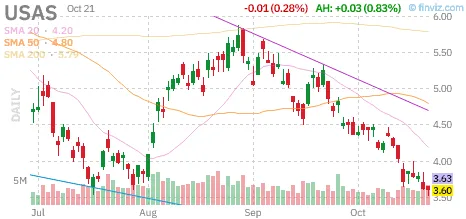
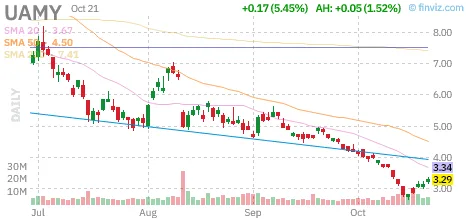
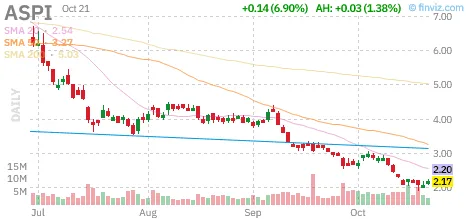
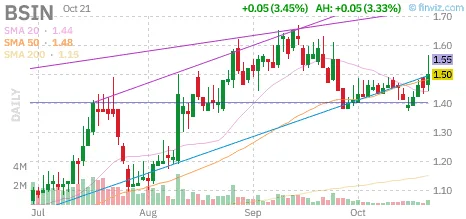
Static daily charts captured October 21, 2026. Chart observations are separate from the dated company disclosures discussed below. The images are not a comparative total-return series or a technical trading recommendation.
01 The product determines which part of the value chain gets paid
An antimony-bearing concentrate, a finished antimony ingot and liquid helium all contain a strategically useful material. Their economics depend on how much processing remains, which specifications the customer requires and who pays to get the product to its next destination. A quoted price becomes meaningful only after those responsibilities are clear.
The four companies provide two useful comparisons. Americas Gold and Silver, trading as $USAS in the United States, produces antimony alongside other metals at Galena. United States Antimony, $UAMY, processes material into products including antimony metal, oxide and trisulfide. Their February agreement links a source of mine material with processing expertise and a route to market.[1][5]
ASP Isotopes, $ASPI, reaches the helium market through Renergen and its Tetra4 subsidiary in South Africa. The Virginia Gas Project combines LNG with a liquid-helium development. Big Sky Industrial, $BSIN, is building a Montana industrial-gas and carbon-management project whose helium agreement specifies contained helium delivered at the plant gate. ASPI and BSIN are independent projects, not commercial partners.[7][10][12]
This distinction keeps the comparison useful. UAMY and USAS share the prospective economics of one new facility, but have different businesses outside it. ASPI and BSIN share an element, while the form of the intended product and the surrounding project economics differ. The four stocks do not represent one integrated supply chain or interchangeable exposure to the same commodity.
02 USAS already produces antimony; the venture seeks a larger share of its value
Galena’s antimony is an existing part of Americas’ operating story. The June 2026 MD&A reported 234,291 pounds of antimony produced in the first half, including 97,213 pounds in the second quarter. Those quantities describe mine output associated with the concentrate business, not finished metal from the proposed joint-venture plant.[1][2]
The October 19 production update added a more recent operating reference. Third-quarter antimony production was 101,011 pounds and antimony sales were 121,691 pounds. The same release reported consolidated silver production of 800,458 ounces and silver sales of 860,850 ounces. Production and sales are separate measures: material produced in one period can be sold in another.[4]
For USAS, antimony has two possible economic roles. It contributes to the value of the material already mined and sold. A successful processing venture could also give Americas a share of the margin earned after that material leaves the mine. The February announcement explicitly described the opportunity to improve the value realized from antimony contained in Galena’s silver concentrate.[1]
The February agreement gives Americas a 51% interest in the venture. Americas contributes the site at Galena and would sell antimony feed material to the venture on market terms. Its material has priority, while the facility could also process feed from other mines. UAMY brings processing knowledge and marketing relationships.[1]
A miner can therefore participate in more than one stage of the same material’s journey. That does not make the extra margin free. Americas must fund its share of an approved project budget, and the plant must recover saleable material at a cost customers will support. The value retained by USAS would depend on both its feed-sales economics and its interest in the processing operation, after the costs and obligations at each level.[1]
The wider mining business still matters. The August results described substantial investment at Galena and a strong quarter at Cosalá. By-product credits enter the company’s AISC calculation, so better antimony realization can affect reported silver costs without changing how many physical ounces of silver were produced. AISC is a non-IFRS measure and should be read with its definition and reconciliation.[2][3]
This gives the antimony project a practical context. Its potential contribution belongs beside mine development, maintenance, other metal prices and capital spending. An attractive additional product can improve a multi-metal operation; it does not make the cost of the original mine disappear.
03 UAMY shows why processing capacity still needs a workable purchase-to-sale margin
UAMY sells several antimony products rather than one uniform material. Its June quarterly report describes metal, oxide and trisulfide, alongside precious-metal recovery and a separate zeolite business. The report identifies different applications for these products, including flame-retardant systems, batteries, ordnance and ammunition primers.[5]
The processing operation must acquire or produce suitable feed, recover the material, meet the required specification and sell it on acceptable terms. A strategically important plant can still face a poor margin when its selling price falls faster than its cost base.
The second quarter provides a clear example. UAMY’s report said antimony sales volumes rose 26% from the prior-year quarter, while the average selling price per pound fell 52%. Antimony revenue declined 39%. Higher physical sales therefore coexisted with lower revenue and much weaker gross profit. These are period-specific operating results, not a forecast for the next quarter.[5]
The government business introduces a separate product and acceptance requirement. The DLA contract described in the quarterly report is a five-year IDIQ arrangement with a maximum value of $245 million, covering antimony metal ingots of 99.65% purity. Delivery orders establish their own pricing, and revenue recognition requires delivery to the depot and formal government acceptance.[5]
That acceptance condition has already affected reported timing. The first two shipments, approximately 82,000 pounds, were delivered during June and formally accepted in July. The filing states that the related $2.6 million of revenue was recognized in July. June physical delivery and third-quarter revenue recognition can both be correct descriptions of the same shipments.[5]
The September 30 operating update adds another layer to the margin question. UAMY reported receipt of high-purity antimony flake from its Bolivian partner’s hydrometallurgical facility, and said processing of Stibnite Hill material had begun. The company described more than 400,000 pounds of antimony contained in material stockpiled at Radersburg. Management expected these feed sources to help processing efficiency and margins.[6]
Those are different forms of operating evidence. Feed received is not finished product sold. Antimony contained in stockpiled material is not an equivalent quantity of accepted ingots. The eventual benefit depends on recovery, processing cost, product mix and the price at which the resulting material is sold.
The new Idaho venture sits within this broader business. It could give UAMY another processing platform and access to Galena feed. It also requires capital and operating performance. The same company can be a buyer of feed, a processor, a seller of finished product and a minority owner of a new facility; each role has a different claim on the economics.[1][5]
04 The Idaho agreement allocates capital as well as future profit
The 51% USAS and 49% UAMY ownership split is only part of the venture’s structure. The February agreement provides for equal representation on a six-member management committee, with UAMY as operator and Americas chairing the committee. Capital contributions follow ownership interests, and a member that does not contribute can be diluted.[1]
The construction timetable is conditional. The agreement contemplates 18 months to complete the facility starting from completion of an agreed project budget. That is not an unconditional countdown beginning on the press-release date. Supply agreements were to be negotiated within 90 days, with either party able to suspend construction if those agreements were not finalized. The agreement also contains specified deadlock and buy/sell provisions.[1] In its June 2026 quarterly report, UAMY described the JV as in the early stages of organizational development, with its approved budgets and project development schedule still in process.[5]
These terms explain what the collaboration could change. Galena’s material would have a defined domestic processing route, while both companies could participate in the processing business. But the economics require an agreed budget, capital contributions, supply terms and a working plant. An ownership percentage cannot substitute for those steps.
The venture also creates a useful distinction between company-level exposure and project-level exposure. USAS shareholders retain the mining business and its other operations. UAMY shareholders retain the existing processing platform and other activities. The JV’s future performance would affect both, without determining either company’s entire result.[1][3][5]
For the next meaningful project update, the useful details would be the budget, actual contributions, construction progress, feed and offtake arrangements, and the point at which the plant is expected to produce saleable material. These would allow a clearer assessment of how much additional value each company could retain.
05 ASPI’s helium exposure belongs to an integrated gas project and a wider group
ASP Isotopes acquired Renergen in January 2026. Renergen’s principal asset is its 94.5% interest in Tetra4, the entity developing the Virginia Gas Project in South Africa’s Free State province. The project includes natural-gas liquefaction, helium separation and further liquefaction of the helium.[8]
The LNG and helium streams share a project but serve different markets. LNG provides an energy product for customers including domestic industrial users. The helium system adds a specialized product whose commercial performance depends on the required processing and reliable delivery. Progress in LNG is useful operating evidence, but it does not establish that the helium system is running continuously.[7][14]
The history is more informative than a single commissioning headline. The October registration statement describes LNG production beginning in September 2022 and initial helium production in January 2023. A leak required repairs; a small-scale liquid-helium sale occurred in February 2025, followed by a shutdown while drilling increased available gas supply. The filing’s risk discussion states that the helium liquefaction system had not yet achieved sustained production.[9]
On August 20, ASPI announced the start of commissioning after engineering optimization and targeted commercial shipments during September. The October registration statement targeted full Phase 1 production capacity for LNG and liquid helium, and the start of full commercial operations at Phase 1, during the fourth quarter of 2026. As of October 21, 2026, the company had not announced completed commercial helium shipments. The later timetable belongs beside the earlier announcement; a past demonstration sale should not be confused with the beginning of recurring supply at the planned operating scale.[7][9]
The production targets also need their product labels. Phase 1 is designed for approximately 2,500 GJ per day of LNG and approximately 70 Mcf per day of liquid helium, or about 350 kg per day. These are nameplate objectives, not reported daily sales. Actual availability, commissioning performance and customer demand determine what can be delivered.[7][9]
The opportunity is an integrated project with two potential revenue streams. The operating challenge is to make the shared infrastructure dependable enough for both. That includes gas supply and compression as well as the helium equipment. A technically successful batch answers a narrower question than sustained output at a repeatable cost.
06 ASPI’s contracts define demand, while the corporate structure defines the shareholder’s exposure
The October registration statement describes a five-year take-or-pay agreement with an Asian industrial-gases company for liquid helium, priced above $600 per Mcf of contained helium on an all-in plant-gate basis. The agreement represents approximately 15% of expected Phase 1 helium nameplate capacity. Contracting a portion of planned capacity is different from having the entire plant’s output sold on the same terms.[9]
The LNG side has its own agreements. An August 6 announcement described an additional five-year take-or-pay contract with a South African food processor, representing approximately 10% of Phase 1 nameplate LNG capacity. The company said signed contracts then covered about 75% of anticipated Phase 1 LNG volumes. These percentages refer to different products and cannot be combined into one utilization figure.[14]
Management’s August illustration of more than $27 million of annualized Phase 1 revenue combined LNG and helium, using stated price and production assumptions. It was a forecast for the integrated project after expected completion, not reported helium revenue and not earnings attributable in full to an ASPI share.[7][14]
The distinction matters because ASPI is a wider materials group. Its June balance sheet reported $219.596 million of cash and equivalents and $35.300 million of short-term investments. First-half operating cash use was $41.094 million, including discontinued operations. These are consolidated group figures, not a standalone Virginia Gas Project cash budget.[8]
The proposed Noble Africa transaction involving ENDRA adds a corporate consideration. The registration statement describes a proposed combination and a continuing relationship with ASPI, with closing conditions and financing arrangements. Registration itself does not complete that transaction. The eventual ownership structure, subsidiary debt and funding terms determine how project value would reach the parent and its shareholders.[9]
Phase 2 requires a separate financing assessment. The October filing describes non-binding, conditional indications of support of up to $535 million from DFC and up to $250 million from Standard Bank. It also states that no binding definitive agreements had been executed for either facility. These indications support a potential financing route; they are not cash already available to spend on construction.[9]
For this comparison, the near-term operating question remains Phase 1 reliability and delivery. A larger future development does not remove the need to demonstrate the economics of the first plant, and a parent cash balance does not answer every project-level funding condition.
07 BSIN’s helium agreement sells a defined product at a defined handover point
Big Sky Industrial is the former U.S. Energy Corp. The name and Nasdaq ticker changed to BSIN effective June 8, 2026. The rebrand did not create a new reporting company or remove the obligations associated with the existing business.[13]
The June quarterly report still described an oil-and-gas revenue base while the industrial-gas activities were in development. Big Sky’s intended operating platform combines helium production with carbon-management activities connected to its Montana assets. The August operating update targeted commissioning in late 2026 and first gas, commercial operations and first revenue in the first quarter of 2027.[11][12]
The helium agreement has more precise terms than a generic statement of customer interest. The April 27 Form 8-K reports an agreement entered into on April 24 for all contained helium produced at the plant, subject to a maximum of 1.2 million cubic feet per month. The base price is $285 per thousand standard cubic feet, or Mcf, on an EX-WORKS plant basis.[10]
Title and risk pass after the buyer connects its tractor to the filled tube trailer. The buyer bears downstream transport, tolling, processing and distribution costs. Big Sky still has to produce qualifying material and bear the costs of its own field and plant operations.[10]
The take-or-pay obligation is tied to production made available by Big Sky. It includes exceptions for force majeure, non-conforming product and other contractual conditions. It is not an unconditional payment for the maximum monthly volume when the plant cannot produce or make conforming material available.[10]
The initial five-year term starts with the month in which the first tube trailer is filled for delivery. The April filing anticipated, without guaranteeing, commencement around March 1, 2027, and gives the buyer a termination right if commencement has not occurred by the July 1, 2027 outside date. Those terms make commissioning a commercial deadline as well as an engineering task.[10]
The contract provides a route to market. Its value depends on the plant’s ability to deliver reliably within that route, at a cost that leaves an adequate contribution after debt service and other project obligations. Fixed pricing can improve visibility while limiting the benefit of a stronger market and leaving exposure to rising production costs.
08 Two helium prices do not establish a margin comparison
The $285/Mcf Big Sky base price and the greater-than-$600/Mcf Renergen contract figure can look directly comparable because both are expressed per Mcf of contained helium. Both prices are also stated at the plant: Renergen’s on an all-in plant-gate basis, Big Sky’s EX-WORKS Plant. The common unit and handover label do not, however, make the physical products or the production costs identical.[9][10]
Renergen’s agreement concerns liquid helium from an integrated LNG and helium project. Big Sky’s filing specifies contained helium transferred at the plant in a filled tube trailer, with downstream processing and distribution assigned to the buyer. The comparison therefore needs the product specification, processing performed before handover, contractual obligations and operating cost at each facility.[9][10]
A higher selling price can accompany more processing and a different cost structure. A lower plant-gate price can leave some downstream work with the purchaser. Neither observation establishes which project has the higher margin. That requires comparable cost and delivery evidence, rather than subtraction of prices alone.
Big Sky’s disclosed maximum volume allows a limited revenue illustration. At 1.2 million cubic feet per month, twelve months would equal 14.4 million cubic feet, or 14,400 Mcf. At the initial $285/Mcf base price, that would produce $4.104 million of annual gross helium sales. This is a calculation using the contractual maximum, assuming all that volume is produced, conforming and available. It is not a guaranteed minimum payment, profit or company revenue forecast.[10]
It would also be misleading to place that helium-only illustration beside Renergen’s more-than-$27-million integrated Phase 1 forecast and call the difference a valuation gap. The latter includes LNG, depends on management’s production and price assumptions, and belongs to a different project and corporate structure.[7][14]
The same discipline applies to the antimony pair. A pound reported in mine concentrate and a pound of finished metal sit at different points in the production chain. Recovery, payability, processing charges and product specifications connect those points. The material’s strategic use does not collapse them into one comparable sales unit.[1][2][5]
09 The other products can support the project, but their contribution must be counted once
USAS’s antimony exposure sits within a silver and base-metals operation. The company’s cost reporting treats by-product metals as credits in AISC. An improved antimony realization can strengthen mine economics, but adding that same benefit again as an entirely separate increment to profit would count it twice unless the underlying calculation is reconciled.[2][3]
Renergen’s LNG and helium streams arise from the same project. LNG contracts can support customer demand while the helium system moves toward sustained operations. Shared wells and infrastructure can be useful, but the project still has to carry the relevant production, maintenance and financing costs. A combined revenue forecast cannot be assigned entirely to helium.[7][9][14]
For BSIN, carbon management forms another potential economic leg. The August release described MRV applications under EPA review and management’s expected access to Section 45Q benefits. The quarterly report separately warned that eligibility, technical requirements, verification, timing and changes in the rules affect the availability of those benefits. An expected tax credit is therefore conditional project economics, not an existing helium sales receipt.[11][12]
UAMY’s zeolite business is a different kind of complement. It is a separate operating activity, not another product automatically recovered from every pound of antimony feed. Its volumes, freight costs and contribution need their own assessment. A group can have useful diversification without every operation sharing the same equipment or economics.[5]
These distinctions help explain the four exposures. Some products share a physical project; others share only a listed parent. The financial contribution depends on the actual connection, not the number of commodity labels that can be attached to the company.
10 Capital must reach the operating milestone before it can earn a processing return
The balance-sheet comparison is deliberately dated. The companies do not publish identical information at identical times, and group liquidity is not interchangeable with a project’s unrestricted construction budget.
| Company | Disclosed financial reference | What it does and does not establish |
|---|---|---|
| USAS | Unaudited cash of US$63 million at September 30, 2026; reported in the October 19 update.[4] | A more recent cash reference than the June accounts. It does not by itself establish final quarterly cash flow, covenant outcomes or the JV’s remaining budget. |
| UAMY | US$41.434 million cash and equivalents at June 30, 2026, with Treasury investments reported separately.[5] | A resource for the wider company, alongside feed purchases, operating needs and expansion. It is not cash reserved exclusively for the Idaho venture. |
| ASPI | US$219.596 million cash and equivalents and US$35.300 million short-term investments at June 30, 2026.[8] | Consolidated resources across a materials group. They do not establish that every subsidiary can draw the same amount without financing conditions. |
| BSIN | US$4.9 million cash and US$16.4 million total available liquidity at August 4, 2026.[12] | Liquidity includes undrawn borrowing capacity. The two amounts cannot be added together as separate cash resources. |
Each business has a different funding problem. USAS must allocate capital across producing mines and future processing. UAMY must finance feed and working capital as well as new facilities.[1][5]
ASPI must manage several businesses, subsidiary obligations and the proposed corporate transaction.[8][9]
BSIN must bridge construction and commissioning before the new industrial-gas revenue begins.[11][12]
More downstream participation can increase the share of value a company retains, but it usually adds responsibility. The prospective owner must fund equipment, support working capital and manage operating performance. Giving up some processing margin to a customer or partner can reduce that burden. Neither structure is automatically superior; the contract and the cost of capital decide the trade-off.
11 The operating evidence that would change this comparison
For USAS and UAMY, the most useful shared update would connect the Idaho venture’s agreed budget with actual contributions, construction progress and supply arrangements. A more specific commissioning path would make the future processing contribution easier to assess. Until then, current mine and processing results remain separate from the new plant’s prospective earnings.[1]
At USAS, the October production update gives an existing antimony sales base. Subsequent financial reporting can connect those sales with realized revenue, costs, capital spending and cash. At UAMY, the DLA acceptance rule makes the status of shipments important, while commercial selling prices and the cost of new feed determine whether higher throughput improves margin.[4][5][6]
For ASPI, reliable Phase 1 liquid-helium production and repeat commercial deliveries would answer a more immediate question than the scale of Phase 2. Contracting more planned output may improve demand visibility, but accepted deliveries and a clearer project cash contribution would provide stronger operating evidence. The corporate transaction’s final terms remain a separate matter.[9]
For BSIN, the sequence runs through gathering completion, commissioning, first conforming helium made available under the agreement and the carbon pathway’s relevant approvals and qualification. Management’s late-2026 and first-quarter-2027 windows identify targets, not completed milestones. The plant and the financing bridge must remain aligned.[10][11][12]
The constructive outcome would be more value retained from existing material or shared infrastructure: better antimony realization and a viable new processing operation, alongside gas projects that deliver their intended products reliably. The adverse outcome would be additional capital tied up in processing before a sustainable margin appears, compounded by weaker prices, delays or new financing claims.
12 Two pairs are more informative than a four-stock basket
The antimony pair is a collaboration between a mine-material supplier and a processor, with both seeking exposure to the new facility’s economics. The helium pair is a comparison between independent gas projects, one aiming to sell liquid helium alongside LNG and the other selling contained helium under a defined plant-gate agreement.[1][9][10]
Their common issue is the distribution of value along an industrial chain. Producing more material, processing it further and retaining more of the resulting margin are different achievements. Extra processing can create a better business when its contribution exceeds the additional capital and operating burden. It can also add another expensive step before the company collects cash.
For these four companies, the next useful developments will show more precisely what product is being sold, what the customer accepts, which costs remain with the seller and how much value survives the funding required to deliver it. That is a more durable comparison than a ranking based on resource size or a pair of headline commodity prices.
Related Merlintrader research
Disclaimer
This article is published by Merlintrader for educational and informational purposes. It is independent commentary, not financial advice, an investment recommendation, or an offer or solicitation to buy or sell securities. Company forecasts and proposed transactions are uncertain. Figures refer to the dates and periods stated; non-IFRS measures are not substitutes for financial statements. Mining, materials and development companies carry commodity, operational, regulatory, financing and dilution risks, including the possibility of total loss. Readers should conduct their own research and consult a licensed financial adviser where appropriate. See the Merlintrader disclaimer and terms of use and privacy.
Sources and documents
- JV antimony agreement, February 10, 2026
- Americas June 2026 MD&A
- Americas Q2 2026 results
- Americas Q3 production, October 19, 2026
- United States Antimony June 2026 Form 10-Q
- United States Antimony September 30, 2026 shipment update
- ASP Isotopes helium commissioning, August 20, 2026
- ASP Isotopes June 2026 Form 10-Q
- ENDRA registration statement and Renergen disclosures, October 2026
- Big Sky helium contract, April 27, 2026 Form 8-K
- Big Sky June 2026 Form 10-Q
- Big Sky Q2 results and construction update, August 11, 2026
- Big Sky rebranding announcement, June 4, 2026
- ASP Isotopes LNG contract, August 6, 2026