Merlintrader Trading Pub
Biotech catalyst, news and analysis PDUFA tracker
Merlintrader Trading Pub
Biotech catalyst, news and analysis PDUFA tracker
AI transparency: articles and reports are produced with the help of artificial intelligence and checked through a process that does not constitute specialist validation. They may contain errors: verify relevant information with independent sources. Read the full disclaimer.
Stock Hub 2026 · Biotech & Healthcare
Nasdaq: $ABUS
Premiumreportfree with an ad
ABUS Stock Hub: Arbutus Biopharma News, AB-101 and the Moderna Settlement
AB-101 regains a U.S. development path after the $230 million tender; imdusiran and the remaining legal assets still require their own evidence.
Get every Merlintrader report in real time on Telegram: join @merlintraderpub_com.
Daily chart
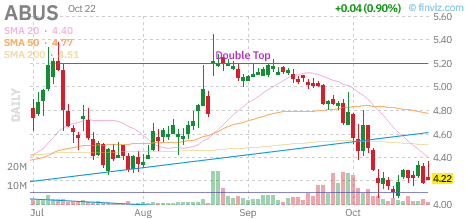
Daily chart $ABUS – October 22, 2026Finviz chart (affiliate) — informational, not a recommendation.
Next catalyst
Next development decision — no announced date
AB-101 can proceed in the U.S.; the next clinical program is still to be defined
The October 22 announcement removes the FDA hold but says Arbutus is evaluating next steps. Imdusiran’s proposed Phase 2b design alignment is a separate milestone. A new study commitment, funding and execution would be more substantive than regulatory flexibility alone.[25][23]
Key data
Expected post-tender shares
153.276M
Company expectation at October 1; not a later period-end count.[26]
The financial distinction
Settlement proceeds, retained cash and contingent recoveries are not the same
The $2.25B headline combines aggregate noncontingent and conditional payments to Arbutus and Genevant. Arbutus’s documented initial receipt is $178.4M. The later tender reduces cash as well as shares; June liquidity is not a current post-return balance.[18][23][26]
Latest company newsOctober 22, 2026 — FDA clinical hold removed for AB-101. Additional U.S. development is permitted; management is evaluating next steps.[25]
The constructive case
The case against
Operating and financial position
A lean development company after a major capital-allocation event
Executive summary
Arbutus combines investigational HBV therapies with contractual and equity interests linked to Genevant. October’s AB-101 hold removal is a regulatory milestone, not an efficacy result. The tender accepted 46M shares at $5, while the remaining Moderna component and Pfizer/BioNTech cases require separate legal outcomes. The next test is a defined development path supported by an up-to-date financial picture.[25][26][17]
Latest news
October 22, 2026 — AB-101 U.S. hold removed
Arbutus may undertake additional U.S. development. The company is evaluating next steps; the release gives no new trial-start or results date.[25]
October 1, 2026 — final tender results
46 million shares accepted at $5.00 for $230 million before expenses. Expected shares after completion: approximately 153.276 million.[26]
August 12, 2026 — results and clinical alignment
June liquidity was $92.625M and Q2 net loss $5.143M. Arbutus reported FDA design and safety alignment for a proposed imdusiran Phase 2b study.[23]
July 16, 2026 — settlement receipt and expanded litigation
Arbutus confirmed its July receipt and announced three international Pfizer/BioNTech enforcement actions. The cases are distinct from the Moderna resolution.[22]
Extended analysis
Does $ABUS deserve a place in your portfolio?
The full deep dive has the answer’s building blocks: cash, dilution, catalysts and risks, every figure sourced.
Free. No signup. You decide, we don’t recommend.
01 Three scenarios: clinical optionality after a substantial capital return
Constructive scenario — a smaller share base supports a credible next clinical step
Arbutus enters this phase with two tangible changes rather than only a development story. Its October 22, 2026 announcement says the FDA removed the clinical hold on the AB-101 investigational application, permitting additional development in the United States. Separately, the October 1 final tender announcement says the company accepted 46 million shares for purchase at $5.00, using $230 million before transaction expenses. The first event expands regulatory flexibility; the second changes capital allocation and the ownership denominator. Neither by itself establishes that a treatment will succeed commercially.[25][26]
In a constructive scenario, management converts that flexibility into a defined, appropriately funded clinical program. Imdusiran has already reached FDA alignment on the design and safety parameters of a proposed Phase 2b study, as reported in August. That is a useful starting point for a larger test, but a final protocol, financing commitment and actual execution are separate steps. For AB-101, the October release says management is evaluating next steps, not that another trial has begun. Progress would become more substantive when development decisions specify the program, responsibilities and resources rather than simply restate the availability of the assets.[23][25]
The legal assets offer a second possible source of value, but the favorable case does not require treating them as cash already earned. An additional Moderna payment depends on the limited Section 1498 appeal, while the Pfizer/BioNTech proceedings remain separate. A positive outcome could strengthen resources or support further capital returns; its timing, amount and the portion attributable to Arbutus would have to follow the actual contractual and judicial results.[17][22]
Middle scenario — valuable assets, an extended period of decisions
A less dramatic path is continued evaluation, modest operating expenditure and slow movement through legal and clinical milestones. The first half of 2026 used $14.128 million in operating cash, while the June-quarter research and development expense was $2.898 million. Those figures describe a streamlined organization, not a company already paying for a large late-stage program. If management commits to a materially larger study, historical spending becomes a weak guide to future expenditure. Maintaining a small cost base while deciding what to develop can preserve flexibility, but it does not independently advance a candidate toward approval.[23]
In that middle scenario, the next financial statements matter because they connect the July settlement receipt with the later repurchase and any other cash movements. A balance dated June 30 is not a post-tender cash balance. The capital return can be meaningful without creating a recurring earnings base, and the remaining business can retain clinical and legal options without having a near-term product launch. These distinctions make the sequence of disclosures more informative than any single headline.
Adverse scenario — monetization is followed by delay, expenditure or weaker claims
The unfavorable path combines delayed development, disappointing clinical results, reduced legal recovery or inefficient use of the resources retained after the tender. Removal of the AB-101 hold does not establish long-term safety or efficacy. Likewise, a prior settlement does not determine the outcome against another defendant. The aggregate contingent Moderna amount is shared with Genevant and subject to legal conditions, including possible proration and, in specified circumstances, repayment with interest. Treating its full headline as an Arbutus receivable would obscure the downside.[17][25]
These scenarios are descriptions of different operating paths, not price forecasts. The central question is whether each successive decision improves the expected quality and timing of the cash flows attributable to the remaining shares. A smaller denominator helps only in relation to the assets, obligations and spending that remain with it.
02 What Arbutus Biopharma does: an HBV pipeline and an intellectual-property asset
Arbutus Biopharma Corporation is a Canadian-incorporated, Nasdaq-listed clinical-stage company whose current therapeutic focus is chronic hepatitis B. Its two named programs are imdusiran, also called AB-729, and the oral PD-L1 inhibitor AB-101. The company also participates in the economics of delivery-technology intellectual property licensed to Genevant. That makes ABUS different from a conventional single-trial biotech: clinical development, contractual income and litigation can affect the same equity through different channels.[16][25]
Imdusiran is an investigational RNA-interference therapy intended to reduce viral antigens. AB-101 is an investigational immune-checkpoint inhibitor. At a business level, the distinction is straightforward: one program aims to reduce the antigen burden, while the other seeks to support an immune response. Their scientific rationale does not establish the effectiveness of a particular future combination, and ownership of both assets does not mean a combined trial is underway. Clinical claims must remain attached to the actual study that generated them.[23][25]
The organizational model has also changed. The annual report describes the discontinuation of in-house scientific research, workforce reductions and a remote organization of 19 employees at December 31, 2025. Clinical operations rely on external providers. This is a leaner structure than an integrated research and manufacturing company; its advantages are lower fixed costs and flexibility, while its limitations include dependence on contractors and the resources needed to restart or expand development.[16]
The geographic rights to imdusiran are important. Arbutus and Qilu ended their strategic partnership in June 2025, after which Arbutus again held global imdusiran rights. The Qilu license is therefore no longer a source of future development milestones. The associated release of deferred revenue affected reported results, but the terminated arrangement is not an active commercial partnership.[7]
There is no direct equivalence between the HBV drug assets and the Genevant license. Arbutus licensed delivery-platform rights outside HBV, subject to previously granted rights, while retaining HBV rights. Genevant’s contractual payments and Arbutus’s equity interest are economically distinct from the cost and probability of developing imdusiran or AB-101. A sound reading keeps those streams separate before considering how they interact through capital allocation.[7]
The company can consequently make progress in one area while remaining uncertain in another. A legal receipt may improve financial flexibility even if a clinical trial is not ready to begin. An encouraging clinical signal may support further work without producing revenue. Returning capital can reduce the share count while also reducing cash available for development. The overall picture depends on the interaction of these decisions, not on assigning the same level of certainty to every asset.
03 ABUS stock catalysts: distinguish completed events from the next decisions
The closest catalyst is no longer the lifting of the AB-101 hold: that event was announced on October 22, 2026. The next clinical question is what management chooses to do with the reopened U.S. development path. The release does not set a trial-start date, a readout date or a budget.[25]
| Track | Established event | Next substantive evidence | Timing status |
|---|---|---|---|
| AB-101 | U.S. IND hold removed, announced October 22, 2026.[25] | Development decision and a defined next program. | No next-step date in that announcement.[25] |
| Imdusiran | Fast Track announced April 15; proposed Phase 2b design alignment reported August 12.[20][23] | Final program commitment, responsibilities and execution. | Proposed study, not an announced results date.[23] |
| Capital return | Final tender results announced October 1: 46 million shares accepted at $5.[26] | Post-transaction balance sheet and share-count reconciliation. | Historical transaction; settlement was scheduled on or about October 5.[26] |
| Moderna contingent payment | Contract provides an aggregate conditional payment tied to the Section 1498 appeal.[17] | Qualifying appellate outcome and its contractual consequences. | Outcome-dependent, not cash on a fixed promised date. |
| Pfizer/BioNTech | U.S. litigation and three international enforcement actions described in 2026.[22] | Material rulings, scheduling or settlement terms. | Separate proceedings; no monetary recovery assumed. |
The distinction between an event and its financial recognition is especially important here. The Moderna agreement was signed in March, generated recognized income before collection, and produced a cash receipt in July. The tender was announced later and accepted shares after the September expiration. Each step belongs to a different reporting or cash-flow period. The next financial report should be read as a reconciliation of those steps, not merely as a test of quarterly revenue growth.[21][23][26]
For a clinical catalyst, useful evidence would show what question the next study is intended to answer and whether the organization has committed the resources to answer it. For a legal catalyst, useful evidence would show what the court actually decided and how that decision maps to the payment contract. For a capital-allocation catalyst, useful evidence would show cash spent, remaining liquidity and the actual share count. These are different standards of progress.
There is also a timing mismatch between the legal and clinical assets. A court process can advance independently of a trial, and a trial can require spending before a legal payment becomes available. No assumed synchronization belongs in a base financial picture. An appealing sequence of possible events is not the same thing as a funded schedule with defined milestones.
04 Imdusiran clinical evidence: a published early-stage foundation, not a registrational result
The published AB-729-001 Phase 1a/b study provides a useful independent documentary basis for the early clinical development of imdusiran. The original abstract reports 83 participants who received study treatment or placebo across healthy-volunteer and chronic-HBV parts. Its patient portions were open-label rather than a randomized comparison designed to establish a functional-cure advantage. The main endpoint was safety. These design features define the strength and limits of what the study can support.[36]
The abstract reports no discontinuations of imdusiran because of adverse events and no deaths. That supports the early tolerability assessment within the studied population and exposure. It does not eliminate the possibility of less common events or establish the risk-benefit profile of a later combination regimen. A larger program and longer follow-up can reveal risks that an early study does not capture.[36]
The company’s subsequent development includes Phase 2a combination work and long-term follow-up. In its August 2026 update, Arbutus described eight patients achieving functional cure in Phase 2a studies and two additional patients achieving that outcome during long-term follow-up. Six of the original eight were described as continuing to sustain functional cure for more than two years. These are different observation windows, and the additional follow-up patients are not a new randomized trial. The June-quarter report adds that the other two of the original eight seroreverted during long-term follow-up but remained virally suppressed and off nucleos(t)ide analogue therapy.[23][7]
The signal is clinically relevant because durable control after a finite treatment course is a different proposition from ongoing suppression during treatment. Its investment significance nevertheless depends on reproducibility, patient selection, the contribution of other agents and the size of a future controlled study. A collection of responders can justify further investigation without supplying a reliable population-wide response estimate.
The proposed Phase 2b pathway is the next developmental bridge. Arbutus said it reached alignment with the FDA in May 2026 on design and safety parameters and intended to incorporate the feedback into a final protocol. Alignment can reduce uncertainty about how to proceed; it does not demonstrate that the study has enrolled patients or that a pivotal endpoint has been met.[23]
One earlier combination path has narrowed. IM-PROVE II, the completed Phase 2a study of imdusiran followed by VTP-300, an HBV immunotherapeutic from Barinthus Biotherapeutics, included a cohort with low-dose nivolumab; the collaboration allowed a larger Phase 2b depending on the Phase 2a results. After Barinthus announced in January 2025 a shift in strategic focus that included postponing further VTP-300 development, the June-quarter report states that the parties do not intend to undertake a larger Phase 2b with that combination regimen. The statement concerns that specific regimen, not the separate imdusiran Phase 2b design discussed with the FDA.[7]
The clinical registry offers a separate check on historical program identity. NCT04980482, the imdusiran study with pegylated interferon and background nucleos(t)ide analogue treatment, is listed as completed, with an April 29, 2026 update. NCT06277037 is a distinct long-term follow-up study. Registry status identifies the study and its reported administrative stage; it does not independently verify every company-reported response or supply missing Phase 2b results.[34][35]
Imdusiran’s commercial relevance would therefore grow most clearly through a program that connects the early signal with a credible probability of an approvable, competitive treatment. The asset has a clinical foundation, but its future cost, timing and place in therapy remain different questions from whether the earlier studies produced promising observations.
05 Functional cure, antigen decline and remaining off treatment are not interchangeable
The preferred functional-cure endpoint described in the 2022 AASLD-EASL conference report requires sustained surface-antigen loss and HBV DNA below the lower limit of quantification 24 weeks off treatment. This is more demanding than a temporary reduction in surface antigen while a drug is being given. It also differs from remaining off a nucleos(t)ide analogue without satisfying the antigen-loss criterion.[38]
That distinction matters directly to the Arbutus data. Its annual report described 49 of 105 Phase 2a patients as achieving functional cure or remaining off nucleos(t)ide analogue therapy after discontinuation. The combined measure was reported as 47%. It is not a 47% functional-cure rate. Combining an outcome with another clinically meaningful but different outcome does not make them equivalent.[16]
The August release supplies a more specific durability description: eight Phase 2a functional cures, six continuing for more than two years, plus two further cures in long-term follow-up. It also describes 41 additional patients who stayed off nucleos(t)ide analogue therapy for at least 48 weeks during their Phase 2a studies. These observations are valuable only if their denominators, follow-up periods and endpoint definitions remain attached to them.[23]
There are several ways an otherwise accurate number can become misleading. A responder-only follow-up can describe durability among responders while saying little about the chance that an unselected patient will respond. A selected low-antigen subgroup can perform differently from the overall study population. A result obtained with a combination cannot be assigned entirely to one component without evidence separating those contributions. None of these limitations makes the observation worthless; each limits the conclusion it can carry.
The same caution applies to safety language. “Generally well tolerated” summarizes observed experience in a particular program. It does not mean that every event was absent, that a treatment is appropriate for every patient or that a rare adverse effect has been excluded. For a finite-treatment proposition, confidence must cover both the treatment period and what happens after treatment stops, including loss of disease control.
A useful scientific reading therefore asks four linked questions: how many patients were treated, how many reached the specified endpoint, when that endpoint was assessed, and how many maintained it at later follow-up. The comparator and selection rules come next. Without those elements, a percentage can be numerically correct but unsuitable for comparing investment cases across companies.
This is also why the emerging competitive benchmark cannot be used as a simple ranking exercise. The GSK studies and the Arbutus early program differ in scale, design and populations. Numerical comparisons across those studies are not randomized evidence that one regimen is superior. They can identify the level of evidence a future program will need to address, but they cannot substitute for that program.[36][37]
06 AB-101 FDA hold lifted: regulatory flexibility returns, development remains a decision
On October 22, 2026, Arbutus announced that the FDA removed the clinical hold on the AB-101 IND and that additional U.S. clinical development may proceed. The program is an oral PD-L1 inhibitor intended for chronic hepatitis B. The company’s immediate statement was that it is evaluating next steps. The important change is permission to develop, rather than a new approval to market the drug or a commitment to a particular next trial.[25]
The 2023 hold no longer applies. The annual report described the hold first disclosed in April 2023, when the planned U.S. study had not begun and patients had not been dosed in that U.S. program. The October announcement changes that regulatory fact. It does not retroactively turn overseas early-stage evidence into a completed U.S. development program.[16][25]
The October release says the Phase 1a/1b AB-101-001 study is complete and describes generally favorable tolerability, evidence of high receptor occupancy in seven patients with chronic HBV, and antigen declines in two patients. The release does not provide a functional-cure result. Receptor engagement is evidence that the drug affects its intended target; it is not the same endpoint as durable clinical control after treatment stops.[25]
The ClinicalTrials.gov record NCT05960240 is consistent with a completed early-stage study and reports an actual enrollment of 128 participants across the entire study. That total is not the denominator for the seven-patient observation in the October release. The registry’s whole-study enrollment includes different parts and populations. Using it to manufacture an overall response rate would combine incompatible groups.[33]
Strategically, removal of a hold can widen the set of available choices. A company might advance an asset itself, seek a partner, revise priorities or decide the expected return does not justify additional spending. These are possible paths, not announced transactions. The release names no partner or buyer, attaches no deal value and makes no statement about combining AB-101 with imdusiran.
The next decision will have both a scientific and financial meaning. A defined program can clarify the efficacy question, but it can also increase expenditure relative to the streamlined 2026 cost base. A licensing transaction could transfer some costs and rights, while its economics would depend on actual terms. Continued evaluation avoids an immediate large commitment but leaves the time to a material result uncertain.
The balanced reading is consequently positive about the removal of a regulatory obstacle and cautious about what comes after it. The obstacle was real and its removal is material. The clinical and economic tests remain ahead. AB-101 remains an early-stage asset with renewed development flexibility, not a de-risked commercial product.[25][33]
07 HBV competition: a new approved benchmark raises the evidence bar
The competitive landscape changed immediately before the AB-101 announcement. On October 20, 2026, GSK announced U.S. approval of Hibsago, or bepirovirsen, with nucleos(t)ide analogue reverse transcriptase inhibitor therapy for a defined adult chronic-HBV population. The announced indication excludes cirrhosis and requires prior treatment, suppressed HBV DNA and specified antigen criteria. It is not an approval for every person with HBV.[32]
This changes the strategic context for an investigational functional-cure program. Arbutus is no longer being evaluated only against the aspiration of a finite treatment; a competing therapy has reached an announced U.S. approval in a specified population. That can validate the clinical and regulatory relevance of the treatment goal while increasing the evidence and differentiation a subsequent entrant will need.[32]
The original Phase 3 abstract reports functional cure at week 72 in 127 of 650 treated patients versus none of 328 controls in B-Well 1, and 106 of 570 versus none of 286 in B-Well 2. It also reports serious adverse events in 7% of the pooled treated group and 4% of controls. These are large controlled studies, unlike the small early-stage Arbutus observations. Their efficacy and safety results provide context, not a head-to-head estimate for imdusiran or AB-101.[37]
The future competitive question is broader than which trial displays the largest percentage. A treatment’s place can depend on eligible population, durability, safety, burden of administration, compatibility with other therapies, cost and reimbursement. An approved product may leave substantial room for alternatives, but “room in the market” is not the same as evidence that a particular alternative will win it.
The disease burden remains substantial. The WHO fact sheet updated July 28, 2026 estimates 240 million people with chronic hepatitis B in 2024 and 1.1 million related deaths that year. Those are dated epidemiological estimates, not the number of patients immediately eligible for a U.S. branded therapy. Diagnosis, access, clinical criteria and affordability separate global prevalence from a commercial addressable market.[31]
For ABUS, the relevant implication is a higher requirement for clarity. A proposed trial or partnering discussion becomes more informative when it identifies what benefit the asset is expected to add to an evolving standard of care. Broad statements about the worldwide burden do not resolve that question. The next development program needs to earn its differentiation through evidence rather than inherit it from the size of the disease.
08 Moderna settlement: the aggregate headline and Arbutus’s receipt are different amounts
The March 3, 2026 agreement provides a $950 million noncontingent payment to Arbutus and Genevant together and a possible further $1.3 billion linked to the Section 1498 appeal. The frequently quoted $2.25 billion is the sum of those aggregate components. It is neither cash entirely payable to Arbutus nor an unconditional amount already collected.[18]
The subsequent collection provides the essential company-specific anchor. Arbutus reported receiving $178.4 million on July 8, 2026 as its share of the noncontingent payment, including reimbursement of litigation costs. The aggregate $950 million was paid to the parties under the settlement. These two figures are consistent with different economic scopes, not competing estimates of the same Arbutus cash balance.[22][23]
The distinction also matters for reported earnings. Arbutus recognized estimated settlement-related license revenue before the cash was collected, so a large first-quarter income figure did not mean the same amount was already in the bank at March 31. The receivable from the Genevant license was $178.741 million at March 31, 2026 (first-quarter Form 10-Q) and $179.373 million at June 30, 2026; July collection followed later. Recognized revenue, receivables and cash are three stages of the same financial sequence.[21][23][7]
The settlement resolves the Moderna patent-enforcement disputes described in the agreement while preserving the limited appeal mechanism. It includes a fully paid-up, royalty-free, nonexclusive license and covenants covering specified Moderna products and applications. The license is fully paid-up and royalty-free, so it creates no recurring royalty; the Pfizer/BioNTech cases remain open.[17]
The agreement has already demonstrated that the intellectual-property assets can produce a substantial realized receipt. It does not establish the size of future recoveries, and it does not remove the costs or risks of the remaining proceedings. Each additional amount needs its own route from legal entitlement to allocation and collection.
There is a further per-share consideration: returning settlement proceeds through a tender distributes capital to selling holders and reduces the number of shares that remain. It is therefore inappropriate to retain all of the pre-return settlement cash in a valuation narrative while simultaneously applying the lower post-tender share count. That combination would count an economic benefit twice.
The useful conclusion is precise rather than promotional. Arbutus received a large, documented amount from the noncontingent settlement. The remainder of the headline is conditional and shared. The cash return and the future clinical program determine how the realized monetization translates into the continuing company’s resources and risk.
09 Section 1498 appeal: conditional recovery, proration and repayment risk
The remaining Moderna mechanism is tied to a limited appeal concerning whether 28 U.S.C. Section 1498 bars the infringement claims for specified vaccine doses. The settlement provides for an aggregate $1.3 billion contingent payment on defined favorable outcomes, including the contractual treatment of a voluntary dismissal. This is a legal condition attached to payment, not an ordinary receivable with a calendar maturity.[17]
The contract also contemplates a partial outcome. If the appeal bars claims for some but not all relevant doses, the payment can be prorated. Where the appellate decision does not clearly establish the required dose allocation, the agreement provides a route through agreement or accelerated binding arbitration. A headline binary description therefore misses the possibility that the economic result is less than the maximum.[17]
Initial victory and final economic entitlement can also differ. Under specified circumstances, if a favorable outcome is later reversed in a final nonappealable decision, the payment must be returned with interest. Mutual financial covenants protect the potential payment or repayment. Money received under a reversible entitlement is not equivalent to capital that can automatically be distributed without regard to the remaining conditions.[17]
Arbutus’s licensing economics then operate on top of the legal result. Litigation costs and contractual allocation matter, and Arbutus also holds an equity interest in Genevant. Neither the license interest nor the equity stake turns the full aggregate contingent payment into an ABUS entitlement. A company-level net amount requires the actual allocation, costs and distribution terms.[7]
The proceeding against the United States in the Court of Federal Claims is another distinct track. The June-quarter filing describes the complaint filed March 19, 2026 concerning doses supplied directly to government employees and a protective request addressing any further doses affected by the appeal. That claim is not a second unconditional entitlement to the same proceeds. Possible recoveries must be understood in relation to overlapping legal scope, rather than added as independent maximum amounts.[7]
For scenario analysis, the disciplined approach is to separate legal success, the resulting aggregate payment, allocation to Arbutus and final availability of those funds. Assigning a particular probability or an expected per-share payment without an adequate legal and economic basis would create false precision. The relevant next evidence is the actual judicial decision and the company’s account of its contractual consequences.
That uncertainty is not a reason to ignore the asset. It is the reason the asset remains conditional. Its value can change materially with a ruling or settlement, but conditional upside is different from the financial resources available to fund payroll or a trial today.
10 Pfizer and BioNTech litigation: an independent recovery path
The U.S. Pfizer/BioNTech action is separate from the resolved Moderna enforcement litigation. Arbutus and Genevant filed it in the District of New Jersey in April 2023. The June 2026 quarterly filing describes a September 2025 claim-construction ruling that the company generally considered favorable and says the parties were awaiting further scheduling. A favorable interpretation of claim terms is not a final damages judgment.[7]
The July 16, 2026 announcement added three international enforcement actions: one in Canada and two at the Unified Patent Court. Arbutus and Genevant seek monetary remedies and injunctions under the asserted patents. These are claims and requested remedies, not cash recoveries. The international actions broaden the litigation footprint but also introduce separate procedural, jurisdictional and timing questions.[22]
A previous defendant’s settlement can demonstrate that negotiated monetization is possible. It cannot establish another defendant’s liability, the damages calculation or the timing of a settlement. Patent scope, validity arguments, accused conduct and procedural history differ. Applying the Moderna headline to Pfizer/BioNTech based on a sales ratio would replace those legal questions with an unsupported shortcut.
The cases also interact with licensing economics. Even a successful aggregate recovery would need to be allocated under the agreements with Genevant and reduced by applicable costs. The legal maximum, the amount ultimately collected and the net benefit to each remaining ABUS share are different measures. A clear update would connect a court or settlement event with those economic steps rather than rely on the size of historical vaccine sales.
Accordingly, the Pfizer/BioNTech track remains an event-driven component of the company rather than a recurring operating forecast. It can change materially on a ruling, agreement or other substantive development. Until that occurs, its uncertainty belongs alongside the clinical assets and capital commitments, not hidden inside an assumed cash balance.
11 Genevant economics: contractual proceeds and a minority equity stake
Arbutus has two different economic connections to Genevant. One is the license governing particular revenue and infringement proceeds. The other is an approximately 16% common-equity interest in Genevant’s parent company reported at June 30, 2026. The investment’s carrying value was zero at that date. Zero carrying value is an accounting measure, not proof that the stake has no economic value or that it can be freely sold at a readily observable price.[9][7]
The disclosed license distinguishes a mere sublicense from a bona fide collaboration. The specified revenue percentages are 20% and 14%, respectively, subject to the alternative low-single-digit sales-royalty provisions. For infringement proceeds, the disclosed entitlement is calculated after litigation costs and is also subject to the contractual alternative. These provisions are not an unconditional right to take a fixed percentage of every dollar associated with Genevant.[7]
The equity stake can generate a dividend separately from license income. In August, Arbutus expected a material Genevant dividend in the third quarter of 2026. As of October 22, 2026, no filing or release quantifying or confirming its receipt had been published.[9][23]
The relationship with Roivant adds governance context. The quarterly filing describes Roivant’s substantial control of Genevant and Arbutus’s nonvoting observer right. Arbutus is therefore not the sole decision-maker over Genevant distributions or strategy. A minority economic interest may be valuable while remaining different from cash directly controlled by Arbutus.[7]
A separate RSV-related agreement illustrates why the details matter. The July filing describes its termination for a $1 million fee, and the June-quarter report records receipt of that fee on July 21, 2026. That amount is a separate contractual payment, not another percentage of the Moderna aggregate and not a new recurring royalty. It is distinct from other Genevant-related proceeds.[9][7]
The analytical benefit of separating these streams is clarity. Contract revenue, dividends and a minority equity asset can all relate to the same underlying technology while having different accounting, availability and control. Their interaction can support value, but adding them without checking overlap can overstate that value.
12 ABUS earnings: settlement income is not a recurring product business
The contrast between the first and second quarters explains why a headline earnings multiple is a poor description of the operating business. First-quarter 2026 revenue was $179.126 million and net income was $169.695 million, driven by recognized license revenue related to the Moderna settlement. In the second quarter, revenue was $1.014 million and the net loss was $5.143 million. These quarters have very different nonrecurring contributions.[21][23]
| USD millions | Q1 2026 | Q2 2026 | Interpretation |
|---|---|---|---|
| Total revenue | 179.126 | 1.014 | Q1 was dominated by settlement-related license recognition.[21][23] |
| Research and development | 4.120 | 2.898 | A streamlined cost base, not the cost of a launched late-stage program.[21][23] |
| General and administrative | 5.889 | 3.867 | Q2 increase attributed by the company to higher stock compensation.[21][23] |
| Net income / (loss) | 169.695 | (5.143) | Accounting profitability is not recurring product cash generation.[21][23] |
| Operating cash used | 8.110 | 6.018, calculated | Q2 equals H1 cash use less Q1.[21][23] |
The prior-year comparison has its own distortion. Second-quarter 2025 revenue included recognition of previously deferred Qilu revenue when that partnership ended. The decline in June-quarter revenue therefore does not mean an established product franchise lost a similar proportion of demand. Arbutus is still a clinical-stage business with licensing and royalty income, not a company selling an approved HBV drug.[23]
First-quarter settlement recognition also explains why income and cash diverged. The receivable was recorded before collection, so the half-year income statement showed a large profit while operating cash flow remained negative. Once the receivable is collected, cash flow changes without requiring the same revenue to be recognized again. Counting the July cash receipt as a second independent earnings event would duplicate the economic contribution.[21][23]
The reduced cost base is meaningful but needs context. Lower trial activity and the discontinuation of internal research can reduce spending; they can also mean the business is between major clinical commitments. An increase in R&D would not automatically indicate deterioration if it reflects a credible new program. Conversely, maintaining low spending would not automatically indicate execution success if the pipeline remains undecided.
The next results are most informative when read through cash movements, commitments and the future development plan. A trailing profit measure heavily influenced by a settlement says little about sustainable revenue after that settlement. Its denominator may also be affected by the tender’s timing, because earnings per share uses a period-weighted share count rather than simply the expected number outstanding after completion.
13 Arbutus cash, historical burn and the post-tender reporting gap
At June 30, 2026, Arbutus reported $19.171 million of cash and equivalents plus $73.454 million of marketable securities, for combined liquidity of $92.625 million. The July $178.4 million settlement receipt occurred after that balance-sheet date. The later tender committed $230 million before fees. These observations describe a sequence, not a current balance that can be obtained by presenting the June figure unchanged.[23][26]
Operating activities used $14.128 million in the first half, compared with $8.110 million in the first quarter. The calculated second-quarter amount is $6.018 million; the calculated half-year monthly average is about $2.355 million. These are historical operating-cash measures, not a forecast for a larger clinical program. They exclude the later tender and are not a substitute for the company’s next cash-flow statement.[21][23]
The August quarterly filing said management believed resources were sufficient for at least the next twelve months. That is a dated management liquidity assessment. It predates the tender. Future clinical spending, legal costs, compensation, distributions and other movements can change the financial cushion.[7][26]
There is no sound basis for a precise current cash-per-share number using only the June statement and later headlines. Such a calculation would need to account for all subsequent receipts, dividends, operating costs, bonuses, transaction expenses and settlement of the repurchase. It would also need the actual post-transaction share count. A partial bridge can explain events, but it cannot certify the balance left to fund the business.
The balance sheet also contains obligations beyond conventional debt. The June-quarter statement reported a $3.111 million liability related to the sale of future royalties and $8.817 million of contingent consideration, along with payables and a lease obligation. These are not all immediately payable bank borrowings, but they prevent “no debt” from being interpreted as “no financial obligations.”[23]
The royalty-sale arrangement is particularly easy to misread. OMERS retains a sold ONPATTRO royalty interest until the contractual collection threshold is reached, while a separate Acuitas-related royalty remained with Arbutus. The quarterly filing says Arbutus is not required to reimburse OMERS if the assigned royalties do not reach the threshold. Accounting recognition of a royalty liability is therefore different from a normal loan payable on a fixed maturity.[7]
The practical financial test is whether the remaining resources are proportionate to the next clinical and legal commitments. A lean historical organization can operate with modest cash use while still facing a larger capital requirement if development accelerates. A large legal opportunity can remain illiquid. Evaluating funding and development together avoids treating either a historical burn rate or an aggregate litigation figure as a guarantee.
14 ABUS buyback and share dilution: what the $230 million tender changed
The offer began August 24, 2026 with a stated price range of $5.00 to $5.75 per share and expired September 29. The October 1 final announcement says Arbutus accepted 46 million shares at the bottom of that range, for an aggregate $230 million excluding fees and expenses. The shares were to be purchased for cancellation. This was an issuer tender, not a special cash dividend paid equally to every continuing share.[27][26]
The final announcement anticipated 153,275,907 shares outstanding immediately after completion. Its language is an expected post-completion count, not a newly filed period-end cap table. The company also said the accepted shares represented approximately 23% of the outstanding total at the September 29 close. The June share count is an earlier reference and differs from the transaction denominator.[26]
The economic mechanism has two sides. Holders whose shares are purchased receive cash and cease to participate through those shares. Holders who retain shares own a larger percentage of a company with fewer shares, but the company also spends cash. Percentage ownership can rise without aggregate company value rising by the same amount. Whether the transaction creates per-share value depends on what was paid relative to the value of the remaining assets and obligations.
Roivant’s participation makes the ownership outcome more specific. Roivant tendered proportionately; its October 5, 2026 Schedule 13D/A reports 29,880,079 shares, approximately 19.5%, after 8,967,383 shares were purchased at $5.00. Its pre-offer stake was not simply left untouched while the denominator contracted. Assuming every large holder’s ownership percentage rose automatically would ignore this structure.[26]
The transaction does not eliminate future dilution. Share-based compensation awards and financing decisions can expand the denominator again. Shareholders approved a new incentive plan on May 26, 2026 authorizing 16.3 million shares under that plan. This is an authorization for potential issuance, not proof that all those shares have been granted or issued. Those shares become outstanding only if awards are granted and settled; the authorization is not a cash-equity offering.[10]
Similarly, the August 12, 2026 announcement reported 8.6 million stock options and unvested restricted stock units outstanding as of June 30, 2026. Exercise, vesting, forfeiture, settlement and subsequent grants can change the realized effect. Neither the award pool nor the plan capacity is identical to a fully diluted current count. The most useful later disclosure will reconcile actual common shares and outstanding instruments after the tender.[23]
Finally, the historical $5 tender price is not a standing market floor. The offer ended and accepted a finite number of shares under its terms. Investors trading afterward face the remaining business and prevailing market demand, not a continuing commitment by Arbutus to buy any quantity at that price. The tender is important capital-allocation history, not a guaranteed future exit.
15 Governance and litigation-linked compensation
Legal monetization has a direct compensation dimension. The July 16 current report disclosed a CEO bonus equal to 1.5% of Arbutus’s noncontingent settlement share, with 2.0% of specified remaining Moderna-related proceeds and 2.5% of specified Pfizer/BioNTech proceeds, subject to the stated terms. The CEO calculations exclude dividends attributable to the Genevant equity stake. These percentages apply to the company’s proceeds as defined, not to the full aggregate litigation headlines.[9]
The same filing describes a CFO bonus of 0.25% connected to the noncontingent proceeds, including related Genevant dividends, and a potential future bonus on specified remaining proceeds subject to board discretion and the stated conditions. Different scopes apply to the CEO and CFO arrangements. Combining the rates without respecting those scopes would misstate the expense.[9]
The governance significance is not that incentives are automatically improper. Compensation tied to realized recoveries may reward substantial work and align management with monetization. It also creates a claim on cash that matters when assessing resources available for trials or distributions. A complete cash bridge should include the contractual compensation consequences rather than treating gross receipts as entirely unencumbered.
The repurchase is another governance decision: management and the board chose a large capital return rather than retain all realized proceeds for internal development. The result says something concrete about allocation priorities, but it does not decide whether the next clinical program should be self-funded, partnered or deferred. That choice must still be evaluated against evidence, costs and the company’s remaining resources.
Institutional influence also needs correct dating. Roivant is both a major Arbutus shareholder and the controlling party described in the Genevant relationship. Roivant’s October 5, 2026 Schedule 13D/A reports its post-transaction ownership at approximately 19.5%. Older ownership tables and vendor percentages may use different denominators. Their existence is not proof of an identical present-day voting position.[7][26]
The relevant governance questions are therefore practical: what resources remain, what commitments have been approved, what incentives apply to each receipt, and how clearly management explains the next program. A share repurchase does not remove future capital-allocation risk.
Recent Form 4 filings show how insider holdings moved around the tender. On September 18, 2026, the CEO exercised options covering 126,864 shares, the CFO 293,100 shares and two other directors 131,333 shares each; in each case the company withheld shares, valued at $5.07, to cover the exercise price (Form 4s of September 23, 2026: CEO, CFO, director, director). These were option exercises, not open-market purchases. In the tender accepted on October 1, 2026, the CEO sold 24,655 shares, the CFO 48,081 and the two directors 17,948 and 17,142 shares, all at $5.00 (Form 4s of October 7, 2026: CEO, CFO, director, director).
Among outside holders, Whitefort Capital reported 15,794,261 shares, or 8.0% of the pre-tender share count, in a Schedule 13G filed September 4, 2026. Morgan Stanley reported 12.2% as of September 30, 2026 in a Schedule 13G/A filed October 7, 2026.
16 ABUS stock data, ownership denominators and market sentiment
The reference close is $4.18 on October 21, 2026. Market data are separate from the financial statements and share-count announcements. A quotation can be fresh while a vendor’s reported shares outstanding still reflects an earlier filing.[29]
The distinction is material after this tender. 197.6 million shares were outstanding at June 30, 2026, and the company anticipated approximately 153.3 million after the tender. At the $4.18 reference price, the latter implies a calculated common-equity value of approximately $640.7 million. That is an illustration using the expected transaction count, not a certified current capitalization or fully diluted valuation.[7][29][26]
It would be misleading to combine the lower denominator with a pre-tender cash balance to announce an enterprise-value bargain. The same transaction that reduces shares also uses cash. Equity value, enterprise value and remaining liquidity require dates and definitions that agree. Where a vendor has not yet reconciled the transaction, its automatically calculated ratios can lag the underlying economics.
Short interest and float deserve the same caution. A changed share count can alter the denominator of a short-percentage measure, while reported positions have their own settlement date. A high displayed short percentage is not proof of an imminent squeeze, and days to cover is a volume ratio rather than a deadline. Without a reconciled post-tender float and a clearly dated position, precision in a short-float percentage can be more apparent than real.
The near-term discussion can nevertheless be understood qualitatively. Regulatory flexibility, a smaller share base, capital-return expectations and the uncertain legal assets can all affect how traders interpret news. Optimism about renewed development can coexist with impatience over timing or concern about spending. Those are possible sentiment drivers, not evidence of a clinical outcome or a legal entitlement.
17 What would change this reading: the next evidence that matters
The central reading is a company with an early clinical portfolio, a realized legal monetization followed by a large capital return, and further conditional legal assets. It would strengthen if management committed to a credible next study with resources proportionate to the work, or if clinical data materially improved confidence in durable benefit. It would weaken if development remained indefinite while resources declined or if later evidence undermined safety, efficacy or execution.
For imdusiran, a final and activated Phase 2b program would be more substantive than repeating the existing design alignment. For AB-101, the first major step after hold removal is a development decision; a controlled efficacy result would belong to a later stage. The October release supports renewed flexibility, but it does not close the gap between permission to proceed and demonstrated patient benefit.[23][25]
For the financial picture, the next balance sheet should show the actual consequences of settlement collection, tender settlement, compensation and other cash flows. A fully reconciled post-return share count would improve interpretation of per-share metrics. It could also show that an earlier market-data estimate was obsolete without implying that the company had issued new shares at the time of the quote.
For the litigation assets, a material ruling or settlement would require a new reading of the contract, net allocation, costs and any repayment constraints. The qualifying event matters more than a general expectation of success. Likewise, the Pfizer/BioNTech actions need their own evidence; the Moderna agreement is historical context, not a substitute judgment.[17][22]
The largest red flags are accordingly a mismatch between headline amounts and company entitlements, a mismatch between historic cash and the post-tender business, or a mismatch between early biomarkers and functional cure. Each can make a narrative appear more advanced or better funded than its documents demonstrate. Keeping those distinctions visible makes future updates easier to assess.
ABUS is therefore best understood through the sequence of decisions and evidence rather than one dominant headline. The clinical hold has been removed, the tender has accepted a substantial block of shares, and the legal portfolio still contains contingent opportunities. What matters next is how the remaining resources and assets become a defined path forward. None of those observations is a recommendation to buy, sell or hold the shares.
Primary Sources and Reference Links
7. Arbutus Form 10-Q, quarter ended June 30, 2026; filed August 129. Arbutus Form 8-K, July 16, 2026: agreements and compensation10. Arbutus Form 8-K, May 27, 2026: incentive plan approval16. Arbutus Form 10-K, year ended December 31, 2025; filed March 23, 202617. Arbutus Form 8-K, March 3, 2026: Moderna settlement terms18. Global Moderna settlement announcement, March 3, 202620. Imdusiran Fast Track announcement, April 15, 202621. Arbutus first-quarter results, May 13, 202622. International enforcement and July receipt, July 16, 202623. Arbutus second-quarter results, August 12, 202625. AB-101 FDA hold removal, October 22, 202626. Tender offer final results, October 1, 202627. Tender offer commencement, August 24, 202629. ABUS market quotation and daily price data31. Hepatitis B fact sheet; updated July 28, 202632. Hibsago U.S. approval announcement, October 20, 202633. AB-101 study NCT05960240; registry record updated April 13, 202634. Imdusiran combination study NCT04980482; updated April 29, 202635. Long-term follow-up NCT06277037; registry record36. AB-729-001 Phase 1a/b: original published trial abstract, 202637. Bepirovirsen Phase 3: original published trial abstract, 202638. HBV-HDV treatment endpoints: 2022 conference report, published 2023ABUS Stock FAQ: Arbutus Biopharma Questions Answered
What changed for AB-101 on October 22, 2026?
Arbutus announced that the FDA removed the hold on its IND, permitting further U.S. clinical development. The company is evaluating next steps. The announcement is not marketing approval and does not announce a new efficacy result or trial timetable.[25]
Is imdusiran already in an announced Phase 2b results window?
The August update reported alignment with the FDA on the design and safety parameters of a proposed Phase 2b study. That milestone is separate from a final program commitment, enrollment or a scheduled readout.[23]
Does the reported 47% mean a 47% functional-cure rate?
No. The annual report’s 49 of 105 patients combined functional cure with patients remaining off nucleos(t)ide analogue therapy. Those outcomes are not interchangeable. The August release separately describes the functional-cure observations and their different follow-up periods.[16][23]
Did Arbutus receive the entire $2.25 billion Moderna headline?
No. That headline combines aggregate payments to Arbutus and Genevant, including an additional conditional component. Arbutus reported receiving $178.4 million on July 8, 2026 as its share of the initial noncontingent payment, including reimbursement of litigation costs.[18][23]
Was the $230 million tender a dividend?
No. It was a repurchase for cancellation. The final announcement accepted 46 million shares at $5 each, excluding transaction fees and expenses. Continuing holders did not receive the tender cash for shares they retained.[26]
What share count did the final announcement anticipate?
Approximately 153,275,907 shares immediately after completion. That was a company expectation in the October 1 announcement, not a later period-end count. Roivant tendered proportionately; its October 5, 2026 Schedule 13D/A reports 29,880,079 shares, approximately 19.5%, after 8,967,383 shares were purchased at $5.00.[26]
How much cash was reported before the later transactions?
June 30, 2026 liquidity was $92.625 million: $19.171 million cash and equivalents and $73.454 million marketable securities. It predates the July settlement receipt and tender. It is not a post-tender cash balance.[23]
Is the contingent Moderna payment guaranteed?
No. The aggregate conditional amount depends on defined appellate outcomes and can be prorated. Specified circumstances can also require repayment with interest after a later reversal. Arbutus’s contractual share is distinct from the aggregate amount.[17]
Did the Moderna settlement end the Pfizer/BioNTech cases?
No. The Pfizer/BioNTech litigation is separate. Arbutus and Genevant announced additional international enforcement actions in July 2026. Requested damages and injunctions are not realized proceeds.[22]
Does the prior tender establish a $5 stock-price floor?
No. It was a time-limited offer for a finite purchase. Its historical transaction price is not a continuing commitment to buy shares in the market. Subsequent trading reflects the remaining company, its prospects and market conditions.[26]
Join the Merlintrader community: follow the discussion and get more deep dives on our subreddit — r/MerlintraderPub — and on the Telegram channel @merlintraderpub_com.
Get these reports in real time
Every Merlintrader stock hub, catalyst update and market brief is published to Telegram the moment it goes live. No paywall, no spam, just the research.
Disclaimer. Merlintrader publishes educational and informational analysis. This is not investment advice, a recommendation or an offer to buy or sell any security. Clinical observations and company development targets are not guarantees of approval or commercial success.
Early-stage biotech companies face clinical, regulatory, financing, competition and execution risks. Litigation outcomes and contingent payments are uncertain. Investors may lose part or all of their capital. Figures retain their reference dates and can change. Readers should perform their own research and consult a licensed financial adviser where appropriate.
Artificial intelligence supports research and organization under editorial supervision. The cover is an illustrative generated image, not a photograph of an Arbutus facility or product. Merlintrader may hold positions in mentioned securities. Affiliate links, including Finviz, may generate a commission at no additional cost. See the disclaimer and terms and privacy information.
ABUS Stock Hub: Arbutus Biopharma News, AB-101 and the Moderna Settlement — Merlintrader
Biotech Catalyst Calendar
Clinical readouts, regulatory decisions and other dated biotech events, in one free calendar.
Open the Biotech Catalyst Calendar →