
Merlintrader Trading Pub
Biotech catalyst, news and analysis PDUFA tracker
Merlintrader Trading Pub
Biotech catalyst, news and analysis PDUFA tracker
AI transparency: articles and reports are produced with the help of artificial intelligence and checked through a process that does not constitute specialist validation. They may contain errors: verify relevant information with independent sources. Read the full disclaimer.
Stock Hub 2026 · Biotech
Nasdaq: $DMAC
Premiumreportfree with an ad
DMAC Stock Hub: DiaMedica Therapeutics News, DM199 and ReMEDy2
DM199 targets vascular dysfunction in stroke, preeclampsia and fetal growth restriction. ReMEDy2 reached its 200-patient interim threshold; the next questions are functional recovery, maternal-fetal safety and funding for the remaining trials.
Get every Merlintrader report in real time on Telegram: join @merlintraderpub_com.
Daily chart
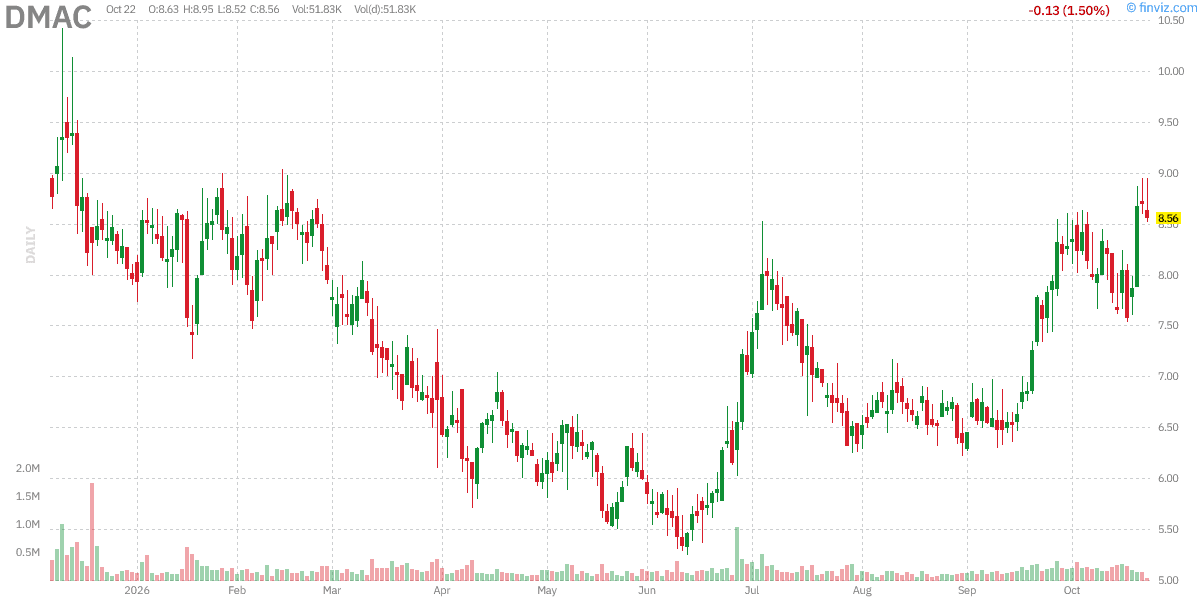
Daily chart $DMAC · October 22, 2026 · Intraday, delayedOpen chart (affiliate link) · For information only.
Next catalyst
November 24, 2026 · Preliminary FGR clinical event
FGR findings next; ReMEDy2 interim expected in Q1 2027
The rescheduled November 24 event is expected to discuss preliminary results from the first two early Phase 2 FGR cohorts. ReMEDy2 has reached 200 enrolled participants; after their 90-day follow-up, an independent board will assess sample-size re-estimation or futility. DiaMedica remains blinded, and expects the interim in Q1 2027. Source · Related announcement
Key data
Latest announcementOctober 22, 2026 — ReMEDy2 enrolls its 200th participant; independent interim analysis expected in Q1 2027 Source
Dates of the figuresFinancial statements: Quarter and six months ended June 30, 2026. Source
The constructive case
DM199 addresses substantial unmet needs through a coherent vascular mechanism. Stroke enrollment has reached the interim threshold, while pregnancy studies provide another route to test clinical value. A persuasive controlled recovery benefit or reproducible maternal-fetal signal could support further development and financing flexibility.
The case against
The earlier stroke study lacked significant Day 90 secondary efficacy findings, and its favorable non-endovascular signal was post hoc. Pregnancy observations are small and open-label. Hypotension history, trial expansion, regulatory work, manufacturing dependence and further equity funding remain material risks.
Operating and financial position
Clinical-stage, pre-commercial developer concentrated in DM199. ReMEDy2 is Phase 2/3; the pregnancy programs are earlier. June 30 liquidity was $43.5M against $17.2M H1 operating cash use, with management forecasting funding through 2027. The August 3 common-share count was 53.93M; equity awards and financing capacity add future dilution exposure. Source · Related source
Executive summary
DiaMedica Therapeutics is developing DM199, a recombinant human KLK1 protein, to improve vascular function in acute ischemic stroke, preeclampsia and fetal growth restriction. ReMEDy2 reached 200 enrolled patients on October 22. Its Q1 2027 interim concerns sample size or futility, and the company stays blinded; final enrollment may range from 300 to 728 if it proceeds. Preliminary FGR findings are scheduled for November 24. Early pregnancy observations support further study, while the key questions remain clinical outcomes, maternal-fetal safety and financing. June liquidity was $43.5M and management expected planned operations to be funded through 2027.
Latest news
October 22, 2026 — ReMEDy2 enrolls its 200th participant; independent interim analysis expected in Q1 2027
The stroke study reached its prespecified enrollment threshold. The independent board will assess sample-size re-estimation or futility after the first 200 participants complete 90-day follow-up. DiaMedica remains blinded and recruitment continues; if the study proceeds, final enrollment can range from 300 to 728. Source
October 19, 2026 — FGR webinar moved to November 24 to include preliminary findings from two cohorts
The event replaces the October 23 date. The company plans to discuss safety, tolerability and early findings from the first and second FGR cohorts. Twelve participants were enrolled across the two cohorts; efficacy observations remain preliminary. Source
September 30, 2026 — FGR webinar first scheduled for October 23
The first cohort was completed with six participants at 5 µg/kg, and dosing began in the second cohort at 10 µg/kg. The August 10 update had originally targeted a September call; the event has since moved to November 24. Source
August 10, 2026 — Q2 update reports $43.5M June liquidity and late-onset preeclampsia activity
Cash, equivalents and securities totaled $43.5M at June 30, with $17.2M of H1 operating cash use. Management expected funding through 2027. The open-label combined highest-dose preeclampsia cohorts included 15 participants and showed maternal blood-pressure reductions; larger studies are needed to establish broader maternal-fetal benefit. Source
June 16, 2026 — FDA feedback outlines additional work for the U.S. pregnancy development pathway
The company described nonclinical exposure and activity information intended to support a U.S. preeclampsia IND. The feedback identifies a possible evidentiary route; a clinical authorization and approval of the medicine remain separate decisions. Source
Extended analysis
Does $DMAC deserve a place in your portfolio?
The full deep dive has the answer’s building blocks: cash, dilution, catalysts and risks, every figure sourced.
Free. No signup. You decide, we don’t recommend.
Using an ad blocker? The free “watch an ad” option is hidden automatically. Pause it on merlintrader.com and reload the page to see the free option.
01 What DiaMedica Therapeutics does: the DMAC stock story
DiaMedica Therapeutics is a clinical-stage biopharmaceutical company developing DM199, also called rinvecalinase alfa, for conditions in which vascular dysfunction and inadequate tissue perfusion can cause severe harm. Its main programs address acute ischemic stroke, preeclampsia and fetal growth restriction. The company is incorporated in British Columbia and operates from Minneapolis, Minnesota. Its voting common shares trade on the Nasdaq Capital Market under DMAC. It has no approved commercial product and has financed development primarily through equity. Company and operating background
The medical appeal is substantial. Stroke can leave a person with permanent disability. Preeclampsia threatens maternal health and can force early delivery. Fetal growth restriction can create an urgent trade-off between remaining in an inadequate placental environment and facing the consequences of prematurity. DM199 is being studied as a way to improve vascular function across these settings. A shared rationale connects the programs, while their clinical populations, safety requirements and regulatory paths remain different.
The most advanced controlled study is ReMEDy2, an adaptive Phase 2/3 trial in acute ischemic stroke. On October 22, 2026, DiaMedica announced enrollment of the 200th participant. That reaches the threshold for a planned interim analysis after those participants complete 90-day follow-up. The analysis is expected in the first quarter of 2027 and concerns sample-size re-estimation or futility. Enrollment continues while that work proceeds. October 22 enrollment milestone
A separate nearer event concerns fetal growth restriction. The company moved its planned clinical webinar from October 23 to November 24, 2026 so the presentation could include preliminary findings from two early Phase 2 cohorts. That event can help investors assess the pregnancy program’s initial biological and clinical observations, while its small, open-label design limits the conclusions. Updated event and FGR disclosure
The financial structure makes the clinical sequence important. At June 30, the company held $43.5 million in cash, equivalents and marketable securities, against $17.2 million of operating cash use in the first six months of 2026. Management expected its resources to fund planned activities through 2027. A larger stroke sample, expanded pregnancy studies or delays could change the funding requirement. Second-quarter financial results
Merlintrader’s assessment is that DMAC offers a focused scientific thesis with several potential applications and concentrated product risk. Multiple indications can create more opportunities to demonstrate value, but the programs depend on the same experimental medicine. A product-wide safety or manufacturing concern could affect more than one study. The meaningful stock question is whether the next observations advance DM199 toward a reproducible clinical benefit while preserving enough financial flexibility to complete development.
02 DM199 and KLK1: the medicine’s scientific rationale
DM199 is a recombinant form of human tissue kallikrein-1, or KLK1. This enzyme participates in vascular regulation through the kallikrein-kinin system. The therapeutic rationale involves signaling that promotes vasodilation and supports endothelial function, including nitric oxide, prostacyclin and endothelium-derived hyperpolarization pathways. At a clinical level, the company wants to improve blood flow in vulnerable tissue rather than simply change an isolated laboratory measurement. Mechanistic rationale and stroke development context
In ischemic stroke, the concept centers on tissue surrounding the most severely damaged region. Some of that tissue may remain viable but poorly perfused. Improving collateral or microvascular flow could potentially protect function even when reopening the main blocked vessel is impossible or insufficient. This is a biological hypothesis that must be tested against disability and recovery outcomes. An effect on a pathway or an imaging measure would be helpful evidence, but the pivotal value depends on what happens to patients.
In pregnancy complications, the focus shifts to maternal vascular dysfunction and placental perfusion. Better vascular regulation could potentially improve maternal blood pressure and blood supply to the placenta. Those effects would have to translate into acceptable maternal and fetal outcomes. A blood-pressure reduction is a measurable pharmacodynamic response; the additional claims of protecting organs, safely extending pregnancy or improving newborn outcomes require their own evidence.
KLK1-based treatments have a history of use in parts of Asia, described in the company’s filings. That history provides context for the approach, while differences in product source, formulation, manufacturing, patient selection and clinical evidence matter. Experience with a urine-derived treatment cannot substitute for demonstrating the safety and efficacy of DiaMedica’s recombinant product in the populations and jurisdictions it targets. KLK1 background and product distinctions
A published 2017 healthy-volunteer study evaluated DM199 exposure, tolerability and administration by intravenous and subcutaneous routes. Such work helps establish a foundation for subsequent clinical studies. Healthy participants lack the vascular instability, concurrent treatment and organ dysfunction present in stroke or complicated pregnancy, so the evidence has a defined scope. It supports development of an exposure and safety profile, rather than proof of benefit in either disease. Original healthy-volunteer study
The 2025 stroke publication describing the broader biological case is a review and rationale paper. It assembles mechanistic and earlier clinical observations, while the randomized ReMEDy1 publication and ongoing ReMEDy2 trial provide the direct clinical tests. Keeping those evidence types distinct helps avoid a common biotechnology mistake: treating a coherent mechanism as though it already established the medicine’s clinical effect. For DM199, the mechanism explains why the experiment is worth conducting; controlled outcomes determine whether it creates a useful therapy.
03 ReMEDy1 results: the foundation and its limitations
ReMEDy1 was a Phase 2, randomized, double-blind, placebo-controlled study conducted at 13 Australian sites. It randomized 92 patients within 24 hours of ischemic-stroke onset, with safety and tolerability as the primary objective. The publication appeared in the July 2026 issue of the International Journal of Stroke. Its principal contribution is direct human experience with DM199 in the disease of interest, together with exploratory observations that informed further development. Original ReMEDy1 publication
The key limitation is explicit: the study found no statistically significant differences in its secondary efficacy outcomes at Day 90. Post hoc analyses of patients who had not received endovascular treatment suggested a favorable tendency in excellent global outcomes. Those analyses help form a hypothesis for a selected population. They have less evidentiary weight than a prospectively specified positive efficacy endpoint in a sufficiently powered study.
Safety findings need equal attention. In the treated safety population, serious adverse events occurred in 20 of 46 DM199 participants and 14 of 45 placebo participants. The study involved people with a serious acute illness, so all-cause adverse-event counts alone cannot establish causation. They do establish that the experience included substantial morbidity and requires detailed interpretation. The full publication, rather than a general statement of tolerability, is the appropriate basis for understanding which events were considered related and how they evolved. ReMEDy1 full text and safety table
For an investor, a safety-focused early study and an efficacy-focused later study serve different purposes. ReMEDy1 helped establish whether continued testing was reasonable and where a therapeutic effect might be found. ReMEDy2 now asks a more demanding question about functional recovery in a prospectively defined population. Positive exploratory findings increase interest, while their uncertainty remains part of the stock’s risk.
The distinction between a subgroup and the full study is especially important in stroke. Endovascular treatment can substantially alter recovery, and patient selection changes the balance of disease severity and therapeutic opportunity. Selecting a population in which the drug has a plausible role can improve a later trial’s relevance. It also narrows the population to which any eventual positive result can directly apply.
Merlintrader’s interpretation is that ReMEDy1 provides a clinical foothold rather than a completed efficacy case. Its randomized design is useful, and the absence of significant Day 90 secondary efficacy findings is material. The next study must demonstrate that the selected hypothesis survives prospective testing. A successful result would be a substantial advance over exploratory encouragement; a disappointing result would show why the earlier signal required confirmation.
04 ReMEDy2 trial design: who is studied and what success means
ReMEDy2 is an adaptive, randomized, double-blind, placebo-controlled Phase 2/3 study of DM199 in acute ischemic stroke. Participants begin treatment within 24 hours of onset and receive study treatment for three weeks, with final follow-up at Day 90. The primary efficacy endpoint is the proportion achieving a modified Rankin Scale score of 0 or 1 at Day 90, representing an excellent functional outcome. Current trial registration
The modified Rankin Scale measures disability, ranging from no symptoms through progressively greater dependence and death. A shift toward excellent outcomes would matter because stroke’s consequences extend far beyond the initial hospital admission. The endpoint asks whether patients recover a level of function associated with little or no disability, rather than whether a biological marker briefly improves. That makes the clinical question important and demanding.
The study excludes patients treated with mechanical thrombectomy and specified major-vessel occlusions or eligibility for thrombectomy. Patients previously treated with thrombolytic medicines can participate if they retain a qualifying neurological deficit and meet the other criteria. These details define a possible place for DM199 in the treatment pathway. The trial is not testing the experimental medicine as a replacement for every established stroke intervention. October 22 study-population description
Dichotomizing recovery at mRS 0 or 1 creates a clear primary test, but groups together patients with very different residual disability outside that threshold. The secondary analysis across the scale can help reveal whether the medicine moves patients from severe dependence toward a less disabling state even when they miss the excellent-outcome definition. Conversely, a modest change around the primary threshold needs to be assessed with the broader disability distribution. The size of the benefit and the severity of the remaining impairment both matter for patients and healthcare systems.
The current registry specifies a neurological-severity range and additional clinical exclusions. Such criteria can reduce variation and protect participants, while limiting generalization. A positive result would need to be interpreted in light of age, baseline disability, severity, time to treatment and concurrent care. The broad worldwide burden of stroke is much larger than the directly studied population.
An adaptive design permits prespecified changes based on interim information while preserving the statistical framework. In ReMEDy2, the final sample size can range from 300 to 728 if the study continues. That range has both clinical and financial implications. More patients can increase the ability to detect a treatment effect, but also add recruitment, follow-up, monitoring and drug-supply costs. Adaptive design and sample-size range
Secondary outcomes examine the wider distribution of disability and other aspects of neurological recovery. They can explain a primary result and reveal whether a benefit is consistent across clinically relevant measures. The interpretation still depends on the planned analyses and control of statistical error. Several favorable secondary comparisons cannot automatically compensate for failure of the prespecified primary endpoint.
Execution in acute stroke is difficult. Recruitment requires rapid identification, eligibility assessment and consent during a stressful medical event. Patients may move between hospitals and rehabilitation facilities, making treatment continuity and follow-up challenging. DiaMedica’s filings describe staffing, competing trials, site logistics and selection criteria as factors affecting enrollment. Reaching 200 participants represents tangible operating progress, while patient retention and complete outcome assessment remain necessary for a reliable result. Trial-conduct risks and operating response
05 DMAC stock catalysts: interpreting the Q1 interim analysis
The October 22 milestone is a trigger for the next analysis, rather than an efficacy verdict. The independent Data Safety Monitoring Board will conduct the prespecified interim review after the first 200 participants complete their 90-day follow-up. The company expects completion of that analysis in the first quarter of 2027. Recruitment continues in the meantime. Current interim timetable
The board’s task is to assess sample-size re-estimation or stopping for futility under a predetermined statistical plan. DiaMedica will remain blinded to the interim data. Investors should therefore expect the communication to focus on the study’s continuation and required size, rather than assume the company will publish an unblinded treatment-effect estimate or a complete statistical efficacy analysis.
Maintaining the company’s blind protects the ongoing comparison from changes in behavior based on knowledge of treatment assignments. It also limits the conclusions investors can draw from the next communication. A disclosure that the board recommended a specified sample size may contain less information than an ordinary efficacy readout. The content of the actual recommendation, rather than assumptions about what the board must have seen, should guide interpretation.
A recommendation to continue could be encouraging because it keeps the development path open. Its meaning depends on what the protocol permits the board and company to disclose. Continuing at a selected sample size is different from demonstrating the final primary endpoint. The full randomized result still needs adequate enrollment, follow-up, data quality and analysis.
A larger required sample would have an ambiguous investment meaning. It could preserve the possibility of demonstrating an effect with more information, while adding time and cash requirements. A smaller sample within the allowed framework could shorten the remaining workload, without guaranteeing the final outcome. The relationship between sample size and clinical effect cannot be inferred precisely from a headline recommendation alone.
Futility is the adverse possibility. It generally concerns whether continuing has a sufficient prospect of answering the efficacy question under the study’s rules. It differs from a decision about safety, although safety monitoring continues throughout a clinical program. For DMAC, a futility outcome would affect the stroke opportunity and could alter financing conditions and resource allocation across the pregnancy studies.
The funding consequences make the interim more important than a simple calendar event. At the lower end of the final enrollment range, the remaining study burden would differ greatly from a path toward 728 participants. The company’s financial guidance is based on an operating plan, and the actual adaptive outcome can change that plan. Readout quality, recruitment speed and access to capital interact.
The registry’s estimated completion dates are planning fields and may lag later operational developments. The registry still lists an estimated primary completion of December 2026, which predates the company’s Q1 2027 interim timetable. The October announcement supplies the current company expectation for the interim after the 200-patient threshold. A precise final efficacy-reporting date has not been provided in that announcement. The useful sequence is completion of the first group’s follow-up, the independent recommendation, the company’s updated trial and funding plan, and eventual final controlled results. ReMEDy2 registry record
06 Preeclampsia: early clinical activity and the next evidentiary step
Preeclampsia is a pregnancy disorder involving high blood pressure and potentially serious organ dysfunction. Current management includes surveillance, control of maternal blood pressure, prevention or management of complications and decisions about delivery. A therapy able to improve the underlying vascular problem while protecting both mother and fetus could have substantial medical value. Existing supportive management remains essential while experimental approaches are tested. Pregnancy-hypertension management context
DiaMedica’s investigator-sponsored program in South Africa explores safety, dose selection and pharmacodynamic activity. The published protocol describes an open-label study, including participants with planned birth within 72 hours and separate work in preterm preeclampsia and fetal growth restriction. Adverse events and umbilical-cord DM199 concentrations are among the primary measures. The protocol describes the clinical questions and planned measurements; it contains no completed efficacy results. Original pregnancy-study protocol
The August 2026 corporate update reported results from the combined highest-dose late-onset preeclampsia cohorts, totaling 15 participants. Mean systolic blood pressure fell 29.1 mmHg from a mean baseline of 169.3 mmHg, and diastolic pressure fell 17.0 mmHg from 103.7 mmHg, measured five minutes after the intravenous infusion ended. The company reported statistical significance for those changes and systolic pressure below 160 mmHg at all measured points over 24 hours. Part 1a results in the Q2 update
These are pharmacodynamic observations in a small, open-label population near delivery. They support further dose exploration, but the design offers no randomized concurrent comparison separating the medicine’s effect from all other influences. The size and persistence of a pressure change are important; maternal complications, placental function, gestational prolongation and newborn outcomes require additional assessment.
The same update discussed reductions in uterine-artery pulsatility index in selected dose cohorts. That measurement can contribute to the assessment of vascular resistance, while its clinical implications depend on the whole maternal and fetal course. Changes in perfusion-related measures are useful intermediate evidence, rather than a guarantee that delaying delivery would be safe or beneficial.
Early-onset disease creates a more demanding question because additional time in the womb could help a premature fetus only if maternal and fetal safety remain acceptable. A program aimed at expectant management must show more than a transient blood-pressure response. It needs an evidence package supporting the balance between continued pregnancy and delivery, with adequate monitoring of complications.
Health Canada authorized a separate early-onset Phase 2 dose-finding study, and the August release described preparations for Canada and the United Kingdom. It expected the first Canadian patient in the fourth quarter, subject to practical readiness and applicable approvals. That was a forward-looking plan, separate from completed South African observations. The U.S. pathway still required additional nonclinical information for an investigational-new-drug submission. Canadian and U.S. development plans
The August update also expected Parts 1b and 2 of the South African preeclampsia study to begin enrolling in September or October 2026. As of October 22, 2026, the company had not announced the start of enrollment. August 10 study timetable
07 Fetal growth restriction: the November event and what to examine
Fetal growth restriction describes a fetus failing to achieve its growth potential, often because placental function is inadequate. It is distinct from simply being small. A clinically useful treatment would need to improve the balance of fetal growth, placental function, time to delivery and maternal and newborn safety. Those outcomes depend on gestational age, disease severity and the reason growth is restricted. FGR disease and study context
The South African program began enrolling the FGR component in June 2026. It uses repeated subcutaneous treatment in an open-label, single-center study, with up to 30 participants planned across dose cohorts. The October 19 release said the first two cohorts, totaling 12 enrolled participants, had been recruited. Enrolled participants and the number with complete evaluable outcomes are different measures; follow-up and data availability determine what can be reported at a particular event.
The August 10 update had originally targeted a September call with first-cohort topline results; a September 30 announcement then set the event for October 23. DiaMedica rescheduled the planned October 23 webinar to November 24, 2026. The company says the event will include preliminary results from the second cohort; its panel description refers to findings from the first six treated participants. The event is expected to discuss safety, tolerability and early clinical observations. No FGR efficacy results had been published before the event. October 19 schedule and cohort update · September 30 event announcement
The absence of a concurrent control group will matter. A pregnancy that continues longer after enrollment can look encouraging, but the expected course varies with baseline severity, clinical decision-making and other care. Small cohorts can be affected strongly by individual cases. Gestational age at entry, maternal conditions, fetal measurements and reasons for delivery will help explain the meaning of any reported average.
Individual patient courses will be especially informative at this stage. A mean number of days gained can conceal an early delivery in one patient and a much longer observation in another. Results also need a clear starting point: enrollment, first treatment and a clinically determined delivery decision are distinct events. Reporting the denominators for each safety or growth analysis would make the preliminary findings easier to assess.
For clinical value, several observations need to fit together. A change in a blood-flow measure should be considered alongside fetal growth and the maternal course. More days before delivery should be evaluated with neonatal outcomes and complications, rather than treated as inherently beneficial. Safety includes exposure to both the mother and fetus, as well as the possibility that maternal hemodynamic changes could have different effects in different patients.
The published protocol expressly includes measurement of umbilical-cord drug concentrations. A protein’s size may support a rationale for limited placental transfer, while actual exposure remains an empirical safety question. An assumption about the placental barrier cannot substitute for the planned measurements and clinical follow-up. Pregnancy protocol and fetal-exposure assessment
Merlintrader’s assessment is that the event could materially improve understanding of the program because early FGR treatment data are scarce and the biological objective is compelling. Its findings will still be hypothesis-generating. The next valuation step would depend on a credible progression toward larger, preferably controlled evidence, with endpoints capable of demonstrating that an apparent biological response produces an acceptable maternal-fetal benefit.
08 Safety history and regulatory pathways
DM199’s history includes a clinical hold in the stroke program. The FDA imposed the hold in July 2022 and lifted it in June 2023. The company’s current filings continue to identify prior clinically significant hypotension events and the surrounding history as relevant to investigator concerns and trial execution. The release lifting the hold confirms permission to resume development, while future safety remains subject to ongoing monitoring. Hold removal; current risk disclosure; 2025 Form 10-K
That history is particularly relevant for a drug intended to change vascular tone. Blood-pressure effects can be therapeutic in one setting and undesirable in another. A patient with acute brain ischemia has a different physiological problem from a pregnant patient with severe hypertension. Safety must therefore be assessed within each population, with appropriate attention to concurrent medicines and baseline vascular conditions.
The pregnancy pathway adds reproductive and developmental safety requirements. In June 2026, the company reported FDA feedback suggesting that existing rat reproductive-toxicology work might support a U.S. submission if adequate exposure, enzyme activity and pharmacologic effects could be demonstrated. DiaMedica planned additional work and submission of the resulting information for review. The statement describes a possible route to an acceptable package, rather than a cleared U.S. pregnancy trial. June 16 regulatory update
Geography also matters. Authorization in one country permits the specified study under that jurisdiction’s rules. It leaves other agencies free to request additional information, different study conditions or further safety work. Evidence from South Africa and Canada can inform development elsewhere, while each application needs a package acceptable to the relevant regulator.
Approval would ultimately require efficacy, safety, manufacturing quality and a suitable benefit-risk assessment for a defined indication. A Phase 2/3 label describes the trial’s development stage, rather than a guarantee that one study alone will be sufficient. The company says ReMEDy2 was designed with the potential to support registration if successful, and its October release also acknowledges that the completed study could be insufficient.
For the stock, safety risk is broader than a binary serious event. It includes tolerability that complicates use, restrictions that narrow eligibility, monitoring that increases treatment burden and manufacturing or administration issues that slow implementation. The useful measure of progress is an evidence package that becomes more persuasive and practical over time, with the historical concerns addressed through data rather than omitted from the story.
09 DMAC earnings, cash, burn and runway
At June 30, 2026, DiaMedica reported $5.129 million in cash and equivalents and $38.375 million in marketable securities, totaling $43.504 million. The comparable December 2025 total was $59.890 million. Working capital was $37.721 million, and total current liabilities were $6.594 million. Those figures describe the quarter-end financial position; subsequent spending changes the amount available later in the year. June balance sheet
Operating activities used $17.196 million of cash in the first six months, compared with $14.747 million in the prior-year period. The 2026 figure averages approximately $2.866 million a month. This calculation describes historical cash use, not a contractual spending rate. Trial timing, payments to vendors and expansion of development can make future quarters differ materially.
The company reported a second-quarter net loss of $10.139 million and a first-half net loss of $20.181 million. Research and development expense reached $8.153 million for the quarter and $16.140 million for the half year, compared with $5.822 million and $11.478 million a year earlier. Second-quarter general and administrative expense was $2.345 million. The larger research bill reflects the cost of progressing the clinical programs and the organization supporting them. Earnings and expense detail · Form 10-Q, expense detail
Management stated that current resources were expected to fund planned clinical studies and corporate operations through 2027. The financial-statement discussion separately describes funding for at least twelve months after issuance. Those statements serve different purposes: one is a management operating forecast and the other supports the financial statements’ liquidity assessment. Neither guarantees a fully financed path through approval and launch.
A simple sensitivity divides June liquidity by the first-half monthly operating-cash average. That produces approximately 15.2 months from June 30, before allowing for changes in spending, investment returns, financing or other cash flows. The calculation helps illustrate scale and funding sensitivity. It is different from management’s forecast because the future operating plan can have a different spending profile.
The balance sheet contains modest finance-lease and operating-lease obligations, rather than a large disclosed borrowing facility. The company states that it has no existing credit facilities available for borrowing. Low conventional financial debt reduces interest and repayment pressure, while the absence of a credit line leaves equity or partnerships as important potential funding sources. Funding sources and obligations
Cash and marketable securities should also be distinguished from working capital and shareholders’ equity. Working capital includes other current assets and subtracts current liabilities; equity includes noncash assets and all recognized liabilities. Those measures cannot be added together as separate funding pools. Selling or allowing an investment security to mature converts an existing asset into cash, rather than creating new clinical funding.
ReMEDy2’s adaptive design is the main variable linking clinical evidence to the financial outlook. A path toward the higher end of the 300–728 range could consume substantially more time and resources than the initial lower-size plan. Pregnancy expansion adds another demand. The quality of the clinical signals will influence the terms on which DiaMedica can fund that work. A useful assessment therefore follows cash consumption and clinical requirements together, rather than treating the runway statement as a fixed expiration date.
10 DMAC share dilution, equity capacity and trading liquidity
DiaMedica had 53,925,697 common shares outstanding at June 30 and the same count on August 3, 2026. Options, deferred share units and restricted share units create additional potential claims, subject to exercise, vesting and settlement. The Form 10-Q for the quarter ended June 30, 2026 (filed August 10, 2026) lists 8,180,495 outstanding stock options, 190,785 deferred share units and 1,677 restricted share units. It also distinguishes securities already awarded from shares merely available for future grants. Capital structure
That distinction prevents an inflated dilution calculation. A plan’s unused authorization is future capacity, while an outstanding option is an existing contractual right with an exercise price and vesting terms. Adding both indiscriminately to common shares can double-count or mischaracterize the economic denominator. At the same time, considering only current common shares overlooks future dilution if employees exercise awards or the company raises more capital.
Option exercise can bring cash into the company while increasing outstanding shares. Its financing contribution depends on contractual exercise prices, vesting and holders’ decisions. Multiplying every outstanding option by the current stock price would overstate the proceeds available to fund development.
The company has already relied on substantial new equity. In July 2025 it issued 8,606,425 common shares at $3.50, receiving approximately $30.0 million net. It also sold 1,724,472 shares through its at-the-market program for $13.3 million net during 2025. The quarterly filing reported $86.2 million of remaining ATM capacity as of June 3, 2026. Available capacity is an authorization to raise funds under applicable conditions, rather than cash already received. Equity financing history and ATM
After quarter-end, an August 11, 2026 Form S-8 registered an additional 3.5 million shares for the equity incentive plan, and new restricted share units were granted on August 10. August 11, 2026 Form S-8 · Form 4 filed August 12, 2026
Equity financing can be productive if it buys enough time to answer a meaningful clinical question. The per-share cost depends on the amount raised, price, transaction terms and value created by the funded work. A major trial expansion following an ambiguous interim signal could make that trade-off harder. Strong evidence could improve financing flexibility, while still leaving the business with substantial spending ahead.
Trading liquidity deserves separate treatment from the company’s cash. The October 22 market page showed average daily volume of about 182,000 shares and a public float considerably smaller than total outstanding shares. These are market-data measures that change over time. A relatively limited trading pool can magnify price moves around clinical announcements and make the displayed price a poor guide to the execution available for a large order. DMAC market data
Institutional or insider ownership can affect available float, but it cannot establish clinical efficacy. Holdings also have different reporting dates and incentives. Similarly, short interest reflects positions and market structure, rather than a validated scientific conclusion. The most useful ownership question is how financing and award issuance change the economic claims on future success. For DMAC, preserving liquidity through important milestones while limiting unnecessary issuance would improve operating resilience, even though a development-stage company can rationally choose additional financing before its cash balance becomes urgent.
11 Competition, commercial value, manufacturing and rights
Stroke treatment already includes effective options for eligible patients. Alteplase and tenecteplase are approved thrombolytic medicines, and mechanical thrombectomy is an important intervention for selected patients. The U.S. stroke indication for TNKase was approved in 2025. DM199’s proposed role concerns a different mechanism and a selected population, including patients who remain impaired despite thrombolysis or who are outside the thrombectomy pathway defined by the trial. Approved TNKase stroke indication
The opportunity is therefore about improving recovery beyond what the relevant patient’s existing pathway achieves. A practical treatment would need a clinically meaningful effect, acceptable safety and integration into hospitals and post-acute care. Its eventual label, treatment duration, administration demands and reimbursement would shape use. The total number of strokes is an indication of disease burden, while the eligible, diagnosed and reachable population is the more relevant commercial starting point.
In preeclampsia and FGR, a disease-modifying medicine could potentially create value through fewer complications or safer extension of pregnancy. Established antihypertensive and supportive treatment already addresses aspects of care. A new drug would have to show what additional benefit it provides and for whom. The evidence threshold is particularly demanding because treatment involves maternal and fetal risks, and the consequences can extend beyond delivery. Preeclampsia management framework
DiaMedica relies on outside manufacturing. Its annual filing describes Catalent as the manufacturer of DM199 drug substance and the licensor of certain technology. The license can entail milestones and royalties and is exclusive for the relevant manufacture of DM199 or human KLK1. This creates an important distinction between owning the development opportunity and retaining every dollar of future sales. Third-party obligations and supply dependence remain part of the eventual economics. Manufacturing and licensing arrangements
The company had not finalized a commercial distribution strategy in that filing and expected that a large pharmaceutical partner could play a role in sales execution. A partnership could bring capital, hospital relationships and commercial infrastructure, while allocating rights or economics to the partner. A hypothetical acquisition or license deal is a possible business outcome, rather than an announced asset or a reliable valuation floor.
The annual filing also describes DM300, a longer-term recombinant ulinastatin program with a potential application in severe acute pancreatitis. It is distinct from the main DM199 clinical programs and is at an earlier stage. The current clinical and financing catalysts remain concentrated in DM199, so the broader intellectual-property portfolio provides less diversification than multiple independently validated late-stage medicines.
Manufacturing consistency, clinical supply and regulatory-quality documentation will remain essential even if a study succeeds. Scaling a protein medicine from trial supply to commercial requirements involves a different operational test. Partner selection and execution could influence both time to market and eventual margins. The business case requires a chain of successful steps: useful clinical evidence, an acceptable regulatory package, reliable supply and adoption within real healthcare pathways.
12 Risk scenarios and what would change the DMAC case
The constructive scenario combines encouraging pregnancy observations with a ReMEDy2 recommendation that preserves a manageable path to final testing. Subsequent controlled stroke data would need to show a meaningful improvement in functional recovery with acceptable safety. For pregnancy, the early findings would have to support dose selection and progression toward evidence on maternal and neonatal outcomes. Clinical success could improve funding and partnership options, while leaving regulatory and commercial work ahead.
An intermediate scenario is equally plausible in structure: the stroke trial continues but requires more patients, while pregnancy findings remain interesting and incomplete. That would sustain the scientific thesis while increasing cost, time and possible dilution. A positive blood-pressure result could coexist with uncertainty about gestational or newborn benefit. A favorable interim continuation recommendation could coexist with a final efficacy outcome that remains unresolved.
The adverse scenario includes stroke futility, an unacceptable safety finding or pregnancy observations that fail to translate into a credible benefit-risk profile. Because the indications share the same product, some problems could spread across the program. Other failures might be population-specific and leave a different indication scientifically viable, but pursuing it could become more difficult if financing conditions weaken. Principal development and funding risks
The evidence most likely to change the assessment is specific. In stroke, it includes the board’s actual recommendation, the final required sample, functional-outcome differences, confidence intervals and consistency across relevant groups. In pregnancy, it includes baseline severity, exposure, maternal and fetal adverse events, reasons for delivery and whether apparent improvements persist in more patients. Across the business, cash use, financing terms, supply readiness and a credible regulatory plan determine how much of the medical opportunity can be pursued.
Merlintrader’s view is that DMAC merits attention because the need is substantial and the next questions are becoming more concrete. Reaching the stroke interim threshold is real execution progress, and the pregnancy program introduces a second clinical dimension. The remaining evidence is incomplete: the earlier stroke trial lacked significant Day 90 secondary efficacy findings, the pregnancy work is small and uncontrolled, and the company will require additional resources to complete its ambitions. The stock represents exposure to that development process, with concentrated scientific and financing risks. This analysis is informational and educational, and is not an investment recommendation or individualized medical guidance.
DMAC Stock FAQ: DiaMedica Therapeutics Questions Answered
What is DM199?
DM199, or rinvecalinase alfa, is an experimental recombinant form of human tissue kallikrein-1. DiaMedica is studying its vascular effects in acute ischemic stroke, preeclampsia and fetal growth restriction. All three applications remain in clinical development. A shared mechanism provides a rationale for the programs, while clinical benefit and safety must be demonstrated in each population. Development overview
What happened on October 22, 2026?
The 200th participant entered ReMEDy2, reaching the enrollment threshold for its planned interim analysis. The independent board will review the data after the first 200 participants complete 90-day follow-up. The company expects the interim in Q1 2027, remains blinded and continues recruitment. This is an enrollment milestone, rather than a completed final efficacy result. Milestone announcement
How large could ReMEDy2 become?
If the study continues after interim review, the final sample can range from 300 to 728 under its statistical plan. The independent board assesses sample-size re-estimation or futility. A larger sample would increase the remaining clinical work and could change the company’s funding needs. Continuation alone leaves the primary efficacy question open. Adaptive study plan
Did ReMEDy1 prove efficacy in stroke?
The 92-patient study primarily assessed safety and tolerability. Its publication reported no statistically significant differences in secondary efficacy outcomes at Day 90. A favorable tendency in patients without endovascular treatment came from post hoc analysis. ReMEDy2 prospectively tests the next efficacy hypothesis in its selected population. Original randomized study
When will the FGR results be discussed?
The company rescheduled its webinar to November 24, 2026, replacing the October 23 date. The company says the event will include preliminary results from the second cohort; its panel description refers to findings from the first six treated participants. The study is open-label and small, so those observations will need interpretation alongside the patients’ baseline conditions, safety, delivery decisions and completeness of follow-up. Updated event announcement
Does a reduction in maternal blood pressure prove pregnancy benefit?
It establishes an important pharmacodynamic observation when measured reliably. The broader treatment objective also involves maternal organ safety, placental function, timing of delivery and newborn outcomes. The reported late-onset cohorts were small and open-label, and a response near planned delivery cannot automatically establish the benefit-risk balance of prolonged treatment earlier in pregnancy. Pregnancy trial protocol
How much cash does DiaMedica have?
At June 30, 2026, cash and equivalents were $5.129 million and marketable securities were $38.375 million, totaling $43.504 million. First-half operating cash use was $17.196 million. Management expected planned operations to be funded through 2027, while also disclosing the need for additional capital to complete development. Financial results · Form 10-Q, balance sheet and cash flow
Is dilution still a risk without a large bank loan?
Yes. Clinical spending can require fresh capital even when financial debt is modest. DiaMedica has used private placements and an ATM program, and outstanding equity awards create additional potential issuance. The timing, price and use of future funding determine its effect on existing shareholders. Remaining ATM capacity is financing optionality, rather than current cash. Capital and funding disclosures
Is DM199 competing with established stroke care?
The ReMEDy2 population excludes mechanical thrombectomy and specified major-vessel cases, while allowing qualifying patients with persistent deficits after thrombolysis. DM199 uses a different proposed mechanism from clot dissolution. Its eventual role would depend on the controlled evidence and approved label, if development succeeds. Established acute stroke care remains the relevant clinical background. Current trial eligibility
Sources and further reading
- October 22, 2026 ReMEDy2 milestone: 200-patient interim threshold, Q1 2027 expectation, blinding and adaptive sample size.
- October 19, 2026 FGR update: November 24 webinar and cohort progress.
- Q2 financial and business update and Form 10-Q for the quarter ended June 30, 2026: clinical observations, liquidity, cash use, shares, awards and funding.
- ReMEDy2 registration: population, endpoints and study design.
- Original ReMEDy1 publication, DOI 10.1177/17474930251396480: randomized safety study and efficacy limitations.
- Original pregnancy protocol, DOI 10.1136/bmjopen-2025-104035, registration PACTR202404895013782: safety, fetal-exposure measurements and exploratory objectives.
- Stroke rationale review, DOI 10.1161/STROKEAHA.124.048858: mechanism and development rationale.
- Healthy-volunteer original study, DOI 10.18203/2349-3259.ijct20174861: early exposure and tolerability evidence.
- June 2026 FDA-feedback update and June 2023 hold removal: distinct regulatory events.
- 2025 Form 10-K: manufacturing, licensed technology, commercial planning and earlier programs.
- Approved TNKase label and pregnancy-hypertension guidance: established clinical context.
Join the Merlintrader community: follow the discussion and get more deep dives on our subreddit — r/MerlintraderPub — and on the Telegram channel @merlintraderpub_com.
Get these reports in real time
Every Merlintrader stock hub, catalyst update and market brief is published to Telegram the moment it goes live. No paywall, no spam, just the research.
Disclaimer. This content is published by Merlintrader for educational and informational purposes only. It is independent journalism and research. It does not constitute investment advice, an investment recommendation, an offer or a solicitation to buy or sell any security, and it is not a research report within the meaning of applicable United States securities regulation. Nothing here should be read as a recommendation to buy, sell or hold $DMAC or any other security.
Figures are taken from public filings with the U.S. Securities and Exchange Commission, company press releases and market-data providers, and are stated with their reference dates. Data can change without notice, and figures published before a results release become outdated the moment that release is issued. Merlintrader makes no representation that the information is complete or current at the time of reading. Readers should verify every figure against the primary source before acting on it.
Biotechnology companies face clinical, safety, regulatory, manufacturing, commercial and financing risks. Trials can fail, adverse effects can limit use, regulatory applications can be delayed or rejected, and an approved medicine may not achieve commercial expectations. Additional borrowing or equity issuance can increase obligations or dilute existing shareholders. Investors can lose part or all of their capital. Every reader is responsible for their own decisions and should consult a licensed financial adviser where appropriate.
Merlintrader may hold positions in securities mentioned. Some links on this page are affiliate or referral links, which may generate a commission at no cost to the reader. Full legal information is available on the disclaimer and terms of use and privacy pages.
DMAC Stock Hub: DiaMedica Therapeutics News, DM199 and ReMEDy2 · Merlintrader
Biotech catalysts and company research
Clinical milestones, regulatory events and independent company analysis.
Open the biotech catalyst calendar → · Top Ten Biotech →