Merlintrader Trading Pub
Biotech catalyst, news and analysis PDUFA tracker
Merlintrader Trading Pub
Biotech catalyst, news and analysis PDUFA tracker
AI transparency: articles and reports are produced with the help of artificial intelligence and checked through a process that does not constitute specialist validation. They may contain errors: verify relevant information with independent sources. Read the full disclaimer.
Stock Hub 2026 · Biotech
Nasdaq: $KRRO
Premiumreportfree with an ad
KRRO Stock Hub: Korro Bio News, KRRO-121 ANCHOR and KRRO-111
Korro is testing RNA editing for ammonia control and rebuilding its AATD program. ANCHOR has entered healthy-volunteer dosing; KRRO-111 adds strong mouse results, with patient evidence and clinical translation still ahead.
Get every Merlintrader report in real time on Telegram: join @merlintraderpub_com.
Daily chart
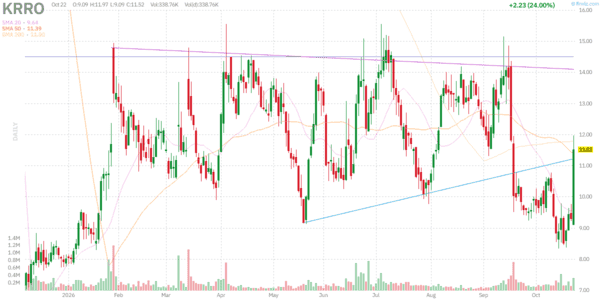
Daily chart $KRRO · October 22, 2026 · Intraday, delayedOpen chart (affiliate link) · For information only.
Next catalyst
H1 2027 · UCD patient dosing and AATD regulatory milestone expected
ANCHOR moves toward patients; KRRO-111 prepares for regulatory submission
Korro expects KRRO-121 dosing in UCD patients in H1 2027, subject to authorization, and an interim clinical readout in H2 2027. Separately, KRRO-111’s regulatory submission is forecast for H1 2027. The two programs face different tests: initial human safety and ammonia control for KRRO-121, and readiness to enter human development for preclinical KRRO-111. Source · Related announcement
Key data
Latest announcementOctober 22, 2026 — KRRO-111 reports strong preclinical editing and protein activity Source
Dates of the figuresFigures as of June 30, 2026 unless otherwise stated. Source
The constructive case
Medically important targets and two distinct protein strategies create meaningful upside if human activity is reproducible. ANCHOR has begun dosing, and KRRO-111 generated strong preclinical editing and protein effects. June liquidity and management’s H2 2028 runway forecast provide time to pursue clinical learning.
The case against
The predecessor KRRO-110 produced less functional protein than projected and was discontinued. KRRO-121 has only just entered human assessment, while KRRO-111 remains preclinical. Repeated-dose safety, clinical benefit and competition remain open. Substantial pre-funded warrants, employee awards and future funding needs affect per-share value; Novo’s collaboration is paused.
Operating and financial position
Early clinical-stage RNA-editing developer with KRRO-121 in ANCHOR and KRRO-111 in preclinical AATD development. Unrestricted liquidity was $137.921M at June 30, 2026; H1 operating cash use was $33.067M. Management forecasts funding into H2 2028. The March equity raise strengthened funding while increasing economic ownership through common shares and pre-funded warrants. Source · Related source
Executive summary
Korro Bio is testing whether endogenous ADAR RNA editing can produce useful medicines for hyperammonemia and alpha-1 antitrypsin deficiency. The lead current program, KRRO-121, entered healthy-volunteer dosing in ANCHOR in 2026, with UCD patient work and interim clinical data forecast for 2027. KRRO-111 offers a second route to value through restoration of functional AAT and reduction of mutant protein, supported by mouse results. The failed KRRO-110 experience underscores the gap between molecular activity and a viable patient profile. Funding improves execution capacity; clinical translation, diluted ownership, competition and the paused Novo agreement remain central to the stock case.
Latest news
October 22, 2026 — KRRO-111 reports strong preclinical editing and protein activity
Repeat-dose NSG-PiZ mice reached 96% RNA editing and 93% M-AAT as a fraction of circulating AAT. A separate immunocompetent mouse model showed 95% lower whole-liver Z-AAT versus vehicle at Day 57. Korro forecasts a regulatory submission in H1 2027; human efficacy remains untested for this candidate. Source
October 5, 2026 — First healthy-volunteer cohort dosed in ANCHOR
KRRO-121 entered the phase 1/2 ANCHOR program for hyperammonemia. UCD patient dosing is expected in H1 2027, subject to authorization, with an interim clinical readout in H2 2027. The initial human assessment focuses on safety, tolerability and pharmacokinetics. Source
August 19, 2026 — Ethics submission for the first-in-human KRRO-121 trial
Korro announced a submission to the Alfred Health Human Ethics Committee in Australia to initiate the first-in-human phase 1/2 trial of KRRO-121, the study now known as ANCHOR. The trial is designed to assess safety, tolerability and pharmacokinetics of escalating doses and to evaluate effects in healthy volunteers and participants with UCDs; it is registered on ClinicalTrials.gov as NCT07773246. Source
August 6, 2026 — June liquidity of $137.9 million supports the clinical plan
Korro reported $137.9M in unrestricted cash, equivalents and marketable securities at June 30, with projected funding into H2 2028. Q2 collaboration revenue was zero during the agreed pause with Novo Nordisk. Source
May 19, 2026 — KRRO-111 nominated as the new AATD candidate
Korro selected its GalNAc-delivered RNA-editing candidate for alpha-1 antitrypsin deficiency, aiming to restore normal M-AAT while reducing mutant Z-AAT production. The program was supported by preclinical data. Source
Extended analysis
Does $KRRO deserve a place in your portfolio?
The full deep dive has the answer’s building blocks: cash, dilution, catalysts and risks, every figure sourced.
Free. No signup. You decide, we don’t recommend.
Using an ad blocker? The free “watch an ad” option is hidden automatically. Pause it on merlintrader.com and reload the page to see the free option.
01 KRRO stock: Korro Bio’s business after the clinical reset
Korro Bio is a Cambridge, Massachusetts biotechnology company listed on the Nasdaq Capital Market as KRRO. Its business centers on investigational medicines that edit RNA, the temporary instructions cells use to produce proteins. The company’s OPERA platform aims to recruit naturally occurring ADAR enzymes to change a selected RNA message. The commercial ambition is to repair a defective protein or produce a protein with a useful new property. Korro has no approved medicine, and its financial results depend on funding and research activity rather than product sales. Korro’s Form 10-Q for the quarter ended June 30, 2026 (filed August 6, 2026).
The current investment case has two distinct programs. KRRO-121 entered human testing in the ANCHOR phase 1/2 program for hyperammonemia associated with urea cycle disorders, or UCDs. Korro announced the first healthy-volunteer cohort had been dosed on October 5, 2026. KRRO-111, nominated on May 19, 2026, remains a preclinical candidate for alpha-1 antitrypsin deficiency, or AATD. Its October 22 results describe activity in cells and mice, with a regulatory submission forecast for the first half of 2027. These programs differ in disease, intended protein effect and evidence maturity. ANCHOR announcement, KRRO-111 nomination, October 22 results.
That distinction matters because the earlier AATD candidate, KRRO-110, disappointed in patients. The company reported functional protein production but levels below its preclinical projections, then discontinued development and terminated REWRITE. The newer AATD program uses a different delivery approach. This creates a plausible opportunity to improve performance, while leaving a substantial burden of clinical proof. The prior experience is directly relevant to how much confidence investors place in striking animal results. November 2025 clinical update, second-quarter 2026 Form 10-Q.
Korro therefore combines an early clinical asset, a potentially valuable second program and an established warning about translation. The equity’s value will depend less on the breadth of the platform description than on whether the next experiments in people demonstrate adequate exposure, useful biological effects and acceptable safety. A first cohort dosed reduces trial-start uncertainty. It leaves the much larger uncertainty of whether a medicine works.
The balance sheet gives the company time to pursue those questions. At June 30, 2026, unrestricted cash, equivalents and marketable securities totaled $137.921 million. Management projected funding into the second half of 2028. That operating horizon supports a meaningful development attempt, although it depends on spending assumptions and offers no protection against negative clinical findings. For shareholders, both clinical evidence and the number of economic claims on the business matter. Second-quarter financial results.
02 OPERA and ADAR: the clinical rationale for RNA editing
RNA editing seeks to change a protein instruction without permanently rewriting the underlying DNA. Korro’s approach uses an RNA-editing oligonucleotide to recruit an endogenous ADAR enzyme. At a conceptual level, this can correct a disease-associated message or generate a protein variant with an intended therapeutic function. The company’s two leading programs illustrate those different aims: KRRO-111 is intended to restore normal AAT production, while KRRO-121 is designed to stabilize an enzyme involved in ammonia clearance. Korro’s program descriptions.
The temporary nature of RNA provides a possible clinical advantage. An effect that depends on repeat treatment can potentially be adjusted or allowed to diminish. It also creates a commercial and clinical obligation: the medicine must deliver enough activity for a useful interval, remain tolerable with repeated exposure and fit a practical treatment schedule. Reversibility changes the risk profile. A drug can still cause inflammatory reactions, organ toxicity or unintended biological effects while it is present.
Original research published in Nature Biotechnology in 2022 demonstrated endogenous ADAR-mediated editing in nonhuman-primate liver, with effects persisting for at least a month. This provides preclinical support for the feasibility of the therapeutic class. It involved another research platform and a different target transcript; it supplies neither clinical results for Korro’s products nor evidence that a particular editing percentage improves disease. The distinction between a successful molecular intervention and a useful medicine remains central. Original nonhuman-primate study, DOI 10.1038/s41587-022-01225-1.
Delivery is a major part of the investment thesis. KRRO-121 and KRRO-111 use GalNAc conjugation to favor uptake by liver cells and are intended for subcutaneous administration. The predecessor KRRO-110 used lipid nanoparticles. A familiar delivery category may reduce some development uncertainties, but the resulting product remains a new investigational medicine. Experience with other oligonucleotide drugs cannot substitute for the safety and activity of the specific candidate. October 5 program overview, October 22 KRRO-111 results.
RNA editing also differs from RNA interference. Silencing reduces the amount of a target message; editing aims to change what an existing message produces. In AATD, the theoretical attraction is simultaneous restoration of useful protein and reduction of harmful protein production. In hyperammonemia, the attraction is enhanced function through an alternative clearance pathway. These are biological hypotheses with different clinical endpoints, rather than interchangeable claims that the platform has worked.
A convincing clinical package must connect several steps: appropriate drug exposure, the intended protein effect, a measurable change in disease biology and an outcome relevant to patients. A strong result at one step can justify further development while leaving the others unresolved. The commercial reward becomes more credible as those links are demonstrated in the intended population and maintained over time.
03 Hyperammonemia: why the KRRO-121 target matters
Ammonia is a waste product that normally enters pathways allowing nitrogen to be removed from the body. UCDs involve inherited deficiencies affecting that process. Patients can develop dangerous ammonia elevations, including crises associated with neurological injury, coma and death. Disease severity, residual enzyme activity and the circumstances triggering a crisis vary. The burden includes ongoing dietary management, medicines, monitoring and the possibility that an intercurrent illness will destabilize otherwise acceptable control. UCD clinical overview, Korro’s hyperammonemia background.
KRRO-121 is designed to produce a stabilized form of glutamine synthetase, an enzyme involved in ammonia clearance. The intention is to strengthen an alternative route that could operate across different underlying UCD mutations. That creates a broader development concept than repairing one defective urea-cycle enzyme. Breadth remains an objective: different UCD genotypes, disease severities and background therapies can produce materially different responses. Clinical activity in one subgroup would need interpretation before extrapolation to all patients. KRRO-121 description.
For patients, the potential value would extend beyond a laboratory number if better control reduced ammonia excursions, treatment burden or emergency events. Less reliance on nitrogen scavengers and greater dietary flexibility are attractive development goals. They require evidence that benefits can be achieved without exposing patients to avoidable metabolic instability. A transient change in ammonia after treatment would be an early signal; durable control during ordinary life would be a more demanding achievement.
Existing therapy provides a relevant standard. Glycerol phenylbutyrate, marketed as Ravicti, is labeled for chronic management when dietary restriction and supplementation alone are insufficient. Its labeling distinguishes maintenance treatment from acute hyperammonemia, which requires faster intervention. An investigational maintenance approach must show where it fits alongside established care and how it performs when patients are already receiving treatment. Convenience alone has limited value if clinical control deteriorates. Ravicti prescribing information.
The rare-disease setting creates both opportunity and practical constraints. Specialized treatment centers and recognizable metabolic outcomes can support focused development. Recruitment can be difficult, and small samples may contain substantial variation in disease history, diet and baseline risk. A few favorable observations may be clinically interesting without defining the size or consistency of benefit. Background management and changes in concomitant therapy will affect how ammonia results are interpreted.
Korro reported European Medicines Agency orphan drug designation for KRRO-121 in UCDs in its August 2026 update. Designation recognizes a development category and may provide regulatory incentives under the applicable framework. Marketing authorization still requires an acceptable evidence package, and the designation supplies no human efficacy result. Its investment relevance is support for the development pathway, while safety, benefit and the eventual label remain the central determinants of medical and commercial value. August 6 update.
The intended use is also important economically. A medicine providing sustained control could generate repeat use, but adoption would depend on tolerability, reliability, access and the extent to which existing treatment can safely be simplified. Korro has not established those commercial characteristics. The near-term value of KRRO-121 lies in whether ANCHOR can produce a credible first human profile that supports a larger and more definitive development plan.
04 ANCHOR phase 1/2: design, endpoints and the 2027 catalysts
The October 5, 2026 announcement marked an achieved operational milestone: Korro had administered KRRO-121 to the first healthy-volunteer cohort. The ANCHOR program begins with single- and multiple-ascending-dose studies intended to characterize safety, tolerability and pharmacokinetics. Healthy volunteers help establish an initial human exposure and safety profile before the company asks whether the drug can benefit people with impaired ammonia disposal. The first healthy-volunteer cohort received a single 2 mg/kg dose, and the trial is enrolling healthy volunteers in Australia. The registry lists one recruiting site, Nucleus Network in Melbourne, an actual start date of September 28, 2026 and an estimated primary completion date of August 2027. First-cohort announcement, October 5 SEC exhibit, NCT07773246 registry record.
Korro describes a program of up to 50 healthy volunteers, comprising up to 30 in the single-dose portion and up to 20 in the multiple-dose portion. A subsequent phase 2 component would include up to 15 participants with UCDs across genotypes, subject to regulatory approval. The current registry, NCT07773246, lists estimated enrollment of 30 and presently posts healthy-volunteer eligibility criteria, while its title and summary describe the broader phase 1/2 program. The company’s announcement separately describes up to 50 healthy volunteers and up to 15 patients. ANCHOR program description, NCT07773246.
The registry identifies safety outcomes including dose-limiting toxicities and treatment-emergent adverse events, plus drug-concentration assessment. Early results will be most useful when they explain the number exposed, duration of observation, adverse-event severity, discontinuations and exposure at the intended clinical range. A statement that dosing has proceeded is useful operational information. It provides a narrower form of evidence than a detailed safety dataset. ANCHOR registry.
Patient dosing is forecast for the first half of 2027, with an interim clinical readout expected in the second half of 2027. Those are company development targets. The patient component depends on regulatory authorization and the preceding work. The sequence matters: a delay in healthy-volunteer assessment or dose selection could shift the subsequent stage, even without a formal program termination. October 5 timetable.
The first UCD observations will have a different evidentiary role from healthy-volunteer results. Patients are where the proposed clearance mechanism encounters the disease state, existing medicines and metabolic vulnerability. Ammonia measurements will need context on baseline variation and background therapy. An encouraging average can conceal uneven response, while a small study may be unable to establish changes in relatively infrequent crisis events. These limits shape the conclusions that an interim dataset can support.
Small early studies also have limited power to characterize uncommon adverse events. A clean initial cohort would be encouraging, but longer observation and additional exposed participants are needed to describe risk with greater confidence. The distinction between single and repeated exposure matters when a product is intended for continuing treatment. Event timing, reversibility and any relationship to exposure can be as important as the headline proportion experiencing an adverse event. These are clinical interpretation questions rather than predictions that a specific toxicity will occur.
Successful ANCHOR execution would establish a basis for later study, including which patients to enroll and what benefit to test. It would still leave pivotal development and marketing authorization ahead. The investment catalyst is therefore the quality of the emerging human profile, rather than a calendar date alone. A timely result with weak activity can be less valuable than a modest delay followed by interpretable exposure and disease evidence.
05 Hepatic encephalopathy: a separate opportunity with separate risks
Korro also identifies hepatic encephalopathy, or HE, as a potential application for KRRO-121. HE is a neuropsychiatric complication of liver disease associated with impaired ammonia handling and other consequences of hepatic dysfunction. Symptoms range from cognitive impairment to severe disturbances of consciousness. The intended therapeutic link is the same broad biological objective as in UCDs: improve ammonia clearance. The underlying disease and clinical setting are materially different. Korro’s KRRO-121 overview.
The current ANCHOR patient component is described for UCDs. HE remains an additional development opportunity, rather than an enrolled HE efficacy cohort in the announced program. Evidence of activity in UCDs could support interest in further study, but patients with cirrhosis may differ in liver function, comorbidities, drug exposure and vulnerability to adverse events. A common biomarker does not make those populations clinically interchangeable. ANCHOR scope.
The relevant commercial comparator is established treatment that helps prevent recurrent events. Rifaximin, marketed as Xifaxan, is labeled to reduce the risk of overt HE recurrence in adults. In its placebo-controlled HE trial, most participants also used lactulose. That treatment context illustrates the question a new medicine would face: can it add useful protection or reduce burden within a complex care regimen? The approved label also highlights limited experience in very advanced liver disease. Xifaxan prescribing information.
For an HE program, the clinically valuable outcomes would include fewer episodes, hospitalizations and associated functional disruption, with acceptable safety in the intended liver-disease population. Biomarker improvement could help establish activity, but medical value would depend on how reliably it translates into those outcomes. Chronic liver disease also produces competing causes of deterioration, making careful interpretation especially important.
The opportunity can be attractive without being assigned immediate revenue value. Development would require its own patient evidence, regulatory discussions and resource allocation. A broad indication could consume considerably more capital than the initial rare-disease study. Partnering might change that burden, but the terms would determine how much future economics remain with Korro. Assigning the full commercial potential to the current UCD trial would overstate what has been achieved.
The sensible valuation distinction is between the funded lead experiment and an adjacent possibility. KRRO-121’s initial human program provides the near-term test. HE could become an additional source of value if tolerability and ammonia control justify progression into that population. Before then, the indication expands the scientific thesis and the range of potential future decisions; it does not supply an independent clinical success or a second stream of product revenue.
06 AATD and KRRO-111: the value of treating lung and liver biology
Alpha-1 antitrypsin deficiency creates a dual therapeutic problem. In severe forms associated with the Z variant, insufficient functional circulating protein leaves the lungs vulnerable, while abnormal protein can accumulate in the liver. The intended benefit of KRRO-111 is to change the protein output of affected liver cells: increase normal M-AAT while reducing production of mutant Z-AAT. A successful medicine could address two disease mechanisms through one treatment. That is the principal clinical attraction behind the program. October 22 KRRO-111 announcement.
The existing approved treatment category establishes a meaningful benchmark. For example, the FDA lists Glassia, an alpha-1 proteinase inhibitor, for chronic augmentation and maintenance in adults with clinically evident emphysema due to severe hereditary deficiency. This provides replacement protein for a defined lung-disease population. KRRO-111’s intended combination of normal protein restoration and reduction of the liver’s mutant-protein burden would be a different therapeutic proposition, subject to successful clinical development. FDA Glassia indication.
Several measurements answer different questions. RNA editing indicates a change in the message. The fraction of circulating AAT that is M-AAT describes protein composition. Absolute functional protein concentration addresses how much potentially useful material is available. Liver Z-AAT burden addresses a separate pathological process. Favorable movement across those measures would strengthen the biological case, but each remains distinct from demonstrated preservation of lung function or improvement in liver disease.
The distinction between protein fraction and absolute amount is particularly important. A high M-AAT percentage can be encouraging, yet clinical relevance also depends on total AAT and protein function. A reduction in harmful protein is similarly more persuasive when accompanied by evidence about tissue consequences over time. These relationships make a multidimensional human dataset more valuable than a single record editing percentage.
Korro nominated KRRO-111 on May 19, 2026. The program uses GalNAc delivery and subcutaneous administration, differing from the discontinued LNP-based KRRO-110. By October 22 the company reported additional preclinical activity and forecast a regulatory submission in the first half of 2027. A submission is a step toward human testing; authorization, trial initiation and human results are subsequent milestones. Candidate nomination, October update.
The commercial opportunity depends on a usable treatment profile as much as biological ambition. Repeat subcutaneous administration could be attractive if it provides durable activity and acceptable tolerability. The evidence will need to define the appropriate population, whether existing augmentation remains necessary, and what longer-term monitoring is required. Korro’s current results justify attention to those questions, while the previous clinical shortfall increases the importance of answering them directly in patients.
07 October 22 KRRO-111 data: strong animal activity, clinical translation ahead
Korro’s October 22, 2026 announcement reported preclinical activity in hepatocytes and several mouse models. In mouse and human hepatocytes, KRRO-111 showed potent RNA editing activity, with an EC50 of about 1 nM and up to 98% editing. The most prominent repeat-dose result came from NSG-PiZ mice: SERPINA1 RNA editing reached 96%, M-AAT represented 93% of total circulating AAT, and total AAT reached 172 micromolar at Day 57, approximately six times the vehicle-control value. These are animal molecular and protein results. They provide a rationale for further development while leaving human dose, safety, protein response and disease benefit unresolved. October 22 SEC exhibit.
In a separate immunocompetent C57BL/6-PiZ model, whole-liver Z-AAT was reduced by 95% versus vehicle at Day 57. That finding addresses the harmful-protein side of the disease hypothesis. Its model differs from the NSG-PiZ experiment supporting the circulating-protein figures. The results reinforce the proposed dual mechanism across experiments, with the translational limits of each animal system still relevant. Model-specific preclinical findings.
Single-dose experiments in C57BL/6-PiZ mice produced up to 91% editing and M-AAT up to 88% of total circulating AAT; both responses remained detectable through at least Day 42. Persistence supports the possibility of a useful treatment interval. Detectable activity at a time point differs from a clinically validated interval maintaining adequate protection in humans. The human program will have to establish the extent and duration of the response under its own conditions. Single-dose results.
The next evidence should also distinguish total circulating protein from its functional contribution. A sustained concentration is more useful when supported by evidence that the protein performs its protective role. For the liver, changes in stored mutant protein need interpretation alongside tissue health and longer follow-up. These are complementary questions: a strong result for circulating AAT would leave a separate task of demonstrating meaningful effects on established liver pathology.
The clinical value of these findings lies in consistency across the intended chain of events: editing, useful protein production and less mutant protein. The remaining questions include how well human liver uptake translates, whether activity persists at a tolerable exposure, and whether repeated treatment produces a satisfactory safety profile. The KRRO-110 experience demonstrates why an animal-to-human assumption carries meaningful investment risk even when the biological target is well understood.
The announcement does not provide a randomized human comparison with another AATD therapy. Claims of leading preclinical potential are hypotheses about future positioning. Superiority in patients would depend on comparable evidence about functional protein, liver effects, tolerability and treatment burden. Different species, assays, sample collection times and experimental conditions prevent a valid ranking based solely on percentages quoted by separate companies.
Korro expects the regulatory submission for KRRO-111 in the first half of 2027. The company said it looks forward to advancing KRRO-111 into the clinic in the first half of 2027. The same announcement lists the ongoing GLP toxicology evaluation of KRRO-111 among its forward-looking matters, and its cautionary statements cite the absence of head-to-head comparisons supporting any best-in-class potential. The nearer operational questions concern completion of the required development package and the regulator’s assessment. The larger financial catalyst would come later from a human profile that addresses the prior program’s limitations. The October results increase the program’s scientific interest, while its present evidentiary stage remains preclinical. Regulatory timetable and development risks.
08 KRRO-110 and REWRITE: what the failed program teaches
The historical KRRO-110 results are essential to understanding Korro’s risk. In November 2025, the company reported that the candidate generated functional M-AAT in AATD patients but failed to achieve the protein levels projected from preclinical work. It identified differences in the behavior of delivery components between healthy volunteers and patients as a possible contributor. The company then shifted its AATD strategy toward GalNAc delivery. November 12, 2025 program update.
The earlier study provided evidence of biological activity without delivering the intended product profile. That distinction is more informative than labeling the technology either proven or disproven. Protein production in people supports part of the mechanism. Insufficient magnitude of effect undermined the particular therapeutic attempt. The failure shows that demonstrating an edit and creating a commercially viable medicine require different levels of evidence.
The November safety update reported no dose-limiting toxicities or treatment-emergent serious adverse events in the disclosed dataset, alongside mild to moderate infusion-related reactions in some healthy volunteers and AATD patients. Those observations relate to KRRO-110, its LNP formulation and the exposure then available. They cannot establish the safety of KRRO-121 or KRRO-111, whose delivery and product characteristics differ. Each new program needs its own evidence. REWRITE safety observations.
The second-quarter 2026 Form 10-Q confirms the phase 1/2a REWRITE trial was terminated during the first quarter of 2026, and Korro discontinued KRRO-110 development. The current pipeline therefore centers on KRRO-121 and KRRO-111. KRRO-110 remains historical clinical evidence and a source of lessons about translation, rather than an additional active asset supporting the next catalyst. Current program and expense discussion.
The financial response also matters. Korro reduced its workforce by approximately 20% in May 2025 and undertook a further reduction of approximately 34% in November 2025. These were separate actions against different workforce bases. They helped concentrate resources and lower spending, but they also leave a smaller organization responsible for clinical execution, regulatory work and new-program development. Cost savings improve runway only if the resulting operation can deliver the essential work. The Chief Executive Officer also serves as interim Chief Financial Officer, as shown by his signature on the company’s August 19, 2026 Form 8-K. Restructuring note.
For investors, the useful response is a higher demand for transparent human data. Exposure, individual variability and the link between editing and functional protein deserve particular attention. The change in delivery gives KRRO-111 a distinct opportunity; the previous failure gives shareholders a concrete reason to avoid assuming that better mouse performance guarantees adequate patient performance. That combination supports interest in the new experiments with a disciplined view of what remains uncertain.
09 Competition, commercial value and the limits of a platform premium
Korro competes on more than the ability to change RNA. A successful medicine must improve the balance of benefit, risk and treatment burden relative to existing care and other investigational approaches. In UCDs, the intended advantages include sustained ammonia control and potentially less daily treatment burden. In AATD, the proposed advantage is simultaneous normal-protein restoration and reduction of harmful protein production. Both objectives are valuable if demonstrated in a usable product.
Wave Life Sciences provides a relevant AATD comparison because WVE-006 also uses a subcutaneous GalNAc RNA-editing approach. Its May 18, 2026 update reported results from the open-label phase 1b/2a RestorAATion-2 study in AATD patients, including increased M-AAT and reduced circulating Z-AAT. Those are human biomarker observations from another candidate. They place competitive pressure on Korro’s development timeline, while offering broader evidence that therapeutic RNA editing can produce measurable protein changes in people. Wave’s clinical update.
The comparison has strict limits. WVE-006 patient biomarker results and KRRO-111 mouse experiments differ in population, assays, dosing exposure and evidentiary stage. A larger editing percentage in mice cannot demonstrate clinical superiority to a human program. Korro will eventually need a persuasive human profile on its own terms. Potential differentiation could involve the magnitude and durability of functional protein, liver effects, tolerability or practical dosing, but those characteristics remain to be established.
The established-care comparison is equally important. A new UCD medicine enters a setting with chronic ammonia scavengers and intensive specialist management. An AATD medicine enters a setting with approved augmentation therapy for a defined lung-disease population. These treatments establish practical expectations for reliability and access. A future Korro product could offer added value without eliminating all background care, and the ultimate label would determine the addressable population. Ravicti label, FDA augmentation indication.
Commercial value also depends on diagnosis, treatment eligibility and reimbursement. A broad prevalence estimate counts people with a condition; the initial treated population would depend on genotype, severity, evidence and regulatory restrictions. Multiplying prevalence by an assumed premium price can create a misleading revenue figure. At Korro’s stage, the more useful commercial question is what specific patient problem a successful trial would solve and what evidence would support payment for that solution.
Platform breadth can provide future options, but it also creates resource choices. Korro’s August update targeted nomination of a third GalNAc program in the second half of 2026. That was an additional development objective, with lower immediate evidentiary weight than the active clinical trial and the next AATD regulatory package. A platform premium becomes more defensible when successive products generate interpretable clinical results within a sustainable capital budget. Second-quarter pipeline update.
10 Partnerships and rights: Novo’s pause and conditional economics
Korro’s agreement with Novo Nordisk requires careful treatment. The collaboration originally provided an exclusive worldwide license under specified intellectual property for an initial cardiometabolic target and a possible second target. Korro was responsible for designated research activities, with potential reimbursement and downstream economics. Novo could undertake subsequent development and commercialization of licensed products. These rights relate to the agreement’s defined targets and products; they are not a blanket transfer of Korro’s entire pipeline. Collaboration note in the second-quarter 2026 Form 10-Q.
Effective November 11, 2025, the parties agreed to a 12-month pause. Research and development activities and corresponding obligations were suspended during the hold period without liability or payment obligations for either party, apart from specified wind-down arrangements. Other provisions, including exclusivity, confidentiality and termination terms, continued. Korro disclosed that wind-down activities were completed and reimbursed by March 31, 2026. The 12-month hold period began November 11, 2025, so the agreement’s status after mid-November 2026 is a near-term point to watch. November 2025 Form 8-K, Amendment disclosure, Financial note in the second-quarter 2026 Form 10-Q.
The pause changes how the partnership contributes to valuation. It represents a contractual relationship with conditional future activity, rather than ongoing external funding of the current clinical program. Korro recorded zero collaboration revenue in the first half of 2026. The existence of a large pharmaceutical counterparty supplies neither a guaranteed restart nor clinical validation of KRRO-121 or KRRO-111. Investors need actual future developments before assigning renewed research receipts or milestones. Revenue and partnership disclosures.
Korro received a $10 million upfront payment in October 2024. The June 2026 accounting transaction price of $40 million combines that upfront amount with estimated research services for the first target. It is an accounting measure of the arrangement, rather than a statement that all $40 million had been received as unrestricted cash. Deferred revenue of approximately $7.835 million at June 30 similarly represents an obligation under accounting rules, distinct from a new source of financing. Novo revenue-recognition note.
A separate Genevant license dates from March 2023. The disclosed terms include a $2.5 million initial payment, conditional clinical milestones up to $13.5 million, regulatory and development milestones up to $27 million, commercial milestones up to $57 million, and mid-single-digit royalties on licensed products within that agreement’s scope. These amounts are conditional obligations associated with defined licensed products. Korro’s annual filing associates the Genevant LNP technology with the now-terminated KRRO-110 REWRITE program; KRRO-121 and KRRO-111 use GalNAc delivery. Annual report, delivery technology discussion. Genevant agreement note.
The broader financial implication is that partnerships can exchange development burden for future economics. A new agreement could extend runway or support a larger indication, while reducing retained ownership of commercial value. Until a transaction is signed, the investment case rests on the disclosed funding and programs. Conditional milestones, potential collaboration receipts and possible licensing deals are opportunities, rather than substitutes for cash already available to operate.
11 KRRO cash, burn, runway and dilution
At June 30, 2026, Korro held $24.905 million in cash and equivalents, $90.131 million in short-term marketable securities and $22.885 million in long-term marketable securities. The sum was $137.921 million of unrestricted liquidity. An additional $2.409 million of restricted cash is separate. The balance sheet reported no conventional borrowing line for a term loan or bond; it did include operating-lease liabilities totaling $42.213 million. Lease obligations remain relevant to spending and enterprise value even though their character differs from financial debt. Total liabilities were $60.220 million, including $6.810 million of non-current deferred revenue and a $1.504 million contingent value rights liability linked to the legacy multiple sclerosis program of Frequency Therapeutics, the company name Korro used before its November 2023 reverse merger, which is matched by an asset of the same fair value under the related asset purchase agreement. June 2026 balance sheet and lease note.
First-half operating cash use was $33.067 million, compared with $43.680 million in the first half of 2025. The 2026 figure averages approximately $5.51 million a month. Dividing June liquidity by that historical average produces about 25 months from June 30, as an illustrative constant-spend calculation. Management’s forecast was funding into the second half of 2028. The forecast incorporates a planned operating path; the historical calculation assumes a flat rate and excludes future changes in clinical activity, working capital and financing. The Form 10-Q itself states the narrower formal assessment: the $137.9 million is expected to fund planned operating expenses and capital expenditures for at least 12 months from the issuance of the financial statements. It also reports an accumulated deficit of $422.4 million at June 30, 2026 and states that the company’s future viability depends on generating operating cash or raising additional capital. Cash-flow statement, Company runway forecast.
Spending sensitivity shows the dependence on execution. Using the June 30 balance alone, an illustrative $6 million monthly net cash use would cover approximately 23 months; $8 million would cover about 17 months, and $10 million about 14 months, all measured from that balance-sheet date. These are arithmetic scenarios, excluding new financing, investment returns and changing working capital. They are separate from management’s operating forecast. Their purpose is to show how trial expansion or delay can shorten the time available to resolve clinical uncertainty.
The operating statement shows why burn differs from loss. Korro recorded a second-quarter net loss of $18.916 million and a first-half net loss of $38.541 million. First-half research and development expense was $26.539 million and general and administrative expense was $14.007 million. Noncash costs and movements in operating balances affect the relationship between those expenses and cash outflow. Trial expansion could raise spending despite the savings from terminating KRRO-110 and reducing headcount. Results and cash-flow discussion.
The stronger cash position followed substantial equity financing. The March 10, 2026 private placement raised approximately $85 million gross, with $80.258 million net proceeds. It issued 4,501,928 common shares and pre-funded warrants covering 3,148,836 shares. Investors paid $11.109 for each pre-funded warrant, leaving a $0.001 exercise price. January ATM sales added $5.020 million net, or $5.1 million gross, through 501,861 common shares sold under the sales agreement with TD Cowen, which is entitled to up to 3.0% of gross proceeds. These are funding events and increases in economic ownership, rather than operating income. Financing notes.
June 30 common shares were 14,705,646. Adding the 3,148,836 unexercised pre-funded warrants gives 17,854,482 economic share equivalents before other awards, at that date. Pre-funded warrant exercise contributes only the tiny residual payment. The filing separately reported 14,725,646 common shares on August 5 and an agreement that day to exchange one million existing common shares for one million pre-funded warrants. Following the exchange, Korro reported 13,725,646 common shares outstanding and 4,148,836 unexercised pre-funded warrants, or 17,874,482 economic share equivalents before options and other awards; pre-funded warrants then equaled roughly 30% of common shares, according to the August 5, 2026 Form 8-K. That exchange changes the form of ownership without itself creating one million additional economic claims or new financing proceeds. Share and subsequent-event notes.
At June 30, 2026, pre-funded warrants increased the common-plus-warrant denominator by approximately 21.4% relative to common shares alone. This is arithmetic on disclosed instruments, before employee awards and ordinary warrants. A valuation using only listed common shares can therefore differ materially from the economic capitalization. Because pre-funded warrants are excluded from the listed share count, a market capitalization based on common shares alone understates economic ownership by roughly 30% on the post-exchange figures.
Other June potential dilution included 1,874,041 options, 270,611 restricted stock units, 70,000 performance units and 8,049 ordinary warrants. The option weighted-average exercise price was $22.62; vesting, exercise economics and conditions affect actual issuance. Korro’s $100 million ATM authorization is financing capacity, not cash. New employee grants continue, including 5,000 inducement options with a $12.93 exercise price granted on September 9 to three new employees and announced September 11, and 4,000 options announced October 16. Per-share analysis must distinguish common shares, near-fully-paid warrants, contingent awards and future capital raises. Equity notes, October inducement grants, September inducement grant.
Recent ownership filings show both selling and buying. Funds affiliated with Atlas Venture sold about 79,600 shares between August 11 and September 14 under a Rule 10b5-1 trading plan adopted April 8, 2026, including 48,690 shares on September 11 and 14 at weighted-average prices of about $14; after those sales the two Atlas funds reported 773,260 shares. Their Schedule 13D/A filed August 4 had reported 706,556 shares, or 4.9%, held by Atlas Venture Fund XI and 146,305 shares, or 1.0%, held by Atlas Venture Opportunity Fund II. The Senior Vice President, Finance sold 7,358 shares between September 8 and 11 under a Rule 10b5-1 plan, and the Chief Executive Officer’s sale of 5,802 shares on August 4 was a mandatory sale to cover tax withholding on vesting restricted stock units. On the buying side, Lynx1 Capital Management, which reports as a holder of more than 10%, bought 5,222 shares on August 6 and 1,462 shares on August 10. Among institutions, BlackRock reported 5.2% in a Schedule 13G filed July 29 and Balyasny Asset Management reported 6.6% in a Schedule 13G/A filed August 14, both as of June 30, 2026. Atlas Form 4, August, Atlas Form 4, September, Atlas Schedule 13D/A, SVP Finance Form 4, CEO Form 4, Lynx1 Form 4, BlackRock Schedule 13G, Balyasny Schedule 13G/A.
12 KRRO stock scenarios, catalysts and execution risks
The constructive scenario begins with KRRO-121 progressing through healthy-volunteer assessment without safety findings that prevent useful exposure. UCD enrollment would then test whether the proposed mechanism improves ammonia control in patients. An interpretable clinical signal, maintained over time and across relevant backgrounds, could support a more valuable subsequent development program. For KRRO-111, an acceptable regulatory package and permission to begin testing would create the opportunity to determine whether strong animal protein effects translate to humans. ANCHOR forecast, KRRO-111 timetable.
The adverse scenario includes inadequate drug exposure, insufficient biological response or tolerability that limits the necessary activity. Delay alone can also be costly: a smaller company may spend much of its available runway waiting for regulatory work or patient recruitment. The earlier KRRO-110 disappointment supplies a specific example of positive preclinical expectations failing to produce the intended patient profile. A failure in either current program would also influence how investors value the remaining platform.
An intermediate scenario is possible. Healthy-volunteer safety may be acceptable while patient activity remains variable or difficult to interpret. AATD development could proceed on schedule while UCD enrollment moves more slowly, or the reverse. Such outcomes may justify additional work without supporting a clear increase in commercial expectations. The important questions become the cost of resolving uncertainty and whether the remaining balance sheet can fund a decision-quality study.
The principal announced calendar comprises UCD patient dosing expected in the first half of 2027, KRRO-121 interim clinical data expected in the second half of 2027 and KRRO-111’s regulatory submission expected in the first half of 2027. A separate August objective targeted a third GalNAc candidate in the second half of 2026. The 12-month Novo Nordisk hold period began November 11, 2025, so the agreement’s status after mid-November 2026 is also a near-term point to watch. Each milestone has a different weight: nomination adds an option, authorization enables testing, and patient data begin to measure the central medical hypothesis. October 5 clinical plan, October 22 AATD plan, August pipeline update.
Trading conditions add another risk. October 22 market data showed average volume around 150,000 shares, consistent with a relatively small and potentially volatile stock. A clinical surprise or financing can change the amount of available liquidity and the price at which orders execute. Reported market capitalization reflects listed common shares only; a common-share quote may underrepresent economic ownership when substantial pre-funded warrants are outstanding. Market data, SEC warrant disclosure.
Korro’s strongest attributes are medically meaningful targets, a repeat-treatment approach and a balance sheet intended to fund clinical learning. Its central weakness is the distance between platform promise and reproducible patient benefit, highlighted by the predecessor’s failure. The decisive evidence will be specific to each current medicine: safety, magnitude and durability of biological activity, relevance to patients and the capital needed for the next stage. Those results will determine whether the science supports lasting per-share value.
FAQ — Korro Bio stock, medicines and financial risk
What does Korro Bio develop?
Korro develops investigational RNA-editing medicines. Its OPERA platform recruits endogenous ADAR enzymes to change selected RNA messages, aiming to repair a protein or generate a useful protein variant. The current leading clinical program is KRRO-121; KRRO-111 is a preclinical AATD candidate. Korro has no approved product. Company filing.
Is KRRO-121 already treating UCD patients in ANCHOR?
The October 5, 2026 announcement concerned the first healthy-volunteer cohort. Korro forecast UCD patient dosing in the first half of 2027, subject to the relevant authorization, with interim clinical results in the second half of 2027. The patient phase is a later component of the program. ANCHOR announcement.
Why might KRRO-121 work across several UCD genotypes?
Its intended mechanism strengthens ammonia clearance through stabilized glutamine synthetase, rather than repairing each defective urea-cycle enzyme. This supports a broad development rationale. Whether different patient groups obtain useful and safe ammonia control remains a clinical question. Reduced treatment burden and dietary flexibility are potential future benefits requiring patient evidence. KRRO-121 mechanism and objectives.
What did KRRO-111’s October 22 results demonstrate?
They demonstrated preclinical editing and protein effects in cells and mouse models. Repeat-dose NSG-PiZ mice reached 96% editing and 93% M-AAT as a fraction of circulating AAT. A separate immunocompetent model showed 95% lower whole-liver Z-AAT versus vehicle at Day 57. These findings support further development; human clinical efficacy remains untested for KRRO-111. October 22 results.
What happened to KRRO-110 and REWRITE?
KRRO-110 generated functional protein in AATD patients, but levels fell below the company’s projections. Korro pivoted to a GalNAc-delivered approach and discontinued KRRO-110. The second-quarter 2026 Form 10-Q confirms REWRITE termination during the first quarter of 2026. Its clinical history is relevant to translation risk, while the new candidate requires separate assessment. Historical clinical update, Current filing.
How much funding does Korro have?
At June 30, 2026, unrestricted cash, equivalents and marketable securities totaled $137.921 million, including $24.905 million in cash and equivalents. Management forecast that funding would support operating expenses and capital needs into the second half of 2028. That is a company projection based on its operating plan; actual spending and development timelines may differ. Financial statement, Runway forecast.
Why do pre-funded warrants matter for KRRO stock?
June 30 common shares were 14,705,646, with an additional 3,148,836 pre-funded warrants outstanding. Their $0.001 exercise price means substantially all the purchase price was already paid. They represent economic ownership beyond reported common shares and provide minimal new cash upon exercise. Other options and awards have different conditions and economics. SEC financing and equity notes.
Is Novo Nordisk actively funding the research collaboration?
The latest financial disclosure describes a 12-month pause effective November 11, 2025, with research activities and corresponding obligations suspended during that period. Korro recorded no collaboration revenue in the first half of 2026. Future value depends on developments under the agreement and its retained terms, rather than an assumption of uninterrupted activity. Collaboration amendment, Second-quarter 2026 Form 10-Q note.
Is KRRO a small-cap company?
October 22 market data placed listed common equity below $200 million, a size often described as micro-cap within the broader small-company universe. The company also had relatively modest average trading volume. Market capitalization changes with price and share count, and pre-funded warrants create additional economic exposure beyond common shares. Market data, SEC ownership instruments.
Sources — filings, trial information and original science
- Korro Bio official website and investor relations.
- SEC Form 10-K: year ended December 31, 2025.
- SEC Form 10-Q: quarter and six months ended June 30, 2026.
- August 6, 2026 financial and business update.
- October 5, 2026 ANCHOR first-cohort announcement.
- ANCHOR study NCT07773246.
- October 22, 2026 KRRO-111 preclinical announcement, SEC exhibit.
- May 19, 2026 KRRO-111 nomination.
- November 12, 2025 KRRO-110 clinical update.
- November 2025 Novo agreement amendment and restructuring.
- October 16, 2026 employee option grants.
- Original ADAR study in nonhuman primates, Nature Biotechnology 2022.
- Wave’s May 18, 2026 WVE-006 clinical results.
- FDA Glassia indication, Ravicti label, Xifaxan label.
- Market data.
Join the Merlintrader community: follow the discussion and get more deep dives on our subreddit — r/MerlintraderPub — and on the Telegram channel @merlintraderpub_com.
Get these reports in real time
Every Merlintrader stock hub, catalyst update and market brief is published to Telegram the moment it goes live. No paywall, no spam, just the research.
Disclaimer. This content is published by Merlintrader for educational and informational purposes only. It is independent journalism and research. It does not constitute investment advice, an investment recommendation, an offer or a solicitation to buy or sell any security, and it is not a research report within the meaning of applicable United States securities regulation. Nothing here should be read as a recommendation to buy, sell or hold $KRRO or any other security.
Figures are taken from public filings with the U.S. Securities and Exchange Commission, company press releases and market-data providers, and are stated with their reference dates. Data can change without notice, and figures published before a results release become outdated the moment that release is issued. Merlintrader makes no representation that the information is complete or current at the time of reading. Readers should verify every figure against the primary source before acting on it.
Biotechnology companies face clinical, safety, regulatory, manufacturing, commercial and financing risks. Trials can fail, adverse effects can limit use, regulatory applications can be delayed or rejected, and an approved medicine may not achieve commercial expectations. Additional borrowing or equity issuance can increase obligations or dilute existing shareholders. Investors can lose part or all of their capital. Every reader is responsible for their own decisions and should consult a licensed financial adviser where appropriate.
Merlintrader may hold positions in securities mentioned. Some links on this page are affiliate or referral links, which may generate a commission at no cost to the reader. Full legal information is available on the disclaimer and terms of use and privacy pages.
KRRO Stock Hub: Korro Bio News, KRRO-121 ANCHOR and KRRO-111 · Merlintrader
Biotech catalysts and company research
Clinical milestones, regulatory events and independent company analysis.
Open the biotech catalyst calendar → · Top Ten Biotech →