Merlintrader Trading Pub
Biotech catalyst, news and analysis PDUFA tracker
Merlintrader Trading Pub
Biotech catalyst, news and analysis PDUFA tracker
AI transparency: articles and reports are produced with the help of artificial intelligence and checked through a process that does not constitute specialist validation. They may contain errors: verify relevant information with independent sources. Read the full disclaimer.
RAS is not one target: the different cancer strategies behind Revolution Medicines, Verastem, Erasca and Lilly
Compare RAS and KRAS cancer programs: mutation selectivity, trial populations, safety, combinations and the different financial exposure of four companies.
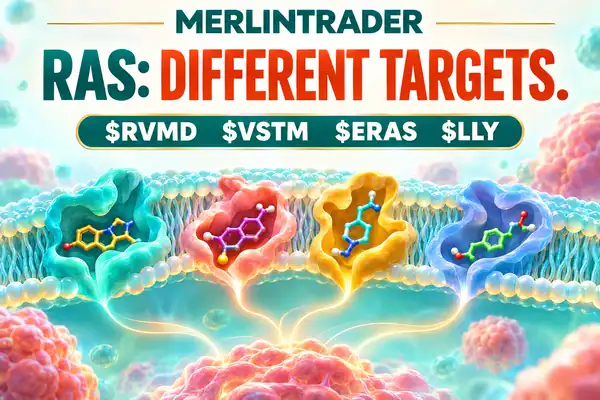
A pancreatic cancer medicine with an FDA approval, a selective G12D inhibitor moving toward a first-line trial, two early RAS programs with different breadth, and a G12C drug being tested alongside immunotherapy belong to the same scientific story. They answer different clinical questions. That difference matters for patients, for the interpretation of trial results and for the businesses financing development.
Revolution Medicines, Verastem Oncology, Erasca and Eli Lilly provide four useful ways into that story. Revolution has moved daraxonrasib into commercial treatment while continuing to investigate other RAS inhibitors and combinations. Verastem is developing VS-7375 against KRAS G12D while operating a separate approved ovarian-cancer business. Erasca is advancing ERAS-0015 and ERAS-4001, which have different target breadth. Lilly is investigating olomorasib against KRAS G12C, including combinations in previously untreated lung cancer. The molecule, mutation, disease setting and treatment partner all influence what success would mean. Revolution’s November 4 update, Verastem’s November 5 update, Erasca’s pipeline, Lilly’s October 25 clinical update.
The central investment question is how a particular biological advantage can become a useful treatment in a defined population. A broad inhibitor might address more mutations, while a narrower one might offer a different balance of exposure and tolerability. A combination might deepen activity while adding toxicity, cost and trial complexity. An early response can justify further development; an adequately controlled survival result can support a much stronger conclusion. Those stages involve different amounts of evidence and capital.
Biology, trial design, safety and financing interact throughout development. An approved indication is an achieved regulatory outcome, while an investigational program remains a continuing clinical proposition. The wider business also changes the exposure: a diversified pharmaceutical group and a biotechnology company concentrated around a small number of programs can have very different sensitivity to the same scientific event. An important clinical advance can therefore carry a different financial weight for each company.
Extended analysis
Continue with the extended analysis: $RVMD $VSTM $ERAS $LLY
The full comparison, company developments, financial context and upcoming milestones.
Free. No signup. You decide, we don’t recommend.
01. The RAS switch explains why the drug names can be misleading
RAS proteins help transmit signals that regulate cell behavior. The KRAS gene provides instructions for one member of that family. The protein binds guanine nucleotides and participates in the RAS/MAPK signaling pathway. In a simplified description, the GTP-bound state is active and the GDP-bound state is inactive. Mutations can disrupt the regulation of this switch and support persistent growth signaling. MedlinePlus Genetics: KRAS.
That basic mechanism creates several possible points of intervention. A medicine can be designed around a particular mutant protein, around a binding configuration that becomes available in a particular state, or around a broader set of RAS proteins. Other medicines act further along the signaling pathway or block inputs that help the pathway reactivate. A statement that a company targets RAS therefore leaves several important questions unanswered.
Consider a simple analogy: identifying a faulty switch in a building tells an engineer where a problem starts, but it does not specify the repair. One approach replaces the defective component. Another interrupts the signal leaving it. A third controls a wider circuit. Each choice can work differently when the surrounding system changes. In cancer, that surrounding system includes the tumor’s tissue of origin, other molecular alterations, previous treatments and the pathways available for resistance.
The analogy also has a limit. A tumor is a population of evolving cells rather than a fixed electrical installation. The selective pressure created by treatment can change which cells survive. Drug exposure varies across tissues, and normal cells also use growth-signaling pathways. The desired effect therefore has to be achieved within a practical therapeutic window. More complete pathway suppression is an attractive hypothesis only if the treatment can be delivered with an acceptable overall benefit-risk profile.
This is why the words selective, broad, ON and OFF deserve careful reading. They describe aspects of pharmacology, not a complete clinical result. Selectivity can refer to a mutation or protein family. Breadth can refer to the number of mutants addressed. State dependence refers to how the molecule interacts with the protein’s activation cycle. These dimensions can overlap without becoming interchangeable.
For shareholders, the consequence is concrete. Two companies can use similar scientific vocabulary while pursuing different product opportunities. Their relevant competitors, treatment settings, development expenses and eventual commercial rights may differ. Understanding the intended biological role is the first step toward identifying which future observation would actually improve the value of a program.
02. G12C, G12D and a broader RAS strategy define different populations
The letters in a mutation name carry information about the altered protein. G12C and G12D refer to different amino-acid substitutions at the same numbered position. A drug designed for one substitution cannot automatically be assumed to work against the other. Nor can a result in one cancer type be carried directly into another simply because both tumors contain a KRAS alteration. KRAS gene and associated cancer biology.
The four companies illustrate the practical consequences. Verastem describes VS-7375 as a selective KRAS G12D inhibitor designed to bind both active and inactive states. Lilly describes olomorasib as a selective G12C inhibitor that locks the mutant protein in its inactive state. Erasca distinguishes the pan-RAS molecular glue ERAS-0015 from the pan-KRAS inhibitor ERAS-4001. Revolution describes daraxonrasib as a RAS(ON) multi-selective inhibitor and is also developing mutation-selective molecules. VS-7375 mechanism and development rights, olomorasib mechanism, Erasca pipeline, Revolution pipeline.
A broader target can create a larger biological opportunity, but commercial size depends on more than the number of mutations on a slide. Diagnosis, treatment eligibility, line of therapy, competing regimens, reimbursement and access all affect the number of people who may receive a medicine. Those factors can be different in pancreatic, lung and colorectal cancer. The population in an early trial can also be narrower than the population a sponsor ultimately hopes to treat.
Conversely, a specific mutation can support a substantial development program when the unmet need and clinical benefit are meaningful. A narrower strategy may also be combined with another treatment to address feedback or resistance. The central question becomes whether the regimen improves outcomes sufficiently in that selected group, at a tolerability and delivery burden that clinicians and patients can sustain.
The word pan deserves similar discipline. A label used to describe a candidate’s pharmacology should be connected to its actual molecular scope and clinical evidence. It does not imply identical activity against every tumor carrying any RAS alteration. Clinical eligibility can depend on mutation subtype, prior treatments, dose, organ function and other criteria. An enrollment criterion and an approved prescribing indication are distinct boundaries.
The U.S. daraxonrasib indication provides an especially useful example. The FDA approval is defined by adult metastatic pancreatic adenocarcinoma and prior-treatment or treatment-fitness criteria; it does not require a specified RAS mutation in the indication. That regulatory outcome comes from the particular evidence assessed for that application. It does not transfer to another broad RAS candidate, another cancer or an earlier treatment setting. FDA approval, August 26, 2026.
03. Four companies occupy different places on the evidence map
| Company | Central RAS approach in this comparison | Current clinical distinction |
|---|---|---|
| Revolution Medicines · RVMD | Daraxonrasib and a wider RAS(ON) portfolio | A defined U.S. daraxonrasib indication is approved; other uses and regimens remain under investigation |
| Verastem Oncology · VSTM | VS-7375, selective KRAS G12D ON/OFF inhibition | Investigational program across pancreatic, lung and colorectal cancers |
| Erasca · ERAS | ERAS-0015 pan-RAS and ERAS-4001 pan-KRAS | Early clinical programs with separate mechanisms and development questions |
| Eli Lilly · LLY | Olomorasib, selective KRAS G12C inhibition | Investigational combinations, including a randomized first-line lung-cancer program |
Revolution’s approved product has crossed a regulatory threshold that the other candidates have not crossed. At the same time, approval in one setting leaves considerable development risk around expansions and combinations. Verastem and Erasca can generate meaningful clinical information before approval, but the interpretation depends on study design, sample size and duration. Lilly’s large corporate scale changes its financial exposure without removing the uncertainty of a particular trial.
These differences also affect how news should be interpreted. A candidate beginning a trial, a company choosing a dose, a randomized study completing enrollment and a regulator approving an indication are distinct events. Each can matter, but each resolves a different uncertainty. Counting them as equal milestones conceals the amount of evidence still required.
The same principle applies to the broader business. Verastem’s approved AVMAPKI FAKZYNJA CO-PACK belongs to a separate product and indication from investigational VS-7375. Revenue from that product can support the company, but it cannot validate VS-7375’s efficacy. Lilly’s group revenue measures an operating pharmaceutical business rather than the commercial contribution of olomorasib, which remains investigational. Erasca’s two candidates should retain separate identities even when management discusses them as one franchise. Verastem Q3 filing, Lilly Q3 filing, Erasca’s June 30 quarterly filing.
04. Revolution has an approved result, with a specific clinical boundary
On August 26, 2026, the FDA approved daraxonrasib, marketed as RASONQUE, for adults with metastatic pancreatic adenocarcinoma who have received at least one prior systemic therapy or who are not candidates for multiagent systemic therapy. The evidence came from RASolute 302, a randomized, open-label study in patients whose disease had progressed after one prior line of systemic therapy. Five hundred patients were randomized equally between daraxonrasib and physician’s choice of standard chemotherapy. FDA approval summary.
In the overall population described in the FDA’s approval summary, median overall survival was 13.2 months with daraxonrasib and 6.7 months with chemotherapy. The reported hazard ratio was 0.40. Median progression-free survival was 7.2 versus 3.6 months, with a hazard ratio of 0.49. These are results from a defined randomized comparison, rather than a comparison assembled from separate single-arm trials. The approval summary also describes statistically significant findings in the RAS G12 population.
The value of randomization is especially visible here. Within the same trial, the two treatment groups were evaluated under a common protocol and follow-up framework. Differences in the patients selected for entirely separate development programs are consequently a much smaller interpretive problem. Randomization still leaves questions about applicability to people outside the study population, but it provides a stronger foundation for estimating a treatment effect against the chosen control.
The label also includes substantive safety requirements. Warnings and precautions cover dermatologic and soft-tissue toxicity, stomatitis and oral disorders, diarrhea, gastrointestinal perforation, interstitial lung disease or pneumonitis, and embryo-fetal toxicity. The practical clinical value includes the treatment’s benefits together with monitoring, supportive care, interruptions and other management demands. Approval means the regulator assessed a favorable benefit-risk balance for the stated use. It does not make adverse events irrelevant. RASONQUE prescribing information.
For the business, the product creates a new operating responsibility. Manufacturing, supply, clinician education, access and continuing development must function together. Revolution’s November 4 results reported approximately five weeks of commercial availability in the third quarter. That operating period gives evidence about the start of commercialization while remaining short relative to the lifespan of an oncology franchise. The company’s research portfolio continues to require investment alongside the new commercial operation.
The next question is therefore more specific than whether RAS can be targeted in patients. In this approved setting, that question has a regulatory answer. Development in earlier lines, other tumors and combination regimens requires its own evidence. Each expansion can alter both the clinical opportunity and the competing treatment landscape. RASolute 302 registry, Revolution’s November business update.
05. Revolution's wider portfolio turns the comparison into a combination question
Daraxonrasib is only one part of Revolution’s RAS strategy. The company is investigating mutation-selective programs and combinations that bring different forms of inhibition together. In its November 4 update, Revolution described progress with zoldonrasib, its RAS(ON) G12D-selective inhibitor, including combination development in pancreatic cancer. The company had begun treating patients in RASolute 309, evaluating daraxonrasib plus zoldonrasib in treatment-naïve metastatic RAS G12D pancreatic cancer. November 4 development update.
The scientific proposition is understandable. Different components of a regimen may address different parts of the tumor’s signaling behavior or help reduce routes of escape. Combining a broader approach with a mutation-selective one could potentially create a useful pattern of inhibition. Clinical development must then determine exposure, dose, tolerability and outcomes for the complete regimen. The number of mechanisms combined cannot substitute for that work.
An earlier-line program also changes the standard against which a treatment is judged. People beginning systemic treatment may have different performance status and disease burden from people who have progressed through several regimens. They may remain on therapy longer. The available comparator may be more effective than a later-line option. A favorable later-line result can support a rationale for moving earlier without predicting the magnitude of benefit in that new setting.
The earlier doublet experience also contains an important safety signal. Revolution’s November presentation described 60 patients with second-or-later-line RAS G12D pancreatic cancer receiving zoldonrasib 1,200 mg and RASONQUE 300 mg once daily. At the February 9, 2026 cutoff, 21 patients had Grade 3 or higher treatment-related adverse events, including one Grade 5 event of intestinal perforation. This was the earlier cohort, separate from the newly initiated first-line RASolute 309 study. The finding belongs alongside the rationale for developing the combination. November 4 presentation, slide 63.
Revolution’s lung-cancer development adds another layer. The RASolve 301 registry describes a randomized Phase 3 daraxonrasib study in previously treated RAS-mutated non-small cell lung cancer. The tumor type, molecular selection and control differ from the pancreatic-cancer approval. The program asks whether the approach can improve outcomes in a second disease context with its own treatment history. RASolve 301 trial.
For investors, a portfolio can distribute scientific opportunities while concentrating operational demands. Several late-stage studies require sites, drug supply, data systems, regulatory engagement and funding at the same time. A strong balance sheet can support that effort, but development expenditure remains real. Program sequencing matters because running every possible combination immediately can create a substantial burden before the clinical priorities are clear.
The most informative observations therefore connect the portfolio’s pieces: whether a regimen can maintain useful exposure, whether activity persists with longer follow-up, whether randomized studies support the proposed clinical role and whether additional complexity produces a sufficient improvement. Those observations explain the strategic value of a multi-program platform more clearly than a count of trial names alone.
06. Verastem's G12D program begins with a narrower molecular proposition
VS-7375 is designed to inhibit KRAS G12D in both its active and inactive states. Verastem holds development and commercialization rights outside the GenFleet markets of mainland China, Hong Kong, Macau and Taiwan; the molecule is developed in China as GFH375. Those territorial rights are relevant when moving from a scientific opportunity to the economic opportunity owned by shareholders. October 14 clinical and rights update.
The company’s October update described an early pancreatic-cancer cohort receiving 900 mg once daily. At the October 7 data cutoff, confirmed responses were reported in nine of 22 patients in the second-or-later-line population. The second-line subgroup contained eight patients, four of whom had confirmed responses. Median follow-up for the broader cohort was 6.4 months. These are small, nonrandomized groups, with substantially less outcome information than a completed comparative survival study.
The denominator deserves attention. The 22-patient analysis included two people who were not evaluable: one died from coronary artery disease and stroke; another withdrew consent before the first assessment and died two months later. The company described both deaths as unrelated to treatment. Keeping such patients in the population makes the reported analysis different from an analysis restricted to people with a post-baseline scan. That methodological choice matters when comparing superficially similar percentages.
Response confirmation also matters. A reduction in measured tumor size at one assessment can be encouraging, but a confirmed response requires the applicable follow-up assessment. The October update described two complete responses in the pancreatic cohort, with one confirmed and the other unconfirmed. Combining them into a count of two confirmed complete responses would change the clinical claim. The distinction is particularly important when the underlying sample is small.
Verastem’s safety analysis used another population and date. For 900 mg monotherapy across tumor types, it reported 48 patients at a September 29 cutoff. Grade 3 treatment-related adverse events occurred in 10%, and adverse events led to discontinuation in 2%. Nausea, vomiting and diarrhea were the principal treatment-related adverse events described. A tolerability assessment therefore has its own denominator; it is not simply the pancreatic efficacy cohort viewed from another angle.
The commercial implication of the proposed selectivity remains conditional. A regimen that preserves useful exposure while controlling toxicity could be valuable, particularly in combinations. Establishing that role requires larger datasets, longer observation and the planned studies. Early clinical activity supports a development rationale; the eventual treatment position depends on the complete benefit-risk comparison in the intended setting.
07. Verastem's trial architecture changes the questions being asked
The TARGET-D program separates an initial Phase 1/2 study from disease-specific Phase 2 programs. TARGET-D 201 studies pancreatic cancer, TARGET-D 202 studies non-small cell lung cancer and TARGET-D 203 studies colorectal cancer. The initial study includes dose escalation, expansion and combinations. These programs create different opportunities to learn about VS-7375 rather than interchangeable repetitions of the same experiment. TARGET-D 101, TARGET-D 201, TARGET-D 202, TARGET-D 203.
Dose selection is one example. A company may observe greater activity at a higher dose and then need to examine whether that exposure can be maintained over a practical treatment period. The dose selected for an expansion or registrational program should balance exposure, tolerability and activity. A short period of favorable treatment delivery is encouraging, while cumulative effects and discontinuations become clearer as more people remain on therapy longer.
The partner medicines also change the experiment. In colorectal cancer, Verastem is investigating combinations involving anti-EGFR treatment. Its proposed first-line pancreatic program includes different combination strategies. A result from monotherapy in previously treated pancreatic cancer cannot directly estimate what an anti-EGFR combination will do in colorectal cancer. The molecular alteration may be shared, while the tumor environment and treatment history differ.
In its November 5 update, Verastem said it had reached FDA alignment on the design of the planned Phase 3 TARGET-D 301 study in first-line metastatic pancreatic cancer and planned to open it by year-end. The quarterly filing described a three-arm design examining VS-7375 combinations against standard chemotherapy. That is a company development plan. It creates a future comparison whose outcome remains unknown. November 5 Form 10-Q.
A registration-directed program is designed around a potential regulatory use. The design may be intended to support an application, but the usefulness of the final dataset depends on execution, results and regulatory assessment. Enrollment itself requires sites to identify the right molecular population and deliver the assigned regimen. The wider the development plan becomes, the more important coordinated operational delivery becomes.
The company’s approved ovarian-cancer treatment adds operating experience, relationships and revenue, but it has a separate clinical foundation. The approval, sales and development history of AVMAPKI FAKZYNJA CO-PACK belong to a different regimen from VS-7375. Treating the company as one undifferentiated RAS exposure would mix a marketed combination with an investigational direct G12D program.
08. Erasca is pursuing breadth through two separate molecules
Erasca’s pipeline identifies ERAS-0015 as a pan-RAS molecular glue that forms a complex with cyclophilin A and prevents RAS interaction with effector proteins. ERAS-4001 is a pan-KRAS inhibitor that binds the inactive, GDP-bound state. The distinction is strategically important. A molecular glue approach and a candidate directed at KRAS across mutations create different pharmacological propositions, even when the company presents them within a common RAS franchise. Each candidate needs its own exposure, safety and activity evidence. Erasca pipeline and clinical programs.
AURORAS-1 evaluates ERAS-0015 in advanced or metastatic solid tumors. BOREALIS-1 evaluates ERAS-4001 in advanced solid tumors. Their registry records describe early clinical development. At this stage, defining a practical dose and understanding the behavior of the medicine in patients are major parts of the program. Antitumor activity is important, while the resulting interpretation remains sensitive to who was treated and how long they were observed. AURORAS-1, BOREALIS-1.
Breadth can make a development strategy attractive because several mutations or tumor settings may become addressable. It also increases the number of separate clinical propositions requiring evidence. A broad drug tested in a selected cohort should be assessed first in that cohort. The opportunity to expand into other populations remains a development opportunity until the relevant results arrive.
An early clinical program can also change as it learns. Initial dose escalation may include people with different cancers and several prior treatments. Expansion cohorts can then concentrate around a more specific disease, mutation or combination. As that process progresses, the dataset becomes more relevant to a potential clinical use, while the original pooled experience remains useful for understanding safety and dose behavior.
The two-program structure creates choices about capital allocation. A company can advance more than one approach to a shared biological pathway without assuming that both will succeed or occupy the same commercial position. The most useful future information may show that one molecule fits a particular setting more effectively, or that different combinations merit priority. A disciplined program can narrow its ambitions as well as expand them.
Erasca’s August 11 update described $384.3 million in cash, cash equivalents and marketable securities at June 30, followed by a July equity offering with $632 million in gross proceeds. The offering was a subsequent financing, and gross proceeds are before offering expenses. That capital supports clinical work while increasing the ownership base participating in its potential returns. Second-quarter update and subsequent financing.
The development story is therefore broader than an initial activity headline. Dose optimization, longer follow-up, combination feasibility and the design of subsequent trials will determine which parts of the opportunity can be pursued efficiently. Those steps are particularly important before comparing an early program with a medicine already supported by randomized evidence and approval.
09. Lilly's olomorasib is a G12C and first-line combination proposition
Olomorasib is an investigational selective KRAS G12C inhibitor. Lilly describes it as binding the mutant protein and locking it in its inactive state. The company’s development program includes combinations with pembrolizumab, with or without chemotherapy, in first-line advanced non-small cell lung cancer. This is a different mutation and treatment context from Verastem’s G12D pancreatic-cancer cohorts. October 25 olomorasib update.
The October ESMO announcement described two distinct first-line datasets from the Phase 1/2 LOXO-RAS-20001 study and the safety lead-in portion of SUNRAY-01. These analyses preceded the randomized Phase 3 results. The olomorasib-plus-pembrolizumab analysis included 85 patients and had a median follow-up of 20.7 months. Median progression-free survival and duration of response had not been reached. A separate single-arm analysis of olomorasib plus chemoimmunotherapy included 77 patients, with a median follow-up of 18.7 months. The latter produced a confirmed investigator-assessed response in 48 patients, or 62%, and a median duration of response of 14.5 months.
The difference between those regimens matters. Adding chemotherapy changes both the potential antitumor effect and the toxicity burden. The populations also differed in their PD-L1 distribution. A comparison of the two headline figures would consequently mix treatment components and patient characteristics. The continuing randomized development is intended to provide a more useful answer about the contribution of olomorasib within the relevant backbone regimen.
The activity data came with distinct safety findings for the two regimens. In the 85-patient chemotherapy-free group, the most common Grade 3 or higher treatment-related adverse events included increased ALT, increased AST and diarrhea. In the 77-patient chemoimmunotherapy analysis, the corresponding list included neutropenia, anemia, increased ALT and thrombocytopenia. Lilly reported treatment-regimen discontinuation because of treatment-related adverse events in 11.8% and 7.8%, respectively, and no Grade 5 treatment-related events in those analyses. Those are regimen-specific observations, not an assertion that all toxicity can be attributed to one component.
SUNRAY-01 is a master protocol containing randomized Phase 3 comparisons. Part A compares olomorasib plus pembrolizumab with placebo plus pembrolizumab in patients with PD-L1 expression of at least 50%. Part B compares the chemoimmunotherapy regimens with olomorasib or placebo regardless of PD-L1 expression. Lilly said Part B had completed enrollment and expected the first randomized Phase 3 results in the first half of 2027. That anticipated readout is a company timing statement, not a result already available. SUNRAY-01 registry.
For Lilly shareholders, the program sits within a much wider pharmaceutical business. A positive or negative olomorasib outcome could matter clinically and strategically while representing a different proportion of corporate value from a similar event at a concentrated biotechnology company. The scientific opportunity and the equity exposure therefore need separate consideration. Corporate scale offers operating resources; it cannot determine the outcome of the randomized comparison.
10. A response rate becomes meaningful through its denominator and its clock
A scan showing a smaller tumor answers an important question, but it is only part of the clinical picture. The denominator may include everyone treated, only people who meet a modified analysis definition, or only those with evaluable follow-up. The assessment may be performed by investigators or by an independent central process. Confirmation requirements and the timing of scans also affect what can be counted as a response. These details are part of the result itself.
The small Verastem pancreatic cohort makes the arithmetic tangible. Four responses among eight second-line patients and nine among 22 second-or-later-line patients describe overlapping groups, not two independent studies that can be added together. The smaller subgroup may be clinically interesting, while the broader population contains a different distribution of treatment history. Adding the numerators or presenting the higher percentage without its denominator would distort the underlying evidence.
Follow-up supplies another dimension. A response observed recently has had less opportunity to progress than one observed for a year. Duration-of-response estimates consequently develop over time. When a median is not reached, the immediate meaning is that the relevant survival estimate has not crossed its midpoint under the study’s analysis. It is not a promise about the eventual median. The number remaining at risk and the maturity of follow-up help explain how much information supports the curve.
Overall survival and progression-free survival answer different questions too. Progression-free survival incorporates the defined progression or death endpoint. Overall survival follows death from any cause. Treatment after progression can influence the latter, while assessment procedures and timing can affect the former. A randomized protocol specifies how those outcomes will be evaluated; a single-arm series has less protection against differences in patient selection and background prognosis.
These considerations explain why a percentage from one tumor and regimen cannot be used as a league table against another. The meaningful comparison is between each program’s result and its own clinical task: what was the population, what alternative did it face, how reliably was benefit measured and how long did it last? RASolute 302 study design, TARGET-D 101 study design, SUNRAY-01 study design.
For a market reader, this creates a more useful discipline than selecting the largest headline number. An update that increases the number of people observed, clarifies durability or identifies a manageable dosing strategy may be meaningful even when the response rate changes little. A smaller percentage with mature controlled evidence can carry more decision value than a larger percentage in a tiny exploratory cohort. The clinical context determines what the observation can support.
11. Safety determines how much of the biological idea can be delivered
The tolerability of a targeted medicine influences dose, duration and the possibility of combining it with other treatments. A laboratory result can motivate a development program, but patients need a regimen that can be administered under realistic clinical conditions. Gastrointestinal effects, skin toxicity, liver abnormalities, hematologic effects and other adverse events can alter the amount of treatment people receive. The relevant pattern depends on the medicine, the partner drugs and the population.
Three distinctions help make a safety summary useful. Severity describes how serious the manifestation is on the applicable grading scale. Causality addresses whether the event is considered related to treatment. Regulatory seriousness concerns outcomes or circumstances such as death, hospitalization or other medically important events. These categories overlap, but they answer different questions. A treatment-related Grade 3 event and a serious event assessed as unrelated cannot be merged into one undifferentiated count.
The distinction is visible in the Verastem data. The deaths included in the 22-patient pancreatic efficacy population were described as unrelated to treatment, while the 900 mg monotherapy safety summary covered 48 patients across tumor types at an earlier cutoff. A reader needs both pieces of information to understand the population and the company’s safety assessment. Changing the population between efficacy and safety without explaining it can make a small dataset appear more complete than it is. Verastem’s October 14 clinical update.
Treatment modifications are another practical measure. An interruption can allow recovery. A reduction can make continued treatment possible. A discontinuation ends that regimen for the individual patient. These events can affect the relationship between the dose planned by the protocol and the dose actually delivered over time. They also affect patient experience and the work required from treatment teams.
For combinations, attributing an event to one component can be difficult. Chemotherapy has its own hematologic and other toxicities; immunotherapy and targeted agents bring additional patterns. The full regimen’s benefit-risk balance matters even when a sponsor considers a particular event more likely attributable to the partner medicine. The randomized study can help clarify the incremental effect of adding the investigational component.
Safety therefore belongs in the same economic discussion as efficacy. A medicine that requires additional monitoring, supportive treatment or frequent modifications can still offer substantial clinical benefit, but those requirements influence adoption and delivery. Likewise, an apparently convenient oral regimen can create meaningful management demands. The prescribing information and the complete trial experience are more informative than the route of administration alone. RASONQUE warnings, precautions and treatment management.
12. Combinations offer more routes to benefit and more ways to complicate a trial
The interest in combinations follows naturally from cancer biology. Blocking one signal can leave another route available. Different tumor-cell populations may also have different vulnerabilities. Combining a RAS inhibitor with another targeted medicine, chemotherapy or immunotherapy can create a rationale for improving activity or durability. The question is whether the complete regimen delivers enough additional benefit to justify its added burden.
The four companies are approaching that question from different starting points. Revolution is testing combinations within its own RAS portfolio as well as regimens involving other treatment classes. Verastem is exploring VS-7375 with partners including anti-EGFR treatment and chemotherapy. Erasca’s early programs create opportunities to study monotherapy and combinations. Lilly’s first-line lung-cancer strategy puts olomorasib alongside an immunotherapy backbone, with or without chemotherapy. The development architecture determines which contribution can eventually be measured. Revolution pipeline, Verastem development program, Erasca clinical programs, SUNRAY-01.
A single-arm combination can reveal whether a regimen appears feasible and active. It is less well suited to isolating how much benefit comes from the new component when the partner already has activity. If a regimen contains several medicines, tumor shrinkage alone cannot assign a percentage of that shrinkage to each one. A control group using the same backbone without the investigational addition provides a clearer comparison.
Operational complexity rises as components accumulate. Dose schedules must work together. Drug interactions need attention. Sites must recognize and manage adverse events that may resemble one another. Access to partner medicines and supply continuity can influence trial execution. A scientifically attractive combination can consequently require a substantial practical development effort before a large randomized trial begins.
The commercial model also changes. A new medicine may be used alongside an established product rather than replacing it. The combined regimen can involve different manufacturers, payment arrangements and treatment pathways. The prospective value of the RAS component depends on the clinical improvement it contributes within that system, not simply the total spending associated with the regimen.
For shareholders, combinations can broaden a candidate’s opportunity while extending the development calendar. A company may need several trials to identify the right setting and dose. Future announcements are therefore most informative when they specify the regimen and the comparison being advanced. A general claim of combination potential leaves much of that work unresolved.
13. Tissue context and resistance can change the competitive map
A molecular alteration gives a treatment program a starting point, but the tissue in which a tumor develops continues to matter. Pancreatic, lung and colorectal cancers have different clinical histories, background treatments and biological environments. The same mutation name can appear in patients facing different practical treatment choices. This helps explain why sponsors develop disease-specific cohorts and separate registrational strategies rather than assuming that one small series answers every question.
Treatment history adds another layer. A previously untreated patient and a patient whose disease has progressed after several regimens may differ in organ function, disease burden, resistance mechanisms and ability to tolerate additional therapy. Eligibility rules shape which of those people enter a study. The clinical population described by the protocol is consequently part of the product proposition, not a footnote to the response rate.
Resistance can also affect which competitor matters most. A selective inhibitor might be studied after another targeted treatment, alongside a partner designed to suppress feedback, or in a population that has not received direct RAS inhibition. A broader approach might pursue a different treatment sequence. Those programs can overlap in one setting while remaining distinct in another. The relevant competitive market becomes a combination of mutation, tumor type, treatment line and regimen.
This has implications for how a clinical franchise is valued. A successful drug can change the standard of care that later entrants must confront. It can also create a population of patients who need a subsequent option after progression. The same approval may therefore reduce one opportunity while creating a different development question. Static estimates of a potential market often miss that changing sequence.
The current development plans already reflect this diversity. RASolute 302 supplied evidence in previously treated pancreatic cancer. RASolve 301 addresses previously treated RAS-mutated lung cancer. TARGET-D separates pancreatic, lung and colorectal programs. SUNRAY-01 focuses on first-line G12C-mutant lung cancer and specifies different immunotherapy backbones and biomarker groups. Each protocol maps a particular place in a treatment pathway. RASolute 302, RASolve 301, TARGET-D 202, SUNRAY-01.
The useful forward question is which clinical problem remains after the next result. A response in a resistant population, a more practical regimen in an earlier line, or a controlled improvement in durability can each support a different role. The field can accommodate more than one valuable approach without every candidate becoming commercially successful.
14. The financing task differs as much as the biology
The clinical programs sit inside four very different financial structures. Revolution’s November 4 release reported approximately $3.7 billion of cash, cash equivalents and marketable securities at September 30. It separately identified $250 million received in October under a mandatory debt tranche in its funding arrangement. The company also said it declined an optional $250 million royalty tranche. Those separate decisions show why available financing, drawn financing and an actual balance-sheet date need to remain distinct. Revolution Q3 financial update.
Verastem’s November 5 release reported $172.8 million in cash, cash equivalents and investments at September 30 and presented $422.8 million pro forma including $250 million in gross October offering proceeds. The pro forma measure combines a reported quarter-end balance with a later financing event. It is a company pro forma presentation incorporating a subsequent event, rather than a new audited quarter-end cash balance. Verastem Q3 financial update.
Erasca’s available financial anchor is dated earlier. Its August release reported $384.3 million at June 30 and described the subsequent July offering. That period distinction is important when considering a development program continuing through the autumn. Clinical activity consumes resources between reporting dates, and the final amount available after an offering reflects net proceeds and subsequent spending. Erasca second-quarter release.
Lilly’s balance sheet belongs to a diversified global pharmaceutical business. Its quarterly filing describes a much broader operating and development portfolio than the RAS program alone. Corporate cash flow, capital spending, acquisitions, dividends and other obligations share the same financial resources. The ability to fund a study is therefore a different question from the study’s importance to the company’s overall valuation. Lilly September 30 quarterly filing.
For all four, funding has an economic cost. Equity financing spreads ownership across more shares. Debt brings repayment and other obligations. A royalty arrangement can transfer a portion of future receipts. Internal cash generation can finance development while competing with other uses of capital. None of those mechanisms determines whether the medicine will succeed, but each influences how scientific success reaches the shareholder.
The most helpful comparison links the development plan to the financial resources supporting it. Several large studies can require sustained spending before an application or commercial expansion becomes possible. A company may have enough liquidity to continue its plan while still facing significant dilution, debt or opportunity costs. Gross cash and an announced runway answer only part of that question.
15. Rights, execution and a treatment's place in practice shape the return
Scientific progress becomes an operating business through a chain of rights and responsibilities. A company needs authority to develop and sell the medicine in the relevant markets, reliable supply, regulatory approvals for the intended uses and a practical route to patients. A promising mechanism may sit within a license carrying milestone payments, royalties or territorial limitations. Those terms affect the economics even when the underlying molecule performs well.
Verastem’s agreement around VS-7375 illustrates the territorial issue. The company has rights outside the specified GenFleet markets. A worldwide estimate of disease incidence consequently does not equal the population directly covered by Verastem’s commercial rights. Erasca’s quarterly filing also describes licensed programs and associated obligations. The operating opportunity should be considered together with those contractual terms. Verastem’s description of development rights, Erasca quarterly filing.
Manufacturing is another part of the chain. An oral small molecule can be easier to distribute than some complex therapies, while still requiring consistent manufacturing, quality systems, validated processes and adequate supply. Expansion into new markets can add regulatory and distribution requirements. A medicine’s molecular design alone cannot establish how smoothly those activities will run at commercial scale.
The treatment pathway determines how demand becomes use. Molecular testing must identify the relevant population when a mutation-specific regimen is intended. Clinicians need to consider competing treatments, prior exposure, comorbidities and the expected monitoring burden. Access arrangements and reimbursement affect whether an eligible patient can actually receive the medicine. The eventual business depends on performance across that complete pathway.
Treatment duration links clinical outcomes to operating economics in a particularly direct way. Longer useful treatment can create more product exposure, but it must be accompanied by clinical value and manageable toxicity. Interruptions, reductions and discontinuations can alter the relationship between the intended schedule and delivered therapy. Comparing product opportunities therefore requires more than multiplying a patient estimate by a list price.
A development portfolio also creates execution choices. Running several programs can build expertise and support multiple opportunities, while competing for personnel, investigators and capital. Partnerships can share some responsibilities and change the retained economics. A large pharmaceutical organization and a focused biotechnology company can make different choices around the same trial result because their alternatives and constraints differ.
The long-term return consequently depends on several linked achievements: a useful clinical result, an appropriate regulatory outcome, a practical role in treatment, delivery to eligible patients and sufficient retained economics after the costs and obligations supporting the medicine. The strength of one part can improve the overall proposition, while weaknesses elsewhere can still limit the result.
16. Which developments could change the comparison next?
For Revolution, further randomized outcomes and the progress of earlier-line and combination programs can change the clinical reach of the RAS franchise. The approved pancreatic indication provides a starting point, while lung-cancer and combination studies address additional populations. Regulatory and commercial expansion outside the United States follows its own sequence. In the November update, the company described a positive CHMP opinion and a pending European Commission decision, preserving the distinction between the committee’s recommendation and marketing authorization. Revolution’s November 4 update.
For Verastem, longer follow-up and larger disease-specific datasets can clarify the early VS-7375 observations. The planned first-line pancreatic Phase 3 program is important because it moves the question toward a controlled comparison in a defined treatment setting. The company’s year-end opening target and subsequent development plans remain timing statements. Actual trial initiation, enrollment and results are separate developments. Verastem’s November 5 update.
For Erasca, the important information concerns each molecule separately: its dose and exposure, the durability of activity, the tolerability of proposed regimens and the design of subsequent studies. A program can become more valuable through clearer definition of the population it can serve. Maintaining that distinction between ERAS-0015 and ERAS-4001 helps prevent one candidate’s progress from being assigned automatically to the other. AURORAS-1, BOREALIS-1.
For Lilly, the anticipated randomized SUNRAY-01 readout can address the incremental contribution of olomorasib within first-line treatment. The company’s first-half 2027 timing is an expectation. The clinical question concerns the relevant randomized population and backbone rather than whether an earlier single-arm response percentage looked attractive. SUNRAY-01.
Across the four, progress should become more specific as the evidence grows. The most useful result identifies the patients, the regimen, the comparator, the outcome and the burden of treatment. That is the information that can support a clearer treatment role and a more grounded assessment of the economic opportunity.
17. The patient's treatment experience is part of the clinical proposition
Time without progression has a practical meaning only when considered alongside how that time is lived. Symptoms, the ability to continue ordinary activities, the demands of supportive care and the frequency of medical visits all affect the experience of treatment. Tumor measurements capture one part of that experience. A complete development program can also examine patient-reported outcomes and other measures suited to the disease and setting.
An oral medicine can change how treatment is delivered, while regular monitoring and adverse-event management may still be necessary. A regimen that combines an oral targeted agent with infused medicines retains the scheduling and clinical requirements of those partners. Convenience should therefore be assessed at the level of the whole regimen, including the care needed to deliver it safely.
This is especially relevant when treatment moves into an earlier line. Patients may have more available options and may remain on therapy longer. The comparison needs to consider the time gained, the burden of treatment and the alternatives that remain after progression. A favorable response is valuable, but the wider treatment strategy determines how that response fits into the person’s course of care.
Those considerations also help explain adoption. Clinicians may welcome a medicine with an important benefit while needing experience with dose modification, supportive treatment and patient selection. Treatment teams and patients participate in that learning process. Commercial execution can support access and education, while the underlying clinical proposition remains rooted in the regimen’s actual benefits and harms.
For an investor following the four companies, this creates another useful distinction between an attractive mechanism and a useful treatment. Clinical durability, tolerability and practical delivery must work together. A program that improves one dimension while adding substantial burden elsewhere may occupy a different treatment role from the one originally envisioned.
18. Questions readers often ask about RAS cancer programs
Is every KRAS inhibitor aimed at the same cancer population?
No. Mutation subtype, cancer type, treatment history and other eligibility criteria can differ. A G12C program in first-line lung cancer and a G12D program in previously treated pancreatic cancer address different clinical settings. Their trials and potential commercial roles should be evaluated within those settings.
Is a broader inhibitor necessarily more valuable than a selective one?
Breadth creates possible reach, while clinical value depends on benefit, tolerability and delivery in the intended population. A selective treatment may fit a particular regimen well; a broader approach may offer useful activity across several mutations. The clinical evidence determines where each can contribute.
Does targeting both ON and OFF states mean a drug has already proved superior?
ON/OFF describes a proposed pharmacological characteristic. Comparative clinical benefit requires appropriate patient evidence. For VS-7375, the relevant work includes its disease-specific studies and planned controlled development. The mechanism motivates the program without predetermining the outcome.
Why do confirmed and unconfirmed responses matter?
Confirmation adds a subsequent assessment under the study’s rules. An unconfirmed response can change with further follow-up. In a small cohort, the status of one or two patients can materially change a headline percentage, so the numerator, denominator and confirmation status belong together.
Does an approved product remove the risk of later trials?
An approval applies to the stated product, population and use. Earlier treatment, another cancer or a new combination can have different benefits and harms. Revolution’s approved indication and its investigational portfolio therefore remain distinct clinical propositions.
Why include Lilly alongside much smaller biotechnology companies?
Lilly provides a mutation-specific combination strategy and a different corporate context. The comparison helps show how similar scientific developments can create different degrees of equity exposure. A single RAS program occupies a different position inside a diversified company than inside a concentrated developer.
Can a strong balance sheet compensate for weak clinical results?
Financial resources can support additional studies, alternative programs or more time to investigate a hypothesis. They cannot change an observed treatment effect. Their value lies in the choices they permit, together with the cost of funding and the quality of the development decisions.
What is the most useful way to follow the field?
Follow each medicine’s defined clinical task. Track the population, treatment components, dose, outcome, observation period and regulatory status. Then connect that evidence with the company’s rights, resources and operating responsibilities. That approach makes changes in the competitive landscape easier to understand than a single ranking of response rates.
Further research and calendars
Continue with the Revolution Medicines company hub, the Verastem Oncology company hub and the company research map. The Biotech Research Library and biotech catalyst calendar provide related research and dated events. JC Just Charts provides chart tools.
Disclaimer
This article is for educational and informational purposes. It is not investment advice, an investment recommendation or an offer to buy or sell securities. Clinical development can fail, studies can be delayed, regulatory outcomes can differ from expectations and biotechnology companies can require additional financing. Company forecasts and development plans may change. Financial and clinical figures refer to the periods and populations stated. Readers should verify material information against official documents and consult an authorized adviser where appropriate. Investments can lose part or all of their value. Merlintrader may hold positions in securities discussed, and some site links may be affiliate links. See the full disclaimer and terms and conditions.