
Merlintrader Trading Pub
Biotech catalyst, news and analysis PDUFA tracker
Merlintrader Trading Pub
Biotech catalyst, news and analysis PDUFA tracker
AI transparency: articles and reports are produced with the help of artificial intelligence and checked through a process that does not constitute specialist validation. They may contain errors: verify relevant information with independent sources. Read the full disclaimer.
Drug Royalties: Ligand, Royalty Pharma, Halozyme and Ionis Own Different Parts of the Same Cash Flow
Four drug royalty models compared: purchased rights, delivery technology, partnerships, contract duration, accounting and the cash shareholders retain.
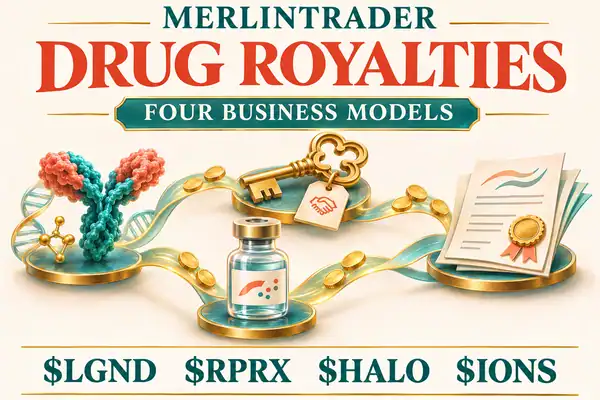
A medicine can generate revenue for its manufacturer, its discoverer, a technology licensor and an investor that bought part of the royalty stream. Those claims can coexist on the same product. They can also have different expiration dates, different exposure to costs and very different consequences when development disappoints. Calling all four businesses “royalty companies” hides the distinctions that matter most.
Ligand Pharmaceuticals ($LGND), Royalty Pharma ($RPRX), Halozyme Therapeutics ($HALO) and Ionis Pharmaceuticals ($IONS) illustrate four overlapping approaches. Ligand combines acquired economic rights, partner programs and technology-related revenue. Royalty Pharma allocates capital to purchased royalties and development funding. Halozyme earns substantial royalties from licensed drug-delivery technology, alongside product and collaboration revenue. Ionis discovers medicines, partners some programs, commercializes others and has sold portions of selected future royalties. Their financial statements describe different positions in the drug economy, rather than four interchangeable collections of passive income.
The practical question is what remains after the word “royalty”: which sales support the payment, who controls the medicine, how long the entitlement lasts, which obligations accompany it and how much cash reaches the shareholder’s company. The latest results provide several useful examples. They also show why a reported royalty line cannot automatically be treated as a cash yield.
Extended analysis
Continue with the extended analysis: $LGND $RPRX $HALO $IONS
The full comparison, company developments, financial context and upcoming milestones.
Free. No signup. You decide, we don’t recommend.
01 — Four business models, one important distinction
The first distinction is between creating a royalty and purchasing one. A developer can earn royalties by licensing intellectual property it helped create. A technology company can license a component that makes another company’s medicine easier to administer. A financial investor can pay an existing rights holder for a share of future proceeds. The resulting payments may all depend on pharmaceutical sales, but the capital invested and the work required to replace an aging stream are different.
Royalty Pharma’s principal activity sits toward the purchased-rights end of that spectrum. Its September-quarter filing describes interests in marketed therapies and development-stage candidates. The value of a new investment depends on the purchase price, the actual rights acquired and the subsequent sales trajectory. A medicine can succeed commercially while an expensive royalty purchase produces an unexceptional return. The product’s success and the purchaser’s investment return are related, but they are separate propositions. Royalty Pharma Q3 Form 10-Q.
Halozyme’s ENHANZE business begins with a licensed delivery technology. Its proprietary enzyme, rHuPH20, facilitates subcutaneous delivery of injected medicines and fluids. Partners combine the technology with their compounds. The royalty therefore reflects a role in the formulation and delivery chain, rather than ownership of every therapeutic molecule that uses it. Technology adoption, partner execution, contractual terms and intellectual property all matter. Halozyme also has product sales, other technologies and operating expenses; the company is broader than an isolated ENHANZE royalty contract. Halozyme Q3 Form 10-Q.
Ionis has a different starting point: drug discovery and development. A partnership can transform a program into upfront payments, development milestones, royalties and, in some arrangements, shared development or commercialization economics. Retaining a medicine can preserve more upside while leaving more spending and execution responsibility with Ionis. Selling a piece of an existing royalty stream adds a financing decision on top of those scientific and commercial choices. Ionis Q3 Form 10-Q.
Ligand spans several of these categories. Its reporting includes intangible royalty assets, financial royalty assets, Captisol sales and contract revenue and income. The appropriate comparison follows those economic components. A single label cannot explain their accounting or the capital needed to generate the next group of assets. Ligand Q3 Form 10-Q.
02 — A map of what each shareholder actually owns
| Company | Main route to royalty exposure | Additional economic responsibilities | A useful question |
|---|---|---|---|
| Ligand | Purchased rights, partner assets and technology-related arrangements | Origination, financing, portfolio management and other businesses | How much growth is organic, acquired or accounting-related? |
| Royalty Pharma | Acquisition of royalties and development funding | Purchase commitments, financing costs and portfolio replenishment | What return remains after acquisition price and funding costs? |
| Halozyme | Licensing delivery technology to pharmaceutical partners | Technology development, supply, partner support and other operations | How durable is the entitlement for each product and country? |
| Ionis | Discovery, partnerships and retained medicines | Research, clinical work, commercialization and selected financing arrangements | Which sales economics are retained, shared or already monetized? |
This map describes emphasis, not exclusive categories. Ligand and Royalty Pharma can both fund development. Halozyme can acquire technologies. Ionis can receive royalties while financing wholly owned launches. Their business models evolve as transactions close and programs mature. The relevant comparison therefore links each material stream to its specific agreement and present corporate context.
A shareholder owns a claim on the company after its obligations. That is different from directly owning a percentage of a drug’s worldwide revenue. Debt service, taxes, operating costs, acquisition spending and minority interests can stand between gross portfolio economics and cash available to the listed parent. Even when an individual royalty is operationally light, the corporate vehicle that holds it can have substantial financing and reinvestment needs.
There is also a distinction between the medicine and the entitlement. The same drug name can appear in the reports of a manufacturer, a developer and a royalty purchaser. Adding those companies’ product-linked revenue lines does not estimate the drug’s total sales. One line may be a percentage of another. Another may represent accounting income on an acquired financial asset. Keeping those claims separate avoids counting the same economic activity more than once.
The business question becomes clearer when expressed as a sequence: a patient receives treatment; the commercial partner records eligible net sales; a contract determines the royalty; reporting and payment occur; the recipient accounts for the amount and meets its own obligations. A disruption at any stage can change the outcome. More prescriptions do not necessarily translate into the same percentage growth at every company in the chain, particularly when rates, thresholds, territory coverage or product mix change.
03 — The latest quarter: numbers with different meanings
For the three months ended September 30, 2026, Ligand reported total royalties of $70.284 million. Its statement separates $47.427 million of revenue from intangible royalty assets and $22.857 million of income from financial royalty assets. The sum is exact within the reported thousand-dollar units: 47.427 plus 22.857 equals 70.284. It is not a statement that $70.284 million of new cash was received during the quarter. Ligand Q3 filing, statements of operations and royalty accounting notes.
Royalty Pharma reported $883 million of Royalty Receipts and $890 million of Portfolio Receipts for the same calendar quarter. Portfolio Receipts combine Royalty Receipts with milestones and other contractual receipts. The company also reported $686 million of net cash provided by operating activities. These are three distinct measures. The difference between them is part of the analysis, rather than an inconvenience to remove by choosing whichever figure looks strongest. Royalty Pharma November 4 results and definitions.
Halozyme’s quarter included $341.001 million of royalty revenue, within $492.974 million of total revenue. The other major lines were $137.328 million of net product sales and $14.645 million of revenue under collaborative agreements. Those figures sum to the reported total. Product revenue introduces a different cost structure from a royalty on a partner’s sales, while collaboration revenue can depend on contractual events and services. Halozyme Q3 filing, consolidated statements of income.
Ionis reported $80.592 million of royalty revenue within $242.721 million of total revenue. Its total included $48.296 million of net product sales, $7.317 million of other commercial revenue and $106.516 million of research and development revenue. The royalty line included $69.393 million from SPINRAZA. These are accounting revenue figures, and Ionis’s sale of a portion of future royalties creates an additional distinction between recognized revenue and retained cash. Ionis Q3 filing, revenue disaggregation and Note 10.
04 — Ligand: the accounting bridge matters
Ligand applies an effective-interest approach to financial royalty assets with reasonably estimable cash flows. It uses non-accrual accounting for certain development-stage or recently commercialized assets whose cash flows are not reasonably estimable. For assets under the effective-interest method, expected cash flows, the initial investment and subsequent changes in estimates influence recognized income. Cash receipts reduce the carrying value, while accrued income increases it for accrual-method assets. The non-accrual category does not accrue that interest income. An analyst reading only the royalty income line can therefore miss the repayment-of-investment component of cash collected. Conversely, treating every dollar collected as new profit would overstate the economic earnings of a purchased asset. Ligand Q3 filing, financial royalty assets accounting policy.
The intangible royalty category follows a different route. Royalty revenue and the amortization of acquired intangible assets appear in different parts of the statement. Comparing that revenue with financial-asset income without considering the related balance-sheet treatment can produce an uneven picture. The economic question is consistent across both categories: what was invested, what has been collected and what realistic future proceeds remain? The accounting presentation supplies evidence, but the headings alone do not answer it.
The acquisition of XOMA also changes the interpretation of growth. Ligand’s October 29 release attributed the quarter’s royalty growth to contributions from the acquired XOMA portfolio and continued momentum in key assets, including Filspari. A larger portfolio can generate more royalties because existing assets sold more, because newly acquired assets joined the consolidation or because both occurred. Acquired growth can create value, but its purchase price and financing are part of the assessment. Ligand Q3 results.
Concentration remains relevant even in an expanding portfolio. A collection of many rights can still depend heavily on a few medicines, commercial partners or therapeutic markets. Counting programs gives each a unit of one, even though their current contribution and probability of success can differ greatly. A diversified list is not necessarily a diversified cash flow. The more meaningful picture weights the established streams and separately considers the uncertain development pipeline.
Ligand’s model also includes Captisol. Material sales have production, inventory and cost-of-sales considerations that differ from receiving a percentage of partner revenue. Their inclusion makes the company an instructive example of why a total revenue multiple cannot, by itself, summarize royalty economics. A change in the mix can affect margins without implying deterioration in every asset. It can also increase reported sales while adding less incremental cash than an equally sized increase in a high-contribution royalty stream.
05 — Royalty Pharma: capital allocation is the operating engine
Royalty Pharma’s operating asset is a portfolio of contractual claims, but building that portfolio requires repeated capital allocation. Buying a royalty brings forward cash to a seller in exchange for future proceeds. The purchaser accepts uncertainty about the medicine, the market and the timing of those proceeds. Development funding introduces another dimension: payment can precede definitive clinical evidence or approval, and contracts can make subsequent funding contingent on milestones.
A marketed product removes some development uncertainty, while leaving commercial, competitive and duration risks. A development-stage asset can offer a different price and potential return, while exposing capital to clinical failure. Neither category is intrinsically superior. The relationship between price, risk and the precise rights acquired determines the economics. A famous medicine is not automatically an attractive investment at every acquisition price.
The Q3 filing is particularly useful because it explains why financial royalty income can move differently from cash receipts. Effective-interest accounting and changes in expected cash flows can create noncash income-statement effects. A changed forecast may affect recognized income before the corresponding future cash would have been received. That sensitivity does not make the accounting irrelevant; it makes the bridge between estimates, carrying values and actual collections essential. Royalty Pharma Q3 filing, financial royalty assets and management discussion.
The company’s November 4 guidance called for 2026 Portfolio Receipts of $3.50 billion to $3.55 billion, excluding contributions from transactions announced after the release. That is a company forecast for its defined receipt measure. It is not guidance for GAAP net income, a guarantee of cash available for distribution or a prediction that every underlying medicine will grow. Royalty Pharma Q3 results.
Portfolio expansion also competes with other uses of funds. Debt repayment, dividends, repurchases and new transactions all draw on capital that cannot be spent twice. A strong quarter of collections can support several options, but the choice between them affects the future portfolio. The more useful question is whether capital allocation improves the value of the residual claim over time, including the royalties that eventually decline or expire.
06 — Halozyme: a platform royalty is still product-specific
Halozyme can participate in the success of several pharmaceutical partners through ENHANZE, but its royalties are not a universal tax on subcutaneous medicines. They arise from particular licensed products under particular agreements. A partner’s decision to develop a formulation, its clinical and regulatory progress, its commercial launch and the contractual royalty term all affect the stream. The technology’s broad relevance does not remove those product-level dependencies.
The September-quarter filing identifies DARZALEX SC, VYVGART Hytrulo and Phesgo as important royalty drivers. It also describes contributions from additional launched partner products. This creates a useful distinction between diversification by brand and diversification by mechanism. Several medicines can use the same enabling technology. Their therapeutic markets may differ, while some intellectual-property or technology-substitution risks remain shared. Halozyme Q3 filing, royalty revenue discussion.
The filing explains that royalty terms generally operate on a product-by-product and country-by-country basis. The term begins with first commercial sale and depends on the agreement’s specified period and relevant valid patent claims. It also describes circumstances in which rates are reduced after expiration of specified patent protection. There is no single defensible expiration date that can be applied indiscriminately to the whole company. A medicine’s separate formulation patents and the licensor’s royalty-relevant rights are not automatically the same legal asset. Halozyme Q3 filing, collaboration agreements and revenue recognition.
A technology platform can also require continued investment. New formulations, manufacturing support, development work and additional delivery approaches can maintain relevance or open new opportunities. Those activities introduce expenses and execution risk. Acquisitions may add technologies and obligations whose economics differ from mature ENHANZE licenses. Treating the whole company as a static runoff portfolio would miss that strategic spending; treating every new technology as an established royalty would move too far in the opposite direction.
The practical interpretation is product-specific durability inside an evolving technology business. Growth from newly launched partner medicines can coexist with slower growth, reduced rates or mature competition elsewhere. The net result depends on the weighted mix, not merely the number of partner announcements.
07 — Ionis: royalties coexist with the cost of inventing and selling medicines
Ionis’s royalty revenue has an origin in discovery and development partnerships. It is one component of a company that also bears research expenses and commercialization costs. This distinction changes the meaning of a royalty dollar. A mature licensed product may contribute attractive revenue while the corporate income statement remains affected by spending on wholly owned medicines and an extensive development portfolio.
For Q3 2026, Ionis reported a $110.0 million net loss, alongside the royalty and other revenue described earlier. The company ended September with approximately $1.9 billion of cash, cash equivalents and short-term investments. These figures describe an operating developer with financial resources and substantial obligations, rather than a royalty-only vehicle. Neither the loss nor the liquidity balance can be interpreted in isolation from the development and commercialization strategy. Ionis Q3 filing.
Its latest release also reduced full-year TRYNGOLZA net product-sales guidance to approximately $50 million, from $100 million to $110 million, while retaining total-revenue guidance of $875 million to $900 million. Those company expectations were issued November 9. The difference illustrates how partnership revenue and other business components can support a total even when one owned launch progresses more slowly than previously anticipated. It does not imply that a reduction in owned-product expectations has no economic significance. Ionis November 9 results.
The mix of ownership and collaboration can change. Ionis disclosed that its opt-out from shared WAINUA responsibilities became effective August 1, 2026. AstraZeneca became responsible for all WAINUA costs under the agreement, while the treatment of remaining development services and reimbursements changed. The financial consequences depend on the actual agreement, rather than a generic assumption that all partnered programs impose the same cost share. Ionis Q3 filing, WAINUA collaboration.
A partnership can reduce future spending and change retained economics at the same time. A royalty sale can supply immediate financing while reducing future cash receipts. Retaining a program can preserve a larger share of sales while requiring a launch organization. These are alternative allocations of risk and capital. Their value depends on execution and terms, not on whether the transaction is described as a partnership, a financing or a wholly owned opportunity.
The same distinction applies when judging management’s allocation of resources. A profitable partnered medicine can fund losses in a new owned program. That use of cash may create value if the new medicine succeeds on attractive terms, or destroy value if development and launch spending exceed the eventual return. The established royalty remains an important asset in either case, but its existence does not settle the merits of the reinvestment. Shareholders own the combined allocation decision. Separating the mature stream from the spending it supports makes both the opportunity and the possible cost visible without assuming the answer in advance.
08 — A live example: Ionis and Royalty Pharma share the same chain
The arrangement between Ionis and Royalty Pharma makes the distinction between reported revenue and retained economics unusually concrete. In 2023, Ionis monetized part of its future SPINRAZA and pelacarsen royalties. It received $500 million upfront, with eligibility for additional milestones. The agreement did not transfer the whole Ionis company or the manufacture of SPINRAZA. It transferred defined economic rights within selected streams. Ionis Q3 filing, Note 10.
The filing states that Royalty Pharma receives 25% of Ionis’s SPINRAZA royalty payments from 2023 through 2027, increasing to 45% in 2028, on up to $1.5 billion of annual sales. Those percentages apply to Ionis’s royalty payments, subject to the agreement’s terms; they are not Royalty Pharma’s direct percentage of all worldwide SPINRAZA sales. Confusing the two bases would materially exaggerate the entitlement.
The arrangement also included a share of potential pelacarsen royalties. On September 4, 2026, Novartis announced that the Phase 3 Lp(a)HORIZON trial did not meet its primary endpoint. Ionis subsequently stated in its Q3 filing that it no longer expected FDA approval and set expected future pelacarsen royalty payments to zero in its estimate for this financing arrangement. That is the disclosed estimate following this trial result, rather than a claim that every future scientific question about the program has been resolved. Novartis September 4 announcement filed with the SEC; Ionis Note 10.
Royalty Pharma’s September 4 update said it did not anticipate milestone payments to Ionis and that its SPINRAZA interest would revert after payments reached $550 million. The company described that amount as 1.1 times the total funded. The arithmetic is 550 divided by 500, equal to 1.10. It is a gross multiple of the cited amounts across time, not a 10% annual return. Timing, financing, expenses and taxes are additional considerations. Royalty Pharma transaction update.
This example shows both the value and the limits of contractual protection. An existing commercial stream can provide recoveries when a development opportunity disappoints. That does not restore the lost upside, eliminate the time value of money or guarantee the same protection in another contract. The royalty purchaser and the developer experience the event through different rights and obligations.
09 — Duration: a growing payment can still be a wasting asset
A royalty can grow in the near term and still have a finite economic life. The medicine may lose exclusivity, encounter a better competitor or reach a contractual limit. A rate can step down before the product disappears. A capped agreement can end after a cumulative payment threshold. These mechanisms create different profiles: gradual decline, an abrupt reduction or an end date linked to collections rather than the calendar.
The relevant duration is the duration of the entitlement, not simply the remaining life of the brand. Halozyme’s product-and-country terms illustrate this distinction. A medicine can remain commercially successful after a contractual royalty reduction. Ionis’s SPINRAZA monetization provides another example: an entitlement can revert when a defined payment amount is reached. A strong sales trajectory can therefore accelerate the end of a capped purchased stream while improving the speed of capital recovery. Halozyme Q3 filing; Ionis Q3 filing, Note 10.
Replacement spending is the next implication. A company distributing all receipts from a declining portfolio could show substantial current cash generation while the future asset base shrinks. A company reinvesting heavily could show less current distributable cash while building future exposure. Neither observation establishes value creation by itself. The return on replacement investments, including unsuccessful purchases and development commitments, determines whether the portfolio is being renewed economically.
This is why a royalty stock’s apparent yield is not equivalent to a bond coupon. Equity has no fixed maturity payment, and corporate distributions can reflect choices about reinvestment and financing. The drug portfolio changes over time. A valuation that capitalizes the current quarter indefinitely assumes away precisely the expiration and replacement issues that make the business interesting.
Duration can also affect sensitivity to interest rates. A claim whose proceeds arrive far in the future has more value tied to those distant payments than one that returns capital quickly. The size of the sensitivity depends on the actual cash-flow schedule, the discount rate and the risks already embedded in it. It cannot be inferred simply from the company’s sector label or the presence of the word royalty.
10 — Control: owning income is different from directing a launch
A royalty owner can benefit from a partner’s commercial capabilities without building an equivalent sales organization. The corresponding limitation is influence. Contractual information rights, enforcement rights and development provisions can protect an entitlement, but they do not automatically confer authority over pricing, marketing budgets, trial design or the order in which indications are pursued. The precise agreement determines how much control exists.
That distinction affects each company differently. Royalty Pharma and the purchased-rights portions of Ligand rely on third parties to generate the underlying sales. Halozyme participates in partner development through technology relationships, while the therapeutic product still belongs within a partner’s strategy. Ionis can have a more direct operating role in retained medicines and defined collaboration activities. None of these positions creates complete control over reimbursement, competition or patient adoption.
The commercial partner’s incentives also matter. A medicine can compete internally for trial spending, manufacturing capacity or sales attention. A partner with a broad portfolio may make a rational corporate decision that is less favorable for one royalty stream. Contract provisions can influence the consequences, but the royalty recipient’s preference and the marketer’s optimal allocation are not necessarily identical.
There is a parallel issue when a product or company changes hands. A transaction may bring a stronger commercial owner, alter priorities or trigger contractual provisions. It does not automatically increase the royalty rate or extend the entitlement. The economic effect depends on what the buyer does with the product and on the agreement’s treatment of assignments, sublicenses and related transactions. Assuming every pharmaceutical acquisition is favorable to every associated royalty would ignore those details.
The appropriate analytical distinction is between commercial exposure and operating authority. A royalty may remove the need to carry some direct operating costs, while preserving exposure to the results of decisions made elsewhere. Diversifying partners can reduce dependence on one organization. It cannot eliminate the need to understand who ultimately determines the product’s development and market position.
11 — Revenue recognition: four bridges to cash
The first bridge is from underlying pharmaceutical sales to the royalty entitlement. Eligible net sales can differ from gross invoice sales because the agreement defines deductions, territory and covered products. A headline prescription trend does not reveal the entire calculation. Changes in price, reimbursement mix, discounts or the balance between countries can affect net sales even when treated-patient numbers grow.
The second bridge is from entitlement to reporting. Halozyme states that final partner royalty reports arrive after its prior-quarter financial statements are completed. It therefore recognizes estimated earned royalties using available information and records subsequent adjustments if necessary. Its filing says material adjustments had not been recorded to date. An estimate-based accounting process is different from having the final royalty statement and collected cash on the same day. Halozyme Q3 filing, revenue recognition.
The third bridge is from collections to accounting income on a purchased asset. Ligand and Royalty Pharma explain effective-interest methods for financial royalty assets. Some cash represents recovery of invested capital. Recognized income reflects the applicable method and estimates, with changes in expected cash flows potentially creating provisions or other adjustments. A cash-flow statement and the asset note therefore answer questions that a top-line royalty figure cannot answer alone. Ligand financial royalty assets policy; Royalty Pharma financial royalty assets discussion.
The fourth bridge is from recognized royalty revenue to cash retained after a sale of future royalties. Ionis records the specified royalty revenue while payments to Royalty Pharma reduce the financing liability. The company also recognizes interest expense under the arrangement’s accounting. Treating the royalty revenue line as entirely unencumbered cash would omit that separate obligation. Ionis Q3 filing, Note 10.
These bridges explain why a simple royalty-revenue league table would be misleading. The same dollar can occupy different places in the economic cycle: sales generated, rights earned, cash collected, investment recovered or income recognized. A valid comparison first identifies the place, then considers growth and profitability within the relevant framework.
12 — Financing: the rate on the debt is only one cost
Purchased royalties require capital before they produce the full expected proceeds. That capital can come from retained cash, debt, equity or a combination. A borrowing rate measures one explicit cost. It does not measure the uncertainty of the acquired drug, the possibility of a delayed launch, transaction expenses or the shareholder’s cost of capital. An investment can produce collections above its financing interest expense while still earning less than its risk would justify.
Debt maturity also matters. A long-lived royalty asset financed with an earlier-maturing obligation introduces a refinancing question. The company may expect collections, portfolio sales or new borrowing to meet the liability. The outcome depends on conditions when payment is due. A comfortable current interest-coverage ratio cannot guarantee the future availability or price of refinancing.
Ligand’s balance sheet illustrates why liquidity belongs beside royalty growth. At September 30, 2026, cash, cash equivalents and short-term investments totaled $447.395 million, excluding restricted cash. The company also had convertible-note obligations. Restricted balances are separately reported because they are not interchangeable with freely deployable funds. The cash figure is a dated balance-sheet measure, not a statement that the whole amount is available for new acquisitions after every future obligation. Ligand Q3 filing, balance sheet and debt notes.
A low or zero coupon does not remove the economic cost of a convertible. Settlement terms, potential dilution, cash principal requirements and the price paid for any related hedges affect shareholders. The appropriate analysis follows the actual instrument. It cannot substitute a general assumption that every convertible is either harmless funding or inevitable full-share dilution.
For Ionis, monetizing future royalties is another financing route. Immediate capital can support development or commercialization without a conventional equity issuance at that moment. The cost appears through future cash surrendered and the agreement’s accounting and contractual conditions. Comparing that choice with debt or equity requires a time-based view of expected payments and risks, rather than equating an upfront receipt with free capital.
13 — Clinical risk: a royalty does not change the biology
The royalty structure changes who funds and receives a medicine’s economics. It does not alter the underlying trial result. A development-stage royalty can become much more valuable after convincing data, or lose expected proceeds when a study fails. Contractual milestone conditions can limit additional funding after failure. Existing commercial rights can provide some recovery. Those protections are valuable where they exist, but they are properties of the agreement rather than of royalties as a whole.
Pelacarsen provides a current example without requiring a hypothetical clinical forecast. The primary endpoint miss was disclosed by the sponsor. Ionis changed its expected royalty-payment estimate, and Royalty Pharma described the consequences for milestone expectations and SPINRAZA reversion. The same event affected development upside, contractual payments and accounting estimates through different channels. Novartis SEC announcement; Royalty Pharma September 4 update; Ionis Q3 Note 10.
A portfolio can absorb one failure more readily than a company dependent on a single candidate, but the amount of protection depends on the distribution of value. Many small early programs do not necessarily offset the loss of one large expected stream. Similarly, several programs sharing a target, mechanism or commercial partner can carry correlated risks. Program count is an incomplete measure of resilience.
Approved medicines retain clinical and regulatory exposure as well. Safety findings, label changes, manufacturing issues or a competitor’s superior evidence can alter sales after launch. A royalty agreement may continue to exist while the economic base supporting it shrinks. The distinction between contractual enforceability and commercial value is essential: an enforceable claim on little revenue can still have limited value.
This leads to a balanced interpretation of diversification. Diversification can spread exposure across independent sources of revenue, while contractual design can limit selected downside pathways. Neither replaces scientific assessment. The most informative view connects each major royalty to the evidence supporting the medicine and the specific protection, if any, built into the investment agreement.
14 — Commercial growth: price, volume and mix reach the owner differently
A drug’s market can expand through more patients, longer treatment duration, new indications or additional countries. It can also change through net pricing. The royalty recipient participates according to the contract’s sales base and rate structure. A larger worldwide market opportunity does not automatically belong in the valuation if the purchased rights exclude relevant territories, formulations or indications.
The rate structure can make growth nonlinear. A tiered royalty may change the incremental percentage above a sales threshold. A cap may end an entitlement sooner when sales are strong. A rate reduction after a specified event may offset part of the underlying product’s growth. These are general contractual possibilities, not assumptions that every agreement in the four portfolios contains each feature.
Competition can work through more than unit market share. A rival may pressure price, change the preferred treatment sequence or reduce treatment duration. A new formulation can preserve a product’s position but move sales between versions with different rights. The medicine’s brand-level trajectory therefore needs to be connected with the exact commercial activity covered by the royalty.
Technology royalties introduce an additional adoption question. A subcutaneous presentation can offer convenience or change administration logistics, but uptake depends on evidence, label, clinical practice, reimbursement and partner execution. The availability of a technology does not mean all eligible patients immediately switch. Halozyme’s partner-by-partner launches illustrate why commercial timing remains important even after the platform’s technical role has been demonstrated.
Ionis’s owned-product guidance change provides the complementary perspective. A developer that retains commercialization carries more direct exposure to the pace of adoption and the cost of building demand. A royalty recipient generally participates in a smaller contractual share while avoiding some direct launch spending. The relative attractiveness depends on the sales outcome and the expenses avoided or retained. There is no universal rule that a smaller royalty is safer at every price or that owning the whole product is more valuable under every scenario.
15 — Valuation: the missing purchase price changes the answer
The four companies cannot be ranked by the absolute amount of royalties reported. Size is not valuation. A large established portfolio may be priced for durability and continued successful reinvestment. A smaller company may carry greater concentration or development exposure. Without a current price, share count, debt position and a consistent cash-flow framework, declaring one stock cheaper would be an unsupported conclusion. A valuation conclusion requires those additional inputs and assumptions.
The analytical framework begins with the rights. Each major stream has an expected commercial path, contractual rate, territory, duration and payment timing. Those assumptions generate expected cash flows, which remain uncertain. Corporate costs, taxes, financing and minority claims then connect the portfolio to the listed equity. New investments and research spending affect both near-term cash and future opportunity.
For a purchased stream, the acquisition price is central. A successful medicine can produce a poor return if the buyer overpays. For a technology licensor, the cost of sustaining the platform and winning future adoption matters. For a developer, research and retained commercial spending cannot simply be removed to make its royalties resemble a financial portfolio. A comparison that excludes each company’s defining cost would describe an asset that shareholders do not actually own.
Accounting adjustments also need economic interpretation. Noncash amortization is different from current cash spending, but acquired rights still consumed capital and can decline in value. Share-based compensation does not use current cash in the same way as payroll, but it changes ownership economics. A development milestone can be nonrecurring while still representing an important contractual return. The useful distinction is between the accounting entry, the cash movement and the economic cost, with none substituted automatically for another.
This framework also explains the limits of a single multiple. Price-to-sales compares figures with different composition. Price-to-earnings can be affected by amortization, provisions and investment revaluations. A cash-flow multiple depends on whether acquisition spending and future replacement needs are considered. Multiple perspectives can inform valuation, but only after their definitions and assumptions are made consistent.
16 — Three scenarios that reveal the differences
A partner medicine sells better than expected. Royalty Pharma or Ligand may receive stronger contractual proceeds from an acquired right. The return still depends on the original price and any cap or step-down. Halozyme may benefit if the growth belongs to a formulation covered by its license. Ionis may receive higher partner royalties, but any sold portion still flows according to the monetization agreement. Improved underlying sales do not produce identical incremental cash at all four companies.
A late-stage program fails. A royalty purchaser may lose development upside, while contingent future funding can stop if the agreement permits. A technology licensor may lose a prospective partner launch without losing every existing license. A developer may lose anticipated royalties and face a decision about ongoing research or retained commercial investment. Contractual recoveries and the rest of the portfolio determine how concentrated the damage is. The Ionis–Royalty Pharma example demonstrates one specific arrangement; its outcome cannot be generalized to unrelated investments.
Financing becomes more expensive. Existing fixed-rate obligations may initially behave differently from new borrowing needs. Purchased-rights investors can face a higher hurdle for acquisitions and a different refinancing environment. A developer may place greater value on partnership funding or retained liquidity. A technology company considering an acquisition may encounter a different trade-off between growth and balance-sheet flexibility. The sensitivity depends on actual maturities, cash generation and investment plans.
These are analytical scenarios, not forecasts. Their purpose is to identify which economic link changes first. Sales growth enters through the commercial base; clinical failure enters through development probability and future rights; financing conditions enter through capital availability and cost. A company can experience several at once. Strong commercial collections may coexist with an unsuccessful development asset or a costly acquisition.
The scenarios also explain why quarterly headline growth can give an incomplete impression. A portfolio may grow because it acquired assets while same-asset collections slow. A developer’s revenue can rise because of a milestone while its owned launch misses expectations. A technology company can report strong royalties while investing in an unproven new delivery platform. The underlying event, its cash consequences and the company’s response are more informative than a single percentage.
17 — What the next update can actually resolve
For Ligand, the next financial update can help separate the continuing contribution of acquired assets from the performance of established streams. The useful evidence includes the revenue disaggregation, the financial-asset reconciliation, changes in expected cash flows and the cost of the enlarged organization. An additional acquisition announcement answers a different question from cash collected on assets already owned.
For Royalty Pharma, collections and portfolio developments can show how commercial growth, milestones and new capital deployment interact. The relevant comparison keeps Royalty Receipts, Portfolio Receipts, operating cash flow and acquisition spending distinct. A raised receipt forecast would be evidence about the company’s defined measure. It would not automatically establish an equivalent increase in intrinsic equity value or future distributions.
For Halozyme, partner-product launches and sales provide evidence about the expansion of the royalty base. Product-specific contractual developments, delivery-technology progress and intellectual-property disclosures address durability and future opportunity. A new collaboration can create development exposure before it produces commercial royalties. A mature product’s quarterly performance can matter more to current earnings than several newly signed early programs.
For Ionis, the distinction between owned product sales, partner royalties and collaboration revenue remains central. The pace of commercialization, research spending, partnership changes and payments under monetization arrangements affect retained cash. The November guidance for an owned medicine and the WAINUA responsibility change make those distinctions particularly relevant. A total revenue figure alone cannot resolve whether a stronger quarter reflects recurring commercial demand or contractual research events.
Across all four, an announced transaction has several stages: agreement, closing, funding and eventual product-linked collections. An early agreement does not necessarily mean all capital has been spent or the acquired rights have begun producing cash. Similarly, a clinical milestone is different from approval, and approval is different from commercial uptake. Following the actual transition avoids treating every favorable announcement as an immediately recurring earnings stream.
18 — A cash-flow example from the current filings
Royalty Pharma’s cash-flow statement for the nine months ended September 30, 2026 reports approximately $2.133 billion of net cash provided by operating activities. Its investing section separately reports approximately $982.4 million of acquisitions of financial royalty assets and $63.2 million of milestone payments. Those are year-to-date figures, distinct from the single-quarter receipt and operating-cash figures cited earlier. Their placement shows why operating cash generation cannot be interpreted as cash remaining after every portfolio investment. Royalty Pharma Q3 filing, consolidated cash-flow statement.
There is no need to redefine the reported operating measure to understand the economics. The statement describes how the cash is classified. The investment analysis then considers what portion of collections must be reinvested to sustain or expand the portfolio. Acquisition spending can be discretionary in a particular quarter while remaining important to the long-term strategy. Calling all of it maintenance spending would be too strong; ignoring it indefinitely would be equally incomplete.
Ionis’s year-to-date cash-flow reconciliation provides a different lesson. It includes adjustments for noncash royalty revenue related to the sale of royalties and noncash interest related to the sale of future royalties. The presence of those adjustments is consistent with the financing arrangement described in Note 10. The income statement and the cash-flow statement are showing different views of the same contractual structure, rather than contradicting each other. Ionis Q3 filing, cash-flow statement and Note 10.
A useful way to interpret the two examples is to separate acquisition from retention. Royalty Pharma allocates cash to acquire rights that can produce later collections. Ionis has received earlier financing and now directs part of selected collections to the financing counterparty. One company is building an asset; the other is meeting an obligation associated with monetized income. Comparing the accounting royalty line without those cash movements would lose the economic relationship.
The distinction also prevents accidental double counting in a financial model. A model that includes all expected product-linked revenue and then adds the royalty financing proceeds as though they were recurring operating income would count different stages of the same value chain as separate permanent earnings sources. Similarly, counting both the full cash receipt and the financial-asset income as incremental profit would combine capital recovery with earnings. The reconciliations make those errors visible.
19 — Currency, payment timing and the liquidity of the claim
A worldwide pharmaceutical market can generate local-currency sales while the listed royalty owner reports in dollars. Exchange rates can change reported growth even when local demand is stable. Contracts determine the currency of the calculation and payment, and companies can have hedging arrangements or different geographical mixes. A reported growth rate therefore needs its stated currency basis before it is interpreted as a pure measure of patient demand.
Payment timing creates a separate effect. A royalty earned on a partner’s sales may be collected after the sales period. Milestones may depend on specified clinical, regulatory or commercial events. A delay can move a payment between quarters without proportionally changing the lifetime economics. Conversely, a payment received on schedule does not prove that the product’s future sales trajectory remains intact. Timing and the ultimate amount are different sources of uncertainty.
The claim’s liquidity is another consideration. A listed shareholder can generally trade shares in an available market, but an individual royalty interest is a negotiated contractual asset. Selling that asset may require agreement on its value, contractual permissions and a suitable counterparty. The company’s ability to dispose of an asset on attractive terms is therefore different from the stock’s daily trading volume. A balance sheet containing valuable royalties is not equivalent to holding the same amount of unrestricted cash.
These distinctions matter most when obligations and opportunities arrive together. A company can have attractive long-term proceeds while facing near-term acquisition commitments, research spending or debt maturities. Cash timing determines which choices remain available without additional financing. A royalty that pays slowly can be economically valuable and still fail to solve an immediate liquidity need.
For the four companies, the practical connection is the same: duration explains when value is expected to arrive; contractual rights explain who receives it; accounting explains how it is reported; liquidity explains what can be spent now. Those dimensions complement the scientific and commercial story. They do not provide a substitute for it, because the future proceeds still depend on medicines that patients, clinicians and payers choose to use.
20 — Questions that keep the comparison useful
Are royalty companies insulated from biotechnology risk?
They can have different exposure from an operating drug developer, especially when a diversified portfolio emphasizes marketed products. They remain exposed to underlying medicines, counterparties, contract terms and financing. Development-stage funding carries clinical risk directly through the potential future stream. An agreement changes the allocation of risk; it does not make the medicine’s outcome irrelevant.
Why is Ionis included if it is not a royalty-only company?
Ionis shows where royalties originate and how they can be retained, shared or sold. Its relationship with Royalty Pharma connects two sides of an actual transaction. Its owned medicines and research expenses also show why a royalty revenue line cannot be valued independently of the corporation’s broader commitments. The difference is central to the comparison, rather than a reason to ignore it.
Is a larger royalty revenue figure evidence of a better investment?
It establishes scale within the stated accounting definition and period. It does not establish the acquisition price of the underlying rights, their remaining life, leverage or the market price of the equity. The four companies report different mixes of earned royalties, financial-asset income, receipts and other revenue. Ranking their headline figures would combine unlike measures before addressing valuation.
Does a contractual cap protect the purchaser completely?
A cap normally limits total participation; additional contractual provisions may provide recoveries or other protections. The specific agreement determines the result. Even an amount above the original investment can provide a modest return if received over a long period or financed at meaningful cost. A multiple such as 1.1 times principal is not an annualized return, and recovery of invested capital is not the same as restoration of the original upside case.
Can royalties continue after a patent expires?
That depends on the agreement, the covered rights and the jurisdiction. Contracts can include specified minimum terms, rate reductions, continuing rights or other provisions. Halozyme’s filing describes product-and-country mechanisms rather than one uniform companywide date. A generic patent-expiration calendar cannot substitute for the actual royalty terms. The continued sale of a medicine and the continued payment of a particular royalty are separate facts.
What makes the four companies worth comparing together?
They expose the full chain from invention and enabling technology to financing and purchased income. Ligand illustrates a mixed portfolio and accounting categories. Royalty Pharma illustrates repeated capital allocation into contractual proceeds. Halozyme illustrates product-specific participation through a delivery platform. Ionis illustrates the choices of a developer that can partner, retain or monetize its economics. Their differences make the comparison useful because they reveal what the shareholder is actually funding.
Further research and calendars
Continue with the Ligand company hub, the Ionis company hub and the company research map. The Biotech Research Library and biotech catalyst calendar provide related research and dated events. JC Just Charts provides chart tools.
Disclaimer
This article is for educational and informational purposes. It is not investment advice, an investment recommendation or an offer to buy or sell securities. Drug development, commercial adoption, counterparties, contractual interpretation and financing can affect the companies discussed. Company guidance and plans may change. Financial figures refer to the stated periods and definitions; analytical scenarios are not forecasts. Investments can lose part or all of their value. Merlintrader may hold positions in securities discussed, and some site links may be affiliate links. See the full disclaimer and terms and conditions.