Merlintrader Trading Pub
Biotech catalyst, news and analysis PDUFA tracker
Merlintrader Trading Pub
Biotech catalyst, news and analysis PDUFA tracker
AI transparency: articles and reports are produced with the help of artificial intelligence and checked through a process that does not constitute specialist validation. They may contain errors: verify relevant information with independent sources. Read the full disclaimer.
Stock Hub 2026 · Company research
Nasdaq: $AVTX
Premiumreportfree with an ad
AVTX Stock Hub: Avalo Therapeutics News, LOTUS and Abdakibart Phase 3
From positive Phase 2 to registration: abdakibart met the LOTUS primary endpoint in HS; Phase 3 and the AVTX-010 IND are planned for the first half of 2027.
Get every Merlintrader report in real time on Telegram: join @merlintraderpub_com.
Daily chart
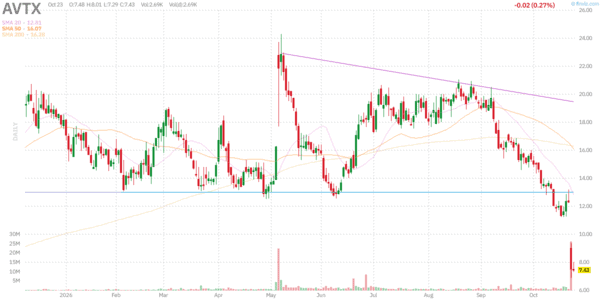
Daily chart $AVTX · October 23, 2026; may include extended-hours dataOpen chart (affiliate link) · For information only.
Next catalyst
Company development targets · First half of 2027
Abdakibart Phase 3 initiation and AVTX-010 IND
Avalo plans to initiate a registrational HS program and submit an IND for the next-generation antibody in the first half of 2027. These are company targets for development steps, with efficacy, safety and regulatory outcomes still uncertain. Source · Related announcement
Key data
Latest clinical presentationOctober 1, 2026 — LOTUS efficacy and safety detail Source
Dates of the figuresFinancial statements as of June 30, 2026. Source
The constructive case
LOTUS provides positive randomized evidence at a demanding HS endpoint. The May financing created substantial resources for registration work and a second IL-1β candidate, reducing immediate funding pressure while the lead program advances. AbbVie’s positive Phase 3 with lutikizumab, a different IL-1α/β antibody, adds late-stage evidence that IL-1 pathway blockade can improve HS outcomes.
The case against
Phase 3 must reproduce benefit and expand safety exposure. The composition patent expired, additional applications are pending, licensed economics carry obligations, and the HS market is becoming more crowded: on October 22, 2026, AbbVie reported positive Phase 3 data for lutikizumab, ahead of any Avalo Phase 3 start.
Operating and financial position
At June 30 Avalo held $472.2 million of cash, equivalents and investments following approximately $404.9 million net proceeds from the May offering. First-half operating cash use was $37.7 million. Management projected funding into 2029; Phase 3 and AVTX-010 can increase spending, and license milestones remain. Source
Executive summary
Avalo is a focused clinical-stage IL-1β developer. Abdakibart delivered positive LOTUS HiSCR75 results, with additional EADV safety and secondary-outcome detail. The opportunity is a funded transition toward registration; the unresolved questions concern replication, durability, intellectual property, licensed obligations and eventual commercial positioning.
Latest news
October 22, 2026 — AbbVie’s Phase 3 IL-1 data in HS weigh on AVTX
AbbVie reported that lutikizumab, an anti-IL-1α/β antibody, met the HiSCR75 primary endpoint in the Phase 3 INTREPID trial, which randomized about 1,400 patients with HS: 31.4% versus 23.4% for placebo at week 16. AVTX shares closed at $7.45 that session, down about 39% from the previous close of $12.26. As of October 23, 2026, Avalo had not issued a press release or Form 8-K on the data. The read-across concerns a different molecule with a different target profile; abdakibart’s own Phase 3 will measure its effect size. Source · Historical market data · Avalo releases · Avalo filings
October 1, 2026 — LOTUS efficacy and safety detail
The official congress presentation details the positive HiSCR75 comparison, secondary outcomes and safety through the observed interval. Registration still requires further development. Source
September 29, 2026 — Employee grants support the expanding organization
Avalo announced 101,600 options granted to three new employees on September 25. The awards vest over time and form part of the equity structure. Source
August 6, 2026 — Resources and the path to Phase 3
Cash and investments totaled $472.2 million at June 30. Management guided to Phase 3 initiation and an AVTX-010 IND in the first half of 2027, with expected funding into 2029. Source
Extended analysis
Does $AVTX deserve a place in your portfolio?
The full deep dive has the answer’s building blocks: cash, dilution, catalysts and risks, every figure sourced.
Free. No signup. You decide, we don’t recommend.
Using an ad blocker? The free “watch an ad” option is hidden automatically. Pause it on merlintrader.com and reload the page to see the free option.
01 What Avalo Therapeutics does: the IL-1β focus behind AVTX stock
Avalo Therapeutics is a clinical-stage biotechnology company developing medicines for inflammatory diseases. Its current investment case centers on IL-1β, an inflammatory signaling protein, and particularly on abdakibart, also known as AVTX-009. The lead indication is moderate-to-severe hidradenitis suppurativa, or HS. Avalo’s principal office is in Wayne, Pennsylvania, and its common shares trade on the Nasdaq Capital Market as AVTX. Its candidates remain investigational, with clinical development and regulatory review still ahead of any potential commercial launch. Quarterly filing
The company has moved beyond the stage of waiting for its first randomized LOTUS readout. Positive Phase 2 topline results were announced in May 2026. By the August corporate update, management’s stated objective was to initiate a registrational Phase 3 program in the first half of 2027. This changes the central question for shareholders. The issue is now how a positive proof-of-concept result translates into a larger, longer and more demanding registration program. Development update
AVTX-010 adds a second branch to the strategy. It is a next-generation anti-IL-1β antibody designed for a longer duration of action, with an investigational new drug application planned for the first half of 2027. That program remains at an earlier stage than abdakibart. Its proposed dosing convenience and potential use in additional inflammatory disorders are development objectives. Human clinical evidence will be needed to assess whether those objectives are achieved. Program announcement
This is therefore a focused platform thesis with different levels of maturity inside it. Abdakibart supplies the randomized human efficacy evidence. AVTX-010 provides an earlier opportunity to extend the franchise. A shared inflammatory target can create scientific and operational overlap, but it also means the programs are not fully independent diversification. Negative findings about target biology, class safety or the relevant patient population could affect how investors assess more than one asset.
Financially, the May financing gave Avalo substantially more resources for the next development interval. The June balance sheet reflected the proceeds and reported a large portfolio of cash and investments. This reduces immediate financing pressure compared with a company approaching a readout with limited cash. It does not remove the need to control spending, meet trial milestones and protect the economics of a potential product through intellectual property and commercial execution.
The useful framework for AVTX combines four elements: the quality and reproducibility of the LOTUS result, the design and timing of Phase 3, the available development capital, and the eventual competitive position in HS. Each answers a different question. Strong funding can support a trial without guaranteeing success; a positive Phase 2 can justify further work while leaving registration risk substantial. The shareholder outcome depends on how those elements develop together.
02 Hidradenitis suppurativa and the therapeutic opportunity
HS is a chronic inflammatory skin disease associated with painful lesions, abscesses and draining tunnels. For a developer, the therapeutic challenge extends beyond reducing one lesion count at a single visit. Patients and clinicians also care about pain, disease activity, persistent drainage, recurrence and the practical burden of treatment. A study can demonstrate improvement on a prespecified endpoint while leaving important questions about durability and broader patient benefit for subsequent development. Clinical study materials
The existence of established biologic treatments makes HS a credible commercial market and a competitive one. A new medicine must earn a role through efficacy, safety, dosing, access and the patient populations for which it is supported. A large disease burden alone is not a sales forecast. The addressable commercial population depends on diagnosis, severity, previous treatment, prescribing behavior, payer decisions and the eventual approved label.
IL-1β is one proposed intervention point within the inflammatory biology of HS. Abdakibart is an antibody directed against that target. Target plausibility gives a reason to conduct controlled trials, while the trials determine whether changing the pathway produces useful clinical outcomes in the population studied. The most relevant evidence for Avalo is the randomized comparison of abdakibart with placebo in LOTUS, rather than a general assumption that all anti-inflammatory approaches will behave similarly.
Endpoints require careful interpretation. HiSCR measures improvement in inflammatory lesion burden with conditions concerning abscesses and draining fistulas. HiSCR75 applies a more demanding response threshold than HiSCR50. That distinction can be clinically interesting, but comparisons across studies require more than lining up headline percentages. Baseline severity, prior biologic exposure, background treatment, analysis rules and the handling of missing observations can all change the apparent result. LOTUS presentation
For the business case, the product’s eventual positioning could depend on whether a reproducible response combines with acceptable tolerability and convenient use. Monthly administration is a potential practical feature of the abdakibart program. Its commercial value depends on what physicians, patients and payers obtain in return, and on how the final regimen compares with available alternatives. Convenience alone cannot compensate for inadequate efficacy or an unfavorable risk profile.
A balanced HS opportunity therefore has two sides. Persistent disease burden can support demand for additional treatment options. Existing alternatives raise the standard that a new entrant must meet. Avalo’s next development steps need to demonstrate a robust clinical profile and clarify the population most likely to benefit. Commercial assumptions become more grounded as registration-quality evidence, labeling and access conditions emerge; before then, precise sales forecasts embed substantial uncertainty.
03 LOTUS results: what the randomized Phase 2 actually showed
LOTUS randomized 253 adults with moderate-to-severe HS in a double-blind, placebo-controlled Phase 2 study. Its primary endpoint was HiSCR75 at week 16. Avalo announced positive topline results on May 5, 2026. The official registry lists the trial as completed, with actual primary completion in February and study completion in March 2026. These dates concern the conduct of the trial; the May announcement was the public results event. Topline announcement · Trial record
The reported week-16 HiSCR75 response rates were 42.2% for the 150 mg group and 42.9% for the 300 mg group, compared with 25.6% for placebo. The reported p values were 0.018 and 0.015, respectively. The combined active groups had a reported response rate of 42.5% with p=0.004. The primary endpoint was met. Those percentages are response rates, while the comparison with placebo describes a smaller percentage-point difference. Results and definitions · Placebo-adjusted differences (16.7 and 17.2 points)
The subsequent official presentation reported stratified Mantel-Haenszel differences of 16.7 and 17.2 percentage points for the two dose groups. These are analysis estimates rather than a simple subtraction of rounded headline rates. The distinction matters when judging the size of the observed effect. A response rate around 42% is clinically and statistically different from an improvement of 42 percentage points over placebo. The placebo-adjusted gap, not the raw response rate, measures the size of the comparison. Efficacy presentation
The randomized design is a strength because the active treatment and placebo groups were studied within the same trial framework. It reduces many of the differences that undermine historical comparisons. It still leaves sampling uncertainty and the possibility that the observed magnitude changes in a larger study. A positive result supports the next development step; Phase 3 must test whether the benefit is reproducible under its own prespecified design and analysis.
The population and observation rules are part of that interpretation. Eligibility criteria define which patients the result directly describes, while missing-data handling and treatment discontinuation rules influence the estimated response. A future program may reproduce the original eligibility or broaden it to address a larger intended label. Broader enrollment could improve commercial relevance while changing the mix of prior therapy, severity and treatment resistance. The resulting effect estimate might differ even when the underlying medicine is unchanged. For an investor, the useful comparison will therefore include the complete trial population and statistical framework alongside the headline percentage. This is also why a registration strategy can become more informative before its first new efficacy result is available.
Dose interpretation also needs restraint. Similar week-16 primary response rates at the two tested doses do not by themselves settle the optimal registration regimen. Additional efficacy measures, exposure, safety, durability and operational considerations can influence that choice. Regulators will evaluate the complete evidence package. The investment relevance lies in whether Avalo can use Phase 2 to select a coherent program that balances the chance of success with development time and cost.
The result has already changed the company’s resources and agenda: a large offering followed the readout, and planning shifted toward registration. The residual risk is consequently more specific than before LOTUS. Investors now have positive controlled evidence in HS, but still face uncertainties about long-term use, larger patient exposure, manufacturing readiness, regulatory requirements and eventual differentiation. The Phase 2 outcome narrows some questions while bringing others into focus.
04 EADV data: secondary outcomes, safety and durability
Avalo’s September announcement scheduled LOTUS material for the 2026 EADV congress, and the official poster and oral presentation are now available. The poster was scheduled for September 30 and the oral presentation for October 1. The additional material helps interpret the topline result by providing secondary efficacy measures, analysis populations and safety detail. Congress announcement · Poster · Oral presentation
The poster reported week-16 HiSCR50 rates of 40.7% for placebo, 59.0% for 150 mg and 64.3% for 300 mg. The corresponding active-versus-placebo p values were nominally 0.013 and 0.001. The word nominal matters: secondary analyses can support consistency across measures, but their statistical interpretation depends on the study’s multiplicity plan. A set of favorable secondary comparisons should be evaluated alongside the primary endpoint rather than treated as a collection of independent confirmatory trials.
The broader outcomes included measures of HS severity and draining tunnels. These can be useful because patients experience the disease through more than one clinical count. Consistency across endpoints increases confidence that the primary response reflects meaningful biological activity. However, selecting only favorable measures can create an incomplete impression of the program. The full presentation, its analysis methods and its follow-up period provide the context needed to understand how much the findings establish about sustained benefit.
Safety exposure remains an important limitation of Phase 2. The official presentation reported treatment-emergent adverse events in 53.5% of placebo recipients, 51.8% of the 150 mg group and 55.4% of the 300 mg group. Serious events occurred in 2.3%, 2.4% and 1.2%, respectively, and no deaths were reported. These figures describe the observed trial interval; they do not mean there were no serious adverse events or that uncommon risks have been excluded. Safety table
The efficacy and safety denominators are not identical in every group. The efficacy population included 84 people assigned to 300 mg, while the safety population included 83 because one randomized participant did not receive treatment. The difference is small but illustrates why percentages need the correct population. Longer studies and larger cumulative exposure can reveal adverse events that a modest short-duration trial cannot characterize reliably.
Durability is the next major interpretive step. An inflammatory condition may require ongoing treatment, so maintaining benefit, managing interruptions and understanding longer-term tolerability have practical and commercial consequences. The presentation described safety follow-up through week 20. Registration development can expand the duration and breadth of evidence, but that expansion requires time, patients and spending. The attractive aspect of the Phase 2 profile is its controlled signal; the remaining task is to test how well it holds under a more demanding development program.
05 AVTX stock catalysts: Phase 3 and the AVTX-010 IND
Avalo’s August update guided to starting a registrational Phase 3 program for abdakibart in HS in the first half of 2027. That is a company target for initiation, not a Phase 3 result date or an approval deadline. The interval before initiation can include regulatory discussions, design selection, trial operations and preparation of clinical supply. Each activity can affect the eventual program’s cost, duration and ability to answer the registration question. Corporate update
The word registrational signals the intended role of the program, while its success still depends on the agreed evidence requirements and actual results. Details such as study population, primary endpoint, treatment duration, geographic footprint and handling of prior therapy can materially affect interpretation. A program designed to replicate the strongest Phase 2 signal may differ from one intended to support a broader commercial label. The tradeoff between development efficiency and market breadth will matter as more details are announced.
AVTX-010 has a separate first-half 2027 target: submission of an investigational new drug application. An IND is a step toward human testing, subject to the regulatory process. It is not marketing authorization and does not provide a clinical efficacy result. The program’s rationale is a longer-acting anti-IL-1β antibody with potential in HS and other inflammatory conditions. Preclinical and early development work must support the transition before later clinical claims can be evaluated. AVTX-010 announcement
Running the programs together can create strategic benefits and resource demands. Experience with the target and disease area may inform development operations. Yet a second candidate also consumes scientific, manufacturing and regulatory capacity. A longer-acting molecule could offer a differentiated profile, but the desired properties must appear in human pharmacology and clinical outcomes. Until then, its value remains development optionality rather than a substitute for successful execution of the lead program.
Financial reporting provides another catalyst category. Avalo’s cash-and-investment balance, spending trajectory and contractual payments will show how the company is using the funds raised after LOTUS. A balance sheet can remain strong while the expected duration of funding changes as a larger program begins. The relevant comparison is actual expenditure against a development plan, with attention to changes in scope rather than a mechanical assumption that historical burn will continue unchanged.
The catalyst map therefore extends beyond a single binary event. Before the next efficacy result, the quality of trial design, timing of initiation, clarity of IP strategy and progress of AVTX-010 can change the assessment. Some updates may reduce operational uncertainty without changing clinical probability; others may alter cost or commercial expectations. Keeping those effects separate makes the program easier to assess as the company moves from Phase 2 evidence toward registration work.
06 AVTX earnings, cash and investments after the May financing
At June 30, 2026, Avalo reported cash and cash equivalents of $85.382 million, short-term investments of $314.894 million and long-term investments of $71.878 million. Together they totaled $472.154 million, conventionally rounded to $472.2 million. Restricted cash of $0.232 million was separate. The combined figure describes liquidity and investments, not cash alone. The distinction helps explain both the company’s financial resources and how those resources are held. Quarterly balance sheet
The large balance followed the May offering. The initial pricing announcement described a $375 million base transaction. After full exercise of the underwriters’ option, gross proceeds were approximately $431.3 million; the quarterly filing reported approximately $404.9 million net. Gross size, net proceeds and the base offering amount are different transaction measures. The net proceeds are the more relevant addition to resources available for development after transaction costs. Offering announcement · Closing update · Quarterly filing
Second-quarter research and development expense was $23.418 million, general and administrative expense was $8.099 million, and total operating expense was $31.517 million. Net loss was $36.358 million. The expense figures included a $10 million license milestone accrual. This is one reason net loss, operating expense and cash spent can diverge. A milestone can be recognized before its eventual cash payment, and noncash valuation changes can affect the earnings line. Quarterly results
For the first half, cash used in operating activities was $37.679 million. A simple historical average is approximately $6.28 million per month. That average describes the six months already reported. Phase 3 and AVTX-010 development can increase expenditure, so extrapolating the historical rate across the full cash-and-investment balance would produce an unrealistically precise runway estimate. Management’s stated expectation was that available resources would fund operations into 2029, subject to the plan and its assumptions. Cash flow and guidance · Corporate update
The balance sheet also contained liabilities with different economic meanings. Total liabilities were $42.123 million, including a $2 million royalty obligation and an $18.530 million derivative liability. A derivative accounting balance is different from a conventional bank loan. At the same time, contractual milestones and royalties can create future cash obligations even where they are not represented as current bank debt. The economic assessment needs the terms and timing of those obligations.
The financing gives Avalo room to pursue a meaningful development program without the same immediate pressure faced by a company with only a few quarters of cash. The benefit is substantial, but its value depends on what the company accomplishes with the capital. Trial execution, scope changes, licensing payments and additional programs determine the future spending path. A well-funded balance sheet improves flexibility; clinical and commercial outcomes still determine whether that flexibility creates durable per-share value.
07 Intellectual property and license obligations
Avalo’s annual filing identifies a material intellectual-property constraint: the United States composition-of-matter patent covering abdakibart expired in February 2026. The company intends to rely primarily on potential biologic regulatory exclusivity if the product is approved. Patent protection and regulatory exclusivity are different legal mechanisms, with different requirements and vulnerabilities. Their practical value depends on the eventual product, jurisdiction and applicable rules. Intellectual-property disclosure
The company also described pending applications concerning HS treatment methods and formulations, with a stated potential term into 2045. Pending applications are at an earlier legal stage than granted claims. Their scope, issuance and enforceability remain important uncertainties. A long potential patent term can be relevant to the strategy, but the economic protection available at launch depends on what claims ultimately exist and how they apply to competing products.
For a clinical-stage biotech, this distinction affects more than an abstract legal assessment. The expected duration and strength of protection influence the period over which development and commercialization spending might be recovered. A therapy with a compelling clinical profile can still face difficult economics if competitors can enter sooner or if protection is narrow. Conversely, effective regulatory exclusivity and additional patent claims may support a workable commercial period even where the original composition patent has expired.
License economics create another layer of claims on future value. The quarterly report for the period ended June 30 (filed August 6, 2026) included a $10 million Lilly milestone accrued in connection with the first patient in Phase 3. The accrual and the eventual payment have different timing. Further development, regulatory and commercial milestones and royalties remain part of the disclosed license structure. A successful product can therefore create substantial value while sharing some of that value with licensors. License notes
The AlmataBio transaction is separate. Avalo paid for an option to buy out an associated milestone and then exercised it, settling the transaction’s remaining contingent milestone obligation through a combination of cash and shares. That settlement concerns the AlmataBio arrangement. The Lilly and Leap license obligations continue under their own terms, so future payments associated with abdakibart remain under those licenses. Buyout announcement · Transaction notes
The investment question is how clinical probability, protection and licensed economics fit together. More favorable efficacy can improve the commercial opportunity, while milestone and royalty burdens reduce the portion retained by Avalo. AVTX-010 may add another route to a differentiated franchise, but its earlier development stage brings its own uncertainty. The most credible valuation framework carries those dimensions explicitly rather than assuming that a positive trial result guarantees an uninterrupted, fully owned revenue stream.
08 AVTX share dilution and the post-financing capital structure
The May offering substantially enlarged Avalo’s resources and its equity base. The quarterly filing reported issuance of 22,899,500 common shares and 1,400,000 prefunded warrants, with approximately $404.9 million net proceeds. This is a meaningful exchange of ownership for development capital. Its ultimate per-share value depends on whether the funded programs create enough additional value to justify that larger base. The amount raised alone cannot answer the question. Capital structure
At June 30, common shares outstanding were 52,900,692. Series C and C-1 preferred securities represented 4,085,379 and 4,294,675 common-share equivalents, respectively, while 1,400,000 prefunded warrants had a $0.001 exercise price. These categories describe different legal securities. Prefunded instruments generally involve most of the economic purchase price being paid upfront, with a small residual exercise amount. Ordinary options and contingent performance awards have different economics and vesting conditions.
The filing’s cover page reported 53,629,989 common shares as of August 3. That later common count already reflects about 726,000 shares issued on Series C conversions after June 30, so the August common count and the June preferred-equivalent figure overlap by that amount. A coherent capitalization table uses a common measurement date or explicitly reconciles changes between dates. Quarterly filing and subsequent events
At June 30, the company also reported options, restricted stock units and performance stock units. Their treatment in a valuation can depend on vesting, performance conditions and exercise prices. Accounting dilution in earnings per share follows prescribed rules, and instruments can be excluded as antidilutive when a company reports a loss. Economic dilution is broader: securities that do not affect the reported loss-per-share denominator can still participate in future value under their terms.
An at-the-market facility creates another source of flexibility. The quarterly filing described up to $75 million of capacity, with no sales during the first half. Capacity is an authorization to raise funds under specified conditions, rather than cash already available. A company with a substantial balance sheet may retain such flexibility for opportunistic financing or changing development needs. Future use would still affect the share count and must be evaluated through actual transaction terms.
The post-financing structure makes simplistic historical share-price comparisons less useful. A price before the offering represented an ownership fraction of a different resource base and share count. A price afterward represents a company with more cash and more claims on future success. The economically meaningful comparison concerns value per share after incorporating both changes. Clinical progress, funding and dilution are not independent headlines: together they determine what each share ultimately represents.
09 Manufacturing, development operations and competitive positioning
Abdakibart’s next stage requires more than enrolling a larger trial. Clinical supply, quality systems, regulatory interactions and operational execution need to support a registration program. Avalo’s annual filing describes reliance on third parties for manufacturing, including a single contract manufacturer for clinical abdakibart supply. That dependence can be efficient for a small developer, while exposing the program to the capacity, performance and continuity of an outside organization. Manufacturing risk disclosure
Manufacturing readiness and clinical efficacy address different risks. A trial may demonstrate a beneficial response, while a product still needs consistent production, validated controls and a submission-quality package. Development timelines can change because of operational work even where the biological thesis remains intact. For shareholders, the useful interpretation of an operational update is how it changes the program’s ability to generate reliable evidence and reach regulatory review.
Competition in HS adds another dimension. A future approved product would be evaluated against established treatment options and other emerging mechanisms. Clinical differentiation may involve depth of response, durability, tolerability, patient selection and practical administration. A positive placebo-controlled result provides a necessary part of the evidence, while a direct claim of superiority would require an appropriate comparative basis. Different trials can enroll different populations and apply different analytical rules.
Three biologics — adalimumab, secukinumab and bimekizumab — are approved for moderate-to-severe HS. Incyte’s oral JAK1 inhibitor povorcitinib is under FDA review, with Incyte anticipating a potential U.S. approval by the first quarter of 2027, and AbbVie plans regulatory submissions for lutikizumab in the second half of 2027. LOTUS poster · Incyte quarterly report · AbbVie announcement
Access and prescribing also matter. Even an effective therapy may encounter payer criteria, step requirements or restrictions to particular populations. The eventual label and supporting evidence influence those decisions. For Avalo, commercial preparation would therefore need to connect the trial population with a realistic place in the treatment sequence. A broad theoretical population can be substantially larger than the patients initially accessible under reimbursement conditions.
AVTX-010’s proposed longer duration of action may be commercially relevant if clinical performance supports it. Less frequent administration can be attractive, yet it must be considered alongside efficacy, safety, handling and access. Longer exposure can also influence how adverse effects or treatment interruptions are managed. Those are development questions for the candidate’s own evidence rather than assumptions that follow automatically from its design goals.
The favorable operational scenario is a focused company using its capital to execute a clear program and build reliable supply. The difficult scenario is expanding commitments faster than the organization can manage them, with delays increasing cash use before decisive evidence arrives. The balance sheet gives Avalo flexibility to address problems, but execution determines how much time and capital is consumed. That is why initiation timing, trial design and manufacturing progress remain important even between major efficacy readouts.
10 IL-1 evidence in HS: why the earlier studies give mixed context
The scientific history of IL-1 intervention in HS supports a plausible development rationale and substantial uncertainty. The agents studied act at different points in the pathway. Anakinra blocks signaling through the IL-1 receptor and therefore affects both IL-1α and IL-1β activity. Bermekimab is directed against IL-1α. Abdakibart is directed against IL-1β. Their results cannot be treated as interchangeable tests of one identical drug class. Anakinra trial · Bermekimab trial
A small randomized anakinra study enrolled 20 participants, with 19 in the per-protocol analysis. Treatment lasted 12 weeks, followed by a further observation period. Its primary outcome concerned a disease activity score, while HiSCR was evaluated retrospectively. That work provided an early controlled signal, but the sample was small and the endpoint framework differed from LOTUS. Its role in assessing AVTX is historical biological context rather than a numerical benchmark for abdakibart efficacy. Original trial · Published correction
Early bermekimab work also appeared encouraging. A randomized study in 20 patients reported a week-12 HiSCR result favoring active treatment, and a subsequent open-label study enrolled 42 participants. Small randomized samples have wide uncertainty, while an uncontrolled study cannot separate treatment effect from changes that might also occur without the investigational drug. These designs can justify further testing without providing a reliable estimate of comparative commercial performance. Randomized study · Open-label study
The later development history is essential. The larger Phase 2a/2b bermekimab study NCT04988308 enrolled 151 participants and was terminated after a prespecified interim futility assessment on the primary endpoint. The posted week-16 HiSCR50 analysis showed 37.1% for bermekimab and 37.1% for placebo, compared with 57.1% for the adalimumab arm, with 35 analyzed participants per group for that comparison. These are results within that study, rather than a comparison with LOTUS. Trial results and termination reason
This mixed history changes the interpretation of pathway enthusiasm. Positive early signals can fail to reproduce, and different target components can produce different outcomes. The negative IL-1α result neither erases abdakibart’s positive randomized Phase 2 nor proves that selective IL-1β intervention will succeed in Phase 3. Avalo’s case rests on its own trial evidence, with the earlier literature illustrating why replication and a rigorous registration design matter.
The largest IL-1 dataset in HS now comes from outside Avalo. On October 22, 2026, AbbVie reported that lutikizumab, a dual-variable-domain antibody that blocks both IL-1α and IL-1β, met the HiSCR75 primary endpoint at week 16 in the Phase 3 INTREPID trial, with response rates of 31.4% versus 23.4% for placebo among about 1,400 randomized patients, a difference of about 8 percentage points. AbbVie also reported fewer flares and greater skin-pain improvement than placebo and plans regulatory submissions in the second half of 2027. Beside LOTUS, where the stratified differences were 16.7 and 17.2 points, the numbers can look favorable to abdakibart, but the comparison is not direct: the trials differ in phase, size, populations, placebo response and analysis methods, and no head-to-head study exists. A 253-patient Phase 2 estimate also carries wider uncertainty than a 1,400-patient Phase 3. What INTREPID does establish is that IL-1 pathway blockade has produced a positive Phase 3 in HS, and that a large company is ahead of Avalo in development. AbbVie Phase 3 announcement · LOTUS presentation
The clinically useful question is therefore specific: can abdakibart produce a reproducible, durable and acceptable benefit in the intended HS population? LOTUS supplies controlled evidence in favor of continuing development. The broader literature supplies reasons to remain disciplined about extrapolation. A mechanism with a credible rationale still needs adequate trials, and an attractive response rate needs to survive the transition into a larger evidence package before commercial conclusions become reliable.
11 AVTX valuation and constructive, middle and adverse scenarios
Avalo’s value combines financial assets with uncertain development assets and contractual obligations. Cash and investments provide a visible resource base on a specified reporting date. The programs’ value depends on clinical probability, development cost, time to potential launch, protection, competitive position and the portion of economics retained after milestones and royalties. A valuation that focuses only on the cash balance leaves out both future spending and the potential value or failure of the pipeline.
The constructive scenario is a coherent transition from LOTUS into Phase 3. Regulatory discussions support an executable program, enrollment proceeds effectively, the response is reproduced and longer-term safety remains acceptable. Adequate funding allows the company to pursue the trial without a distressed capital raise. AVTX-010 progresses through its planned regulatory step and eventually offers a second clinically useful profile. In this path, the capital raised after Phase 2 finances a material increase in the company’s evidence and options.
The middle scenario includes slower development and a narrower eventual opportunity. Phase 3 begins later or costs more, the effect size is smaller than the Phase 2 estimate, or commercial positioning becomes concentrated in a subset of patients. Competing late-stage programs, including lutikizumab after its positive Phase 3 on October 22, 2026, could reach the market first and raise the bar for differentiation. The company may still have a viable product strategy, but the time and capital required can reduce present value. A large balance sheet makes such setbacks more manageable; it does not make their economic cost disappear.
The adverse scenario is a failed or inconclusive registration program, a material safety issue, or a product profile that struggles to compete. An IP or manufacturing problem can compound the challenge. Cash is then consumed without producing a commercially viable asset, and additional programs may require a change in strategy. The liquid asset balance can cushion the transition, but a shareholder cannot assume that every dollar remains available indefinitely while development continues.
Scenario analysis also needs a share denominator. The preferred securities, prefunded warrants and employee awards can affect the value attributable to common shares. A financing that supports successful development may be worthwhile despite dilution; a financing that merely extends unsuccessful spending may not create per-share value. The relevant comparison includes the funds received, securities issued and subsequent evidence, rather than treating dilution as either automatically harmful or automatically justified.
No fixed numerical probability is required to recognize these tradeoffs. The most informative changes will concern the registration program’s design, progress and cost, the quality of additional clinical data, clarity around protection and licensed economics, and the progress of competing HS programs such as lutikizumab and povorcitinib. As those facts emerge, the range of plausible outcomes can narrow. Before then, a single price target would conceal the sensitivity of the result to several unresolved clinical and commercial assumptions.
12 Ownership, sentiment and the evidence that changes the thesis
The large May financing is a better documented capital event than a general impression of enthusiasm around the stock. Investors supplied resources after the positive Phase 2 announcement, and the company issued securities in return. That transaction demonstrates the terms on which capital was raised at that moment. It is not a continuing promise that the same investors will hold through every subsequent development stage or that future financing would occur on similar terms. Offering documents · Quarterly capitalization
Ownership disclosures can also include preferred conversion rights, options and other derivatives. Beneficial ownership rules and common-share economic exposure are related but not identical. Percentages can change with conversions even where the holder’s underlying economic claim changes little. The June and August share counts show why the exact date and security category matter when interpreting the shareholder base.
Schedule 13G filings show a concentrated institutional base. The largest reported positions were FMR at 10.8% (as of July 31, 2026) and Commodore Capital at 9.9% (as of June 11, 2026), followed, as of June 30, 2026, by Deep Track Capital at 6.87%, BlackRock at 6.5%, RA Capital Management at 6.3%, Caligan Partners at 5.9%, and State Street and Affinity Asset Advisors at 5.5% each. Separately, a resale registration statement on Form S-3, effective July 28, 2026, covers up to 128,189 shares issued to former AlmataBio stockholders under the milestone buyout. Each percentage is as of the date stated in the respective filing and may have changed since. Schedule 13G filings · Resale prospectus
The narrative around AVTX has shifted from whether LOTUS could work to what a registrational program might deliver. That shift is understandable: the primary endpoint was met, and funding increased materially. Expectations can nevertheless move faster than evidence. On October 22, 2026, AVTX fell about 39% on the day AbbVie reported Phase 3 lutikizumab data, without an Avalo press release or Form 8-K on those data. A positive Phase 2 result supports further development while leaving questions about replication, durability, safety and commercial differentiation. Market optimism is most informative when connected to specific expectations for those next steps. · Historical market data · Avalo releases · Avalo filings
The September employee option grants provide a smaller execution-related event. Avalo announced grants of 101,600 options to three new employees, with a September 25 grant date and a $15.47 exercise price. The awards vest over time under the disclosed schedule. Hiring and incentives can support development capacity, while employee equity remains part of the potential share structure. The announcement is an organizational update rather than a clinical readout. Grant announcement
September also brought several smaller equity events. On September 4, 2026, Avalo announced inducement options for 78,000 shares granted on September 2 to six new employees at a $19.34 exercise price. Form 4 filings show the Chief Financial Officer exercised options and sold 10,185 shares on September 10 at a weighted average of about $17.62 and 12,394 shares on September 16 at about $16.33, under a Rule 10b5-1 trading plan adopted on May 18, 2026. On October 2, three non-employee directors reported fully vested stock options granted on September 30 in lieu of board fees; these were compensation awards, not open-market purchases. Inducement grant announcement · Form 4, September 10 · Form 4, September 16 · Director Form 4
The strongest future evidence would combine a clearly defined Phase 3 design, timely initiation, transparent spending and data supporting the intended product profile. A weaker pattern would involve repeated delays, shifting assumptions or a widening gap between trial objectives and available resources. The assessment can also improve along one dimension while worsening along another, such as a more ambitious trial offering a broader label opportunity at greater cost.
For shareholders, the central discipline is to connect the evolving story to the next document that can resolve it. A trial initiation announcement confirms operations have advanced; a clinical result answers efficacy and safety questions; a filing shows capital and obligations. Each has a proper role. Avalo’s current position is a funded clinical development opportunity supported by positive Phase 2 evidence, with registration, protection and commercial risks still determining the eventual outcome.
AVTX Stock FAQ: Avalo Therapeutics Questions Answered
What is abdakibart?
Abdakibart, also called AVTX-009, is Avalo’s investigational anti-IL-1β antibody. The lead program concerns moderate-to-severe hidradenitis suppurativa. Positive LOTUS Phase 2 results support continued development, while Phase 3 and regulatory review remain ahead of potential commercialization. Program update
Did LOTUS meet its primary endpoint?
Yes. The study’s week-16 HiSCR75 primary endpoint was met. Reported response rates were 42.2% and 42.9% for the active groups versus 25.6% for placebo, with p=0.018 and p=0.015. Those are response rates, not 42-percentage-point advantages over placebo; the official presentation reported placebo-adjusted differences of 16.7 and 17.2 percentage points. Topline release · Oral presentation
Is LOTUS still recruiting?
The official trial record lists LOTUS as completed, with 253 actual participants. Avalo announced the readout in May 2026. The next development phase is the planned registration program rather than continued LOTUS enrollment. Trial registry
When is Phase 3 expected?
The August corporate update guided to initiating the HS registrational program in the first half of 2027. This is an initiation objective and remains a company forecast. It is not a results deadline or a guaranteed approval timetable. Corporate update
How much liquidity did Avalo report?
Cash, equivalents and short- and long-term investments totaled $472.2 million at June 30, 2026. Cash and equivalents alone were $85.382 million. Management expected the resources to fund operations into 2029, subject to its development plans and assumptions. Financial statements · Guidance
What is AVTX-010?
It is an earlier next-generation anti-IL-1β antibody intended to offer a longer duration of action. The company planned an IND submission in the first half of 2027. Clinical benefit, safety and practical differentiation remain questions for its own development evidence. Program announcement
What is the principal IP risk?
The annual filing states that the U.S. composition-of-matter patent for abdakibart expired in February 2026. The company described pending method and formulation applications and potential biologic regulatory exclusivity if approved. These protections have different conditions and uncertainty. Annual filing
Does the AlmataBio buyout remove all license obligations?
The buyout settled the remaining contingent milestone from that transaction. Separate Lilly and Leap milestone obligations and Lilly royalties remain. The June 30 balance sheet included a distinct $10 million Lilly milestone accrual associated with the first Phase 3 patient. Quarterly notes
Does earlier IL-1 research prove how Phase 3 will perform?
Earlier studies involved different agents, targets, populations and endpoints, including both encouraging small studies and a later bermekimab futility result. Abdakibart’s registration case depends on its own evidence. The wider literature supports the biological question while reinforcing the importance of replication. Earlier study · Later trial
Sources
- Quarterly financial statements and license notes
- Annual business, manufacturing and intellectual-property disclosures
- August corporate update and development guidance
- LOTUS topline results
- Official LOTUS poster
- Official LOTUS oral presentation
- LOTUS trial record
- AVTX-010 program announcement
- May offering terms
- Offering closing update
- AlmataBio milestone buyout
- Employee equity grants
- Randomized anakinra study
- Correction to the anakinra publication
- Early randomized bermekimab study
- Open-label bermekimab study
- Subsequent bermekimab trial and posted results
- AbbVie INTREPID Phase 3 topline results for lutikizumab
- Incyte quarterly report: povorcitinib regulatory status in HS
- September 4 inducement grants to new employees
- Chief Financial Officer Form 4, September 10 transactions
- Chief Financial Officer Form 4, September 16 transactions
- Director Form 4, options in lieu of board fees (1 of 3)
- Director Form 4, options in lieu of board fees (2 of 3)
- Director Form 4, options in lieu of board fees (3 of 3)
- Schedule 13G/A, FMR (July 31, 2026)
- Schedule 13G, Commodore Capital (June 11, 2026)
- Schedule 13G/A, Deep Track Capital (June 30, 2026)
- Schedule 13G, BlackRock (June 30, 2026)
- Schedule 13G/A, RA Capital Management (June 30, 2026)
- Schedule 13G/A, Caligan Partners (June 30, 2026)
- Schedule 13G, State Street (June 30, 2026)
- Schedule 13G/A, Affinity Asset Advisors (June 30, 2026)
- Resale prospectus for 128,189 shares issued to former AlmataBio stockholders
Join the Merlintrader community: follow the discussion and get more deep dives on our subreddit — r/MerlintraderPub — and on the Telegram channel @merlintraderpub_com.
Get these reports in real time
Every Merlintrader stock hub, catalyst update and market brief is published to Telegram the moment it goes live. No paywall, no spam, just the research.
Disclaimer. This content is published by Merlintrader for educational and informational purposes only. It is independent journalism and research. It does not constitute investment advice, an investment recommendation, an offer or a solicitation to buy or sell any security, and it is not a research report within the meaning of applicable United States securities regulation. Nothing here should be read as a recommendation to buy, sell or hold $AVTX or any other security.
Figures are taken from public filings with the U.S. Securities and Exchange Commission, company press releases and market-data providers, and are stated with their reference dates. Data can change without notice, and figures published before a results release become outdated the moment that release is issued. Merlintrader makes no representation that the information is complete or current at the time of reading. Readers should verify every figure against the primary source before acting on it.
Biotechnology companies face clinical, safety, regulatory, manufacturing, commercial and financing risks. Trials can fail, adverse effects can limit use, regulatory applications can be delayed or rejected, and an approved medicine may not achieve commercial expectations. Additional borrowing or equity issuance can increase obligations or dilute existing shareholders. Investors can lose part or all of their capital. Every reader is responsible for their own decisions and should consult a licensed financial adviser where appropriate.
Merlintrader may hold positions in securities mentioned. Some links on this page are affiliate or referral links, which may generate a commission at no cost to the reader. Full legal information is available on the disclaimer and terms of use and privacy pages.
AVTX Stock Hub: Avalo Therapeutics News, LOTUS and Abdakibart Phase 3 · Merlintrader
Biotech catalysts and company research
Clinical milestones, regulatory events and independent company analysis.
Open the biotech catalyst calendar → · Top Ten Biotech →