Merlintrader Trading Pub
Biotech catalyst, news and analysis PDUFA tracker
Merlintrader Trading Pub
Biotech catalyst, news and analysis PDUFA tracker
AI transparency: articles and reports are produced with the help of artificial intelligence and checked through a process that does not constitute specialist validation. They may contain errors: verify relevant information with independent sources. Read the full disclaimer.
Stock Hub 2026 · Biotech
Nasdaq: $CRBP
Premiumreportfree with an ad
CRBP Stock Hub: Corbus Pharmaceuticals News, CRB-701 and CRB-913
A registrational cancer study and an early oral obesity program: TEMPO-1 tests the Nectin-4 ADC CRB-701, while CANYON-1 adds weight-loss evidence and unresolved psychiatric tolerability questions for CRB-913.
Get every Merlintrader report in real time on Telegram: join @merlintraderpub_com.
Daily chart
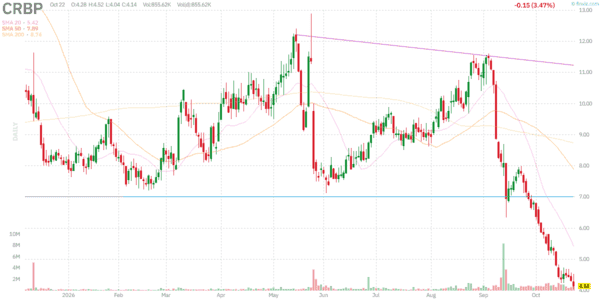
Daily chart $CRBP · October 22, 2026 · Intraday, delayedOpen chart (affiliate link) · For information only.
Next catalyst
November 15, 2026 · CANYON-1 scientific presentation
ObesityWeek adds detail to the CRB-913 phase 1b evidence
The scheduled poster covers efficacy, safety and tolerability from CANYON-1. Additional detail can clarify the weight-loss signal and its tolerability tradeoffs. Sustained benefit and acceptable persistence over longer treatment remain central clinical questions. Source
Key data
Latest announcementOctober 22, 2026 — CANYON-1 poster scheduled for November 15 Source
Dates of the figuresFinancial data as of June 30, 2026; ATM prospectus dated August 7, 2026. Source
The constructive case
CRB-701 produced an indication-specific tumor-response signal that supports a randomized OPSCC program. CRB-913 generated a dose-related weight-loss signal with a different mechanism from incretin medicines. Useful controlled oncology benefit and durable obesity efficacy with acceptable persistence could strengthen both assets and financing options.
The case against
CRB-701 has clinically important ocular toxicity and early efficacy comes from small cohorts. CRB-913 psychiatric discontinuations increased across assigned doses in CANYON-1, leaving chronic tolerability unresolved. Pivotal oncology evidence extends beyond the nearest catalysts, while active development, conditional milestones and equity financing can reduce value per share.
Operating and financial position
Clinical-stage oncology and obesity developer. June 30 cash, equivalents and investments totaled $117.941M; the August financial release forecast funding into 2028. A new prospectus supplement dated August 7 registered up to $127.5M of sales under the existing Jefferies Open Market Sale Agreement. That capacity represents potential share issuance, while future cash balances depend on actual sales and spending. Source · Related source · Related source
Executive summary
Corbus Pharmaceuticals is testing two distinct clinical propositions. CRB-701, also called SYS6002, is a Nectin-4/MMAE ADC now in the TEMPO-1 randomized registrational study for previously treated oropharyngeal cancer. Its response signal is promising, while eye toxicity and confirmation of benefit remain central. CRB-913 is an oral peripheral CB1 inverse agonist whose CANYON-1 study showed early weight loss alongside psychiatric and other tolerability issues requiring longer study. The near-term calendar includes ObesityWeek and first-line oncology combination data; the larger questions concern controlled efficacy, chronic safety, retained licensing economics and the amount of financing needed to reach decisive evidence.
Latest news
October 22, 2026 — CANYON-1 poster scheduled for November 15
Corbus announced a late-breaking ObesityWeek presentation of CRB-913 phase 1b efficacy, safety and tolerability. The poster is scheduled for November 15; the conference runs November 14–17. Additional clinical detail can help assess the next development stage. Source
September 30, 2026 — RA Capital Management reports a 9.9% stake
A Schedule 13G filed September 30 disclosed beneficial ownership of 1,914,788 CRBP shares as of September 23. A 13G is a filing for passive investors. Source
September 29, 2026 — First patient dosed in TEMPO-1
Corbus announced on September 29, 2026 that the first patient had been dosed in the randomized registrational study of CRB-701 in previously treated oropharyngeal cancer. It compares the Nectin-4 ADC with investigator-selected monotherapy, using response for potential accelerated approval and survival for potential conversion to full approval. Source
September 14, 2026 — CRB-913 reports 5% weight loss at 12 weeks
CANYON-1 randomized 254 adults without diabetes and reported 5.0% placebo-adjusted least-squares mean weight loss in the assigned 60 mg group. Psychiatric and gastrointestinal tolerability remain important questions for the planned phase 2 program and longer exposure. Source
August 6, 2026 — June liquidity of $117.9 million; runway forecast into 2028
Corbus reported $117.9 million of cash, equivalents and investments at June 30 and projected funding into 2028 under its operating plan. Quarterly net loss was about $35 million, including a $10 million CRB-701 development milestone payment. Source
Extended analysis
Does $CRBP deserve a place in your portfolio?
The full deep dive has the answer’s building blocks: cash, dilution, catalysts and risks, every figure sourced.
Free. No signup. You decide, we don’t recommend.
Using an ad blocker? The free “watch an ad” option is hidden automatically. Pause it on merlintrader.com and reload the page to see the free option.
01 What Corbus Pharmaceuticals Does: Cancer and Obesity
Corbus Pharmaceuticals Holdings is a clinical-stage biotechnology company headquartered in Norwood, Massachusetts, with common stock listed on the Nasdaq Capital Market as CRBP. Its principal programs address two very different medical problems: CRB-701 is an antibody-drug conjugate for cancer, and CRB-913 is an oral cannabinoid receptor drug for obesity. Neither program currently supplies an approved commercial product. The business depends on converting clinical evidence into an approvable treatment while financing development. Company overview.
The oncology program has advanced into a randomized registrational study. On September 29, 2026, Corbus announced the first patient dosed in TEMPO-1, testing CRB-701 in previously treated oropharyngeal squamous cell carcinoma, or OPSCC. Earlier tumor-response results support that choice of indication, but the controlled trial must test the proposition against existing treatment. The company is also investigating cervical cancer and a combination with pembrolizumab. TEMPO-1 initiation.
The obesity program remains earlier. CANYON-1 reported a weight-loss signal after a short course of CRB-913, including a placebo-adjusted mean reduction of 5% at the highest assigned dose. Its mechanism offers a possible alternative to incretin drugs, but chronic efficacy, psychiatric tolerability and treatment persistence require larger and longer studies. A successful early weight-loss result and a marketable long-term obesity medicine involve substantially different evidence requirements. CANYON-1 results.
These assets provide scientific diversification, while drawing on the same corporate resources. An oncology trial requires specialist sites, imaging, toxicity management and survival follow-up. An obesity program requires extended exposure in a much broader population, disciplined safety surveillance and an eventual commercial proposition against established medicines. Progress in both programs can increase financing requirements before either produces revenue.
The legal ownership structure also matters. CRB-701 is licensed for specified territories from CSPC, while CRB-913 comes from a worldwide license with Jenrin. Corbus therefore controls valuable development opportunities without owning every possible dollar of future product economics. Royalties and milestones reduce retained cash flows if development succeeds; clinical and operating expenditures absorb cash before success is known. License disclosures.
The central investment question is whether these programs can create durable clinical value at a cost and ownership structure that benefits each CRBP share. Tumor shrinkage, weight reduction, regulatory progress and financing capacity are separate parts of that question. A strong result in one part can improve the opportunity while leaving substantial risks elsewhere.
02 CRB-701: SYS6002, Nectin-4 and the ADC Rationale
CRB-701 is also identified as SYS6002. It is a Nectin-4-targeted antibody-drug conjugate carrying monomethyl auristatin E, or MMAE, a cytotoxic payload. The antibody binds a tumor-associated surface protein and delivers the linked payload into target cells. Its site-specific cleavable linker and approximately two payload molecules per antibody are intended to improve the balance between antitumor exposure and unwanted systemic toxicity. Molecule description.
That identity distinguishes the program from other ADCs sharing the same target or payload. Nectin-4 expression gives a biological reason to study a tumor type, while antibody binding, internalization, linker behavior, payload sensitivity and normal-tissue exposure determine how an individual medicine performs. Similar target names can conceal meaningful differences in activity and toxicity. Conversely, an attractive molecular design still needs clinical confirmation.
A September 2026 original research paper in Cancer Research Communications characterized CRB-701 in laboratory and animal models. It reported antitumor activity in xenografts, greater circulating stability and lower systemic MMAE release relative to enfortumab vedotin, with favorable pharmacokinetic and safety-margin findings in monkeys. This is product-specific preclinical evidence supporting the design rationale. The reported comparisons concern experimental models; comparative response, survival and tolerability in patients depend on human trials. Original preclinical research.
Nectin-4 already has clinical validation through enfortumab vedotin, marketed as Padcev. FDA approval of Padcev with pembrolizumab in advanced urothelial cancer demonstrates that this target can support an effective oncology treatment. That precedent reduces uncertainty about the broad biological concept, while leaving CRB-701’s molecule, indications, dosing and development program to prove themselves. A bladder-cancer approval cannot be transferred to OPSCC or cervical cancer. FDA approval.
Corbus’s strategy emphasizes tumor settings beyond its competitor’s established bladder-cancer franchise. OPSCC is the lead registrational opportunity, with cervical cancer providing another clinically active setting. This focus could make development more targeted and commercially manageable for a smaller company. It also concentrates the thesis on whether activity in selected tumor populations persists in larger trials.
The early scientific literature includes a first-in-human SYS6002 conference abstract published in 2024. It described the linker approach, initial pharmacokinetics and exploratory tumor responses. Its small dose-escalation cohorts belong to the program’s development history. Later Western data provide the more relevant evidence for the current indication and dose selection. First-in-human meeting abstract.
The practical goal is a useful therapeutic window: enough sustained exposure to control cancer without toxicity that prevents patients from receiving treatment. A low nominal payload ratio or favorable animal comparison is one component of that goal. Delivered dose, treatment interruptions, duration of benefit and patient function determine its eventual medical value.
The preclinical paper also puts an important boundary around the platform argument. It supplies evidence that the specific ADC behaves as intended in experimental systems, rather than relying solely on another drug’s target validation. That strengthens confidence in investigating the molecule. It leaves the size of the human advantage uncertain, because animal pharmacokinetics and tumor models capture only part of the variability in heavily treated cancer patients. Clinical differentiation ultimately requires the drug to maintain useful exposure across that variability. Translational evidence.
03 CRB-701 Clinical Evidence: Why OPSCC Became the Lead
The Western phase 1/2 study, NCT06265727, evaluates CRB-701 in advanced solid tumors and includes dose optimization. The 2026 ASCO head-and-neck and cervical abstracts describe earlier September 2025 analyses. They identify the study, methods and preliminary activity; the company subsequently reported a larger April 2026 analysis with longer follow-up. Those publications represent different stages of the same evolving evidence base. HNSCC abstract, cervical abstract.
The May 26 update reported confirmed responses in 9 of 21 evaluable OPSCC patients receiving 3.6 mg/kg, a 42.9% confirmed objective response rate. Median duration of response was 6.3 months and median progression-free survival was 5.6 months, with follow-up ongoing. At 2.7 mg/kg, 4 of 20 evaluable OPSCC patients responded, or 20%. These small cohorts support an activity signal and dose selection. Updated clinical results.
The anatomical distinction is important. In the same update, non-oropharyngeal head-and-neck cancers had confirmed response rates of 0 of 16 at 3.6 mg/kg and 1 of 14 at 2.7 mg/kg. OPSCC therefore contributed a more persuasive clinical signal than the broader HNSCC category. That contrast between OPSCC and other head-and-neck cancers is the result that shaped Corbus’s development strategy. Tumor-subgroup results.
The May update also reported HPV biomarker data. HPV status was determined for 97.3% of HNSCC participants in the 2.7 mg/kg and 3.6 mg/kg cohorts; 57.3% of enrolled HNSCC patients were HPV-positive, including 85.4% of those with oropharyngeal disease. Eight of the nine OPSCC patients who achieved a partial response were HPV-positive, and higher Nectin-4 levels were associated with HPV-positive disease. The eight-of-nine figure describes the responders, not a response rate within the HPV-positive subgroup. Corbus stated that a more detailed biomarker analysis will be presented at a future conference. HNSCC biomarkers.
Confirmed response means that radiographic tumor shrinkage met the applicable criteria and was confirmed on a later assessment. It is clinically useful in a refractory setting, especially when responses last. It captures a different outcome from living longer, maintaining function or improving symptoms. Duration of response concerns responders; progression-free survival concerns a broader treated population. Their denominators and clinical meanings remain distinct.
The reported efficacy populations also require attention. The May update included 75 patients with HNSCC at the two selected doses, of whom 71 were evaluable, and 72 with cervical cancer, of whom 70 were evaluable. The remaining patients lacked post-baseline scans. An evaluable-patient response rate describes those with the required assessments; a broader analysis retaining early discontinuations can answer a more demanding treatment question. Larger trials will need transparent handling of those outcomes. Analysis populations.
The OPSCC result also emerged from a selected subgroup within a multi-tumor development study. Small samples can produce unstable percentages, and patient characteristics can influence outcomes. A few additional responses or early progressions would materially change a cohort of this size. The observed difference between dose groups is interesting, but an early dose-optimization study offers limited precision for estimating comparative benefit.
Cervical cancer adds a second signal. At 3.6 mg/kg, 11 of 32 evaluable patients had confirmed responses, including two complete responses, for a 34.4% confirmed response rate. Median response duration was 8.0 months and progression-free survival 4.3 months, with follow-up ongoing. The lower-dose cohort had 7 responses among 38 evaluable patients. These findings justify continued investigation while leaving randomized benefit to be tested. Cervical results.
The most constructive reading is that Corbus has identified an indication-specific path rather than an indiscriminate solid-tumor claim. The corresponding vulnerability is concentration: if the selected OPSCC activity weakens with broader enrollment, much of the current registrational rationale would need reassessment.
04 CRB-701 Safety: Ocular Toxicity Is a Real Development Issue
The May 2026 analysis included a safety population of 317 patients across tumor types and doses. Corbus reported grade 3 treatment-related adverse events in 19.2% and grade 4 in 0.9% in its October 2026 presentation, with no grade 5 events reported. These results require attention to the entire safety distribution. Low treatment-discontinuation rates sit alongside meaningful toxicity. Safety update, October 2026 presentation.
Eye effects are particularly prominent. Ocular adverse events occurred in 66.2% of participants, including grade 3 events in 12.6% and a grade 4 event in 0.3%. The latter involved worsening of pre-existing punctate keratitis and microcysts, with recovery to baseline within six weeks. Keratitis was among the most frequent treatment-related events. This profile makes eye assessment, prophylaxis and dose management central parts of development. Ocular safety findings.
The October presentation adds operational context: dose reductions occurred in 15.5% and interruptions in 37.2% of the study safety population. An interruption can be an effective way to manage toxicity, while also changing actual exposure. The eventual clinical proposition depends on whether such management preserves benefit and remains practical outside highly experienced trial centers. October corporate presentation.
Peripheral neuropathy occurred in 7.3%, with reported events limited to grades 1 or 2. Overall discontinuations related to CRB-701 were 2.8%; discontinuations due to ocular events were 1.9%. These are encouraging observations within the reported population, especially for an MMAE-based ADC, but exposure duration, patient selection and follow-up can alter cumulative toxicity. Neuropathy and discontinuations.
Toxicity has direct business consequences. Additional eye-care appointments can increase patient and site burden. Dose interruptions can complicate treatment scheduling. If a medicine eventually reaches the market, monitoring requirements and specialist access can influence adoption even when oncologists accept its efficacy. A clinically valuable ADC can still require substantial support to use well.
The relevant comparison is benefit relative to burden in the intended treatment setting. Patients with refractory cancer may accept risks that would be inappropriate for a chronic preventive treatment. That clinical context supports continued investigation, while retaining the need for clear informed consent and reproducible management of adverse events.
Larger randomized trials will also clarify which safety differences survive broader exposure. Cross-trial percentages vary with disease, prior treatment, event definitions and treatment duration. Corbus’s design improvements and observed low-grade neuropathy provide reasons to investigate differentiation. Comparative clinical advantage remains an empirical question for sufficiently informative human evidence.
05 TEMPO-1, Regulatory Strategy and the Combination Program
Corbus announced on September 29, 2026 that the first patient had been dosed in TEMPO-1, following FDA clearance to proceed earlier in the year. It compares CRB-701 with investigator-selected capecitabine, cetuximab or docetaxel in previously treated OPSCC. The company described a planned randomized population of approximately 250. The ClinicalTrials.gov record updated October 8 lists an estimated enrollment of 260; both are planning figures rather than actual enrollment totals. Study initiation, TEMPO-1 registry.
The regulatory strategy has two layers. Objective response rate is intended to support a potential accelerated approval, while overall survival is intended to support potential conversion to full approval. FDA permission to conduct a study is an operational milestone. Marketing authorization will depend on the resulting evidence and the regulator’s assessment of benefit and risk. FDA granted CRB-701 Fast Track designation in relapsed or refractory metastatic cervical cancer in December 2024 and in recurrent or metastatic HNSCC previously treated with platinum-based chemotherapy and an anti-PD-(L)1 therapy in September 2025. Fast Track is a development designation, not a marketing approval. Regulatory design, Fast Track dates.
Randomization changes the quality of the test. Rather than comparing an early cohort with historical experience, TEMPO-1 places CRB-701 and existing options in a contemporaneous trial. Balanced allocation can reduce the influence of baseline differences. The eventual interpretation will still depend on patient characteristics, treatment delivery, response assessment, missing data and follow-up, but the design addresses important uncertainties left by the early cohorts.
Response and survival can also develop on different timelines. An early response difference may become visible before enough deaths have occurred to assess survival reliably. Longer observation can reveal whether tumor control persists and whether subsequent treatment affects the overall outcome. That distinction creates both an opportunity for an earlier regulatory pathway and a continuing evidence obligation. The asset’s eventual value depends on the full clinical trajectory, including what happens after the first encouraging scan, rather than solely on the speed of an initial filing.
The October presentation forecasts an interim ORR readout in the first half of 2028 and a potential biologics license application in the second half. These are company development targets. Enrollment speed, adequate follow-up, safety, manufacturing readiness and regulatory feedback can alter that sequence. A proposed filing window represents a possible submission milestone rather than an approval date. Company milestone calendar.
The public registry separately estimates primary completion in December 2027 and overall completion in March 2029. Registry completion fields describe planned study milestones. The company’s result-announcement and filing targets describe different events, so those dates need not coincide. Each can change as the trial progresses. TEMPO-1 record.
Corbus is also investigating CRB-701 with pembrolizumab in first-line OPSCC. Its October presentation targets an initial ORR update in the first quarter of 2027. Moving earlier could expand the treatment opportunity, but a combination must offer enough additional benefit to justify its toxicity and complexity. Results obtained after prior therapy cannot predict the same response rate in a first-line combination population. Combination program.
Cervical cancer remains another development option, with company-reported broad FDA alignment on a randomized registrational design. Prioritization matters because each additional pivotal program would require capital, sites and operational attention. TEMPO-1 is the active lead test; a wider pipeline can become valuable as evidence and resources support expansion.
06 CRB-913: Peripheral CB1 Biology and the Historical Safety Problem
CRB-913 is an orally administered, highly peripherally restricted CB1 inverse agonist. CB1 signaling participates in energy regulation and metabolism. Corbus’s approach seeks to retain useful metabolic effects while limiting exposure in the brain, where earlier CB1 medicines produced psychiatric concerns. Peripheral restriction is a pharmacological strategy whose clinical usefulness depends on the exposure, efficacy and safety achieved in people. Program description.
The distinction from incretin drugs is scientifically meaningful. A non-incretin mechanism could offer another treatment option for patients who need a different balance of efficacy and tolerability. It could also become a combination component if effects are complementary. Those possible roles have different development requirements: evidence for monotherapy cannot automatically support adding the drug to an established obesity regimen.
The class history explains the emphasis on brain exposure. Rimonabant, marketed in Europe as Acomplia, was suspended in 2008 and its authorization withdrawn in 2009. EMA’s review focused on psychiatric harms, including depression, anxiety and other serious disorders. The history demonstrates that weight-loss activity can coexist with an unacceptable overall benefit-risk profile. EMA product history, EMA safety assessment.
Product-specific preclinical support for CRB-913 was published in Obesity in 2023. In diet-induced obese mice, the compound produced weight loss and enhanced weight reduction when combined with incretin medicines. The study also reported reduced brain exposure relative to rimonabant. These animal findings support the mechanism and combination hypothesis. Human efficacy, psychiatric tolerability and the useful clinical dose require direct patient data. Original CRB-913 animal study.
The more recent monlunabant experience reinforces that distinction. A phase 2a study randomized 243 adults with obesity and metabolic syndrome to a 16-week treatment period; 242 received treatment. Weight loss occurred, while withdrawals due to adverse events increased across the tested doses to 13%, 27% and 42%, versus none with placebo. Gastrointestinal and psychiatric symptoms contributed. This is evidence about another molecule, useful for assessing the class’s unresolved challenges. Original monlunabant trial.
A lower measured tendency to enter the brain is encouraging, but the clinically relevant question is whether patients can sustain useful treatment with an acceptable psychiatric profile. Longer exposure, larger populations, concomitant medicines and differences in baseline vulnerability can reveal risks that a small early study misses. Rare but serious events require particular care in a treatment intended for widespread chronic use.
For CRBP, the opportunity comes from potentially separating metabolic benefit from the liabilities that constrained earlier CB1 development. The risk comes from assuming that a design feature has already accomplished that separation. CANYON-1 provides human evidence to examine; the following stages must establish its durability and generalizability.
07 CANYON-1 Weight Loss: What the Phase 1b Result Shows
CANYON-1 randomized 254 adults with obesity without diabetes at U.S. sites. Participants received placebo or assigned CRB-913 doses of 20, 40 or 60 mg once daily, with titration from 20 mg. Treatment lasted 12 weeks, followed by four weeks of observation. The registry records the study as completed, with actual enrollment of 254. Study design and results, CANYON-1 registry.
The September 14 announcement reported least-squares mean weight loss of 2.8%, 3.3% and 5.0% at Week 12 for the ascending assigned doses, compared with 0.0% for placebo. Each comparison had a reported p-value below 0.0001. These efficacy-estimand results used a repeated-measures model. The orderly increase across doses supports a pharmacological activity signal over the studied period. Topline efficacy table.
The October presentation identifies safety and tolerability as the primary endpoint, with weight change among the secondary outcomes. That hierarchy fits the program’s early stage. Statistical significance in weight loss is useful evidence, while the broader development decision also depends on dose selection, adverse events, retention and the feasibility of longer treatment. CANYON-1 endpoints.
Corbus reported that 44.4% of participants completing treatment in the 60 mg cohort lost at least 5% of baseline weight. This responder percentage applies to completers. It answers a different question from the mean effect across a randomized treatment strategy that includes people who discontinue. The 44.4% figure applies to participants who completed treatment at 60 mg; the 5.0% least-squares mean is a modeled estimate for the assigned 60 mg group. Responder analysis.
The absence of an observed plateau during treatment is encouraging because the effect was still developing at the end of the study. Longer trials will determine whether weight loss deepens, stabilizes or becomes limited by tolerability. Physiological adaptation, treatment persistence and differences between titration and maintenance exposure will shape the curve beyond the early slope.
Several features deserve attention in later data. A zero mean placebo change makes the placebo-adjusted and baseline-relative treatment effects numerically identical here. Other trials can have different lifestyle interventions, adherence and placebo responses. The dose groups also had unequal retention. The clinical assessment therefore benefits from both the modeled average and the outcome of patients who could not remain on treatment.
The October presentation describes the weight analysis as including participants with non-missing baseline and relevant visit measurements. Missingness consequently matters: people who stop because of symptoms may have a different treatment experience from those who contribute later measurements. Future analyses can make the effect of discontinuation clearer by explaining the estimand, data collection after stopping and sensitivity to missing outcomes. These statistical choices connect directly to the practical question of how much sustained benefit a newly treated patient can expect. Efficacy analysis details.
The current result supports advancing a non-incretin oral candidate into a more informative study. Its eventual medical value will depend on sustainable weight reduction, safety and practical use over a chronic treatment horizon. A short phase 1b result offers an early efficacy signal; registrational evidence requires a broader and more durable account of benefit and harm.
The enrolled population also defines the initial scope of the result. The October presentation reports an average baseline BMI of 37.5 and approximately 71% female participation. Diabetes was excluded. Subsequent development will determine performance across the populations and comorbidities included in any proposed indication. Evidence in adults without diabetes offers a useful starting point, while differences in metabolic disease, concomitant treatment and tolerability can affect the result in broader clinical practice. Baseline characteristics.
08 CRB-913 Safety, Psychiatric Discontinuations and Phase 2
The CANYON-1 psychiatric findings contain both reassuring observations and meaningful limitations. The September release reported no serious or severe psychiatric adverse events and no suicidality. One of 188 participants receiving CRB-913 had a transient moderate depressive symptom. Anxiety, irritability and insomnia also occurred. Those observations describe the duration and population studied, including active psychiatric monitoring. Psychiatric results.
The October presentation provides an additional measure of clinical relevance: discontinuation because of psychiatric adverse events. By assigned cohort, these occurred in 1 of 65 participants at 20 mg, 3 of 61 at 40 mg and 5 of 62 at 60 mg, compared with 1 of 66 on placebo. The increasing observed proportions warrant attention even though the small study leaves uncertainty about the true dose-risk relationship. Psychiatric discontinuation table.
Severity and acceptability are different dimensions. A mild or moderate symptom can still make someone stop a chronic medicine. Conversely, a transient symptom that resolves while treatment continues can have a different practical significance. The next study’s dose, titration, duration and monitoring will help clarify whether efficacy can be preserved with better persistence.
Titration complicates interpretation of psychiatric events by nominal dose. Participants assigned a higher maintenance dose initially received a lower dose, so the assigned cohort and the dose being taken when a symptom began are different variables. Corbus presents both views. Assigned-cohort results preserve the randomized treatment strategy and its practical retention outcome; event-onset analyses can help explore timing. Neither view alone resolves causation in a small study, making both useful for selecting the next regimen. Assigned-cohort and event-dose analyses.
The overall safety table also distinguishes events occurring during treatment from events attributed to the drug. Serious treatment-emergent events occurred in two participants assigned 20 mg and one each assigned 40 and 60 mg; the presentation reported no serious treatment-related events. An absence of serious drug-attributed events and an absence of all serious events are different statements. Overall safety table.
Gastrointestinal effects were present. At 60 mg, nausea occurred in 22.6% and diarrhea in 22.6%; vomiting was reported in 1.6%. The release described GI events as mild or moderate without serious or severe GI cases. Treatment discontinuations for any adverse event ranged from 3.1% to 13.1% across active cohorts. The October presentation also reports discontinuations for any reason in 10 of 65 participants (15.4%) at 20 mg, 16 of 61 (26.2%) at 40 mg and 16 of 62 (25.8%) at 60 mg, compared with 12 of 66 (18.2%) on placebo. Longer exposure will clarify cumulative burden and its effect on sustained weight reduction. GI safety and discontinuations, discontinuations by assigned cohort.
Corbus plans a phase 2 monotherapy study, called CANYON-2 in its October presentation, for the first half of 2027. FDA discussions and study execution remain ahead. A useful trial will need to make the efficacy-persistence tradeoff clearer while adding substantially more exposure. Combination development with GLP-1 therapy remains a separate possibility. Development plan.
The next scheduled scientific event is the CANYON-1 poster on November 15 at ObesityWeek. The October 22 announcement supplied presentation details, while the topline efficacy results had already been announced in September. The informative question for the poster is what additional detail it adds about efficacy analysis, psychiatric assessments, discontinuations and follow-up. ObesityWeek announcement.
09 Competition and the Medical Value Required for Adoption
Corbus competes in markets with substantial unmet need and increasingly demanding evidence standards. For oncology, the opportunity depends on better outcomes in a defined treatment sequence. For obesity, it depends on sustained benefit in a chronic disease with effective established choices. A differentiated mechanism creates an opening; patient outcomes, treatment burden and access determine the size of that opening.
Enfortumab vedotin supplies relevant Nectin-4 evidence beyond bladder cancer. In the published EV-202 head-and-neck cohort, 46 previously treated patients had a confirmed response rate of 23.9%, with grade 3 or worse treatment-related events in 34.8%. This supports target activity in advanced HNSCC. Differences in anatomical subsets, prior therapies and follow-up prevent a reliable efficacy or safety ranking against the small CRB-701 OPSCC cohorts. Original EV-202 study.
Other approaches also compete for the same patients. Petosemtamab is being evaluated in the randomized phase 3 LiGeR-HN2 study against investigator’s choice therapy in previously treated HNSCC. The development landscape can change before TEMPO-1 matures, affecting expected benefit, physician choices and the commercially relevant comparator. The existence of another late-stage study adds execution pressure without revealing which medicine will ultimately perform better. LiGeR-HN2 registry.
In cervical cancer, Tivdak has traditional FDA approval after progression on chemotherapy. Its randomized confirmation study showed a survival benefit, providing an established clinical standard for an ADC in that setting. CRB-701’s response signal is an early reason to pursue development, while comparative survival, toxicity and sequencing will shape any eventual role. FDA cervical-cancer approval.
The evidence bar is concrete. Tivdak’s confirmation study randomized 502 patients and reported median overall survival of 11.5 months versus 9.5 months with chemotherapy. Those controlled survival data have a different evidentiary weight from an early response cohort. For Corbus, a commercially meaningful cervical opportunity would require evidence adequate for its own development pathway and a clear place relative to available treatments. A higher response percentage in a separate early trial does not meet those requirements on its own. Randomized confirmation results.
Obesity competition already includes oral incretin options. Orforglipron, marketed as Foundayo, received U.S. approval in 2026 for appropriate adults with obesity or overweight and a weight-related condition. An oral formulation alone consequently offers limited differentiation. CRB-913’s commercial case would need a useful non-incretin benefit-risk profile, an attractive treatment experience or a substantiated combination role. FDA approval announcement.
The company compares CANYON-1 with published incretin and monlunabant trials. Such comparisons can help frame hypotheses, while differing durations, eligibility, titration and analysis methods materially affect the numbers. The most persuasive evidence of advantage would come from appropriately designed comparative trials or a sufficiently compelling, reproducible clinical profile in the intended use setting.
Commercial value also depends on practical adoption. Cancer treatment can involve specialist infusion networks and toxicity monitoring. Obesity treatment requires long-term adherence, affordable access and a convincing reason for patients and clinicians to choose another medicine. Revenue potential must account for discontinuation and reimbursement, alongside the number of people with a disease. Broad prevalence alone offers little guidance to Corbus’s eventual sales or retained cash flow.
10 Licenses, Territories and the Programs That Receive Capital
Corbus’s CRB-701 license covers the United States, Canada, the European Union including EFTA, the United Kingdom and Australia. Those are valuable territories, but the agreement covers a specified list of markets. CSPC’s separate Chinese clinical activity can inform the molecule’s development history without giving Corbus ownership of Chinese product sales. Territorial economics are therefore central to evaluating the asset. CSPC license terms.
Corbus paid a $7.5 million upfront license fee and a $10 million development milestone in April 2026. Remaining potential payments include up to $120 million of development and regulatory milestones and $555 million of commercial milestones, plus low-double-digit royalties on net sales. These amounts are conditional on specified achievements. Their timing could create financing needs before or during commercialization. License payment obligations.
The economics have two sides. Licensing allowed Corbus to obtain a clinical asset without originating every stage internally. If the program succeeds, the licensor participates through milestones and royalties. A valuation based on gross product sales would consequently overstate the amount available to fund Corbus’s operations or return value to its shareholders. Development costs, manufacturing, commercialization and contractual payments must all be considered.
The Jenrin agreement grants worldwide rights to licensed products that include CRB-913. Following an earlier clinical milestone, the Form 10-Q for the quarter ended June 30, 2026, filed August 6, disclosed up to $18 million in additional potential CRB-913 milestones and mid-single-digit royalties on net sales, subject to reductions. The retained geographic opportunity is broader than CRB-701’s, while obesity development and commercial requirements may also be larger. Jenrin agreement.
The historical pipeline also includes CRB-601, an integrin alpha-v beta-8 antibody program distinct from the Nectin-4 ADC. The August 7 prospectus supplement states that Corbus has deprioritized the program and does not plan to enroll additional patients; the second-quarter 10-Q reports that the phase 1 dose-escalation study was completed and that no additional patients were enrolled in 2026. Current corporate presentations emphasize CRB-701 and CRB-913. That allocation of attention is relevant to operating forecasts: CRB-601 is a deprioritized program, not an active pivotal opportunity. Program expenditure discussion, August 7 prospectus supplement.
Maintaining several licensed programs creates choices about sequencing and capital allocation. A cervical trial, a first-line combination expansion or an obesity combination could each increase potential value, while also competing with the lead studies for funding. The most useful measure of pipeline breadth is how much actionable evidence the company can generate with the resources available.
Partnerships could change that balance. A collaboration might bring capital or commercial capabilities, while reducing retained economics or strategic control. The value of a future transaction would depend on its actual terms and the stage of evidence supporting it. Potential deal interest is consequently a scenario variable rather than a source of current operating cash.
11 CRBP Stock Dilution, Cash Use and Financial Runway
At June 30, 2026, Corbus held $23.370 million of cash and equivalents and $94.571 million of investments, totaling $117.941 million. It separately reported $0.385 million of restricted cash. The balance sheet had no funded borrowing line; liabilities included operating leases, accounts payable and accrued expenses. These dated balances describe the financial position before subsequent trial spending and financing activity. June balance sheet.
The August financial release projected funding into 2028 under the operating plan then in place. The 10-Q’s liquidity discussion also stated that resources supported at least twelve months after issuance, while acknowledging the need for significant additional capital. Those statements have different precision. An operating runway forecast depends on spending assumptions, clinical sequencing and payments associated with progress. Financial update and runway, Liquidity discussion.
First-half operating cash use was $55.197 million. Dividing by six gives approximately $9.2 million per month as a historical average. The period included a material licensing milestone and expanding clinical activity, so that average provides spending context rather than a precise forecast. Investment maturities generated cash within the portfolio; moving securities into cash differs from creating operating revenue. Cash-flow statement.
Quarterly net loss was about $35.0 million, including the $10 million CSPC development payment. Research spending can therefore move sharply when a milestone is achieved. Removing an unusual payment can help understand recurring costs, but successful development can trigger further payments and larger trials. The financing burden is tied partly to progress itself. Quarterly results.
Common shares outstanding were 18,671,498 at June 30 and 19,341,293 at August 4. The June capital structure also included pre-funded warrants for 1,025,000 shares, with a minimal exercise price, plus employee equity and a small legacy warrant. Pre-funded warrants represent an economic ownership claim even before conversion into issued common stock. Their exercise provides little additional cash compared with their original purchase proceeds. Share counts and warrants.
The pre-funded warrants originated in the offering completed November 3, 2025, which raised approximately $75 million gross and $70.2 million net. That funding helped establish the resources available for subsequent development. The second-quarter 10-Q also listed 2,037,010 stock options and 634,006 unvested restricted stock units. These instruments have different exercise, vesting and economic characteristics, so a fully diluted ownership assessment needs more than adding every security indiscriminately. The basic common-share count remains only one view of participation in future asset value. Financing and employee equity.
The company raised approximately $9.1 million net through its ATM in the first half and another $6.7 million net from July 1 through the August filing. A new prospectus supplement dated August 7 registered up to $127.5 million of sales under the existing Jefferies Open Market Sale Agreement. The $127.5 million is offering capacity, not cash received; actual issuance depends on subsequent sales. Under the prospectus supplement, Jefferies receives a fixed commission of 3% of the gross sales price of shares sold. ATM activity, August ATM prospectus.
On October 21, 2026, CRBP closed at $4.285 per share. Applied to the 19,341,293 shares outstanding on August 4, 2026, as reported on the cover of the second-quarter 10-Q, that price implies a market capitalization of approximately $82.9 million, below the $117.9 million of cash, equivalents and investments held at June 30. Both reference points predate later cash use and any subsequent ATM sales, and the share count excludes pre-funded warrants. Market data, Form 10-Q.
Recent ownership filings add further context. On August 7, 2026, the CEO sold 17,000 shares and the CFO 12,000 shares at weighted average prices of approximately $10.08, under Rule 10b5-1 trading plans adopted March 11, 2026; the related Form 144 notices identify the shares as acquired through vested restricted stock units (Form 4: CEO, CFO; Form 144: CEO, CFO). On August 11, the Chief Business Officer bought 2,600 shares at $9.63 (Form 4). On August 16, the new Chief Medical Officer, in office since August 3, 2026, received inducement awards of 191,676 stock options with a $10.09 exercise price and 58,333 restricted stock units, announced on August 17 (appointment 8-K, Form 4, inducement grant release). On September 14, a director sold 2,000 shares at a weighted average price of $7.8415 under a Rule 10b5-1 plan adopted June 12, 2026 (Form 4). Among institutions, a Schedule 13G/A filed August 14 reported a 1.1% Citadel position as of June 30, 2026 (Schedule 13G/A), and RA Capital Management reported 9.9% as of September 23 in a Schedule 13G filed September 30 (Schedule 13G).
For shareholders, the important financing outcome combines capital raised, price received and the evidence that the money enables. Additional shares can support a higher-value clinical program while reducing each existing share’s participation. Weak results or delayed catalysts can make that tradeoff less favorable. Access to an ATM improves financing flexibility, while leaving dilution as a continuing part of the business model.
12 CRBP Stock Catalysts, Scenarios and Observable Thesis Tests
The nearest scheduled scientific event is the November 15 CANYON-1 presentation at ObesityWeek. Its value lies in additional detail about an already disclosed phase 1b study. A clearer account of missing data, psychiatric symptoms, discontinuations and post-treatment follow-up could materially improve interpretation even if the headline weight-loss number remains unchanged. Presentation announcement.
The next company targets are the CRB-701/pembrolizumab first-line OPSCC update in the first quarter of 2027 and initiation of CRB-913 phase 2 in the first half. TEMPO-1’s interim ORR and potential filing windows extend into 2028. These milestones differ in maturity and significance: a conference presentation adds interpretation, a trial start adds execution evidence, and a controlled clinical result can change the estimated medical value of a program. Milestone calendar.
In a constructive scenario, CRB-701’s activity remains concentrated in a clinically useful OPSCC population and translates into a convincing randomized effect, with eye toxicity manageable at the intended exposure. Combination evidence expands the opportunity without unacceptable added burden. CRB-913 then sustains weight reduction over longer treatment while showing a dose and titration strategy that patients can continue. That sequence would strengthen both clinical assets and financing options.
A middle scenario is slower and more selective. Oncology benefit may remain meaningful in a narrower population or require more follow-up. Obesity development may advance at a dose that sacrifices some weight-loss effect for better persistence. Additional capital may be necessary before a decisive result. In that case, asset progress and per-share value could diverge depending on the cost of funding and the commercial scope ultimately supported.
An adverse scenario involves weakening tumor-response durability, a disappointing controlled comparison, ocular burden that limits usable exposure, or obesity discontinuations that prevent sustainable benefit. Larger or longer CRB-913 studies could also reveal psychiatric risks inadequately characterized by early exposure. Delays would consume resources while leaving major milestones farther away, potentially forcing dilution or changes in program priorities.
The key thesis tests are observable. For CRB-701, they include randomized response benefit, duration, survival follow-up, treatment delivery and ocular outcomes. For CRB-913, they include retention by assigned dose, psychiatric discontinuations, long-term weight trajectories and the treatment effect under analyses accounting for discontinuation. For the company, they include operating cash use, actual ATM issuance and continued alignment between available funding and the clinical calendar.
The timing of those tests matters for financing. A company can have promising medicines while facing a gap between its projected operating horizon and the evidence needed for a stronger negotiating position. Earlier combination data or an informative obesity study could narrow that gap; slow enrollment or additional safety work could widen it. The appropriate financial question is how much capital each stage requires and what ownership remains after obtaining it. That assessment can change even when the underlying target biology remains credible.
Market liquidity can add another layer of risk around these events. A small listed biotechnology company’s trading conditions can change sharply when new clinical evidence arrives. Daily volume offers limited protection against an overnight information gap, and a quoted cash balance is being spent on development rather than reserved as a shareholder distribution.
The medical opportunity is substantive: a targeted treatment for difficult cancers and a possible new oral obesity mechanism. Its realization depends on evidence that survives larger controlled trials, a tolerable treatment experience and an economic structure that leaves meaningful value after development costs and contractual payments. Those requirements connect the science to the eventual outcome for each CRBP share.
CRBP Stock FAQ
What does Corbus Pharmaceuticals develop?
Corbus develops CRB-701, a Nectin-4 antibody-drug conjugate for cancer, and CRB-913, an oral peripheral CB1 inverse agonist for obesity. It remains a clinical-stage business without an approved product from either program. Company overview.
Is CRB-701 the same molecule as SYS6002?
Yes. CRB-701 and SYS6002 identify the same Nectin-4-targeted MMAE ADC. It is distinct from enfortumab vedotin and from Corbus’s integrin antibody CRB-601. CRB-701 description.
What is TEMPO-1 testing?
TEMPO-1 is a randomized registrational study in previously treated OPSCC. It compares CRB-701 with investigator-selected monotherapy, with response intended to support possible accelerated approval and survival intended to support conversion to full approval. Trial announcement.
What did CANYON-1 show for weight loss?
The phase 1b study reported 5.0% placebo-adjusted least-squares mean weight loss at 12 weeks in the assigned 60 mg group. Longer trials must establish durability and the benefit achieved when discontinuation is considered. CANYON-1 results.
Has psychiatric risk been resolved for CRB-913?
Long-term psychiatric safety remains a development question. CANYON-1 reported no serious or severe psychiatric events, while psychiatric discontinuations occurred in active groups and increased across assigned doses. The limited duration and population leave uncertainty about chronic use. Detailed safety presentation.
What is the next CRBP catalyst?
The CANYON-1 poster is scheduled for November 15, 2026. The company also targets a first-line CRB-701 combination update in Q1 2027 and CRB-913 phase 2 initiation in H1 2027. These development windows remain forecasts. Poster announcement, Milestone calendar.
How much cash did Corbus report?
Cash, equivalents and investments totaled $117.941 million at June 30, 2026, excluding restricted cash. The August release forecast funding into 2028 under its operating plan. Subsequent spending and financing change the later balance. Quarterly financial update.
Why do warrants and the ATM matter for CRBP stock?
Pre-funded warrants represent additional economic ownership, while ATM sales can finance development by issuing common shares. The August prospectus provided up to $127.5 million of offering capacity; actual sales determine proceeds and dilution. Capital structure, ATM prospectus.
Sources
- Corbus official website and investor relations.
- Form 10-Q, quarter ended June 30, 2026.
- Q2 financial and corporate update, August 6, 2026.
- ATM prospectus, August 7, 2026.
- October 15 corporate presentation.
- CANYON-1 results, September 14, TEMPO-1 initiation, September 29, and ObesityWeek announcement, October 22.
- CRB-701 updated clinical results, May 26; original ASCO abstracts 2024 SYS6002, 2026 HNSCC, 2026 cervical.
- Original research: CRB-701 preclinical characterization, CRB-913 mouse study, monlunabant randomized trial, EV-202 head-and-neck study.
- Trial registries: TEMPO-1, CRB-701 phase 1/2, CANYON-1, LiGeR-HN2.
- Regulatory context: EMA Acomplia history, Tivdak approval, Padcev combination approval, Foundayo approval.
Join the Merlintrader community: follow the discussion and get more deep dives on our subreddit — r/MerlintraderPub — and on the Telegram channel @merlintraderpub_com.
Get these reports in real time
Every Merlintrader stock hub, catalyst update and market brief is published to Telegram the moment it goes live. No paywall, no spam, just the research.
Disclaimer. This content is published by Merlintrader for educational and informational purposes only. It is independent journalism and research. It does not constitute investment advice, an investment recommendation, an offer or a solicitation to buy or sell any security, and it is not a research report within the meaning of applicable United States securities regulation. Nothing here should be read as a recommendation to buy, sell or hold $CRBP or any other security.
Figures are taken from public filings with the U.S. Securities and Exchange Commission, company press releases and market-data providers, and are stated with their reference dates. Data can change without notice, and figures published before a results release become outdated the moment that release is issued. Merlintrader makes no representation that the information is complete or current at the time of reading. Readers should verify every figure against the primary source before acting on it.
Biotechnology companies face clinical, safety, regulatory, manufacturing, commercial and financing risks. Trials can fail, adverse effects can limit use, regulatory applications can be delayed or rejected, and an approved medicine may not achieve commercial expectations. Additional borrowing or equity issuance can increase obligations or dilute existing shareholders. Investors can lose part or all of their capital. Every reader is responsible for their own decisions and should consult a licensed financial adviser where appropriate.
Merlintrader may hold positions in securities mentioned. Some links on this page are affiliate or referral links, which may generate a commission at no cost to the reader. Full legal information is available on the disclaimer and terms of use and privacy pages.
CRBP Stock Hub: Corbus Pharmaceuticals News, CRB-701 and CRB-913 · Merlintrader
Biotech catalysts and company research
Clinical milestones, regulatory events and independent company analysis.
Open the biotech catalyst calendar → · Top Ten Biotech →