01 IONS stock: what the October catalyst can change
Ionis Pharmaceuticals enters October 2026 with a more complicated investment case than a simple countdown to an FDA decision. The company has an established RNA drug discovery platform, income from partnered medicines and a growing commercial organization for products it sells itself. That combination provides several sources of potential value. It also makes reported revenue, cash generation and clinical news harder to interpret than at a company with one experimental asset. The central question is whether these activities can produce durable shareholder returns after development spending, launch costs and obligations to financing partners.
The nearest dated regulatory event is October 26, the FDA target action date for GSK’s bepirovirsen application in chronic hepatitis B. This is not an olezarsen decision: the broader U.S. TRYNGOLZA indication was approved in June. Nor is it the original September target for zilganersen, which became the approved medicine ZANVASTRO on September 3. Treating those completed decisions as future events would overstate the remaining calendar. Bepirovirsen received its first approval in Japan in August; the U.S. application remains a separate regulatory process. [1] [4] [5] [6]
For shareholders, bepirovirsen is primarily a royalty and milestone opportunity through GSK. Ionis does not receive every dollar that GSK might sell. The amended contract’s geographic exclusions and royalty range therefore matter as much as the clinical headline. An approval could improve confidence in a future revenue stream, while a delay, restrictive label or complete response could reduce or postpone that value. The actual stock reaction would also depend on what investors already expect, the accompanying information and conditions elsewhere in the portfolio. A calendar date alone cannot establish an expected percentage return.
There is a constructive thesis: a successful partnered hepatitis B medicine, better sales from owned products, and progress in neurology and kidney disease could diversify commercial income. There is an equally concrete opposing thesis: recent cardiovascular failures remove potential value, new launches consume resources, and substantial cash balances coexist with debt and royalty obligations. Neither case should erase the other. A portfolio needs an asset-by-asset assessment rather than a vote on whether RNA medicines work in general.
The useful investment horizon extends beyond the decision day. Label details, patient eligibility, launch timing, net sales and royalty recognition will determine how much of the scientific promise reaches Ionis’ accounts. Investors should separate the event that reduces regulatory uncertainty from the subsequent evidence that reduces commercial uncertainty. This distinction is especially relevant at a company whose expenses are already supporting several launches and a broad research organization. A favorable decision is potentially valuable; it is not the same as immediate profitability.
02 Company identity, RNA platform and business model
The July 29, 2026 pipeline update reported cognitive benefit for diranersen in Phase 2 CELIA, with Biogen planning Phase 3; salanersen had entered Phase 3 in SMA and received FDA Breakthrough Therapy designation. Sapablursen had advanced to Phase 3 in polycythemia vera. REVEAL enrollment for obudanersen in Angelman syndrome was complete, with data expected in H2 2027, while ION775 entered Phase 2 in severe and moderately elevated hypertriglyceridemia. These are separate programs and development stages, not interchangeable demonstrations of efficacy. Primary source 1.
Ionis Pharmaceuticals, Inc. is a Carlsbad, California biotechnology company listed on Nasdaq under IONS. Its investor disclosures describe a business centered on RNA-targeted medicines, with marketed products and development programs spanning neurological, cardiometabolic and other diseases. The company combines directly commercialized medicines with programs licensed or partnered to larger pharmaceutical businesses. These arrangements create different responsibilities for clinical development, regulatory submissions, manufacturing and selling. They also produce different types of revenue, which should not be added together without understanding their durability. [2] [3]
An antisense oligonucleotide is a designed sequence that interacts with a selected RNA target. Depending on the molecule and its mechanism, changing that RNA’s processing or abundance can alter production of a disease-relevant protein. This is a platform description, not proof that every target will improve patient outcomes. Delivery to the intended tissue, adequate exposure, safety, disease biology and trial design all remain program-specific questions. Success with one molecule can validate aspects of the platform without validating every biological hypothesis pursued with it.
That distinction is unusually visible in the current portfolio. A viral target in hepatitis B, triglyceride metabolism, a rare neurological disorder and cardiovascular risk reduction involve different biology and different clinical endpoints. A biomarker can move in the expected direction while a patient outcome fails to improve sufficiently in a controlled trial. The 2026 cardiovascular results make this more than a theoretical concern. Platform expertise helps create candidates, but the decisive evidence still comes from each medicine’s trials, regulatory review and subsequent real-world use.
The economic structure is similarly varied. Owned-product sales can retain more revenue per treatment but require a commercial infrastructure and operating expenditure. Partnered royalties can be less costly to collect, but their rate, territory and deductions limit Ionis’ participation. Milestones can be substantial while remaining episodic. Collaborative research revenue may fund work while also carrying development obligations. These are all legitimate business activities; their cash-flow profiles differ. A quarter with a large milestone cannot automatically be treated as a recurring annual earnings base.
Management’s transition toward a broader commercial business therefore requires two kinds of execution. Research must continue to produce medicines with meaningful clinical evidence, and commercial spending must convert into access, adoption and retained economic value. Investors can monitor that transition through product-level sales, royalty trends, operating cash flow and the pace of spending. The company’s scientific history is relevant context, but a valuation based on future cash requires evidence that the present portfolio can support the present cost structure. The headquarters, listing and reported balances identify the issuer; they do not substitute for that operating analysis.
03 Bepirovirsen: the clinical evidence behind October 26
Bepirovirsen is an antisense medicine developed with GSK for chronic hepatitis B. Its clinical proposition differs from simply suppressing viral replication while treatment continues: the pivotal program assessed sustained functional cure after treatment withdrawal. GSK’s May presentation reported pooled functional cure in 233 of 1,220 bepirovirsen recipients, approximately 19%, versus none of 614 placebo recipients. Both groups received the relevant background standard of care under the trial protocol. The population was selected by baseline hepatitis B surface antigen, so the result must not be generalized to every person with chronic hepatitis B. [7] [8]
The two B-Well trials were randomized, double-blind and placebo-controlled. At week 72, the reported functional-cure outcome required hepatitis B surface antigen and viral DNA to meet the specified undetectable or quantification criteria after at least 24 weeks off all treatment. Participants entered on nucleos(t)ide analogue therapy, with baseline surface antigen no higher than 3,000 IU/mL. In the ranked subgroup with baseline surface antigen at or below 1,000 IU/mL, the pooled response was 26%, versus zero in the comparison group. The subgroup’s higher rate does not replace the overall primary result. [7] [8]
This evidence has several strengths for an investor evaluating the application: two trials, a controlled design, an endpoint linked to treatment-free disease control and results reproduced across the program. The relevant limitations are equally important. Most treated participants did not meet the functional-cure endpoint, selected entry criteria constrain generalization, and the observed follow-up does not establish lifetime freedom from complications. Functional cure is not a claim that every trace of the virus has been eradicated. It also should not be described as proof that liver cancer risk becomes zero.
Safety belongs in the same discussion as efficacy. GSK identified injection-site redness, local pain and temporary liver-enzyme elevations among the most frequent adverse events. The company characterized tolerability as consistent with prior studies; that characterization does not remove the need for the regulator to assess the full safety database and monitoring requirements. For commercial modeling, the eventual U.S. label and clinical implementation can affect the eligible population, prescriber confidence, follow-up needs and adoption. A stronger efficacy result does not make these practical details irrelevant. [7]
The older B-Clear study supplies context rather than a substitute for pivotal evidence. The peer-reviewed 2022 report, located through Consensus and retrieved before use, studied different treatment arms and populations, including participants receiving and not receiving background antiviral therapy. It supported continued development but was not the 2026 Phase 3 result. Cross-trial numerical comparisons would mix different designs, patient selection and treatment-withdrawal rules. The appropriate reading is a sequence of evidence becoming more mature, with the current application judged on the current dossier. [9]
04 U.S. review, Japanese approval and the meaning of a PDUFA
Ionis announced on April 28 that the FDA accepted GSK’s application for Priority Review and assigned October 26, 2026 as the target action date. Breakthrough Therapy and Fast Track designations were also reported. These designations can support development and review, but none is an approval. The target date identifies an expected regulatory action window rather than a promised authorization, a guaranteed decision at a particular hour or an assured launch date. Investors should watch the actual regulator and company communications instead of inferring the outcome from the countdown. [1]
On August 24, GSK announced Japanese approval under the HIBSAGO brand. This was the first global approval and replaced the earlier description of Japan as a pending jurisdiction. It supports the proposition that a major regulator found a favorable benefit-risk case for the specified Japanese population. It does not legally determine the FDA’s assessment, U.S. label or commercial conditions. Different agencies can ask different questions, evaluate different local requirements or reach decisions on different timetables. An international approval is evidence, not automatic reciprocity. [6]
Three practical scenarios are useful without assigning invented probabilities. A favorable U.S. decision could allow the commercial process to advance under an approved label. A decision accompanied by a narrower population or additional requirements could still create value while changing the sales opportunity. A delay or unfavorable action could shift the timeline and require further work. The financial consequence depends on which scenario occurs and why: a document issue, manufacturing concern, safety question and efficacy requirement would not all imply the same cost or duration.
The label deserves close reading because trial eligibility and commercial eligibility are related but not identical. A headline about a large worldwide disease burden is not a calculation of U.S. treatable patients. Diagnosed patients, people meeting the label, those clinically suitable, those with coverage and those who choose treatment are progressively different groups. A royalty valuation needs the resulting net sales, not a worldwide prevalence estimate multiplied by an assumed price. This is particularly important for a finite treatment intended to produce sustained control rather than indefinite repeated dosing.
Following a positive decision, the next questions would concern launch readiness, access and how treatment is integrated into existing clinical care. Following a negative decision, the priority would be the specific issues and any disclosed route to resolution. Neither response should be reduced to a predetermined stock-price target. The same formal outcome can produce different market reactions depending on whether its details improve or weaken the expected cash-flow path. For Ionis, those details then have to be translated through the partnership terms rather than modeled as wholly owned product revenue.
05 GSK royalties, milestones and geographic exclusions
The June 30 Form 10-Q is essential because the bepirovirsen agreement was amended during the second quarter. Ionis disclosed tiered royalties of 10% to 12% on net sales outside China, Hong Kong and Macau. The amended total payment eligibility exceeded $510 million across license, development, regulatory and sales categories. That total includes historical components; it is not a statement that more than $510 million remains unpaid. Using an older worldwide royalty description or treating the total as all future cash would materially overstate the opportunity. [3]
The distinction between a milestone and a royalty is straightforward but consequential. A milestone is triggered by a defined contractual event and may be recognized in a particular period. A royalty depends on actual qualifying sales, the contractual rate and accounting terms. A major approval can therefore create a discrete payment opportunity and improve the prospective royalty stream, but those two effects should not be counted twice. Revenue recognition, cash receipt and the triggering announcement can also fall in different reporting periods.
As of June 30, the filing described a next $35 million milestone associated with approval in a major country other than China. Japan subsequently approved HIBSAGO in August. The June statement should therefore not be repeated in October as though the same payment necessarily awaits U.S. approval. The available evidence does not justify inventing the precise date on which cash was received or assuming a second identical U.S. payment. The next financial report should reconcile the later event with milestone recognition and cash collection. This is a concrete example of why contract terms need a reporting date. [3] [6]
For scale, a hypothetical $1 billion of annual qualifying net sales would correspond to roughly $100 million to $120 million of annual royalties at the stated range. This is arithmetic, not a sales forecast, and actual tiering would depend on the contract. The example excludes nonqualifying territories and does not predict launch speed, price or market share. It also is not an estimate of incremental free cash flow after every corporate cost. Its purpose is to show why GSK’s gross opportunity and Ionis’ retained economic exposure differ.
The same logic applies to upside narratives. A large partner can provide development resources and commercial reach, yet the economics retained by the originator are limited by the agreement. This can still be attractive if it creates a durable stream without proportionate selling costs. Conversely, a successful product may generate less value for Ionis than a headline using worldwide sales implies. An investor should model qualifying net sales, the royalty schedule, timing and risk separately, then integrate the resulting stream with the rest of Ionis. Scientific success and economic ownership are both necessary inputs; neither can stand in for the other.
06 TRYNGOLZA and DAWNZERA: sales quality matters
TRYNGOLZA, olezarsen, gained a broader U.S. approval on June 24 for adults with severe hypertriglyceridemia, in addition to its earlier familial chylomicronemia syndrome setting. The announced indication includes triglyceride reduction and reduction of acute pancreatitis risk as an adjunct to diet. The clinical and commercial opportunity is therefore broader than the original rare-disease launch. It is also already an approved event as of this report, not a pending December catalyst. The next evidence is commercial execution and the quality of reported net sales. [4]
Second-quarter TRYNGOLZA net sales were approximately $5 million, while first-half sales were $32 million. Ionis linked the quarter’s result to the price reduction effective April 1 as it prepared for broader use. That creates a discontinuity: fewer reported dollars do not automatically mean fewer treated patients, while a larger addressable population does not guarantee an immediate revenue acceleration. Price, gross-to-net deductions, inventory, reimbursement and patient demand can move differently. A useful review needs successive quarters and management’s reconciliation rather than a single extrapolated growth rate. [2]
DAWNZERA, donidalorsen, is approved for prophylaxis of hereditary angioedema attacks in adults and pediatric patients aged 12 and older. It is a separate commercial franchise with different competitors, treatment choices and access considerations. Ionis reported $26 million in second-quarter net sales and $42 million for the first half. The increase from the first quarter is encouraging evidence of launch progress, but a launch curve should still be evaluated through persistence, coverage and net revenue. Initial uptake alone does not establish the eventual mature sales level. [2] [10]
April guidance anticipated full-year TRYNGOLZA sales of $100 million to $110 million and DAWNZERA sales of $110 million to $120 million. The July results reaffirmed the financial outlook. These are company forecasts, not realized sales. They imply substantial remaining-year contribution compared with the first-half totals and need to be tested against subsequent results. A forecast made before later pipeline news should also retain its original date; this report does not silently convert it into a fresh October promise. [2] [10]
Owned launches introduce costs that a royalty business can largely avoid. Field teams, patient support, distribution, market access and postapproval work can consume resources before sales reach scale. Consequently, revenue growth and operating improvement need not occur together in the first launch periods. The economically useful question is whether each incremental investment creates a sustainable stream with attractive retained margins. Ionis should be assessed on that conversion, while recognizing that a company can rationally invest ahead of sales. The risk is that the investment persists longer than expected or that competition and reimbursement constrain the return.
07 ZANVASTRO and the rare-neurology opportunity
Recordati’s June agreement provides up to $75 million: $30 million upfront, $15 million regulatory milestones and $30 million sales milestones, plus tiered royalties reaching the mid-20% range. The upfront payment arrived in July; conditional milestones are not cash already received. Primary source 1.
On September 3, Ionis announced FDA approval of ZANVASTRO, zilganersen, for Alexander disease in pediatric and adult patients. It is an important scientific and regulatory achievement in a rare neurological disease. The date supersedes the previously listed September 22 target. Investors should recognize the completed approval and then focus on availability, eligible patients, treatment infrastructure and the economics of introducing a specialized medicine. This is not an event that remains available to be counted again as a future binary decision. [5]
The pivotal study involved 54 participants across a broad age range. The primary analysis in patients aged five and older used the 10-meter walk test, with a reported least-squares mean difference in percentage change at week 61 of 33.3% and a p-value of 0.041. Younger children were assessed with age-appropriate measures, including a gross-motor scale. Those analyses should not be collapsed into a claim that every age group had the same measured effect. A small rare-disease trial can be persuasive while still requiring careful attention to endpoint definition and population. [5]
The approved medicine is administered intrathecally, and the release identifies safety considerations including aseptic meningitis. This is relevant to the investor because delivery through specialized care can influence treatment capacity and access. It is not an invitation to provide dosing or treatment advice. The commercial question is how an approved product reaches suitable patients under its label, with the necessary clinical services and coverage. A very high unmet need does not eliminate operational complexity or establish how rapidly a launch can expand.
Ionis also received a rare pediatric disease priority review voucher. Such a voucher can be an asset, but receipt is not equivalent to a completed sale or a known cash inflow. This analysis does not insert an assumed transaction price into available liquidity. If the company later sells or uses the voucher, the disclosed terms and accounting treatment should be evaluated then. Similarly, international rights and development responsibilities must be respected: the company announced an arrangement with Recordati for territories outside the United States, rather than retaining every potential global sale. [5]
Rare-neurology programs can create meaningful value even when the patient population is small, because the unmet need and treatment benefit can be substantial. However, a stock model still needs realistic diagnosis rates, geographic rights, uptake and commercial costs. A broad statement that a medicine is first in its category cannot replace those assumptions. ZANVASTRO strengthens the portfolio’s evidence base and adds an execution opportunity. Its contribution to the whole company will depend on the relationship between a specialized market and the resources required to serve it over time.
08 Cardiovascular setbacks: preserve the negative evidence
Ionis’ July and September cardiovascular announcements are central to a balanced assessment. CARDIO-TTRansform, the eplontersen cardiomyopathy study partnered with AstraZeneca, did not meet its primary endpoint. The later Lp(a)HORIZON outcome study of pelacarsen, partnered with Novartis, also failed its primary endpoint. These results concern potentially important expansion opportunities and should not be omitted because other programs are advancing. They reduce confidence in the specific clinical and commercial paths tested, even though they do not invalidate every medicine made using the platform. [11] [12]
For eplontersen, the distinction between disease settings is critical. WAINUA remains an approved medicine for polyneuropathy associated with hereditary transthyretin-mediated amyloidosis in adults. A failed cardiomyopathy trial does not retroactively make that existing indication unapproved. Equally, the existing approval does not establish efficacy in the separate cardiomyopathy population. The reported favorable signal in a monotherapy subgroup requires its own statistical and clinical context; it cannot be used to relabel the overall pivotal study as successful. [10] [11]
Pelacarsen illustrates the difference between a biological effect and a demonstrated clinical outcome. Lowering lipoprotein(a) is not itself proof that the particular regimen reduces the trial’s cardiovascular event endpoint. The September announcement reported that Lp(a)HORIZON did not achieve its primary endpoint despite lowering the biomarker. An investor should not continue valuing an unqualified positive cardiovascular outcome as though it had occurred. Any future development path would need to rest on new disclosed evidence and regulatory discussions rather than an assumption that biomarker reduction is sufficient. [12]
The financial implications extend beyond an asset’s hypothetical future sales. Partner milestones, royalties, development priorities and the allocation of internal resources may all change. Some losses of prospective value may already be reflected in the share price; that is different from concluding that the fundamental consequences are irrelevant. A current valuation should explicitly reduce or remove assumptions no longer supported by the evidence. It should also avoid overcorrecting by automatically marking unrelated neurological, viral or rare-disease programs as failures.
This is where disciplined portfolio analysis is more useful than a binary verdict on management or the platform. Each failed trial provides information about the tested target, population, comparator, background treatment and endpoint. Some findings may inform future hypotheses, but explanatory narratives do not restore a missed prespecified primary endpoint. Investors should look for the full data, peer-reviewed analysis and any credible revised development plan. Until then, the hub treats these as material setbacks and does not bury them behind positive launch headlines or assign them recovery value without evidence.
09 Ulefnersen and the limits of a positive topline release
On September 22, Ionis reported positive Phase 3 FUSION results for ulefnersen in FUS-related amyotrophic lateral sclerosis. The primary analysis included 73 participants and used a joint-rank endpoint incorporating function, survival and time to rescue treatment through day 505. The reported primary p-value was 0.0005. This is meaningful evidence for the studied rare genetic form of ALS, but it is not a statement that the drug has demonstrated the same effect in all ALS. The company described FUS-related disease as a small fraction of the overall population. [13]
A joint-rank endpoint combines several clinically important dimensions under a specified analysis. Its statistical result cannot be rewritten as a percentage survival improvement without the relevant underlying estimates. Likewise, a significant neurofilament result is not interchangeable with a quantified functional benefit. The release reported favorable secondary evidence, but a full appraisal needs the detailed effects, confidence intervals, missing-data handling, rescue rules and safety findings. The distinction protects readers from an exaggerated interpretation while preserving the significance of a positive late-stage result.
The development path remains prospective. Regulatory discussions and submissions are different milestones from an approved indication, and this report does not assign ulefnersen an invented PDUFA date. Ionis has a partnership with Otsuka, which also matters when considering territorial rights and retained economics. A future authorization could add to the portfolio, but its value needs to be modeled using the actual licensed rights and the eligible genetic population. A broad ALS market estimate would overstate the specific opportunity unless a separately supported expansion were established. [13]
The program also illustrates how evidence can evolve within a volatile news sequence. Negative cardiovascular results earlier in the year should not cause a later positive neurological study to be ignored. Conversely, a positive rare-disease result does not erase the loss of a larger unproven cardiovascular opportunity. Both facts can coexist in the valuation. The useful comparison is the risk-adjusted contribution of each asset, its timeline and Ionis’ share of the economics, not a count of favorable versus unfavorable press releases.
For the next update, the most valuable additions would be full clinical presentation, publication and a clearly stated regulatory plan. Investors should look for the magnitude and consistency of benefit, the safety profile, durability and how treatment fits the natural history of FUS-related ALS. Those details can affect both confidence in approval and the practical launch path. Until available, the headline is positive but bounded: a successful reported pivotal primary analysis in a selected genetic disease, with the next regulatory steps still to be established.
10 Sefaxersen, Roche and the kidney-outcome distinction
On September 23, Ionis announced positive interim Phase 3 IMAgINATION results from partner Roche for sefaxersen in IgA nephropathy. The randomized study included 459 participants, allocated one to one, and met its primary endpoint based on change in urine protein-to-creatinine ratio at week 37. The announcement did not provide a complete numerical effect estimate suitable for an independent detailed comparison with competing treatments. The report should therefore preserve the positive endpoint result without inventing its magnitude. [14]
The study continues for longer-term kidney-function assessment, including estimated glomerular filtration rate at week 105. This separation matters: a reduction in proteinuria can be important evidence, but it is not the same as completed proof that the treatment prevents kidney failure over many years. An interim endpoint and a longer-term outcome answer related but distinct questions. The continuing blinded follow-up is therefore part of the value proposition, not an irrelevant administrative detail after an already finished study. [14]
Sefaxersen targets factor B through an RNA-directed approach. For investors, the central scientific question is whether the biological mechanism translates into a meaningful, durable benefit with acceptable safety in the intended patient population. Competition in kidney disease also means that a statistically positive result is only the first stage of a comparative commercial assessment. Label, administration, background therapy, adverse effects, access and the quality of outcome data may influence use. Cross-trial comparisons need caution because entry criteria and treatment backgrounds can differ substantially.
The Roche partnership means the same economic discipline used for bepirovirsen applies here. Potential market sales cannot simply be added to Ionis revenue. The company may participate through collaboration payments, milestones and royalties under the relevant agreement, while the partner bears specified development and commercial responsibilities. Until sufficient terms and sales assumptions are supported, a precise valuation would communicate more certainty than the available information allows. The asset can be strategically important without assigning a fabricated near-term revenue figure.
The September result also updates the interpretation of earlier commentary. An opinion written before these data should not be presented as though it had incorporated them. A current hub must distinguish the date of an external investment thesis from the date of new clinical evidence. That applies equally to optimistic and pessimistic commentary. The strongest use of third-party analysis is to test its assumptions against subsequent primary disclosures, retaining the arguments that remain valid and revising those whose factual basis has changed. Sefaxersen is a concrete example of why a static view can become incomplete within weeks.
11 Revenue, operating losses and the quality of earnings
For Q2 2026, the release reports partner sales of $402 million for SPINRAZA and $70 million for WAINUA. Those sales belong to the partners. Ionis’ 10-Q records corresponding royalties of $53.486 million and $16.436 million. The release narrative’s $54 million SPINRAZA royalty differs from its rounded table ($53 million); the filing supplies the precise accounting figure. Primary source 1; Primary source 2.
For the quarter ended June 30, Ionis reported approximately $268 million in revenue and a GAAP net loss of $115 million. First-half revenue was $514 million and the GAAP net loss was $207 million. The composition is as important as the totals: second-quarter commercial revenue was $119 million, while research and development revenue was $149 million. Direct product sales, royalties and collaboration payments do not have identical recurrence, margins or cash timing. A revenue multiple that ignores this mix can obscure the business’s underlying transition. [2]
Second-quarter operating expenses were approximately $370 million, including $217 million of research and development and $150 million of selling, general and administrative expense. The non-GAAP expense measure excluded stock compensation and was lower. Excluding a noncash item can help isolate some aspects of current spending, but stock compensation still has an economic cost through ownership dilution or cash used to offset it. GAAP and adjusted figures should be shown with their definitions rather than selected according to which creates a more attractive narrative. [2]
The June filing shows first-half stock-based compensation of approximately $88.9 million. This expense does not leave the bank account in the same manner as a supplier payment, yet it matters for per-share value. Cash-flow statements add back noncash compensation when reconciling net loss to operating cash, so an investor should not interpret that adjustment as newly created economic profit. A business can improve cash liquidity while existing owners still bear compensation-related dilution. Both cash resources and the share count belong in the assessment. [3]
The year-over-year comparison also needs context because collaboration revenue can be uneven. A quarter with unusually large prior-year payments creates a difficult comparison even if owned-product sales improve. Conversely, a current milestone can lift revenue without proving a sustainable commercial run rate. The most informative approach is to track commercial components separately and examine the development revenue schedule over multiple periods. That reduces the risk of extrapolating an exceptional quarter into a permanent growth or decline assumption.
April’s full-year outlook called for $875 million to $900 million of revenue, a non-GAAP operating loss of $425 million to $475 million and year-end cash, equivalents and short-term investments above $1.6 billion. July reaffirmed the outlook. These remain dated management expectations and should be compared with subsequent reported results, not presented as completed facts. The company’s longer-term cash-flow break-even objective is similarly an execution target. Launch outcomes, spending, partner milestones and later clinical developments can change the path, and a forecast should be revised when the evidence warrants it. [10] [2]
12 Cash, debt and royalty financing: read the whole balance sheet
The 10-Q describes two patent disputes. After Somerset’s generic SPINRAZA application notice on June 1, 2026, Biogen, Cold Spring Harbor Laboratory and Ionis sued on June 22. Separately, Ionis sued Arrowhead over plozasiran in September 2025; Arrowhead counterclaimed to invalidate the patent. These contested claims are litigation risks, not judgments proving infringement. Primary source 1.
At June 30, cash, cash equivalents and short-term investments totaled approximately $2.055 billion. That is a substantial resource base, but it is not all bank cash: the filing separates cash and equivalents from the short-term investment portfolio. The combined balance had declined from approximately $2.677 billion at year-end. It would be incorrect to call the entire decline operating cash burn because the period included a major convertible-note repayment and other financing and investment movements. The cash-flow statement supplies the necessary reconciliation. [3]
First-half operating cash use was approximately $227.3 million, with about $37.8 million of capital expenditure. Ionis repaid approximately $432.5 million of 2026 convertible notes on April 1. These are different uses of money and have different implications for a forward runway assessment. Debt repayment reduces an obligation; operating outflow funds continuing activities. A simple historical cash-decline rate would mix them and could substantially distort the implied number of quarters of funding. Even the operating outflow is not guaranteed to remain constant as launches and milestones evolve. [3]
The remaining convertible principal included $575 million due in 2028 and $770 million due in 2030. Their combined principal of $1.345 billion differs from the approximately $1.323 billion carrying amount after accounting adjustments. The 2028 notes carry a 1.75% coupon and the 2030 notes a zero coupon, with different conversion terms. A zero coupon does not mean an obligation has no economic cost: repayment, refinancing or conversion still affects capital allocation and shareholder outcomes. Conversion prices also are contractual terms, not predictions of where the stock will trade. [3]
The filing additionally reports roughly $575.5 million of liability associated with a royalty sale, including current and noncurrent portions. This structure is not identical to a conventional bank loan, but it represents a claim on specified future economics. It should not disappear from an analysis merely because it has a different accounting name. Likewise, noncash royalty revenue and noncash interest associated with the arrangement can affect reported results without matching contemporaneous cash collection. Readers should avoid double counting both the sold economics and the cash received for them. [3]
The practical conclusion is that the cash balance provides flexibility but does not establish a debt-free business or unlimited runway. Ionis has resources to pursue commercial growth, alongside continuing operating needs and future obligations. An investor can assess resilience by considering cash use under several launch outcomes, the timing of debt maturities and the availability of partner income. That is more useful than dividing cash by a single quarter’s accounting loss. It also avoids assigning a precise funding date unsupported by management’s spending plans and the variability of milestone receipts.
13 Market snapshot, ownership data and external opinion
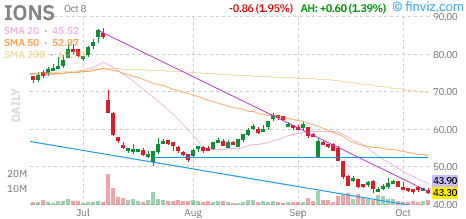
The dated market reference for this hub is the October 8 regular-session close of $43.30, with Finviz reporting approximately $7.20 billion in equity market capitalization. Trading volume for that session was about 3.35 million shares. These are historical market data, not a live October 9 quote. The share price and capitalization can move before or after publication, while the underlying financial statements remain dated June 30. Combining dates is unavoidable in equity research; making those dates explicit is what keeps the comparison interpretable. [15]
Market capitalization is the value of common equity at the referenced price and share basis. It is not enterprise value, cash in the company or the amount a buyer would necessarily pay. Subtracting cash while ignoring convertible principal and royalty-financing claims would create an incomplete valuation bridge. Conversely, treating every reported liability as an ordinary loan without understanding its terms would also be misleading. A transparent model should specify which obligations are included and why, rather than presenting a single unexplained enterprise-value number.
Ownership datasets require similar care. Finviz’s institutional aggregate can exceed 100% because datasets may combine reporting dates, positions and share bases that do not align. This hub does not present that aggregate as literal current ownership. The SEC filing reports 166,184,322 shares outstanding as of July 23, while market-data providers can use another dated basis. These differences should be disclosed or the unreconciled metric omitted. They are not proof of hidden ownership or a particular trading mechanism. Short-interest statistics likewise describe a dated position, not a guaranteed future squeeze. [3] [15]
An accessible Seeking Alpha article published after the pelacarsen setback took a bearish view of Ionis following a sequence of disappointments. It is useful as an attributed investment opinion about risk and valuation, not as an authoritative source for every clinical fact. It also predates the September 22 and September 23 positive updates discussed above. A current assessment must incorporate those later events rather than repeat the earlier thesis unchanged. This hub uses the article to identify questions for examination, while primary releases and filings control the facts. [16]
The market can assign value to expected future royalties well before they enter reported earnings. It can also reduce that value sharply when clinical evidence fails. That forward-looking character explains why a trailing multiple alone is a weak summary of Ionis. Readers need to examine the assumptions embedded in the price: commercial adoption, partner economics, timing, risk and the cost of sustaining the portfolio. Neither a fall from an earlier price nor an apparently low multiple demonstrates undervaluation without that underlying analysis.
14 Valuation scenarios without invented price targets
A useful Ionis valuation separates four components: existing royalty streams, directly commercialized medicines, partnered development assets and the net effect of corporate costs and financing obligations. Each component requires a different set of assumptions. Existing royalties need a view on product durability and contractual sharing. Owned products need sales, gross-to-net and operating-cost estimates. Pipeline assets need evidence-based probabilities and timing. Corporate spending and obligations then determine how much of the aggregate value belongs to current common shareholders.
The constructive scenario assumes that owned launches broaden commercial income, bepirovirsen becomes a meaningful qualifying royalty stream and later-stage programs continue to add value. Under that scenario, commercial growth eventually absorbs a larger portion of the cost base, while diversification reduces dependence on a few historical partnerships. This is an editorial scenario, not company guidance. Its credibility would improve with sequential net-sales progress, favorable regulatory details, disciplined expenditure and actual cash conversion. It would weaken if revenue growth required persistently greater spending than expected.
The cautious scenario assumes slower adoption, lower retained economics, more competition or further pipeline setbacks. A delay in a partnered approval may have limited immediate selling-cost impact on Ionis yet still remove valuable future income. Weak owned-product uptake can be more operationally demanding because commercial costs are already committed. Debt maturities and compensation-related dilution can amplify the effect on per-share value. This scenario does not require every program to fail; several moderate disappointments can matter when the cost base is substantial.
Sensitivity analysis is preferable to a false point estimate. For bepirovirsen, investors can vary qualifying sales and the royalty rate, then discount the timing and uncertainty. For owned products, vary net sales and the spending required to generate them. For failed cardiovascular programs, remove unsupported success assumptions instead of leaving them embedded in a legacy model. The resulting range will be wider than a confident price target, but it more honestly represents the information available. A precise output from uncertain inputs remains uncertain.
This hub does not assign an approval probability or a target share price because the required assumptions would exceed what the verified sources establish. Its Health Score is an editorial framework for business robustness, not a valuation model. The most useful question for a reader is which observable evidence would make the constructive case stronger or weaker. An actual label, product-level quarterly sales, revised expense guidance and a full pivotal dataset are more informative than a generalized statement that the pipeline is promising or the stock has fallen enough.
15 What to watch next and how to update the thesis
October 26 is the verified U.S. target action date for bepirovirsen. The first task on any subsequent update is to replace the pending status with the actual disclosed action, preserving the announcement date and any separate effective or launch date. If the action is favorable, the hub should examine the approved population, warnings, administration requirements and launch information. If it is unfavorable or delayed, the specific reasons and disclosed next steps matter more than an unsupported estimate of how quickly the issue will be resolved. [1]
The next quarterly financial report should clarify owned-product launch progress, milestone recognition after the Japanese bepirovirsen approval and the evolution of cash use. Particular attention belongs to TRYNGOLZA following its price and indication changes, DAWNZERA’s growth, and the early ZANVASTRO commercial path. The same report may update spending expectations and the company’s longer-term objectives. A calendar should not invent an earnings date before a confirmed announcement; the monitoring item here is the next reported financial update and its disclosed schedule.
Ulefnersen’s full clinical presentation and regulatory plan are separate watchpoints. Sefaxersen’s longer-term kidney-function follow-up is another. Neither should be collapsed into the October FDA event. New publications can change confidence in efficacy, safety and durability even when no regulatory deadline is imminent. For a diversified biotechnology company, these quieter evidence updates can be economically important because they affect the probability and timing of future development or commercialization. They deserve explicit tracking rather than appearing only after a major price move.
Commercial evidence should also be monitored over more than one period. A single quarter can be affected by inventory, price transitions, milestones and payment timing. Several consistent quarters provide a stronger basis for evaluating adoption and operating leverage. The same caution applies to negative evidence: a one-time timing issue is not automatically a structural deterioration, but repeated misses without a convincing reconciliation should reduce confidence. The purpose of the hub is to keep the underlying thesis responsive to facts rather than defend an initial conclusion.
The catalyst can influence IONS because it changes expectations about future economic benefits and the credibility of the portfolio. Its importance is real, but its impact cannot be isolated from prior expectations, partnership terms, other clinical results and market conditions. The decision should therefore be read as one major input into a continuing business assessment. A reader following this framework can distinguish scientific success, regulatory progress, commercial adoption and shareholder value, recognizing that each step supplies evidence needed for the next without guaranteeing it.
Sources and research references
Primary disclosures control facts. Finviz supplies dated market data. Seeking Alpha supplies an attributed accessible opinion. Consensus research records were fetched before use; publication design and limitations remain explicit.
[1] Ionis: bepirovirsen FDA priority review and October 26 target, April 28, 2026[2] Ionis: Q2 2026 results and reconciliations, July 29[3] Ionis Form 10-Q, quarter ended June 30, filed July 29, 2026[4] Ionis: TRYNGOLZA broader FDA approval, June 24, 2026[5] Ionis: ZANVASTRO FDA approval, September 3, 2026[6] GSK: HIBSAGO approved in Japan, August 24, 2026[7] GSK: Phase 3 B-Well results, May 28, 2026[8] Hou et al., Bepirovirsen in Chronic Hepatitis B, NEJM 2026; DOI 10.1056/NEJMoa2515131[9] Consensus fetched record: Yuen et al., Efficacy and Safety of Bepirovirsen in Chronic Hepatitis B, NEJM 2022[10] Ionis: Q1 results and 2026 guidance, April 29[11] Ionis: CARDIO-TTRansform primary endpoint not met, July 9, 2026[12] Ionis/Novartis: Lp(a)HORIZON primary endpoint not met, September 4[13] Ionis: ulefnersen FUSION Phase 3 topline, September 22[14] Ionis/Roche: sefaxersen IMAgINATION interim Phase 3, September 23[15] Finviz IONS; API data at October 8, 2026 regular-session close[16] Seeking Alpha: Ionis, Downgrading To Sell After A Series Of Unfortunate Events; September 4 opinion predates later positive trialsIonis stock and bepirovirsen: frequently asked questions
What is the next verified PDUFA date for IONS?
October 26, 2026 is the FDA target action date announced for GSK’s bepirovirsen application in chronic hepatitis B. It is a target for regulatory action, not a guaranteed approval. Olezarsen’s broader TRYNGOLZA indication and ZANVASTRO were already approved earlier in 2026 and should not remain listed as upcoming decisions. [1] [4] [5]
Does Ionis receive all bepirovirsen sales?
No. GSK holds the licensed program, and Ionis participates through contractual payments and royalties. The amended June filing specifies tiered royalties of 10% to 12% outside China, Hong Kong and Macau. Worldwide product sales therefore cannot be booked conceptually as Ionis revenue. Historical payments must also be separated from future conditional milestones. [3]
Does the Japanese approval guarantee FDA approval?
No. Japan approved HIBSAGO in August, providing a completed regulatory milestone in that jurisdiction. The FDA independently evaluates the U.S. application. The Japanese decision is relevant evidence but does not determine the U.S. label, timing or outcome. Any later update should rely on the actual U.S. decision rather than assume reciprocity. [6]
Does a 19% functional-cure rate mean every patient benefits?
No. The reported rate describes the defined endpoint in the selected B-Well population. Most treated participants did not meet that endpoint, and the result does not establish universal eligibility, sterilizing cure or zero future liver-cancer risk. Patient-level treatment decisions require qualified clinical assessment and the applicable approved label. [7] [8]
Is Ionis profitable or debt-free?
The company reported a first-half GAAP net loss and operating cash use. Its substantial June cash and investment balance coexists with convertible notes and a royalty-financing liability. Those obligations and continuing operating requirements need to be considered together. The cash balance alone does not establish profitability or a debt-free capital structure. [2] [3]
Can the catalyst move the share price?
Yes, an outcome that changes expected royalties, timing or confidence can affect valuation. The direction and size of the reaction are not knowable from the date alone. Expectations already reflected in the price, label details and unrelated portfolio news can all matter. This report provides evidence and scenarios rather than a trading instruction or promised return.
 Umbria