Merlintrader Trading Pub
Biotech catalyst, news and analysis PDUFA tracker
Merlintrader Trading Pub
Biotech catalyst, news and analysis PDUFA tracker
AI transparency: articles and reports are produced with the help of artificial intelligence and checked through a process that does not constitute specialist validation. They may contain errors: verify relevant information with independent sources. Read the full disclaimer.
Stock Hub 2026 · Company research
Nasdaq: $ELTX
Premiumreportfree with an ad
ELTX Stock Hub: Elicio Therapeutics News, AMPLIFY-7P and Funding
A revised cancer-vaccine thesis after a negative primary endpoint: the ESMO abstract adds subgroup and post-hoc analyses, while funding determines the next development interval.
Get every Merlintrader report in real time on Telegram: join @merlintraderpub_com.
Daily chart
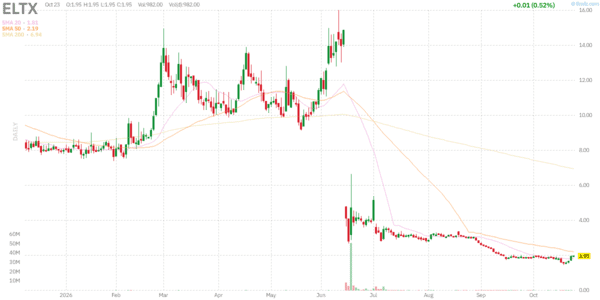
Daily chart $ELTX · October 23, 2026; may include extended-hours dataOpen chart (affiliate link) · For information only.
Next catalyst
Company plans · Q4 2026 and the next financing interval
Combination study execution and funding for the revised strategy
Elicio targeted a metastatic Phase 1 start in Q4 2026. Its adjuvant Phase 3 is conditional on an additional raise. The annual shareholder meeting is scheduled for November 12, 2026. Source · Related announcement
Key data
Latest clinical disclosureOctober 23, 2026 — ESMO abstract confirms the primary miss Source
Dates of the figuresFinancial statements as of June 30, 2026. Source
The constructive case
ELI-002 generates human immune responses, and the ESMO analyses may help define a prospectively testable population or combination. A credible development design with workable financing could preserve a meaningful clinical opportunity.
The case against
AMPLIFY-7P missed primary ITT DFS. Nominal subgroup results and a post-hoc adjusted model retain selection and modeling uncertainty. Short funding guidance, secured debt and further capital needs make per-share economics particularly sensitive to financing.
Operating and financial position
June 30 cash was $23.480 million. The July offering raised approximately $13.6 million net, a transaction completed after the quarter end. First-half operating cash use was $19.810 million. August guidance projected funding into Q1 2027, and the quarterly filing retained going-concern doubt. Source · Related source · Related source
Executive summary
Elicio is developing lymph-node-targeted mutant-KRAS cancer immunotherapies. The 2P Phase 1 publications show early biological activity; the 7P randomized Phase 2 missed its primary clinical endpoint. The current case turns on whether a refined hypothesis can earn prospective validation and attract the capital needed to test it.
Latest news
October 23, 2026 — ESMO abstract confirms the primary miss
Primary DFS HR was 0.85, p=0.539. The abstract adds nominal subgroup analyses and a post-hoc adjusted model; 99% immunogenicity concerns evaluable patients, not a clinical response rate. Source
October 9, 2026 — Proxy updates shares and the annual meeting
The record-date common count was 27,091,187 on September 17. The annual meeting is scheduled for November 12; the proxy also describes the related-party secured note. Source
September 24, 2026 — AMPLIFY-7P selected for late-breaking ESMO oral
Elicio said new pre-specified analyses would be presented as LBA83 on October 23 in Madrid. Source
August 13, 2026 — Resources and the revised development interval
The company reported June cash of $23.480 million and projected resources into Q1 2027 after July financing. Metastatic combination work was targeted for Q4 2026. Source
Extended analysis
Does $ELTX deserve a place in your portfolio?
The full deep dive has the answer’s building blocks: cash, dilution, catalysts and risks, every figure sourced.
Free. No signup. You decide, we don’t recommend.
Using an ad blocker? The free “watch an ad” option is hidden automatically. Pause it on merlintrader.com and reload the page to see the free option.
01 What Elicio Therapeutics does: the ELI-002 development thesis
Elicio Therapeutics is a clinical-stage biotechnology company developing lymph-node-targeted cancer immunotherapies. Its lead program, ELI-002, is an investigational therapeutic vaccine directed at cancers carrying specified mutant KRAS alterations. The company is based in Boston, Massachusetts, and its common shares trade on the Nasdaq Capital Market as ELTX. It has no established product-sales business supporting the current development program. Its resources, clinical evidence and financing options therefore determine the near-term investment case. Quarterly filing
ELI-002 is designed to stimulate an immune response against tumor-associated mutant KRAS targets. It is a therapeutic approach for people with cancer, rather than a routine preventive vaccination. The seven-peptide formulation, ELI-002 7P, is also called camupepimut in the September corporate announcement. An earlier two-peptide formulation was studied in AMPLIFY-201. Those formulations and studies are related, but their populations, trial designs and results need to be assessed individually. Program description
The central current fact is the outcome of the randomized Phase 2 AMPLIFY-7P study. Elicio announced in June 2026 that the trial missed its prespecified primary disease-free survival endpoint in the intent-to-treat population. The official ESMO abstract available October 23 reports the corresponding hazard ratio and additional analyses. This negative primary result is the starting point for evaluating the revised strategy, even though the program continues to show immune activity and signals in selected analyses. June results · ESMO abstract
The company’s response has been to explore more focused development questions. These include the role of residual disease, surgical margins and combinations with other treatments. A narrower hypothesis can be scientifically reasonable after a broad study fails. Its investment value depends on whether it can be tested prospectively with an appropriate design, adequate resources and regulatory alignment. A favorable retrospective analysis is a reason for further work, while the next trial must supply its own evidence.
The financial position makes that distinction practical. June cash and a July offering supported an operating interval extending into early 2027 under the company’s August guidance. The quarterly filing explicitly linked a future adjuvant Phase 3 start to an additional capital raise. Clinical strategy and financing are therefore intertwined: a credible design needs funding, while potential funding partners or investors will assess the quality of the revised clinical case. Development and liquidity update · Quarterly filing
ELTX is consequently an uncertain redevelopment case supported by a biological platform, rather than a company with a successful randomized Phase 2 ready for an already-funded registration program. The opportunity is that a more precise population or combination could unlock useful clinical benefit. The risk is that immune activity and subgroup findings fail to translate into a reproducible patient outcome before resources become constrained. Both possibilities need to remain visible in the analysis.
02 Lymph-node targeting, mutant KRAS and the evidence ladder
The AMP platform aims to direct immune stimulation toward lymph nodes, where immune responses are organized. ELI-002 combines that delivery concept with mutant KRAS targets. The scientific rationale is to generate T cells capable of recognizing relevant tumor antigens. A successful immune response is an important biological observation. Whether it prevents recurrence, prolongs survival or improves another patient outcome is a separate clinical question requiring an appropriate trial. Original Phase 1 publication
The off-the-shelf concept is commercially interesting because it differs from manufacturing an individualized product for each patient. A standardized product could offer logistical advantages if its target coverage and clinical performance are sufficient. Yet availability alone does not settle efficacy, manufacturing cost, reimbursement or the final treatment setting. A product must demonstrate benefit in a defined population before those practical features can support a durable commercial proposition.
Mutant KRAS is a specific tumor characteristic, and relevant mutations vary across cancers and patients. The transition from a two-peptide to a seven-peptide formulation expanded the set of targeted mutations. Broader target coverage can increase the potential eligible population, but the proportion of tumors carrying a target is not the same as a reimbursed market. Stage of disease, prior therapy, resection status, residual disease and the eventual label can narrow the practical opportunity substantially. Program and trial record
The evidence ladder has several levels. Immunogenicity measures whether a biological response is induced. Biomarker changes can show a change in a marker associated with disease. Clinical time-to-event outcomes assess events such as recurrence or death over follow-up. These levels can be associated without becoming interchangeable. A high proportion of immune responders is not a high tumor-response rate, and a favorable biomarker change is not automatically a proven survival benefit.
This distinction is particularly important in the adjuvant setting, where treatment follows surgery and other standard therapy. Patients may have no visible measurable tumor but remain at risk of recurrence. A randomized comparison helps determine whether additional treatment changes that risk. An uncontrolled early-phase cohort can provide safety, immune and exploratory outcome observations, while patient selection and underlying prognosis make causal efficacy conclusions more difficult. Phase 1 final results · Randomized study results
For investors, platform plausibility creates the opportunity to conduct development. The clinical evidence determines how much of that opportunity has been validated. ELI-002 has demonstrated biological activity in early studies, while AMPLIFY-7P failed its primary randomized efficacy test. Further development must connect those two observations through a testable explanation and a credible prospective program. The mechanism remains relevant, but it cannot carry the valuation independently of the clinical outcome.
03 AMPLIFY-7P: the randomized primary endpoint was not met
The randomized Phase 2 portion of AMPLIFY-7P enrolled 144 patients at 24 U.S. centers after treatment for resected mutant-KRAS pancreatic ductal adenocarcinoma. The official ESMO abstract reports 96 assigned to ELI-002 7P and 48 to observation. The study assessed investigator-determined disease-free survival. The June announcement said the prespecified primary endpoint was missed, and the October abstract supplies a primary DFS hazard ratio of 0.85 with p=0.539. June announcement · Official abstract
The primary outcome measures the randomized study’s central efficacy question. The hazard ratio summarizes the relative rate of events over the analyzed period, rather than the percentage of patients cured or the number of months gained. A value below one can favor treatment numerically while remaining insufficient under the trial’s success criteria. The reported p value and the stated failure make the result a negative primary analysis, even though other outcomes warrant further examination.
The trial framework described in the abstract included a target hazard ratio of 0.70 or lower and an approximate two-sided alpha of 0.10. The observed primary estimate did not meet the study’s objective. This matters when assessing later analyses: the original test and its outcome remain the most direct evidence for the enrolled randomized population. Subsequent adjustments can explore explanations without retroactively changing that result.
The June release highlighted an imbalance in surgical margins. R1 resection, indicating microscopic residual tumor at a margin, was reported in 19% of the treatment group and 10% of observation. In a post-hoc R0 analysis involving 121 patients, the company reported DFS HR 0.65, p=0.048, and median DFS of 23.8 versus 12.8 months. These are selected post-hoc findings with a different evidentiary status from a successful primary test. June subgroup analysis
Surgical and biological imbalances can be relevant to a study’s interpretation, especially with modest sample sizes. They may motivate stratification or eligibility changes in a future program. The strength of that explanation depends on whether it predicts benefit in a subsequent prospectively defined population. A data-driven refinement can be valuable while retaining the risk that the apparent subgroup effect reflects chance, selection or interactions that are not reproduced.
The immediate investment implication is a higher burden of proof for the next development strategy. The company needs more than a continuation of the earlier immunogenicity narrative. It needs a convincing clinical question, a feasible design and capital to test it. Positive selected analyses can support that planning, but a future program will have its own endpoint, population and statistical requirements. The negative randomized primary result remains material to both the science and the financing discussion.
04 ELTX stock catalysts: the October ESMO abstract and its limits
The official ESMO 2026 program includes LBA83, the AMPLIFY-7P randomized Phase 2 abstract. Its available text reports the failed primary DFS comparison and several additional analyses. These data are available in the abstract separately from the oral presentation scheduled for ESMO 2026 on October 23. The distinction matters because the numerical evidence can be assessed directly without assuming that an oral presentation has changed or superseded the written results. Official ESMO abstract
The abstract reports a six-month DFS rate, listed as a pre-specified secondary endpoint (the June release had described the landmark analyses as post-hoc), with rates of 75.7% for treatment and 61.7% for observation, HR 0.55 and p=0.0557. That p value is above the conventional 0.05 threshold, while the study’s stated approximate alpha was 0.10. Its interpretation also depends on the endpoint hierarchy and the failed primary analysis. The six-month observation describes an early interval, while the primary DFS result addresses the broader time-to-event question.
The abstract also reports a baseline ctDNA-positive imbalance: 20 of 96 participants in the treatment group versus six of 48 in observation. ctDNA can be associated with residual disease and prognosis, making this a potentially important explanatory factor. The available analyses explore that relationship. They are part of the effort to understand heterogeneity in the randomized population, rather than a replacement for the primary result.
In the ctDNA-negative subgroup, involving 93 patients overall, the reported HR was 0.51 with nominal p=0.0280; median DFS was not reached versus 21.2 months. In the subgroup without radiation, involving 106 patients, the HR was 0.59 with nominal p=0.0221 and medians of 23.8 versus 10.4 months. Nominal p values retain the uncertainty associated with multiple comparisons. Subgroup table
A median reported as not reached means that the observed event pattern had not crossed the median threshold at that analysis. It is not an estimate of an infinite benefit or a guarantee about later follow-up. Time-to-event curves can change as more events occur, and a selected subgroup can have a different risk profile from the overall trial. For the same reason, a hazard ratio and a pair of median times summarize different aspects of an outcome. Interpreting them together requires the population, follow-up and analysis method. This is especially relevant when a company’s development decision rests on distinguishing a plausible favorable population from a negative overall randomized result.
A separate multivariable model is explicitly post-hoc. It reported an adjusted treatment HR of 0.45, with a 95% confidence interval of 0.25–0.80 and p=0.0064. A model can help explore the relationship between treatment, baseline risk and outcomes, but its estimate depends on the selected covariates and assumptions. The contrast with the unadjusted primary HR is scientifically relevant and requires prospective validation before it can support a reliable estimate for a future patient population.
The biological and safety observations remain distinct. Mutant-KRAS-specific T-cell responses were observed in 89 of 90 evaluable patients, or 99%. That is an immunogenicity rate in an evaluable subset. Overall grade-three-or-higher adverse events were reported in 10.4% versus 14.6%, and serious adverse events in 6.3% versus 8.3%. These overall event categories are not interchangeable with treatment-related events. The commercial case still requires a patient benefit supported by the full efficacy and safety evidence, not immunogenicity alone.
05 AMPLIFY-201: early biological activity and the same-cohort follow-up
AMPLIFY-201 studied ELI-002 2P in 25 patients with evidence of minimal residual mutant-KRAS disease after standard locoregional treatment. Twenty had pancreatic cancer and five had colorectal cancer. The original 2024 report described a Phase 1, nonrandomized study focused on safety and development parameters, with immune, biomarker and exploratory outcome assessments. Its size and design are appropriate to an early development question, while limiting causal efficacy conclusions. Original study
The original paper reported mutant-KRAS-specific T-cell responses in 21 of 25 patients, or 84%. Tumor biomarker responses were also reported in 21 of 25, with clearance in six of 25. These are different observations: an immune response concerns the induced T cells, a biomarker response concerns a measured marker, and clearance concerns the disappearance of the marker under the assay definition. None is a conventional randomized tumor-response rate.
The final 2025 publication followed the same clinical study and cohort. It added longer-term immune and clinical observations, with median follow-up of 19.7 months. Patients with higher measured T-cell responses had more favorable relapse-free and overall survival observations than lower responders. That association supports a biological hypothesis, while the groups were not formed by randomizing patients to high or low immune response. Underlying prognosis and post-treatment factors can influence both group membership and outcome. Final results
The final analysis used a data-derived immune-response threshold. Such a threshold can help identify a candidate predictor, but its performance may be more favorable in the dataset used to select it than in a new population. Prospective validation tests whether the relationship remains useful after the threshold and analysis are fixed in advance. The 2024 and 2025 publications add depth to one study; they are not two independent randomized demonstrations of benefit.
The formulation and disease setting also differ from the later randomized program. ELI-002 2P covered a narrower mutation set, and the early cohort was selected for residual-disease markers. AMPLIFY-7P tested a broader formulation in a randomized adjuvant pancreatic population. Differences can help explain why results are not numerically comparable. They also make a clear prospective hypothesis more important if the next program returns to a more selected disease-risk group.
The early work retains value after the randomized miss because it shows that the platform can induce relevant immune activity in humans. Its value is biological and exploratory rather than confirmatory. The next commercial development decision must determine whether that activity can become a reproducible improvement in an appropriate clinical outcome. Funding, design and execution then determine whether the question can be answered within a realistic development interval.
06 The next studies: combinations, neoadjuvant work and Phase 3 funding
The August corporate update described a planned Phase 1 study of ELI-002 7P with a RAS small-molecule inhibitor, with or without anti-PD-1 treatment, in metastatic pancreatic cancer. Initiation was targeted for the fourth quarter of 2026. The quarterly filing discussed potential readouts three to six months after study start. These are development expectations tied to an actual future start and the trial’s progress, rather than a fixed calendar promise of efficacy results. August update · Quarterly development discussion
The rationale for the metastatic study draws on observations the company reported on June 17, 2026. Three patients whose disease progressed after ELI-002 7P in AMPLIFY-7P later achieved confirmed complete radiographic and complete metabolic responses after subsequent gemcitabine/nab-paclitaxel chemotherapy and nivolumab. These are anecdotal, uncontrolled observations in three patients: they support testing the combination prospectively, but they do not show how much of each response is attributable to the vaccine. June 17 release
Combination development asks a different question from the randomized adjuvant study. Patients with metastatic disease have a different disease burden, treatment history and prognosis. Additional agents can influence both efficacy and toxicity. A favorable combination outcome would need analysis of the full regimen and study design. It would not automatically identify the contribution of each component or establish that the earlier adjuvant program was effective in its full randomized population.
A separate investigator-initiated neoadjuvant study was announced open in August. The trial is led by Memorial Sloan Kettering and studies ELI-002 7P in an approach beginning before surgery, alongside other treatment components. The registry describes a randomized open-label pilot with an estimated 20 participants. This is distinct from the company-planned metastatic study, with different sponsorship, objectives and patients. Investigator study announcement · Trial record
External funding of an investigator study can broaden the clinical questions studied around a program. It differs economically from a pharmaceutical licensing agreement with an upfront payment and commercial rights. The value lies in the evidence that may be generated and the degree to which it can inform further development. Small pilot work can explore feasibility and biological activity while leaving a registration program and commercial funding needs ahead.
For the proposed adjuvant Phase 3, the quarterly filing is explicit about capital: the company did not expect to commence it until completing an additional raise. That condition is central to the catalyst map. A development design may be attractive, but enrollment cannot proceed at the intended scale without resources and operational readiness. The financing requirement also affects common shareholders because the terms can change the allocation of future value. Capital requirement
Registry dates provide useful operational context, with a different meaning from company result guidance. AMPLIFY-7P is listed as active, not recruiting, with 158 total participants across the broader Phase 1/2 program; the randomized Phase 2 population was 144. Estimated study completion is an administrative forecast, not a promised press-release date. The next meaningful events are the actual study starts, financing decisions and prospectively defined development plans that can turn the revised hypothesis into a testable program. AMPLIFY registry
07 ELTX earnings, cash burn and the July financing
Elicio reported cash of $23.480 million at June 30, 2026. Current assets were $25.485 million and current liabilities were $9.202 million. The resulting working-capital position is different from cash available for development because it includes other current assets and liabilities. Total assets were $31.330 million, liabilities $23.393 million and shareholders’ equity $7.937 million. The dated balance sheet provides a clear starting point, while subsequent financing and spending change the later position. Quarterly balance sheet
During the first half, operating cash use was $19.810 million and net loss was $20.040 million. The cash-flow figure corresponds to a historical average of approximately $3.30 million per month. That average is useful for understanding the scale of expenditure, but it is not a forward spending forecast. Clinical programs can start, stop or change scope, and payments can move between periods. The actual cash position in October cannot be reconstructed reliably from the June balance and a constant monthly assumption.
The July registered direct offering raised $15 million gross. The company reported approximately $13.6 million net, with 4,380,313 shares sold at $3.43. Gross size and net resources have different meanings because transaction expenses reduce the funds retained. The offering occurred after the June reporting date. Adding net proceeds to June cash gives only a pro-forma illustration before intervening expenditure, rather than a reported later cash balance. Offering closing · Prospectus
The August update guided to funding operations into the first quarter of 2027. The quarterly filing retained substantial doubt concerning the company’s ability to continue as a going concern. Both observations belong to the disclosed operating plan and financial assessment. A financing can extend the available interval while leaving a need for more capital. The particularly important condition is that the proposed adjuvant Phase 3 requires a further raise. Liquidity guidance · Capital and going-concern disclosure
The second-quarter net loss was $8.217 million, while operating expenses were $10.429 million. Those measures differ because the net result includes items outside operating expense. The investment assessment should focus on the resources needed to generate the next useful clinical evidence, along with obligations that compete for the same cash. A lower accounting loss in one quarter does not necessarily imply that a larger future trial is funded or that monthly cash needs have permanently declined.
Financial flexibility therefore has direct clinical consequences. A focused program with a limited budget may reach an informative early result sooner, but a registration trial can demand substantially more capital and time. Management must decide which questions provide the greatest evidence for the available resources. For common shareholders, the quality of that allocation matters alongside the terms of the next financing. Preserving operations and creating enough new value per share are related objectives with potentially different outcomes.
08 ELTX share dilution, warrants and the secured note
The October proxy reported 27,091,187 common shares outstanding at the September 17 record date. This is later than the 26,281,882 shares on the August 11 cover page of the quarterly filing. The distinction matters when comparing market value with financial resources. A share count is a dated measure, and ongoing issuance can alter it. Period-average shares used in earnings calculations describe a different denominator from the shares outstanding at a record date. Proxy capitalization · Quarterly filing
Elicio used its at-the-market facility during the first half, issuing 4,077,772 shares for approximately $24.4 million net. The filing also described a newer ATM authorization of up to $100 million and a shelf of up to $400 million. Those capacities create potential financing routes subject to their terms and market conditions. They are not cash already raised. The July direct offering is an actual transaction and therefore belongs separately in the financing chronology. Financing notes
At June 30, total warrants were 6,188,021, including 2,632,702 prefunded warrants with a $0.01 residual exercise price and 3,555,319 ordinary warrants. The ordinary instruments include series with exercise prices of $5.00, $7.80 and $7.75, as well as legacy instruments. Prefunded warrants and ordinary warrants have different economic and funding characteristics. Most of the purchase price for a prefunded instrument has already been paid, while cash from an ordinary exercise depends on the holder exercising under the applicable conditions.
The company also reported options and unvested restricted awards. Their participation depends on their terms, vesting and exercise conditions. Loss-per-share accounting can exclude potential shares because they are antidilutive in a loss period, even though those instruments remain relevant to future ownership. A fully diluted valuation needs a consistent methodology rather than simply adding every disclosed instrument without considering cash proceeds or conditions.
A separate $10 million senior secured related-party note remained outstanding at the proxy date. Its maturity is June 3, 2028, with principal payments scheduled to start July 1, 2027. Interest is prime plus five percentage points, capped at 12.5%. These terms create claims on future cash before common shareholders receive residual value. The older $20 million convertible note had been satisfied through conversion in March 2025 and is a different historical financing. Debt disclosure
The capital structure combines a development opportunity with several claims on the outcome. New financing may be essential to test the revised clinical strategy, yet it can change the share base or priority of claims. Warrant exercise can add resources under favorable conditions, but anticipated proceeds remain conditional. The central question is whether each financing interval enables evidence that increases the company’s value enough to compensate for the capital supplied and the additional securities issued.
09 Intellectual property, manufacturing and platform economics
Elicio’s platform depends in part on an exclusive worldwide license from MIT covering specified AMP patents and applications. The relationship originated in 2016 and includes development, maintenance, milestone and royalty obligations. The annual filing described expected patent-expiry ranges extending from 2033 to 2041 for the relevant licensed portfolio, with different timing for other intellectual property. A range across patent families is different from a single guaranteed exclusivity date for ELI-002 in every market. License and IP disclosures
The quarterly report for the period ended June 30, 2026, filed August 13, identified remaining potential development and commercial milestones of up to $26.2 million under the license, with disclosed royalties ranging from 0.25% to 2% depending on the applicable definitions and products. These amounts are conditional. They need to be considered when modeling a successful development path, while their timing differs from the immediate operating cash requirement. A platform license can provide essential rights and still leave meaningful obligations attached to future progress. License notes
Intellectual property protects different aspects of a biotechnology product. Claims concerning delivery, composition, use or manufacture can have different scope and exposure to challenge. Practical protection also depends on jurisdiction and competitors’ approaches. For a clinical-stage company, patent count alone is therefore a poor substitute for understanding what rights support the eventual commercial product and how long those rights may remain effective.
Manufacturing is another step between an immune signal and a viable medicine. An off-the-shelf approach may simplify some logistics relative to an individualized product, but it still requires reproducible quality, supply and regulatory controls. The economics depend on the eventual process, scale, regimen and commercial setting. Potential logistical advantages can be part of a development thesis while remaining unproven as a final cost advantage.
The earlier programs ELI-007 and ELI-008 broaden the platform concept toward mutant BRAF and TP53 targets, respectively. They remain preclinical. Their value is therefore early optionality with additional scientific, development and financing risk. They cannot be counted as independent late-stage clinical assets or assumed to replace the financial value lost from a negative randomized result in the lead program. Pipeline stages · Quarterly business description
The most useful platform economics are tied to evidence. Rights, manufacturing and additional targets become commercially valuable when a product can demonstrate patient benefit in a setting where it can be developed, approved and supplied. A broader set of scientific applications can expand future opportunities, but it also increases the potential resource requirement. In Elicio’s current position, prioritization and funding of the next decisive clinical question are more immediate than the full theoretical reach of the platform.
10 The KRAS vaccine landscape and combination evidence
Research on mutant-KRAS-directed vaccination provides an independent scientific context for Elicio’s work. The 2024 AMPLIFY-201 publication established early human immune activity for ELI-002 2P, and its 2025 follow-up added longer observation of the same cohort. Other groups have tested different KRAS vaccines and combinations. A common target creates a biological connection across these programs, while differences in products, regimens and populations limit how their numerical results can be compared. Initial ELI-002 study · Independent combination study
One 2026 Phase 1 publication studied a different mutant-KRAS vaccine, mKRAS-VAX, combined with ipilimumab and nivolumab in 12 patients with resected pancreatic cancer. The investigators reported immune responses to the targeted antigens and to tumor-specific mutations. Those observations concern immunology, not a randomized estimate of tumor response or recurrence reduction. The product was different from ELI-002, and the combination added checkpoint therapies with their own activity and risks. Original combination publication
The safety distinction is equally important. Events attributed to the vaccine were grade one or two, while the combined treatment program also produced grade-three immune adverse events associated with checkpoint therapy. A favorable vaccine-attributed event profile is therefore narrower than saying that the whole regimen had no serious toxicity. For an investor considering combination development, the total regimen’s tolerability and feasibility matter as much as the attribution to an individual component.
The field-level implication is that mutant-KRAS immune targeting can be studied through several approaches, including different delivery platforms and combinations. It remains a development field where small cohorts can show compelling biological signals without resolving clinical utility. Independent activity can support the scientific importance of the question, yet it also represents potential competition for patients, partners, capital and eventual commercial positioning.
Comparative claims require more than similar antigen targets. An adjuvant population after standard therapy differs from metastatic disease or a setting before surgery. Additional treatment can alter both outcomes and adverse events. A randomized control within the relevant population provides a stronger basis for assessing the treatment question than comparing response percentages across early studies. ELI-002’s primary randomized result must therefore remain part of its own evaluation even when the wider field advances.
The constructive research path is prospective refinement: choose a population and regimen for a clear reason, define the relevant outcome in advance, and test it with enough rigor to distinguish benefit from selection and chance. The unresolved investment question is which company can execute that path with adequate resources and a useful clinical profile. Biological enthusiasm is an input to that process; the final value depends on evidence, development time and the economics retained by shareholders.
11 ELTX valuation: constructive, middle and adverse paths
The constructive case starts with a narrower, clinically credible explanation for the AMPLIFY-7P outcome. Baseline risk, residual disease or treatment context identifies a population in which benefit can be tested prospectively. Regulators and potential funding sources find the proposed question sufficiently persuasive, the company obtains capital on workable terms, and subsequent studies produce reproducible clinical evidence. In that path, the immune activity and selected analyses become useful inputs to a successful development strategy.
The financing requirement remains central even in the constructive case. A strong scientific plan needs sufficient resources to enroll patients, maintain supply, follow outcomes and prepare the relevant regulatory package. A partnership could share risk or development costs, while an equity raise would increase the ownership base. The value attributable to existing common shares depends on the terms, not merely on whether funding arrives.
The middle case is continued scientific activity with a longer and more expensive route to a decisive answer. Small combination or investigator studies may produce interesting observations while leaving registration questions unresolved. The company may refine the strategy again as evidence accumulates. Such progress can preserve options, but time and repeated financing can reduce the present value of those options for each existing share.
The adverse case is that favorable immune responses and selected analyses fail to predict useful patient benefit in the next program. Alternatively, funding may be unavailable on acceptable terms before the company can conduct an adequate test. Operational or safety issues could further narrow the available route. In that outcome, a scientifically plausible platform may retain research interest while providing little value to common shareholders after capital consumption and senior claims.
Cash-based valuation also has limits. The June balance sheet and July net proceeds are dated resources, with ongoing spending and debt obligations. A market value near or below an earlier cash figure can appear compelling while ignoring how much capital is needed to reach a new evidence milestone. Conversely, an early clinical company can create substantial value if a relatively focused trial resolves a high-value uncertainty. The useful question is the cost and probability of obtaining that evidence, rather than a static comparison with historical cash alone.
These paths are analytical scenarios without assigned probabilities or price targets. The facts that can move the assessment include an actual financing, a defined registration strategy, initiation of the planned combination work, and prospectively interpretable clinical outcomes. A change in one variable can alter several others: a narrower trial can reduce cost but limit market breadth, while a broader program can increase potential value and funding requirements. The per-share result depends on that full relationship.
12 Ownership, governance and the next decision points
The September record-date ownership disclosures show meaningful concentration. The proxy reported GKCC at 23.2%, the controlling director’s beneficial ownership at 31.1%, and directors and executive officers as a group at 34.6%. These positions overlap. Beneficial ownership includes certain exercisable rights using holder-specific calculations, so the percentages are not additive and do not all represent simple percentages of common shares alone. Ownership table
Among outside holders, the proxy lists Moti Investments LLC at 5.2%, based on its Schedule 13G filed July 16, 2026, which reported 6.1% as of July 1, 2026. Knoll Capital Management reported 5.3% in a July 8, 2026 Schedule 13G/A. Moti Investments 13G · Knoll Capital 13G/A
Concentration can support continuity and access to committed capital, while also shaping governance and the practical influence of other shareholders. Related-party financing creates an additional relationship between a capital provider and the company. The assessment should focus on disclosed terms, priorities and decision rights. Speculating about an individual’s motives is less useful than understanding which claims must be satisfied and how future financing could affect common holders.
The annual shareholder meeting is scheduled for November 12, 2026. That is a governance event identified in the proxy. Meeting business, voting outcomes and later financial reporting can each change the information available to shareholders, with different implications for development, oversight and capital. Meeting notice
Investor sentiment can be pulled between strong immunogenicity and a negative primary endpoint. The tension is real because both observations exist. Optimism may focus on a refined population or combination; skepticism may focus on statistical selection and the need for more capital. The useful comparison concerns the specific next test that could resolve those competing views. General enthusiasm for cancer vaccines cannot substitute for the evidence of this particular program.
The strongest next update would connect a clear prospective hypothesis with resources and an executable program. An actual study start would confirm an operational step, while efficacy would still require follow-up and analysis. An actual funding transaction would improve resources while setting new ownership terms. Reading those developments together provides a better picture than treating each announcement as an independent success or failure.
For ELTX, the current position combines promising human immune activity, a failed randomized primary endpoint and a limited financing interval. The revised strategy may produce an important clinical opportunity, but it carries a substantial burden of proof and a need for additional capital. The appropriate assessment remains conditional on what the next studies and transactions actually deliver. The evidence can strengthen, narrow or weaken the thesis as those events occur.
ELTX Stock FAQ: Elicio Therapeutics Questions Answered
What is ELI-002?
ELI-002 is an investigational lymph-node-targeted therapeutic cancer vaccine directed at specified mutant KRAS targets. The seven-peptide formulation is also called camupepimut. It is being studied in cancer treatment settings, with clinical benefit and regulatory approval still uncertain. Program announcement
Did AMPLIFY-7P meet its primary endpoint?
No. The randomized Phase 2 missed its prespecified intent-to-treat DFS endpoint. The official ESMO abstract reports HR 0.85 and p=0.539. Selected subgroup and adjusted analyses have different evidentiary status from the failed primary comparison. June results · ESMO abstract
What does the 99% immune-response figure mean?
The ESMO abstract reports mutant-KRAS-specific T-cell responses in 89 of 90 evaluable patients. It is an immunogenicity result in that subset, not a tumor-response rate, cure rate or proof of randomized survival benefit. Clinical outcomes remain the key development question. Abstract
Are the ESMO subgroup findings confirmatory?
The ctDNA-negative and no-radiation analyses have nominal p values. The multivariable adjusted model is explicitly post-hoc. They can motivate future study design while retaining selection, multiplicity and modeling uncertainty. The primary randomized result remains negative. Official abstract
Are the 2024 and 2025 AMPLIFY-201 papers separate trials?
They describe the original and final follow-up of the same 25-patient Phase 1 study of ELI-002 2P. The later report adds follow-up rather than an independent randomized replication. Their immune and outcome associations remain early clinical evidence. Original publication · Follow-up
How much cash did Elicio report?
June 30 cash was $23.480 million. The July offering added approximately $13.6 million net after a $15 million gross transaction. Ongoing spending separates those dated amounts from a later cash balance. August guidance projected resources into Q1 2027, and going-concern doubt remained explicit. Quarterly filing · Offering · Guidance
Is Phase 3 already funded?
The quarterly filing said the adjuvant Phase 3 was not expected to begin until an additional capital raise. A future design and its financing are therefore linked. The planned metastatic Phase 1 and the separate investigator-led neoadjuvant pilot ask different clinical questions. Development plans
When is the 2026 annual meeting?
November 12, 2026, at 10:30 a.m. ET, held virtually, according to the October 9 proxy statement. Proxy
What would strengthen the development case?
A prospectively defined program supported by financing, followed by reproducible clinical benefit in the intended population, would strengthen the case. Additional immune or selected subgroup findings can guide that work, while patient outcomes and adequate safety evidence determine the clinical proposition. This is an analytical framework, not an investment recommendation.
Sources
- Quarterly financial statements and development plans
- Annual business and intellectual-property disclosures
- October proxy, meeting and ownership
- June randomized Phase 2 results
- August operating and financial update
- Official ESMO LBA83 abstract
- ESMO presentation announcement
- AMPLIFY-201 original publication
- AMPLIFY-201 final follow-up
- Independent KRAS-vaccine combination study
- Registered direct offering closing
- Offering prospectus
- Neoadjuvant study announcement
- AMPLIFY-7P registry
- Neoadjuvant study registry
- Pipeline stage overview
Join the Merlintrader community: follow the discussion and get more deep dives on our subreddit — r/MerlintraderPub — and on the Telegram channel @merlintraderpub_com.
Get these reports in real time
Every Merlintrader stock hub, catalyst update and market brief is published to Telegram the moment it goes live. No paywall, no spam, just the research.
Disclaimer. This content is published by Merlintrader for educational and informational purposes only. It is independent journalism and research. It does not constitute investment advice, an investment recommendation, an offer or a solicitation to buy or sell any security, and it is not a research report within the meaning of applicable United States securities regulation. Nothing here should be read as a recommendation to buy, sell or hold $ELTX or any other security.
Figures are taken from public filings with the U.S. Securities and Exchange Commission, company press releases and market-data providers, and are stated with their reference dates. Data can change without notice, and figures published before a results release become outdated the moment that release is issued. Merlintrader makes no representation that the information is complete or current at the time of reading. Readers should verify every figure against the primary source before acting on it.
Biotechnology companies face clinical, safety, regulatory, manufacturing, commercial and financing risks. Trials can fail, adverse effects can limit use, regulatory applications can be delayed or rejected, and an approved medicine may not achieve commercial expectations. Additional borrowing or equity issuance can increase obligations or dilute existing shareholders. Investors can lose part or all of their capital. Every reader is responsible for their own decisions and should consult a licensed financial adviser where appropriate.
Merlintrader may hold positions in securities mentioned. Some links on this page are affiliate or referral links, which may generate a commission at no cost to the reader. Full legal information is available on the disclaimer and terms of use and privacy pages.
ELTX Stock Hub: Elicio Therapeutics News, AMPLIFY-7P and Funding · Merlintrader
Biotech catalysts and company research
Clinical milestones, regulatory events and independent company analysis.
Open the biotech catalyst calendar → · Top Ten Biotech →