Merlintrader Trading Pub
Biotech catalyst, news and analysis PDUFA tracker
Merlintrader Trading Pub
Biotech catalyst, news and analysis PDUFA tracker
AI transparency: articles and reports are produced with the help of artificial intelligence and checked through a process that does not constitute specialist validation. They may contain errors: verify relevant information with independent sources. Read the full disclaimer.
LNG Beyond the Export Boom: Cheniere, Venture Global, NextDecade and Golar Follow Four Different Routes to Cash
Compare Cheniere, Venture Global, NextDecade and Golar through LNG contracts, construction, project ownership, financing and cash flow.
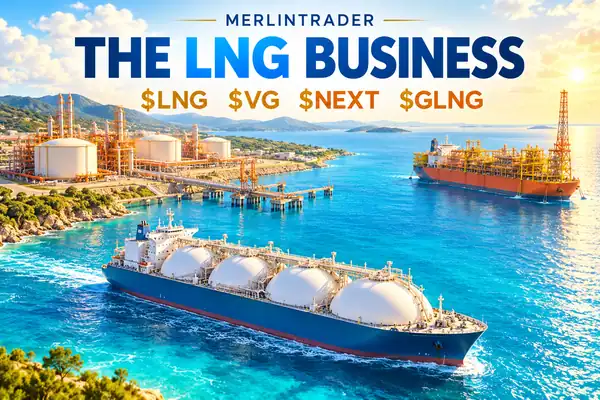
A cargo of liquefied natural gas leaves a terminal only after a long chain of work has come together. Gas has to reach the plant, equipment has to run reliably, storage has to be available and a ship has to arrive within the right window. Behind that physical chain sits another one: construction contracts, lenders, customers, minority investors and the agreements deciding who receives the money.
The second chain is where four apparently similar LNG stocks become very different businesses. Cheniere operates an established export platform while developing further expansions. Venture Global is moving large projects through commissioning into long-term commercial arrangements. NextDecade is building Rio Grande LNG through joint ventures with distribution rights that vary by phase. Golar owns floating liquefaction infrastructure whose earnings depend on contracts with gas-resource owners and the cost of converting, operating and redeploying its vessels.
All four can benefit from demand for moving natural gas across oceans. They do not capture that demand in the same way. A high LNG selling price may be valuable to a seller of uncontracted cargoes, less important to a fixed-fee infrastructure provider, and irrelevant to a project that is still spending heavily before first production. The relevant question is how a change in the market reaches the particular asset and then survives the claims ahead of the common shareholder.
By late October 2026, the comparison had become especially concrete. Cheniere and NextDecade had released third-quarter updates. Venture Global was approaching its planned year-end commercial milestone for Plaquemines Phase 1. Golar had followed its latest interim accounts with a new bond-pricing announcement and the acquisition agreement for another conversion vessel. Each development advanced a different part of the journey from an LNG concept to cash that can be reinvested or distributed.
Extended analysis
Continue with the extended analysis: $LNG $VG $NEXT $GLNG
The full comparison, company developments, financial context and upcoming milestones.
Free. No signup. You decide, we don’t recommend.
01. The useful business starts before the gas becomes liquid
LNG is natural gas cooled to a liquid state for storage and transport. Liquefaction reduces its volume dramatically, making it possible to move large quantities by sea to places that cannot be reached economically by pipeline. The process connects gas supply in one region with demand somewhere else, but it requires specialized infrastructure at both ends. The U.S. Energy Information Administration explains the LNG chain.
That physical transformation does not create a single uniform business model. A company might buy gas, liquefy it and sell the resulting LNG. It might provide liquefaction capacity to a customer that has arranged the gas and the eventual sale. It might own part of a terminal while another entity finances and operates it. The same industrial process can consequently support different sources of revenue and different exposures to commodity prices.
The location of the asset changes the surrounding requirements too. A U.S. onshore plant needs pipeline connections, utilities, storage tanks, loading facilities and access to suitable water. A floating unit needs a gas-supply arrangement, mooring and marine systems, and a compatible plan for taking LNG away. Putting liquefaction equipment on a vessel changes the configuration; it leaves the need for a coordinated chain intact.
For an equity investor, that means the terminal’s advertised capacity is only the beginning. Capacity describes how much the asset may be able to process under specified conditions. It does not say how much will be produced in a particular year, how the output is sold or which entity is entitled to the proceeds. Maintenance, commissioning and the timing of a contract can all alter the connection between capacity and cash.
The units themselves deserve attention. Tonnes measure LNG mass, while British thermal units measure energy. Revenue contracts can refer to energy delivered even when project presentations advertise annual capacity in tonnes. The conversion depends on the gas composition and the terms of measurement. A comparison becomes more useful when the number retains its unit and its place in the operating chain.
These details matter because LNG investment is often presented as a broad view on global gas demand. The broad view can be right while an individual project struggles with cost, timing or contract economics. A shareholder participates in the specific company that owns the asset and its obligations, not in the global LNG market in the abstract.
02. A long-term contract answers some questions and creates others
Long-term LNG agreements can make a capital-intensive project easier to finance by providing a clearer view of future demand and pricing arrangements. Their value depends on the actual obligations: when delivery starts, how price is calculated, what happens if a cargo is not taken and which conditions must be satisfied before performance begins.
Cheniere’s October 2026 agreements with QatarEnergy provide a current example. The contracts cover a total of four million tonnes per year from Sabine Pass and Corpus Christi, with deliveries beginning in the early 2030s and continuing through 2054. The purchase price is linked to Henry Hub plus a fixed fee, and part of the Sabine Pass volume depends on a positive investment decision for an expansion. Cheniere’s QatarEnergy agreement announcement.
Those terms separate the value of liquefaction from the cost of gas. They also show that a signed agreement can contain a condition attached to future capacity. The existence of the contract improves the commercial picture, while the project still needs to cross its remaining investment and development steps.
Delivery terms affect responsibility beyond the plant. Under a free-on-board arrangement, the buyer generally takes responsibility at the loading point specified in the contract. Other delivery structures place more of the transport chain with the seller. Shipping cost, vessel availability and timing can therefore matter differently even when two sales refer to LNG from the same terminal.
The distinction between fixed and variable elements is equally important. A contract can provide a recurring fee while passing through a commodity-linked component. A seller can also retain exposure to additional output or cargoes sold outside its long-term commitments. That mix determines how strongly a change in regional gas prices may influence earnings.
For customers, a long contract can secure access to supply. For lenders, it can support confidence in future cash flow. For shareholders, it can reduce some uncertainty while committing the company to obligations that may last decades. A low-cost plant still has to deliver as promised, and a well-contracted project still needs enough financial flexibility to manage construction and operations.
The practical reading of a contract is consequently more detailed than its duration or headline volume. A useful agreement links a capable asset, a creditworthy customer and obligations that the parties can meet under changing conditions. The value is earned through that relationship over time.
The buyer’s purpose can influence what it is willing to commit to. An importing utility may want dependable volumes for customers whose demand rises in cold weather. A global trading business may place greater value on being able to move cargoes between destinations. A producer expanding its own international portfolio can have another reason to secure supply. These are different commercial uses of the same product. The seller’s job is to match the commitments it makes with capacity and flexibility it can actually provide. A contract that looks attractive on volume alone can be less attractive if it gives away valuable options without enough compensation. Equally, accepting a more predictable return can be sensible when it supports financing on better terms. The relevant bargain includes both the money and the operating choices each party retains.
03. Commissioning is a period of production with unfinished obligations
First LNG is a significant physical milestone. It shows that a project has brought together enough systems to make liquid product. Commercial operations is another milestone, governed by the contractual conditions that determine when the long-term delivery relationship begins. Between them, a plant may produce and sell cargoes while testing, completing and integrating the wider facility.
Venture Global’s filings make this distinction explicit. Commissioning cargoes are produced before a project or phase reaches its contractual commercial operations date, or COD. The filing also distinguishes accounting treatment: proceeds can reduce construction cost before assets are placed in service for accounting purposes, and later be recognized as revenue. Accounting in-service timing can differ from contractual COD. Venture Global’s second-quarter 2026 Form 10-Q.
For a shareholder, that creates several separate clocks. The equipment begins making LNG. The accounts begin recognizing revenue under the relevant accounting criteria. Contractual conditions trigger the start of long-term customer obligations. A project may move forward on one clock while another remains unresolved.
The financial effect can be substantial because commissioning sales and post-COD contracts can carry different pricing economics. Strong spot markets may support attractive revenue during commissioning. A transition to long-term sales can make earnings more predictable while reducing exposure to those temporary margins. Production growth and margin change can therefore pull in opposite directions.
Commissioning also brings operating uncertainty. Systems need to perform together, and the supporting power, feed-gas and marine arrangements must be reliable. A succession of individual equipment milestones can be encouraging without telling the whole story of a completed facility. The plant has to operate as a system rather than a collection of successful components.
This is why the first cargo should be followed by questions about repeatability and contractual progress. How consistently can the plant run? Which parts of the project remain under completion? What obligations change when COD occurs? The answers influence both the durability of earnings and the relationship with long-term customers.
The distinction is not merely technical language. It affects the cash available during a project’s early life, the risks accepted by lenders and the possibility of disagreement between seller and buyer. The period between first production and full commercial service can be economically attractive, operationally demanding and legally important at the same time.
04. Cheniere now combines operating scale with another expansion cycle
Cheniere enters this comparison with substantial operating history at Sabine Pass and Corpus Christi. Its current task is to sustain those assets while adding capacity and deciding how much of the resulting cash to direct toward growth, debt reduction and shareholders.
The completion of Corpus Christi Stage 3 illustrates the development-to-operation transition. Cheniere announced that the seventh and final train reached substantial completion on August 28, 2026. The project expanded the company’s LNG production capacity by more than 20%, according to its September announcement. Cheniere’s Stage 3 completion announcement.
An expansion of that size changes the operating base, but the investment return continues to depend on utilization, costs and the way volumes are sold. Completing construction removes a major set of risks and replaces them with the work of running the asset well. The new equipment also joins an established organization with customer relationships and shared infrastructure.
The third-quarter numbers show the financial scale of the business. For the three months ended September 30, 2026, Cheniere reported revenue of $6.17 billion, net income attributable to the company of $1.17 billion, consolidated adjusted EBITDA of $1.90 billion and distributable cash flow of $1.23 billion. The latter two measures are non-GAAP figures with company-defined reconciliations. Cheniere’s third-quarter results.
The operating base gives Cheniere choices that a pre-production developer does not yet have. Existing cash generation can contribute to growth spending and allow a more flexible mix of external finance. It can also support shareholder distributions before the next expansion is complete. Those choices still compete with one another: cash committed to a project cannot simultaneously be used to reduce debt or repurchase shares.
The next expansions are not simply copies of completed capacity. They need their own commercial support, permits, construction commitments and financing. Cheniere’s third-quarter update described environmental-review progress at Sabine Pass and Corpus Christi and financing commitments connected with the first phase of the Sabine Pass expansion. Cheniere’s September-quarter filing.
The company’s advantage is the combination of an established platform and repeat development experience. The question for shareholders is how effectively that advantage carries into the next allocation of capital. Operating scale can reduce some uncertainties without making expansion cost, schedule and returns automatic.
05. Cheniere's cash measures need to be read through ownership
A consolidated financial statement can include an asset’s full operating results even when the parent does not own all of its economic interest. Cheniere’s structure makes that distinction relevant. At September 30, 2026, its interest in Cheniere Energy Partners included all of the general partner interest and a 48.6% limited partner interest. Cheniere’s third-quarter ownership disclosure.
That means a group-wide operating measure and cash ultimately available to Cheniere common shareholders answer different questions. Minority interests, debt obligations and the location of cash within the structure affect what can move to the parent. The distinction becomes more important as investors compare companies using headline capacity or consolidated EBITDA.
Cheniere’s third-quarter release also showed why net income can move differently from operating cash measures. For the first nine months of 2026, the company reported a substantial unfavorable change in the fair value of derivatives, predominantly related to integrated production marketing agreements. Such changes affected reported earnings even as delivered LNG margins and adjusted EBITDA increased. Cheniere’s results and derivative discussion.
The accounting reflects the contracts the company has entered, and those contracts carry economic meaning. At the same time, a noncash remeasurement can make a particular period’s net income a poor shorthand for the cash generated by shipments in that period. Looking at both the accounts and the reconciled operating measures gives a more complete picture.
Capital allocation is the next step. During the third quarter, Cheniere used cash for share repurchases, dividends, growth investment and debt repayment. A mature infrastructure business can pursue all four, but the balance matters. Growth spending may support future cash generation while distributions provide a current return of capital to shareholders. Debt reduction can improve resilience and preserve choices for later projects.
The quality of those decisions becomes visible over a long period. A project can look attractive when global gas prices are high and less compelling after new supply reaches the market. Long-term contracts can protect part of the return, while the original construction cost and financing remain important throughout the asset’s life.
Cheniere’s investment case therefore combines operating execution with stewardship of an existing cash-generating platform. It is a different question from whether a first terminal can be completed. The risks have moved forward in the chain, toward maintaining reliability and committing fresh capital on terms that remain worthwhile beyond the current market conditions.
06. Venture Global's growth is moving through a changing sales mix
Venture Global is expanding an operating platform while projects occupy different stages of commissioning and contracted service. That combination can produce rapid volume growth and changes in the economics of each cargo at the same time.
The company reported second-quarter 2026 revenue of $4.578 billion and net income attributable to common stockholders of $1.347 billion. It exported 127 cargoes during the quarter. Its results attributed much of the increase in sales volume to commissioning progress at Plaquemines, while the transition of Calcasieu Pass to post-COD sales affected realized pricing economics. Venture Global’s second-quarter results.
This mix matters when thinking about the following year. More production can increase the quantity sold, while the shift from commissioning sales to long-term contracts can change margin per unit. A strong quarter in a favorable market may contain earnings that will not recur on the same terms after the contractual transition.
Venture Global’s August update targeted Plaquemines Phase 1 COD in the fourth quarter of 2026 and Phase 2 COD in mid-2027. Those were company targets. The distinction between the two phases also matters: a large project can move into commercial service in stages, with each stage changing the balance of commissioning and contracted volumes. Venture Global’s quarterly release filed with the SEC.
The company’s integrated approach extends beyond liquefaction equipment. Feed-gas transport, power and marine arrangements are part of the operating system. In October, Venture Global announced frame agreements supporting further expansion of its grid-independent industrial power network. The agreements concern infrastructure that would support development; their scope is different from completed generating capacity already serving a finished plant. Venture Global’s October power-network announcement.
For shareholders, the opportunity is the growth of a large asset base whose operating experience can feed into further projects. The demands are equally clear. The company must complete facilities, manage customer obligations and fund construction while the revenue mix changes. Fast physical growth can make those transitions more consequential rather than less.
The most useful reading of Venture Global’s results follows each project’s stage. Calcasieu Pass, Plaquemines and CP2 contribute different kinds of cash flow and require different kinds of spending. Adding their capacity together gives a view of scale. Understanding how that scale becomes available to shareholders requires the separate commercial and financing histories of the projects.
07. The arbitration history puts contractual timing into financial terms
The disagreement over Calcasieu Pass demonstrates how valuable the definition of commercial operations can be. Buyers and sellers can attach very different economic consequences to the date on which long-term delivery obligations begin. A dispute about timing can therefore become a dispute about the cash retained during a period of unusually attractive market conditions.
Venture Global’s June 30, 2026 Form 10-Q described a partial award in the BP arbitration finding breaches of specified obligations, including the timely declaration of COD. The filing stated that remedies had not yet been determined and that a damages hearing was scheduled for May 2027. BP’s damages request is different from an amount awarded by the tribunal. Venture Global’s arbitration disclosure.
The same filing described the resolution of other proceedings and the termination of the Edison arbitration in June following a March settlement. Different counterparties have separate contracts and proceedings. Their outcomes cannot be combined into a single conclusion that every remaining claim has been resolved in the same way.
For the company, the financial significance reaches beyond the amount of any eventual payment. An adverse outcome can affect project-level cash, distributions and financing obligations. The filing discusses those possible consequences. The precise result remains tied to the individual proceedings and their eventual remedies.
The wider business lesson is that a commissioning strategy has to be understood alongside the contract governing the transition. Producing a saleable cargo is an engineering achievement. Determining which customer is entitled to it, under which pricing terms and from which date is a commercial and legal question. Both influence the return on the facility.
A shareholder may reasonably separate confidence in physical operating capability from uncertainty about a contractual outcome. Strong production does not settle a dispute, and a dispute does not make the physical plant disappear. The two can affect different parts of the company’s future cash flow.
The ongoing development pipeline adds another consideration: customer relationships matter to future contracts. An LNG business planning decades of additional capacity needs buyers willing to commit for long periods. The terms of those commitments, and confidence in how they will be performed, are part of the commercial asset the company is building.
That makes legal and operating execution connected subjects. The company can continue to win new agreements while defending old disputes, but investors still need to understand the risks retained in each part of the portfolio. A headline about one case or one new contract offers only a portion of that picture.
08. Financing a larger platform is different from financing one train
Venture Global’s growth requires capital across several projects and related assets. Project finance can tie borrowing to a particular facility, while corporate or intermediate holding-company borrowing can support a broader set of needs. The location and terms of debt influence who receives cash first and how readily money can move through the group.
In March 2026, Venture Global announced the investment decision and closing of $8.6 billion of financing for CP2 Phase 2, bringing the project’s combined financing to $20.7 billion. The announcement described financing committed to a project under development, rather than revenue generated by an operating plant. Venture Global’s CP2 Phase 2 financing announcement.
Large financing commitments can remove an important obstacle to construction. They also create obligations that must be serviced as the project moves toward operation. The return depends on the cost of completing the asset, its operating performance and the cash remaining after those obligations are met.
Refinancing can improve that equation by replacing more expensive or less suitable debt. It can reduce interest cost, extend maturities or release capacity in an existing facility. The benefit should be distinguished from entirely new funding for growth. A transaction used to repay previous borrowing changes the liability structure; it does not necessarily provide the same amount of incremental cash to spend.
Liquidity facilities serve another purpose. They can help a group manage the timing between spending and cash receipts, but availability is subject to the terms and collateral supporting the facility. A large undrawn commitment is useful capacity, while a drawn loan is cash accompanied by a repayment obligation.
The same logic applies when comparing the four companies. A developer financing initial construction is solving a different problem from an established operator refinancing a completed asset. Golar’s funding needs reflect vessel conversion and redeployment schedules. NextDecade’s financing is attached to joint ventures whose distributions will be shared with partners. Cheniere can combine existing operating cash with external debt.
Debt becomes more understandable when attached to the asset and the stage it finances. The amount alone says little about whether the structure is resilient. A suitable repayment schedule, dependable contracted revenue and a well-performing asset can support substantial borrowing. Timing mismatches, unexpected cost or restricted cash movement can make a smaller amount more difficult to manage.
The common shareholder’s return sits after that structure. Growing a portfolio of LNG assets can create value, but the financing determines how much of that value belongs to the equity and how much uncertainty the equity must absorb while the assets are being completed.
09. NextDecade is approaching first production on a clearly staged calendar
NextDecade’s Rio Grande LNG project is still making the transition from construction into operations. That gives its milestones a different meaning from the quarterly production results of an established exporter. Progress reduces development uncertainty, while the main operating revenue and distribution opportunity remains ahead.
The October 29, 2026 update expected first LNG from Train 1 in the second quarter of 2027 and substantial completion in the third quarter. It also expected first gas into the facility before the end of 2026. These are separate stages: bringing gas to the site, producing LNG and reaching substantial completion under the construction contract. NextDecade’s third-quarter business update.
The sequence matters because commissioning draws on systems beyond the liquefaction train itself. Feed-gas facilities, storage, power, loading and marine access need to be ready in a coordinated way. A delay in a supporting system can affect the use of otherwise advanced equipment.
NextDecade’s September construction table showed overall completion for Trains 1 and 2 of 79.7%, with engineering and procurement much further advanced than physical construction. That percentage describes the combined project work measured under the company’s methodology. It is not a production utilization rate or a percentage of future cash distributions already earned.
The first five trains are at different stages. A site can therefore be preparing its first operating unit while continuing large construction programs nearby. That creates a practical advantage through shared infrastructure and experience, alongside the need to coordinate operating activity with further building work.
The company’s October update also described completed dredging and progress on the gas inlet facilities and Bay Runner pipeline. Those developments help explain how the wider system is moving toward initial operation. A short statement about a train’s progress becomes more meaningful when connected with the infrastructure required to use it.
For a shareholder, the central question is how closely the physical sequence follows the financial plan. Earlier production can bring forward cash opportunities, while delay can extend spending and financing costs before contracted operations begin. The value of being ahead of a construction guarantee depends on what the company can do with that time and the conditions in the market when output becomes available.
NextDecade’s upcoming period is consequently one of conversion: completed engineering and construction work must become a reliable operating asset. The milestones are concrete and increasingly near, but each one retains its own function in reaching commercial performance.
10. Rio Grande's capacity and NextDecade's cash rights are different numbers
NextDecade’s joint-venture structure is one of the most important distinctions in this comparison. The company is associated with a large LNG development, but its shareholders do not receive every dollar of the project’s future available cash.
Its third-quarter update described rights to receive up to 20.8% of available operating cash distributions from the Phase 1 joint venture. For Train 4, its initial economic interest is 40%, rising to 60% after partners achieve specified returns. For Train 5, the corresponding interest is initially 50%, rising to 70% after partner-return conditions are met. NextDecade’s description of joint-venture distribution rights.
These arrangements explain why gross project capacity is an incomplete measure of the equity’s economic exposure. Two trains with similar output can contribute different amounts to the parent, depending on ownership and the distribution rules. Even the same train can contribute a different share after the partners have passed a contractual return threshold.
The financial structure has a purpose. Outside partners provide capital that makes development possible, and they receive a claim on the cash in return. NextDecade can participate in a larger development than it could finance alone, while sharing the proceeds and accepting conditions governing when its interest increases.
For investors, the important task is to follow the distribution path. Project revenue first supports operating requirements and obligations at the relevant entity. Cash available for distribution is then allocated under the venture’s agreements. Parent-level costs and financing can stand between those distributions and any eventual return to common shareholders.
A simple multiplication of total site capacity by a single ownership percentage would miss the changing interests across phases. It could also hide the timing of when distributions become available. The more accurate picture follows each venture’s operating start, debt obligations and distribution waterfall.
This structure also changes the interpretation of future expansion. A later train may be developed with a different ownership mix, financing package or partner-return arrangement. The company’s potential share of a new phase can therefore differ from its share of the initial development, even if the physical design is similar.
NextDecade’s opportunity is to build an economically meaningful position across multiple stages of Rio Grande. Its shareholders’ return depends on the specific rights attached to those stages. Understanding those rights gives a clearer view of the business than treating every tonne of site capacity as equally attributable to the listed company.
The return thresholds also introduce a timing question. A larger eventual share of distributions can be valuable, but the date on which it begins depends on the cash the project produces and the agreement’s conditions. Stronger early cash generation may help the partners reach their required return sooner. A weaker period can push that point further away. The listed shareholder therefore owns a changing claim whose future size is connected with the project’s path, rather than a fixed share of every dollar from the first cargo. That feature belongs in any assessment of the difference between early operating cash and the more mature distribution profile.
11. A financed project still has to manage interest, contracts and expansion
Construction financing is designed to get an asset to operation, but financing decisions continue long after the initial close. As work progresses, a project may replace parts of its borrowing with longer-dated debt better suited to the expected operating life.
Rio Grande Phase 1 completed a $3.5 billion senior secured note offering in July 2026. NextDecade’s third-quarter update said the proceeds were used primarily to repay existing project borrowings and pay transaction costs. It also described additional note issuance in September and financing activity connected with later trains. NextDecade’s third-quarter financing update.
The significance lies in the change in funding structure. Replacing construction borrowing can extend maturities and alter interest exposure. A long-lived infrastructure asset benefits from financing that fits the pattern of expected cash generation, but that benefit has to be weighed against coupons, fees, amortization and restrictions.
Long-term sales commitments help support the structure, while uncontracted or commissioning volumes can create a different earnings opportunity. The latter may be attractive under favorable market conditions, but their value depends on prices and timing. A forecast made from current forward prices is a conditional view, not a locked-in return on every future cargo.
Expansion adds more decisions. NextDecade is developing Train 6 while moving the first five trains toward operation. The October update described a U.S. Army Corps authorization for Train 6 and an expected final FERC environmental impact statement in June 2027. These are parts of the development process, with further work remaining before the company’s targeted investment decision. NextDecade’s development calendar.
The order of those steps matters. A developer needs commercial commitments, regulatory progress and an acceptable financing plan to fit together. Advancing one element can improve the prospects of the others, but it cannot replace them. A permit milestone is useful because it removes a particular obstacle; it does not fund the construction budget.
For NextDecade, operating the early trains and financing later development will overlap. That can create a path toward a larger and more mature business, while also requiring careful control of commitments. The company must avoid allowing the promise of the next expansion to obscure the demands of bringing the current one into service.
The equity’s eventual value will reflect the quality of that progression. Capacity under construction, capacity permitted and capacity operating are different stages of a capital commitment. The return improves when those stages advance on terms that preserve an attractive share of the resulting cash for the parent.
12. Golar sells a liquefaction service on floating infrastructure
Golar changes the setting of the comparison. Its core assets are floating liquefaction units that can provide a service to gas-resource owners. The customer relationship and contract can therefore be different from an onshore exporter buying gas and marketing LNG from a U.S. terminal.
Golar’s fleet includes Gimi, operating under a long-term arrangement offshore Mauritania and Senegal, and Hilli, which completed its Cameroon contract and is being prepared for redeployment. Esperanza is under conversion for an Argentine contract. Those assets sit at different points in their operating lives, so the fleet’s combined capacity includes different current and future cash-flow profiles. Golar’s fleet information.
The floating configuration creates flexibility, but moving an industrial facility is not comparable with sending an ordinary cargo ship to another port. Redeployment can require refurbishment, modifications, transport, installation and coordination with a new gas-supply and export system. The vessel’s ability to move is an option whose value depends on the work and capital needed to use it.
Hilli makes that point tangible. Golar’s August update described the end of its Cameroon contract and movement toward Singapore for modifications before a new twenty-year contract in Argentina. The company had budgeted substantial spending for upgrades, positioning and the period before the next commercial start. Golar’s second-quarter operating update.
A period between contracts can reduce current earnings while preparing the asset for another long operating life. The future contract may be economically attractive, but the shareholder still has to finance the gap. The return on redeployment depends on the new revenue, the costs of getting there and the time during which the asset is unavailable for normal service.
Gimi offers a different stage of the model. Its commercial operations began in 2025, so a fuller period of operation contributes to the 2026 comparison. Its service arrangement and ownership structure influence how operating performance appears in Golar’s accounts and how much belongs to the listed company.
The relevant commercial question is therefore what the customer is buying from Golar. A liquefaction service can provide contracted infrastructure earnings, potentially with additional commodity-linked elements. The economics depend on the individual agreement. Floating LNG can reduce some constraints of onshore development while adding marine, conversion and counterparty considerations of its own.
13. The fourth FLNG shows why delivery and operation have separate dates
Golar committed to another floating unit in August 2026, signing an engineering and construction agreement for a 3.5-million-tonne-per-year MKII design. The company described an estimated fully delivered cost of approximately $2.45 billion and expected yard delivery by the end of 2029. Golar’s fourth-unit announcement.
In October, it agreed to acquire the LNG carrier Grace Dahlia as the conversion vessel for that project. The announcement described conversion alongside Esperanza at the CIMC Raffles yard. Selecting a vessel advances a specific element of the plan: it supplies the hull and storage platform around which the new liquefaction unit will be built. Golar’s October 7 conversion-vessel announcement.
The construction timeline is only part of the route to earnings. A completed vessel still needs its operating destination, the relevant customer arrangements, gas supply and the systems required for installation and start-up. Yard redelivery and commercial service can therefore fall in different periods.
That distinction is especially important for a mobile asset. The engineering project can be progressing well while commercial arrangements are still being finalized. Conversely, a long-term customer can be ready for capacity that remains under conversion. The value comes from aligning both sides closely enough to avoid a long idle period or expensive delay.
Repeat design can offer learning and purchasing advantages. A company and its contractors can use experience from an earlier conversion to improve execution on a later one. Yet the customer location, supporting infrastructure and financing conditions may differ. Industrial repetition reduces some uncertainty while leaving project-specific work to complete.
The fourth unit also enlarges the commitment on Golar’s balance sheet. A construction opportunity can be attractive precisely because capacity is scarce and delivery slots are limited. Committing before the full operating cash flow arrives means accepting a period of concentrated funding demands.
For shareholders, the questions are closely connected: how much cash is required before delivery, how the funding is secured, when the customer begins paying and which risks remain with Golar after that point. A new unit adds potential capacity and an obligation to turn that potential into a financed, contracted and operating asset.
The October acquisition agreement is therefore meaningful progress, but it belongs within the whole project. The industrial object is the vessel; the investment is the chain of commitments that makes it useful to a customer over many years.
14. Golar's financing history needs its latest chapter
Golar’s June 30, 2026 interim filing discussed the capital demands of Esperanza, Hilli’s redeployment, the fourth FLNG and related investments. Its liquidity assessment said additional capital was needed over the following twelve-month period and described financing initiatives and contingency actions. Those statements tied liquidity planning to the timing of major commitments. Golar’s August interim filing, general and going-concern note.
The subsequent financing sequence matters. Golar announced the closing of a $600 million revolving credit facility in August, secured by its investment in the unit being converted for the Argentine contract. In September, it announced pricing of $500 million of senior unsecured notes due in 2031, bearing a 7.5% annual coupon. The September announcement priced the notes at 99% of principal. Golar’s revolving-facility announcement, September bond-pricing announcement.
These events extend the financing story beyond the earlier interim assessment. They also demonstrate the cost of supporting growth ahead of new operating cash flow. A revolving facility supplies flexibility under its terms. A corporate bond adds funding with a coupon and maturity. Neither is equivalent to the asset having generated the money itself.
The October vessel-acquisition agreement is another later development. The fourth-unit plan continued to advance after the interim filing’s discussion of possible contingency actions. The dated sequence is more informative than treating an earlier conditional plan as an announcement that the project had been cancelled.
Golar’s cash terminology requires similar care. Its reported Total Golar Cash measure includes cash equivalents and restricted cash with specified adjustments. It is useful for understanding the company’s presentation, but it is not identical to unrestricted cash available for any purpose. Debt measures also reflect adjustments for structures and ownership interests.
The broader financing question remains how growth commitments fit with operating receipts and future asset-level borrowing. Long-term contracts can support financing, while the timing of conversion spending can require bridge funding before the asset is ready. Managing that interval is central to the model.
For a shareholder, this is the price of building a larger fleet: money must be committed before the additional service income arrives. The return depends on the contract secured, the construction outcome and the financing terms. Golar’s progress should therefore be read as a combined industrial and capital-allocation story.
15. Four earnings statements cannot be compared by one headline multiple
The companies’ different stages and structures make a single profit measure an incomplete comparison. Cheniere has a broad operating base. Venture Global has a changing blend of commissioning and contracted sales. NextDecade is approaching its first production through joint ventures. Golar’s results combine service income, lease accounting and other contractual features attached to floating assets.
Golar’s second-quarter release reported net income attributable to the company of about $38 million and adjusted EBITDA of about $127 million. Its reconciliation explains how the treatment of Gimi’s sales-type lease affects the relationship between the accounting statements and the company’s supplemental measure. Some cash receipts include a principal component that is handled differently in the income statement. Golar’s interim results and reconciliations.
That does not make one measure inherently sufficient. The accounts describe the transaction under the applicable rules. Supplemental measures can help explain recurring cash economics, provided their adjustments remain visible. An investor still needs to consider maintenance, financing, taxes and the capital required to sustain or expand the asset base.
The same discipline applies to a terminal developer. A large future distribution opportunity can coexist with limited current operating earnings. A price-to-earnings comparison with an established operator would then be answering a different question. It might say more about development stage than about the attractiveness of the eventual project.
Ownership adds another complication. Consolidated output or EBITDA may include value attributable to minority partners. A joint venture may instead be reflected through a different accounting line. The listed shareholder’s claim is the cash and economic interest that remains after those arrangements, not every operating metric reported for the asset.
Commodity-linked features can also produce volatility. A contract may have a stable base plus exposure to a gas or oil index. Derivatives may be remeasured before related cash is received. An unusually strong period can therefore reflect both operating performance and market movements that will not necessarily repeat.
A useful comparison follows a common sequence without forcing identical accounting: operating receipts, necessary operating costs, sustaining capital, financing obligations, partner interests and the parent’s remaining cash. Development spending can then be considered separately as capital committed for future growth.
The asset’s age and future maintenance also affect that sequence. A new train and a refurbished floating unit can require different spending patterns even when their current operating margins look similar. Some work can be performed while the wider facility remains in operation; other work may require an interruption. Cash generated in a strong period can help prepare for that interruption, or it can be committed elsewhere and leave a later funding need. This is one reason current earnings and the long-term capacity to distribute cash can diverge. An infrastructure asset earns its return over an operating life that includes maintenance, upgrades and changes in use, as well as the periods when everything is running well.
The differences are part of what makes these four stocks distinct. They offer exposure to the LNG chain through different contractual claims and stages of maturity. Understanding that exposure is more valuable than assigning a superficial ranking from whichever quarterly number is easiest to retrieve.
16. Permits, engineering and customer demand have to arrive together
LNG development depends on more than finding a market willing to buy gas. The physical facility, export permissions, construction arrangements and financing must all support the proposed activity. These processes interact, and a delay in one can affect commitments made under another.
In the United States, the Department of Energy’s role concerns natural-gas export authorization, while FERC typically has jurisdiction over the siting, construction and operation of LNG export facilities. The required path depends on the project and its circumstances. A favorable step in one process does not automatically complete the other. DOE’s explanation of its LNG role.
NextDecade’s Train 6 illustrates the sequence. An Army Corps authorization advanced a particular part of the development plan, while the company still expected a later final environmental impact statement from FERC. Cheniere’s planned expansions likewise had environmental-review and investment-decision steps distinct from the operating plants already producing LNG.
For shareholders, the timing has a financial cost. Engineering, procurement and commercial work may need to proceed before every uncertainty is removed. Waiting can preserve capital but lose an attractive construction window or customer opportunity. Moving early can secure equipment and commitments while exposing the company to further spending if the schedule changes.
Onshore and floating projects face different configurations of this problem. A U.S. terminal is tied to its location and surrounding infrastructure. A floating unit can move, but the destination still needs gas, marine arrangements and a viable route to market. Mobility cannot substitute for a complete customer project.
Environmental and community requirements belong within the development economics as well. Compliance can affect design, cost and schedule. Operational reliability also has local consequences, including the management of emissions and other impacts. Those obligations continue after construction is complete, alongside the company’s commitments to lenders and customers.
The most resilient development plan leaves room for the pieces to move at different speeds without making every delay a financial crisis. Adequate liquidity, clear contractual responsibilities and realistic scheduling can help. None removes the need for competent engineering and a customer willing to pay for the resulting service.
The companies in this comparison have different balances of these tasks ahead of them. Their growth opportunities depend on bringing the pieces together repeatedly, on terms that remain attractive after the original project announcement has faded from view.
17. The calendar is now about different forms of conversion
The next developments will not have the same significance for each company. Cheniere’s new operating capacity is moving into its established export system, while its planned expansions require further commercial, regulatory and investment progress. The relevant question is how current cash generation supports the next cycle without weakening the quality of the existing business.
Venture Global scheduled its third-quarter 2026 results for November 10. The release will provide a newer operating and financial period as the company approaches its targeted fourth-quarter Phase 1 commercial milestone at Plaquemines. The transition matters because it changes contractual obligations and the balance of sales types within the portfolio. Venture Global’s results-date announcement.
NextDecade’s calendar follows the preparation for first gas before year-end, first Train 1 LNG in the second quarter of 2027 and substantial completion in the third quarter, according to its October update. The company’s progress needs to be considered alongside the rights to future joint-venture distributions and the spending attached to later trains.
Golar scheduled its third-quarter results for November 18. That update follows the interim financing discussion, September bond pricing and October conversion-vessel agreement. It will place those developments alongside a newer period of operating and financial performance. Golar’s third-quarter results announcement.
Across the four, the central task is conversion in several senses: engineering into reliable operation, signed contracts into receipts, project receipts into available distributions and those distributions into a return on the capital committed by shareholders. Each link can advance at a different pace.
The attraction of LNG infrastructure is its ability to connect a useful gas resource with customers over a long period. The challenge is that the equity return is earned through specific assets, financing and obligations. A strong market can help all four companies while rewarding them very differently.
Cheniere’s maturity, Venture Global’s commissioning cycle, NextDecade’s distribution structure and Golar’s floating-service model offer four distinct ways to participate. Their differences are the substance of the comparison. The capacity number tells us what the industry is building; the contract and capital structure tell us which shareholder ultimately gets paid.
Sector research, calendars and charts
Company hubs: Cheniere $LNG · Venture Global $VG · NextDecade $NEXT · Golar LNG $GLNG.
Explore the Merlintrader energy, critical minerals and rare earths sector page and the complete stock-hub map for related company research. JC JustCharts provides a chart workspace for following the market alongside the business developments.
For a wider view of dated sector developments, use the space, defense and AI events page, the space launch calendar and the biotech catalyst calendar when following companies across those markets.
Disclaimer
This article is published for educational and informational purposes. It is not investment advice, an investment recommendation or an offer to buy or sell securities. LNG businesses face construction, commissioning, operating, environmental, commodity-price, contractual, legal, financing and counterparty risks. Forecasts, budgets and schedules can change, and securities can lose substantial or all of their value. Financial information refers to the periods stated. Readers should conduct their own research and consult appropriately qualified advisers. See the Merlintrader disclaimer and terms of use.