01 The Mineralys stock thesis: a clinical decision with commercial consequences
Mineralys Therapeutics is approaching a consequential decision for its principal drug candidate, lorundrostat. The FDA target is December 22, 2026 for its hypertension application. This is a development-stage company seeking a first commercial transition, so the outcome can change the distribution of future cash flows much more directly than a small label expansion at a diversified pharmaceutical group. The event is relevant to equity value, but relevance does not establish approval certainty or a predictable percentage move in the stock. [1] [3]
The constructive case begins with randomized evidence that the drug reduces blood pressure when added to existing treatment. It then requires several additional steps: an acceptable label, workable safety monitoring, access through insurers, prescribing by clinicians, treatment persistence and economics that survive launch expenditure. These steps are connected but distinct. A good clinical result can support regulatory review without proving that a new product will gain a large market share. An approved drug can generate sales while still consuming cash during an expensive commercial buildout.
The cautious case is equally specific. Mineralys depends heavily on one molecule, the target population already receives multiple drugs, and an approved competitor now occupies the same mechanistic class. Electrolyte and renal effects may influence the eventual monitoring burden. Commercial differentiation therefore cannot rest on a molecular description alone. It must become something that matters in practice: a useful label, an appropriate benefit-risk profile, convenient implementation, reliable supply, payer acceptance or evidence that resolves a clinically important uncertainty. [1] [12]
Financial resources provide time to execute, but they do not remove this concentration. The June balance sheet contains substantial liquidity alongside debt and contractual obligations. The royalty-elimination transaction changes the economics of future sales, while the financing introduces conditions that depend partly on regulatory and commercial progress. This creates two-sided operating leverage. Successful uptake could produce more retained product economics, but disappointing uptake would leave the company carrying fixed launch costs and financing obligations against a weaker revenue base.
The practical analytical question is consequently broader than whether December brings a positive headline. It is whether the final decision and supporting evidence improve expected, risk-adjusted cash generation relative to what investors already assume. That comparison requires dated market information, an explicit distinction between facts and scenarios, and attention to what remains unknown. Approval, launch performance and share-price reaction are three separate outcomes. None should be silently substituted for another when evaluating the investment case.
02 Company identity, management and the transition to commercialization
Mineralys Therapeutics, Inc. trades on Nasdaq under MLYS and is based in Radnor, Pennsylvania. It was founded by Catalys Pacific. Jon Congleton is chief executive officer. The August corporate update identified James J. “Terry” Ferguson III as chief medical officer effective August 10, with David Rodman moving to a full-time strategic advisory role. The official corporate and investor-relations websites provide the reference points for company identity, regulatory announcements and financial filings. Older biographies should not override the disclosed management change. [2]
The company is focused on diseases associated with dysregulated aldosterone, with lorundrostat as its central development asset. This creates scientific coherence but limited asset diversification. A hypertension program, kidney-related analyses and sleep-apnea work may involve different patient groups, yet they still depend on the same molecule and much of the same manufacturing, safety and intellectual-property foundation. Counting each study name as an independent pipeline asset would exaggerate the diversification available to shareholders. [1]
A development organization and a commercial organization have different tasks. Clinical development emphasizes trial conduct, data quality, regulatory documentation and scientific interpretation. Commercial operations add payer contracting, demand forecasting, field execution, distribution, inventory and ongoing safety support. The transition is therefore not complete merely because a filing is accepted. Investors should look for evidence that the organization can connect these functions without letting fixed expenses run substantially ahead of sustainable demand.
Management experience can support execution, but titles and prior appointments do not guarantee a successful launch. A more useful assessment follows observable milestones: completion of required regulatory work, readiness of manufacturing partners, quality of launch disclosures and reconciliation between operational statements and financial results. After approval, if obtained, prescription activity would need to be evaluated together with net revenue, access and persistence. A large field organization or high initial awareness would not by itself establish attractive unit economics.
Mineralys also relies on external parties for important activities, as described in its risk disclosures. Such dependence is common in biotechnology, but it changes what shareholders should monitor. A company may control commercial strategy while depending on suppliers, research partners and contractual rights for delivery. The relevant question is not whether outside providers exist; it is whether their performance, capacity and contractual obligations support the plan. A concentrated product business can be materially affected by a single interruption even when the underlying clinical thesis remains intact. [1]
03 Lorundrostat, aldosterone synthesis and the limits of mechanistic claims
The company reports 374-fold selectivity for aldosterone synthase over cortisol synthase in vitro and an observed half-life of 10–12 hours. These pharmacologic properties do not establish superior clinical efficacy or safety versus another drug. Mineralys topline results press release.
Lorundrostat is an investigational oral inhibitor of aldosterone synthase, the CYP11B2 enzyme involved in aldosterone production. The development rationale is to address aldosterone-driven biology upstream by reducing hormone synthesis. This differs mechanistically from blocking the mineralocorticoid receptor after the hormone has been produced. The distinction explains the research strategy, but it does not prove that the drug is clinically superior to receptor antagonists or to another synthase inhibitor. Such claims require appropriately designed comparative evidence. [3] [12]
Mechanistic precision matters because attractive biological language can become an unsupported commercial conclusion. Selectivity measured in a laboratory is a property of an assay and its conditions. It does not directly establish fewer adverse events in routine use, better cardiovascular outcomes or a broader final label. Similarly, an observed reduction in a circulating hormone demonstrates pharmacologic activity but does not by itself quantify the benefit that an individual patient will experience. The clinical program must bridge those levels of evidence.
Blood-pressure trials are an important part of that bridge. They test whether the drug produces an effect beyond background treatment and placebo under specified conditions. The appropriate comparison retains the population, dose, duration and measurement method. Office measurements and ambulatory measurements answer related questions, but they are not interchangeable observations. A larger change in one setting does not demonstrate superiority over a smaller change measured with a different protocol in another trial.
Mechanism also helps explain why efficacy and safety must be interpreted together. A drug affecting aldosterone biology can alter electrolyte handling and renal measurements. A useful clinical profile therefore requires more than a statistically persuasive blood-pressure reduction. It also requires an acceptable balance of benefit, monitoring and tolerability in the intended population. The detailed trial evidence, and eventually the regulator’s approved instructions if approval occurs, are more relevant than describing the molecule as selective or novel.
For equity analysis, the mechanism is best treated as the starting hypothesis. It supports the logic of development and helps identify plausible risks, but it does not determine market size or value. Commercial differentiation must be supported by evidence and practical use. Investors should be especially cautious when a presentation moves directly from enzyme selectivity to a claim about broad patient adoption. That step skips the clinical, regulatory and reimbursement decisions through which a scientific property becomes an economic advantage.
04 Launch-HTN: the Phase 3 result and what the primary endpoint measures
Launch-HTN (NCT06153693) randomized participants 1:2:1: 270 to 50 mg with possible escalation after week six, 541 to fixed 50 mg and 272 to placebo. The publication separately reports 808 in the pooled 50 mg analysis at week six. That analysis denominator is distinct from the 1,083 randomized total and is not obtained by simply adding the two randomized active-arm counts. PubMed publication record.
The Launch-HTN publication reports 1,083 randomized participants with uncontrolled hypertension despite two to five prescribed antihypertensive medicines. The trial included fixed 50 mg lorundrostat, a 50 mg group eligible for later escalation, and placebo. Its primary comparison used automated office systolic blood pressure at six weeks. In the pooled 50 mg analysis, the reported adjusted reduction was 16.9 mmHg versus 7.9 mmHg with placebo; the adjusted treatment difference was 9.1 mmHg, with a 95% confidence interval of 4.9 to 13.3 mmHg in favor of lorundrostat. [4] [6]
The adjustment is relevant. Subtracting rounded group values produces a slightly different number, but the published statistical estimate is the figure that counts. A confidence interval describes uncertainty around that estimate under the analysis assumptions. It is not a range within which every patient’s response will fall. Some participants may obtain substantially greater benefit, some less, and some may stop treatment. The group result is not a promise about individual outcomes.
The two active groups shared the initial 50 mg dose, which explains why they can contribute to the primary six-week comparison before the later dose-escalation period. The main endpoint was not a direct test of 100 mg against placebo. The randomized population, the population available for a particular analysis and the safety population also have different denominators. Preserving these distinctions prevents a common error in which every reported percentage is implicitly assigned to the total enrollment count.
The trial supports the proposition that lorundrostat can lower office blood pressure as an add-on in the studied population. It does not directly establish superiority over an active competing drug. Nor does a short blood-pressure endpoint independently demonstrate fewer strokes, heart attacks, hospitalizations or deaths. Those outcomes may be relevant to the broader therapeutic rationale, but product-specific claims require the corresponding evidence. A regulatory decision can rely on an accepted endpoint without turning every plausible downstream benefit into an observed trial result.
The investment implication is that a meaningful component of efficacy uncertainty has been addressed, while commercial and implementation questions remain. The effect must be considered alongside safety, durability, the eventual label and the care pathway. A clinician deciding whether to add another medicine may weigh laboratory monitoring, other available options and the patient’s existing regimen. The published result strengthens the clinical foundation of the application; it does not remove the practical decisions that stand between an approved label and sustained sales.
05 Advance-HTN: ambulatory evidence and why higher dosing is not automatically better
The registry identifier for Advance-HTN is NCT05769608, allowing its standardized background-medication design to be distinguished from Launch-HTN and the open-label extension. ClinicalTrials.gov record NCT05769608.
Advance-HTN randomized 285 participants after a standardized background-treatment period. Its primary endpoint was the change in average 24-hour ambulatory systolic blood pressure at week 12. The stable 50 mg group showed a placebo-adjusted reduction of 7.9 mmHg, with a 97.5% confidence interval from 2.6 to 13.3 mmHg in favor of treatment. The dose-adjustment group showed a 6.5 mmHg reduction versus placebo. Potassium above 6.0 mmol/L occurred in five stable-dose participants, seven dose-adjustment participants and none receiving placebo. [5] [7]
Ambulatory monitoring adds a useful perspective because it samples blood pressure over the day rather than relying solely on an office visit. That does not make the office endpoint invalid; the two approaches provide complementary information. The standardized background regimen also helps interpret the added effect of the investigational treatment. At the same time, a carefully managed trial setting may differ from routine practice, where adherence, medication combinations and follow-up can be more variable.
The numerical results do not support a simplistic assumption that escalation necessarily produces greater benefit. Different groups contain different patients, and an escalation rule creates a treatment strategy rather than a clean comparison of two doses in identical circumstances. Without a valid prespecified comparison demonstrating superiority, the higher dose cannot be called better. Dose selection must balance incremental efficacy, tolerability and the conditions under which escalation is appropriate.
The study also illustrates why a favorable average effect can coexist with clinically relevant adverse findings. Reporting the blood-pressure result without the potassium observations would give an incomplete account of the evidence. Conversely, pointing to an adverse event without retaining the randomized design, denominators and magnitude of benefit would also distort the assessment. The analytical task is to preserve both sides and identify which questions the regulator and clinicians will need to resolve.
For shareholders, agreement between office and ambulatory evidence can increase confidence that the program is measuring a real antihypertensive effect. The studies nevertheless should not be pooled informally into a single headline number. Their endpoints, timing and treatment protocols differ. A disciplined interpretation asks whether the body of evidence is coherent while preserving those differences. It then separates that clinical coherence from unproven assumptions about prescribing preference, payer access and long-term financial returns.
06 Electrolytes, renal function and the practical meaning of tolerability
The published Launch-HTN record identifies hyperkalemia, hyponatremia and reduced kidney function as events reported more often with lorundrostat than placebo. Treatment discontinuations for these individual reasons were uncommon in the reported groups, but uncommon discontinuation is not equivalent to absence of risk. Advance-HTN separately documented potassium values above 6.0 mmol/L. These observations belong in the main evaluation of the drug rather than being relegated to a generic risk statement after the efficacy discussion. [4] [5]
Several safety measures answer different questions. The number of participants with an event differs from the number of events. A laboratory abnormality differs from a serious adverse event. Dose interruption differs from permanent discontinuation. A low discontinuation rate may reflect monitoring and successful management within a trial, and it is not proof that monitoring is unnecessary. Likewise, an adverse laboratory change does not automatically establish irreversible organ injury. The definition and clinical context matter.
Renal measurements require particular care in a program involving blood pressure and aldosterone biology. A change in estimated filtration can have more than one interpretation, and a short study cannot settle every question about long-term kidney outcomes. Not all declines are harmless, and not all declines are permanent damage. It retains the observed results and treats further follow-up, adjudication and regulatory instructions as necessary parts of the assessment. That approach avoids replacing evidence with a convenient narrative.
The commercial implications are practical. If the final label requires baseline laboratory testing, follow-up measurements, dose adjustments or restrictions in certain populations, those requirements may affect how readily a product fits into existing workflows. Such requirements can be manageable and appropriate, yet they still influence implementation costs and prescribing decisions. Until the lorundrostat label exists, the exact burden is unknown; instructions from another product or trial protocols do not automatically become its prescribing requirements.
A useful post-decision review would compare the authorized population, contraindications, warnings and monitoring language with the assumptions used before approval. Material differences could alter the addressable population or the economics of launch. A positive regulatory outcome accompanied by restrictive conditions may therefore have a different financial meaning from a broad, practical label. Conversely, a workable safety framework could help clinicians use the drug appropriately. The direction of the stock reaction would depend on the difference between that outcome and prior expectations, not on the word approval alone.
07 Kidney disease, sleep apnea and hypotheses beyond blood pressure
Explore-CKD included 59 participants; its active-treatment safety denominator was 58. The four-week cystatin-C-based eGFR result was a 4.58% placebo-adjusted reduction (p=0.0362). This was a change in a renal-function biomarker, not proof of improved long-term kidney outcomes. The open-label extension Transform-HTN is registered as NCT05968430; it is distinct from the randomized parent studies. Mineralys topline results press release; Mineralys TRANSFORM-HTN open-label press release.
Explore-CKD was a small crossover study in hypertension with kidney disease and albuminuria. The company reported a 7.5 mmHg placebo-adjusted systolic reduction at four weeks and a 25.6% placebo-adjusted reduction in spot urine albumin-to-creatinine ratio. These are distinct from the approximately 31% within-treatment UACR decline highlighted in the announcement. Confirmed potassium above 6.0 mmol/L occurred in three of 58 lorundrostat-treated participants. Short-term albuminuria findings do not establish prevention of kidney failure. [8]
Explore-OSA provides an important counterweight to an overly broad mechanism story. The 48-participant trial did not produce a clinically meaningful difference in its primary apnea-hypopnea index endpoint. Blood-pressure findings in the same study do not reverse that result. They address a different question. The program can show antihypertensive activity in a population with sleep apnea without demonstrating that the drug effectively treats the sleep-apnea disorder itself. An unsuccessful primary endpoint still matters even when secondary observations are interesting. [3]
The June ENDO presentation concerned a post hoc proteomic analysis rather than a heart-failure outcomes trial. Changes in biomarkers can support biological hypotheses and help design future research. They do not prove fewer heart-failure events or a new approved indication. The distinction matters financially because optional future programs should be valued according to their stage and uncertainty, not counted as established commercial products. Research breadth can be useful without being equivalent to validated diversification. [16]
The same discipline applies to conference announcements. Mineralys announced an ASN Kidney Week analysis involving participants with CKD stages 1–3 from Launch-HTN. The announcement identifies a planned scientific presentation; it does not supply a complete new dataset that this report can independently analyze in advance. The October AHA Hypertension program likewise includes additional analyses. The calendar can identify when evidence may become available, but the content must be assessed after the actual results are accessible. [9] [10]
For the investment case, these programs offer potential extensions of knowledge rather than automatic additions to revenue forecasts. A positive surrogate result can justify further development, which may also require additional spending. A negative exploratory result can narrow a hypothesis without invalidating a different successful primary program. The useful question is which uncertainty each study resolves and whether that resolution changes a realistic commercial assumption. Treating every favorable biomarker as a separate market opportunity would overstate the maturity of the evidence.
08 The December 22 FDA target and the outcomes that matter
The FDA accepted the lorundrostat application for review, with a target action date of December 22, 2026. The application concerns hypertension in combination with other antihypertensive medicines. Filing acceptance means that the application entered substantive review; it is not approval. The target date is a review milestone rather than a promise that a particular decision will occur on that exact day. The company’s disclosed date is the reference point, and Merlintrader has found no public announcement of an advisory-committee schedule or inspection outcome. [3]
Several dimensions of a decision matter to value. The first is whether approval is obtained. The second is the wording of the indication and the population eligible for use. The third is the prescribing framework, including dose, monitoring and safety restrictions. Additional commitments, manufacturing conditions or timing issues can affect execution. A binary calendar entry compresses these dimensions into one line, but the economics of the result may depend heavily on details that a headline leaves out.
An adverse or delayed decision would also require careful interpretation. A request for additional manufacturing work has different implications from a demand for new clinical efficacy evidence. The expected cost, duration and likelihood of resolving the issue would differ. The existence of a particular deficiency is not known. It identifies the categories that would need to be assessed if the regulator’s response creates new obligations. The company announcement and the available FDA documentation would be the controlling evidence.
The financing structure creates another reason to read the timing precisely. Certain debt provisions depend on regulatory approval by specified dates. A short delay and a prolonged failure to meet an approval condition could therefore have different consequences beyond the launch schedule itself. The financial calendar should be reviewed alongside the regulatory calendar, rather than treating available funding as independent of the clinical outcome. The relevant contractual details appear in the financing chapter. [1]
The disciplined response to the event would compare the actual decision with the assumptions in this report and update only the parts that changed. Approval would not require erasing competition or execution risks. A setback would not justify declaring the molecule permanently worthless without examining the reason and remedy. Either outcome could change valuation materially. The size and direction of the market move remain uncertain because investors enter the event with different expectations, positions and estimates of the eventual commercial opportunity.
09 Baxfendy, established therapy and the differentiation question
Lorundrostat would enter a market that already has established antihypertensive treatments and an approved aldosterone synthase inhibitor. AstraZeneca announced U.S. approval of baxdrostat, branded Baxfendy, in May 2026; the FDA prescribing information confirms its approved status. Calling lorundrostat the first approved member of the class would therefore be incorrect at this report’s date. The existence of a competitor does not eliminate a potential opportunity, but it changes the launch context and the evidence required to argue for differentiation. [12] [13]
The main comparison should begin with approved indications, dosing, warnings, practical use and access. It should not begin with a ranking assembled from unrelated trial headlines. Patient selection, background medication, baseline blood pressure, measurement methods and analysis timing can all influence observed changes. Without a direct comparative trial, differences between studies cannot establish that one drug is superior. A responsible analysis can identify questions for comparison while acknowledging that the available evidence does not answer them conclusively.
Generic therapy also remains relevant. A new branded medicine must find a place within treatment pathways that already use inexpensive drugs. The economic opportunity depends on the patients whose needs remain unmet, the evidence supporting use at that point in care and the willingness of payers to reimburse treatment. A large prevalence figure is therefore not a revenue forecast. The path from total disease burden to treated, reimbursed and persistent users involves several filters, each of which can materially reduce the practical market.
Competition can affect both volume and price. A product might achieve meaningful clinical use while facing rebates or contracting pressure that limits net revenue. Alternatively, a well-defined patient segment could support useful adoption without dominating the entire hypertension market. An all-or-nothing framing is therefore misleading. The relevant issue is whether the segment available to Mineralys can support the cost of commercialization and an attractive return on the capital already committed to development, licensing and launch preparation.
10 From approval to sales: the operating assumptions that need evidence
A commercial model should start with a sequence of observable steps. Eligible patients need to be identified, clinicians need to prescribe, payers need to permit access, patients need to obtain the medicine and treatment needs to persist. Each step can create attrition. Multiplying a disease-prevalence estimate by an assumed annual price bypasses this sequence and can produce a misleadingly large market estimate. Such a calculation is not a forecast for lorundrostat.
Net sales also differ from list-price arithmetic. Discounts, rebates, distribution arrangements, returns and other adjustments can affect realized revenue. A useful launch analysis would distinguish new prescriptions, total prescriptions, paid treatment and revenue recognition. Early channel stocking can differ from end-patient demand. Management’s first commercial disclosures, if approval is obtained, will therefore matter for definitions and reconciliation, not just for a single headline growth rate.
Persistence is especially important in chronic therapy. Initial prescriptions may reflect trial use, introductory programs or pent-up interest. Repeat treatment indicates something different: sustained clinical use, tolerability, access and patient willingness to continue. A business can generate strong initial attention yet require substantial spending to retain patients. Conversely, gradual initial adoption can become economically valuable if treatment persists and acquisition costs normalize. The relevant pattern would emerge over several reporting periods, not necessarily in the first launch quarter.
The royalty-elimination agreement increases the share of future product economics retained by Mineralys, but it does not remove manufacturing, distribution, sales, administrative or financing costs. A royalty-free license is not the same thing as a cost-free product. The company has exchanged a future royalty burden for an upfront payment and remaining milestone obligations. Whether that exchange creates value depends partly on the eventual sales trajectory. Higher sales make retained economics more important; weaker sales make the upfront commitment harder to recover. [1]
A practical monitoring framework would compare actual launch expenditure with the progress of access and paid use. It would also watch inventory, receivables and changes in cash guidance. Those measures can reveal whether the commercial plan is becoming more or less efficient. None is available as a mature operating track record before launch. The present investment case therefore contains execution assumptions worth keeping in view. Approval may authorize the opportunity, but repeated commercial evidence would be needed to validate the economics.
11 June financials: separating liquidity, accounting loss and cash consumption
At June 30, Mineralys reported $138.268 million in cash and equivalents and $523.144 million in short-term investments, totaling $661.412 million. The corresponding combined balance at year-end was $656.635 million. These are dated balance-sheet amounts, not an October cash estimate. Subsequent operating expenses and financing activity can change the position. The August update projected funding into 2028, which is management guidance based on assumptions rather than a guaranteed endpoint for liquidity. [1] [2]
The second quarter included $221.377 million of research and development expense and $24.663 million of general and administrative expense. The resulting net loss was $241.071 million. A major component was the $200 million payment associated with the Tanabe license amendment. It would be misleading to annualize the entire quarterly loss as if every component recurred at the same rate. It would also be misleading to ignore the payment simply because it was unusual: real capital was committed to acquiring improved future economics. [1]
The cash-flow statement supplies the necessary distinction. For the first six months, operating activities used $72.027 million. Investing activities used $230.162 million, including the $200 million license payment. Financing activities provided $267.536 million. The cash-and-equivalents line declined by $34.653 million over the period. These categories explain why accounting loss, operating cash use and the change in the combined cash-and-investment balance are not interchangeable measures of financial consumption. [1]
The appropriate forecast begins with recurring costs and then adds clearly identified nonrecurring or conditional commitments. Commercial preparation may increase spending even if portions of clinical development decline. Working capital can also become more important after launch. Inventory, receivables and payment timing can cause cash use to diverge from accounting expense. A simple historical burn multiple can be a rough sensitivity tool, but it should not override the company’s evolving operating model or the specific obligations disclosed in its filings.
A strong liquidity position is valuable because it reduces immediate dependence on raising equity at an unfavorable moment. It does not guarantee that additional capital will never be needed. The ultimate requirement depends on regulatory timing, launch costs, uptake, milestones and access to conditional debt. Investors should refresh this chapter when the next financial report becomes available. Until then, the June balance sheet and August guidance retain their original dates; the absence of a new announcement does not imply a later cash balance.
12 Tanabe rights and the conditional $500 million debt facility
The lenders are BPCR Limited Partnership and BioPharma Credit Investments V (Master) LP, funds managed by Pharmakon Advisors; BioPharma Credit PLC acts as collateral agent. Optional Tranche C is $150 million, available through December 14, 2028 after the Tranche B approval condition and specified net-sales milestones. Optional Tranche D is $100 million, available through June 14, 2029 after drawing Tranche C and meeting further sales milestones. Neither was drawn at June 30, 2026. Interest is three-month SOFR with a 3.25% floor plus a 5.50% margin. The dates and amounts describe conditional financing capacity, not additional unrestricted cash. Mineralys SEC filing (period ended June 30, 2026).
The June 2 Tanabe amendment eliminated sales royalties in exchange for a $200 million upfront payment and revised obligations. The remaining commercial milestone ceiling was $255 million, including the new milestones added by the amendment; it should not be increased by adding the newly described $100 million again. A separate second-indication development milestone of up to $10 million remained. The disclosed license became worldwide, exclusive, royalty-free, perpetual and irrevocable under its terms. A contemplated later intellectual-property assignment is not completed until there is evidence that it has been. [1]
The term-loan facility provides up to $500 million, but only $100 million of principal had been drawn at June 30. The net carrying amount was lower after financing costs. The remaining $400 million was conditional capacity, not cash on the balance sheet. Tranche B was $150 million, tied to approval and a required draw deadline in April 2027; later optional tranches depended on further conditions, including sales milestones. These distinctions prevent double counting future financing as present liquidity. [1]
The contractual maturity was June 3, 2031, with an earlier June 30, 2028 maturity if the specified approval condition was not satisfied by September 30, 2027. The agreement also described installments beginning in September 2027 under that circumstance. Interest was linked to three-month SOFR with a floor plus a margin; the initial rate was 9.15%. The facility included fees, security over substantially all assets and covenants. A financing headline that omits these terms would overstate flexibility. [1]
The economic tradeoff is straightforward but significant. Debt can reduce immediate equity dilution, yet it places claims ahead of common shareholders and creates contractual obligations. Conditional availability can align funding with progress, but it also means the company may have less incremental liquidity in an adverse scenario. The most demanding scenario may combine delayed approval, continued launch preparation and unavailable future tranches. That combination should be considered explicitly rather than assuming that the maximum facility remains accessible regardless of events.
The royalty transaction and the debt financing also interact. The company paid capital today to retain more potential revenue later, partly supported by financing and equity issuance. This can be attractive if the asset performs well, but it increases the importance of successful commercialization. A valuation needs to include the improved royalty economics and the associated obligations in the same model. Crediting the former while omitting the latter would systematically bias the analysis toward a favorable result.
13 Share count, equity financing and the dated market reference
The company reported 88,351,196 common shares outstanding at June 30 and 88,406,885 at August 3. The June public offering involved 5,660,378 shares at $26.50, with approximately $150 million gross proceeds. The filing also described first-half use of the at-the-market program and remaining capacity of $187.2 million at June 30. Remaining capacity is neither a completed share issuance nor money already received. The actual share count and the potential sources of future dilution are different things. [1]
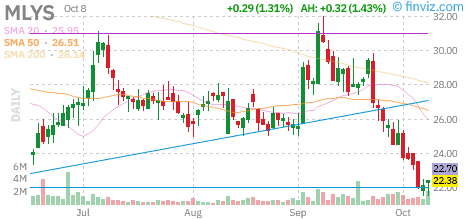
The Finviz API snapshot used here gives an October 8 regular-session close of $22.38, up 1.31%, on volume of 2,245,272 shares, with market capitalization of approximately $1.98 billion. These figures are a dated reference, not a live quote. The chart is dated October 9 and may update independently of the textual reference. Market capitalization can differ slightly from a calculation using an older reported share count because data providers update their share inputs on different schedules. [14]
Dilution should be evaluated as an economic exchange rather than treated as automatically good or bad. New capital can fund a valuable program, improve bargaining power or reduce the risk of a distressed financing. It also increases the number of claims on future cash flows. The relevant question is whether the capital raised creates sufficient incremental value per share. A large cash balance achieved through issuance should not be celebrated without acknowledging the larger share base through which future results will be distributed.
Share-based compensation, options and other potentially dilutive instruments require attention as the company grows. Basic shares outstanding are not necessarily the appropriate denominator for every valuation scenario. At the same time, adding every theoretical instrument without considering its terms can exaggerate immediate dilution. A careful model distinguishes issued shares, instruments that may vest or be exercised, and financing capacity that management has not used. An unsupported fully diluted count would blur those separate categories.
Trading volume provides context for liquidity but does not eliminate event risk. A stock can trade actively and still gap sharply when information changes outside regular hours. Historical price levels and volume patterns cannot determine the FDA’s decision or guarantee an exit price. The chart is therefore a market reference alongside the fundamental analysis. It is not a basis for turning a clinical calendar into a deterministic trading signal or for inferring undisclosed regulatory knowledge from a short-term price move.
14 A scenario framework for translating the catalyst into equity value
A useful valuation framework separates regulatory probability, commercial scale, timing, margins and financing. Before approval, expected value depends partly on the likelihood of reaching a viable commercial state. After approval, uncertainty shifts toward launch execution and the size and durability of cash generation. These are not the same risks. A favorable decision can reduce one category while revealing constraints in another, particularly through label wording or the practical requirements for treatment.
The constructive scenario would combine a useful label with manageable monitoring, credible access and sustained prescribing. In that case, royalty-free retained economics could become valuable as sales scale. The moderate scenario would allow approval but assume slower adoption, stronger rebates or higher commercial costs. The adverse scenario would involve a regulatory setback or a launch unable to support the fixed cost base. These are analytical scenarios, not company guidance, and this report assigns no unsupported numerical probability or price target to them.
A transparent sensitivity example can clarify the mechanics without pretending to forecast. If a hypothetical product generated $100 million in annual net sales, a ten-percentage-point change in its operating margin would change operating profit by $10 million before financing and taxes. That arithmetic says nothing about whether lorundrostat will achieve those sales or margins. Its purpose is to show why access, net pricing and spending can matter as much as a headline estimate of patient numbers.
The share-price reaction also depends on expectations already reflected in the market. An outcome viewed as highly likely can produce a muted or even negative reaction if the details disappoint. An uncertain outcome can produce a larger repricing if it resolves a material risk favorably. Positioning, liquidity and broader market conditions can influence the immediate move. None of these factors allows a reliable percentage forecast from the PDUFA date alone. The date identifies when important information may arrive, not how investors must respond.
An equity model needs to reconcile enterprise value with cash, debt and other obligations using consistent dates and definitions. It should not subtract the full maximum loan facility as debt already drawn, nor add its undrawn portion to current cash. Milestone obligations depend on their conditions and timing. The same consistency is required for the share denominator. A valuation built from mismatched snapshots can look precise while embedding substantial errors before any commercial assumption is considered.
15 The evidence calendar and the questions for the next update
The October 7–11 AHA Hypertension meeting now has an October 9 company results update. Additional Launch-HTN analyses show 46% of participants receiving lorundrostat 50 mg below 130 mmHg office systolic pressure at Week 12. Final Explore-OSA findings show lower morning blood pressure but no measurable improvement in apnea-hypopnea indices. The blood-pressure result does not change the failed apnea endpoint. Company release.
ASN Kidney Week is scheduled for October 21–25 in Denver. Mineralys announced a lorundrostat analysis involving kidney-related measures in a Launch-HTN subgroup. The available announcement does not justify inventing an exact presentation day beyond the disclosed conference window. Transform-HTN long-term extension data are separately scheduled for November 8 at 3:30 p.m. Central at the AHA Scientific Sessions in Chicago. These are two different meetings, not a single generic AHA catalyst. [9] [11]
Transform-HTN is an open-label extension drawing participants from eligible parent studies. Longer follow-up can contribute important information about durability and tolerability. The design nevertheless differs from a blinded randomized comparison, and participants who enter or remain in an extension may not represent every patient originally enrolled. A favorable result should be evaluated with the number followed, duration, discontinuations and analysis methods. Long exposure is informative, but it does not remove selection effects or create an active-comparator trial.
The December 22 FDA target remains the central regulatory checkpoint. The next financial report is also relevant because the June cash position predates several months of spending. Merlintrader has found no public announcement of the next earnings date. A useful update would refresh liquidity, operating costs, shares and financing access alongside any regulatory communication. Scientific and financial updates need to be read together rather than as separate narratives that use incompatible assumptions.
The most useful questions are concrete. Has the FDA timetable changed? What does the actual label permit if approval occurs? Do extension data clarify safety and persistence? Has management changed launch spending or cash guidance? Are conditional financing requirements satisfied? Is there evidence of access and paid use after launch? Answers to these questions would change the analysis. A conference appearance, an inducement award or a routine calendar reminder is not an equally material development simply because it produces a new timestamp.
Sources and research references
Primary disclosures control facts. Finviz supplies dated market data. Study design and limitations are noted alongside each cited paper.
[1] Mineralys Form 10-Q, quarter ended June 30, 2026[2] Mineralys second-quarter results and update, August 11[3] FDA filing acceptance and Explore-OSA results, March 9[4] Consensus fetched record: Launch-HTN randomized clinical trial[5] Consensus fetched record: Advance-HTN, NEJM 2025[6] NIH PubMed: Launch-HTN publication and abstract[7] NEJM: Advance-HTN, DOI 10.1056/NEJMoa2501440[8] Explore-CKD topline results, June 17, 2025[9] Mineralys ASN Kidney Week announcement, October 2[10] Mineralys AHA Hypertension announcement, October 1[11] Transform-HTN AHA presentation announcement, September 23[12] FDA: Baxfendy approved prescribing information, 2026[13] AstraZeneca: U.S. baxdrostat approval, May 18[14] Finviz MLYS quote: October 8 regular session[16] Mineralys ENDO exploratory proteomic analysis, June 14Frequently asked questions about MLYS and lorundrostat
When is the lorundrostat PDUFA date?
The disclosed FDA target is December 22, 2026 for the hypertension application. It is a target action date, not approval or a guarantee of a decision on that exact day. Any subsequent change would come from the company or the FDA. [3]
Can the decision materially affect Mineralys stock?
Yes, it can change expectations for the company’s principal asset and its transition to commercial operations. The direction and size of the price reaction cannot be inferred from the calendar alone. Label details, prior expectations, financing and launch assumptions all matter.
Is lorundrostat already approved or first in its class?
Lorundrostat remains investigational at this report’s date. Baxdrostat, branded Baxfendy, was already approved in the United States in May 2026. No direct comparative evidence presented here establishes that lorundrostat is superior to the approved competitor. [3] [12] [13]
Did Explore-OSA demonstrate a treatment for sleep apnea?
No. The study did not achieve a clinically meaningful difference in its primary apnea-hypopnea index endpoint. Blood-pressure findings in that population address a different outcome and are not a successful sleep-apnea result. [3]
Does the $500 million loan facility mean Mineralys has that much extra cash?
No. Only $100 million of principal had been drawn at June 30. Further tranches were conditional. The $661.4 million cash-and-investment balance is a separate dated figure and already reflects financing completed by that date. Adding the full facility would double count and overstate resources. [1]
Why is the quarterly loss much larger than operating cash use?
The quarter included the $200 million Tanabe transaction expense. The related cash payment appears in investing activities, while first-half operating cash use was $72.0 million. Accounting expense, operating cash flow and total cash movement answer different questions; none substitutes for the others. [1]
 Umbria