Merlintrader Trading Pub
Biotech catalyst, news and analysis PDUFA tracker
Merlintrader Trading Pub
Biotech catalyst, news and analysis PDUFA tracker
AI transparency: articles and reports are produced with the help of artificial intelligence and checked through a process that does not constitute specialist validation. They may contain errors: verify relevant information with independent sources. Read the full disclaimer.
Stock Hub 2026 · Biotech
Nasdaq: $SGMT
Premiumreportfree with an ad
SGMT Stock Hub: Sagimet Biosciences News, Denifanstat and AURORA
A new oral approach to acne: denifanstat targets lipid synthesis and inflammation, with U.S. phase 3 AURORA now dosing patients. Partner clinical evidence, adolescent development, funding and dilution define the next stage.
Get every Merlintrader report in real time on Telegram: join @merlintraderpub_com.
Daily chart
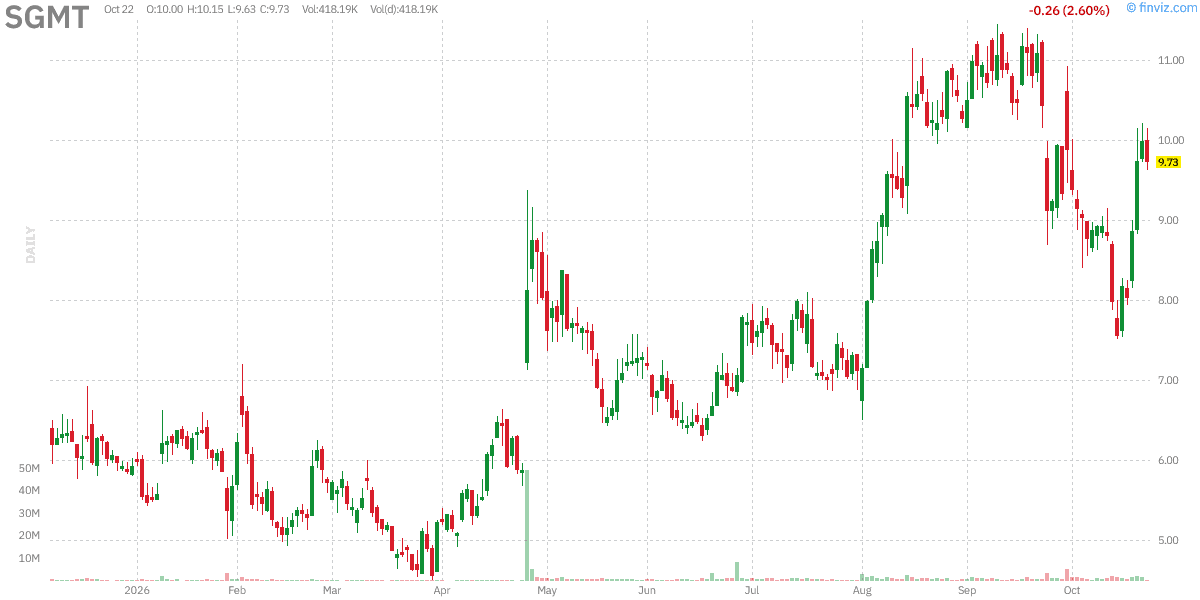
Daily chart $SGMT · October 22, 2026 · Intraday, delayedOpen chart (affiliate link) · For information only.
Next catalyst
H2 2027 · AURORA topline results expected
AURORA moves into execution; earlier TVB-3567 milestone ahead
The principal clinical catalyst is AURORA’s expected H2 2027 topline result. Enrollment and adolescent participation are the immediate execution tasks. The October presentation also targets phase 2 initiation for TVB-3567 before year-end 2026; timing remains a company forecast. Source
Key data
Latest announcementOctober 22, 2026 — First patient dosed in U.S. phase 3 AURORA Source
Dates of the figuresFinancial statements: Quarter and six months ended June 30, 2026; subsequent financing completed October 1, 2026; runway forecast October 22, 2026. Financing and operating events carry their own dates. Source
The constructive case
A controlled phase 3 study in China showed benefit on multiple acne endpoints, and longer follow-up added exposure at the selected dose. AURORA now tests the U.S. case, including adolescents. Recent financing supports management’s projected runway through mid-2029, while a non-antibiotic oral mechanism could provide a differentiated option if clinical and regulatory development succeeds.
The case against
AURORA must replicate useful efficacy across three co-primary endpoints in a different population. Dry-eye and skin tolerability, longer treatment, established inexpensive competitors and payer access can constrain value. Two major equity raises have substantially enlarged the share base; MASH development remains conditional on non-dilutive funding.
Operating and financial position
Clinical-stage dermatology developer with denifanstat in U.S. phase 3 and TVB-3567 in earlier development. June 30 cash, equivalents and securities totaled $257.6M; a separate October 1 offering raised about $115M gross. The October presentation forecasts funding through mid-2029. No cash balance after June 30, 2026 has been reported yet; the next update is expected with third-quarter results. Source · Related source · Related source
Executive summary
Sagimet Biosciences is testing whether FASN inhibition can deliver a competitive oral treatment for moderate to severe acne. Partner Ascletis generated randomized phase 3 and longer extension results in China; AURORA began U.S. dosing in October 2026 with topline expected in H2 2027. The important clinical questions are replication, adolescent benefit and long-term tolerability. Retained rights outside Greater China provide commercial opportunity but also leave development and launch responsibilities. A strengthened balance sheet improves execution capacity, while substantial dilution and a competitive treatment market remain central to the per-share assessment.
Latest news
October 22, 2026 — First patient dosed in U.S. phase 3 AURORA
Sagimet began dosing in AURORA, its U.S. registrational acne study. The trial plans about 800 participants aged 12 and older, including about 450 adolescents. Topline results are expected in H2 2027. Source
October 1, 2026 — $115 million gross offering completed
The offering comprised 8,750,010 Series A shares and pre-funded warrants covering 2,750,010 shares. The funding supports the acne program, pre-launch activity and earlier FASN-inhibitor development while expanding the ownership base. Source
September 30, 2026 — Acne extension results through Week 52 presented
The Chinese extension reported 56.7% treatment success and mean reductions of 71.8% in total lesions and 76.9% in inflammatory lesions from the original baseline. All extension participants received active treatment; long-term safety was the primary objective. Source
August 13, 2026 — FDA study-may-proceed letter supports U.S. trial start
Sagimet announced IND clearance and a study-may-proceed letter for its phase 3 acne program. The authorization allowed the study to advance, with marketing approval dependent on later evidence and review. Source
Extended analysis
Does $SGMT deserve a place in your portfolio?
The full deep dive has the answer’s building blocks: cash, dilution, catalysts and risks, every figure sourced.
Free. No signup. You decide, we don’t recommend.
Using an ad blocker? The free “watch an ad” option is hidden automatically. Pause it on merlintrader.com and reload the page to see the free option.
01 What Sagimet Biosciences Does: A Dermatology Business Built Around FASN
Sagimet Biosciences is a clinical-stage biotechnology company developing fatty acid synthase inhibitors, with its current investment priority centered on dermatology. Its Series A common stock trades on the Nasdaq Global Market under SGMT. The company is headquartered in Foster City, California. Denifanstat is its lead oral medicine, while TVB-3567 and a planned topical formulation provide earlier opportunities within the same scientific area. Company overview.
The key change in the business during 2026 was a deliberate shift in capital allocation toward acne. Sagimet previously attracted considerable attention for denifanstat in metabolic dysfunction-associated steatohepatitis, or MASH. In April, it decided to advance denifanstat in U.S. acne development and make further MASH work conditional on securing non-dilutive funding. The distinction changes both the immediate catalyst calendar and the interpretation of its financial resources. Strategic update.
On October 22, 2026, Sagimet announced the first patient dosed in AURORA, its U.S. phase 3 acne study. The study builds on clinical experience generated in China by license partner Ascletis, where denifanstat is known as ASC40. That earlier work provides a substantial foundation, including randomized phase 3 results and longer open-label follow-up. AURORA must establish the treatment’s performance in the intended U.S. development population, including adolescents. AURORA initiation.
The economic structure combines a directly controlled development program outside Greater China with potential payments from a regional license. This gives Sagimet two distinct ways to benefit from the same molecule. Success in its retained territories could support direct commercialization or another partnership. In Greater China, value would flow through the license’s milestone and royalty terms, subject to their conditions. Worldwide product sales would therefore differ from revenue attributable to Sagimet.
The company remains pre-commercial. Its financial capacity expanded materially through two 2026 equity financings, but those transactions also expanded the ownership base. The investment question is whether the clinical benefit and eventual commercial economics can justify the capital consumed and shares issued. A successful mechanism, a successful pivotal trial and a successful launch are successive achievements, each with its own requirements.
Sagimet’s concentration can be an advantage if a clear acne strategy produces efficient execution. It also leaves the company exposed to a limited set of related mechanisms. Denifanstat and TVB-3567 are separate molecules, yet both rely on the usefulness of FASN inhibition in skin disease. AURORA is consequently the dominant near-term test of the business thesis, while the earlier pipeline and funding-dependent MASH opportunity add possibilities with different maturity and financing needs.
02 Acne and the Medical Value of Another Oral Treatment
Moderate to severe acne is a medical condition with consequences that extend beyond appearance. Inflammatory lesions can be painful, persistent disease can lead to scarring, and the condition can carry substantial psychosocial burden. The treatment objective includes controlling active lesions, limiting lasting damage and making care practical enough for patients to continue. These concerns explain why an effective additional medicine could have meaningful value even in an established therapeutic market. Clinical guideline.
Existing care includes several topical drug classes, systemic antibiotics, hormonal approaches in appropriate patients and isotretinoin for selected severe or treatment-resistant disease. The breadth of available treatments demonstrates both that acne is treatable and that a new product faces a demanding comparison. An additional oral agent needs an attractive combination of efficacy, tolerability, convenience and access. A novel biological target alone supplies only part of that proposition.
For patients with persistent moderate disease, the practical issue may be incomplete control despite topical treatment, difficulty maintaining a multi-product regimen or the limitations of extended antibiotic use. Treatment recommendations support limiting systemic antibiotic exposure and combining therapies with different mechanisms. An effective non-antibiotic oral option could fit into this setting if clinical evidence and eventual labeling support its use. That is a potential role, rather than a prediction about where prescribers will place denifanstat. Treatment recommendations.
Adolescents are especially important to Sagimet’s U.S. program. Acne frequently appears during a period when adherence, school routines and concerns about appearance can complicate care. At the same time, a medicine used by younger people must provide a sufficiently characterized safety profile. The adult Chinese clinical experience supports further study, while AURORA’s planned adolescent participation will contribute evidence in a population central to the proposed market.
Sagimet estimates that roughly ten million people in the United States have moderate to severe acne annually. This is a company-cited disease estimate, not a forecast of treated customers. The accessible population would depend on a future label, prior-treatment requirements, insurance coverage, physician preference and willingness to use a systemic medicine. Some patients will respond well to existing inexpensive treatments; others may need another approach. October program update.
The clearest medical opportunity would be reliable lesion improvement with manageable adverse effects and a regimen patients can sustain. The relevant benefit includes how many patients reach clear or almost clear skin, the number and type of lesions reduced and how the effect persists with treatment. Measures of treatment burden and tolerability can matter alongside statistical significance, particularly when physicians can choose among several established therapies.
AURORA is designed around moderate to severe acne, with exclusions that narrow the studied population. Its result will therefore have a defined scope. Severe cystic presentations and patients with clinically important pre-existing dry eye raise different questions from the enrolled population. Commercial assumptions become more credible when matched to the actual eligibility criteria and eventual label, rather than the entire population experiencing any form of acne.
03 Denifanstat: FASN Inhibition, Sebum and Inflammation
Denifanstat is an oral small-molecule inhibitor of fatty acid synthase, an enzyme involved in de novo lipogenesis: the production of fatty acids within cells. In skin, this pathway contributes to the lipids produced by sebocytes and incorporated into sebum. Excess sebum and inflammation are relevant parts of acne biology. Sagimet’s hypothesis is that inhibiting this process can improve disease by influencing both lipid production and associated inflammatory activity. FASN science.
This approach differs from simply removing surface oil. An oral drug acts on a biological pathway, with exposure beyond the visible skin lesion. The attractive part of the hypothesis is the possibility of affecting a contributing process upstream of lesion formation. The corresponding challenge is achieving enough beneficial activity without creating unacceptable effects in tissues that also depend on normal lipid biology.
Early denifanstat studies measured changes in sebum lipids as pharmacodynamic observations. These helped connect drug exposure with the intended biological effect. Some measurements came from studies using doses higher than the 50 mg dose advanced in acne. Their importance lies in supporting target engagement; the dose-specific clinical case for acne comes from the actual acne trials. October 2026 presentation.
The company has also presented nonclinical experiments in human sebocytes showing reduced de novo lipid levels. These observations support the proposed mechanism but sit earlier in the evidence chain than patient outcomes. A reduction in a lipid marker can show that a pathway is affected while leaving the magnitude of clinical benefit uncertain. Randomized lesion and assessment endpoints test whether that biological activity helps patients in a useful way.
The oral once-daily regimen is part of the proposed treatment experience. Convenience could support adherence, but it must be evaluated together with adverse effects, monitoring and the need for other medicines. A single daily tablet can still be difficult to sustain if it causes bothersome dryness or requires burdensome precautions. Conversely, a tolerable regimen with predictable benefit could be valuable for patients struggling with complicated care routines.
FASN inhibition is also relevant to the interpretation of safety. Dry skin, dry eye and other effects observed during clinical development deserve attention because the intended pathway concerns lipid production. Their presence is not, by itself, evidence that the approach is unusable. The important questions are severity, frequency, duration, reversibility and the proportion of patients who interrupt or stop treatment. Those practical outcomes help define the balance between meaningful acne control and treatment burden.
The mechanism has been studied in other indications, especially MASH, where lipid synthesis, inflammation and fibrosis are relevant. Evidence in one disease can inform understanding of the molecule’s exposure and safety, while efficacy remains indication-specific. Improvement in liver histology and improvement in acne lesions are different clinical achievements. For SGMT stock, the immediate question is whether FASN inhibition can produce a competitive acne medicine at the selected dose and in the U.S. population.
04 Denifanstat Acne Evidence: Phase 2 and the Chinese Phase 3 Study
The published phase 2 acne trial enrolled 179 participants across denifanstat 25 mg, 50 mg, 75 mg and placebo groups. Treatment lasted 12 weeks. At 50 mg, the median total-lesion reduction was 61.3%, compared with 34.2% on placebo. The trial provided a signal that the drug could reduce acne lesions, but another endpoint was less conclusive: the comparison across four groups for a two-grade IGA improvement was not statistically significant, with p=0.336. Phase 2 publication.
At 50 mg, 14 of 44 patients achieved that IGA improvement, compared with seven of 45 on placebo. These observations helped justify larger testing, while the nonsignificant group comparison remained a limitation. The endpoint also differs from the stricter clear-or-almost-clear success definition used in the later pivotal program. A reduction in lesion counts and an assessment-based success rate capture related but distinct aspects of benefit.
The subsequent Chinese phase 3 study, ASC40-303, enrolled 480 adults and randomized them equally to denifanstat 50 mg or placebo for 12 weeks. The company reported that the study met all primary and secondary endpoints. IGA treatment success reached 33.2% with denifanstat versus 14.6% with placebo, an 18.6 percentage-point difference. The reported p value was below 0.0001. Phase 3 results.
Mean total-lesion reduction was 57.4% versus 35.4%, and inflammatory-lesion reduction was 63.5% versus 43.2%. Non-inflammatory lesions fell 51.9% versus 28.9%. These are within-group changes, and the incremental treatment differences are smaller than the active-arm percentages alone. The placebo response is clinically relevant because repeated assessment and trial participation can accompany considerable improvement even without the investigational drug.
The safety summary reported comparable overall treatment-emergent adverse-event incidence between groups. Dry skin occurred in 6.3% of denifanstat patients versus 2.9% on placebo, and dry eye in 5.9% versus 3.8%. The October 2026 company presentation, which groups “dry eye” and “xerophthalmia”, reports treatment-related dry eye in 10.9% versus 8.0% on placebo (October 2026 presentation). These findings are useful because they identify specific tolerability issues, rather than relying only on the broad description of generally well tolerated. More exposure is needed to understand uncommon effects and sustained use.
The randomized phase 3 result is stronger evidence than an uncontrolled baseline comparison. It also belongs to a defined study population in China, with adults aged 18 to 40 in the registered protocol. AURORA will study a broader U.S. age range including adolescents. Differences in population, background characteristics, assessment and trial conduct can influence the observed result. The earlier study lowers some uncertainty by demonstrating activity in a controlled setting, while leaving the new trial to answer its own questions. Chinese trial registry.
For shareholders, the sequence is encouraging but nuanced. The smaller phase 2 study had a lesion signal and an inconclusive IGA comparison; the larger phase 3 study subsequently showed a clear difference on multiple endpoints. That progression supports the selected dose and development rationale. The next investment-relevant test is replication in the planned U.S. program, especially because its three co-primary endpoints and substantial adolescent enrollment are central to the intended regulatory package.
05 The Extension Through Week 52: Durability, Dryness and Evidence Limits
The ASC40-304 extension enrolled 240 participants who had completed the 12-week Chinese phase 3 study. Of those, 116 had initially received denifanstat and 124 had initially received placebo. Both groups received denifanstat during the extension, for up to 40 additional weeks. Their cumulative exposure therefore differed: original active-treatment patients could reach 52 weeks, while crossover patients began active treatment after the randomized phase. September 30 results.
The combined reported treatment-success rate was 56.7%, rounded to 57% in the release headline. Mean total lesions were reduced 71.8% and inflammatory lesions 76.9% from the original study baseline. The continuous-treatment and crossover groups had broadly similar success rates of 57.8% and 55.6%, respectively. These results support interest in maintained and additional improvement during longer treatment, while the comparison is no longer against a concurrent placebo group.
The study’s primary purpose was long-term safety; efficacy measures were secondary. Sagimet reported no permanent discontinuations due to adverse events and no drug-related serious adverse events among denifanstat-treated patients in the extension. Treatment-related dry skin occurred in 7.1% and dry eye in 5.9%, the only treatment-related categories above 5% over the reported period. In the 40-week open-label extension alone, the October 2026 presentation reports an incidence of treatment-related adverse events of 2.5% for dry skin and 2.1% for dry eye (October 2026 presentation). The duration and specific findings add useful information beyond the original 12-week experience.
Two interpretation points matter. First, the extension population consisted of people who completed the earlier study and elected to continue, so it may differ from all patients who originally entered. Second, both groups knew they were receiving active medicine. These features make the extension valuable for observing exposure, persistence and emerging adverse effects while limiting causal claims about how much additional improvement is attributable to treatment over time.
The 57% success rate therefore answers a different question from the original 33.2% versus 14.6% randomized comparison. The former describes longer treated follow-up among extension participants; the latter estimates a controlled 12-week difference in the original trial. They cannot be interpreted as two separate placebo-adjusted efficacy estimates. Likewise, crossover patients had a different treatment history, which matters when describing duration.
Dryness deserves practical attention even when severe events are uncommon. Patients using an acne medicine may accept some manageable discomfort if lesion control is substantial, but persistent ocular symptoms can affect willingness to continue. Larger studies and broader use, if approved, would give more information about uncommon problems, susceptible patients and treatment persistence. The existing results support further development while leaving room for the safety profile to evolve with additional exposure.
The extension is especially relevant to the business because acne often requires ongoing management. A useful chronic medicine needs more than a favorable first assessment: patients must be able to remain on treatment, clinicians must understand its risks and benefit should persist sufficiently to justify continued use. AURORA’s own extension will add longer U.S. experience, including a population with a different age composition. This makes long-term tolerability a material part of the commercial case rather than a secondary technical detail.
06 SGMT Stock Catalysts: AURORA, Adolescents and the U.S. Filing Path
AURORA began dosing in October 2026 and is intended to enroll approximately 800 U.S. participants aged 12 and older, including about 450 adolescents aged 12 to 17. The planned allocation is 2:1 to denifanstat 50 mg or placebo once daily for 12 weeks. The October 22 announcement placed topline results in the second half of 2027. These enrollment totals and the results window are company plans, not completed enrollment or an available efficacy result. Current trial update.
The three co-primary endpoints at Week 12 are treatment success on a global severity assessment, absolute change in inflammatory lesions and absolute change in non-inflammatory lesions. Assessment success requires a score of clear or almost clear and at least a two-point improvement from baseline. The registry labels this assessment EGSS; the company describes it as a global assessment score. This structure requires a coherent clinical result across both the overall assessment and lesion types. AURORA registry.
The choice of absolute lesion changes deserves attention. The Chinese study’s primary lesion endpoints were percentage changes in total and inflammatory lesions; AURORA separately tests absolute changes in inflammatory and non-inflammatory lesions. The underlying clinical concept overlaps, but the analysis and primary endpoints are not identical. Comparing the studies should account for baseline lesion burden and endpoint definitions rather than assuming a direct reproduction of every earlier percentage.
Approximately 530 eligible completers may enter a 40-week open-label extension. Its stated purpose is evaluating longer-term safety. This produces a separate body of evidence from the randomized phase. A positive 12-week efficacy result would be a major milestone, while the full safety package and regulatory requirements would still matter for the application.
The registry includes participants with defined moderate or severe assessment scores and specified lesion counts. It excludes certain cystic presentations and people with clinically significant dry-eye histories, among other restrictions. These criteria influence the population to which the result most directly applies. An eventual prescribing population could depend on the FDA’s interpretation of the total evidence, including how safety findings relate to the selected participants.
The FDA cleared the U.S. IND and issued a study-may-proceed letter, announced in August 2026. This allowed the development work to move forward. Marketing authorization requires a later review of clinical efficacy, safety, manufacturing and the proposed use. AURORA’s status as registrational describes the company’s development purpose; it leaves the outcome of both the study and review ahead. IND announcement.
Enrollment progress, adolescent participation, adherence, withdrawals and the quality of the endpoint data will help assess execution before topline. The strongest result would combine clear differences across co-primary endpoints with manageable adverse effects and consistent findings in relevant age groups. A mixed result could create questions about the label or additional work. No U.S. approval decision date has been set in the announced development plan; a future filing depends on the evidence and regulatory requirements.
07 Competition and the Commercial Test for Denifanstat
Denifanstat would compete in a market with effective established therapies, including inexpensive generics. Topical retinoids, benzoyl peroxide and combination products address much routine care. Oral antibiotics and selected hormonal medicines provide systemic approaches, while isotretinoin has an important role in severe or resistant disease. The commercial opportunity depends on finding patients whose needs are insufficiently met by those options and demonstrating enough incremental value to justify access. Acne treatment landscape.
Systemic antibiotic use is a relevant comparison because guidelines encourage limiting its duration and pairing it with appropriate topical therapy. A non-antibiotic oral medicine could appeal where repeated antibiotic courses are undesirable, provided its efficacy and tolerability are competitive. Sagimet’s mechanism may support differentiation, but an antibiotic-sparing role would ultimately depend on the clinical package, label and prescriber experience rather than mechanism alone.
Isotretinoin is a powerful established treatment with a specific restricted-distribution safety framework because of severe embryo-fetal risk. The FDA describes the iPLEDGE system as intended to mitigate that risk. These requirements create practical burdens, yet isotretinoin’s effectiveness and existing clinical role remain important. Comparing a new candidate requires evidence about its own benefit and risks; the limitations of one product cannot supply a safety advantage for another. FDA isotretinoin information.
Adherence can shape real-world performance. A once-daily oral regimen may be attractive compared with multiple products, but physicians may still combine it with topical care if supported. Insurers may require prior use of established medicines. Patients may discontinue because of cost, delayed improvement or adverse effects even when a drug works in a trial. The eventual value proposition therefore combines clinical effect with a practical route through prescribing, coverage and continued use.
The trial populations also influence competitive positioning. AURORA’s inclusion of adolescents could support a broad age-related development case, while the exclusion of certain severe cystic presentations makes it inappropriate to assume replacement of every existing isotretinoin use. Lesion-count reductions and global success rates can inform comparison, but separate studies differ in population, baseline burden, treatment history and study conduct. Head-to-head superiority remains a separate clinical question.
For revenue, the crucial inputs would be eligible patients starting treatment, duration, persistence and realized net pricing. A large disease population can coexist with modest revenue if coverage is restrictive or many people prefer existing inexpensive options. Conversely, a differentiated product with sustained use could create a substantial business within a fraction of that population. Neither outcome follows automatically from a prevalence estimate or from approval alone.
Commercial preparation will require capabilities beyond running AURORA: reliable manufacturing, appropriate medical education, payer engagement and a workable distribution system. The recent financing earmarked funds partly for pre-launch activities, indicating that spending may rise before product receipts. A convincing launch would show that trial efficacy translates into treatment use and retention. Until then, commercial potential remains an analytical scenario, with the pivotal clinical result as its most important initial requirement.
08 Ascletis Rights, Royalties and the Economics of Greater China
Sagimet licensed denifanstat and related compounds to Ascletis for Greater China, defined in the filing as mainland China, Hong Kong, Macau and Taiwan. The license includes development, manufacturing and commercialization rights under specified intellectual property. Sagimet retains the opportunity outside that territory. The arrangement explains why Chinese clinical development is conducted by the partner while the U.S. program is Sagimet’s own development investment. License disclosure.
The filing describes potential development and commercial milestones totaling up to $122 million and tiered royalties ranging from high-single-digit to mid-teen percentages on future net sales in Greater China. These are contractual opportunities dependent on achievements and sales. They are distinct from cash already on the balance sheet. The company recognizes milestone-related revenue when the relevant accounting conditions are met, while royalties depend on actual eligible sales.
The rights and obligations were assigned within the Ascletis group to Gannex, with Ascletis remaining responsible for performance under the arrangement. This legal detail matters when reading filings that refer to different partner entities. The broader economic relationship remains a regional license, rather than a sale of all worldwide rights or a shared global commercial business.
The partner’s clinical work is valuable beyond potential regional revenue. It provides experience with the molecule, dose and long-term treatment that informs the rationale for further development. However, each regulator assesses the package submitted for its own jurisdiction. Sagimet’s U.S. program must address the requirements relevant to its intended population and application. A favorable regional development result can support confidence while leaving local clinical and review questions unresolved.
The October presentation reported that the Chinese NDA had been accepted for review in December 2025. Acceptance is an application milestone, with any approval and resulting sales requiring their own announcements. The economic importance for Sagimet would depend on the contractual milestone terms, net sales and royalty rate applicable at each level. A gross sales figure reported by the partner would not all become Sagimet revenue. October presentation.
The license also creates dependence on another company’s priorities and execution. Manufacturing, regulatory progress, commercialization and regional access influence the partner’s performance. Sagimet can benefit from external development investment, but it has less direct control over commercial decisions in the licensed territory. The quality and frequency of partner disclosures will therefore matter when assessing the timing and reliability of potential cash receipts.
Outside Greater China, retaining rights preserves possible upside and the option to select future partners. It also leaves the development and commercial financing burden with Sagimet unless another agreement changes that allocation. The current capital raises help fund that choice, while later decisions could trade a portion of economics for resources or geographic capabilities. The appropriate valuation separates retained-market opportunities, conditional regional royalties and milestones, rather than adding every headline amount as immediately available value.
09 TVB-3567, Topical Research and MASH Optionality
TVB-3567 is Sagimet’s follow-on oral FASN inhibitor being developed for acne. Its first-in-human phase 1 study began in June 2025. In the October 2026 presentation, the company reported completion of dosing in the single-ascending-dose, multiple-ascending-dose and food-effect portions, generally favorable tolerability and identification of phase 2 doses. It continued to target phase 2 initiation before year-end 2026. These are development milestones, with the candidate’s clinical efficacy in acne still requiring evaluation. Current pipeline presentation.
The phase 1 program evaluates safety, tolerability, pharmacokinetics and pharmacodynamics in participants with or without acne, including analysis of sebum. Such work helps establish exposure and whether the intended biological pathway responds. It also supports dose selection for later testing. A favorable early profile can justify the next study, while the clinical question of meaningful lesion reduction needs an appropriately designed patient trial. TVB-3567 study.
The company is also developing a topical FASN-inhibitor formulation. Local delivery could create a different treatment experience if adequate skin activity and tolerability are achieved, but formulation, exposure and efficacy are separate development challenges. A topical program should be valued according to concrete progress, rather than assumed to reproduce the oral drug’s effects. It could broaden a future dermatology franchise if clinical evidence supports an appropriate role.
MASH remains scientifically important in the company’s history. In the 168-patient FASCINATE-2 phase 2b trial, the intent-to-treat analysis showed a two-point or greater improvement in disease activity without worsening fibrosis in 38% on denifanstat versus 16% on placebo. MASH resolution with the specified activity improvement and no fibrosis worsening occurred in 26% versus 11%. These results support biological and clinical interest, while they represent a phase 2b population and endpoints. MASH publication.
Safety in that study included alopecia in 19% of denifanstat participants versus 4% on placebo; dry-eye symptoms were reported in 9% versus 14%. Drug-related adverse events were graded 1 or 2, and serious events were not considered drug related in the publication. Differences in disease, population and treatment duration limit direct comparisons with acne safety rates. The observations add to the molecule’s experience while preserving the need for indication-specific assessment.
Further MASH development is conditional on obtaining non-dilutive funding. Sagimet has explored a denifanstat-resmetirom combination and disclosed intellectual-property arrangements with TAPI related to forms of resmetirom for a potential fixed-dose combination. The filing describes a $2.5 million upfront payment, potential additional manufacturing milestones up to $5.5 million and a low-single-digit royalty on future combination sales. Those terms concern that possible combination, rather than a royalty on all acne sales. Combination agreement.
According to the October 2026 presentation, a patent covering the denifanstat-resmetirom combination was granted in the third quarter of 2026, with expiration in 2044. The denifanstat composition-of-matter patent expires in 2032, with a potential patent term extension to 2037, and the TVB-3567 composition-of-matter patent expires in 2035, with a potential extension to 2038. October 2026 presentation.
The practical distinction is between funded dermatology execution and a liver opportunity needing a financing or partnership solution. A successful external arrangement could reopen a development route and change the resource allocation. The company still describes denifanstat in F2/F3 MASH as phase 3-ready and targets phase 2 readiness for the denifanstat-resmetirom combination by end of 2026, but further MASH development will proceed only with non-dilutive funding. The most credible pipeline assessment gives AURORA the largest immediate weight, TVB-3567 an earlier clinical role and MASH a conditional development value. October 2026 presentation.
10 SGMT Earnings, Cash and the Funding Horizon
At June 30, 2026, Sagimet held $165.896 million in cash and equivalents, $74.232 million in short-term marketable securities and $17.436 million in long-term securities. Together these totaled $257.564 million. The balance sheet showed total liabilities of $7.275 million, including $1.940 million of operating-lease liabilities, with no separate funded-borrowings line. These figures describe the June reporting date. Second-quarter balance sheet.
The cash position already included the April financing, which sold 29,166,700 shares for approximately $175 million gross. The second-quarter filing reported approximately $163.9 million net after issuance costs. Adding the April gross proceeds again to June cash would therefore count the transaction twice. The financing strengthened liquidity by increasing the share base rather than generating product revenue. April offering.
Sagimet subsequently completed another offering on October 1, announced at approximately $115 million gross. The prospectus estimated $107.5 million net proceeds after underwriting discounts, commissions and estimated offering expenses. This additional funding followed the June balance sheet. The sum of June liquidity and an estimated net receipt is not a reported cash balance, because it does not account for operating spending and other movements since June 30. Offering completion, offering prospectus.
The October 2026 presentation extended management’s expected funding horizon to mid-2029, including the AURORA readout and NDA submission, using the June resources together with the subsequent financing. This is the relevant current company forecast, superseding the through-2028 horizon described in the August results. The forecast depends on the operating plan, development costs and the events required to reach a filing. October funding outlook.
During the first six months of 2026, operating cash use was $19.710 million, about $3.3 million monthly by simple historical averaging. The H1 net loss was $24.603 million. Research and development expense was $18.530 million and general and administrative expense $9.001 million. The second quarter alone produced a $13.953 million net loss, $11.535 million R&D expense and $4.283 million administrative expense. Second-quarter Form 10-Q.
That historical burn rate belongs to a period before full AURORA execution and the planned phase 2 expansion. It would be misleading to project an unchanged monthly rate through a pivotal study and commercial preparation. Site activity, patient follow-up, manufacturing, regulatory work and hiring can shift the cost base. The H1 reduction in spending versus 2025 also reflected lower MASH-program costs, illustrating how strategic allocation influences the apparent rate.
Cash-flow and accounting measures answer different questions. Noncash stock compensation was $5.530 million in H1, while working-capital changes affected when expenses translated into payments. Marketable-security purchases move resources between investments and cash without representing the same economic activity as trial spending. The useful financial assessment combines the resources available, the operating plan and the buffer beyond key milestones. Recent financing improves resilience, but additional studies, delay or a more expensive launch could still change the capital needed.
11 SGMT Stock Dilution, Share Classes and Ownership
Sagimet had 61,215,440 Series A common shares and 567,494 Series B common shares outstanding at June 30, 2026. The cover of its second-quarter filing reported 61,591,159 Series A and the same Series B count at August 4. These are dated legal share counts. They differ from the weighted-average shares used to calculate a quarter’s earnings per share and from any later economic count incorporating additional financing. Share disclosures.
The April transaction issued 29,166,700 Series A shares, almost as many as the company had outstanding at the beginning of the year. The later offering added 8,750,010 Series A shares plus pre-funded warrants covering 2,750,010 shares. These transactions substantially increased the ownership denominator in exchange for cash that supports development. The connection between funding and dilution is central to assessing value per share, even when the company’s overall resources improve.
The pre-funded warrants were purchased at $9.9999 with a remaining exercise price of $0.0001. Their economic funding was therefore almost entirely paid upfront. Exercise would convert them into common shares with little additional cash for the company. Legal ownership limitations can affect when a holder exercises; the underlying economic interest still matters when evaluating a broadly diluted share base. Warrant terms.
At June 30, the company also reported approximately 7.57 million options, 1.13 million restricted stock units and 616,800 performance stock units, along with a small separate warrant balance. These instruments have different exercise, vesting and performance conditions. Their inclusion in a valuation depends on the method used, while their exclusion from loss-per-share accounting reflects anti-dilution rules rather than an absence of future ownership impact.
Sagimet also has an at-the-market sales agreement with Leerink Partners dated August 14, 2025. Effective September 30, 2026, the company suspended the ATM and terminated the related prospectus supplement; no shares had been sold under the agreement, which remains in effect. Further sales under it would require a new prospectus supplement. ATM prospectus supplement.
Institutional participation in the offerings demonstrates access to capital. The offering completed October 1, 2026 was led by Commodore Capital, with participation from institutional investors including RA Capital Management, Spruce Street Capital and BVF Partners. In a Schedule 13G filed October 7, 2026, Commodore Capital reported beneficial ownership of 7.6% of the Series A common stock as of September 30, 2026, a figure that includes shares issuable on exercise of pre-funded warrants. Participation does not reveal every investor’s horizon, hedging strategy or assessment of clinical risk. Periodic holdings reports also arrive with a lag. Ownership percentages are most useful when the reporting date and share denominator are clear, especially after large issuance changes the base between reporting periods. Offering completion, Schedule 13G.
The small-cap trading profile can amplify reactions to clinical or financing news. Liquidity can support ordinary trading while becoming less reliable during a major surprise. Reported market value and enterprise value also depend on the current share count and the cash figure used. Combining an updated price with a June cash balance and an older share base can produce a distorted comparison. The financing chronology is therefore as important as the displayed valuation multiple.
For shareholders, stronger financing can improve the probability that the company reaches important milestones without interruption, while reducing percentage ownership in the same future opportunity. The economic result depends on whether the funded work creates enough value to offset the larger denominator. A successful clinical program can still produce a disappointing per-share outcome if development takes longer, costs rise or further capital is needed on unfavorable terms.
12 SGMT Scenarios, Risks and the Results That Matter
The constructive scenario starts with AURORA meeting its co-primary endpoints with a clinically useful benefit and a manageable safety profile in adults and adolescents. That would strengthen the case for a differentiated non-antibiotic oral option and support the planned U.S. application. Longer-term tolerability, manufacturing and regulatory review would remain important, while the financing buffer would help fund the transition toward a potential commercial organization.
A mixed scenario could include strong lesion-count improvements but a weaker global-assessment result, differing age-group effects or tolerability that limits sustained use. Such an outcome might leave clinical value while creating questions about the regulatory package, label or commercial niche. Because AURORA contains multiple co-primary endpoints, the pattern and consistency of results will matter alongside the most favorable percentage in a release headline.
The adverse scenario includes failure to replicate a useful controlled benefit, clinically important safety findings, substantial enrollment delay or a need for additional studies. Acne provides several existing treatment options, so a modest effect combined with material burden could limit adoption even after a favorable regulatory outcome. Concentration in related FASN programs also means that the earlier pipeline offers partial diversification rather than an entirely separate scientific business.
The clinical thesis would be strengthened by a robust active-versus-placebo difference, interpretable absolute lesion changes, consistent global success and manageable discontinuation rates. The extension should add evidence about persistence and longer exposure. Findings that depend on selective subgroups, important missing data or an imbalance in withdrawals would deserve closer examination. The same applies if ocular or skin adverse effects become more consequential with broader use.
The commercial thesis would become more concrete through payer access, prescriber adoption and continued use after treatment initiation. A plausible position is another systemic option for patients insufficiently served by current care, but the actual label and reimbursement conditions will shape that role. The clearest early evidence would be a practical path from an eligible patient to an affordable prescription, followed by enough benefit and tolerability to support continuation.
TVB-3567 could broaden the opportunity if its next studies demonstrate useful efficacy and a favorable profile. A topical candidate could address another treatment setting. MASH could regain development momentum through a suitable non-dilutive arrangement. Each would require its own evidence and resources. Their value should grow with completed milestones, while AURORA remains the principal determinant of near-term clinical and financial expectations.
The balanced assessment is a focused dermatology company with a differentiated mechanism, controlled efficacy evidence from a partner program, a newly initiated U.S. pivotal study and a strengthened financing position. Against that stand replication risk, the importance of adolescent evidence, longer-term tolerability, established competition and substantial dilution. The most important upcoming evidence is the complete AURORA benefit-risk picture, rather than novelty alone or the size of the total acne population. This is informational analysis, not an investment recommendation.
SGMT Stock FAQ: Sagimet Biosciences Questions Answered
What is Sagimet’s lead medicine?
Denifanstat is an investigational oral FASN inhibitor being developed for moderate to severe acne. Sagimet is conducting the U.S. AURORA phase 3 trial, while partner Ascletis has generated phase 3 and extension data in China under the ASC40 name. Current update.
What happened on October 22, 2026?
Sagimet announced that the first AURORA patient had been dosed. This advances actual trial execution beyond screening and preparation. The company expects topline results in the second half of 2027; the announcement contains no U.S. phase 3 efficacy result.
What must AURORA show?
The study tests global treatment success and absolute reductions in inflammatory and non-inflammatory lesions after 12 weeks. It plans approximately 800 participants aged 12 and older, including about 450 adolescents. A subset may continue in a 40-week safety extension. Trial registry.
How strong are the earlier acne results?
The Chinese phase 3 study reported IGA success of 33.2% versus 14.6% on placebo and improvement on all primary and secondary endpoints. The earlier phase 2 study showed lesion reduction but an inconclusive IGA group comparison. The longer extension adds exposure and durability information, with no concurrent placebo comparison. Randomized phase 3 results, phase 2 publication.
What are the main safety findings?
Dry skin and dry eye are recurring tolerability observations. In the extension summary through Week 52, treatment-related rates were 7.1% and 5.9%, respectively, with no permanent adverse-event-related discontinuations or drug-related serious events reported. Larger U.S. exposure remains important to characterize benefit and risk. Extension results.
How is the company funded?
June 30 liquidity was $257.6 million, including the April offering proceeds. A subsequent offering completed October 1 raised approximately $115 million gross. The October presentation forecast funding through mid-2029 under the current operating plan. No cash balance after June 30, 2026 has been reported yet; the next update is expected with third-quarter results. Funding outlook.
Does Sagimet retain all worldwide rights?
Ascletis holds licensed denifanstat rights in Greater China; Sagimet retains the opportunity elsewhere. The arrangement provides conditional milestones and royalties on eligible Greater China sales. Partner sales and Sagimet revenue are different measures. License terms.
Is the MASH program the main current catalyst?
The funded development priority is dermatology. Further MASH development is conditional on non-dilutive funding. The liver phase 2b evidence remains relevant, but the immediate pivotal catalyst is AURORA’s expected H2 2027 result. Strategy.
Sources and Further Reading
- Sagimet corporate website.
- First patient dosed in AURORA, October 22, 2026.
- October 2026 corporate presentation filed October 22.
- AURORA, NCT07863193.
- Chinese randomized phase 3 results, June 4, 2025.
- ASC40-303 trial, NCT06192264.
- Full extension results, September 30, 2026.
- ASC40-304 extension, NCT06248008.
- Acne phase 2 publication, DOI 10.1111/jdv.70119.
- MASH phase 2b publication, DOI 10.1016/S2468-1253(24)00246-2.
- TVB-3567 phase 1 study, NCT06989840.
- Dermatology prioritization, April 27, 2026.
- April financing announcement.
- Q2 financial results, August 11, 2026.
- June 30, 2026 Form 10-Q.
- October 1 offering completion.
- September 30 financing agreement filing.
- Subsequent offering prospectus, September 30, 2026.
- FDA study-may-proceed announcement, August 13, 2026.
- Acne clinical guideline publication.
- Acne guideline overview.
- FDA isotretinoin information.
Informational and educational content. Interpretations are the blog’s analysis; company development and funding timelines remain forecasts. This material is not investment advice or a recommendation to buy or sell securities. Readers should conduct their own research and consult an appropriately licensed adviser when needed.
Join the Merlintrader community: follow the discussion and get more deep dives on our subreddit — r/MerlintraderPub — and on the Telegram channel @merlintraderpub_com.
Get these reports in real time
Every Merlintrader stock hub, catalyst update and market brief is published to Telegram the moment it goes live. No paywall, no spam, just the research.
Disclaimer. This content is published by Merlintrader for educational and informational purposes only. It is independent journalism and research. It does not constitute investment advice, an investment recommendation, an offer or a solicitation to buy or sell any security, and it is not a research report within the meaning of applicable United States securities regulation. Nothing here should be read as a recommendation to buy, sell or hold $SGMT or any other security.
Figures are taken from public filings with the U.S. Securities and Exchange Commission, company press releases and market-data providers, and are stated with their reference dates. Data can change without notice, and figures published before a results release become outdated the moment that release is issued. Merlintrader makes no representation that the information is complete or current at the time of reading. Readers should verify every figure against the primary source before acting on it.
Biotechnology companies face clinical, safety, regulatory, manufacturing, commercial and financing risks. Trials can fail, adverse effects can limit use, regulatory applications can be delayed or rejected, and an approved medicine may not achieve commercial expectations. Additional borrowing or equity issuance can increase obligations or dilute existing shareholders. Investors can lose part or all of their capital. Every reader is responsible for their own decisions and should consult a licensed financial adviser where appropriate.
Merlintrader may hold positions in securities mentioned. Some links on this page are affiliate or referral links, which may generate a commission at no cost to the reader. Full legal information is available on the disclaimer and terms of use and privacy pages.
SGMT Stock Hub: Sagimet Biosciences News, Denifanstat and AURORA · Merlintrader
Biotech catalysts and company research
Clinical milestones, regulatory events and independent company analysis.
Open the biotech catalyst calendar → · Top Ten Biotech →