Merlintrader Trading Pub
Biotech catalyst, news and analysis PDUFA tracker
Merlintrader Trading Pub
Biotech catalyst, news and analysis PDUFA tracker
AI transparency: articles and reports are produced with the help of artificial intelligence and checked through a process that does not constitute specialist validation. They may contain errors: verify relevant information with independent sources. Read the full disclaimer.
Stock Hub 2026 · Biotech
Nasdaq: $STOK
Premiumreportfree with an ad
STOK Stock Hub: Stoke Therapeutics News, Zorevunersen and EMPEROR
RNA medicines for genetic disease: zorevunersen in Dravet syndrome, the EMPEROR pivotal study and an earlier optic-atrophy program. The clinical value depends on controlled benefit, durable safety and practical adoption.
Get every Merlintrader report in real time on Telegram: join @merlintraderpub_com.
Daily chart
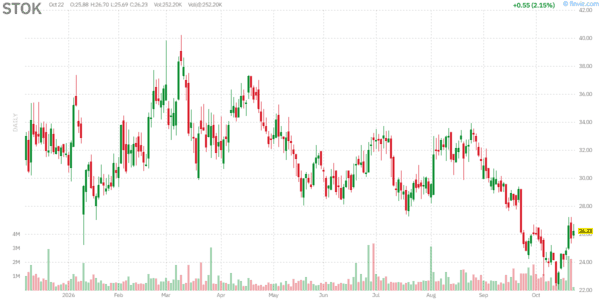
Daily chart $STOK · October 22, 2026 · Intraday, delayedOpen chart (affiliate link) · For information only.
Next catalyst
October 29, 2026 · Business and financial update
Quarterly update ahead; pivotal results expected in Q3 2027
The next scheduled corporate event is the October 29 business and financial update. The principal clinical catalyst is the EMPEROR phase 3 readout, expected in Q3 2027; initial STK-002 OSPREY results are expected in H1 2027. Source
Key data
Latest announcementOctober 22, 2026 — Third-quarter business and financial update scheduled for October 29 Source
Dates of the figuresFinancial statements: Quarter and six months ended June 30, 2026. Financing and operating events carry their own dates. Source
The constructive case
Zorevunersen targets an underlying protein deficiency in a severe disease, with encouraging early seizure and adaptive-function observations, a fully enrolled U.S. primary-analysis cohort and Biogen’s support outside retained North American markets. A persuasive controlled result could establish differentiated clinical value.
The case against
The pivotal controlled result remains ahead. Early studies were open-label; invasive repeat administration, long-term safety, endpoint interpretation, competition, regulatory execution and further share dilution can all limit the outcome. A positive seizure result may still leave the broader disease-modification thesis unproven.
Operating and financial position
Clinical-stage, pre-commercial RNA-medicine developer. Zorevunersen in EMPEROR is the dominant late-stage program; STK-002 is in phase 1. June 30 liquidity was $354.3M; a subsequent $65.7M net ATM raised the August-announced pro forma figure to about $420M. Management forecast funding through a potential early-2028 U.S. launch, subject to the operating plan. Source
Executive summary
Stoke Therapeutics is developing zorevunersen for Dravet syndrome by increasing functional NaV1.1 protein from the unaffected SCN1A copy. EMPEROR is testing whether the early signals translate into a controlled benefit on seizures and adaptive function. The October 5 FDA update clarified a planned Vineland-3 analysis and the path to an H2 2027 NDA, with phase 3 data expected in Q3 2027. Biogen holds rights outside the United States, Canada and Mexico. The central questions are clinical magnitude, durability, safety, financing and practical adoption, while STK-002 adds an earlier ophthalmology opportunity.
Latest news
October 22, 2026 — Third-quarter business and financial update scheduled for October 29
Stoke scheduled its next business and financial update for October 29. The announcement sets the calendar for the next results and program discussion; it contains no new pivotal efficacy results. Source
October 16, 2026 — Employee option grants accompany organizational expansion
Stoke announced options covering 245,920 shares for 18 new employees, effective October 15 and subject to vesting. The grants create potential future dilution rather than an immediate issuance of the same number of common shares. Source
October 12, 2026 — STK-002 advances through OSPREY dose cohorts
At AAO, Stoke presented ADOA natural-history and preclinical evidence and reported completion of dosing in OSPREY’s first two cohorts. Third-cohort dosing is expected to finish by year-end, with initial safety and efficacy data in H1 2027. Source
October 5, 2026 — FDA meeting clarifies adaptive-function analysis and submission plan
Stoke plans a U.S. multicomponent analysis of four prespecified Vineland-3 subdomains in EMPEROR. The company expects a Q3 2027 readout and completion of the U.S. NDA in H2 2027, supporting a potential early-2028 launch if development and review succeed. Source
Extended analysis
Does $STOK deserve a place in your portfolio?
The full deep dive has the answer’s building blocks: cash, dilution, catalysts and risks, every figure sourced.
Free. No signup. You decide, we don’t recommend.
Using an ad blocker? The free “watch an ad” option is hidden automatically. Pause it on merlintrader.com and reload the page to see the free option.
01 What Stoke Therapeutics Does: RNA Medicines for Missing Proteins
Stoke Therapeutics is a clinical-stage biotechnology company developing medicines intended to restore protein production in severe genetic diseases. Its Nasdaq ticker is STOK, and its headquarters are in Bedford, Massachusetts. The company concentrates on conditions in which one functioning copy of a gene produces too little protein to sustain normal cellular activity. Its lead program, zorevunersen, addresses Dravet syndrome; its second clinical program, STK-002, addresses autosomal dominant optic atrophy. Both remain investigational. Company overview.
Zorevunersen could establish a commercial franchise if it succeeds; STK-002 tests the platform in another organ. Each product requires independent clinical evidence: a positive epilepsy result would validate that drug, dose and population rather than every application of protein restoration.
Stoke’s TANGO platform stands for Targeted Augmentation of Nuclear Gene Output. It uses antisense oligonucleotides, or ASOs, to influence how cells process RNA. Many investors associate ASOs with lowering an unwanted protein. Stoke’s objective is to increase a useful protein where its absence or insufficiency causes disease. That distinction explains both the company’s appeal and its concentration: development depends on identifying genes for which restoring an appropriate amount of protein can plausibly improve function. Scientific platform.
Biogen is the principal partner for zorevunersen outside the United States, Canada and Mexico. Stoke retains those three markets. This arrangement creates a mixed future business model: potential direct product sales in retained markets, combined with potential royalties and milestones elsewhere. The geographic split matters when comparing worldwide sales projections with the revenue that would actually accrue to Stoke. Collaboration terms.
The central question for STOK stock is whether zorevunersen can deliver clinically persuasive benefits that justify repeated intrathecal treatment and a specialist commercial infrastructure. The broader platform adds possible future opportunities, but the company remains strongly dependent on the Dravet program. A substantial cash balance can support the work; it cannot substitute for an effective medicine or turn encouraging uncontrolled observations into a successful controlled trial.
02 Dravet Syndrome: The Medical Value Behind Zorevunersen
Dravet syndrome is a severe developmental and epileptic encephalopathy. It combines recurrent seizures with major effects on learning, communication, behavior and everyday function. Many cases involve a pathogenic change in one copy of SCN1A, leaving insufficient functional NaV1.1 sodium-channel protein. The clinical burden extends beyond seizure counts to the ability to interact, learn skills, move safely and participate in family life. Disease information.
This breadth is essential to understanding the medicine’s potential value. Reducing a dangerous seizure is valuable in itself. If a treatment also improves communication or adaptive skills, the benefit could affect daily life in a different and complementary way. Families may experience a meaningful change through an accumulation of small abilities, even when a child remains substantially affected. A clinical development program must therefore distinguish seizure control from a wider change in the course of the disease.
The BUTTERFLY natural-history study followed children and adolescents receiving standard treatment. Its 24-month analysis documented persistent problems with seizures and development, including a widening gap from typical developmental trajectories. It was observational, so its contribution is to describe the illness and inform measurement. It is not a randomized comparison proving the effect of another drug. Natural-history study.
An important measurement issue is that gaining a skill and keeping pace with typical development are different outcomes. A child may learn something new while still falling farther behind age peers. Scores based on age norms can therefore move differently from measures of absolute skill acquisition. This matters when interpreting adaptive-behavior results: an impressive-looking percentage or change in a standardized score needs its scale, population and clinical meaning explained.
There are approved medicines for seizures associated with Dravet syndrome, including fenfluramine, cannabidiol and stiripentol under their respective labels. Their availability makes the treatment setting more demanding than an untreated disease. An additional therapy must show useful benefit on top of existing care, with acceptable adverse effects and treatment burden. The approved options also establish that seizure improvement alone is a real clinical objective, even when broader developmental disease modification remains uncertain. FINTEPLA label (FDA); EPIDIOLEX label (DailyMed); DIACOMIT label (DailyMed).
Zorevunersen’s proposed medical distinction is to address insufficient protein production upstream of some disease manifestations. This is a biological hypothesis with encouraging clinical signals, not a guarantee that established impairments can be reversed. The age at treatment, surviving neural function, disease severity and duration of follow-up may all influence what improvement is possible. A medicine can be useful without restoring normal development or eliminating the need for other treatments.
The highest-value clinical outcome would combine substantial seizure benefit, durability, acceptable long-term safety and convincing improvement in abilities that matter to patients. A narrower result could still be medically relevant, but would support a different commercial and regulatory argument. EMPEROR will test these possibilities against a controlled comparison.
03 How Zorevunersen and TANGO Are Intended to Work
Zorevunersen, formerly STK-001, is designed to increase production of functional NaV1.1 from the unaffected copy of SCN1A. It is an RNA-modulating ASO rather than a treatment that inserts replacement DNA. Its intended action relies on the cell retaining a functional gene copy from which additional useful protein can be produced. The EMPEROR protocol describes this approach and excludes documented SCN1A gain-of-function variants. Trial record.
The scientific basis of TANGO involves changing naturally occurring RNA processing that can otherwise generate transcripts unsuitable for productive protein manufacture. By redirecting that processing, an ASO can increase useful messenger RNA and, potentially, the corresponding protein. The published platform research established a mechanistic rationale for this strategy. Moving from this rationale to a treatment requires adequate distribution, a suitable dose, enough biological effect and acceptable safety in the target tissue. Platform research.
The approach has a potentially useful feature: treatment can be repeated and adjusted over time. That also creates a continuing treatment obligation. Zorevunersen is delivered into cerebrospinal fluid by intrathecal administration, requiring a lumbar-puncture procedure and an appropriate clinical setting. The relevant comparison is therefore the complete treatment experience, including procedures and follow-up, rather than the drug’s molecular mechanism alone.
A recurrent treatment can be commercially attractive if patients obtain sustained benefit and remain on therapy, but continued use depends on tolerability and the practicality of care. Families may need to travel to specialist centers; providers need procedural capacity; payers must cover both the medicine and associated services. These requirements can influence uptake even if a trial demonstrates statistical efficacy. They are particularly relevant in a pediatric disease already associated with substantial caregiving demands.
Protein restoration also raises a different question from simply maximizing exposure. The aim is an appropriate functional effect within the relevant cells. More drug is not automatically better, and a biological response does not automatically produce a proportionate clinical response. Dose selection must balance the intended activity against adverse effects, procedural burden and durability. The dose schedule tested in a pivotal study is therefore part of the product’s eventual value proposition.
The clinical hypothesis also has boundaries. Existing brain development and years of disease may limit what a treatment can change, while seizure reduction and adaptive improvements may follow different time courses. A compelling mechanism can justify investigation without predicting the magnitude of benefit in any individual patient. Interpretation should focus on actual treatment-versus-control results and the consistency of effects across clinically relevant measures.
04 Zorevunersen Clinical Evidence: Encouraging Signals and Safety Questions
The peer-reviewed early clinical report covered 81 patients in two open-label phase 1/2a studies, with 75 subsequently entering extension studies as of May 30, 2025. Participants received background antiseizure treatment. The program generated encouraging seizure and adaptive-behavior observations, but its early studies principally evaluated safety and pharmacokinetics and lacked a randomized sham comparison. Clinical publication.
In a higher-dose subgroup followed into the extensions, median reductions in convulsive-seizure frequency ranged from approximately 59% to 91% across monthly intervals during the first 20 months. Those figures describe a subgroup, repeated periods and changes from baseline. They are not a single estimate of benefit over standard care, and they are not the primary endpoint result of EMPEROR. The distinction is consequential because selection, background treatment and the natural variability of seizures can affect uncontrolled comparisons.
The same publication reported post-lumbar-puncture syndrome in 25% of patients in the phase 1/2a studies and elevated cerebrospinal-fluid protein in 45% in the extensions. It also recorded a patient with suspected unexpected serious adverse reactions, a withdrawal associated with an adverse event and three deaths: two from sudden unexpected death in epilepsy and one from malnutrition. These events require their clinical context; the counts alone do not establish drug causality. Safety and efficacy report.
For an investor, safety analysis requires more than asking whether most events were mild or moderate. Relevant questions include whether adverse effects accumulate, whether they alter dosing, whether monitoring becomes more intensive and whether procedures become harder to sustain over years. A manageable finding in an experienced trial center may still affect convenience and cost in routine care. Conversely, an abnormal laboratory value is not automatically evidence of a clinically consequential injury.
Open-label extensions add useful exposure and allow longer observation of abilities that may develop slowly. They can reveal whether early improvements persist and whether new safety problems emerge. Their weaknesses also persist: patients and caregivers know treatment is being given, and the people remaining in follow-up may differ from those who leave. A long duration of observation increases knowledge about experience on therapy without recreating the protections of randomization.
The company has subsequently presented longer follow-up, including four-year observations from the ongoing extensions. These presentations support continued interest in durability and broader function. Their interpretation still depends on the number of participants assessed at each time point, treatment exposure, missing observations and changes in concomitant medicines. A long-term graph is most informative when the population behind each point remains visible. May 2026 program update.
A coherent clinical case would show that multiple measures move in compatible directions without depending on a particularly favorable subgroup. Strong seizure improvement combined with caregiver and clinician assessments is more persuasive than an isolated exploratory result. However, different endpoints can carry different statistical protections and regulatory importance. An exploratory scale can generate a useful hypothesis while remaining less definitive than a prespecified controlled endpoint.
The transition to EMPEROR is therefore a transition in the quality of evidence. The early results explain why a pivotal trial is justified and why families and specialists are interested. The controlled study must establish the incremental benefit, define its uncertainty and provide a clearer assessment of safety against a comparator. The magnitude observed in open-label follow-up may be reproduced, reduced or absent; none of those possibilities can be settled by mechanism or extension participation alone.
05 EMPEROR Phase 3: The Decisive Test for STOK Stock
EMPEROR is a global randomized, double-blind, sham-controlled phase 3 study in children aged 2 to under 18 with Dravet syndrome and an eligible SCN1A variant. Patients continue background antiseizure treatment. Stoke completed enrollment of 162 patients in the United States, United Kingdom and Japan in June 2026. Those patients constitute the planned primary analysis population for the U.S. submission. Enrollment filing.
The controlled treatment period lasts 52 weeks. The regimen includes two 70 mg loading doses, followed by 45 mg maintenance doses during that period. The registered primary endpoint measures seizure change at Week 28; secondary measures extend to seizure durability and adaptive behavior at Week 52. The registry describes a later treatment period in which eligible participants receive active treatment. Protocol and schedule.
The choice of a sham comparator is particularly important for a procedure-based treatment. It supports blinding and helps separate the drug’s effect from expectations, additional clinical attention and changes in reporting. It cannot eliminate every practical challenge, but it provides a much stronger basis for inference than comparing treated patients with their own earlier experience. The controlled comparison also captures effects against contemporary background care.
Following the October 5 regulatory update, Stoke described the U.S. primary analysis as a mixed model for repeated measures using information collected through Week 52. The primary treatment effect remains the change in log-transformed major motor seizure frequency at Week 28, specifically the four-week interval immediately before that visit. The first key secondary endpoint evaluates durability at Week 52. October 5 endpoint update.
The second key secondary endpoint examines cognition and behavior through four prespecified Vineland-3 subdomains: expressive communication, receptive communication, interpersonal relationships and personal skills. The U.S. analysis will assess them together using the stated model. This approach attempts to capture improvement across aspects of adaptive functioning, rather than expecting every child to improve identically in one isolated skill. Its value will depend on the actual treatment effect, its uncertainty and the clinical relevance of the changes.
A positive headline needs several layers of interpretation. The difference between groups matters more than the reduction within the active arm alone. Confidence intervals show how precisely the benefit is estimated. The distribution of response matters because a median can conceal substantial variation. Results by age, background medication and disease characteristics may help explain who benefits, while subgroup findings require caution when patient numbers are small or analyses are exploratory.
Missing data also matter in a year-long pediatric trial. Withdrawals, missed assessments and changes in concomitant treatment can complicate comparisons. The statistical plan should address these events, but the public result will still need enough detail to understand their extent and balance between arms. A result becomes more persuasive when the primary analysis and reasonable sensitivity analyses tell a compatible story.
Stoke also completed enrollment of a separate 34-patient European cohort in August 2026. Its August 3 update explained that additional European and Chinese cohorts were not planned for the U.S. NDA dataset (August 3 update). Differences in sham procedures and regional development requirements are reasons to keep these populations distinct when discussing enrollment. Adding every region together can overstate the size of the population supporting the principal U.S. analysis. Regional development update.
The company’s announced pivotal readout window is the third quarter of 2027. That is a forecast for results, distinct from a registry estimate of when a particular study milestone occurs. As of its October 20, 2026 update, the ClinicalTrials.gov record listed EMPEROR as active, not recruiting, with estimated primary completion in March 2027 and estimated study completion in October 2028 (EMPEROR registry record). Data cleaning, follow-up and analysis take time after patients reach scheduled visits. The most meaningful interpretation of EMPEROR will join seizure efficacy, adaptive-function results, safety and completion data into one clinical picture. A statistically successful seizure endpoint with little broader improvement would support a different thesis from compelling benefit across both domains.
06 STOK Stock Catalysts: FDA Path, OSPREY and the Next Earnings Update
The October 5, 2026 regulatory update was a material development because it clarified how Stoke intends to analyze adaptive functioning and assemble its U.S. application. The company plans to submit data to the FDA throughout the first half of 2027, expects the pivotal readout in the third quarter and plans to complete the U.S. NDA submission in the second half. Potential approval and launch in early 2028 remain company objectives dependent on successful development and review. Regulatory update.
A productive meeting reduces some uncertainty about the planned route to a filing. It leaves the central clinical test ahead. Regulators still need to assess the evidence, the benefit-risk balance, manufacturing and the proposed labeling. A discussion of statistical methods is therefore economically relevant without implying that the trial will succeed or that the eventual application will be accepted or approved on the proposed timetable.
Zorevunersen has received designations including FDA Breakthrough Therapy and orphan-drug designation. Such programs can support interaction and development in serious conditions. They do not provide a substitute for the data required for marketing authorization. The FDA describes Breakthrough Therapy designation as a development tool based on preliminary evidence of potential improvement over available therapy. FDA explanation.
The earliest scheduled corporate event is the October 29, 2026 business and financial update, announced on October 22. It can refresh the financial position and program progress. The announcement itself contains no new pivotal efficacy results and does not represent publication of third-quarter financial results. The June financial statements remain the historical balance-sheet reference until the next results are released. October 22 announcement.
The first half of 2027 also brings expected initial safety and efficacy observations from STK-002’s OSPREY study. Because that program is early and open-label, the information will answer different questions from EMPEROR. It may inform dose selection, tolerability and whether the ocular mechanism merits more testing. An encouraging result would broaden the clinical story but would not replace the need for confirmatory development or offset a failed pivotal Dravet result by itself.
Calendar changes should also be interpreted by cause. A delay caused by longer follow-up differs from a requirement for a new trial, and both differ from a manufacturing issue. For shareholders, the effect depends on additional cost, the remaining cash buffer and the evidence that emerges. An extra quarter without product revenue is more expensive as commercial preparation accelerates. The most useful updates will therefore connect schedule, clinical work and financing rather than simply repeat a target launch year.
07 Biogen Rights, Milestones and the Commercial Opportunity
The Biogen agreement announced in February 2025 gave Stoke a $165 million upfront payment and preserved exclusive rights in the United States, Canada and Mexico. Biogen received the remaining territories. External clinical development costs are shared 70% by Stoke and 30% by Biogen. Potential milestones total up to $385 million, and royalties on future net sales in Biogen’s territory range from low double digits to high teens. Agreement announcement. The second-quarter Form 10-Q splits that ceiling into approximately $50 million of development milestones and $335 million of commercial milestones, and states that no milestones had been achieved as of June 30, 2026 (Q2 filing).
The structure provides financial support and geographic reach while preserving substantial exposure to the retained markets. It also means that global zorevunersen sales and Stoke revenue would differ. In direct markets, sales could become Stoke product revenue, accompanied by manufacturing, distribution and commercial costs. In licensed markets, the company would generally receive the contractual royalties and any earned milestones. The partner’s gross sales would not all flow through Stoke’s income statement.
Milestones should be considered event-dependent payments, rather than a current cash balance or a guaranteed financing line. Development milestones depend on contractual achievements, while commercial milestones usually require sales performance. They may arrive after the spending they are intended to reward. Counting the entire headline amount as available funding would conceal both timing risk and the possibility that some events are never reached.
Stoke’s responsibility for most shared clinical costs also qualifies the idea of partnership-driven risk reduction. The partner contributes money and capabilities, but Stoke retains a substantial funding burden and the consequences of clinical failure. A partner’s involvement is evidence of a commercial agreement, not independent proof of efficacy. The agreement’s value grows if the program succeeds and reaches markets where the partner can execute effectively.
Commercial opportunity begins with the population that is eligible under a future label, genetically identified, reachable through care networks and able to obtain reimbursement. A disease-prevalence estimate is only the beginning of that calculation. Trial age ranges, variant eligibility, procedural suitability and payer rules can narrow the initial treated population. Patients may be treated gradually as centers develop capacity and clinicians accumulate experience.
For a chronic rare-disease therapy, net revenue would depend on the number of people starting treatment, persistence, dosing and the realized net price. Gross prices, if eventually announced, would not describe discounts or the cost of supporting access. Procedure-related expenses could also affect treatment decisions and payer assessment. A high medical need can support interest while leaving meaningful uncertainty around actual adoption and economics.
An operationally credible launch requires more than hiring sales personnel. Centers need a practical referral route, clear eligibility criteria, reliable supply and a process for scheduling repeated administration. Families need understandable support and continuity of care. These details can influence the slope of uptake, especially when patients already receive several medicines. Early launch spending is therefore an investment in a future system whose returns remain conditional on approval and use.
The strongest commercial case would combine a meaningful benefit beyond available care with evidence that patients can remain on treatment safely and practically. A narrower benefit, restrictive label or heavy monitoring requirement could reduce adoption or net economics even after approval. For that reason, a durable clinical result and an executable treatment pathway are more important inputs than multiplying a broad population estimate by an assumed annual price.
08 Dravet Competition: Existing Medicines and New Mechanisms
Zorevunersen enters a treatment landscape with meaningful existing options. FINTEPLA is fenfluramine, EPIDIOLEX is prescription cannabidiol and DIACOMIT is stiripentol. Each has a specific approved indication and safety framework. Their presence means that the relevant clinical question is often incremental benefit in patients already receiving active care, rather than benefit compared with no treatment. FINTEPLA label (FDA); EPIDIOLEX label (DailyMed); DIACOMIT label (DailyMed).
FINTEPLA’s U.S. label includes a boxed warning for valvular heart disease and pulmonary arterial hypertension, with echocardiographic monitoring requirements. EPIDIOLEX has its own adverse-effect and interaction considerations. These product-specific requirements illustrate why treatment selection involves the full benefit-risk and practical profile. They do not establish that an investigational treatment with a different mechanism will be safer or easier to use. FINTEPLA prescribing information, EPIDIOLEX prescribing information.
The potential distinction for zorevunersen is the breadth of benefit if protein restoration changes more than seizures. A convincing controlled adaptive-function result could help distinguish it from drugs principally developed around seizure suppression. That distinction must come from the data and eventual label. The words disease modifying are most valuable when tied to durable outcomes that are clinically meaningful and sufficiently supported, rather than used as a substitute for endpoint interpretation.
New medicines are also being developed. In September 2026, Lundbeck announced completion of randomization in DEEp SEA, its phase 3 study of bexicaserin in Dravet syndrome. This provides a concrete example of an evolving competitive standard. Competitors may affect background care, physician expectations and the bar for adding another therapy before zorevunersen reaches commercial review. Lundbeck announcement.
Direct numerical comparisons between trials can be misleading. Patient selection, age, severity, background medicines, seizure definitions, study length and comparator response can all differ. A large reduction from baseline in an open-label extension cannot establish superiority over a medicine tested in a separate randomized trial. Competitive interpretation becomes stronger when populations and endpoints are comparable or when a direct study is available.
Competition can be complementary as well as substitutive. A patient who benefits from an existing medicine might still have substantial residual seizures and developmental impairment. A treatment addressing another mechanism could be added if the incremental benefit outweighs the burden. Conversely, better seizure control from other therapies may reduce the additional benefit achievable or change who is willing to undergo an invasive procedure.
For Stoke, a defensible position would rest on a combination of meaningful efficacy, functional relevance, durability and an acceptable treatment experience. Scientific novelty alone is insufficient. A less invasive competitor with strong efficacy could pressure uptake, while a clearly differentiated developmental benefit could support a distinct role. The commercial result will depend on that balance rather than on winning a broad claim to being the most innovative mechanism.
09 STK-002, OSPREY and the Pipeline Beyond Dravet
STK-002 is intended to increase OPA1 protein in autosomal dominant optic atrophy, an inherited optic-nerve disease associated with progressive vision loss. OPA1 supports mitochondrial function, which is particularly relevant to energy-demanding retinal ganglion cells. This program applies the same general protein-restoration concept to a different organ and target. That makes it scientifically relevant to the platform thesis while introducing a separate development challenge. STK-002 update.
A 2024 preclinical study found that STK-002 increased OPA1 protein and improved mitochondrial respiratory function in fibroblasts derived from patients with ADOA. In animal work, STK-002 or a species-specific surrogate increased retinal OPA1 protein; the experiments included rabbits and nonhuman primates. These observations connect the intended molecular effect with cellular function and delivery to the relevant eye tissue. They support a mechanistic rationale for clinical development, while visual benefit in people remains a question for the ongoing program. Patient-derived cells and animal retinal measurements represent earlier evidence than controlled improvements in human vision. Preclinical study.
At the October 2026 ophthalmology meeting, Stoke presented natural-history and preclinical observations supporting the biological rationale. The company also reported completion of dosing in OSPREY’s first two cohorts, expected completion of the third cohort by year-end and initial safety and efficacy information in the first half of 2027. Those clinical progress points are distinct from demonstrating that STK-002 preserves or improves vision in patients.
OSPREY is an open-label, dose-escalating phase 1 study in patients aged 6 to 55 with eligible OPA1-associated disease. Its primary objectives address safety, tolerability and systemic exposure; secondary objectives include visual function, ocular structure and quality of life. First-patient dosing was announced in February 2026. Study initiation.
The central clinical challenge differs from epilepsy. Slowing deterioration can be valuable even without improving vision, but detecting stabilization requires a credible understanding of natural progression. Existing nerve-cell loss may limit reversibility. A molecular effect, a structural eye measure and a patient’s ability to see are related but distinct observations. Early results need to show how these measures connect before broader claims become persuasive.
The company also works with Acadia on SYNGAP1-related disorders. The June 2026 filing describes an ongoing collaboration with shared development and commercialization economics, while the August 3 business update described SYNGAP1 work as in lead optimization to identify a clinical candidate (August 3 update). Two other earlier Acadia collaboration programs were terminated by Acadia in September 2025, with rights returning to Stoke. Keeping the continuing and discontinued parts distinct is necessary to understand the actual pipeline. Q2 filing.
For STOK, the pipeline can diversify the story over time, but it currently leaves Dravet as the dominant late-stage program. Strong OSPREY results could make the business more resilient by supporting another clinical path. Weak results could narrow confidence in application to the eye without necessarily disproving zorevunersen. Conversely, success in one organ does not eliminate the need to establish distribution, dose and functional benefit in another.
10 STOK Earnings, Cash, Burn and Runway
At June 30, 2026, Stoke reported $110.004 million in cash and equivalents and $244.316 million in current and long-term marketable securities, totaling $354.320 million. A subsequent ATM sale raised $65.7 million net. The August 3 update therefore described approximately $420 million on a pro forma basis. The company expected this funding to support operations through a potential U.S. launch in early 2028. The $420 million figure is not an October cash balance. Q2 financial results.
The June balance sheet lists no separate borrowings or funded-debt line. Total liabilities of $48.419 million included operating items, deferred revenue and lease-related obligations. Deferred revenue represents accounting obligations associated with collaboration arrangements, rather than a conventional lender claim. The distinction matters when assessing financial flexibility, although operating commitments and leases still require resources. June balance sheet.
The June figures also include restricted cash that sits outside the $354.3 million liquidity total: $0.494 million current and $3.227 million long-term, which brings cash, cash equivalents and restricted cash in the cash-flow statement to $113.725 million. In January 2026 Stoke signed a lease for new headquarters and laboratory space of approximately 98,500 square feet in Waltham, Massachusetts, running to March 31, 2038, with aggregate estimated base rent of about $86.6 million over the term and a $3.0 million security deposit in the form of a standby letter of credit. The company expects to occupy the space late in 2026. The rent is a commitment spread across more than a decade, not a near-term lump-sum payment, but it adds to the fixed costs that come with a larger organization. Q2 filing, lease and cash notes.
For the first six months of 2026, operating cash use was $117.167 million, approximately $19.5 million per month by simple division. Dividing the June liquidity balance by that historical rate gives roughly 18 months; adding the subsequently raised net proceeds before allowing for later spending gives roughly 21.5 months. These are mechanical sensitivities, not a forecast of cash at a future date. Trial costs, payments, hiring, capital spending and partner receipts change over time.
Management’s runway forecast incorporates a forward operating plan. The relevant financial issue is the buffer after pivotal data and during potential commercialization, when costs may continue before meaningful product receipts arrive.
Second-quarter 2026 revenue was $9.325 million and the net loss was $61.618 million. Research and development expense reached $49.501 million, while sales, general and administrative expense was $25.253 million. Revenue came from collaboration and licensing obligations, not sales of an approved Stoke medicine. Development activity and launch preparation contributed to rising costs. Quarterly results.
Stoke’s 2025 revenue included a large recognition associated with the Biogen license, while its 2026 revenue reflects continuing collaboration obligations. Contractual accounting and the timing of earned milestones can produce large changes between periods. Future product sales would depend on approved medicines reaching patients; collaboration revenue follows the performance obligations and milestone terms of the agreements. Equity issuance increases cash through financing activities.
Net loss and cash burn also differ. Stock compensation is a noncash expense at the time of recognition, while working-capital movements can shift cash usage between periods. Cash received for equity issuance increases financing cash flow and dilutes ownership; it does not reduce the underlying operating cost. Maturing marketable securities can raise the cash line without increasing total cash plus investments. Reading all three statements together avoids mistaking these transfers for operating improvement.
The principal financial risk is therefore execution through an expensive transition. A longer review, additional study or slower launch could consume more cash than planned. A financing completed before those uncertainties are resolved can strengthen resilience but reduce existing shareholders’ percentage ownership. The balance sheet gives Stoke room to pursue important milestones; the combination of growing spending and a single pivotal program means that room still requires disciplined management.
11 STOK Stock Dilution, Ownership and Market Expectations
Stoke had 62,402,595 common shares outstanding at June 30, 2026 and 64,526,242 at July 30, according to its second-quarter filing. It also had 3,703,730 unexercised pre-funded warrants. These nearly fully paid instruments matter to economic ownership even before conversion into common shares. Weighted-average EPS denominators include them, which explains why the quarterly EPS share count differs from legal common shares outstanding. Share and warrant disclosures.
The company reported approximately $80.7 million net proceeds from ATM sales in the first half of 2026 and a further $65.7 million after June. The first-quarter update identified approximately 2.6 million shares sold during that quarter. Equity financing has therefore been an actual source of funding, rather than only a theoretical option. It extends the operating runway while spreading the future business over more shares. First-quarter financing update.
Employee equity is another source of potential dilution. At June 30, 2026, the second-quarter filing listed 11,532,638 outstanding options, 1,938,698 restricted stock units and 219,000 performance stock units, excluded from diluted per-share figures because they were anti-dilutive (Q2 filing). On October 16, Stoke announced options covering 245,920 shares for 18 new employees, effective October 15. The grants vest over time and have exercise conditions; they are not the same as immediately issuing that number of common shares. They nevertheless illustrate how building a development and commercial organization can enlarge the future ownership base. Inducement-grant announcement.
For valuation, the relevant denominator depends on the question. A legal share count is useful for current voting ownership. A broader economic count can include pre-funded warrants and appropriately treated employee awards. Adding every option at face value without considering exercise proceeds or vesting can also mislead. Any per-share estimate should state its treatment of these instruments and the date of the underlying count.
A Schedule 13G filed on September 30, 2026 reported that Biotechnology Value Fund entities beneficially owned 3,608,968 shares, or 5.6% of the class, as of the close of business on September 30, 2026; September 23, 2026 is the date of the event that required the filing. Schedule 13G. Institutional filings arrive with a lag, and holdings can change between the reported date and publication. A high reported ownership percentage can also reflect different denominators or reporting conventions.
On October 21, 2026, a former Stoke director, who left the board effective September 23, 2026, filed a Form 144 notice covering a proposed sale of 1,496,042 shares acquired that day through option exercises, with an aggregate market value of about $38.4 million; the notice cited 64,526,242 shares outstanding. A Form 144 is a notice of intended sale, not confirmation that a sale was completed. The option exercises add shares to the outstanding count. Form 144; board change, Form 8-K.
The relevant market expectations are the assumptions embedded in enthusiasm for a late-stage disease-modifying therapy: meaningful seizure benefit, broader function, a timely filing and enough funding to reach commercial use. Disappointment can occur even with a technically positive trial if the magnitude, safety or label outlook falls short of those expectations. Equally, a clean, clinically persuasive result can change the assessment without altering the underlying prevalence of the disease.
For STOK, ownership dilution, spending growth and the eventual treatment effect will interact; a larger company value can coexist with a smaller per-share gain if more financing is required along the way.
12 STOK Scenarios, Risks and the Evidence That Changes the Thesis
The constructive scenario begins with EMPEROR demonstrating a persuasive seizure benefit, durable effect and an acceptable safety profile, alongside credible adaptive-function improvement. That combination would strengthen the argument for a differentiated medicine and support the planned regulatory filing. Commercial success would still depend on the eventual label, treatment access, manufacturing and adoption. A pivotal result changes the evidence base; it does not complete the entire business transition.
A narrower positive scenario is also plausible in principle. The trial could establish useful seizure reduction while adaptive-function results are less convincing or more difficult to interpret. In that case, the medicine’s medical value could remain meaningful, but the breadth of its differentiation would be smaller. Pricing, access and competition might then be evaluated more heavily against other seizure therapies. This scenario shows why a successful primary endpoint and the full disease-modification thesis are not interchangeable.
The adverse scenario includes failure of the primary comparison, safety findings that undermine repeat treatment, a requirement for additional studies or a materially delayed filing. Because zorevunersen is the lead late-stage program, such developments would affect both the expected commercial opportunity and the financing path. The remaining pipeline and cash would retain some relevance, but their presence would not automatically compensate for the lost value of a failed pivotal program.
The clinical evidence that would strengthen the thesis includes a treatment effect that is both statistically credible and meaningful to patients, consistency across prespecified measures, manageable adverse effects and enough detail to understand withdrawals. Longer-term persistence would matter for a chronic treatment. The evidence that would weaken it includes a small or unstable difference, effects dependent on selective subgroups, important missing data or worsening tolerability with continued exposure.
Commercial evidence will arrive later and answer different questions. Practical center capacity, payer coverage, treatment initiation and continuation would show whether the clinical benefit translates into use. Manufacturing reliability and timely supply would determine whether demand can be served. A high level of physician interest before approval is encouraging context, but completed treatment starts and sustained use would be more direct evidence of a functioning business.
STK-002 adds a separate set of indicators: safe dose escalation, usable visual-function measurements and a convincing rationale for the next study. A small open-label signal could justify more research without supporting a near-term revenue forecast. The continuing Acadia program adds discovery optionality, but its contribution should remain proportionate to its stage. Broad pipeline descriptions are most useful when matched to concrete development work and funding requirements.
The Merlintrader assessment is therefore balanced between high medical relevance and concentrated execution risk. Stoke is investigating a serious disease with a mechanism intended to restore a missing biological function, and it has advanced that hypothesis into a controlled pivotal study with an established partner. The decisive issues remain the magnitude and breadth of benefit, long-term safety, the regulatory outcome and the capital needed to turn an investigational therapy into a viable treatment service. This is informational analysis, not a recommendation to buy or sell STOK.
STOK Stock FAQ: Stoke Therapeutics Questions Answered
What is the main medicine being developed by Stoke Therapeutics?
Zorevunersen, formerly STK-001, is an investigational antisense oligonucleotide for Dravet syndrome. It is designed to increase functional NaV1.1 protein from the unaffected SCN1A copy and is being evaluated in the phase 3 EMPEROR study. Its proposed value extends from seizure reduction to possible improvement in adaptive function. Trial record.
When are EMPEROR results expected?
Stoke expects the pivotal readout in the third quarter of 2027. Its October 2026 plan targets completion of the U.S. NDA in the second half of 2027 and a potential U.S. approval and launch in early 2028. These are company forecasts dependent on successful development and regulatory review. October regulatory update.
Is zorevunersen approved?
No. It remains investigational. Breakthrough Therapy and orphan-drug designations support aspects of development but do not authorize routine commercial sale. The company must complete development and obtain the required marketing authorization. FDA designation explanation.
What does the Biogen partnership cover?
Stoke retains the United States, Canada and Mexico; Biogen holds the rest of the world. The parties share specified development costs, with Stoke responsible for 70% and Biogen for 30%. Stoke received an upfront payment and is eligible for additional conditional milestones and royalties. Partnership announcement.
How much cash does Stoke have?
The June 30, 2026 balance sheet reported $354.3 million in cash, equivalents and marketable securities. Adding $65.7 million of subsequently raised net ATM proceeds produced the approximately $420 million pro forma figure announced in August. It is a dated funding figure, not cash remaining in October. Financial results.
What is STK-002?
STK-002 is an investigational ASO for OPA1-associated autosomal dominant optic atrophy. Its phase 1 OSPREY study is evaluating safety, dose escalation and early functional observations. Initial safety and efficacy information is expected in the first half of 2027. October ophthalmology update.
What are the largest risks for STOK shareholders?
The largest risks are failure or limited benefit in EMPEROR, long-term safety concerns, regulatory delay, a difficult commercial launch and further dilution. Positive early open-label observations support the program but do not guarantee the result of the controlled trial. The company also needs to translate any eventual approval into access, repeat treatment and sustainable economics.
What was announced on October 22, 2026?
Stoke scheduled its third-quarter business and financial update for October 29. The October 22 release was an agenda announcement, not a release of new pivotal efficacy data or third-quarter financial statements. Announcement.
Sources and Further Reading
- Stoke corporate website and platform.
- Second-quarter 2026 Form 10-Q, filed August 3, 2026.
- Second-quarter 2026 results and business update, August 3, 2026.
- FDA meeting and planned U.S. submission update, October 5, 2026.
- EMPEROR trial record, NCT06872125.
- Primary analysis population enrollment filing, June 30, 2026.
- Zorevunersen early clinical publication, March 2026.
- Dravet 24-month natural-history publication.
- TANGO platform research.
- Biogen collaboration announcement, February 18, 2025.
- STK-002 clinical initiation, February 11, 2026.
- STK-002 preclinical OPA1 and mitochondrial-function publication, 2024.
- STK-002 ophthalmology update, October 12, 2026.
- First-quarter 2026 update.
- Employee option grants, October 16, 2026.
- Third-quarter call announcement, October 22, 2026.
- FDA Breakthrough Therapy program.
- FINTEPLA prescribing information.
- EPIDIOLEX prescribing information.
- Bexicaserin phase 3 randomization announcement, September 2026.
Informational and educational content. Interpretations are the blog’s analysis, while company development timelines remain forecasts. This material is not investment advice or a recommendation to buy or sell securities. Readers should conduct their own research and consult an appropriately licensed adviser when needed.
Join the Merlintrader community: follow the discussion and get more deep dives on our subreddit — r/MerlintraderPub — and on the Telegram channel @merlintraderpub_com.
Get these reports in real time
Every Merlintrader stock hub, catalyst update and market brief is published to Telegram the moment it goes live. No paywall, no spam, just the research.
Disclaimer. This content is published by Merlintrader for educational and informational purposes only. It is independent journalism and research. It does not constitute investment advice, an investment recommendation, an offer or a solicitation to buy or sell any security, and it is not a research report within the meaning of applicable United States securities regulation. Nothing here should be read as a recommendation to buy, sell or hold $STOK or any other security.
Figures are taken from public filings with the U.S. Securities and Exchange Commission, company press releases and market-data providers, and are stated with their reference dates. Data can change without notice, and figures published before a results release become outdated the moment that release is issued. Merlintrader makes no representation that the information is complete or current at the time of reading. Readers should verify every figure against the primary source before acting on it.
Biotechnology companies face clinical, safety, regulatory, manufacturing, commercial and financing risks. Trials can fail, adverse effects can limit use, regulatory applications can be delayed or rejected, and an approved medicine may not achieve commercial expectations. Additional borrowing or equity issuance can increase obligations or dilute existing shareholders. Investors can lose part or all of their capital. Every reader is responsible for their own decisions and should consult a licensed financial adviser where appropriate.
Merlintrader may hold positions in securities mentioned. Some links on this page are affiliate or referral links, which may generate a commission at no cost to the reader. Full legal information is available on the disclaimer and terms of use and privacy pages.
STOK Stock Hub: Stoke Therapeutics News, Zorevunersen and EMPEROR · Merlintrader
Biotech catalysts and company research
Clinical milestones, regulatory events and independent company analysis.
Open the biotech catalyst calendar → · Top Ten Biotech →