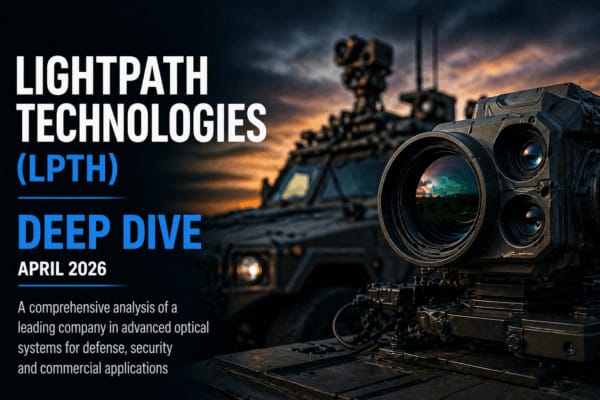
LightPath Technologies (Nasdaq: $LPTH): Defense Optics, BlackDiamond Glass and the High-Stakes IR Systems Re-Rating
LightPath has become one of the more interesting small-cap defense-technology stories of 2026: a former optics component name now trying to become a vertically integrated supplier of infrared cameras, optical assemblies, BlackDiamond chalcogenide glass and U.S.-aligned defense imaging systems.
Executive summary
LightPath Technologies is no longer being traded only as a small optical-components manufacturer. The company has deliberately repositioned itself around infrared imaging, defense supply-chain reshoring, higher-value optical assemblies, thermal camera systems and its proprietary BlackDiamond chalcogenide glass platform. That repositioning is the reason the market has started to treat LPTH as something more than a quiet photonics micro-cap.
The previous Merlintrader article on LightPath already captured the first major inflection: fiscal Q2 2026 revenue reached $16.4 million, up 120% year over year, gross margin improved to roughly 37%, adjusted EBITDA turned positive, cash rose to about $73.6 million after the December 2025 equity raise, and total backlog reached approximately $97.8 million at December 31, 2025. Those are not small numbers for a company that only recently was still viewed by many traders as a niche component supplier.
The story has continued to develop after that report. LightPath held its February 2026 Investor Day, where management framed the company as a global leader in optical and infrared solutions, emphasized that 85% of the backlog was tied to defense, surveillance, security and public-safety applications, and stated that 70% of the December backlog was scheduled for requested delivery during calendar 2026. Management also presented an illustrative path to revenue in excess of $300 million within five years, while clearly connecting that ambition to defense demand, BlackDiamond glass, camera systems, domestic supply chains and selective M&A.
The core bull case is powerful but not simple. LightPath is trying to move up the value chain from components into subsystems and full infrared camera solutions. It has G5 Infrared for cooled-camera capabilities, Visimid for design and prototyping, AMI assets for chalcogenide glass production, a manufacturing footprint across Orlando, Plano, Hudson and Riga, and a proprietary glass platform licensed from the U.S. Naval Research Laboratory. It also has a defense-market tailwind because U.S. and allied customers are increasingly sensitive to optical material provenance, Chinese critical mineral exposure, germanium alternatives and domestic/NDAA-compliant sourcing.
The bear case is just as important. LPTH has already re-rated sharply. It is no longer an undiscovered micro-cap priced for very little. The company is still GAAP loss-making, the latest reported net loss was affected by a G5 earn-out fair-value adjustment, the December 2025 capital raise created dilution, the fully diluted share count presented at Investor Day is materially higher than the basic share count, and the backlog still needs to be converted into revenue, margin and cash flow. In other words, the story has improved, but expectations have also increased.
For Merlintrader readers, LPTH is best understood as an execution story with a catalyst calendar. The next important checkpoint is fiscal Q3 2026 earnings, expected around mid-May based on available earnings-calendar indications, pending company confirmation. The market will not only look at revenue. It will look at backlog conversion, gross margin, adjusted EBITDA, cash use, G5 integration, AMI integration, new order momentum, defense-program commentary, BlackDiamond adoption and whether management’s long-term revenue ambition still sounds credible.
The key point is this: LPTH is not a clean “cheap stock” story anymore. It is a company trying to justify a new valuation through backlog, defense relevance and manufacturing execution. The upside case depends on becoming a scarce U.S.-aligned infrared-optics platform. The downside case depends on the market deciding that the re-rating has moved faster than the financial proof.
Why LPTH matters now
LightPath matters now because it sits at the intersection of four market themes that are unusually active in 2026: defense modernization, infrared imaging, domestic supply-chain security and the search for smaller public companies with real exposure to mission-critical hardware. That combination is what makes LPTH more interesting than a normal small-cap industrial earnings story.
The first theme is defense. Infrared imaging is not a decorative technology. It is central to surveillance, targeting, counter-drone systems, missile seekers, thermal weapon sights, border security, public safety and critical infrastructure. The world’s defense and security environment has become more demanding, and the market has started to reward companies that can sell into that demand with differentiated technology and domestic or allied manufacturing footprints.
The second theme is supply-chain provenance. In optics and infrared systems, material sourcing matters. Germanium has historically been important in infrared optics, but it is expensive, strategically sensitive and exposed to critical-mineral dynamics. LightPath’s BlackDiamond glass story matters because the company presents it as a U.S.-produced alternative to germanium that can be used in infrared optical systems. The company is not merely selling lenses; it is selling a supply-chain answer.
The third theme is moving up the value chain. A component supplier can be technically excellent but financially constrained by pricing pressure, customer concentration and limited share of the final system value. A systems supplier can potentially capture more value, build deeper customer relationships and become harder to replace. LightPath’s acquisitions and product roadmap show a clear attempt to shift from components to assemblies, modules and cameras.
The fourth theme is scarcity. There are not many small public companies that combine optics, infrared imaging, defense exposure, proprietary material technology and a visible backlog. That scarcity can attract retail traders, small-cap funds and thematic investors. But scarcity also creates valuation risk: when the crowd discovers a name quickly, expectations can move ahead of the operating proof.
Company overview: what LightPath actually does
LightPath Technologies describes itself as a provider of next-generation optics and imaging systems for defense and commercial applications. Its product menu includes optical components, thermal imaging lens assemblies, precision molded optics, infrared optical components, BlackDiamond infrared chalcogenide glass, broadband infrared solutions, long-wave infrared solutions, mid-wave infrared solutions and G5 thin-film products. The company serves aerospace and defense, industrial and oil & gas markets.
Historically, LightPath’s identity was closer to that of a precision optics company. Precision molded glass, lenses, infrared optics and assemblies were the technical foundation. That foundation still matters because it gives the company the optical design and manufacturing base required to support more complex systems. But the current investment thesis is not built only on molded optics. It is built on the transition from components to integrated infrared imaging solutions.
The G5 Infrared acquisition is central to this transition. G5 added advanced cooled-camera production and infrared camera/module capability. That matters because cooled infrared cameras are typically used in demanding applications where performance, reliability and system integration matter. Bringing that capability in-house gives LightPath a higher-value product layer and changes the conversation with customers from “we can provide parts” to “we can provide more of the mission-relevant imaging chain.”
Visimid also matters because it supports prototyping, R&D, uncooled cameras and industrial camera work from Plano, Texas. In a market where customer-specific designs, qualification cycles and program-level engineering are important, having a prototyping and R&D hub is not cosmetic. It can accelerate design wins and shorten the path from customer problem to engineered solution.
The AMI asset acquisition strengthens the material side of the story. LightPath said AMI added complementary chalcogenide glass technology, including high-grade glass melting as large-diameter plates, which the company views as critical for large optics, advanced defense and space programs. It also added a second NDAA-compliant manufacturing location for BlackDiamond glass. In a defense supply-chain story, that language matters because customers increasingly ask where critical materials come from and whether production can be trusted in crisis conditions.
The strategic pivot: from component supplier to optical systems platform
The central strategy is simple to describe and difficult to execute: move upstream. Management’s Investor Day presentation explicitly framed the last five years as a transformation period. The company right-sized the business, changed its global footprint, added new leadership, expanded its Orlando plant, shifted sales and manufacturing away from China toward the U.S. and Europe, acquired G5 Infrared, added AMI assets and built a backlog that management says is now overwhelmingly defense, surveillance, security and public-safety oriented.
That is the right strategy for the current environment. Defense customers are less likely to view high-performance optical systems as generic parts. They care about qualification, reliability, material origin, production continuity and long program lifespans. If LightPath can insert its technology into defense programs, the revenue can become more durable than short-cycle component orders. But that same durability comes with demanding qualification cycles and strict execution requirements.
The key phrase is “systems and solutions provider.” That phrase appears often in small-cap industrial stories, but in LightPath’s case it has concrete operating implications. A systems provider needs engineering depth, procurement discipline, quality systems, program management, field reliability, customer support, inventory planning and the ability to ship complex assemblies on time. It is not enough to have a better material. The company must prove it can deliver mission-relevant products repeatedly.
The potential reward is that the market may assign a higher multiple to an optical systems platform than to a commodity components supplier. The risk is that the company gets caught in the middle: more complexity, more capex, more inventory and more customer expectations before it fully earns systems-level economics.
BlackDiamond glass: why the material story matters
BlackDiamond is the most important technology narrative inside the LPTH story. LightPath describes BlackDiamond as a proprietary chalcogenide-based glass material sold under an exclusive license from the U.S. Naval Research Laboratory. The company presents it as an alternative to germanium for infrared applications, with a domestic supply-chain angle that is increasingly relevant to defense and aerospace customers.
The market cares about BlackDiamond because it gives LPTH something more defensible than a catalog of optics. If BlackDiamond can replace germanium in selected applications without performance compromise, the company can offer customers a cost, availability and provenance advantage. In an environment of critical mineral concerns and defense-sourcing restrictions, that could become strategically valuable.
However, material stories need proof. The adoption cycle for optical materials is not instant. Defense customers and system integrators need qualification, testing, reliability data and confidence that performance remains stable under real operating conditions. The Investor Day presentation referred to camera redesigns using BlackDiamond instead of germanium, same or improved optical performance, no change to size, weight or interfaces, and design wins in new defense programs. Those are important claims, but investors should watch for revenue evidence, not just product-roadmap language.
BlackDiamond also connects to AMI. If LightPath wants to push BlackDiamond into larger optics and more demanding defense or space programs, it needs internal capacity and process control. AMI’s glass-melting capabilities are therefore not a side note. They are part of the argument that LightPath can control enough of the production chain to be credible as demand grows.
Backlog: the number that changed the story
The most important financial number in the LPTH thesis is backlog. At December 31, 2025, LightPath reported total backlog of about $97.8 million, up 162% from $37.4 million at June 30, 2025. The company’s 10-Q stated that G5 Infrared backlog was $70.8 million at December 31, compared with $16.6 million at June 30, and that the increase included about $40 million in orders from a leading global technology customer for advanced infrared camera systems expected to ship in calendar 2026 and 2027.
Backlog is powerful because it changes the debate from “will demand appear?” to “can the company execute?” For small industrial and defense-technology names, that is a major upgrade. A visible backlog can help support revenue expectations, improve investor confidence and create operating leverage if production scales efficiently.
But backlog is not revenue yet. It must be manufactured, delivered, accepted and recognized. If customers push timelines, if components are delayed, if yields disappoint, if working capital balloons or if gross margin compresses, backlog can become a source of stress rather than comfort. That is why future earnings calls must be judged by backlog conversion and replenishment, not just backlog size.
Investor Day added more useful detail: management presented $97 million in total order backlog as of December 2025, with 85% tied to defense, surveillance, security and public safety, 13% commercial and 2% other. The company also indicated that 70% of backlog was scheduled for requested delivery in calendar 2026 and 30% in calendar 2027. That creates a real near-term scoreboard.
| Backlog angle | Why it matters | What to verify next |
|---|---|---|
| Size | $97.8M is large relative to recent quarterly revenue. | Updated backlog at Q3 FY2026. |
| Mix | Investor Day framed 85% as defense/surveillance/security/public safety. | Whether mix remains defense-heavy after deliveries. |
| Timing | 70% requested delivery in calendar 2026 creates near-term revenue potential. | Conversion speed, slippage and customer acceptance. |
| Replenishment | Backlog supports growth only if new orders replace shipped orders. | Book-to-bill, new awards and pipeline commentary. |
Financial analysis: growth is real, but profitability must prove itself
Fiscal Q2 2026 was the quarter that forced the market to pay attention. Revenue rose to $16.4 million from $7.4 million in the prior-year quarter. Gross profit rose to $6.0 million from $1.9 million. Gross margin expanded to 37% from 26%. Adjusted EBITDA improved to positive $0.6 million from negative $1.3 million. Those are the kinds of numbers that can change the market’s perception of a small company.
The growth was not evenly distributed. Assemblies and modules revenue increased to about $7.2 million, up sharply year over year, driven by G5 camera and module sales. That is crucial because it shows the acquired systems capability contributing meaningfully to the revenue mix. Infrared components also improved, helped by better mix and resolved manufacturing yield issues. Engineering services benefited from a non-recurring defense customer project.
The problem is that GAAP profitability remains noisy. The company reported a net loss of $9.4 million, or $0.20 per basic and diluted share, compared with a $2.6 million loss a year earlier. Management attributed the wider loss primarily to a $7.6 million fair-value adjustment related to the G5 earn-out liability. Investors should not ignore that explanation, but they should also not ignore the broader point: the company has not yet shown clean GAAP profitability at scale.
The balance sheet improved after the December 2025 public offering. LightPath said it raised $60 million in gross proceeds, with net proceeds supporting working capital, strategic investments, acquisitions and general corporate purposes. At December 31, 2025, cash and equivalents stood at $73.6 million. That gives the company more operating flexibility, but it came with dilution. Investor Day showed 55.8 million Class A common shares as the basis for EPS and an “all-in” fully diluted common count of roughly 73.2 million when including preferred common equivalents, potential PIK preferred, G5 earnout shares and stock incentives.
That fully diluted number matters. Traders often look only at market cap based on current basic shares. But for a company that has preferred equivalents, earnout shares and incentive equity, the fully diluted view gives a more realistic sense of future ownership claims. It does not invalidate the bull case, but it raises the bar for per-share value creation.
| Metric | Latest reported detail | Merlintrader interpretation |
|---|---|---|
| Revenue | $16.4M in Q2 FY2026, +120% YoY. | Clear growth inflection, helped by G5 and order momentum. |
| Gross margin | ~37% in Q2 FY2026. | Improved mix and execution, but sustainability matters. |
| Adjusted EBITDA | $0.6M positive in Q2 FY2026. | Encouraging operating signal, not the same as clean GAAP profit. |
| Net loss | $9.4M loss in Q2 FY2026. | Heavily affected by G5 earn-out accounting, but still a GAAP loss. |
| Cash | $73.6M at December 31, 2025. | Strong short-term flexibility after equity raise. |
| Dilution | Investor Day showed roughly 73.2M all-in common shares. | Per-share value creation must be judged on a fully diluted mindset. |
CEO and management: Sam Rubin’s role in the transformation
Sam Rubin is the central executive figure in the LPTH story. He has served as President, Chief Executive Officer and Director since March 2020, according to management-profile data. His background is important because LPTH is not a pure financial-engineering story. It is a technical manufacturing transformation, and the CEO’s ability to understand optics, photonics, customer requirements and industrial execution matters.
Rubin is widely described as an optics and photonics veteran. Public profile information and interviews describe him as having deep experience in photonics, including prior roles connected to Thorlabs and xLight Photonics. A 2024 industry podcast framed him as an optics veteran “with the heart of an engineer.” That is relevant because LightPath’s current strategy depends on more than selling a story to investors. It depends on technical credibility with defense, industrial and imaging customers.
What stands out in Rubin’s tenure is the deliberate movement away from commodity-style optics and toward higher-value systems. The company’s own narrative emphasizes moving away from germanium optics, scaling BlackDiamond glass, pushing up the value chain into complete IR camera systems and reshaping the global manufacturing footprint. That is a coherent strategy. The open question is whether the operating organization can scale fast enough to match the ambition.
The board also matters. In October 2025, LightPath appointed Mark Caylor to the board. Caylor previously served as corporate vice president and president of Northrop Grumman’s Mission Systems sector, a major defense business focused on advanced sensing and communications technologies. His presence adds credibility to the defense-transition narrative. It does not guarantee contracts, but it signals that the company wants defense-market expertise at governance level.
In April 2026, LightPath appointed Doug Schoen as Senior Vice President of Global Sales and Ryan Workman as Vice President of Business Development & Product Management. Schoen’s background includes defense and aerospace roles at Elbit Systems of America, Bell, Honeywell and Collins Aerospace. Workman brings electro-optical/infrared and federal law-enforcement experience, including Silent Sentinel and Motorola Solutions exposure. These appointments matter because the next phase is commercial execution: orders, programs, channels and customer qualification.
Insiders, ownership and dilution
Insider and ownership analysis for LPTH needs to be handled carefully. Public data sources show insider ownership in the low-single-digit range to roughly 5%, depending on source and reporting date, while institutional ownership appears meaningful but still not dominant. Trendlyne’s January 2026 ownership snapshot showed insiders moving from 4.93% to 5.02% and institutional investors from 33.31% to 33.45%. That kind of data is useful as a directional read, but the official filings remain the source that should be used for final ownership verification.
The insider story is not currently defined by a simple “massive insider buying” signal. Instead, it is defined by whether management’s incentives are aligned enough and whether the board and executives can justify the dilution taken to fund the transformation. The December 2025 offering strengthened the balance sheet, but it increased the share count. For a company trying to scale, dilution can be acceptable if it funds accretive capacity, acquisitions and backlog conversion. It becomes a problem if revenue growth fails to translate into per-share value.
Investor Day’s capital-structure slide is one of the most important pieces of the puzzle. The company showed 55.8 million Class A common shares as the basis for EPS, 9.75 million common equivalents from Series G preferred, 5.6 million potential PIK preferred, estimated G5 earnout shares, and stock incentives, leading to a roughly 73.2 million “all-in” common share count. That does not mean all dilution arrives immediately or in the same way, but it does mean the per-share analysis should be conservative.
The market may tolerate dilution if LPTH continues to convert backlog, expand gross margin and build a credible path toward positive operating cash flow. It will be less forgiving if dilution is followed by execution slippage, backlog delays or margin compression. For this reason, any deep dive on LPTH has to treat dilution as a central risk, not a footnote.
Institutional holders and analyst coverage
Institutional ownership has become more relevant as LPTH has re-rated. MarketBeat’s institutional ownership data has shown filings from firms including Tudor Investment Corp, Peregrine Investment Management, SG Americas Securities, Wealth Effects and others. These filings should not be interpreted as a single institutional endorsement, but they show that LPTH is on more screens than it was when the stock was a quieter micro-cap.
Analyst coverage has also expanded. Public analyst-summary sources list coverage from firms including Canaccord Genuity, B. Riley, Colliers Securities and others. Market data sources show a range of ratings and price targets, with some public summaries indicating an average target in the low-to-mid teens and high targets around the mid-teens. Canaccord initiated coverage in January 2026 with a Buy rating and a $15 price target, according to Marketscreener summary data, while later third-party summaries referenced target adjustments around $15 to $15.50.
Analyst targets should be treated as context, not truth. In a fast-moving small-cap, price targets can chase the stock higher or lower after the market has already repriced the story. The more useful part of analyst coverage is the framework: defense backlog, BlackDiamond adoption, camera systems, margin expansion and operating leverage. If future earnings support those variables, analysts may keep defending higher valuation. If they do not, targets can compress quickly.
For Merlintrader readers, the key institutional/analyst question is not “what is the average price target?” The key question is whether the analyst community is modeling revenue growth and margin expansion that the company can actually deliver. If the Street is already expecting strong growth, the bar is high. A good earnings report must beat not only last year’s numbers, but also the upgraded narrative.
Retail sentiment: why traders are interested
Retail sentiment around LPTH is strong because the ticker has several ingredients that traders like: a real operating inflection, a defense angle, an AI-adjacent imaging angle, a supply-chain reshoring angle, a backlog number that is easy to understand, and a small-cap float dynamic that can create fast moves. It is not hard to see why the stock became attractive to momentum traders.
The retail bull narrative is usually simple: LPTH has a huge backlog relative to its historical revenue base, it is tied to defense and infrared imaging, BlackDiamond could replace germanium in important applications, the U.S. wants domestic supply chains, and the company could become a takeout candidate or a scarce public vehicle for optics exposure. That is a compelling story for forums and social platforms because it has both numbers and imagination.
The retail bear narrative is also visible: the move may already price in a lot, GAAP losses remain, dilution is meaningful, defense contracts can be slow, backlog conversion can slip, and the stock can be extremely volatile after a major re-rating. Traders who arrive late can be exposed to sharp drawdowns if earnings are merely good but not good enough.
Reddit presence appears limited and thin compared with bigger retail names; one recent Reddit post tied to the Sterling award had little discussion at the time it was visible. X/Twitter-style discussion appears more active, but much of it is momentum-oriented and should not be treated as factual confirmation. Stocktwits-style sentiment, when active, should be used only as a gauge of trader positioning and excitement, not as evidence about contracts or fundamentals.
For a Merlintrader report, the correct treatment is to include retail sentiment as a separate layer. Retail enthusiasm can help explain price action and volatility, but it cannot validate backlog, NDAA positioning, program wins or revenue trajectory. Those must come from filings, company releases and primary materials.
Projects, programs and pipeline opportunities
Investor Day provided one of the clearest windows into the company’s opportunity set. Management referenced active pipeline opportunities in aerospace and defense, including counter-UAS examples, FIFA 2026 World Cup stadium surveillance and security-camera deployments, Department of Homeland Security procurement opportunities tied to a dedicated counter-UAS program office, JIATF-401 defense of the National Capital Region, defense programs, new seeker opportunities, space programs, optical assemblies for FPV drones and expansion of existing missile programs.
This list is important, but it must be interpreted correctly. A pipeline opportunity is not the same as a booked order. Some opportunities may become programs, some may be delayed, some may be competed away, and some may never reach material revenue. However, the list shows where management believes its technology can be relevant: counter-drone, surveillance, missile seekers, space, defense optics and high-security imaging.
The company also presented existing program examples with potential revenue ranges and timelines. The Investor Day deck included program references with potential revenue of $50 million to $100 million per year, $10 million to $20 million annually, and $20 million in calendar 2026 bookings, depending on the program. Those figures are management presentation data and should be treated as potential, not guaranteed revenue.
The most exciting part of the program story is also the riskiest: defense programs can have long lifespans, but they can also be delayed, rebid, reprioritized or affected by government budgets. The market tends to get excited about large program numbers. Experienced investors look for award status, sole-source language, production timing, funding line items and evidence that LightPath is not only technically qualified but commercially embedded.
| Opportunity area | Why it fits LPTH | Investor caution |
|---|---|---|
| Counter-UAS | Thermal imaging and surveillance are critical for detection and tracking. | Competitive field with fast-changing requirements. |
| Missile seekers | Infrared optics and advanced materials can be mission-critical. | Long qualification cycles and program dependency. |
| Space programs | Large optics, materials and advanced imaging can be relevant. | High reliability standards and long timelines. |
| Stadium / public safety | Thermal cameras and surveillance systems fit security needs. | Event-related demand can be lumpy. |
| FPV drone optical assemblies | Small optics and imaging payload demand can scale quickly. | Pricing pressure and rapid design cycles. |
Competitive landscape
LPTH operates in a demanding competitive landscape. It is not competing in isolation. The broader optics and infrared ecosystem includes large defense primes, specialized optics manufacturers, camera-module suppliers, thermal-imaging companies, material suppliers and internal capabilities inside major defense contractors. This is why LightPath’s value proposition must be specific.
The company is not likely to win by being the largest supplier. It must win by being specialized, responsive, vertically integrated and strategically aligned with customers that care about U.S. and allied supply chains. BlackDiamond glass is the differentiation point. G5 gives camera-system depth. AMI strengthens material control. The Riga facility gives European defense support. The Orlando and Plano sites add U.S. manufacturing and engineering credibility.
The competitive risk is that larger players can internalize capabilities, acquire competing suppliers or pressure pricing. Another risk is that alternative materials or designs reduce the need for BlackDiamond in specific applications. LightPath’s answer must be performance, reliability, cost, supply security and engineering support. The company must prove that its solution is not only technically interesting but commercially preferable.
Catalysts to watch
The most important near-term catalyst is fiscal Q3 2026 earnings, expected around mid-May 2026 based on available earnings-calendar indications, pending company confirmation. This report matters because it will test whether the Q2 surge was a new baseline or a consolidation-assisted spike. Investors will look for revenue growth, gross margin stability, adjusted EBITDA, updated backlog, cash use and management’s language on delivery timing.
The second catalyst is backlog conversion. If LightPath shows that the December backlog is converting into revenue on schedule, confidence in the model should improve. If conversion is slower than expected, the market may question the timing and reliability of the growth path.
The third catalyst is new order momentum. A large backlog is useful, but it must be replenished. The best setup would be strong revenue conversion combined with new program wins. That would show that the company is not simply burning down backlog but building a larger, more durable business.
The fourth catalyst is BlackDiamond adoption. Any concrete customer design win, camera redesign, qualification milestone or defense-program incorporation tied to BlackDiamond would be important. The market wants proof that the material story is not only strategic but revenue-bearing.
The fifth catalyst is the Sterling Manufacturing Business Excellence award presentation on May 29, 2026. This is not a financial catalyst in the same way earnings are, but it supports the manufacturing-quality narrative. For a company that must prove production reliability, manufacturing recognition has reputational value.
The sixth catalyst is the broader defense budget and procurement environment. Counter-UAS, missile defense, surveillance, border security, drones and European defense spending all matter for LPTH’s addressable market. Any policy or procurement development that pushes customers toward domestic or allied infrared supply chains can strengthen the narrative.
Bull case
The bull case starts with backlog. A company with $16.4 million in quarterly revenue and nearly $98 million in backlog has visibility that many small-cap technology names lack. If 70% of that backlog is requested for calendar 2026 delivery, the next few quarters could show meaningful revenue momentum.
The second bull point is mix. Assemblies, modules, cameras and systems are more strategically valuable than commodity components. If G5 and future camera redesigns push the company into higher-value product categories, LightPath can potentially support stronger margins and more durable customer relationships.
The third bull point is supply-chain positioning. U.S. and allied defense customers increasingly care about where critical materials and optical systems come from. LightPath’s BlackDiamond and AMI story gives it a direct answer to that concern. If customers actively seek germanium alternatives and NDAA-aligned sources, LPTH could become more than a supplier; it could become a supply-chain solution.
The fourth bull point is management’s long-term ambition. Investor Day included an illustrative path to revenue in excess of $300 million in five years. That is not guidance and should not be treated as guaranteed. But it shows the scale of management’s ambition. If even part of that pathway becomes credible, the market may continue to support a higher valuation.
The fifth bull point is scarcity. Small public defense-optics names with proprietary material technology and real backlog are rare. Scarcity can attract both institutional and retail attention, especially when macro headlines favor defense spending, critical minerals, drones and domestic manufacturing.
Bear case and red flags
The bear case begins with valuation. LPTH has already moved dramatically from its prior micro-cap perception. When a stock re-rates before the financial model is fully proven, the market can punish even minor disappointments. A good quarter may not be enough if expectations are too high.
The second bear point is profitability. Revenue growth is real, but GAAP profitability is not yet clean. The latest reported net loss was affected by earn-out accounting, but adjusted numbers cannot replace long-term cash generation. Investors need to see operating leverage turn into durable positive cash flow.
The third bear point is dilution. The December raise strengthened the balance sheet, but it increased the equity base. Investor Day’s all-in common share count should remain front and center in valuation analysis. If future growth requires more capital, dilution risk could return.
The fourth bear point is execution. Backlog conversion is not automatic. Manufacturing yields, supply chain constraints, customer acceptance, defense-program timing, capacity expansion and working capital can all create friction. A backlog-heavy story becomes vulnerable if delivery timing slips.
The fifth bear point is customer concentration. The 10-Q referenced roughly $40 million in orders from a leading global technology customer for advanced infrared camera systems. Large customers can validate a business, but they can also create concentration risk if timing or demand changes.
The sixth bear point is narrative crowding. LPTH now touches defense, AI-adjacent imaging, drones, counter-UAS, domestic manufacturing and critical minerals. These are hot themes. Hot themes can support momentum, but they can also attract fast money that exits quickly when momentum fades.
Base case, bull case and bear case scenarios
| Scenario | What happens | Market interpretation |
|---|---|---|
| Bull case | Backlog converts on schedule, gross margin stays near or above recent levels, adjusted EBITDA remains positive, new defense orders arrive, and BlackDiamond adoption becomes more visible. | LPTH can be viewed as a credible small-cap defense-optics platform with scarcity value. |
| Base case | Revenue grows, but conversion is uneven; margins fluctuate; new orders arrive but not explosively; cash remains adequate; the stock stays volatile around earnings. | The story remains valid, but valuation debate becomes more balanced. |
| Bear case | Backlog conversion slips, margins compress, cash burn rises, order momentum slows, or management’s long-term path looks too optimistic. | The market treats the prior move as overextended and compresses the valuation. |
The most realistic framework is not to treat LPTH as a binary winner or loser. It is a progress-check stock. Each quarter either confirms the transformation or raises questions about the pace of that transformation. This is why the next earnings update matters so much.
Merlintrader bottom line
LPTH is one of the cleaner examples of a small-cap stock where the story has genuinely changed. The company has moved beyond a simple optics-component identity and now has a credible narrative around infrared systems, defense, BlackDiamond glass, domestic supply chains and vertically integrated manufacturing.
The attraction is obvious: large backlog, improving revenue, better gross margin, positive adjusted EBITDA, meaningful cash, defense relevance, technical differentiation and a management team that has articulated a clear five-year ambition. The company has the kind of story that can keep traders engaged and give long-only small-cap investors something to underwrite.
The caution is just as important: the stock has already re-rated, dilution is meaningful, GAAP profitability is not yet clean, backlog conversion must be proven, and defense-system scale-up is never easy. The company has created a more interesting story, but the market has already started to price in success.
For Merlintrader, the right stance is not promotional and not dismissive. LPTH deserves a serious place on the watchlist because it is tied to real trends and real company-specific progress. But it should be analyzed as an execution-sensitive defense-technology re-rating, not as a guaranteed winner. The next earnings report and backlog update will matter more than any social-media narrative.
The best version of LPTH is a vertically integrated, U.S.-aligned infrared optics and camera-systems company that captures defense and public-safety demand while scaling BlackDiamond into meaningful programs. The worst version is a hot small-cap that raised expectations faster than it can convert orders into profitable revenue. The stock is now living between those two versions.
That is what makes it worth watching: not because the outcome is certain, but because the next few quarters should reveal whether LightPath’s transformation is turning into a durable business model or simply a well-timed re-rating around defense and infrared themes.
Primary and reference sources
- Merlintrader — previous LightPath Technologies report
- LightPath Investor Relations
- LightPath — fiscal Q2 2026 results
- SEC — Form 10-Q for quarter ended December 31, 2025
- LightPath — February 2026 Investor Day presentation
- LightPath — defense and commercial sales appointments
- LightPath — Sterling Council award
- LightPath Governance
- Merlintrader Free Catalyst Calendar
LightPath Technologies (Nasdaq: $LPTH): ottiche defense, BlackDiamond glass e re-rating ad alta tensione sugli IR systems
LightPath è diventata una delle storie small-cap defense-tech più interessanti del 2026: un ex nome da componenti ottici che ora prova a diventare un fornitore verticalmente integrato di camere infrarosse, optical assemblies, vetro calcogenurico BlackDiamond e sistemi di imaging defense allineati agli Stati Uniti.
Sintesi esecutiva
LightPath Technologies non viene più trattata dal mercato soltanto come una piccola società di componenti ottici. La società si è riposizionata in modo deliberato su imaging infrarosso, reshoring delle supply chain defense, optical assemblies a maggior valore, thermal camera systems e piattaforma proprietaria BlackDiamond basata su vetro calcogenurico. Questo riposizionamento è il motivo per cui il mercato ha iniziato a guardare LPTH come qualcosa di più di una tranquilla micro-cap photonics.
Il precedente articolo Merlintrader su LightPath aveva già colto il primo grande punto di svolta: nel fiscal Q2 2026 i ricavi hanno raggiunto $16,4 milioni, +120% anno su anno, il gross margin è migliorato a circa 37%, l’adjusted EBITDA è tornato positivo, la cassa è salita a circa $73,6 milioni dopo l’aumento di capitale di dicembre 2025, e il backlog totale ha raggiunto circa $97,8 milioni al 31 dicembre 2025. Per una società che fino a poco tempo fa era vista da molti trader come un fornitore di nicchia, questi numeri hanno cambiato il quadro.
La storia si è sviluppata ulteriormente dopo quel report. LightPath ha tenuto l’Investor Day di febbraio 2026, in cui il management ha inquadrato la società come leader globale nelle soluzioni ottiche e infrarosse, ha sottolineato che l’85% del backlog era legato a defense, surveillance, security e public safety, e ha indicato che il 70% del backlog di dicembre aveva delivery request nel calendario 2026. Il management ha anche presentato un percorso illustrativo verso ricavi superiori a $300 milioni entro cinque anni, collegando questa ambizione a domanda defense, BlackDiamond glass, camera systems, supply chain domestiche e M&A selettivo.
Il bull case è potente ma non semplice. LightPath sta cercando di salire nella catena del valore, passando da componenti a subsystem e soluzioni complete di infrared camera. Ha G5 Infrared per le capacità cooled-camera, Visimid per design e prototipazione, asset AMI per produzione di vetro calcogenurico, una footprint produttiva tra Orlando, Plano, Hudson e Riga, e una piattaforma proprietaria di vetro in licenza dallo U.S. Naval Research Laboratory. Ha inoltre un tailwind defense perché clienti USA e alleati sono sempre più sensibili a provenienza dei materiali ottici, esposizione a critical minerals cinesi, alternative al germanium e sourcing domestico/NDAA-compliant.
Il bear case è altrettanto importante. LPTH si è già rivalutata molto. Non è più una micro-cap non scoperta prezzata per pochissimo. La società resta in perdita GAAP, l’ultima perdita netta riportata è stata influenzata da una rettifica fair value sull’earn-out G5, l’aumento di capitale di dicembre 2025 ha creato diluizione, la fully diluted share count presentata all’Investor Day è materialmente superiore alla basic share count, e il backlog deve ancora essere convertito in ricavi, margini e cash flow. In altre parole, la storia è migliorata, ma anche le aspettative sono salite.
Per i lettori Merlintrader, LPTH va capita come una execution story con calendario catalyst. Il prossimo checkpoint importante è il fiscal Q3 2026 earnings, atteso intorno a metà maggio secondo indicazioni di earnings calendar disponibili, in attesa di conferma societaria. Il mercato non guarderà solo ai ricavi. Guarderà conversione backlog, gross margin, adjusted EBITDA, uso di cassa, integrazione G5, integrazione AMI, momentum dei nuovi ordini, commenti sui programmi defense, adozione BlackDiamond e credibilità del percorso di lungo periodo.
Il punto chiave è questo: LPTH non è più una semplice storia “cheap”. È una società che deve giustificare una nuova valutazione attraverso backlog, rilevanza defense ed esecuzione manifatturiera. L’upside case dipende dalla possibilità di diventare una piattaforma rara e allineata agli USA nell’infrared optics. Il downside case dipende dalla possibilità che il mercato decida che il re-rating si è mosso più velocemente della prova finanziaria.
Perché LPTH conta adesso
LightPath conta adesso perché si trova all’incrocio di quattro temi molto attivi nel 2026: modernizzazione defense, imaging infrarosso, sicurezza delle supply chain domestiche e ricerca di piccole società quotate con esposizione reale a hardware mission-critical. Questa combinazione rende LPTH più interessante di una normale storia earnings industriale small-cap.
Il primo tema è la difesa. L’imaging infrarosso non è una tecnologia decorativa. È centrale per sorveglianza, targeting, sistemi counter-drone, missile seekers, thermal weapon sights, border security, public safety e critical infrastructure. L’ambiente defense e security globale è diventato più esigente, e il mercato ha iniziato a premiare le società che possono vendere dentro questa domanda con tecnologia differenziata e footprint produttive domestiche o alleate.
Il secondo tema è la provenienza della supply chain. In optics e infrared systems, l’origine dei materiali conta. Il germanium è storicamente importante nelle ottiche infrarosse, ma è costoso, strategicamente sensibile ed esposto alle dinamiche dei critical minerals. La storia BlackDiamond di LightPath conta perché la società la presenta come alternativa prodotta negli Stati Uniti al germanium, utilizzabile in sistemi ottici infrarossi. La società non sta vendendo solo lenti; sta vendendo una risposta di supply chain.
Il terzo tema è la salita nella catena del valore. Un fornitore di componenti può essere tecnicamente eccellente ma finanziariamente limitato da pressione sui prezzi, concentrazione clienti e quota ridotta del valore finale del sistema. Un fornitore di sistemi può potenzialmente catturare più valore, costruire relazioni più profonde con i clienti e diventare più difficile da sostituire. Le acquisizioni e la roadmap prodotto di LightPath mostrano chiaramente il tentativo di spostarsi da componenti ad assemblies, moduli e camere.
Il quarto tema è la scarsità. Non esistono molte piccole società pubbliche che combinano optics, infrared imaging, esposizione defense, tecnologia proprietaria sui materiali e backlog visibile. Questa scarsità può attrarre retail trader, fondi small-cap e investitori tematici. Ma la scarsità crea anche rischio valuation: quando il crowd scopre rapidamente un nome, le aspettative possono correre più dei risultati operativi.
Company overview: cosa fa davvero LightPath
LightPath Technologies si descrive come provider di next-generation optics e imaging systems per applicazioni defense e commerciali. Il menu prodotti include optical components, thermal imaging lens assemblies, precision molded optics, infrared optical components, BlackDiamond infrared chalcogenide glass, broadband infrared solutions, long-wave infrared solutions, mid-wave infrared solutions e G5 thin-film products. La società serve aerospace and defense, industrial e oil & gas markets.
Storicamente, l’identità di LightPath era più vicina a quella di una precision optics company. Precision molded glass, lenses, infrared optics e assemblies erano la base tecnica. Quella base resta importante perché offre la capacità di optical design e manufacturing necessaria per supportare sistemi più complessi. Ma la tesi attuale non è costruita soltanto sulle molded optics. È costruita sulla transizione da componenti a soluzioni integrate di infrared imaging.
L’acquisizione di G5 Infrared è centrale in questa transizione. G5 ha aggiunto capacità di produzione di advanced cooled cameras e camera/module infrarossi. Questo conta perché le cooled infrared cameras sono tipicamente utilizzate in applicazioni esigenti dove performance, affidabilità e system integration contano. Portare questa capacità in-house offre a LightPath uno strato prodotto a maggior valore e cambia la conversazione con i clienti da “possiamo fornire parti” a “possiamo fornire più catena mission-relevant dell’imaging”.
Visimid conta perché supporta prototyping, R&D, uncooled cameras e industrial camera work da Plano, Texas. In un mercato dove design specifici per cliente, cicli di qualifica e engineering a livello programma sono importanti, avere un hub R&D e prototipazione non è cosmetico. Può accelerare design wins e ridurre il percorso dal problema del cliente alla soluzione ingegnerizzata.
L’acquisizione degli asset AMI rafforza il lato materiali. LightPath ha detto che AMI ha aggiunto tecnologia complementare su vetro calcogenurico, inclusa capacità di melting di high-grade glass in large-diameter plates, considerata critica per grandi ottiche, advanced defense e space programs. Ha anche aggiunto una seconda sede manufacturing NDAA-compliant per BlackDiamond glass. In una storia di defense supply chain, questo linguaggio conta perché i clienti chiedono sempre più spesso da dove arrivano i materiali critici e se la produzione può reggere in condizioni di crisi.
Il pivot strategico: da component supplier a optical systems platform
La strategia centrale è semplice da descrivere e difficile da eseguire: salire upstream. La presentazione Investor Day del management ha inquadrato gli ultimi cinque anni come periodo di trasformazione. La società ha ridimensionato il business, cambiato footprint globale, aggiunto nuova leadership, espanso lo stabilimento di Orlando, spostato vendite e produzione dalla Cina verso USA ed Europa, acquisito G5 Infrared, aggiunto asset AMI e costruito un backlog che il management descrive come ormai prevalentemente legato a defense, surveillance, security e public safety.
È la strategia giusta per l’ambiente attuale. I clienti defense sono meno inclini a vedere i sistemi ottici ad alte prestazioni come parti generiche. Guardano qualifica, affidabilità, origine dei materiali, continuità produttiva e durata dei programmi. Se LightPath riesce a inserire la propria tecnologia dentro programmi defense, i ricavi possono diventare più duraturi rispetto a ordini component short-cycle. Ma la stessa durata porta cicli di qualifica duri e requisiti di execution severi.
La frase chiave è “systems and solutions provider”. Questa frase compare spesso nelle storie industriali small-cap, ma nel caso LightPath ha implicazioni operative concrete. Un systems provider ha bisogno di profondità engineering, disciplina procurement, sistemi qualità, program management, field reliability, customer support, inventory planning e capacità di spedire assemblies complessi in tempo. Non basta avere un materiale migliore. La società deve dimostrare di poter consegnare ripetutamente prodotti mission-relevant.
Il premio potenziale è che il mercato può assegnare un multiplo più alto a una optical systems platform rispetto a un fornitore di componenti commodity. Il rischio è che la società resti in mezzo: più complessità, più capex, più inventario e più aspettative clienti prima di aver davvero conquistato economics da systems company.
BlackDiamond glass: perché la storia dei materiali conta
BlackDiamond è la narrativa tecnologica più importante dentro la storia LPTH. LightPath descrive BlackDiamond come materiale proprietario chalcogenide-based glass venduto sotto licenza esclusiva dello U.S. Naval Research Laboratory. La società lo presenta come alternativa al germanium per applicazioni infrarosse, con un angolo supply-chain domestica sempre più rilevante per clienti defense e aerospace.
Il mercato guarda BlackDiamond perché offre a LPTH qualcosa di più difendibile di un catalogo di ottiche. Se BlackDiamond può sostituire il germanium in applicazioni selezionate senza compromessi di performance, la società può offrire ai clienti un vantaggio di costo, disponibilità e provenance. In un contesto di preoccupazioni su critical minerals e restrizioni di sourcing defense, questo può diventare strategicamente prezioso.
Le storie sui materiali, però, richiedono prova. Il ciclo di adozione per materiali ottici non è istantaneo. Clienti defense e system integrator richiedono qualifica, testing, dati di affidabilità e fiducia che la performance resti stabile in condizioni operative reali. L’Investor Day ha parlato di camera redesign usando BlackDiamond al posto di germanium, performance ottica uguale o migliore, nessun cambiamento su size, weight o interfaces, e design wins in nuovi programmi defense. Sono claim importanti, ma gli investitori devono cercare prova di ricavi, non solo linguaggio roadmap.
BlackDiamond si collega anche ad AMI. Se LightPath vuole spingere BlackDiamond in ottiche più grandi e programmi defense o space più esigenti, ha bisogno di capacità interna e controllo di processo. Le capacità glass-melting di AMI non sono quindi una nota laterale. Sono parte dell’argomento secondo cui LightPath può controllare una parte sufficiente della catena produttiva per essere credibile quando la domanda cresce.
Backlog: il numero che ha cambiato la storia
Il numero finanziario più importante nella tesi LPTH è il backlog. Al 31 dicembre 2025, LightPath ha riportato backlog totale di circa $97,8 milioni, +162% rispetto a $37,4 milioni al 30 giugno 2025. Il 10-Q della società ha indicato che il backlog G5 Infrared era pari a $70,8 milioni al 31 dicembre, rispetto a $16,6 milioni al 30 giugno, e che l’aumento includeva circa $40 milioni di ordini da un leading global technology customer per sistemi avanzati di camere infrarosse attesi in spedizione nel 2026 e 2027.
Il backlog è potente perché cambia il dibattito da “la domanda arriverà?” a “la società saprà eseguire?”. Per nomi small-cap industriali e defense-tech, questo è un upgrade importante. Un backlog visibile può supportare aspettative di ricavi, migliorare la fiducia degli investitori e creare operating leverage se la produzione scala in modo efficiente.
Ma backlog non significa ancora revenue. Deve essere prodotto, consegnato, accettato e riconosciuto. Se i clienti spostano timeline, se componenti tardano, se gli yield deludono, se il working capital esplode o se il gross margin comprime, il backlog può diventare fonte di stress anziché conforto. Per questo le prossime earnings call vanno giudicate su conversione e replenishment del backlog, non solo sulla sua dimensione.
L’Investor Day ha aggiunto dettaglio utile: il management ha presentato $97 milioni di total order backlog a dicembre 2025, con 85% legato a defense, surveillance, security e public safety, 13% commercial e 2% other. La società ha anche indicato che il 70% del backlog aveva delivery request nel calendario 2026 e il 30% nel 2027. Questo crea un vero tabellone a breve termine.
| Angolo backlog | Perché conta | Cosa verificare |
|---|---|---|
| Dimensione | $97,8M è grande rispetto ai ricavi trimestrali recenti. | Backlog aggiornato al Q3 FY2026. |
| Mix | Investor Day ha descritto 85% come defense/surveillance/security/public safety. | Se il mix resta defense-heavy dopo le consegne. |
| Timing | 70% richiesto in delivery nel 2026 crea potenziale revenue vicino. | Velocità di conversione, slippage e accettazione clienti. |
| Replenishment | Il backlog sostiene crescita solo se nuovi ordini rimpiazzano quelli spediti. | Book-to-bill, nuovi award e commentary pipeline. |
Analisi finanziaria: crescita reale, ma la profittabilità deve ancora dimostrarsi
Il fiscal Q2 2026 è stato il trimestre che ha costretto il mercato a prestare attenzione. I ricavi sono saliti a $16,4 milioni da $7,4 milioni nel trimestre dell’anno precedente. Il gross profit è salito a $6,0 milioni da $1,9 milioni. Il gross margin si è espanso a 37% da 26%. L’adjusted EBITDA è migliorato a positivo $0,6 milioni da negativo $1,3 milioni. Sono numeri capaci di cambiare la percezione del mercato su una piccola società.
La crescita non è stata distribuita in modo uniforme. I ricavi assemblies and modules sono saliti a circa $7,2 milioni, in forte aumento anno su anno, spinti dalle vendite G5 di camere e moduli. Questo è cruciale perché mostra che la capability systems acquisita sta contribuendo in modo significativo al mix ricavi. Anche infrared components è migliorata, aiutata da mix migliore e risoluzione di problemi yield produttivi. Engineering services ha beneficiato di un progetto non ricorrente per un cliente defense.
Il problema è che la redditività GAAP resta rumorosa. La società ha riportato una perdita netta di $9,4 milioni, o $0,20 per azione basic e diluted, contro perdita di $2,6 milioni l’anno precedente. Il management ha attribuito la perdita più ampia principalmente a una rettifica fair-value da $7,6 milioni legata alla G5 earn-out liability. Gli investitori non dovrebbero ignorare questa spiegazione, ma nemmeno il punto più ampio: la società non ha ancora mostrato profittabilità GAAP pulita su scala.
Il bilancio è migliorato dopo l’offerta pubblica di dicembre 2025. LightPath ha detto di aver raccolto $60 milioni di gross proceeds, con net proceeds destinati a working capital, investimenti strategici, acquisizioni e general corporate purposes. Al 31 dicembre 2025, cash and equivalents erano $73,6 milioni. Questo dà alla società più flessibilità operativa, ma è arrivato con diluizione. Investor Day mostrava 55,8 milioni di Class A common shares come base EPS e una “all-in” fully diluted common count di circa 73,2 milioni includendo preferred common equivalents, potential PIK preferred, G5 earnout shares e stock incentives.
Quel numero fully diluted conta. I trader spesso guardano solo la market cap basata sulle basic shares correnti. Ma per una società con preferred equivalents, earnout shares e incentive equity, la vista fully diluted offre una lettura più realistica delle future claim economiche. Non invalida il bull case, ma alza l’asticella per la creazione di valore per azione.
| Metrica | Dato più recente | Interpretazione Merlintrader |
|---|---|---|
| Ricavi | $16,4M in Q2 FY2026, +120% YoY. | Chiara inflection di crescita, aiutata da G5 e order momentum. |
| Gross margin | ~37% in Q2 FY2026. | Mix ed execution migliorati, ma sostenibilità da provare. |
| Adjusted EBITDA | $0,6M positivo in Q2 FY2026. | Segnale operativo incoraggiante, non uguale a GAAP profit pulito. |
| Net loss | Perdita $9,4M in Q2 FY2026. | Molto influenzata da accounting earn-out G5, ma resta una perdita GAAP. |
| Cassa | $73,6M al 31 dicembre 2025. | Flessibilità di breve termine forte dopo aumento capitale. |
| Diluizione | Investor Day mostrava circa 73,2M all-in common shares. | La creazione di valore per azione va giudicata su base fully diluted. |
CEO e management: il ruolo di Sam Rubin nella trasformazione
Sam Rubin è la figura esecutiva centrale nella storia LPTH. Ricopre il ruolo di President, Chief Executive Officer e Director dal marzo 2020, secondo dati pubblici sul management. Il suo background è importante perché LPTH non è una pura storia di financial engineering. È una trasformazione tecnica e manifatturiera, e la capacità del CEO di capire optics, photonics, requisiti clienti ed execution industriale conta.
Rubin viene spesso descritto come veterano di optics e photonics. Informazioni pubbliche e interviste lo descrivono con profonda esperienza in photonics, incluse esperienze collegate a Thorlabs e xLight Photonics. Un podcast di settore del 2024 lo ha inquadrato come un optics veteran “with the heart of an engineer”. Questo è rilevante perché la strategia attuale di LightPath dipende da più che vendere una storia agli investitori. Dipende da credibilità tecnica con clienti defense, industrial e imaging.
Ciò che spicca nel mandato di Rubin è il movimento deliberato lontano da optics commodity-style verso sistemi a maggior valore. La narrativa societaria enfatizza uscita dal germanium optics, scaling di BlackDiamond glass, salita nella value chain verso complete IR camera systems e reshaping della footprint produttiva globale. È una strategia coerente. La domanda aperta è se l’organizzazione operativa può scalare abbastanza rapidamente da mantenere il passo con l’ambizione.
Anche il board conta. Nell’ottobre 2025, LightPath ha nominato Mark Caylor nel board. Caylor ha precedentemente servito come corporate vice president e president del Mission Systems sector di Northrop Grumman, un grande business defense focalizzato su advanced sensing e communications technologies. La sua presenza aggiunge credibilità alla narrativa di transizione defense. Non garantisce contratti, ma segnala che la società vuole competenza defense a livello governance.
Nell’aprile 2026, LightPath ha nominato Doug Schoen Senior Vice President of Global Sales e Ryan Workman Vice President of Business Development & Product Management. Il background di Schoen include ruoli defense e aerospace presso Elbit Systems of America, Bell, Honeywell e Collins Aerospace. Workman porta esperienza electro-optical/infrared e federal law enforcement, incluse esposizioni a Silent Sentinel e Motorola Solutions. Queste nomine contano perché la prossima fase è execution commerciale: ordini, programmi, canali e qualifica clienti.
Insider, ownership e diluizione
L’analisi insider e ownership di LPTH va trattata con prudenza. Fonti pubbliche mostrano insider ownership in area low-single-digit fino a circa 5%, a seconda della fonte e della data, mentre l’ownership istituzionale appare significativa ma non dominante. Lo snapshot Trendlyne di gennaio 2026 indicava insider in aumento da 4,93% a 5,02% e institutional investors da 33,31% a 33,45%. Questo tipo di dato è utile come lettura direzionale, ma i filing ufficiali restano la fonte da usare per verifica finale dell’ownership.
La storia insider non è definita al momento da un semplice segnale di “massive insider buying”. È definita piuttosto da allineamento del management e capacità di giustificare la diluizione presa per finanziare la trasformazione. L’offerta di dicembre 2025 ha rafforzato il bilancio, ma ha aumentato la base azionaria. Per una società che prova a scalare, la diluizione può essere accettabile se finanzia capacità accretive, acquisizioni e conversione backlog. Diventa un problema se la crescita dei ricavi non si traduce in valore per azione.
La slide di capital structure dell’Investor Day è uno dei pezzi più importanti del puzzle. La società ha mostrato 55,8 milioni di Class A common shares come basis for EPS, 9,75 milioni di common equivalents da Series G preferred, 5,6 milioni di potential PIK preferred, stime di G5 earnout shares e stock incentives, arrivando a circa 73,2 milioni di “all-in” common shares. Questo non significa che tutta la diluizione arrivi immediatamente o nello stesso modo, ma significa che l’analisi per-share deve essere conservativa.
Il mercato può tollerare diluizione se LPTH continua a convertire backlog, espandere gross margin e costruire un percorso credibile verso operating cash flow positivo. Sarà meno indulgente se la diluizione è seguita da slippage execution, ritardi backlog o compressione margini. Per questo ogni deep dive su LPTH deve trattare la diluizione come rischio centrale, non come nota a margine.
Istituzionali e analisti
L’ownership istituzionale è diventata più rilevante man mano che LPTH si è rivalutata. I dati MarketBeat sugli institutional holder hanno mostrato filing da soggetti come Tudor Investment Corp, Peregrine Investment Management, SG Americas Securities, Wealth Effects e altri. Questi filing non vanno letti come endorsement istituzionale unico, ma mostrano che LPTH è finita su più schermi rispetto a quando era una micro-cap molto più silenziosa.
Anche la copertura analisti si è allargata. Fonti pubbliche di sintesi analisti elencano copertura da società come Canaccord Genuity, B. Riley, Colliers Securities e altri. Fonti market-data mostrano un range di rating e price target, con alcune sintesi pubbliche che indicano target medi in area low-to-mid teens e high target in area mid-teens. Canaccord ha avviato copertura a gennaio 2026 con Buy rating e target $15 secondo dati Marketscreener, mentre sintesi successive di terze parti hanno riportato aggiustamenti intorno a $15-$15,50.
I target degli analisti vanno trattati come contesto, non verità. In una small-cap molto dinamica, i price target possono inseguire il titolo dopo che il mercato ha già riprezzato la storia. La parte più utile della copertura analisti è il framework: defense backlog, adozione BlackDiamond, camera systems, margin expansion e operating leverage. Se i prossimi earnings supportano queste variabili, gli analisti possono continuare a difendere valutazioni più alte. Se non lo fanno, i target possono comprimersi rapidamente.
Per i lettori Merlintrader, la domanda istituzionale/analisti non è “qual è il target medio?”. La domanda è se la community analisti sta modellando crescita ricavi ed espansione margini che la società può davvero consegnare. Se lo Street sta già aspettando forte crescita, l’asticella è alta. Un buon earnings report deve battere non solo i numeri dell’anno scorso, ma anche la narrativa aggiornata.
Sentiment retail: perché i trader sono interessati
Il sentiment retail su LPTH è forte perché il ticker ha diversi ingredienti che piacciono ai trader: inflection operativa reale, angolo defense, imaging AI-adjacent, reshoring supply chain, numero backlog facile da capire e dinamica small-cap capace di creare movimenti rapidi. Non è difficile capire perché il titolo sia diventato attraente per il momentum retail.
La narrativa retail bullish è di solito semplice: LPTH ha un backlog enorme rispetto alla sua base storica di ricavi, è legata a defense e infrared imaging, BlackDiamond potrebbe sostituire il germanium in applicazioni importanti, gli Stati Uniti vogliono supply chain domestiche, e la società potrebbe diventare target acquisitivo o veicolo pubblico raro per esposizione optics. È una storia forte per forum e social perché contiene numeri e immaginazione.
La narrativa retail bearish è altrettanto visibile: il movimento potrebbe già prezzare molto, le perdite GAAP restano, la diluizione è significativa, i contratti defense possono essere lenti, la conversione del backlog può slittare e il titolo può essere estremamente volatile dopo un re-rating importante. Chi arriva tardi può subire drawdown violenti se gli earnings sono buoni ma non abbastanza buoni.
La presenza Reddit appare limitata e sottile rispetto ai nomi retail più grandi; un recente post Reddit legato allo Sterling award aveva poca discussione visibile. La discussione stile X/Twitter appare più attiva, ma spesso momentum-oriented e non va trattata come conferma fattuale. Il sentiment tipo Stocktwits, quando attivo, serve solo come gauge di posizionamento ed eccitazione dei trader, non come prova su contratti o fondamentali.
Per un report Merlintrader, il trattamento corretto è includere il retail sentiment come layer separato. L’entusiasmo retail può spiegare price action e volatilità, ma non può validare backlog, posizionamento NDAA, program wins o traiettoria ricavi. Questi elementi devono venire da filing, comunicati societari e materiali primari.
Progetti, programmi e pipeline opportunities
L’Investor Day ha offerto una delle finestre più chiare sul set di opportunità della società. Il management ha citato pipeline opportunities attive in aerospace e defense, incluse opportunità counter-UAS, FIFA 2026 World Cup per stadium surveillance e security camera deployments, Department of Homeland Security procurement legato a un dedicated counter-UAS program office, JIATF-401 per defense of National Capital Region, defense programs, new seeker opportunities, space programs, optical assemblies per FPV drones ed espansione di missile programs esistenti.
Questa lista è importante, ma va interpretata correttamente. Una pipeline opportunity non è uguale a un booked order. Alcune opportunità possono diventare programmi, altre possono slittare, altre possono essere vinte da concorrenti e altre possono non diventare mai ricavi materiali. Tuttavia la lista mostra dove il management vede rilevanza tecnologica: counter-drone, surveillance, missile seekers, space, defense optics e imaging ad alta sicurezza.
La società ha anche presentato esempi di programmi esistenti con potenziali range di revenue e timeline. La presentazione Investor Day includeva riferimenti a programmi con potenziale revenue di $50 milioni-$100 milioni all’anno, $10 milioni-$20 milioni annui e $20 milioni in bookings calendar 2026, a seconda del programma. Questi dati sono materiali di presentazione del management e vanno trattati come potenziale, non come revenue garantita.
La parte più eccitante della storia programmi è anche la più rischiosa: i programmi defense possono avere cicli di vita lunghi, ma possono anche essere ritardati, ricompetuti, riprioritizzati o influenzati dai budget governativi. Il mercato tende ad eccitarsi per numeri di programma grandi. Gli investitori esperti cercano award status, linguaggio sole-source, timing produzione, funding line items e prova che LightPath sia non solo tecnicamente qualificata ma commercialmente embedded.
| Opportunity area | Perché si adatta a LPTH | Cautela investitori |
|---|---|---|
| Counter-UAS | Thermal imaging e sorveglianza sono critici per detection e tracking. | Campo competitivo con requisiti che cambiano rapidamente. |
| Missile seekers | Ottiche infrarosse e materiali avanzati possono essere mission-critical. | Cicli di qualifica lunghi e dipendenza dai programmi. |
| Space programs | Grandi ottiche, materiali e imaging avanzato possono essere rilevanti. | Standard di affidabilità molto alti e timeline lunghe. |
| Stadium / public safety | Thermal cameras e surveillance systems si adattano ai bisogni security. | Domanda legata a eventi può essere lumpy. |
| FPV drone optical assemblies | Domanda per piccole ottiche e imaging payload può scalare rapidamente. | Pressione pricing e cicli design rapidi. |
Scenario competitivo
LPTH opera in uno scenario competitivo esigente. Non compete in isolamento. L’ecosistema più ampio di optics e infrared include grandi defense primes, produttori specializzati di ottiche, fornitori di camera modules, società thermal imaging, fornitori di materiali e capacità interne dei grandi contractor defense. Per questo la value proposition di LightPath deve essere specifica.
La società probabilmente non vincerà diventando il fornitore più grande. Deve vincere essendo specializzata, reattiva, verticalmente integrata e strategicamente allineata con clienti che si preoccupano di supply chain USA e alleate. BlackDiamond glass è il punto di differenziazione. G5 dà profondità camera-system. AMI rafforza il controllo dei materiali. La facility Riga dà supporto alla difesa europea. Orlando e Plano aggiungono credibilità manufacturing ed engineering negli Stati Uniti.
Il rischio competitivo è che player più grandi internalizzino capacità, acquisiscano fornitori concorrenti o comprimano pricing. Un altro rischio è che materiali o design alternativi riducano il bisogno di BlackDiamond in applicazioni specifiche. La risposta di LightPath deve essere performance, affidabilità, costo, sicurezza della fornitura e supporto engineering. La società deve dimostrare che la sua soluzione non è solo tecnicamente interessante, ma commercialmente preferibile.
Catalyst da seguire
Il catalyst near-term più importante è il fiscal Q3 2026 earnings, atteso intorno a metà maggio 2026 sulla base delle indicazioni disponibili da earnings calendar, in attesa di conferma societaria. Questo report conta perché testerà se il surge del Q2 è un nuovo baseline o un picco aiutato da consolidamento. Gli investitori guarderanno crescita ricavi, stabilità gross margin, adjusted EBITDA, backlog aggiornato, cash use e linguaggio del management sui timing di delivery.
Il secondo catalyst è la conversione del backlog. Se LightPath mostra che il backlog di dicembre si sta convertendo in ricavi secondo piano, la fiducia nel modello dovrebbe migliorare. Se la conversione è più lenta del previsto, il mercato potrebbe mettere in discussione timing e affidabilità del growth path.
Il terzo catalyst è il momentum dei nuovi ordini. Un backlog grande è utile, ma deve essere rimpiazzato. Il setup migliore sarebbe forte conversione dei ricavi combinata con nuovi program wins. Questo mostrerebbe che la società non sta solo consumando backlog, ma costruendo un business più grande e più duraturo.
Il quarto catalyst è l’adozione BlackDiamond. Qualsiasi customer design win concreto, camera redesign, milestone di qualifica o incorporazione in programmi defense legata a BlackDiamond sarebbe importante. Il mercato vuole prove che la storia dei materiali non sia solo strategica, ma portatrice di ricavi.
Il quinto catalyst è la premiazione Sterling Manufacturing Business Excellence del 29 maggio 2026. Non è un catalyst finanziario come gli earnings, ma supporta la narrativa di manufacturing quality. Per una società che deve provare affidabilità produttiva, il riconoscimento manufacturing ha valore reputazionale.
Il sesto catalyst è il più ampio ambiente budget e procurement defense. Counter-UAS, missile defense, surveillance, border security, drones e spesa defense europea contano tutti per il mercato indirizzabile di LPTH. Qualsiasi sviluppo policy o procurement che spinga clienti verso supply chain infrared domestiche o alleate può rafforzare la narrativa.
Bull case
Il bull case parte dal backlog. Una società con $16,4 milioni di ricavi trimestrali e quasi $98 milioni di backlog ha una visibilità che molte small-cap technology non hanno. Se il 70% del backlog ha requested delivery nel calendario 2026, i prossimi trimestri potrebbero mostrare momentum ricavi significativo.
Il secondo punto bullish è il mix. Assemblies, modules, cameras e systems sono strategicamente più preziosi dei componenti commodity. Se G5 e i futuri camera redesign spingono la società in categorie prodotto a maggior valore, LightPath può potenzialmente sostenere margini più forti e relazioni clienti più durature.
Il terzo punto bullish è il posizionamento supply-chain. Clienti defense USA e alleati si preoccupano sempre di più dell’origine di materiali critici e sistemi ottici. La storia BlackDiamond e AMI dà alla società una risposta diretta. Se i clienti cercano attivamente alternative al germanium e fonti NDAA-aligned, LPTH può diventare più di un fornitore: può diventare una soluzione di supply chain.
Il quarto punto bullish è l’ambizione long-term del management. L’Investor Day includeva un percorso illustrativo verso revenue superiore a $300 milioni in cinque anni. Non è guidance e non va trattato come garantito. Ma mostra la scala dell’ambizione. Se anche parte di quel percorso diventa credibile, il mercato potrebbe continuare a sostenere una valutazione più alta.
Il quinto punto bullish è la scarsità. Piccoli nomi pubblici defense-optics con tecnologia proprietaria sui materiali e backlog reale sono rari. La scarsità può attrarre attenzione istituzionale e retail, soprattutto quando le headline macro favoriscono defense spending, critical minerals, drones e domestic manufacturing.
Bear case e red flags
Il bear case inizia dalla valutazione. LPTH si è già mossa molto rispetto alla precedente percezione micro-cap. Quando un titolo si rivaluta prima che il modello finanziario sia pienamente provato, il mercato può punire anche piccole delusioni. Un trimestre buono potrebbe non bastare se le aspettative sono troppo alte.
Il secondo punto bearish è la profittabilità. La crescita ricavi è reale, ma la profittabilità GAAP non è ancora pulita. L’ultima perdita netta riportata è stata influenzata dall’accounting earn-out, ma i numeri adjusted non possono sostituire la generazione di cassa di lungo periodo. Gli investitori devono vedere operating leverage trasformarsi in cash flow positivo duraturo.
Il terzo punto bearish è la diluizione. L’aumento di dicembre ha rafforzato il bilancio, ma ha aumentato la base equity. La all-in common share count dell’Investor Day deve restare centrale nell’analisi valuation. Se la crescita futura richiede altro capitale, il rischio diluizione può tornare.
Il quarto punto bearish è l’execution. La conversione backlog non è automatica. Manufacturing yields, vincoli supply chain, customer acceptance, timing programmi defense, capacity expansion e working capital possono creare attrito. Una storia backlog-heavy diventa vulnerabile se i timing di delivery slittano.
Il quinto punto bearish è la concentrazione clienti. Il 10-Q ha citato circa $40 milioni di ordini da un leading global technology customer per sistemi avanzati di camere infrarosse. I grandi clienti possono validare un business, ma possono anche creare concentration risk se timing o domanda cambiano.
Il sesto punto bearish è il crowding narrativo. LPTH ora tocca defense, imaging AI-adjacent, drones, counter-UAS, domestic manufacturing e critical minerals. Sono temi caldi. I temi caldi possono sostenere momentum, ma anche attrarre fast money che esce rapidamente quando il momentum si spegne.
Scenari bull, base e bear
| Scenario | Cosa succede | Lettura mercato |
|---|---|---|
| Bull case | Il backlog si converte secondo piano, il gross margin resta vicino o sopra livelli recenti, adjusted EBITDA resta positivo, arrivano nuovi ordini defense e l’adozione BlackDiamond diventa più visibile. | LPTH può essere vista come credible small-cap defense-optics platform con scarcity value. |
| Base case | I ricavi crescono, ma la conversione è irregolare; i margini oscillano; nuovi ordini arrivano ma non esplosivi; la cassa resta adeguata; il titolo resta volatile attorno agli earnings. | La storia resta valida, ma il dibattito valuation diventa più bilanciato. |
| Bear case | Conversione backlog slitta, margini comprimono, cash burn sale, order momentum rallenta o il percorso long-term del management appare troppo ottimistico. | Il mercato tratta il movimento precedente come eccessivo e comprime la valutazione. |
Il framework più realistico non è trattare LPTH come vincitore o perdente binario. È un progress-check stock. Ogni trimestre conferma la trasformazione o solleva domande sul ritmo della trasformazione. Per questo il prossimo aggiornamento earnings conta così tanto.
Merlintrader bottom line
LPTH è uno degli esempi più puliti di small-cap in cui la storia è cambiata davvero. La società è andata oltre la semplice identità di componenti ottici e oggi ha una narrativa credibile attorno a infrared systems, defense, BlackDiamond glass, supply chain domestiche e manufacturing verticalmente integrato.
L’attrazione è evidente: backlog ampio, ricavi in miglioramento, gross margin migliore, adjusted EBITDA positivo, cassa significativa, rilevanza defense, differenziazione tecnica e management che ha articolato una chiara ambizione a cinque anni. La società ha il tipo di storia che può tenere coinvolti i trader e dare agli investitori small-cap long-only qualcosa da underwriting.
La cautela è altrettanto importante: il titolo si è già rivalutato, la diluizione è significativa, la profittabilità GAAP non è ancora pulita, la conversione del backlog deve essere provata e scalare sistemi defense non è mai semplice. La società ha creato una storia più interessante, ma il mercato ha già iniziato a prezzare il successo.
Per Merlintrader, la posizione corretta non è promozionale e non è dismissive. LPTH merita un posto serio in watchlist perché è legata a trend reali e progressi societari reali. Ma va analizzata come defense-technology re-rating sensibile all’execution, non come vincitore garantito. Il prossimo earnings report e l’aggiornamento backlog conteranno più di qualsiasi narrativa social.
La versione migliore di LPTH è una società verticalmente integrata, allineata agli USA, specializzata in infrared optics e camera systems, capace di catturare domanda defense e public-safety mentre scala BlackDiamond dentro programmi significativi. La versione peggiore è una small-cap calda che ha alzato le aspettative più rapidamente di quanto possa convertire ordini in ricavi profittevoli. Il titolo oggi vive tra queste due versioni.
Ed è proprio questo che lo rende interessante da seguire: non perché l’esito sia certo, ma perché i prossimi trimestri dovrebbero rivelare se la trasformazione di LightPath sta diventando un business model duraturo o soltanto un re-rating ben cronometrato attorno a defense e infrared themes.
Fonti primarie e fonti di riferimento
- Merlintrader — precedente report LightPath Technologies
- LightPath Investor Relations
- LightPath — risultati fiscal Q2 2026
- SEC — Form 10-Q per trimestre chiuso al 31 dicembre 2025
- LightPath — presentazione Investor Day febbraio 2026
- LightPath — nomine sales defense e commercial growth
- LightPath — Sterling Council award
- LightPath Governance
- Merlintrader Free Catalyst Calendar