
Merlintrader Trading Pub
Biotech catalyst, news and analysis PDUFA tracker
Merlintrader Trading Pub
Biotech catalyst, news and analysis PDUFA tracker
AI transparency: articles and reports are produced with the help of artificial intelligence and checked through a process that does not constitute specialist validation. They may contain errors: verify relevant information with independent sources. Read the full disclaimer.
Oct 9, 2026, 9:00 AM ET
CollPlant (Nasdaq: CLGN) announced a private placement of 989,301 ordinary shares and unregistered warrants for up to 1,483,952 shares at $3.74 per share, with gross proceeds expected to be approximately $3.7 million, closing on or about October 14, 2026.
Stock Hub 2026 · Photonic computing & biotechnology
Nasdaq: $CLGN
CLGN Stock Hub: CollPlant News, LightSolver Acquisition and Photonic Computing
Laser-based computing meets regenerative medicine. The LightSolver acquisition, the Boeing partnership, published supercomputing research and the 2028 LPU commercial target, with the financing that supports CollPlant’s transformation.
Daily chart

Daily chart · $CLGNChart link is affiliated. Informational use only.
Next catalyst
Contractual filing deadline
November 17, 2026: resale registration deadline for the LightSolver acquisition shares
The purchase agreement requires a resale registration statement within 75 days of the September 3 closing; the October placement adds a December 8 filing deadline. Further out, LightSolver LPU commercial availability is targeted for 2028, a company forecast with no fixed launch day. Details · Details
Key data · dated figures
Cash & equivalentsJune 30, 2026
$2.559M
Operating cash useSix months to June 30, 2026
$5.382M
RevenueH1 2026; before acquisition
$181K
Financing closedOctober 14, 2026; gross
~$3.7M
Milestone warrantsAmended acquisition terms
Up to 22.23M
Ordinary sharesSeptember 30, 2026 filing basis
2,866,715
June accounts exclude LightSolver’s operations. Milestone warrants are conditional. September shares are a historical denominator before October financing. Financial statements · Financing · Ownership filing
Latest development
On October 29, LightSolver announced a paid development-and-delivery agreement with Israel’s Ministry of Defense, including an initial order for the first 12 months. The order value was not disclosed; funding for future phases remains uncertain. The October placement previously closed with approximately $3.7 million gross. Details
Dates that matter
June 30 financial period; September 3 acquisition closing; September 30 amended consideration; October 14 financing closing; November 17 and December 8 resale registration filing deadlines.
Central risk
The June 30 interim statements include a going-concern note: the company reported substantial doubt about its ability to continue as a going concern. The plan relies on further funding, and milestone warrants could substantially enlarge the share base as LightSolver advances. Details
Constructive case
LightSolver arrives with its own Laser Processing Unit, a strategic financial partnership with Boeing for engineering simulation and joint research with HLRS, the Stuttgart supercomputing center and a member of the Gauss Centre for Supercomputing. rhCollagen adds a biomaterials platform with partnership possibilities, and the October financing was led primarily by existing investors. Commercial validation and disciplined funding are the bridge from this opportunity to shareholder value. Details · Details · Details
Adverse case
The projected speedups still have to be confirmed on physical hardware at scale. The legacy business has a small revenue base after the AbbVie collaboration ended, milestone warrants would enlarge the share count as LightSolver reaches its objectives, and development will need further funding. Details · Details
Operating and financial position
CollPlant now combines photonic computing with its regenerative-medicine platform. H1 operating cash use averaged a calculated $897,000 per month; June cash of $2.559 million predates both the October financing and the consolidation of LightSolver. The first post-acquisition report will show the combined cost base and how the new capital is being deployed. Details
Executive summary
CLGN now gives investors exposure to photonic computing alongside its collagen platform. LightSolver brings a laser-based computing architecture, a strategic partnership with Boeing focused on large-scale engineering simulation and published research with HLRS projecting speedups of roughly 40 to more than 80,000 times on selected linear-system workloads, using an emulator of the LPU. Commercial availability is targeted for 2028. CollPlant’s rhCollagen platform continues alongside, now looking for new partners after the AbbVie collaboration ended. The October placement, led primarily by existing investors, raised approximately $3.7 million gross, and the acquisition includes up to 22.23 million milestone-warrant shares that become exercisable only as LightSolver hits its objectives. The milestones to watch are physical hardware results, customer adoption and the funding path to 2028. Details · Details · Details · Details · Details
Latest news
October 29, 2026 — LightSolver signs paid Israeli defense computing program
LightSolver signed an agreement with the Directorate of Defense Research & Development within Israel’s Ministry of Defense to develop and deliver a Laser Processing Unit. Following earlier proof-of-concept work, the subsidiary secured an initial order covering the first 12 months of a multi-year framework engagement. The order value was not disclosed. Future phases depend on funding, and the program may be delayed, reduced or terminated. The engagement adds a government defense customer to LightSolver’s paid programs alongside its existing engineering program with Boeing. Details
October 15, 2026 — financing closing confirmed
The filing confirms an October 14 closing, approximately $3.7 million gross, 989,301 ordinary shares or pre-funded equivalents and ordinary warrants for 1,483,950 shares. Details
October 6, 2026 — provisional patent application
LightSolver filed a U.S. provisional application concerning analog processing of inhomogeneous boundary-value problems. The announcement expands the proposed application scope; the legal step is a filing. Details
September 30, 2026 — results and amended acquisition terms
The half-year statements report a $5.823 million net loss and update the acquisition consideration following the September amendment. June financial results exclude LightSolver. Details
September 24, 2026 — projected HPC acceleration
Research with HLRS compared an LPU emulator with GPU-based iterative algorithms. Reported projected speedups ranged from about 40× to more than 80,000× across the evaluated problems. Details
Merlintrader Health Score · $CLGN
1.60 / 5Editorial assessment, October 27, 2026. Five weighted pillars describe financial and operational robustness over twelve to eighteen months. Higher scores indicate greater resilience.
| Pillar | Weight | Score / 5 | Reason |
|---|---|---|---|
| Balance sheet / runway | 30% | 1.0 | Going-concern uncertainty, a June cash balance below historical quarterly consumption, and dependence on additional funding. Details |
| Catalysts | 30% | 2.5 | A defined 2028 commercial ambition and industrial development work, with physical implementation and adoption still ahead. Details |
| Dilution | 20% | 1.0 | Large conditional acquisition warrants, additional financing securities and a subsidiary SAFE. Details |
| Trading liquidity | 10% | 1.5 | A recent reverse split and changing share base call for a cautious liquidity assessment. Details |
| Execution | 10% | 2.0 | An acquisition completed and research published, alongside small legacy sales and development-stage commercialization. Details |
The weighted result is 1.60 out of 5. This is an editorial robustness assessment, not a valuation, probability of success or investment recommendation.
01 CLGN stock snapshot: two platforms, one financing challenge
CollPlant Biotechnologies is an Israeli public company with two very different technology businesses. Its established activity develops plant-derived recombinant human collagen, or rhCollagen, for biomaterials, medical aesthetics and tissue engineering. Following the acquisition completed on September 3, 2026, it also owns LightSolver, a developer of laser-based photonic computing. The listed security remains CLGN on Nasdaq. The combination brings together opportunities with different customers, validation requirements, development cycles and sources of risk. Acquisition closing · Operating review
The investment story is now about how these two platforms turn into a sustainable business per ordinary share. A distinctive processor concept with an aerospace partner can attract attention well before it produces material revenue, while the collagen platform offers scientific depth and partnership options. Research requires funding, and the acquisition consideration ties a large block of conditional shares to LightSolver’s progress: technical success can unlock both commercial value and additional warrants. Following enterprise progress and the claim attached to each share together gives the clearest picture.
| Reference point | Disclosed amount or status | What it measures |
|---|---|---|
| Cash and equivalents, June 30, 2026 | $2.559 million | Historical consolidated unrestricted cash before the acquisition |
| Restricted deposits, June 30, 2026 | $475,000 in total | $392,000 current and $83,000 non-current; separate from cash equivalents |
| H1 2026 revenue | $181,000 | Pre-acquisition business revenue |
| H1 operating cash use | $5.382 million | Cash consumed by operations over six months |
| October financing | Approximately $3.7 million gross; closed October 14 | Funding before placement fees and other expenses |
| LightSolver commercial availability | Targeted for 2028 in the August 31 announcement | A company development goal |
Interim statements · October financing filing · Acquisition announcement
Cash, revenue and share counts have different reference dates. The June statements precede LightSolver’s consolidation; the October transaction follows the September acquisition and reverse split. Simply adding a current share price to a pre-acquisition share count can produce an incomplete view of the ownership structure. Likewise, a cash balance reported at the end of June cannot be treated as money still available in late October. Subsequent funding, spending and commitments determine the bridge between those dates.
The operating profile is that of a development company. CollPlant’s historical revenue base is small relative to its expenses, and LightSolver’s commercial roadmap runs to 2028, so the most informative signals are the stages along the way: a signed research arrangement, a qualified product, a paid deployment and then recurring customer purchases. Each stage reduces a different uncertainty and strengthens the case for funding the next one.
02 What CollPlant does: rhCollagen meets LightSolver
The biological platform produces recombinant human Type I collagen using genetically engineered plants. Collagen is a structural protein used in extracellular matrices, and CollPlant develops formulations intended to provide a reproducible material for tissue engineering. Its work spans research bioinks, regenerative fillers and bioprinted breast scaffolds. The annual report describes the production platform and the commercial and development activities built around it. Annual report
LightSolver was founded in 2020 by physicists from the Weizmann Institute of Science, and the company describes its LPU as the first Laser Processing Unit. LightSolver adds a computing architecture based on interacting lasers. Its Laser Processing Unit, or LPU, is designed to map mathematical problems onto an optical system. The potential customer proposition is faster completion of particular computational tasks, especially simulation and optimization workloads. The acquisition announcement positions the LPU as an additional computing layer alongside CPUs and GPUs. This creates a different commercial problem from selling collagen: users need software integration, numerical reliability and evidence of performance within their existing workflows. Technology and acquisition overview
There is no need to assume a scientific synergy to understand the transaction. Both businesses require specialized expertise and capital, but their validation paths differ. A simulation customer evaluates computation time, accuracy and integration cost. A biomaterials customer evaluates consistency, compatibility and performance in a defined application. A medical product developer must also navigate clinical and regulatory requirements. The combined company must allocate resources across these demands without allowing the breadth of its portfolio to obscure the progress of each activity.
The holding-company structure makes subsidiary economics relevant. CollPlant acquired the outstanding share capital of LightSolver, while a pre-existing $2 million SAFE remained outstanding. That instrument can create future equity or settlement rights at the subsidiary level under its terms. Ownership of a subsidiary today and a fixed claim on all its future economics are different propositions. The operating review explicitly identifies the possibility of dilution to CollPlant’s interest in LightSolver. Acquisition structure and SAFE
For shareholders, a useful business map has three layers. The first is the underlying technology: does it work in the intended setting? The second is the commercial model: who pays, for what deliverable, and on what schedule? The third is the listed equity: how much additional capital and consideration must be issued before that commercial outcome arrives? A favorable answer at one layer does not automatically answer the others. CLGN’s transformation makes all three layers material.
03 CLGN stock catalysts: commercial milestones and the 2028 goal
The August 31, 2026 announcement set 2028 as the target for commercial availability of LightSolver’s LPU platform. That is a broad development objective. It is more useful as an organizing point for the roadmap than as a promise of revenue in a particular quarter. Progress toward it can include hardware capabilities, application validation, software integration and customer acceptance. Those steps need their own evidence as development advances. Commercial roadmap
| Watchpoint | Timing | Evidence that would change the picture |
|---|---|---|
| LPU commercial availability | Company target: 2028 | A product with specified capabilities and an executable deployment model |
| Physical hardware performance | No fixed public date in the cited roadmap | Reproducible results at disclosed accuracy and system scale |
| Research and industrial engagements | Development work continues | Paid deliverables, scope, duration and customer acceptance |
| Acquisition milestone warrants | Conditional on specified objectives | A company filing describing achievement and resulting exercisability |
| Regenerative-medicine partnerships | Discussions described in 2026 | A definitive agreement with economic terms and development responsibilities |
| Financing and resale registration | Filing deadlines: November 17, 2026 (acquisition securities) and December 8, 2026 (October placement) | Filed disclosures of capital received, securities and registration status |
Development roadmap · September operating review · October financing · April strategy letter
Two registration deadlines are the nearest dated items. Section 9.1 of the LightSolver purchase agreement requires CollPlant to file, within 75 days of the September 3 closing, a registration statement covering the resale of the closing shares and of the shares issuable under the pre-funded and milestone warrants, with any warrant shares that cannot yet be registered covered by later filings within 30 days of their issuance; the initial window ends on November 17, 2026. The October placement carries a separate obligation: the registration rights agreement signed on October 9 calls for a resale registration statement no later than the 60th calendar day, December 8, 2026, with best efforts to obtain effectiveness within 90 days of the agreement, or 120 days if the SEC reviews the filing. These are contractual filing obligations, not operating milestones. A registration statement makes resale of the covered shares easier once effective; it does not by itself issue new shares, and the milestone warrants still depend on their objectives. As of October 27, 2026, the company had not filed either registration statement. Purchase agreement, Section 9.1 · October financing filing
The next financial update matters because June figures exclude LightSolver’s operations. A post-acquisition reporting period can begin to show the combined cost base, acquisition accounting and the movement in cash. Even then, one quarter may be affected by transaction expenses and the timing of funding. Segment detail, customer revenue and the distinction between development expenditure and central overhead will help establish a more useful operating baseline.
Technical disclosure can be a catalyst without an immediate sale. A physical-system result that reproduces a modeled advantage would address implementation risk. A customer-funded deployment would address willingness to pay. A repeat purchase would address continued usefulness. These are separate forms of evidence, so a sequence of announcements should be read for the uncertainty each one actually reduces. Repeated descriptions of the same collaboration provide less incremental information than a new, measurable deliverable.
Acquisition milestones require particular care. The updated filings give the number of warrants in each series and state that they depend on technological and commercial objectives. Detailed trigger definitions sit in an omitted exhibit to the public purchase agreement. The disclosed structure establishes conditionality; it does not support assigning an invented revenue threshold or a particular benchmark to each tranche. Purchase agreement and exhibits
The financing calendar also affects execution. More cash can allow work to continue, while additional securities change the claim on future success. A strong catalyst assessment therefore asks both what operational event could occur and whether the company can fund the work required to reach it. For CLGN, the 2028 objective makes the intervening financing path part of the operating analysis.
04 LightSolver LPU: how photonic computing could create value
The central idea is to use the dynamics of coupled lasers to solve certain mathematical systems. In the research describing sparse linear solvers, coefficients are mapped into an optical architecture and the resulting state corresponds to a solution. The work explores an alternative to performing every iteration as a sequence of digital operations. The potential benefit is strongest where the mathematical structure fits the physical system and the same type of operation recurs. Research paper
The relevant unit of value is the completed task. A fast mathematical kernel can matter greatly when it dominates an application’s runtime, but its benefit depends on everything around it. Preparing input, transferring data, configuring the system, reading results and checking accuracy can all affect the result a customer experiences. A commercially persuasive benchmark therefore needs a defined workload and a clear boundary around the timing measurement.
Accuracy matters alongside speed. Engineering simulations can influence expensive design and maintenance decisions. If an accelerator produces an answer quickly but requires substantial digital refinement, the comparison must include that refinement. Conversely, some repeatedly solved problems may tolerate a level of approximation that makes an analog approach useful. The attractive customer niche depends on the combination of accuracy, latency, cost and integration effort required by a particular workflow.
This makes software part of the product. Users need a practical way to express their problem, identify suitable workloads and integrate results into existing tools. A processor that requires extensive specialist intervention for every new input can have a different economic profile from one that a customer can operate routinely. Documentation, interfaces, validation methods and support can therefore be as important to adoption as the optical hardware itself.
The commercial model also influences the funding requirement. Selling systems, providing remote access and entering funded development arrangements would have different cash cycles and support obligations. A hardware sale can require manufacturing before collection. A service can require the supplier to own and maintain capacity. A research contract can pay for a defined work program without establishing the economics of a scalable product. Future disclosures of the actual revenue model will make these distinctions more concrete.
Potential applications mentioned by the company include aerospace, engineering simulation, optimization and physical AI. These are target areas, each with its own customer requirements. The breadth of possible uses increases the number of development choices; it also creates a need for focus. Demonstrating repeatable value in a specific workflow can be more informative than expanding the list of industries that might eventually use the architecture. Application overview
05 Mini study: LightSolver technology, numerical limits and whole-system performance
The scientific proposition is an analog optical solver. For a linear system written as Ax = b, A contains known coefficients, b is a known input and x is the solution to obtain. The paper maps that problem onto laser couplings and relative optical phases. The physical system evolves toward a state associated with a solution. The commercial interest comes from using a physical process to perform work that a digital solver would otherwise execute through successive numerical operations. Architecture and mathematical mapping
In the paper’s formulation, n unknowns use n problem lasers and a reference laser. Relative phase encodes the solution, with rescaling needed to remain within the physical operating assumptions. This highlights both the appeal and the engineering burden of analog computation: the hardware itself participates in solving the mathematics, while the mapping, calibration and readout must preserve enough numerical accuracy to make the answer useful. Research paper, Sections 2–3
Three questions organize the technology assessment. First, which problem structures map efficiently onto the optical system? Second, what accuracy and convergence behavior can be sustained at physical scale? Third, how much of an actual application can use the accelerator after setup, data movement and verification are included? These questions connect the published mathematical work with the eventual buying decision of an engineering customer.
The benchmark design gives a specific starting point. The paper uses three multi-banded SuiteSparse matrices: epb3, xenon2 and BenElechi1. They represent different matrix properties and application origins. GPU comparisons use Krylov solvers in the Ginkgo framework on an NVIDIA GeForce RTX 3090. The stopping tolerance is a relative residual of 10⁻⁵, and projected LPU convergence time uses a 20-nanosecond cavity round-trip assumption. The LPU side is emulated; those details define the comparison’s scope. Research paper, Section 4
A relative residual measures how closely the computed x satisfies the equation, compared with the size of b. A small residual is useful, but its relationship to the error in x also depends on the problem’s conditioning. Some systems are sensitive to small changes in inputs or arithmetic. For an industrial workload, acceptance therefore requires the right numerical criterion for the application, rather than a speed comparison at an arbitrary tolerance. This is a general numerical-analysis consideration, not a measured defect in LightSolver’s hardware. Numerical-error and conditioning reference
A second distinction is between solver speed and complete application speed. Consider an application whose original runtime is normalized to one. Let f be the fraction spent in the solver that can be accelerated, and S the speedup of that fraction. If the remaining work is unchanged and no new overhead is introduced, the total speedup is 1 / [(1 − f) + f/S]. This is an illustrative workload calculation; f and S are assumptions, not measurements of a deployed LightSolver product. Classical analysis of limits to computing speedup
| Hypothetical share of original runtime accelerated | If the accelerated part becomes 40× faster | If that part becomes 80,000× faster |
|---|---|---|
| 50% | 1.95× whole-application speedup | Approximately 2.00× |
| 90% | 8.16× | Approximately 10.00× |
| 99% | 28.78× | Approximately 99.88× |
The arithmetic explains why a dramatic kernel result can translate into a much smaller application benefit. At a 90% accelerated fraction, the unchanged 10% limits the maximum speedup to ten times even if the accelerated work becomes effectively instantaneous. Setup, conversion or validation overhead would lower the result further. Reusing the same configuration across many solves could improve the economics by spreading setup costs over more work. These are properties of the workflow, not consequences that can be read directly from the largest reported benchmark ratio.
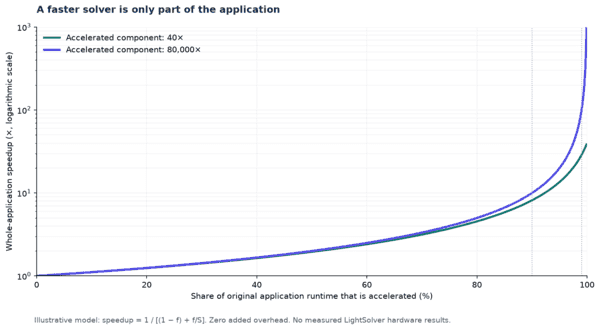
Illustrative calculations from the formula above. The curves are mathematical sensitivities and do not represent measured LPU hardware performance. The chart assumes unchanged unaccelerated work and zero added overhead.
The paper’s proposed hybrid approach is commercially relevant: digital processors can perform preparation, scaling, residual evaluation and fallback handling while an optical accelerator works on suitable subproblems. That division allows a specialized device to complement established computing. It also means the interface between the two parts is part of the product. The useful performance measure includes the accuracy and time of the resulting combined workflow. Research paper, outlook
Physical scaling remains a separate question from emulating larger problems. More optical variables and couplings can create demands on component quality, stability, alignment, control and readout. An efficient mapping for a sparse structured matrix may have a different practical cost from a dense or irregular one. A clear hardware disclosure would describe supported problem size, repeatability, accuracy, configuration time and operating conditions together. Those parameters determine which customer workloads fit economically.
Energy efficiency needs the same complete-system boundary. An optical computational step may use resources differently from a digital one, but a customer pays for the entire machine and its operation. Lasers, control electronics, data conversion, supporting infrastructure and the amount of useful work completed all belong in the comparison. A repeatable energy-per-accepted-solution measure would be more informative than inferring efficiency from the use of light alone.
The technical interpretation is cautiously constructive: the published work gives a mathematical mapping and an emulator-based reason to investigate a specialized accelerator. The next level of evidence is an implemented system that delivers the required numerical result on customer-relevant workloads, with preparation and verification included. For CLGN’s deal economics, that distinction matters because the company must finance the engineering between the research proposition and a product, while successful development can also activate acquisition consideration.
06 The HLRS benchmark: what the projected speedups mean
The September 24 announcement described joint research with the High-Performance Computing Center Stuttgart, or HLRS. It reported projected time-to-solution improvements ranging from roughly 40 times to more than 80,000 times on the evaluated problems and algorithms. The comparison used an emulator of the LPU architecture against established iterative algorithms running on a GPU. HLRS, founded in 1996 as Germany’s first federal supercomputing center and a member of the Gauss Centre for Supercomputing, is a demanding partner for this kind of work, and the paper appeared in the proceedings of the 23rd ACM International Conference on Computing Frontiers. September research announcement
The underlying paper examines selected sparse, multi-banded linear systems and compares convergence behavior and projected solution time. It discusses constraints including scaling and numerical precision. The scope is a specific mathematical workload, rather than every operation performed by a GPU or an entire AI training system. The paper’s framing supports a specialized accelerator thesis whose practical value depends on the problem class. Full research paper
An emulator is useful for exploring an architecture, testing mappings and estimating behavior. It can help identify which problems deserve further development. Physical implementation adds other questions: whether the intended scale can be built, whether calibration is stable, whether numerical performance is repeatable and whether the assumptions used in the projection remain appropriate. Moving from that research stage to a commercial system requires evidence across those questions.
Benchmark selection also matters. A range spanning several orders of magnitude signals that the result depends heavily on the problem and comparison method. The most dramatic figure can be valid within its own setup while remaining unrepresentative of a broad workload portfolio. A customer needs the result on its own inputs, at its required accuracy and with the full workflow included. The research can guide that evaluation without settling it in advance.
There are two useful directions for future evidence. One is depth: more detail on error, stability, timing boundaries and implementation assumptions. The other is breadth: results across additional workloads and independent users. Depth helps explain why an advantage arises; breadth helps show where it persists. Together they would provide a stronger basis for estimating how much of an actual customer’s computing expenditure the LPU could address.
The study gives CLGN something many early-stage computing stories lack: a documented method, a recognized research partner and a defined workload on which progress can be measured. The next step is to show the advantage on physical hardware and inside customer workflows. Product margins, sales volume and the funding needed for commercialization will come into focus as that work advances.
07 Boeing engagement and LightSolver's patent development
LightSolver announced a strategic financial partnership with Boeing in April 2026 to develop laser-based acceleration for large-scale engineering simulation. The release describes Boeing funding continued development and optimization, including accuracy, repeatability and integration with high-performance computing environments. That gives the technology a demanding industrial setting: Boeing Israel described the relationship as a strategic partnership, and LightSolver presented it as validation of physics-based computing. Financial terms were not disclosed. Industrial partnership announcement
The distinction between funded development and a production order is economically important. Development funding can support engineering and help align a technology with a customer’s requirements. A production relationship adds questions about delivery quantities, pricing, acceptance and support. Recurring revenue adds a further question about repeat demand. The value of the Boeing relationship should therefore be assessed through the milestones it achieves and the commercial scope that is subsequently disclosed.
The engagement also illustrates why headline compute speed is only part of the adoption test. Aerospace simulations require reliable numerical results and integration into established processes. The work described in the announcement addresses those practical requirements. A useful future update would explain what was delivered, what performance was accepted and whether the relationship expands. A customer name alone cannot supply those details.
On October 6, CollPlant announced a U.S. provisional patent application covering a method for configuring a programmable analog processor to solve inhomogeneous boundary-value problems. The stated applications include equations associated with heat transfer, diffusion, electrostatics and fluid flow, including complex geometries and boundary conditions. The announcement concerns a filing, so the legal milestone is an application rather than an issued patent. October patent announcement
Patent activity and product validation answer different questions. Intellectual-property protection can help preserve an economic advantage if a useful product emerges. It does not by itself establish freedom to operate, enforceable claim scope, commercial demand or an acceptable cost of production. A provisional application also leaves future prosecution and claim development ahead. The business value depends on what protection is ultimately obtained and how closely it covers the product customers use.
The constructive reading is that an aerospace partner funding development, a new provisional patent filing and published research together form a credible path from the laboratory toward deployment. The task ahead is to turn each new capability into revenue, keeping development focus, funding and customer feedback closely connected. A platform with a broad long-term ambition usually proves itself first in one well-chosen application.
08 CollPlant rhCollagen: bioinks, research customers and manufacturing
CollPlant’s existing platform remains relevant after the acquisition. It is built around recombinant human collagen produced using plant-based genetic engineering. The commercial opportunity includes supplying materials to researchers and developers who need a defined matrix for three-dimensional cell culture and tissue models. Product quality, reproducibility and compatibility with a user’s process can affect adoption even when the material represents a small part of that customer’s overall research budget. Platform description
In February 2026 the company launched BioFlex, a kit intended for Digital Light Processing bioprinting. It combines components around the Collink.3D 50 offering and printing guidance to support preparation of suitable bioinks. The commercial logic is to make the material easier to use within a defined printing process. Selling a research tool and obtaining approval for an implantable medical product involve different requirements and different timelines. BioFlex launch
The company expanded distribution in the United States and Canada in October 2025. A wider distribution network can improve availability and customer support, but access to a channel says nothing on its own about the number of end users or repeat orders. The financial evidence of adoption remains revenue, product mix and eventually margins. Small orders can demonstrate use while still leaving a large gap between commercial activity and a self-funding operation. Distribution expansion
Scientific publications can encourage customers to evaluate a material. In October 2025 CollPlant highlighted work on a humanized bioprinted skin model developed by Mayo Clinic researchers, and a separate comparison involving its bioink and Matrigel conducted at Technion. Those are research settings. Their relevance is to model development and material performance within the studies, rather than approval of a patient treatment. Skin-model announcement · Comparative-study announcement
For the business, repeatability has two meanings. The material must perform consistently across production batches, and customers must repeatedly choose it for useful applications. Strong scientific characteristics can support the first part of that chain, while purchasing behavior establishes the second. Distribution, technical support and fit with common research workflows can influence the conversion from an encouraging publication to sustained sales.
Manufacturing economics remain a constraint. First-half 2026 cost of revenue exceeded product revenue, and the company attributed part of the cost increase to lower facility utilization and inventory write-downs. An existing production capability carries costs even when sales are small. The financial improvement needed is therefore broader than adding a few customers: utilization, pricing, inventory discipline and product mix must develop together. Revenue and cost discussion
The potential role of partnerships is to connect the platform with development budgets and commercialization capabilities outside CollPlant. A partner could assume defined work, provide funding or license a specific application. Those structures have different effects on future revenue and control. Economic terms matter as much as a collaborator’s reputation because they determine how much of the eventual value remains with the listed company.
09 Dermal fillers after the AbbVie termination
The AbbVie relationship changed materially in 2026. CollPlant’s April 13 shareholder letter disclosed that Allergan Industrie SAS, an AbbVie company, had exercised its right to terminate the development agreement on 60 days’ notice. The subsequent interim statements say the termination became effective after the notice period and that CollPlant does not expect additional milestone payments or royalties under that agreement. Historical collaboration payments therefore cannot be carried forward as a continuing revenue stream. April letter · Interim statements, Note 5
The financial effect is visible in the comparison with 2025. First-half 2025 revenue included a $2 million development milestone, while first-half 2026 had no milestone revenue. The change is therefore partly about the loss of a large, irregular payment within a very small revenue base. Looking only at the percentage decline in total sales would obscure the distinction between research-product sales and collaboration economics. Revenue disaggregation
CollPlant continues to describe its own photocurable regenerative filler work. The concept combines structural restoration with a formulation that is activated by light, with the intention of supporting tissue integration. In the April letter, the company characterized that program as preclinical and said it aimed to initiate clinical trials within two years. That was a development ambition expressed in April 2026; it did not establish an authorized trial start or an approval timetable. Development strategy
The Korean patent allowance announced in February concerns aspects of the photocurable filler technology. Intellectual-property progress can support a development program, while safety, clinical performance and regulatory approval remain separate questions. A material intended to become a scaffold inside tissue must demonstrate appropriate behavior in its intended use. Claims about regeneration or durability need evidence at the relevant stage of development. Patent allowance
The company’s discussion of facial changes associated with GLP-1 weight loss identifies a possible application area. It is a market rationale for development. Establishing a differentiated treatment would require a defined product, an appropriate clinical program and evidence of benefit and risk. The size of a potential patient population cannot be substituted for those product-specific steps. Aesthetic-development announcement
A new partnership could alter funding and development responsibilities, but the economic substance would depend on its terms. Upfront cash, reimbursement, milestone payments, royalties and ownership of results each affect the value retained by CollPlant. A definitive agreement should be distinguished from discussions, and a payment contingent on a future event should be distinguished from cash already received.
10 Bioprinted breast implants: a preclinical development program
CollPlant’s regenerative breast-implant concept uses an rhCollagen-based scaffold with supportive biomaterials. The intended approach is to support tissue formation as the scaffold gradually degrades. The company’s product page describes a bioprinted implant used with autologous fat and states that the program remains under development and is not commercially available in the United States or European Union. Breast-implant development page
The March 2026 results update described a preclinical study of 200cc implants initiated in August 2024. It reported imaging observations and favorable findings in one study arm at six months, including tissue ingrowth and vascularization. The limitation to the reported setting and study arm matters. These observations are developmental evidence whose relevance to human use requires further investigation. Preclinical update
The intended product has several linked requirements. It must provide suitable physical support, allow tissue integration and degrade at an appropriate rate. A good result on one dimension may be insufficient if another fails: premature loss of support, poor integration or inconsistent volume retention could undermine the intended outcome. The development problem therefore involves the interaction of material properties, manufacturing and biological response.
Clinical-sized and clinically validated are different descriptions. A scaffold can be manufactured at a size relevant to a future procedure while remaining in an animal study. Human safety and durability require evidence in people, with an appropriate design and follow-up. The commercial path also includes manufacturing quality, surgical handling and regulatory requirements. Each adds time and expense beyond a promising image or early tissue observation.
The company said in April that it was discussing strategic partners for the program. A partner could provide development capabilities and capital, while also receiving rights to future economics. The form of that arrangement matters: funding a defined study, licensing an application and acquiring an asset would have different consequences for CLGN. The value of the program to shareholders depends partly on how development risk and future returns are allocated. Partner discussions
The appropriate analytical role for the implant program is as a development asset with possible long-term value. Its scientific potential sits alongside a requirement for additional evidence and resources. In the combined company, capital allocated to implants also has an opportunity cost relative to photonic computing and other collagen applications. Clear priorities and partnership terms can help investors understand that allocation.
11 CLGN earnings: revenue quality and operating losses
For the first half of 2026, CollPlant reported revenue of $181,000, cost of revenue of $880,000 and a gross loss of $699,000. Research and development expense was $2.843 million, and general, administrative and marketing expense was $2.206 million. The resulting operating loss was $5.748 million, followed by a net loss of $5.823 million. These figures cover the period before the LightSolver acquisition. Interim financial statements
The year-over-year sales comparison needs a revenue bridge. First-half 2025 revenue was $2.234 million, including the $2 million milestone. Goods revenue decreased from $234,000 to $181,000, a calculated reduction of about 22.6%. Total revenue declined much more sharply because the milestone did not recur. Neither comparison establishes that the goods business can cover the operating base, but separating them makes the nature of the change clearer. Revenue note
| Metric, USD thousands | H1 2026 | H1 2025 |
|---|---|---|
| Revenue | 181 | 2,234 |
| Cost of revenue | 880 | 374 |
| Gross profit / (loss) | (699) | 1,860 |
| Research and development | 2,843 | 4,118 |
| General, administrative and marketing | 2,206 | 2,568 |
| Operating loss | (5,748) | (4,826) |
| Net loss | (5,823) | (4,799) |
Operating expenses fell, reflecting the cost-reduction program and lower development spending. That reduction is meaningful for funding needs, but it must be interpreted alongside the work still required. Lower spending can extend the time available to secure a partner while also slowing internal progress. The balance between cash preservation and advancement of the portfolio will matter in subsequent reports. Expense discussion
The second quarter produced $108,000 of revenue and a $2.726 million net loss. The quarter’s revenue exceeded the first quarter’s $73,000, which follows by subtracting second-quarter revenue from the half-year total. These amounts remain small relative to costs, so a sequential improvement alone provides limited evidence about long-term scale. Customer concentration, order timing and product mix can create large percentage movements from a small base. Second-quarter results
The acquisition introduces a break in comparability. Future consolidated results will include a new activity with different development expenses and possible acquisition-related accounting effects. Comparing the next reported loss with the June loss will therefore require more than a percentage calculation. A useful bridge should separate legacy cost changes, new subsidiary operations, transaction items and non-cash charges.
Revenue quality will be central to that interpretation. Product sales, research funding, license fees and milestones have different recurrence and margin characteristics. A large one-time payment can materially change a quarter while leaving the continuing funding requirement intact. Consistent disclosure of revenue type and the costs associated with it would help establish whether the combined business is becoming more economically durable.
12 Cash, burn and going-concern risk
June 30 cash and equivalents were $2.559 million, down from $5.591 million at December 31, 2025. Operating cash use in the first half was $5.382 million, equivalent to a calculated $897,000 per month. Equipment purchases were a further $75,000, while equipment-sale proceeds were $83,000. Restricted deposits totaled $475,000, reported separately from cash and equivalents. Balance sheet and cash-flow statement
Dividing June cash by the historical monthly operating use produces approximately 2.85 months. That is a backward-looking coverage calculation. It is not a forecast of when the combined company runs out of money: subsequent funding, cost changes and LightSolver’s activities change the inputs. Its use is to illustrate how small the June cash balance was relative to the preceding operating consumption.
The interim financial statements issued September 30 state that resources were insufficient to fund operations and obligations for the following twelve months and describe substantial doubt about the company’s ability to continue as a going concern. That disclosure is a material financing risk. It means the company needs additional resources or other changes to support the operating plan, with no assurance that funding will be available on acceptable terms. Going-concern note
A cash bridge must avoid counting the same financing twice. The June placement was announced at $2.6 million gross, but $660,000 had already been received by June 30 and the remaining $1.94 million gross was received in July. Adding the entire headline amount to the June cash balance would overstate new cash after that date. Fees and the subsequent use of funds also matter. Subsequent-events note · June financing announcement
The statements additionally disclose approximately $5.2 million received from warrant exercises in August and September. They also disclose the $5 million investment in LightSolver at acquisition closing. That investment transferred funding into a subsidiary: it should not automatically be treated as an equal amount of consolidated operating cash consumption. The subsidiary’s eventual use of the funds is what affects group liquidity over time. Subsequent-events note
October added approximately $3.7 million gross through the placement that closed on October 14. Gross proceeds, net proceeds and cash remaining at a later date are different measures. The financing documents identify placement compensation and other expenses, so the gross headline is not an exact measure of cash added after costs. A consolidated post-acquisition balance sheet will be more informative than an arithmetic sum of financing announcements. October financing filing
The longer-term issue is the relationship between development duration and available capital. A platform targeted for commercial availability in 2028 may need further funding before sales can support it. Partnership payments could reduce the amount raised from shareholders, while delays could increase it. Historical burn provides context, but the combined development plan, spending discipline and financing terms will determine the actual path.
13 CLGN share dilution: the acquisition consideration
The LightSolver deal is the center of CollPlant’s transformation. The contract was signed on August 29, announced on August 31 and closed on September 3, 2026. A September 30 amendment revised the treatment of certain options and the consideration allocation. CollPlant obtained LightSolver’s outstanding shares and an operating entry into photonic computing. In exchange, the sellers received an initial equity position and rights to much larger potential ownership if development milestones are achieved. Operating review and amended terms
This is an equity-funded acquisition with staged consideration, accompanied by a $5 million investment into the acquired business. The investment finances LightSolver’s working capital and operational requirements; it is distinct from the shares and warrants allocated to sellers. Economically, the public company supplies access to its capital structure and development funding, while the acquired company supplies its technology, organization and industrial relationships. The success of that exchange depends on the future value created relative to the ownership surrendered along the way. Purchase agreement · Acquisition closing
The updated September disclosures contain different consideration amounts from the initial August announcement. The amended terms, expressed on the post-split basis, include 336,103 closing shares, pre-funded warrants for 668,448 shares and milestone warrants for up to 22,231,164 shares. Rollover options cover another 385,198 shares. These are separate categories with different exercise conditions and economic effects. Updated acquisition terms
| Consideration security | Underlying ordinary shares | Main condition or characteristic |
|---|---|---|
| Closing shares | 336,103 | Issued as acquisition consideration |
| Pre-funded warrants | 668,448 | $0.0001 exercise price per share |
| Series 1 milestone warrants | 2,455,120 | Specified operational milestone |
| Series 2 milestone warrants | 9,553,640 | Separate specified operational milestone |
| Series 3 milestone warrants | 10,222,404 | Separate specified operational milestone |
| Rollover options | 385,198 | Converted equity awards subject to their terms |
Acquisition note and operating review
The milestone warrants together represent a very large possible increase in the share base. The proper interpretation is conditional dilution: achievement of objectives can make securities exercisable, while Nasdaq-related issuance limits can require shareholder approval before underlying shares are issued. The warrants’ continued existence creates an economic overhang even when the conditions for issuance have not all been satisfied.
The purchase agreement states that the milestone warrants do not expire and remain capable of becoming exercisable upon achievement of their milestones, subject to the equity blocker. The 2028 commercial objective is therefore not a contractual sunset for this consideration. The agreement also provides for a three-member milestone committee, comprising one LightSolver designee and two independent members, with a third-party expert mechanism for disputes. Achievement is a contractual determination with a defined process, rather than an automatic consequence of a favorable press release. Milestone determination and duration, Section 2.2.4
The scale can be illustrated without assuming a current fully diluted capitalization. Taking the 2,866,715 ordinary shares reported for September 30 as a fixed starting block, the following sensitivity adds only the three milestone-warrant series. It assumes achievement and share issuance cumulatively, with every other source of issuance held constant. It excludes October financing, further pre-funded exercises, options, any additional adviser securities outside the consideration pool and any subsidiary SAFE conversion. The starting block includes all holders already represented in that September denominator, including acquisition shares issued by then. September denominator · Milestone share amounts
| Illustrative milestone-only sensitivity | Total shares in this restricted model | September 30 starting block as % of modeled total |
|---|---|---|
| Starting block; no milestone shares added | 2,866,715 | 100.0% |
| Add Series 1: 2,455,120 | 5,321,835 | 53.9% |
| Add Series 1 and Series 2 | 14,875,475 | 19.3% |
| Add all three series | 25,097,879 | 11.4% |
These are arithmetic sensitivities, not forecasts of issuance or a cap table for today’s company. They show why a modest initial acquisition share count does not describe the full economic bargain. On the stated assumptions, the modeled total becomes approximately 8.75 times the starting block after all three series are added. That does not estimate the value of the acquired technology. It identifies how much the ownership denominator can change if the specified conditions are met.
The scale also changes how technical success should be evaluated. If development progress raises the value of LightSolver and simultaneously unlocks additional consideration, the value attributed to the business and the ownership percentage of existing holders can move in different directions. A valuation framework must account for both. Treating every milestone as pure upside to the present share count would leave out a contractual part of the acquisition economics.
The exercise price is relevant to financing expectations. The pre-funded and milestone consideration carries a nominal $0.0001 per-share exercise price. Exercise of those securities is principally an ownership event and would add little cash relative to the scale of the development program. They differ from financing warrants with a meaningful exercise price that could provide additional capital if exercised for cash. Acquisition securities
For example, cash exercise of all 22,231,164 milestone-warrant shares at $0.0001 would yield approximately $2,223, calculated before any applicable costs. The company would issue more than 22 million shares for that nominal exercise cash because the underlying economic consideration is the acquisition and milestone performance. The warrants are therefore a way of paying for the business, rather than a substantial source of the funding needed to develop it. The distinction is central to any financing model.
The Nasdaq equity blocker adds a procedural constraint. Where issuance would exceed the applicable threshold, shareholder approval is required before the underlying shares can be delivered. The operating review says the company must seek the required approval when an exercise would cross the limit and continue resubmitting the matter if necessary. That mechanism can affect timing and governance. It does not create a permanent ceiling on the company’s eventual share count. Issuance limitation
The subsidiary SAFE creates another possible layer of economic change. Its $2 million purchase amount is a historical instrument that remained outstanding at closing. Future conversion or settlement can affect CollPlant’s interest in LightSolver independently of warrants issued at the listed-parent level. A valuation of the parent therefore needs to consider both how much of the subsidiary it will own and how many parent shares will divide that interest. Retained SAFE
Adviser securities affect the allocation of consideration and potential additional issuance. The interim notes describe 200,000 finder warrants at $3.60. They also describe Advisor Acquisition Securities and Advisory Securities for the adviser to LightSolver that are deducted from the consideration pool, together with a separate category of contingent pre-funded warrants. The adviser allocations within that pool do not increase its total. The finder and contingent securities have their own conditions, alongside existing financing warrants, employee awards and the subsidiary SAFE. Adviser arrangements, Note 8
The acquisition also permits monetization of certain regenerative and aesthetic-medicine assets. For qualifying dispositions within 24 months after closing, the contract allocates 20% of net proceeds to designated officers and employees, including relevant deferred receipts after that period; the remainder stays with the company. Net proceeds reflect applicable costs and taxes. That provision is relevant when considering an asset transaction: a headline sale price, net cash after costs and the amount retained by the company can differ. Asset-disposition arrangement, Section 11.2
This provision changes the role of the original biotechnology portfolio in a possible future restructuring. An asset transaction could fund the combined company, while the designated allocation would reduce the portion of net proceeds retained. It also creates a governance question about the incentive to sell, the price obtained and the approvals associated with compensation. The public contract addresses the allocation and required approvals; a prospective asset sale still requires its own transaction terms and cannot be assumed to occur. Asset-disposition provisions, Sections 11.1–11.3
The strategic upside of the deal is access to a technology whose industrial value could exceed the resources CollPlant could have generated from its legacy sales alone. The strategic risk is that the public shareholders fund a long development program while a large share of the eventual ownership migrates to the acquisition counterparties. These outcomes are compatible: the acquired technology can progress and the original public stake can still become a much smaller fraction of the resulting enterprise. Judging the bargain requires both sides of that equation.
The agreement also addresses continuity and governance. It provides for a LightSolver board designee and continued service by the subsidiary’s two key executives for at least 36 months, subject to contractual exceptions. Those provisions aim to retain the people and representation associated with the acquired platform. They are contractual arrangements, while actual board membership, employment status and any subsequent changes require their own disclosures. Governance and key-person provisions, Sections 3.3.5, 4.1 and 4.4
Shareholder approval requirements constrain issuance under the specified Nasdaq rules; they do not cancel the contractual securities or create operating revenue. The economic analysis should therefore keep a dated basic share count, each class of potential issuance and its trigger separate. A single undifferentiated fully diluted number can conceal both the conditions and the limited cash that some exercises would produce.
14 October financing, reverse split and ownership
The October transaction provided for 989,301 ordinary shares or pre-funded equivalents and ordinary warrants covering 1,483,950 shares in the October 15 filing. The combined ordinary-share package price was $3.74, and the ordinary warrants also carry a $3.74 exercise price. The offering closed October 14. Closing filing
The ordinary warrants were immediately exercisable and expire five years after effectiveness of the registration statement covering their underlying shares. Pre-funded warrants carry a nominal exercise price and remain outstanding until fully exercised. The transaction also includes beneficial-ownership limits and registration rights. These features affect when shares can be issued or resold; they do not make future cash exercise proceeds certain.
A holder can choose whether to exercise a financing warrant, subject to its terms. The company can receive cash from a cash exercise, while circumstances permitting cashless exercise can produce a different outcome. For funding analysis, potential proceeds should remain separate from money already raised. For ownership analysis, the underlying shares remain relevant even before any future cash receipt.
The company implemented a one-for-ten reverse split effective September 4, 2026. Nasdaq’s corporate-action notice independently confirms the ratio and effective date. A reverse split reduces the number of shares and proportionately adjusts the share unit; it does not create cash or increase the operating value of the enterprise. Historical prices, awards and ownership figures require a consistent split basis. Company split announcement · Exchange notice
On September 22 the company announced that it had regained compliance with the $1 minimum-bid requirement after the required run of qualifying closing bids. That resolved the cited deficiency. Continued listing still depends on applicable requirements over time, and restoring the bid price does not resolve the development or financing risks of the business. Compliance announcement
October 8 ownership filings describe a 163,709-share holding representing 5.7% on a denominator of 2,866,715 outstanding shares at September 30. The accompanying amendment says the percentage declined through issuer share issuance, with no acquisition or disposal by that holder since the preceding amendment. The filing sequence reflects a transition to passive reporting for the same holding. Ownership amendment · Ownership statement
That example illustrates denominator dilution. A shareholder can keep exactly the same number of shares and nevertheless own a smaller percentage of the company after new issuance. A filing that records a falling ownership percentage is therefore not automatically evidence of selling. The transaction history and the stated share denominator provide the explanation.
The October 27 Form 144 relates to a proposed sale. Such a notice records an intention and estimated transaction details; it is not a confirmation that the sale occurred. Similarly, registration of resale shares provides a legal mechanism for resale without proving that holders have sold them. Distinguishing issuance, registration, proposed resale and completed resale helps prevent changes in the capital structure from being misread as trading evidence. Proposed-sale notice
15 Competition, analyst context and public sentiment
CLGN spans two competitive settings. In computing, an emerging accelerator must justify adoption within an ecosystem of established processors and software. In biomaterials, a supplier must show why its material and support fit a customer’s workflow. The company’s breadth does not create a single comparable peer group. A profitable hardware vendor, a research-material supplier and a preclinical medical developer have different economics and deserve different analytical treatment.
The most useful comparison is often functional. For a computing customer, the alternative is the current way of solving a defined problem, including its software, people and operating cost. For a bioink customer, the alternative is a material already validated in the laboratory. Switching may require testing and changes to procedures. A new platform must offer enough benefit to justify those costs, even when its scientific properties are attractive.
Analyst targets also require a consistent corporate and share basis. A target created before the LightSolver acquisition or before a reverse split addresses a different information set or share unit. It cannot be assumed to value the combined business as it stands today. A useful coverage update would identify the assets being valued, funding assumptions, consideration securities and the share count used to translate business value into a per-share figure.
Public discussion of CLGN centers on photonic computing, the Boeing partnership and the prospect of the market treating CollPlant as a computing company rather than a pure biotech. These are views of individual, non-professional traders rather than institutional research, and social attention can move trading without settling the commercial questions. Public ticker discussion
Some popular data points need context to be read correctly. Displayed market capitalizations can rely on a share count that predates recent issuance, the largest speedup figures refer to emulated, selected tasks, and the Boeing relationship funds development without disclosed product revenue. Each theme rests on a real fact; the full valuation picture also needs the share count and funding path.
Short interest should be interpreted with a settlement date and a share denominator on the same split basis. Trading volume, short-sale volume and outstanding short positions measure different things. A short-squeeze scenario would also depend on liquidity, borrowing conditions and the willingness of counterparties to trade. Those mechanics are separate from the operating thesis and cannot provide evidence that product development is succeeding.
For price action, the daily chart is a visual reference whose levels change with trading. A break above a moving average can describe recent market behavior, but it does not confirm a hardware milestone or improve the company’s balance sheet. Equally, a weak chart does not determine the scientific result. Keeping market behavior and business evidence distinct makes the eventual interpretation more useful.
16 Risks and scenarios for CLGN stock
The main development risk is the gap between a promising architecture and an economic product. A physical implementation may face constraints that are less visible in a projection, and customer integration can take longer than planned. Competing digital methods can also improve during the development period. The commercial test is the advantage available when the product can actually be deployed, after the full cost of using it is included.
The biotechnology portfolio carries a different set of uncertainties. Research products need repeat demand and workable manufacturing economics. Fillers and implants require additional development, with clinical and regulatory risk before commercialization. Partnership discussions may produce no agreement, or an agreement may transfer a substantial portion of future economics to the partner. The AbbVie termination demonstrates that a collaboration can end before the anticipated commercial outcome. Development and financing risks · Terminated collaboration
Financing risk connects the two portfolios. Development delays can increase the amount of money required, while unfavorable financing can reduce the ownership claim of existing holders. Acquisition milestones also create dilution as the business advances, by design tying the sellers’ reward to LightSolver’s progress. Operational success is the precondition; financing on good terms is what carries it through to each share. The terms and timing of capital formation remain material throughout the development cycle.
| Scenario | Operating development | Financing and ownership implications | Evidence to follow |
|---|---|---|---|
| Constructive | Physical performance and customer acceptance support a deployable LPU; collagen partnerships add economic value | Funding arrives on manageable terms, while milestone consideration is matched by substantial business value | Accepted customer deliverables, transparent cash use and detailed capitalization |
| Intermediate | Technical progress continues, but commercial deployment remains gradual and legacy sales stay small | Additional financing supports development; share issuance absorbs part of any enterprise-value growth | Funding terms, runway and repeat customer activity |
| Adverse | Hardware or customer integration disappoints; biotechnology partnerships fail to replace lost economics | Capital becomes costly, development slows and dilution rises relative to progress | Delays, reduced scope, weak cash conversion and stressed funding |
These are qualitative scenarios, not assigned probabilities or price targets. They describe how execution and financing could interact. A company can move between them as new information arrives. The same announcement may improve one dimension while worsening another: financing can reduce immediate liquidity risk while adding warrants, and milestone achievement can validate progress while activating consideration.
Valuation requires an explicit share bridge. A sum-of-parts framework would separately consider photonic computing, collagen-related assets, cash and obligations, then incorporate the securities associated with the outcome being modeled. Early-stage assets involve a wide range of possible results, so an apparently precise point estimate can obscure uncertainty. Sensitivity to commercial timing, funding and dilution is more informative than a single unsupported number.
Governance and resource allocation also deserve attention. The combination requires choices between unrelated development programs, and the asset-monetization provision affects the proceeds retained by the company. Clear disclosure of spending priorities and transaction economics can help shareholders judge those choices. The relevant question is how each use of capital contributes to a durable business and the value remaining for each share.
17 What would strengthen or weaken the CLGN thesis
A stronger operating case would begin with evidence that reduces the largest uncertainty. For LightSolver, that means physical results at disclosed scale and accuracy, followed by customer acceptance in a useful workflow. For rhCollagen, it means repeat purchasing, improved utilization or a partnership with concrete economics. For the combined group, it means cash consumption that can be connected to measurable progress.
The financing case would strengthen with a transparent post-acquisition cash bridge and a clear explanation of the capital required to reach the next milestone. A new source of money is more informative when its cost, restrictions and associated securities are disclosed. Partnership cash can reduce dependence on equity markets, but contingent amounts need to remain separate from available liquidity until earned and received.
The ownership case would strengthen with a dated reconciliation of basic shares, pre-funded warrants, financing warrants, milestone securities, adviser awards and options. That would make it easier to connect each development scenario to the resulting share base. It would also help explain differences between quote-screen figures and transaction filings without relying on a single stale denominator.
The constructive interpretation would weaken if projected technical advantages fail to translate into useful hardware behavior, if integration work repeatedly expands without customer acceptance, or if spending rises without a corresponding reduction in development uncertainty. It would also weaken if repeated financing adds substantial dilution while leaving the next operational milestone poorly funded. These are conditional analytical tests rather than forecasts that the problems will occur.
There is a parallel test for the legacy biotechnology assets. A continued search for partners is not yet an economic transaction. A signed arrangement should be assessed through rights, responsibilities and cash. Scientific announcements should be assessed at their actual stage of evidence. Treating every research advance as a commercial event would overstate the progress of the portfolio.
CLGN’s transformation is unusual: a biotechnology company that now owns a photonic-computing platform with an aerospace partner, published supercomputing research and a 2028 commercial target. The route from that opportunity to a durable per-share result depends on execution and funding. The next evidence will be specific: what the hardware achieves, what customers adopt, how efficiently cash is used and how the ownership structure evolves as the plan advances.
Sources and supporting documents
- June 30, 2026 interim financial statements, issued September 30
- September 30, 2026 operating and financial review
- October 15, 2026 financing filing, confirming October 14 closing
- August 29, 2026 share purchase agreement, filed August 31
- August 31, 2026 acquisition announcement and commercial roadmap
- September 3, 2026 acquisition closing
- September 24, 2026 photonic-computing research announcement
- Optical sparse-linear-solver research paper, April 2026
- October 6, 2026 provisional patent application announcement
- April 2026 industrial simulation partnership announcement
- April 13, 2026 shareholder letter and collaboration termination
- February 23, 2026 BioFlex launch
- October 27, 2025 distribution expansion
- October 16, 2025 bioprinted skin-model announcement
- October 20, 2025 comparative bioink research announcement
- March 26, 2026 results and preclinical implant update
- Regenerative breast-implant development description
- February 26, 2026 photocurable-filler patent allowance
- February 17, 2026 aesthetic-development announcement
- June 30, 2026 private-placement announcement
- September 1, 2026 reverse-split announcement
- September 2, 2026 exchange corporate-action notice
- September 22, 2026 minimum-bid compliance announcement
- October 8, 2026 ownership amendment, September 30 denominator
- October 8, 2026 beneficial-ownership statement
- October 27, 2026 proposed-sale notice
- 2025 annual report filed March 26, 2026
- Public CLGN ticker discussion; sentiment context only
- Classical analysis of whole-application speedup, 1967
- Numerical error, norms and conditioning reference
CLGN Stock FAQ: CollPlant Questions Answered
What is CLGN after the LightSolver acquisition?
CLGN remains the Nasdaq-listed security of CollPlant Biotechnologies. Since the September 3, 2026 closing, the company combines its rhCollagen-based biotechnology activities with LightSolver’s photonic-computing business. The two operations have different validation and commercialization paths. Details
Is LightSolver’s LPU meant to replace GPUs?
No. The company presents the LPU as a specialized computing layer that works alongside CPUs and GPUs, with commercial availability targeted for 2028. The published sparse-linear-system research projected its performance on selected workloads using an emulator. Details
Who is LightSolver working with?
LightSolver announced a strategic financial partnership with Boeing in April 2026 to develop laser-based acceleration for large-scale engineering simulation, and in September 2026 published joint research with HLRS, the High-Performance Computing Center Stuttgart. Details · Details
Was the 80,000× speedup measured on delivered LPU hardware?
The September 24 announcement describes projected time-to-solution using an LPU emulator. The reported range depends on the problem and comparison algorithm. Hardware implementation, numerical accuracy and full-workflow performance remain important development questions. Details
How much cash did CollPlant report?
Cash and equivalents were $2.559 million at June 30, 2026. Restricted deposits were a separate $475,000. These historical balances precede LightSolver’s acquisition and later financing; they are not an October consolidated cash balance. Details
What is the historical cash burn?
Operating cash use was $5.382 million in H1 2026, or a calculated $897,000 per month. June cash divided by that historical rate gives about 2.85 months. This backward-looking calculation does not forecast the combined company’s runway. Details
What did the October placement raise?
The offering closed October 14, 2026 with approximately $3.7 million gross proceeds before fees and expenses, and the company said it was led primarily by existing investors. It included ordinary shares or pre-funded equivalents and ordinary financing warrants. Future warrant exercise proceeds are separate from cash raised at closing. Details · Details
How large is the acquisition dilution?
The amended consideration includes 336,103 closing shares, 668,448 pre-funded-warrant shares, up to 22,231,164 milestone-warrant shares and 385,198 rollover-option shares. Milestone conditions and issuance restrictions matter; the categories are not all basic shares outstanding today. Details
Is the AbbVie collaboration still a source of future royalties?
The interim statements say the development agreement terminated after the applicable notice period and that the company does not expect additional development, regulatory or commercial milestone payments or royalties under it. CollPlant is pursuing other opportunities for the platform. Details
Are the regenerative breast implants approved for sale?
The company describes the implants as under development and not commercially available in the United States or European Union. Preclinical findings and manufacture of clinical-sized scaffolds are different from approval and evidence in human patients. Details
Does a falling ownership percentage prove that a holder sold?
No. The October 8 amendment describes a lower percentage caused by issuer share issuance while the holder’s share number remained unchanged. A proposed-sale notice is also different from a report confirming an executed sale. Details
Join the Merlintrader community: follow the discussion and get more deep dives on our subreddit — r/MerlintraderPub — and on the Telegram channel @merlintraderpub_com.
Get these reports in real time
Every Merlintrader stock hub, catalyst update and market brief is published to Telegram the moment it goes live. No paywall, no spam, just the research.
Disclaimer. This content is published by Merlintrader for educational and informational purposes only. It is independent journalism and research. It does not constitute investment advice, an investment recommendation, an offer or a solicitation to buy or sell any security, and it is not a research report within the meaning of applicable United States securities regulation. Nothing here should be read as a recommendation to buy, sell or hold $CLGN or any other security.
Figures are taken from public filings with the U.S. Securities and Exchange Commission, company press releases and market-data providers, and are stated with their reference dates. Data can change without notice, and figures published before a results release become outdated the moment that release is issued. Merlintrader makes no representation that the information is complete or current at the time of reading. Readers should verify every figure against the primary source before acting on it.
Early-stage photonic-computing and biotechnology companies carry hardware, numerical-performance, customer-adoption, clinical, regulatory, manufacturing and financing risks. Research projections may fail to translate into usable products, medical development can fail, partnerships can end, and acquisitions may not produce the expected returns. Development announcements do not guarantee commercial sales or cash collection. Additional borrowing or equity issuance can increase obligations or dilute existing shareholders. Investors can lose part or all of their capital. Every reader is responsible for their own decisions and should consult a licensed financial adviser where appropriate.
Merlintrader may hold positions in securities mentioned. Some links on this page are affiliate or referral links, including those to Finviz and Stocktwits, which may generate a commission at no cost to the reader. Full legal information is available on the disclaimer and terms of use and privacy pages.
CLGN Stock Hub: CollPlant News, LightSolver Acquisition and Photonic Computing — Merlintrader
Space, Defense & AI Event Calendar
Conferences, industry summits, government-facing events and company watchpoints across the sector, in one free calendar.
Open the Space, Defense & AI Event Calendar →