googletag.defineOutOfPageSlot('/23357399017/Offerwall-Ad-Unit-4ac7776188ac0199', 'div-gpt-ad-offerwall').addService(googletag.pubads());

Category AI

HIVE Digital Technologies (Nasdaq/TSX: $HIVE): Bitcoin Mining, AI Infrastructure, Paraguay, Canada and the New Compute Trade

HIVE

HIVE is no longer just a public Bitcoin miner. The company is trying to become a dual-engine digital infrastructure platform, using renewable-powered mining scale, GPU infrastructure and BUZZ HPC to participate in the AI compute boom. The opportunity is real enough to monitor closely, but the equity remains exposed to Bitcoin volatility, dilution, capex intensity and major execution risk.

Keel Infrastructure Corp. (Nasdaq/TSX: $KEEL): From Bitcoin Miner To AI Power Infrastructure — A High-Beta Data Center Pivot To Watch

KEEL

Keel Infrastructure is trying to transform the former Bitfarms platform into a North American AI/HPC data center and power infrastructure story. The market narrative is powerful, the asset base is strategically relevant, and the balance sheet has been strengthened — but the investment case still depends on execution, customer leases, capital discipline and proof that megawatts can become durable infrastructure cash flow.

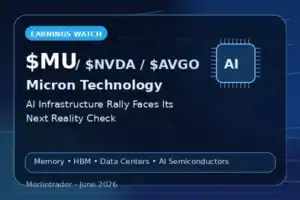
The AI Infrastructure Rally Faces Its Next Reality Check: Micron Earnings And The Memory Bottleneck Trade — $MU / $NVDA / $AVGO

Micron

Micron Technology is about to report earnings at a moment when the market is treating artificial intelligence less like a single-stock story and more like a full infrastructure cycle. Nvidia still sits at the center of the trade. Broadcom has become one of the clearest public vehicles for custom AI accelerators and AI networking. But Micron occupies a different and increasingly important layer: the memory and storage layer that determines whether AI systems can feed accelerators, sustain inference workloads, handle longer context windows and scale data-center token output efficiently.

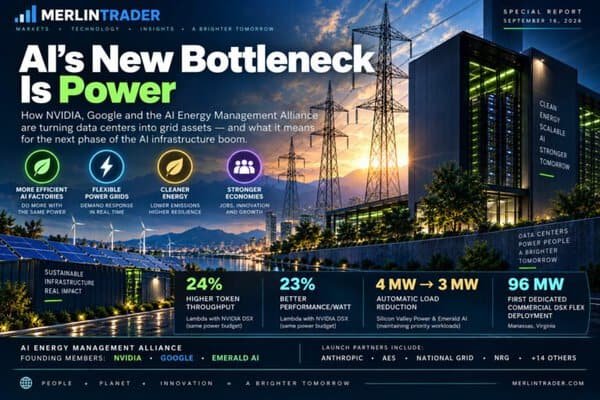
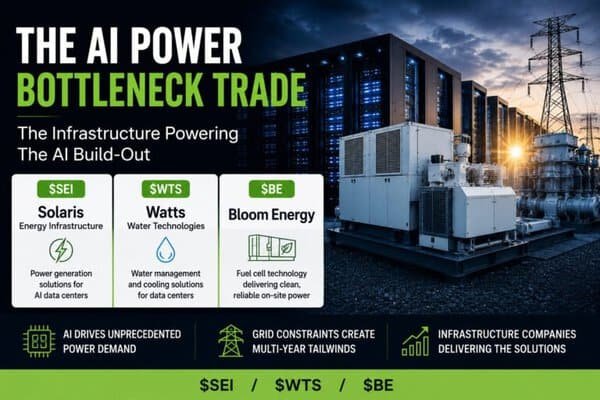
AI Power Bottleneck Trade: $SEI, $WTS and $BE Beyond the Chip Story

AI Power

The AI trade has spent most of the last cycle worshipping at the altar of GPUs, networking chips and hyperscale cloud capex. That made sense. Without compute, there is no AI boom. But the market is now being forced to confront a less glamorous and potentially more durable question: what happens when the servers are ready, the capital is available, the customer demand is real, but the power is not?

Arrive AI (Nasdaq: $ARAI): The Microcap Building Smart Delivery Points for Drones, Robots and Real People

ARAI

Arrive AI is the kind of small-cap story that can look almost too simple at first glance: a smart mailbox. But the deeper question is more interesting. If drones, ground robots, autonomous vehicles, couriers, hospitals, retailers and consumers are all supposed to participate in a more automated logistics network, where does the physical handoff actually happen? Arrive AI’s answer is the Arrive Point: a secure, climate-assisted, sensor-rich endpoint designed to receive and transfer goods asynchronously.

AI Infrastructure, Optical Engines and Aviation-Tech Optionality: $DTST, $POET and $JTAI Move Into Focus After May 15 Updates

DTST POET JTAI

Data Storage Corporation, POET Technologies and Jet.AI each delivered May 15 updates that speak to a broader market theme: artificial intelligence is no longer only a software story. It is becoming an infrastructure story, a photonics story, a power-and-data-center story, and in some cases a corporate-transformation story. These three companies sit in different corners of that map. $DTST is trying to build a regulated-industry AI continuity platform on top of a recurring telecom and connectivity base. $POET is trying to become a core optical-engine and wafer-level photonic-integration supplier for AI networks and hyperscale data centers. $JTAI is the most complex and speculative of the three, combining AI cloud infrastructure, data-center power access, a pending aviation merger with flyExclusive, strategic holdings and a SpaceX-linked economic interest.

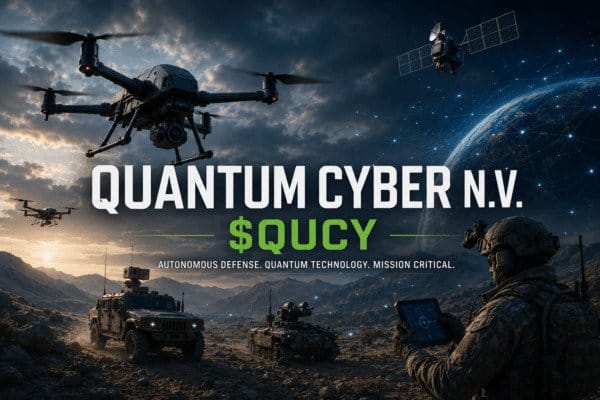
AI Drones, Quantum Defense and the Commercial Space Race: $SPAI, $QUCY and $LUNR Move Into Focus

SPAI, QUCY, LUNR

Safe Pro Group, Quantum Cyber and Intuitive Machines offer three different ways to read the current convergence of artificial intelligence, drones, defense technology and commercial space. Safe Pro Group is the most numbers-driven update in this group, with record first-quarter revenue, a sharp increase in AI product sales and strong gross margins. Quantum Cyber is the most narrative-driven defense platform story, using the launch of quantum-cyber.ai to frame a broader System-of-Systems strategy across autonomous drones, counter-UAS, EMP-hardened components, autonomous demining and quantum antenna communications. Intuitive Machines is the most mature and institutionally visible company in the group, with record quarterly revenue, positive adjusted EBITDA, a record backlog and full-year guidance that still points to a much larger commercial space business in 2026.

Three Different Ways to Play the AI Photonics Race $POET, $COHR and $AAOI

Photonics

The artificial intelligence infrastructure boom is not only a story about GPUs, accelerators, memory, power, cooling and real estate. It is also, increasingly, a story about light. As AI clusters become larger, denser and more power hungry, the bottleneck shifts from raw compute alone to the movement of data between processors, racks, data halls and campuses. Electrical interconnects still matter, but the further the AI buildout moves into high-bandwidth, low-latency and energy-constrained architectures, the more optical networking becomes one of the critical hidden layers of the trade.