Love the view?
Make it your next adventure.
Explore our travel guides. Share your stories, tips and questions on Reddit.

Biotech catalyst, news and analysis PDUFA tracker

Biotech catalyst, news and analysis PDUFA tracker

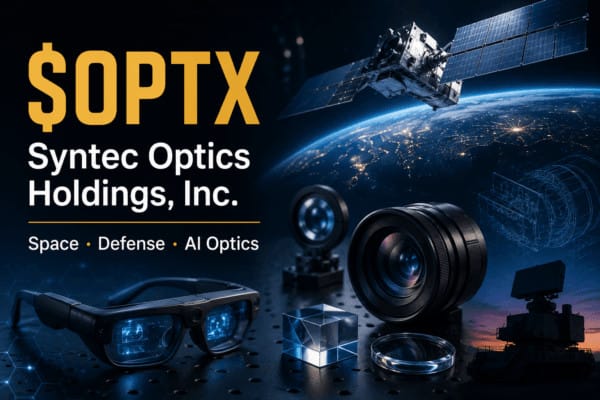
A weak Q1 headline, a guided Q2 revenue reset, fresh space-optics production data, a defense micro-camera order, and a strengthened balance sheet make Syntec Optics a small-cap industrial technology story worth watching carefully — without ignoring dilution, margin volatility and execution risk.

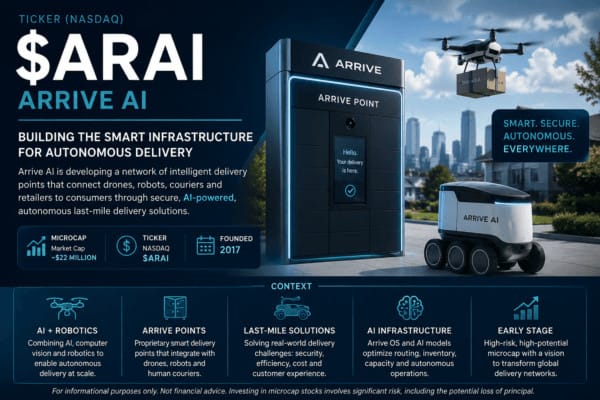
Arrive AI is the kind of small-cap story that can look almost too simple at first glance: a smart mailbox. But the deeper question is more interesting. If drones, ground robots, autonomous vehicles, couriers, hospitals, retailers and consumers are all supposed to participate in a more automated logistics network, where does the physical handoff actually happen? Arrive AI’s answer is the Arrive Point: a secure, climate-assisted, sensor-rich endpoint designed to receive and transfer goods asynchronously.

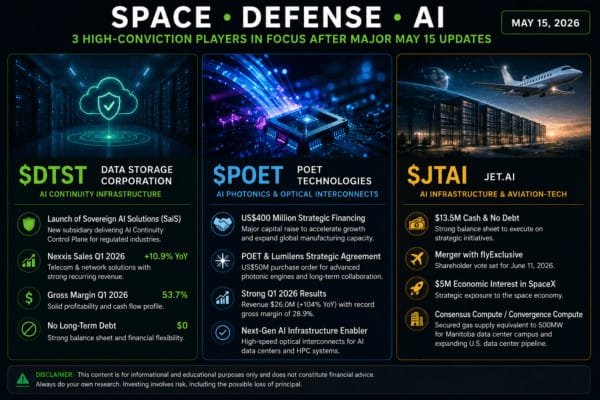
Data Storage Corporation, POET Technologies and Jet.AI each delivered May 15 updates that speak to a broader market theme: artificial intelligence is no longer only a software story. It is becoming an infrastructure story, a photonics story, a power-and-data-center story, and in some cases a corporate-transformation story. These three companies sit in different corners of that map. $DTST is trying to build a regulated-industry AI continuity platform on top of a recurring telecom and connectivity base. $POET is trying to become a core optical-engine and wafer-level photonic-integration supplier for AI networks and hyperscale data centers. $JTAI is the most complex and speculative of the three, combining AI cloud infrastructure, data-center power access, a pending aviation merger with flyExclusive, strategic holdings and a SpaceX-linked economic interest.

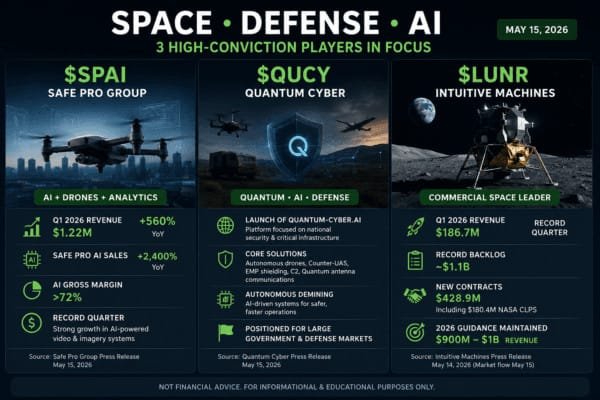
Safe Pro Group, Quantum Cyber and Intuitive Machines offer three different ways to read the current convergence of artificial intelligence, drones, defense technology and commercial space. Safe Pro Group is the most numbers-driven update in this group, with record first-quarter revenue, a sharp increase in AI product sales and strong gross margins. Quantum Cyber is the most narrative-driven defense platform story, using the launch of quantum-cyber.ai to frame a broader System-of-Systems strategy across autonomous drones, counter-UAS, EMP-hardened components, autonomous demining and quantum antenna communications. Intuitive Machines is the most mature and institutionally visible company in the group, with record quarterly revenue, positive adjusted EBITDA, a record backlog and full-year guidance that still points to a much larger commercial space business in 2026.

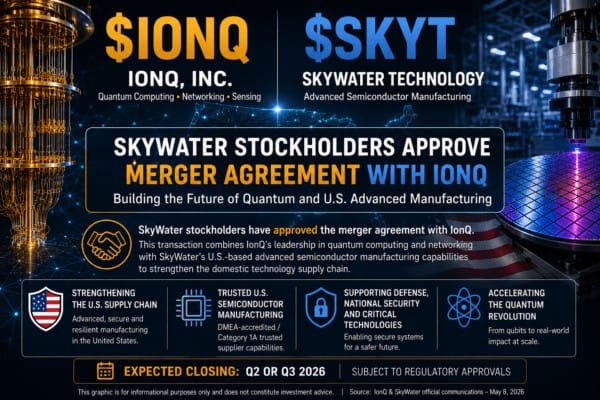
SkyWater stockholders have approved the merger agreement with IonQ. The vote does not close the deal yet, but it moves one of the most unusual quantum transactions of 2026 into its next phase: regulatory review, supply-chain strategy, and the question of whether quantum companies need more than algorithms and cloud access to scale.

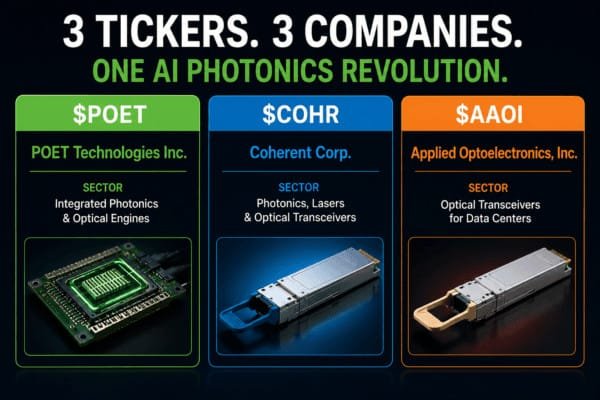
The artificial intelligence infrastructure boom is not only a story about GPUs, accelerators, memory, power, cooling and real estate. It is also, increasingly, a story about light. As AI clusters become larger, denser and more power hungry, the bottleneck shifts from raw compute alone to the movement of data between processors, racks, data halls and campuses. Electrical interconnects still matter, but the further the AI buildout moves into high-bandwidth, low-latency and energy-constrained architectures, the more optical networking becomes one of the critical hidden layers of the trade.

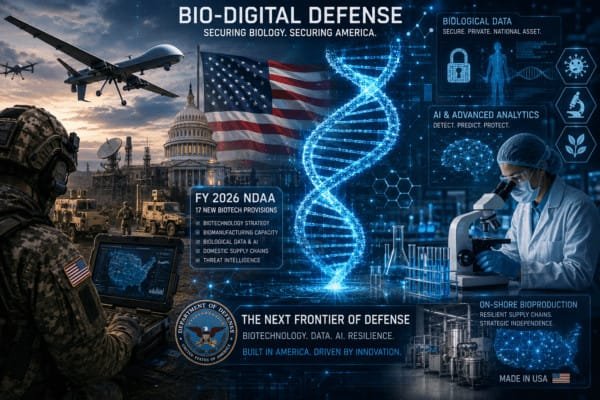
The real story is not that Washington is simply spending more on biodefense. The real story is that the FY 2026 NDAA turns biotechnology into a national-security infrastructure layer: biological data, AI-ready repositories, synthetic DNA/RNA supply, trusted procurement, biomimetic materials, chemical-biological detection and domestic manufacturing capacity now sit inside the same strategic frame.

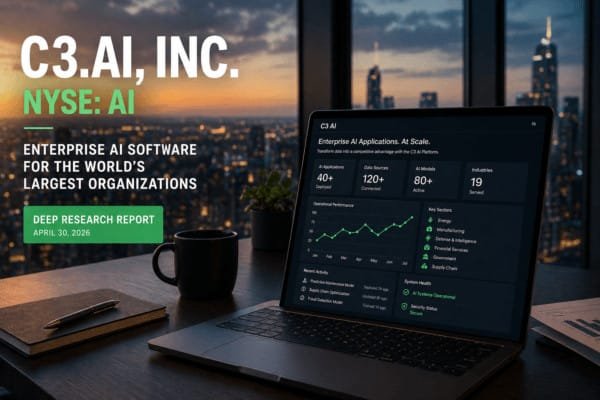
C3.ai, Inc. is a U.S. enterprise software company focused on artificial intelligence applications for large organizations. The ticker is almost too perfect: AI. The business story, however, is no longer being valued as a clean AI momentum trade. As of April 30, 2026, C3.ai is a genuine turnaround case: real enterprise software, real blue-chip customers, major cloud partnerships, a meaningful federal/defense angle, but also a severe FY2026 revenue reset, heavy operating losses, workforce reductions, leadership transition and a market that wants proof rather than promises.

This is the kind of story that can light up the small-cap tape quickly because it combines several ingredients that retail traders actively chase: artificial intelligence infrastructure, data-center bottlenecks, optical interconnects, MicroLED, a low-float style microcap setup, a corporate name change, a ticker change, a financing, and a visible connection to a company with real operating history in advanced displays and optical systems. StableX Technologies, trading as $SBLX at the time of the announcement, is now presenting itself as Fabric.AI and intends to trade as $FABC. The new pitch is straightforward: AI factories need more than GPUs; they need faster, lower-power ways to move data between compute nodes. Fabric.AI wants to start with MicroLED-based optical interconnects, and Kopin is the enabling MicroLED partner.

Intel has spent years as one of the market’s most painful semiconductor turnaround stories. The company lost technological prestige, watched AMD take share in CPUs, watched TSMC become the gold standard in advanced manufacturing, and watched Nvidia capture the center of the artificial intelligence investment cycle. For a long time, Intel was the stock people remembered more than the stock people wanted to own.

SES AI’s April 2026 earnings update changes the tone of the story. For most of its public-market life, SES has been discussed primarily as a lithium-metal battery technology platform with large automotive ambitions, long timelines and heavy cash consumption. The Q1 2026 report does not remove those risks, but it adds a more tangible commercial layer: revenue came in at $6.7 million, up 47% sequentially and well above published consensus estimates, while the company reaffirmed full-year 2026 revenue guidance of $30 million to $35 million.
Hut 8 is no longer an easy one-line story. The old label of “bitcoin miner” is now too narrow, but the new label of “AI infrastructure platform” is still only partially earned. That gap between narrative and proof is exactly why the stock matters right now. Readers are not just looking at another crypto proxy. They are looking at a company trying to turn power access, digital infrastructure, and capital markets agility into a premium multiple.
Allbirds did not just announce a strategic update. It detonated one of the strangest speculative episodes of the year: a company that sold its footwear brand and had been moving toward dissolution suddenly reappeared as “NewBird AI,” backed by a $50 million convertible facility meant to fund a GPU infrastructure strategy. The result was a volume shock, a retail frenzy, and a debate over whether the market is pricing execution or simply pricing narrative.
Today’s update did not change the fact that Safe Pro is still a very early, very promotional, very high-risk small cap. What it did change is the quality of the operating narrative. Safe Pro is no longer talking only about future opportunity in defense AI. It is now stacking a visible sequence of milestones: a government subcontract, rapid delivery, Army exercises, commercial rollout of NODE-X, and another field validation event announced today.

From edge-AI pitch to real program conversion: what today’s autonomous-energy-node order says about OSS, how the business changed after the Bressner divestiture, and what still has to go right before this can be treated as a durable public-market winner.
Revenue fell 44% year over year to $10.3M, while non-GAAP EPS came in at a loss of $0.05. At the same time, quarterly bookings surged to $37.2M and effective backlog reached a record $50.9M. Management also said full-year FY26 revenue should land on the high side of the previously guided $45M-$50M range, while second-half bookings should come in at the high end of the prior $60M-$80M range.
The market is no longer treating Middle East escalation as a passing geopolitical shock. It is increasingly pricing it as a broader economic regime: one that reprices oil and LNG, lifts defense and dual-use space names, pressures airlines and small caps, and forces investors to rethink the physical vulnerability of cloud infrastructure
Zeta Global ended 2025 with roughly $1.3 billion in revenue, high-20s growth, expanding margins and a still-modest GAAP net loss, while launching a strategic collaboration with OpenAI to power Athena, its enterprise AI marketing agent. The investment case now revolves less around “can they grow” and more around “can they sustain growth, expand margins and prove that their data and AI stack is truly differentiated.
SoundHound AI started as a voice and music-recognition company and gradually evolved into a broader conversational-AI provider. It now positions itself as a global platform for voice and agentic AI, powering restaurant phone ordering and drive-thrus, in-car voice assistants, smart devices and enterprise customer-service agents across financial services, healthcare, retail and more.
Rackspace Technology (NASDAQ: RXT) is a heavily leveraged hybrid multicloud and managed services provider that is trying to reposition itself as an “AI-first” infrastructure and operations partner. After years of revenue decline, recurring losses and a difficult competitive landscape, the February 18, 2026 strategic partnership with Palantir has triggered a violent rerating of the stock and reopened the turnaround debate.