AI transparency: articles and reports are produced with the help of artificial intelligence and checked through a process that does not constitute specialist validation. They may contain errors: verify relevant information with independent sources. Read the full disclaimer.
Sector Analysis 2026 · Space, Defense & AI
DefenseDronesTrade policySupply chain
$RCAT · $ONDS · $AVAV · $LPTH
US Drone Tariffs Explained: The Six-Layer Supply Chain Map, With $RCAT, $ONDS, $AVAV and $LPTH As Worked Examples
A 100 percent Section 232 duty lands on September 3, 2026, a 25 percent component tier is deferred to February 9, 2027, and export controls loosened on the same day the tariff was signed. What the three annexes actually cover, which layer of the supply chain each company occupies, and a five-question routine for reading the next announcement.
EU, Japan, Korea, Taiwan, Switzerland / United Kingdom
Weight trigger
25 kg
Above this weight Annex I applies with or without thermal imaging
Layers mapped
6
From raw materials to programme integration
Combined liquidity
$4.06B
Six companies, six different reporting dates
Export threshold
3 hours
Endurance, raised from 30 minutes via 1 hour
Commerce report due
Dec 11, 2026
120 days from signature
Proclamation signed August 13, 2026Section 232 legal basis100% on Annex I from September 3, 202625% on Annex III from February 9, 202715% partner ceiling for the EUBlue UAS cut-off September 2, 2026BIS export threshold raised to 3 hoursOnshoring commitments run to January 20, 2029
Next dated milestone
Annex I and Annex II take effect at 00:01 Eastern on September 3, 2026
Twenty-one days from the signature of August 13, 2026, as written into the proclamation. Companies appearing on the Department of War Blue UAS Cleared List or the FCC Conditional Approval List as of September 2, 2026 instead receive a 180-day deferral. The Annex III component tier is separately deferred to February 9, 2027.
Structural feature
The measure protects domestic assembly while taxing the components domestic assemblers import
Red Cat states in its annual report that it purchases chip sets, optics and micro-displays from third parties and relies on plants in Asia for key components. AeroVironment states that a significant majority of the rare-earth metals in its motors and batteries are sourced from China. Unusual Machines states that it sources from approximately seventy suppliers, some of which are subject to varying tariffs, and separately that it is subject to United States tariffs on certain imported goods ranging from 2 to 30 percent. The onshoring programme answers this with capital-expenditure relief running to January 20, 2029, which makes balance-sheet capacity the operative variable.
01 What actually happened on August 13, 2026
At 21:22 UTC on Wednesday, August 13, 2026, the White House published a proclamation titled
Adjusting Imports of Unmanned Aircraft Systems and Unmanned Aircraft Systems Components into the
United States. It was signed under Section 232 of the Trade Expansion Act of 1962, the same
national-security statute used for steel and aluminium in 2018, following a report the Secretary of
Commerce transmitted to the President within the preceding ninety days.
The headline rate is 100 percent ad valorem. It applies to unmanned aircraft with a maximum take-off
weight above 25 kilograms, to unmanned aircraft that carry thermal imaging, to the docking stations of
those aircraft, and to the critical components listed in Annex I. A second tier of 25 percent covers
smaller aircraft without those capabilities, listed in Annex II, and a third tier of 25 percent covers
the additional components in Annex III. Partner-country ceilings apply: 15 percent for the European
Union, Japan, the Republic of Korea, Taiwan, Switzerland and Liechtenstein, and 10 percent for the
United Kingdom, conditional on certification that the critical components originate within those
countries or the United States.
Three dates matter more than the rates. Annex I and Annex II take effect at 00:01 Eastern time on
September 3, 2026, twenty-one days after signature. Annex III is deferred by a hundred and eighty days,
to February 9, 2027, with the stated purpose of incentivising onshoring. And companies appearing on the
Department of War Blue UAS Cleared List or the FCC Conditional Approval List as of September 2, 2026
receive the same hundred-and-eighty-day deferral on the first two annexes.
The proclamation also authorises the Secretary of Commerce to run an onshoring programme. A company
that commits to building or expanding United States manufacturing capacity before January 20, 2029 may
import components and capital equipment free of the Section 232 duty while that plant is under
construction, in proportion to its projected annual output. The Secretary may add further components to
the annexes on a rolling basis, and owes the President a report within a hundred and twenty days on
whether further action or partial revocation is warranted.
Roughly sixteen hours earlier, on the same day, the Bureau of Industry and Security lodged a final
rule at the Federal Register that moves in the opposite direction on exports. Published on August 14 and
effective August 13, it raises the endurance threshold for national-security controls on unmanned
aircraft from one hour to three hours under ECCN 9A012.a, and removes the wind-gust tolerance parameter
altogether. Military end-use and end-user controls stay in place. The agency estimates the change will
reduce licence applications by thirty a year.
Two federal actions on one day, pointing in opposite directions: harder to bring foreign drones in,
easier to send American ones out. Reading the second without the first produces a distorted picture of
what the week did to this industry.
The four tariff tiers and when each one starts
Ad valorem rates set by the presidential proclamation of August 13, 2026 under Section 232 of the Trade Expansion Act of 1962. The partner ceilings apply only where substantially all hardware, software and technology originates in those countries or the United States.
Annex I: aircraft over 25 kg, aircraft with thermal imaging, docking stations, listed critical components100%
Effective 00:01 ET, September 3, 2026
Annex II: aircraft at or below 25 kg without thermal imaging25%
Companies on the Department of War Blue UAS Cleared List or the FCC Conditional Approval List as of September 2, 2026 receive the same 180-day deferral on Annex I and Annex II that Annex III already carries.
Source: Proclamation Adjusting Imports of Unmanned Aircraft Systems and Unmanned Aircraft Systems Components into the United States, whitehouse.gov, August 13, 2026, with Annex I, Annex II and Annex III.
02 The framing that gets this wrong
The obvious reading of a drone tariff is that it helps companies that build drones in America and hurts
the ones that do not. That reading survives about ten minutes of contact with the annexes.
A tariff on finished aircraft protects assemblers. A tariff on components taxes them. This proclamation
does both, in different proportions, on different dates, to different parts of the same bill of materials.
The company that assembles a quadcopter in Utah does not import the finished aircraft, so the 100 percent
line never touches it. It does import motors, electronic speed controllers, cells, radios and camera
modules, and those are exactly what Annexes I and III reach. Whether the net effect on that company is a
subsidy or a cost increase depends on a question the headline cannot answer: what fraction of its bill of
materials crosses a border, and which annex catches it, and on which date.
So the useful unit of analysis is not the company. It is the layer of the supply chain the company
occupies, and the customs classification of what moves in and out of that layer. Once the map of layers is
in place, a proclamation that looks like a single event resolves into six different events happening to six
different populations of companies.
What follows builds that map, places four companies on it as worked examples, and ends with a triage
routine that can be applied to the next announcement without re-reading any of this. The four are Red Cat
Holdings ($RCAT), Ondas ($ONDS), AeroVironment ($AVAV) and LightPath Technologies ($LPTH). They sit at four
different depths of the same stack, which is the reason for choosing them.
03 Why a tariff, and why now
The problem the proclamation names is concentration. A small-airframe drone is, in bill-of-materials
terms, a consumer electronics device: a frame, four to eight brushless motors, electronic speed
controllers, a flight controller, a radio link, a battery pack and a camera. Every one of those parts has a
mature, high-volume, low-cost manufacturing base, and for most of the past decade that base has been in
Shenzhen. The dominant civil manufacturer built a component ecosystem around itself that Western assemblers
also buy from, because it is cheaper and better supplied than the alternatives.
That dependency became a policy question rather than a procurement question in December 2024, when
Section 1709 of the fiscal 2025 National Defense Authorization Act named DJI and Autel Robotics directly and
required their equipment to be placed on the FCC Covered List within a year unless a national-security
agency determined otherwise. No agency did. On December 22, 2025 the FCC’s Public Safety and Homeland
Security Bureau issued Public Notice DA 25-1086, adding unmanned aircraft systems and their critical
components produced in a covered foreign country to the list. The practical effect is narrow but
directional: no new equipment authorisations. Devices already authorised keep working, and nobody’s
existing fleet was grounded.
Before that, on June 6, 2025, two executive orders set the frame. Executive Order 14307, Unleashing
American Drone Dominance, ordered the FAA toward routine beyond-visual-line-of-sight rulemaking,
directed federal procurement toward domestically manufactured aircraft, told the Defense Innovation Unit to
expand the Blue UAS list, and, in Section 8(a), ordered a review of export controls. Executive Order 14305,
Restoring American Airspace Sovereignty, created a federal task force on detection and tracking and
pointed at the 2026 World Cup and the 2028 Olympics as forcing events.
The BIS rule of August 13, 2026 is the completion of that Section 8(a) review, running through an interim
rule of January 21, 2026. The tariff proclamation is the demand-side counterpart. Neither arrived without
warning; both had been visible in the record for fourteen months.
04 Three constraints that make this a market rather than a headline
First, defence procurement cannot buy what it cannot certify. The Blue UAS list and the
NDAA restrictions already excluded Chinese airframes from most military purchasing. What they did not do was
create American suppliers of the parts inside. A qualified American airframe with Chinese motors satisfies
the letter of some rules and fails others, and the boundary has been moving for three years.
Second, the cost structure is unforgiving at the low end and irrelevant at the high end.
A hundred percent duty on a consumer aircraft with a thin margin is prohibitive. The same duty on a
long-endurance military system priced in the hundreds of thousands is a rounding error against the programme,
because nobody was importing that aircraft in the first place. The tariff bites hardest exactly where
volumes are largest and margins thinnest.
Third, capacity takes eighteen to thirty-six months and capital. The onshoring provision
gives companies until January 20, 2029 to build. That is a deliberate horizon: it acknowledges that no amount
of tariff protection creates a motor winding line in three weeks. Which means the immediate winners of a
tariff are not the companies that will eventually make the parts, but the companies that already hold enough
cash to finance the wait.
05 The stack, layer by layer
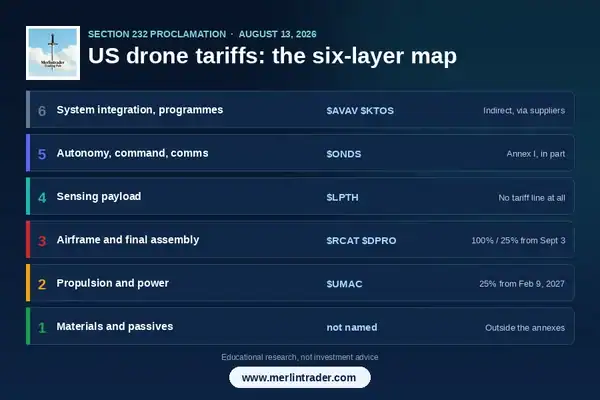
The six layers, the companies used as worked examples at each one, and how the annexes of the August 13, 2026 proclamation treat that layer. Tariff treatment as published in Annex I, Annex II and Annex III.
Six layers, from raw input to fielded programme. Each layer has a different tariff exposure, a different
competitive structure, and a different answer to the question of whether September 3 is good news.
Layer 1, materials and passives. Rare-earth magnets, semiconductors, connectors, printed
circuit boards. Almost nothing here is drone-specific, so almost nothing here appears in the annexes by name.
It is nevertheless where the deepest dependency sits, and the annexes do not touch it.
Layer 2, propulsion and power. Brushless motors, electronic speed controllers, propellers,
battery cells and packs. Propellers and rotors appear explicitly in Annex I and Annex III under headings
8807.10 through 8807.90. This is the layer where a Western assembler’s dependency is most concrete and most
expensive to replace, because motor winding is a capital-intensive process with a long qualification cycle.
Layer 3, the airframe and final assembly. The finished aircraft, classified under headings
8806.21 through 8806.99. This is where the 100 percent and 25 percent rates land directly, split by weight and
by the presence of thermal imaging. An American assembler is not the target here; it is the intended
beneficiary.
Layer 4, the sensing payload. Electro-optical and infrared cameras, lenses, gimbals,
laser designators. The payload is often a larger share of the delivered price of a military drone than the
airframe. Its treatment in the annexes is the single most misread part of this proclamation, and the next
section deals with it on its own.
Layer 5, autonomy, command and control, and communications. Flight controllers, datalinks,
spectrum management, mission software, counter-drone detection. Static converters and electrical control
panels for unmanned aircraft appear in Annex I under 8504.40.9580 and 8537.10.9170, which reaches part of this
layer, but the software and the network do not cross a customs border in any form a tariff schedule
recognises.
Layer 6, system integration and programmes. The prime contractor that packages the layers
below into a fielded capability with a programme of record, sustainment and training. Tariff exposure here is
indirect, arriving through supplier cost and schedule rather than through a customs entry the prime files
itself.
Where the confusion usually starts. Most commentary treats layers 3 and 6 as the same
business because both companies can be described as making drones. They are not remotely the same business.
Layer 3 is a manufacturing margin on a physical product with a bill of materials that a tariff can reprice
overnight. Layer 6 is a services-and-integration margin on a multi-year contract with an escalation clause and
a government customer. A duty that transforms the economics of one barely registers in the other’s quarterly
statement.
Annex I reaches 8504.40.9580 and 8537.10.9170 only
$ONDS
6. System integration and programmes
Prime contracting, sustainment, programmes of record
Indirect, through supplier cost and schedule
$AVAV, $KTOS
Tariff treatment reflects Annex I, Annex II and Annex III as published with the proclamation of August 13, 2026. The Secretary of Commerce is authorised to add components to the annexes on a rolling basis.
06 How to read the annexes, and the thing almost everyone got wrong
The annexes are three PDFs attached to the proclamation, and they are short enough to read in full. Doing so
changes the conclusion.
Annex I, the 100 percent list, contains static converters (8504.40.9580) and electrical
control panels for unmanned aircraft (8537.10.9170); the aircraft themselves across 8806.21 through 8806.99;
and parts of propellers and rotors, undercarriages and other aircraft parts across 8807.10 through 8807.90.
Two markers govern the reading. A subheading marked TI covers only unmanned aircraft that
carry thermal imaging. A heading marked Part covers only parts for aircraft in the annex whose
maximum take-off weight exceeds 25 kilograms, and even then excludes parts for retail delivery use,
agricultural use, or sale to the Department of War.
The TI marker appears only on the six subheadings covering aircraft up to 25 kilograms. The four subheadings
above that weight carry no marker at all, so they are caught whether or not a thermal imager is fitted. Thermal
capability is what pulls a light aircraft up into the 100 percent tier; above 25 kilograms the weight alone is
sufficient.
Annex II, the 25 percent list, is the complement: the same 8806 headings for aircraft at or
below 25 kilograms, applying when the aircraft does not carry thermal imaging.
Annex III, deferred to February 9, 2027, repeats the generic aircraft-parts headings of
8807.10 through 8807.90, applicable when those parts are imported for use in unmanned aircraft. Where a line
appears in both Annex I and Annex III, the Annex I rate governs.
Now the part that matters. Nowhere in the three annexes do the words infrared optics, lens, thermal
sensor, thermal camera or electro-optical module appear as a tariff line. The thermal-imaging trigger
is a property of the finished aircraft, not a classification of the payload sold separately. An infrared lens
assembly shipped to an American camera integrator is not an unmanned aircraft under heading 8806, and it is not
a propeller, an undercarriage or a static converter. The only headings that could conceivably reach it are the
residual “other parts, nesoi” lines, which are drafted generically and would require a customs determination
that the part is a part of an unmanned aircraft rather than of the camera it belongs to.
That distinction is not academic. Within hours of the signature, the retail interpretation circulating on
social platforms held that the thermal-imaging trigger was a targeted intervention in favour of American
infrared suppliers. The trigger is real. Its target is the imported aircraft. Whether any second-order benefit
reaches the optics layer is a commercial question about who wins the resulting orders, not a mechanical
consequence of the tariff schedule. The two are constantly conflated, and the annexes settle the point.
One further asymmetry deserves attention. The Part marker restricts the 100 percent
component lines to aircraft above 25 kilograms and carves out sales to the Department of War. Read literally,
components destined for the largest military platforms, the segment most often invoked to justify the measure,
sit outside the highest rate. The heaviest burden falls on the commercial and light-tactical segment, which is
where price sensitivity is greatest and where the substitution problem is hardest.
07 Worked example one: Red Cat ($RCAT) at layer 3
Red Cat Holdings is an airframe company. Its Form 10-K for 2025 states that manufacturing sits in Salt Lake
City, Utah; Torrance, California; and Valdosta, Georgia, and adds that the company relies on third-party
manufacturing plants in the United States, Asia and elsewhere for key components. That single sentence contains
both sides of this tariff: American final assembly, foreign component sourcing.
The quarter reported on August 6, 2026 shows what scaling that looks like. Revenue for the three months to
June 30, 2026 was $20.189 million against $3.219 million a year earlier. Net loss widened to $35.259 million
from $13.279 million, or $0.26 per share against $0.15. Cash stood at $325.553 million at June 30, 2026 against
$167.865 million at December 31, 2025, after equity raises of roughly $172.5 million in September 2025 and
roughly $258.8 million in May 2026. Shares outstanding were 152,714,362 as of August 4, 2026. Management states
in the filing that the company has sufficient financial resources for at least the next twelve months.
On tariffs the company is explicit. The August 2026 Form 10-Q lists among its cautionary statements “the
imposition or increase of tariffs and other trade barriers that could impact the cost of raw materials,
components, and finished goods” and “delays or disruptions in our supply chain due to global trade restrictions
or political instability”. On sourcing, the annual report states that the company does not manufacture the
integrated circuit chip sets, optics or micro-displays in its products and purchases them from third-party
suppliers, and flags reliance on single-source or small-number suppliers as a distinct risk.
There is also a dated item that most coverage of this company omits. The 2025 annual report describes an FCC
Covered List action recognising a carve-out for unmanned systems on the Defense Contract Management Agency Blue
UAS list, running to January 1, 2027. That date, and the September 2, 2026 Blue UAS cut-off written into the
proclamation, are the two administrative hinges that decide when this company’s component imports are actually
repriced.
Red Cat’s most recently disclosed government award is a $2.49 million firm-fixed-price order from the U.S.
Air Force Security Forces Center for Black Widow systems, announced July 30, 2026. Against a market
capitalisation of roughly $1.72 billion on August 14, 2026, the gap between contract scale and equity value is
the central fact about this position in the stack, and it is not a fact the tariff changes.
08 Worked example two: Ondas ($ONDS) at layers 5 and 6
Ondas reported its second quarter on August 13, 2026, hours before the proclamation was published. Revenue was
$83.772 million against $6.273 million a year earlier. The net loss for the quarter was $89.696 million, or $0.18
per share. The first-half figures require care: a reported net profit of $271.555 million for the six months is
almost entirely the product of $449.7 million of non-cash other income from the revaluation of warrants issued in
the October 2025 and January 2026 financings, against an operating loss of $205.617 million for the same period.
The profit line and the operating line say opposite things, and only one of them describes the business.
Liquidity is the striking number. The company states it held approximately $1.4 billion in cash, cash
equivalents and short-term investments at June 30, 2026, and adds that during the third quarter it used
approximately $325 million of cash closing the DZYNE and Cyberhawk acquisitions. Shares outstanding were
570,552,341 as of August 11, 2026, following an October 2025 raise of roughly $425 million gross and a January
2026 raise of roughly $1 billion gross, which together carried warrants over more than 195 million shares.
Backlog was approximately $613 million at June 30, 2026, or $757 million pro forma for the two acquisitions
that closed in the third quarter. The contract behind most of it is a Lethal Unmanned Strike IDIQ with the U.S.
Army carrying a ceiling of $982 million, against which the company reports having captured more than $240 million
of aggregate orders, including $52.9 million in July 2026. A separate NASA IDIQ ceiling for stratospheric ISR
solutions was raised from $45 million to $395 million.
On the specific question of tariff exposure, the disclosure record is thin. A full-text search of the company’s
SEC filings returns no matches for the word tariff in its annual reports, and no recent annual report contains the
word China. Absence of a risk factor is not absence of a risk, and it is not evidence of insulation either. It
means the exposure has not been characterised by the company, and anyone modelling it is estimating.
What the company does disclose is capacity: an expanded United States manufacturing footprint of six major
facilities totalling 230,000 square feet, with roughly 50,000 more planned. Those are exactly the assets the
onshoring programme is designed to reward, which places this company in an unusual position relative to a
proclamation it has not commented on.
09 Worked example three: AeroVironment ($AVAV) at layer 6
AeroVironment closed its fiscal 2026 on April 30, 2026 and reported on June 29. Revenue for the year was
$1,976.8 million against $820.6 million, a figure that reflects the acquisition of BlueHalo, which closed on May 1,
2025 and gave the company a second reporting segment. Fourth-quarter revenue was $641.6 million against $275.1
million, with net income of $63.2 million and diluted earnings of $1.25 per share. The full year carried a net loss
of $265.1 million, or $5.40 per diluted share, driven by a $240.7 million goodwill impairment in the Space segment
tied to the termination of a government programme.
Guidance for fiscal 2027, given on the same date, is revenue of $2,125 million to $2,225 million, net income of
$8 million to $24 million, non-GAAP diluted earnings of $3.02 to $3.34 and adjusted EBITDA of $305 million to $325
million. Funded backlog was $1.2 billion at April 30, 2026 against $726.6 million a year earlier, with fiscal 2026
bookings of $2.7 billion and a book-to-bill of 1.4. Cash was $377.3 million with $255.0 million of short-term
investments, against long-term debt of $729.0 million following a convertible note issue. Shares outstanding were
50,608,030 as of June 24, 2026.
Here is where a layer-6 company stops looking insulated. The fiscal 2026 annual report states plainly: “Our
products, including motors, batteries, and other advanced components, rely on rare earth metals for their
manufacturing, of which a significant majority are sourced from China.” It adds that the company has “experienced
rising costs for components, shipping, tariffs, warehousing, and inventory”, and lists the imposition of tariffs,
embargoes and export controls among the risks of its international operations.
Read against the stack, that disclosure is layer 1 reaching up through layer 2 into a layer-6 income statement.
The proclamation does not name rare-earth magnets. It does not have to. A prime contractor with a $1.2 billion
funded backlog and fixed-price content absorbs input inflation on a schedule set by its contracts, not by the
Federal Register.
10 Worked example four: LightPath ($LPTH) at layer 4
LightPath Technologies makes infrared optics and, since the acquisitions of G5 Infrared and Amorphous Materials,
complete camera assemblies. It is the company the retail thesis of August 13 pointed at, and it is the cleanest test
of whether that thesis holds.
Its manufacturing footprint, from the fiscal 2025 annual report, is 58,500 square feet in Orlando, Florida;
27,000 square feet in Hudson, New Hampshire; 39,500 square feet in Zhenjiang, China; and 29,000 square feet in Riga,
Latvia, with a further lease in Plano, Texas taken in July 2025. On July 23, 2026 the company announced a definitive
agreement to sell the Zhenjiang operation for $4.5 million payable over five years. No closing had been announced as
of August 14, 2026.
Three observations follow from the footprint, and none of them is the one that circulated on August 13.
The first is that Latvia is in the European Union, which under this proclamation carries a partner ceiling of 15
percent rather than the headline rate, and only if the relevant goods fall inside the annexes at all. On the reading
above, infrared optics as such do not.
The second is that the company’s own risk language is about the tariff regime it already lives in, not the new one.
The fiscal 2025 annual report states that international tariffs, including tariffs applied to goods traded between the
United States and China, could materially and adversely affect the business, and that the company regularly imports
and exports goods and services between those countries. That is a description of a China-facing manufacturer in the
middle of divesting its China plant.
The third is the balance sheet. Cash was $55,235,181 at March 31, 2026 against $4,877,036 at June 30, 2025,
following a June 2026 offering of 3,571,400 shares at $14.00 that raised roughly $47.0 million net. Order backlog was
$110.6 million. The company’s fiscal year ends June 30 and it has reported fourth-quarter results in the second half
of September in each of the last three years, with the Form 10-K due September 28, 2026. Nothing in the proclamation
moves that date, and the fourth-quarter print will settle considerably more about this company than the tariff will.
None of which makes the company irrelevant to the theme. An American-domiciled supplier of ITAR-compatible
infrared optics sits in a policy environment that has been pushing work toward domestic sources for fourteen months,
of which this proclamation is the latest instalment rather than the first. That is a slower and less quotable claim
than the one that moved the shares, and it is the one the documents support.
11 The paradox: the measure taxes its own beneficiaries
Set the four worked examples side by side and a tension appears that the fact sheet does not acknowledge.
The companies the proclamation is designed to advantage are American assemblers at layer 3. Those same companies
are, by their own disclosure, the ones most dependent on imported components at layer 2. Red Cat states that it buys
chip sets, optics and micro-displays from third parties and relies on plants in Asia for key components.
AeroVironment, four layers up, states that a significant majority of the rare-earth metals in its motors and
batteries come from China. Unusual Machines, which built an American motor line in Orlando in the fourth quarter of
2025 precisely to attack this problem, states in its annual report that it sources inventory from approximately
seventy suppliers, some of which are subject to varying tariffs, and separately that it is currently subject to
United States tariffs on certain imported goods ranging from 2 to 30 percent.
The proclamation’s answer to this is the hundred-and-eighty-day deferral on Annex III and the onshoring
programme, which together say: your component costs rise later, and if you commit capital to domestic capacity by
January 2029, they may not rise at all. That is a coherent design. It is also a design that converts a trade measure
into a capital-allocation test. The companies that can pass it are the ones holding enough cash to fund a plant
through a qualification cycle without needing the market to cooperate.
Which reframes the question of who benefits. Not the company with the best drone. The company with the balance
sheet to build the layer below it before February 2027.
A second tension runs alongside. Section 232 measures raise the price of imports for everyone, including the
federal customer. The Part carve-out for sales to the Department of War acknowledges this for the
largest platforms. It does not extend to the commercial, agricultural and public-safety fleets that make up the bulk
of American drone units in service, and those buyers have no equivalent exemption and, for now, few qualified
domestic alternatives at comparable prices.
Who holds the capital to answer the onshoring clause
Cash, cash equivalents and short-term investments as last reported by each company. The onshoring programme rewards domestic capacity commitments running to January 20, 2029, which makes balance-sheet strength the binding constraint rather than order intake.
$4.06B
combined liquidity
Kratos Defense ($KTOS)$1,437.6M35.4%
Ondas ($ONDS)$1,384.5M34.1%
AeroVironment ($AVAV)$632.3M15.6%
Red Cat ($RCAT)$325.6M8%
Unusual Machines ($UMAC)$229.6M5.6%
LightPath ($LPTH)$55.2M1.4%
Reporting dates differ because these companies close their books on different calendars, so the total is an aggregate of six separate balance-sheet dates rather than a single-day figure. Draganfly is excluded because it reports in Canadian dollars.
Source: Kratos EX-99.1 of August 4, 2026 (June 28, 2026); Ondas EX-99.1 of August 13, 2026 (June 30, 2026); AeroVironment Form 10-K for fiscal 2026 (April 30, 2026); Red Cat EX-99.1 of August 6, 2026 (June 30, 2026); Unusual Machines Form 10-Q (June 30, 2026); LightPath Form 10-Q (March 31, 2026).
12 The pincer: import duty up, export control down
The BIS rule and the proclamation are usually reported separately, which loses the shape of the policy.
On the import side, a foreign-built aircraft entering the United States after September 3, 2026 faces 100 or 25
percent depending on weight and thermal capability. On the export side, an American-built aircraft with less than
three hours of endurance dropped out of national-security licensing on August 13, 2026, having already dropped from
the thirty-minute threshold to one hour in the interim rule of January 21, 2026. Military end-use and end-user
controls remain, and range-based missile-technology controls above 300 kilometres are untouched.
The combined intent is a domestic industry with a protected home market and a lighter path to foreign sales. The
combined risk is that protection raises the input cost of the very products that are supposed to be exported more
easily. A three-hour endurance airframe with a tariffed battery pack is easier to license and more expensive to
build, and which of those two effects dominates is an empirical question that will not be answered before the 2027
reporting season.
13 A triage routine for the next headline
The five questions below can be applied to any drone-tariff story in about two minutes, without opening a
filing. They are ordered so that a negative answer early makes the rest unnecessary.
1. Which layer does this touch? Materials, propulsion and power, airframe and assembly,
sensing payload, autonomy and communications, or system integration. Most headlines name a company and leave the
layer implicit. Naming the layer first prevents applying an airframe conclusion to a payload business.
2. Is the good actually in an annex? The annexes are HTS lines, not descriptions. If the
product is not an unmanned aircraft under heading 8806, a static converter, an electrical control panel, a
propeller, an undercarriage or a generic aircraft part, the duty does not attach directly. Second-order commercial
effects may still exist, and they belong in a different sentence from mechanical tariff effects.
3. Which date applies? September 3, 2026 for Annexes I and II; February 9, 2027 for Annex III;
and the hundred-and-eighty-day deferral for anyone on the Blue UAS Cleared List or the FCC Conditional Approval
List as of September 2, 2026. A cost that arrives in February 2027 does not affect a September 2026 quarter.
4. Which way does the company face? An importer of finished aircraft is hurt. A domestic
assembler that imports components has a cost increase deferred and a competitive shield immediately. A prime
contractor absorbs it through suppliers with a lag. An exporter benefits from the BIS side and is untouched by the
tariff side.
5. Can the balance sheet fund the response? The onshoring programme rewards capital
expenditure commitments running to January 2029. Cash, not backlog, is the constraint that determines whether a
company can use the provision. A company with two quarters of liquidity cannot commit to a plant.
Run those five questions against the August 13 move in the shares and the results are uneven, which is the
normal outcome when a single macro event is priced across six different business models in one pre-market
session.
14 The neighbourhood: who sits where
Beyond the four worked examples, the same map places the rest of the sector. Kratos Defense ($KTOS) sits at
layer 6 with $2.084 billion of total backlog at June 28, 2026, of which $1.572 billion funded, revenue of $458.8
million in the second quarter against $351.5 million, and $1,437.6 million of cash after a February 2026 equity
placement of roughly $1.35 billion net. Its second-quarter release lists among its risk factors “risks related to
tariffs or import duties which could affect the Company’s supply chain and customer affordability”, which is the
layer-6 exposure stated in one line.
Unusual Machines ($UMAC) is the purest layer-2 case in the group. It reported second-quarter revenue of
$16.72 million against $2.12 million, cash of $229.6 million at June 30, 2026, and states that it built a motor
production facility in Orlando and started producing drone motors there in the fourth quarter of 2025, alongside
a motor operation in Canberra, Australia acquired with Rotor Lab. In May 2026 it disclosed purchase orders of
approximately $75 million for NDAA-compliant materials from United States suppliers. It also carries the
seventy-supplier tariff disclosure described above, which makes it simultaneously a beneficiary of domestic
substitution and a payer of import duty.
Draganfly ($DPRO) is the cross-border case. It is a Canadian foreign private issuer filing on Forms 40-F and
6-K, reporting in Canadian dollars. For the quarter to June 30, 2026 it reported revenue of CAD 2,664,237 against
CAD 2,115,255 and a net loss of CAD 12,032,834, with cash of CAD 131,908,197. Its August 10, 2026 management
discussion carries an explicit going-concern paragraph stating that the ability to continue as a going concern
depends on obtaining additional financing or achieving profitable operations, and that these factors indicate a
material uncertainty. It also names trade policy directly, citing the potential imposition of unilateral tariffs
on products imported into the United States as a risk to the availability and cost of materials.
The point of listing them together is not comparability. A company with a going-concern paragraph and a
company with $1.4 billion of liquidity are not two versions of the same trade. It is that a single proclamation
lands on all of them at once, and the layer each occupies predicts more about the effect than the sector label
they share.
15 What the balance sheets say about who can respond
The onshoring provision turns this into a capital question, so the capital position is the relevant table. The
figures below are as reported in each company’s most recent periodic filing, with the date attached, and they are
not comparable across identical dates because these companies close their books on different calendars.
Ticker
Last reported period
Revenue
Net result
Liquidity
Backlog
Shares outstanding
$KTOS
Q2 to Jun 28, 2026
$458.8M
$4.4M profit
$1,437.6M
$2,084M total, $1,572M funded
187,721,327 at Jul 31, 2026
$ONDS
Q2 to Jun 30, 2026
$83.8M
$89.7M loss
~$1,384.5M
$613M, $757M pro forma
570,552,341 at Aug 11, 2026
$AVAV
Q4 FY26 to Apr 30, 2026
$641.6M
$63.2M profit
$632.3M
$1,200M funded
50,608,030 at Jun 24, 2026
$RCAT
Q2 to Jun 30, 2026
$20.2M
$35.3M loss
$325.6M
Not disclosed as an operating measure
152,714,362 at Aug 4, 2026
$UMAC
Q2 to Jun 30, 2026
$16.7M
$7.8M loss
$229.6M
Not disclosed
49,956,505 at Jun 8, 2026
$LPTH
Q3 FY26 to Mar 31, 2026
Not shown
Not shown
$55.2M
$110.6M order backlog
See fiscal 2026 Form 10-K, due Sep 28, 2026
$DPRO
Q2 to Jun 30, 2026
CAD 2.66M
CAD 12.03M loss
CAD 131.9M
Not disclosed
37,148,523 at Jun 30, 2026
Every figure is as reported in the filing or release named in the sources section, on the date shown in the second column. Draganfly reports in Canadian dollars and its August 10, 2026 management discussion carries a going-concern paragraph. Ondas liquidity combines cash, cash equivalents and short-term investments and precedes approximately $325 million of third-quarter acquisition payments the company has disclosed. The columns are not comparable across companies because the reporting dates differ.
Quarterly revenue as last reported, on five different calendars
The most recent reported quarter for each company. AeroVironment closes its fiscal year on April 30 and Kratos on the Sunday nearest December 31, so these are not the same three months.
$641.6M$AVAVQ4 FY2026 to Apr 30, 2026
$458.8M$KTOSQ2 to Jun 28, 2026
$83.8M$ONDSQ2 to Jun 30, 2026
$20.2M$RCATQ2 to Jun 30, 2026
$16.7M$UMACQ2 to Jun 30, 2026
LightPath is not shown because its most recent reported quarter ended March 31, 2026 and its fiscal fourth quarter has not yet been published. Draganfly reports in Canadian dollars and is excluded for the same reason as in the liquidity chart.
Source: AeroVironment EX-99.1 of June 29, 2026; Kratos EX-99.1 of August 4, 2026; Ondas EX-99.1 of August 13, 2026; Red Cat EX-99.1 of August 6, 2026; Unusual Machines Form 10-Q for the quarter ended June 30, 2026.
The first repricing, before any company said anything
Change from the August 13, 2026 regular-session close to the last pre-market print read on the morning of August 14, 2026. None of these seven companies had issued a statement on the proclamation when these prices were recorded.
+18.4%$UMAC
+10.2%$RCAT
+8.8%$LPTH
+4.4%$AVAV
+4.3%$KTOS
+3.9%$ONDS
+1.6%$DPRO
Pre-market prints are thin and do not survive the opening auction. The ranking is shown as a record of how a single macro event was distributed across seven different business models in one session, not as a measure of exposure.
Source: Finviz Elite daily series, as of August 14, 2026.
16 What has to be proved, and what could go wrong
The annexes can be extended. The proclamation authorises the Secretary of Commerce to add
components on a rolling basis. A reading based on today’s annexes is a reading of today’s annexes. Optics are
outside them now; nothing in the instrument prevents a later inclusion.
Retaliation is unmodelled. Partner ceilings of 15 and 10 percent are conditional on
certification of origin, and the countries receiving them are also the countries with the largest non-Chinese
component industries. A retaliatory response would land on American exporters at exactly the moment the BIS rule
was intended to help them.
Substitution is slower than the calendar. Qualification of a new motor or cell supplier in a
defence programme is measured in quarters, sometimes years. Between September 2026 and the arrival of domestic
capacity, the realistic outcomes are higher input costs, longer lead times, or both.
The rally priced a policy, not a result. On August 14, 2026 the pre-market moves against the
August 13 close ranged from about 1.6 percent to about 18.4 percent across this group, with the largest move in
the smallest and least profitable name. None of the seven companies had issued a statement about the
proclamation. A move in the absence of company comment is a repricing of expectations, and expectations are
revised at the next earnings date, not by the Federal Register.
The dependency the measure does not address. Rare-earth magnets, semiconductors and cells sit
at layer 1 and appear nowhere in the annexes. The disclosure that a significant majority of an American prime’s
rare-earth inputs come from China was written before this proclamation and remains true after it.
17 The dates that decide this
September 2, 2026. Cut-off for appearance on the Department of War Blue UAS Cleared List or
the FCC Conditional Approval List, which confers the hundred-and-eighty-day deferral on Annexes I and II.
September 3, 2026, 00:01 Eastern. Annex I at 100 percent and Annex II at 25 percent take
effect.
Second half of September 2026. LightPath has reported fiscal fourth-quarter and full-year
results in this window in each of the last three years, with the fiscal 2026 Form 10-K due September 28, 2026.
The first quarterly reporting season after the effective date begins in late October for the December-year
companies.
December 11, 2026. A hundred and twenty days from signature, the deadline for the Secretary
of Commerce to report to the President on whether further action or partial revocation is warranted.
January 1, 2027. Expiry of the FCC Covered List carve-out for Blue UAS-listed systems
described in Red Cat’s annual report.
February 9, 2027. Annex III takes effect at 25 percent, ending the component deferral.
January 20, 2029. Outer limit for the domestic capacity commitments that qualify a company
for relief under the onshoring programme.
Date
What happens
Why it matters
September 2, 2026
Blue UAS Cleared List and FCC Conditional Approval List cut-off
Confers the 180-day deferral on Annex I and Annex II
September 3, 2026
Annex I at 100% and Annex II at 25% take effect at 00:01 Eastern
The first date on which duty is actually collected
Second half of September 2026
LightPath fiscal 2026 fourth quarter and full year
Company has reported in this window for three consecutive years; Form 10-K due September 28, 2026
December 11, 2026
120 days from signature
Secretary of Commerce reports to the President on further action or partial revocation
January 1, 2027
FCC Covered List carve-out for Blue UAS-listed systems expires
As described in Red Cat’s 2025 annual report
February 9, 2027
Annex III takes effect at 25%
Ends the component deferral for everyone not covered by an onshoring approval
January 20, 2029
Outer limit for qualifying domestic capacity commitments
The horizon written into the onshoring programme
18 Bottom line
A hundred percent tariff on imported drones is a large number attached to a narrow set of customs lines. It
lands on finished aircraft above 25 kilograms, on finished aircraft carrying thermal imaging, on docking
stations, and on a specific list of converters, control panels and airframe parts. It does not land on infrared
optics, on rare-earth magnets, on battery cells or on software, and three of those four are where American
dependency is deepest.
What the measure does with certainty is set a clock. Domestic assemblers get a protected home market on
September 3, 2026 and a component bill that rises on February 9, 2027, unless they commit capital to domestic
capacity first. That is a five-month window in which balance sheet strength, not product quality, determines who
can act. Ondas and Kratos each hold well over a billion dollars of liquidity. Red Cat and Unusual Machines hold a
few hundred million. Draganfly filed a going-concern paragraph four days ago. Those differences were already
there on August 12, and the proclamation made them decisive rather than merely descriptive.
For anyone tracking the sector, the useful output of this week is not a view on any one of these companies. It
is the map: six layers, three annexes, four dates, and five questions that separate a mechanical tariff effect
from a narrative one. The next announcement will be easier to read than this one was.
Annex I, Annex II and Annex III: the tariff lines, the TI marker for thermal imaging and the Part marker for components of aircraft above 25 kilograms.
FCC Covered List and Public Notice DA 25-1086, December 22, 2025, adding unmanned aircraft systems and their critical components, pursuant to Section 1709 of the fiscal 2025 National Defense Authorization Act.
Draganfly, Form 6-K of August 10, 2026 with the interim financial statements and the management discussion containing the going-concern paragraph and the trade-policy risk.
Market data: Finviz Elite daily series and screener, as of August 14, 2026.
Every figure carries the filing or release it comes from and the date of that document. Regulatory text is quoted from the proclamation, its annexes and the Federal Register. Market data are as of August 14, 2026 and change continuously.
Get these reports in real time
Every Merlintrader stock hub, catalyst update and market brief is published to Telegram the moment it goes live. No paywall, no spam, just the research.
Disclaimer. This content is published by Merlintrader for educational and informational purposes only. It is independent journalism and research. It does not constitute investment advice, an investment recommendation, an offer or a solicitation to buy or sell any security, and it is not a research report within the meaning of applicable United States securities regulation. Nothing here should be read as a recommendation to buy, sell or hold $RCAT or any other security.
Figures are taken from public filings with the U.S. Securities and Exchange Commission, company press releases and market-data providers, and are stated with their reference dates. Data can change without notice, and figures published before a results release become outdated the moment that release is issued. Merlintrader makes no representation that the information is complete or current at the time of reading. Readers should verify every figure against the primary source before acting on it.
The companies discussed span micro-capitalisation and large-capitalisation defence suppliers. Several are loss-making, one carries a going-concern paragraph in its most recent management discussion, and several have issued substantial equity within the last twelve months. Trade measures adopted by proclamation can be amended, extended or revoked by the same instrument, and the annexes may be expanded on a rolling basis.
Merlintrader may hold positions in securities mentioned. Some links on this page are affiliate or referral links, including those to Finviz and Stocktwits, which may generate a commission at no cost to the reader. Full legal information is available on the disclaimer and terms of use and privacy pages.
Red Cat Holdings, Inc. ($RCAT) Stock Hub — Merlintrader — last updated August 14, 2026
Space, Defense & AI Catalyst Calendar
Earnings dates, launch windows, regulatory deadlines and clinical catalysts in one free, filterable calendar. Open the Biotech Catalyst Calendar →
 Umbria