Category Space

Reusable Rockets Explained: The Launch Economics, $RKLB as the Worked Example, and What China’s First Booster Catch Changes

Reusable rockets launch economics explainer - $RKLB, $SPCX, China Long March 10B booster catch

A plain-English guide to the economics of reusable rockets: why refurbishing beats rebuilding, how cost-per-kg collapsed, where SpaceX ($SPCX), Blue Origin, China's Long March 10B and Rocket Lab ($RKLB) sit on the reuse ladder, a reusable triage for launch news, and what China's first booster catch does and doesn't change. Educational, not investment advice.

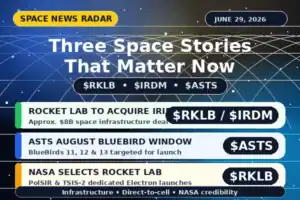
Three Space Stories That Matter Now: $RKLB’s Iridium Shock, $ASTS’s August Launch Window, and Rocket Lab’s NASA Credibility Trade. $IRDM

Space Stories

The public space sector just received a concentrated set of catalysts: Rocket Lab is trying to buy an operating satellite communications network, AST SpaceMobile has placed its next BlueBird batch on the launch calendar, and NASA has selected Rocket Lab for dedicated Sun/Earth science missions. Together, these updates show how the investable space trade is moving beyond launch hype and into infrastructure, networks, services, and execution.

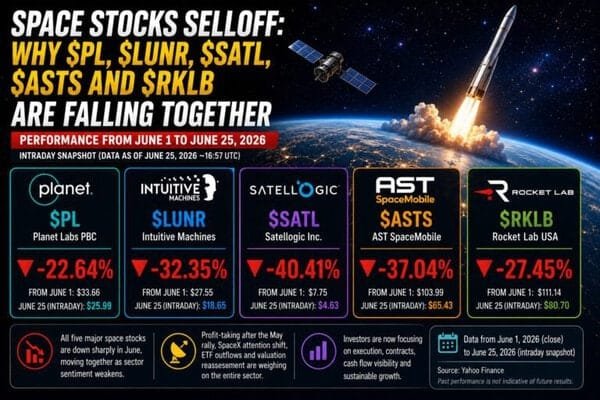
Space Stocks Selloff: Why $PL, $LUNR, $SATL, $ASTS and RKLB Are Falling Together After June’s Rally

space

The June space trade is no longer being priced stock by stock. Planet Labs, Intuitive Machines, Satellogic, AST SpaceMobile and Rocket Lab are being traded as one high-beta space basket — and the unwind has exposed the same pressure points across the sector: SpaceX gravity, ETF outflows, valuation resets, execution risk, launch cadence, defense-contract timing and profit-taking after a crowded rally.

SpaceX IPO Filing Puts the New Space Trade Back in Motion — Why $RKLB, $RDW and $ASTS Moved Today

Space X

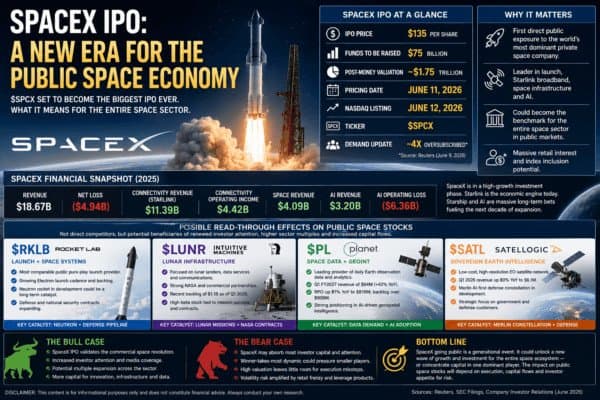
The SpaceX IPO filing has turned into a market-wide valuation event for the space sector. The most important point is not that SpaceX is going public — that had already been widely expected — but that the filing gives investors a new, highly visible reference point for how public markets may price the combined story of reusable launch, Starlink connectivity, satellite infrastructure, defense-linked space services, orbital logistics and long-duration AI/compute ambitions.

AI Drones, Quantum Defense and the Commercial Space Race: $SPAI, $QUCY and $LUNR Move Into Focus

SPAI, QUCY, LUNR

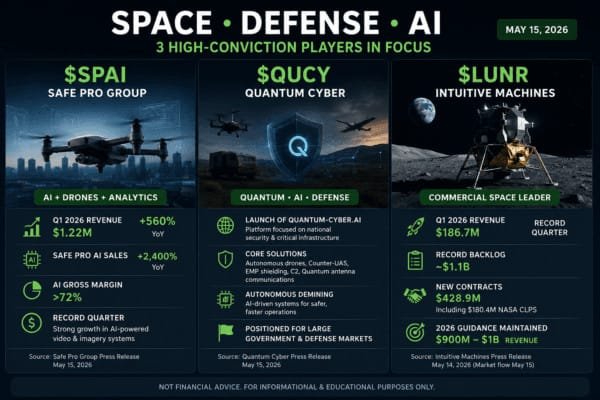
Safe Pro Group, Quantum Cyber and Intuitive Machines offer three different ways to read the current convergence of artificial intelligence, drones, defense technology and commercial space. Safe Pro Group is the most numbers-driven update in this group, with record first-quarter revenue, a sharp increase in AI product sales and strong gross margins. Quantum Cyber is the most narrative-driven defense platform story, using the launch of quantum-cyber.ai to frame a broader System-of-Systems strategy across autonomous drones, counter-UAS, EMP-hardened components, autonomous demining and quantum antenna communications. Intuitive Machines is the most mature and institutionally visible company in the group, with record quarterly revenue, positive adjusted EBITDA, a record backlog and full-year guidance that still points to a much larger commercial space business in 2026.

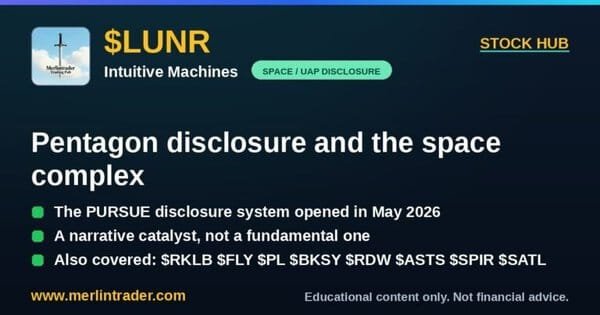
Pentagon UFO Files, Space Stocks and the Market’s New “Alien Premium” . Related tickers : $LUNR $RKLB $FLY $PL $BKSY $RDW $ASTS $SPIR $SATL

On May 8, 2026, the U.S. Department of War launched the Presidential Unsealing and Reporting System for UAP Encounters, or PURSUE, and began publishing a first wave of records tied to unidentified anomalous phenomena. That part is not internet folklore. It is an official government release, framed by the administration as a transparency push and explicitly tied to President Donald Trump’s February 19, 2026 directive to identify, review, declassify and release unresolved UAP-related records.

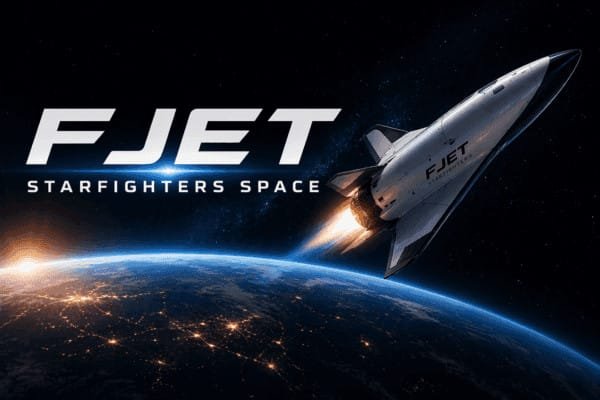
Starfighters Space Deep Dive ( $FJET): FJET’s Space-Test Platform, C-STARS Catalyst, Blackstar Optionality, Insider Picture and Funding Risk

fjet april

Starfighters Space is one of the more unusual public-market stories in the listed space and aerospace universe. The company is not a conventional orbital launch provider, it is not a pure satellite manufacturer, and it is not merely an aviation services company with a space label attached. Its core asset is a scarce commercial fleet of modified F-104 aircraft positioned around sustained Mach 2+ flight, high-altitude testing, launch-support profiles, training, payload development, microgravity-adjacent research and future air-launch optionality. That makes the company difficult to value through a normal revenue-multiple framework, because the investment case is still being built around platform scarcity, mission optionality and the possibility that customers need faster and more flexible access to real flight-test environments.

Amazon ($AMZN), Globalstar ($GSAT), and AST SpaceMobile ($ASTS): why Amazon’s Globalstar deal matters far beyond one takeover

Amazon’s move on Globalstar is not just another satellite headline. It is a deeper attempt to own spectrum, device-level connectivity, Apple continuity, and a bigger slice of the space economy at the same time. That has immediate implications for Globalstar, material strategic implications for Amazon, and a more complicated read-through for AST SpaceMobile.

Momentus ( $MNTS ) Deep Dive 2026 UPDATED APRIL15

Momentus is still one of the most binary small-cap space stories on the board, but after the last two weeks it is harder to dismiss the company as a pure concept trade. The central reason is not a promotional headline. It is sequence. For a company like MNTS, sequence is everything.

Voyager Technologies (NYSE: VOYG) — April 2026 deep dive

Voyager Technologies is one of the more interesting space-defense names because it is not a clean, single-theme stock. It is not just a commercial space dream. It is not just a defense contractor. It is not just a speculative “future station” vehicle either. It is a hybrid company where a real operating business in defense and mission services sits next to a very large long-duration bet on the future commercial low-Earth-orbit economy. That mix is what makes VOYG potentially powerful, but it is also exactly what makes it difficult to value.