Category LUNR

Intuitive Machines Inc

AI transparency: articles and reports are produced with the help of artificial intelligence and checked through a process that does not constitute specialist validation. They may contain errors: verify relevant information with independent sources. Read the full disclaimer.

AI Drones, Quantum Defense and the Commercial Space Race: $SPAI, $QUCY and $LUNR Move Into Focus

SPAI, QUCY, LUNR

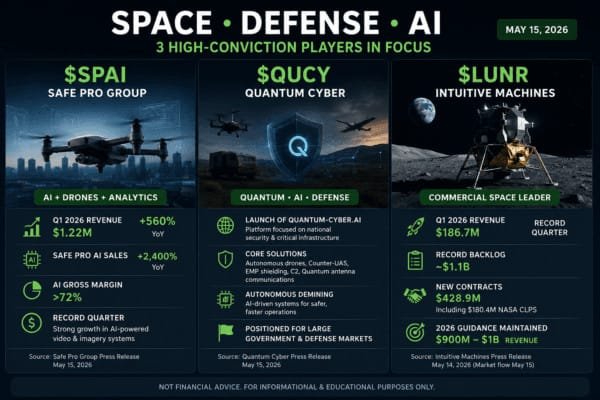
Safe Pro Group, Quantum Cyber and Intuitive Machines offer three different ways to read the current convergence of artificial intelligence, drones, defense technology and commercial space. Safe Pro Group is the most numbers-driven update in this group, with record first-quarter revenue, a sharp increase in AI product sales and strong gross margins. Quantum Cyber is the most narrative-driven defense platform story, using the launch of quantum-cyber.ai to frame a broader System-of-Systems strategy across autonomous drones, counter-UAS, EMP-hardened components, autonomous demining and quantum antenna communications. Intuitive Machines is the most mature and institutionally visible company in the group, with record quarterly revenue, positive adjusted EBITDA, a record backlog and full-year guidance that still points to a much larger commercial space business in 2026.

Pentagon UFO Files, Space Stocks and the Market’s New “Alien Premium” . Related tickers : $LUNR $RKLB $FLY $PL $BKSY $RDW $ASTS $SPIR $SATL

Intuitive Machines LUNR stock cover Merlintrader

On May 8, 2026, the U.S. Department of War launched the Presidential Unsealing and Reporting System for UAP Encounters, or PURSUE, and began publishing a first wave of records tied to unidentified anomalous phenomena. That part is not internet folklore. It is an official government release, framed by the administration as a transparency push and explicitly tied to President Donald Trump’s February 19, 2026 directive to identify, review, declassify and release unresolved UAP-related records.

Space Wars

The question is no longer whether the Space Force truly exists as an autonomous armed service. After the April 15 release and B. Chance Saltzman’s remarks at the 41st Space Symposium, the point is that U.S. leadership is asking markets, industry and Congress to treat it as a fully operational, combat-credible force: a force no longer living on doctrine alone, but one that has already produced real effects in recent operations and now wants to translate that legitimacy into architectures, personnel, industrial production and multiyear contracts

From Artemis to the Battlefield: why $LUNR, $FLY, $SIDU, $PDYN and $BKSY no longer belong to separate stories

For years, the market framed companies like Intuitive Machines, Firefly, BlackSky, Palladyne AI or Sidus Space as disconnected speculative names orbiting around rockets, satellites or futuristic concepts. That framing is becoming outdated. In 2026, the more useful lens is strategic infrastructure. What matters now is who can move payloads, who can see first, who can process data faster, who can coordinate autonomous systems, and who can fit into the increasingly blurred boundary between civil space, defense tech, sovereign priorities and lunar logistics.

Top 5 Space Stocks to Watch – April 2026

Why space matters again
The listed space sector has matured just enough to become interesting again, but not enough to become comfortable. That tension is exactly what makes it useful. Investors are no longer looking only at “space” as a futuristic headline. They are increasingly focusing on what part of the stack a company really owns: imagery, analytics, launch, orbital infrastructure, communications, mission execution or defense-adjacent data services.

In practice, this means the better stories are no longer the ones with the biggest cosmic vocabulary. They are the ones that can plausibly tie their business to recurring demand, sovereign capability, geospatial intelligence, communications resilience or long-duration technology relevance.

Top 10 Space Mid & Small Caps 2026

A simple way to think about this basket is to imagine the space stack as layers: access to orbit, sensing, communications, infrastructure and exploration. Each of the ten names here owns a useful slice of that stack, often in niches that the mega-caps either do not want or cannot address efficiently.

Space Stocks in Free Fall

In the last 30 days the “space trade” has flipped from poster child of risk-on to textbook case of brutal risk-off. Launch, satcom and geospatial names are bleeding double-digit days, while some defense-linked players hold up. Under the surface, it is a story of funding, dilution anxiety, macro rates and a sector where AI and defense still pull in structural demand.

2026 The New Era – Watchlist Space-AI-Defense

2026 opens in a geopolitical environment that looks like a “Cold War 2.0” – but running at a much higher speed and across more domains than anything we have seen before. Classic threat pillars – nuclear deterrence, air and sea control, conventional superiority – are still there, but they have been reshaped by disruptive technologies that make them far more lethal and unpredictable.

Space Defence & AI

When you line up the numbers on artificial intelligence in space operations, autonomous systems and new-generation missile defence, it becomes very clear we are not looking at a “nice theme” to trade for a few quarters. We are watching the birth of a structural, AI-native arms race that stretches easily over the next 20–30 years.