DISCLAIMER — Not financial advice. Educational content only, not an offer or solicitation to buy or sell any security. Biotech and small/mid-cap stocks are highly speculative and volatile and can result in a partial or total loss of capital. Do your own research and consult a licensed advisor where appropriate. / Contenuti a solo scopo informativo e didattico, non costituiscono consulenza finanziaria né offerta o sollecitazione al pubblico risparmio ai sensi delle normative CONSOB e SEC. Le azioni biotech e le small/mid cap sono strumenti altamente speculativi e volatili e possono comportare la perdita parziale o totale del capitale investito. Si raccomanda di effettuare sempre le proprie ricerche e, se necessario, di rivolgersi a un consulente abilitato.

Merlintrader Trading Pub
Biotech catalyst news and analysis. FDA PDUFA tracker
Merlintrader Trading Pub
Biotech catalyst news and analysis. FDA PDUFA tracker
Category CYTK
Cytokinetics Inc
Cytokinetics, Incorporated (Nasdaq: $CYTK): MYQORZO Launch, Q1 Earnings Setup and the ACACIA-HCM Moment
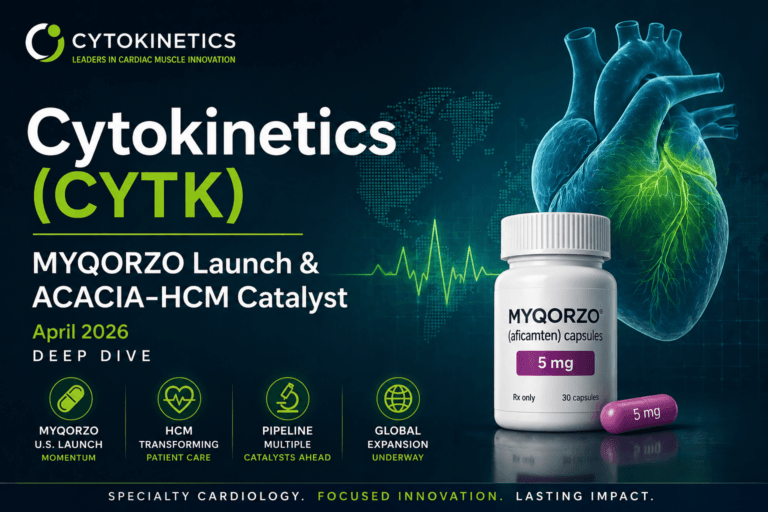
Cytokinetics has moved from a long, often frustrating development-stage narrative into one of the cleanest “now prove the launch” stories in cardiovascular biotech. The company’s first approved medicine, MYQORZO (aficamten), is approved in the United States, China and the European Union for adults with symptomatic obstructive hypertrophic cardiomyopathy, and the U.S. launch began in January 2026 with the REMS, specialty pharmacy network and patient-support system active at availability. That changes the way $CYTK should be analyzed. The old question was whether aficamten could reach the market. The new question is whether Cytokinetics can convert a differentiated label into durable prescriptions, reimbursement access, center adoption and eventually a self-sustaining specialty cardiology franchise.
JPM Healthcare Conference 2026
The 44th Annual J.P. Morgan Healthcare Conference is widely considered the most influential healthcare investment meeting in the world. Often described as the “Super Bowl of Healthcare”, it brings together more than 8,000 participants, including C-suite executives, institutional investors, policymakers, analysts and media.
CYTK Cytokinetics
Cytokinetics enters 2026 in a very different position from just a year ago. After years as a development-stage muscle biology company – including the high-profile failure of omecamtiv mecarbil in chronic heart failure – the company now has its first approved product: MYQORZO (aficamten) for symptomatic obstructive HCM.
CYTK Cytokinetics
Cytokinetics is a late-stage cardiovascular biotech whose investment case now turns almost entirely around aficamten, a next-generation cardiac myosin inhibitor for obstructive hypertrophic cardiomyopathy (oHCM). The clinical package in oHCM is strong: the pivotal SEQUOIA-HCM trial versus placebo and the active-control MAPLE-HCM trial versus metoprolol both met their primary endpoints with clinically meaningful gains in peak oxygen uptake (pVO₂), improved symptoms and a safety profile that appears manageable so far.