DISCLAIMER — Not financial advice. Educational content only, not an offer or solicitation to buy or sell any security. Biotech and small/mid-cap stocks are highly speculative and volatile and can result in a partial or total loss of capital. Do your own research and consult a licensed advisor where appropriate. / Contenuti a solo scopo informativo e didattico, non costituiscono consulenza finanziaria né offerta o sollecitazione al pubblico risparmio ai sensi delle normative CONSOB e SEC. Le azioni biotech e le small/mid cap sono strumenti altamente speculativi e volatili e possono comportare la perdita parziale o totale del capitale investito. Si raccomanda di effettuare sempre le proprie ricerche e, se necessario, di rivolgersi a un consulente abilitato.

Merlintrader Trading Pub
Biotech catalyst news and analysis. FDA PDUFA tracker
Merlintrader Trading Pub
Biotech catalyst news and analysis. FDA PDUFA tracker
Category Editorial
Pentagon UFO Files, Space Stocks and the Market’s New “Alien Premium” . Related tickers : $LUNR $RKLB $FLY $PL $BKSY $RDW $ASTS $SPIR $SATL
On May 8, 2026, the U.S. Department of War launched the Presidential Unsealing and Reporting System for UAP Encounters, or PURSUE, and began publishing a first wave of records tied to unidentified anomalous phenomena. That part is not internet folklore. It is an official government release, framed by the administration as a transparency push and explicitly tied to President Donald Trump’s February 19, 2026 directive to identify, review, declassify and release unresolved UAP-related records.
Backlog Quality Matters: Why $RKLB, $BKSY, $RDW and $BBAI Are Now Being Judged on Conversion, Not Just Contracts
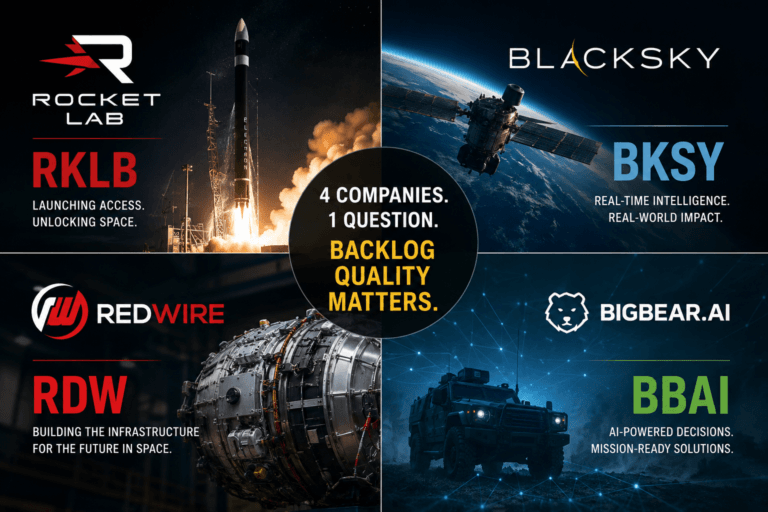
In every strong thematic market, there comes a moment when investors stop rewarding the story and start grading the machinery underneath it. Space, defense technology and AI-enabled government software have all enjoyed powerful narrative support: satellite constellations, national-security budgets, hypersonic testing, geospatial intelligence, autonomous systems, battlefield decision software, and the broader AI infrastructure cycle. But after the latest earnings wave, the central question has become sharper and more practical: how much of the reported backlog can actually convert into durable revenue, margin improvement and cash-flow progress?
Small-Cap AI Valuation Reset 2026: BigBear.ai ($BBAI), Innodata ($INOD) and the KPIs That Actually Matter
The most important change in small-cap AI is not that the artificial-intelligence theme has disappeared. It has not. The real change is that the market has become far less willing to pay for a story without financial confirmation. In 2023 and 2024, the AI label itself was often enough to pull valuation multiples higher. By 2026, that shortcut is much less reliable. Investors are now differentiating between companies that have a real commercial engine and companies that still depend mainly on presentation-deck language.
Bio-Digital Defense: FY 2026 NDAA Catalyst for $AVAV, $BBAI and $EBS
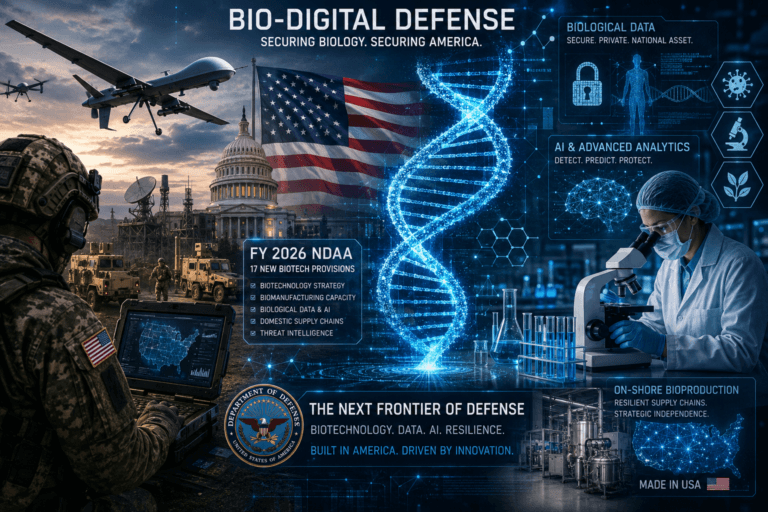
The real story is not that Washington is simply spending more on biodefense. The real story is that the FY 2026 NDAA turns biotechnology into a national-security infrastructure layer: biological data, AI-ready repositories, synthetic DNA/RNA supply, trusted procurement, biomimetic materials, chemical-biological detection and domestic manufacturing capacity now sit inside the same strategic frame.
New FDA Genome Editing Rules .
FDA Genome Editing Draft Guidance • April 2026 English Italiano New FDA Standards for Genome Editing What They Mean for $VRTX $CRSP $NTLA $EDIT $BEAM $PRME $DTIL $CRBU $CLLS $ALLO $SGMO $MGX $SANA $IPSC Nuovi standard FDA per il genome…
Space Wars
The question is no longer whether the Space Force truly exists as an autonomous armed service. After the April 15 release and B. Chance Saltzman’s remarks at the 41st Space Symposium, the point is that U.S. leadership is asking markets, industry and Congress to treat it as a fully operational, combat-credible force: a force no longer living on doctrine alone, but one that has already produced real effects in recent operations and now wants to translate that legitimacy into architectures, personnel, industrial production and multiyear contracts
Elon Musk, Tesla, SpaceX, xAI and Grok: Building an Ecosystem for Humanity’s Future
Elon Reeve Musk, born on June 28, 1971, in Pretoria, South Africa, has become one of the most influential and polarizing entrepreneurs of the modern era. Over the past three decades, he has played a central role in reshaping digital payments, electric vehicles, reusable rockets, satellite connectivity, artificial intelligence, neural interfaces and social platforms. More than a businessman in the traditional sense, Musk positions himself as an engineer-entrepreneur obsessed with long-term civilizational questions.
A World on Edge
There are days when the future feels distant, theoretical, something that belongs to policy papers and conference panels. Then there are days when the future stops waiting politely and arrives all at once. April 11, 2026 feels like one of those days. The geopolitical map is unstable, supply chains are once again hostage to geography, financial markets are discovering that volatility is not a passing phase, and the labor market is beginning to absorb the first serious psychological shock from artificial intelligence.
The war’s real bill: how Washington and Tel Aviv ignited a global economic shock and fractured the Atlantic alliance
Iran remains a dangerous regime. That does not erase a basic political fact: the present war phase was opened by U.S.-Israeli strikes, and the bill was then exported to the world through oil, inflation, shipping disruption and a deeply irresponsible attempt to treat NATO as if it were an offensive instrument.
Perfectly Timed Trades Before Trump’s Moves . Coincidences or an Information Leak in the Market?
In recent days, Reuters pulled together a series of episodes that, taken one by one, could look like simple strokes of luck. Seen together, however, they tell a more troubling story: extremely well-timed financial trades placed shortly before political decisions or geopolitical developments tied to the White House and capable of generating very large profits in futures, options and prediction markets.
Reuters says it has not proved a direct link between those traders and the Trump administration, but it also says the pattern is serious enough to raise hard questions and to warrant regulatory attention. That distinction matters. The story is not that wrongdoing has been proved. The story is that the timing has become too precise, too repeated and too profitable to be brushed away casually.
SpaceX IPO Mania: Why the Internet Is Acting Like the Stock Is Already Public
The quick angle
Some companies prepare for a stock-market debut quietly. They hire banks, polish presentations, file paperwork, and wait for the financial press to notice. SpaceX is clearly not doing that. Long before a confirmed public debut, it has already turned into a giant conversation online. That alone makes the story interesting. But what makes it irresistible is the mix: rockets, Elon Musk, the promise of huge demand, and the feeling that this could become one of those rare public moments when finance starts to look like pop culture.
Iran, US and Israel war: the world (G20) is not lining up behind the Gulf conflict ( $SPY )
The most important change in the last few days is not only inside the Gulf itself. It is outside it. Europe is trying to separate maritime security from direct war participation, Asian importers are already in emergency-management mode, Brazil and South Africa are dealing with the inflation damage at home, Spain is using the conflict to draw a sharper anti-war line, Italy is trying to stay aligned with the West without getting pulled into a frontline mission, Russia is using the crisis to weaken Western cohesion, China is pushing for talks, India is focused on energy and macro stability, and Pakistan has emerged as one of the clearest mediation channels. This is no longer just a Middle East story. It is already a global positioning story.
The Vortex of War: between the Iranian threat, energy chaos, and political incoherence
This article starts from a position many investors and Western policymakers share, but often fail to articulate carefully enough. Iran’s nuclear ambitions are not a theoretical concern. A state that has openly threatened another state’s existence cannot be treated as if its strategic intentions are morally or geopolitically neutral. There is a coherent argument that Tehran had to be stopped, contained, or at least denied a plausible path to a nuclear endgame.
US Airlines in the Energy Storm ( $AAL ) ( $DAL ) ( $UAL )
The current energy crisis is not hitting every U.S. airline the same way. Higher oil matters, but higher jet fuel matters more, and the market is now separating airlines by pricing power, customer mix, balance-sheet flexibility and margin resilience rather than by simple traffic growth.
Planet Labs ( $PL )moving toward strategic infrastructure
The new delay on Middle East imagery is not enough, by itself, to make a full article. But as an editorial trigger, it is strong. It forces a bigger question: is Planet still mainly a commercial satellite-imagery company, or is it becoming a strategic information utility that increasingly operates inside the security architecture of the United States and its allies?
X and the Nasdaq question
A careful bilingual deep dive on whether X could realistically find a route to Nasdaq exposure after today’s Reuters reports, why the answer is more indirect than many headlines suggest, and how payments, regulation, competition and corporate structure change the picture.
Another war in the “Gulf”
A few days after the first wave of attacks, the war is no longer just a story of missiles over Tehran. It now stretches from southern Lebanon to the Strait of Hormuz, from Syrian and Iraqi corridors to the LNG hubs of Qatar and Saudi Arabia, with oil and gas prices repricing risk in real time.