Merlintrader Trading Pub
Biotech catalyst, news and analysis PDUFA tracker
Merlintrader Trading Pub
Biotech catalyst, news and analysis PDUFA tracker
AI transparency: articles and reports are produced with the help of artificial intelligence and checked through a process that does not constitute specialist validation. They may contain errors: verify relevant information with independent sources. Read the full disclaimer.
Arrive AI (Nasdaq: $ARAI): The Microcap Building Smart Delivery Points for Drones, Robots and Real People
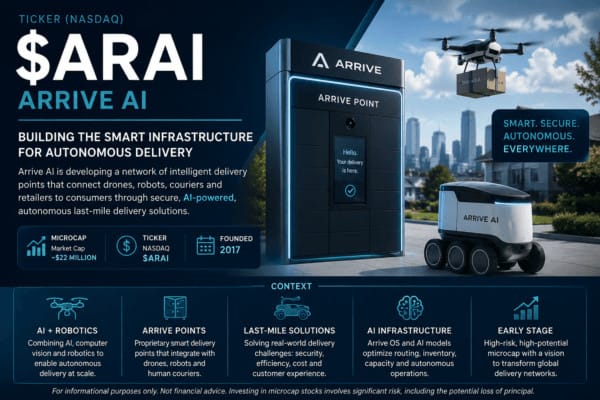
Arrive AI is the kind of small-cap story that can look almost too simple at first glance: a smart mailbox. But the deeper question is more interesting. If drones, ground robots, autonomous vehicles, couriers, hospitals, retailers and consumers are all supposed to participate in a more automated logistics network, where does the physical handoff actually happen? Arrive AI’s answer is the Arrive Point: a secure, climate-assisted, sensor-rich endpoint designed to receive and transfer goods asynchronously.
AI Infrastructure, Optical Engines and Aviation-Tech Optionality: $DTST, $POET and $JTAI Move Into Focus After May 15 Updates
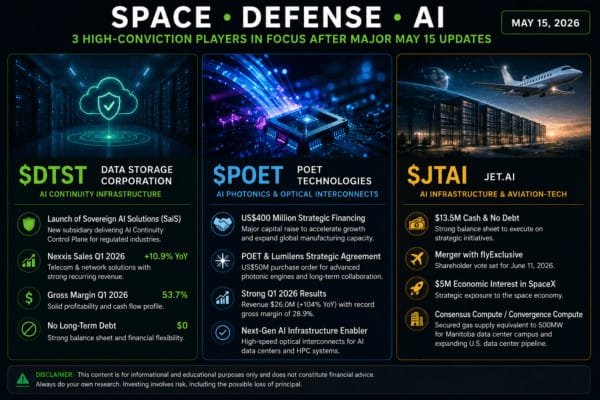
Data Storage Corporation, POET Technologies and Jet.AI each delivered May 15 updates that speak to a broader market theme: artificial intelligence is no longer only a software story. It is becoming an infrastructure story, a photonics story, a power-and-data-center story, and in some cases a corporate-transformation story. These three companies sit in different corners of that map. $DTST is trying to build a regulated-industry AI continuity platform on top of a recurring telecom and connectivity base. $POET is trying to become a core optical-engine and wafer-level photonic-integration supplier for AI networks and hyperscale data centers. $JTAI is the most complex and speculative of the three, combining AI cloud infrastructure, data-center power access, a pending aviation merger with flyExclusive, strategic holdings and a SpaceX-linked economic interest.
AI Drones, Quantum Defense and the Commercial Space Race: $SPAI, $QUCY and $LUNR Move Into Focus
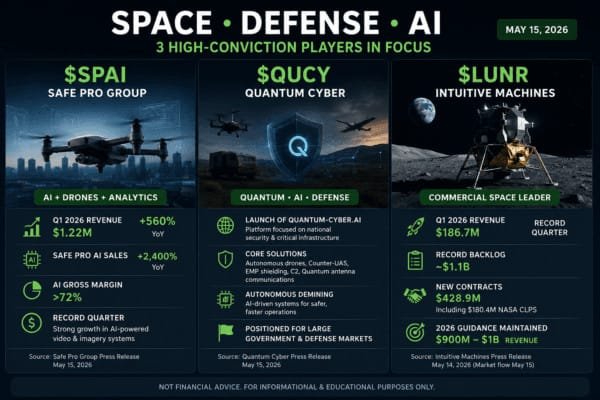
Safe Pro Group, Quantum Cyber and Intuitive Machines offer three different ways to read the current convergence of artificial intelligence, drones, defense technology and commercial space. Safe Pro Group is the most numbers-driven update in this group, with record first-quarter revenue, a sharp increase in AI product sales and strong gross margins. Quantum Cyber is the most narrative-driven defense platform story, using the launch of quantum-cyber.ai to frame a broader System-of-Systems strategy across autonomous drones, counter-UAS, EMP-hardened components, autonomous demining and quantum antenna communications. Intuitive Machines is the most mature and institutionally visible company in the group, with record quarterly revenue, positive adjusted EBITDA, a record backlog and full-year guidance that still points to a much larger commercial space business in 2026.
$CRON, $OGI, $SNDL: Cannabis Earnings Show a Split Sector Before the June 29 Policy Catalyst

The cannabis trade is no longer just about reform headlines. Cronos, Organigram and SNDL have now reported fresh numbers, and the message is clear: the sector may have a policy catalyst, but operating quality, balance-sheet strength, international exposure and margin discipline are starting to separate the stronger stories from the more fragile ones.
DroneShield (OTC: $DRSHF): Record Q1, SaaS Ambition and the Governance Test Behind the Counter-Drone Boom
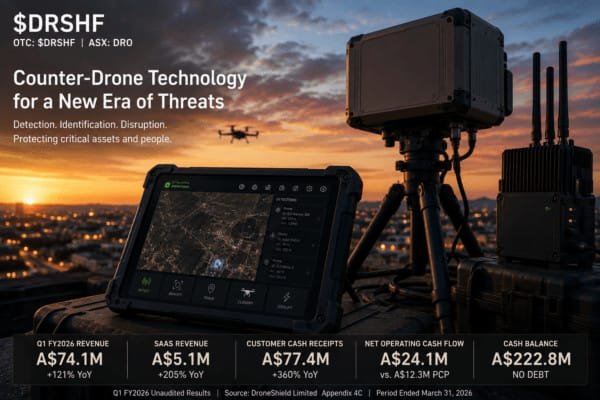
DroneShield has moved from being an interesting counter-drone hardware story into something more dangerous for lazy valuation work: a fast-growing defense technology company trying to attach software, command-and-control, AI updates, warranty, service, and repeat procurement dynamics to a hardware-heavy installed base. That does not automatically make it a classic SaaS company. It does, however, make the margin and revenue-quality debate much more interesting than a simple “guns, jammers and sensors” narrative.
IonQ and SkyWater: Why the $IONQ–$SKYT Deal Turns Quantum Into a U.S. Manufacturing Story
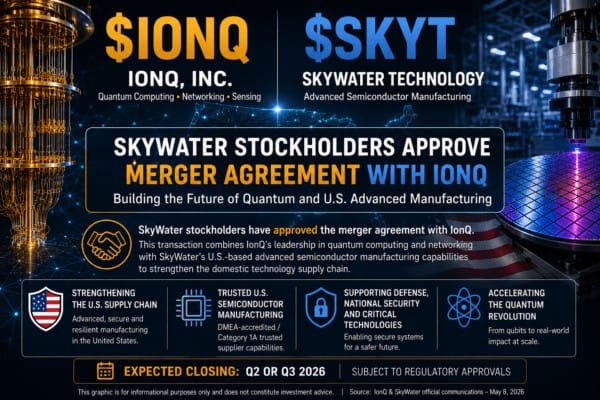
SkyWater stockholders have approved the merger agreement with IonQ. The vote does not close the deal yet, but it moves one of the most unusual quantum transactions of 2026 into its next phase: regulatory review, supply-chain strategy, and the question of whether quantum companies need more than algorithms and cloud access to scale.
Three Different Ways to Play the AI Photonics Race $POET, $COHR and $AAOI
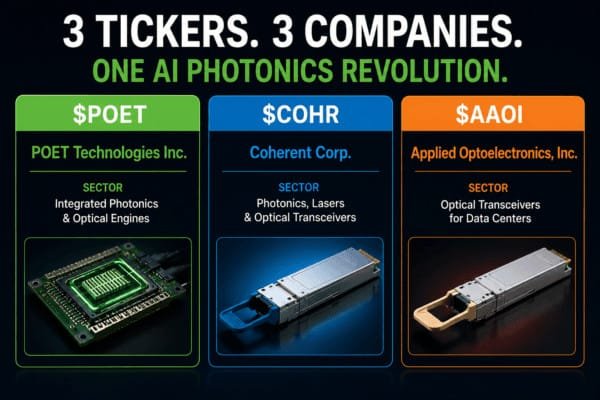
The artificial intelligence infrastructure boom is not only a story about GPUs, accelerators, memory, power, cooling and real estate. It is also, increasingly, a story about light. As AI clusters become larger, denser and more power hungry, the bottleneck shifts from raw compute alone to the movement of data between processors, racks, data halls and campuses. Electrical interconnects still matter, but the further the AI buildout moves into high-bandwidth, low-latency and energy-constrained architectures, the more optical networking becomes one of the critical hidden layers of the trade.
Drone Defense Mid-Caps: Ondas, Red Cat and Kratos Put $ONDS, $RCAT and $KTOS in the Same War-Tech Conversation
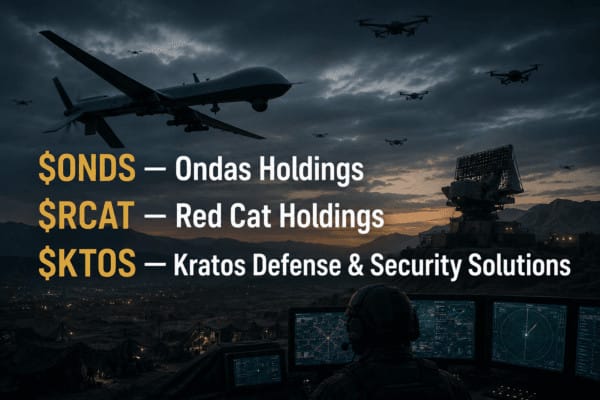
Ondas Holdings, Red Cat Holdings and Kratos Defense & Security Solutions represent three very different ways to read the drone-defense trade: an aggressive autonomous-systems platform buildout, a focused tactical-drone procurement ramp, and a scaled defense-technology contractor with real backlog and unmanned-systems revenue.
Pentagon UFO Files, Space Stocks and the Market’s New “Alien Premium” . Related tickers : $LUNR $RKLB $FLY $PL $BKSY $RDW $ASTS $SPIR $SATL
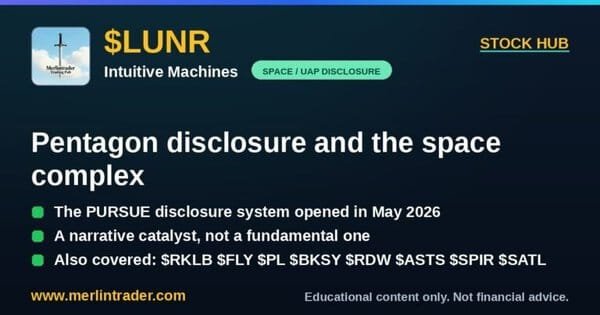
On May 8, 2026, the U.S. Department of War launched the Presidential Unsealing and Reporting System for UAP Encounters, or PURSUE, and began publishing a first wave of records tied to unidentified anomalous phenomena. That part is not internet folklore. It is an official government release, framed by the administration as a transparency push and explicitly tied to President Donald Trump’s February 19, 2026 directive to identify, review, declassify and release unresolved UAP-related records.
YPF Sociedad Anónima (NYSE: $YPF): Vaca Muerta, Argentina LNG and the High-Beta Energy Turnaround

A complete May 2026 deep dive on Argentina’s national energy champion: Q1 2026 profit recovery, shale oil growth, Vaca Muerta, export optionality, LNG ambitions, downstream exposure, state-control risk, litigation overhang, macro sensitivity and the bull/base/bear framework.
SKYX Platforms Corp. (Nasdaq: $SKYX): Smart Ceiling Infrastructure, Retail Expansion, AI Optionality and the Execution Test

SKYX Platforms Corp. is not a simple smart-home gadget story. It is a small-cap infrastructure-adoption story trying to turn the ceiling into a safer, standardized, plug-and-play access point for lighting, fans, heaters, smart devices, builders, hotels, retailers and eventually software-enabled building systems. That ambition is large enough to make the stock interesting, but also large enough to require much more proof than product announcements and channel headlines.
IonQ (NYSE: $IONQ): From Quantum Hype to Platform Ambition After Q1 2026

IonQ has moved from being a speculative quantum computing name to becoming the main public-market test case for whether quantum can evolve into a real commercial platform before the decade is over. The company’s Q1 2026 results changed the conversation: $64.7 million of quarterly revenue, 755% year-over-year growth, full-year guidance raised to $260–270 million, and remaining performance obligations rising to $470 million.
Backlog Quality Matters: Why $RKLB, $BKSY, $RDW and $BBAI Are Now Being Judged on Conversion, Not Just Contracts
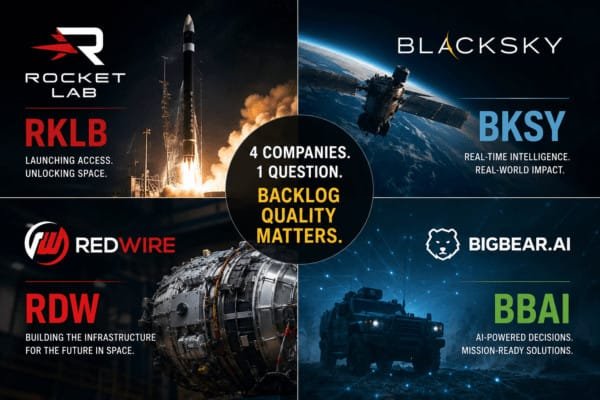
In every strong thematic market, there comes a moment when investors stop rewarding the story and start grading the machinery underneath it. Space, defense technology and AI-enabled government software have all enjoyed powerful narrative support: satellite constellations, national-security budgets, hypersonic testing, geospatial intelligence, autonomous systems, battlefield decision software, and the broader AI infrastructure cycle. But after the latest earnings wave, the central question has become sharper and more practical: how much of the reported backlog can actually convert into durable revenue, margin improvement and cash-flow progress?
Bio-Digital Defense: FY 2026 NDAA Catalyst for $AVAV, $BBAI and $EBS
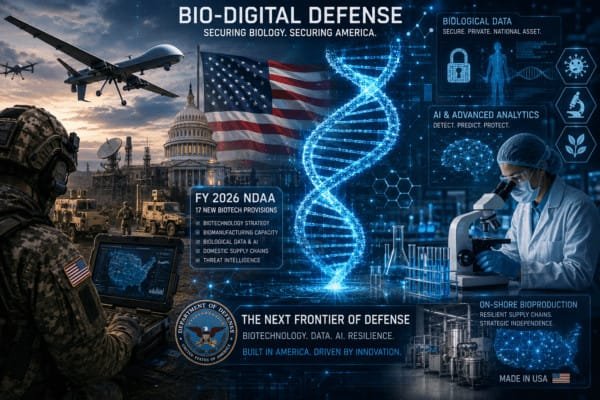
The real story is not that Washington is simply spending more on biodefense. The real story is that the FY 2026 NDAA turns biotechnology into a national-security infrastructure layer: biological data, AI-ready repositories, synthetic DNA/RNA supply, trusted procurement, biomimetic materials, chemical-biological detection and domestic manufacturing capacity now sit inside the same strategic frame.
Skycorp Solar Group (Nasdaq: $PN): When a Solar Microcap Becomes a Full-Control Acquisition Story

Skycorp Solar Group Limited is a China-based solar photovoltaic product provider listed on Nasdaq under ticker PN. The company is primarily known for solar PV cables and connectors, with additional exposure to high-performance computing products and, after the Nanjing Cesun transaction, a broader renewable-energy footprint that may include server equipment sales, inverter production, photovoltaic power station operation and energy management systems.
Reddit, Inc. (NYSE: $RDDT): AI-Powered Ads, Human Conversation and the Profitability Re-Rating

Reddit, Inc. is no longer being judged only as a chaotic social platform with a passionate user base and uncertain monetization. After Q1 2026, the market is increasingly treating Reddit as a scaled, high-margin internet asset with three linked growth engines: performance advertising, search-driven discovery, and commercial value from its archive of human conversation.
Fabric.AI / StableX Technologies $SBLX and Kopin Corporation $KOPN: the MicroLED Interconnect Trade
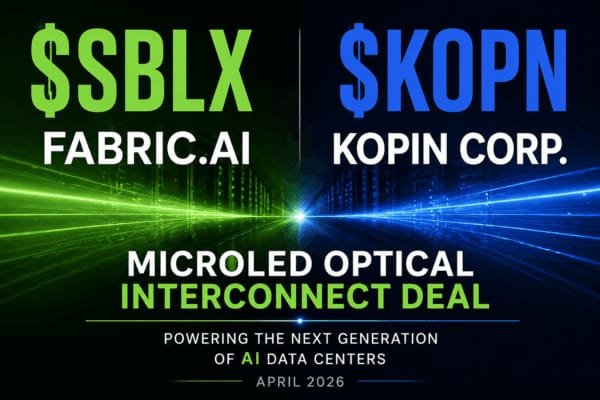
This is the kind of story that can light up the small-cap tape quickly because it combines several ingredients that retail traders actively chase: artificial intelligence infrastructure, data-center bottlenecks, optical interconnects, MicroLED, a low-float style microcap setup, a corporate name change, a ticker change, a financing, and a visible connection to a company with real operating history in advanced displays and optical systems. StableX Technologies, trading as $SBLX at the time of the announcement, is now presenting itself as Fabric.AI and intends to trade as $FABC. The new pitch is straightforward: AI factories need more than GPUs; they need faster, lower-power ways to move data between compute nodes. Fabric.AI wants to start with MicroLED-based optical interconnects, and Kopin is the enabling MicroLED partner.
Nauticus Robotics $KITT: Ocean Robotics, Reverse Split Risk and the 2026 Commercialization Test
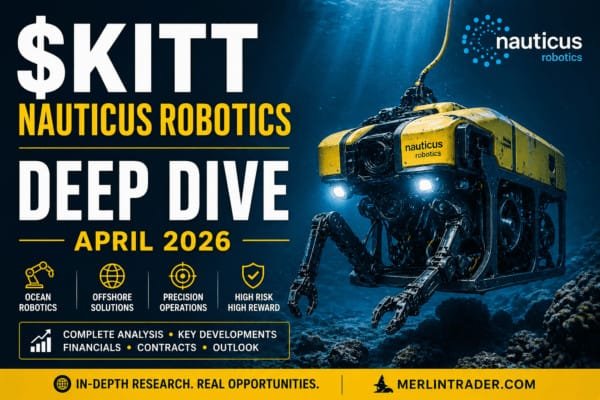
Merlintrader Deep Dive Nauticus Robotics (Nasdaq: $KITT): Ocean Robotics, Reverse Split Risk and the 2026 Commercialization Test A full EN/IT deep dive on Nauticus Robotics, its autonomous subsea robotics platform, SeaTrepid integration, East Coast offshore activity, UAE expansion plan, financial…
U.S. Energy Corp (Nasdaq: $USEG): the helium contract that turns Big Sky from story into execution risk
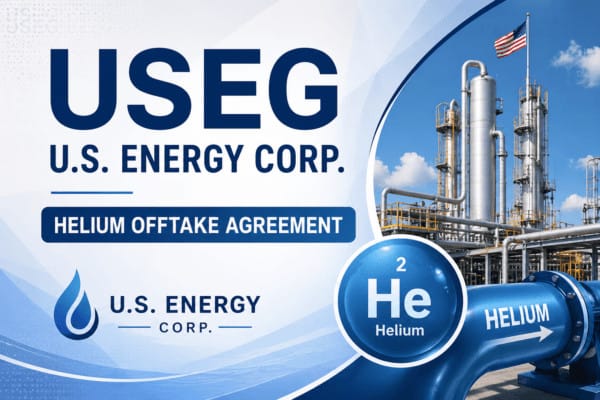
Simple contract math: if the full 14.4 MMCF annual Phase 1 volume is delivered at $285/MCF, the gross plant-gate helium revenue implied by the contract is about $4.1 million per year before operating costs, taxes, timing/ramp effects, CPI escalation, any year-three redetermination, and non-helium revenue streams. This is arithmetic from the disclosed price and volume, not formal company guidance.
Cannabis Stocks Watch: $MSOS, $TLRY, $CGC, $CRON, $ACB and the June 29 Hearing
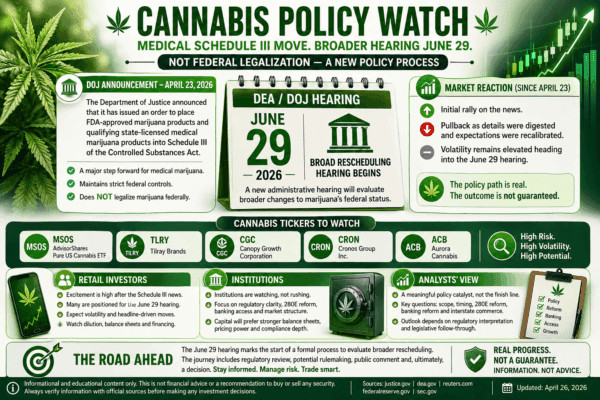
The cannabis sector is back on trader radar because Washington finally gave the market something concrete to trade around. The Department of Justice placed FDA-approved marijuana products and qualifying state-licensed medical marijuana products into Schedule III, while also pointing to a new administrative hearing beginning June 29, 2026, on the broader marijuana rescheduling process.