
Merlintrader Trading Pub
Biotech catalyst, news and analysis PDUFA tracker
Merlintrader Trading Pub
Biotech catalyst, news and analysis PDUFA tracker
AI transparency: articles and reports are produced with the help of artificial intelligence and checked through a process that does not constitute specialist validation. They may contain errors: verify relevant information with independent sources. Read the full disclaimer.
Space Economy 2026: $ASTS vs $RKLB vs $SPCE vs $FJET — Four Business Models Compared
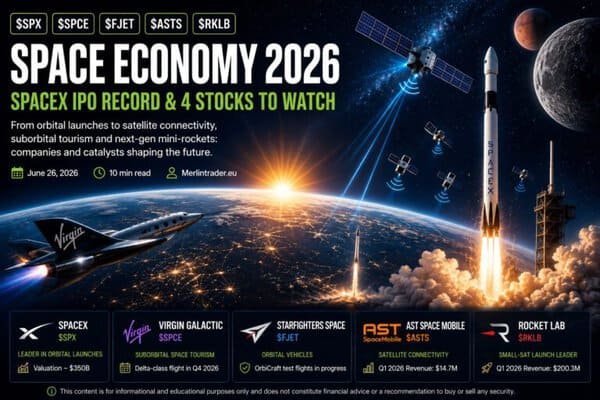
Space Economy · $ASTS · $RKLB · $SPCE · $FJET Space Economy 2026: $ASTS vs $RKLB vs $SPCE vs $FJET — Four Business Models Compared A focused comparison of four publicly traded US space-economy names: satellite-to-phone connectivity ($ASTS), launch and…
Russell 2026 Final Rebalance Radar: Best Post-Upgrade Stocks to Watch by Sector

A sector-by-sector operational screen of the June 2026 Russell reconstitution, focused on stocks that deserve attention after the index event because chart structure, post-rebalance volume, fundamentals, catalysts and analyst target references overlap.
Space Stocks Selloff: Why $PL, $LUNR, $SATL, $ASTS and RKLB Are Falling Together After June’s Rally
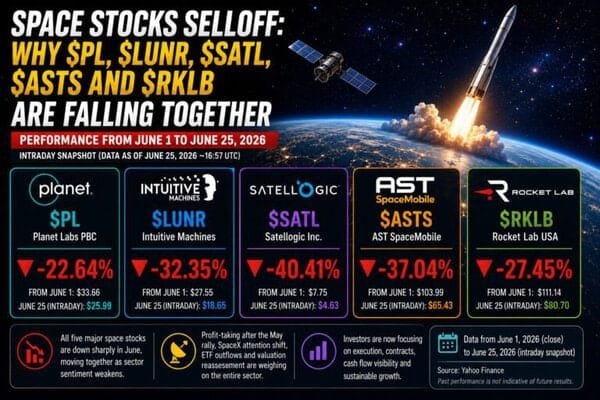
The June space trade is no longer being priced stock by stock. Planet Labs, Intuitive Machines, Satellogic, AST SpaceMobile and Rocket Lab are being traded as one high-beta space basket — and the unwind has exposed the same pressure points across the sector: SpaceX gravity, ETF outflows, valuation resets, execution risk, launch cadence, defense-contract timing and profit-taking after a crowded rally.
Russell 2026 Biotech Watchlist: $UNCY, $GALT, $SPRB, $OVID and the Small-Cap Health Care Additions to Watch

RUSSELL 2026 PRELIMINARY LIST 87 HEALTH CARE ADDITIONS BIOTECH FOCUS Russell 2026 Biotech Watchlist: $UNCY, $GALT, $SPRB, $OVID and the Small-Cap Health Care Additions to Watch The June 2026 Russell reconstitution becomes effective after the U.S. market close on June…
$SPCX, $RKLB, $LMT: Space Defense Is Moving From Launch Hype to Military Infrastructure
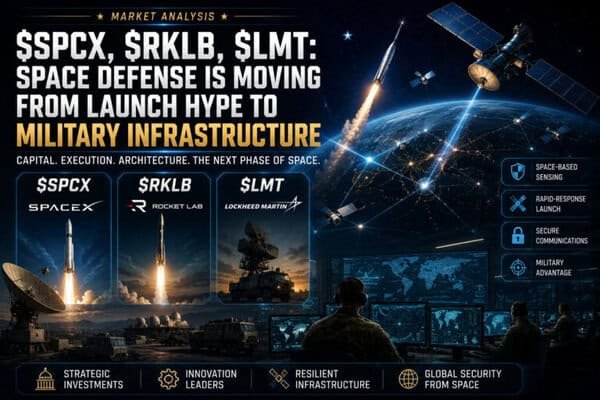
SpaceX’s massive financing push, Rocket Lab’s record-setting rapid-response U.S. Space Force mission, and the SB-AMTI sensing architecture point toward a bigger market theme: the next phase of the space trade may be less about launch spectacle and more about military infrastructure, orbital resilience, sensor networks, and defense procurement.
Biotech Radar – $DFTX $ABSI $NVCT – June 24, 2026
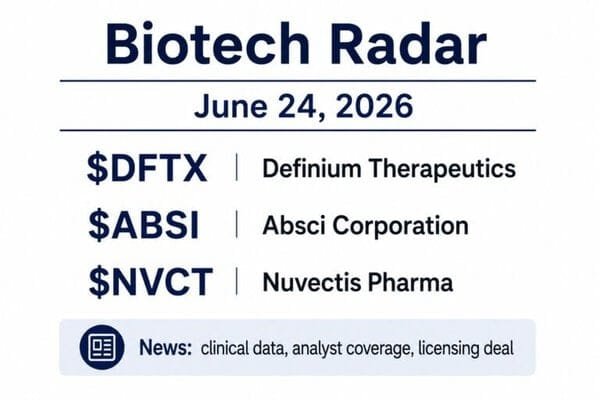
Phase 3 clinical data, analyst coverage and an international licensing deal: three real, verified catalysts across DFTX, ABSI and NVCT.
HIVE Digital Technologies (Nasdaq/TSX: $HIVE): Bitcoin Mining, AI Infrastructure, Paraguay, Canada and the New Compute Trade
HIVE is no longer just a public Bitcoin miner. The company is trying to become a dual-engine digital infrastructure platform, using renewable-powered mining scale, GPU infrastructure and BUZZ HPC to participate in the AI compute boom. The opportunity is real enough to monitor closely, but the equity remains exposed to Bitcoin volatility, dilution, capex intensity and major execution risk.
Keel Infrastructure Corp. (Nasdaq/TSX: $KEEL): From Bitcoin Miner To AI Power Infrastructure — A High-Beta Data Center Pivot To Watch
Keel Infrastructure is trying to transform the former Bitfarms platform into a North American AI/HPC data center and power infrastructure story. The market narrative is powerful, the asset base is strategically relevant, and the balance sheet has been strengthened — but the investment case still depends on execution, customer leases, capital discipline and proof that megawatts can become durable infrastructure cash flow.
FedEx (NYSE: $FDX) Earnings Preview: The Real-Economy Checkpoint and the FedEx Freight Spin-Off Test — $FDX / $FDXF / $UPS

FedEx reports Q4 FY26 on June 23, just weeks after completing the FedEx Freight spin-off and two days before FedEx Freight’s first separate Q4 call. That makes this more than an earnings preview. It is a test of the post-spin FedEx story, the “One FedEx” operating model, freight-cycle normalization, logistics demand, oil exposure, e-commerce activity, cost discipline, and the market’s willingness to reward transportation restructuring after a strong run.
The AI Infrastructure Rally Faces Its Next Reality Check: Micron Earnings And The Memory Bottleneck Trade — $MU / $NVDA / $AVGO
Micron Technology is about to report earnings at a moment when the market is treating artificial intelligence less like a single-stock story and more like a full infrastructure cycle. Nvidia still sits at the center of the trade. Broadcom has become one of the clearest public vehicles for custom AI accelerators and AI networking. But Micron occupies a different and increasingly important layer: the memory and storage layer that determines whether AI systems can feed accelerators, sustain inference workloads, handle longer context windows and scale data-center token output efficiently.
The OpenAI-Anthropic IPO Wave Could Pull the Entire AI Infrastructure Trade Into Focus — Some Possible Protagonists: $VRT / $ETN / $CEG
Why the expected public-market debuts of OpenAI and Anthropic could shift investor attention toward the listed companies powering data centers, grid expansion, cooling, nuclear energy, gas, networking and the physical backbone of artificial intelligence.
Accenture: AI Disruption, Bookings Pressure And The IT Services Repricing — $ACN

Accenture's Q3 FY2026 report was not an operational collapse. Revenue grew, EPS improved and free cash flow remained solid. But weaker Managed Services bookings, softer guidance, a sharp analyst repricing and renewed anxiety about agentic AI turned the quarter into a warning shot for the traditional IT services model.
AI Power Bottleneck Trade: $SEI, $WTS and $BE Beyond the Chip Story
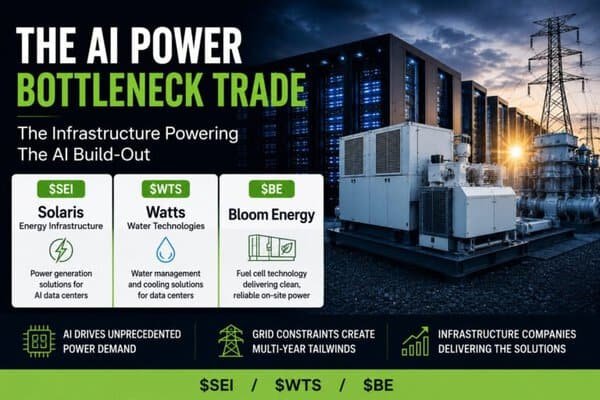
The AI trade has spent most of the last cycle worshipping at the altar of GPUs, networking chips and hyperscale cloud capex. That made sense. Without compute, there is no AI boom. But the market is now being forced to confront a less glamorous and potentially more durable question: what happens when the servers are ready, the capital is available, the customer demand is real, but the power is not?
Lockheed Martin, Northrop Grumman and RTX ($LMT $NOC $RTX): Why the U.S. Air Force CCA Awards Mark a New Phase in Defense AI

The U.S. Air Force has moved Collaborative Combat Aircraft from prototype momentum toward engineering, manufacturing development, production and software competition. General Atomics and Anduril won the airframe contracts, but Lockheed Martin, Northrop Grumman and RTX Collins Aerospace are now inside the mission autonomy software pool — making $LMT, $NOC and $RTX the public-market way to follow a defense-AI shift that could reshape airpower over the next decade.
AIRO Group (Nasdaq: $AIRO): Why the RQ-70 Drone Story Is Suddenly Back on the Radar

AIRO Group is moving back into focus because its RQ-70 Dainn drone story combines several themes that investors are watching closely: long-range ISR, AI-enabled autonomy, GNSS-denied operations, NATO-aligned demand, European defense capacity and small-cap defense momentum.
Micropolis Robotics (NYSE American: $MCRP): Physical AI Moves From Hype To City Streets

Micropolis AI Robotics announced a five-year Abu Dhabi agreement for autonomous urban cleaning systems, giving traders a fresh Physical AI and smart-city robotics catalyst. The news is attention-grabbing, but the stock remains a highly speculative early-stage robotics name with filing, financing and execution risks that should not be ignored.
Defence AI Watch #1: Grok, Iran and the Defence-AI Supercycle — PLTR, KTOS, BBAI and PDYN
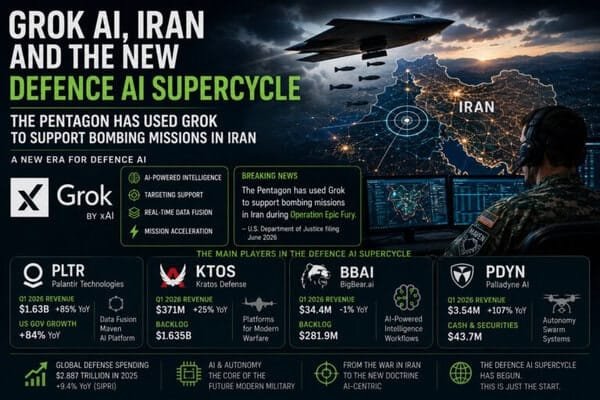
The news hook is today’s new disclosure on Grok’s role in U.S. Iran operations: it does not just change the defence-AI narrative, it reinforces the central theme of this column — data, targeting, drones, intelligence and tactical autonomy are entering the real operational chain.
Airlines and Travel Stocks Rebound as Peace Deal Hopes Drag Oil Lower: Why $AAL, $UAL, $DAL and $CCL Are Back on the Radar

The travel trade is suddenly alive again. A preliminary U.S.-Iran agreement has pushed crude prices sharply lower, lifted risk appetite and brought airlines, cruise lines and tourism-linked stocks back into focus. The setup is not risk-free: the deal still has political loose ends, jet fuel remains volatile, and the airline industry is still working through one of the harshest cost shocks since the pandemic era. But the market has a simple reason to pay attention: lower oil can quickly change the narrative for every company that moves people.
Fed, Inflation and Oil: Why SPY Is Trading the Energy Shock Before the June FOMC

The market is not only reacting to lower crude prices. It is repricing the inflation path, the Federal Reserve’s room for patience, and the durability of the equity rally just as the June 16–17 FOMC meeting begins.
The Truce That Changes the Tape: the U.S.-Iran Deal Reopens the Hormuz Question

To understand the weight of the diplomatic turn announced between June 14 and June 15, it is necessary to go back to late February 2026, when the United States and Israel launched a military campaign against Iran. From that point, the conflict turned the Strait of Hormuz from a latent geopolitical risk into a central variable for oil, gas, inflation, interest rates and global equity markets.