





Reviva Pharmaceuticals (RVPH) – FDA Demands Second Phase 3: Regulatory Shock, New Timeline and Funding Gap
Deep-dive update after the 23 December 2025 pre-NDA feedback: why the FDA now wants a second Phase 3 for brilaroxazine, how the timeline moves out to 2027–2028, and what today’s crash means for risk and funding. Informational only, not a buy/sell call.
RVPH
Nasdaq | CNS / schizophrenia | Late-stage biotech
On 23 December 2025, reviva confirmed in an 8-K and a press release that the FDA, after the pre-NDA meeting, is strongly encouraging a second Phase 3 trial (RECOVER-2) before any NDA submission for brilaroxazine in schizophrenia.
Concretely, this means that the earlier narrative of “one pivotal Phase 3 plus a one-year extension and then NDA in 2026” is no longer valid. The company now lays out a new plan: start RECOVER-2 in the first half of 2026, read out top-line data in the second quarter of 2027, target an NDA in the fourth quarter of 2027 and a potential approval in the fourth quarter of 2028 – all explicitly described as subject to sufficient financing.
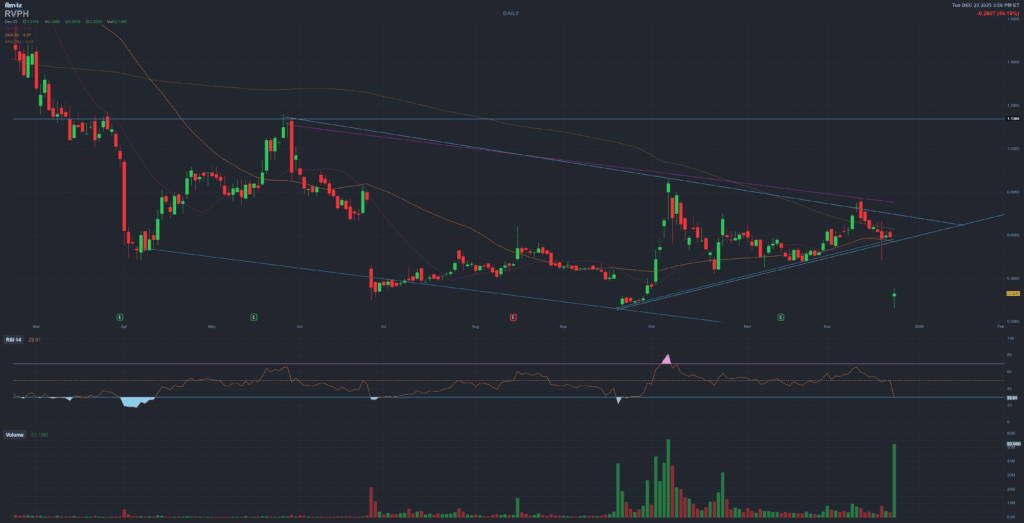
The same 8-K quantifies the cost of RECOVER-2 at around 60 million dollars and mentions an optional negative-symptoms/bipolar Phase 3 of about 30 million. As of mid-December 2025, Reviva reports only about 14.7 million dollars in cash, enough to fund operating expenses – but not RECOVER-2 – to roughly the second quarter of 2026. In the market, the reaction was immediate: RVPH dropped from around 0.59 dollars to the low 0.30s, with roughly 44 million shares traded, wiping out about 30 million in market value in a single session.
If you are reading this after losing money on RVPH, the goal here is not to tell you what to do with your position, but to answer four very basic questions: what exactly did the FDA say, what changed in the timeline, how big is the funding gap now, and how does the risk map look after this hit. The science on brilaroxazine has not disappeared overnight, but the path to monetising it just became longer, more expensive and more uncertain.
What the FDA actually said (PR + 8-K, not rumours)
The December 23 press release states that written feedback from the FDA’s pre-NDA meeting includes a recommendation to conduct a second Phase 3 trial in schizophrenia before submitting an NDA. The company plans to run this trial – called RECOVER-2 – in the first half of 2026, with a design similar to the completed RECOVER Phase 3. The release also highlights that the existing package already contains one Phase 2, one Phase 3 and a one-year open-label extension, with brilaroxazine showing broad-spectrum efficacy and a generally favourable safety profile across roughly 790 treated patients.
The Form 8-K filed the same day adds the missing details. In that document, Reviva explains that:
- The FDA “strongly encouraged” the company to run a second Phase 3 trial, similar to RECOVER, using the 30 mg and 50 mg doses, before bringing an NDA for schizophrenia.
- Reviva told the FDA it intends to conduct that additional Phase 3 study before submitting an NDA, effectively accepting the agency’s recommendation.
- Subject to financing, the company now plans for RECOVER-2 to start in H1 2026, deliver top-line results in Q2 2027, target an NDA in Q4 2027 and a potential approval in Q4 2028.
- The FDA also gave detailed guidance on data-analysis methods, data presentation, and additional studies in areas such as animal pharmacokinetics, human abuse potential and renal/hepatic impairment – all of which must be incorporated into the updated development plan.
In other words: the FDA did not reject brilaroxazine, but it is clearly not ready to accept an NDA on the basis of the existing Phase 2 + Phase 3 + OLE package alone. It wants a second, confirmatory Phase 3 and a larger safety database before moving forward.
What changed vs the “NDA in 2026” thesis
Until yesterday, the working assumption for many investors – including in our own December 22 deep dive – was: one successful Phase 3 + one-year OLE + earlier Phase 2 + clinical pharmacology could be enough for an NDA in 2026. That view was not invented from thin air: in 2024, Reviva had reported that the FDA was open to the idea that two well-run Phase 3s or one Phase 3 plus robust long-term safety could support an application.
| Topic | Before (Dec 22 2025) | After FDA feedback (Dec 23 2025) |
|---|---|---|
| Regulatory path | One pivotal Phase 3 (RECOVER-1) + 1-year OLE viewed as potentially sufficient for NDA in schizophrenia. | FDA now explicitly encourages a second Phase 3 (RECOVER-2) before any NDA is filed. |
| Timeline | Pre-NDA mtg Q4 2025, NDA targeted for Q2 2026, potential FDA decision in 2027. | RECOVER-2 start H1 2026, data Q2 2027, NDA targeted for Q4 2027, potential approval in Q4 2028. |
| Trial cost | Incremental expenses assumed but not quantified; focus on OLE completion and regulatory prep. | RECOVER-2 projected cost ~60M USD (≈35M direct trial costs + ≈25M G&A). Optional negative-symptoms/bipolar Phase 3 another ~30M. |
| Cash and runway | Cash 13.2M USD as of Sept 30 2025; earlier raise already done; expected runway into mid-2026. | Cash 14.7M USD as of Dec 16 2025 after warrant exercises; management explicitly states this covers operating expenses excluding RECOVER-2 only through Q2 2026. |
| Financing gap | Clear need for extra capital, but no official figure and a hoped-for NDA in 2026. | Gap now visible: tens of millions must be raised just to start RECOVER-2, with further capital needed to get through 2027–2028. |
| Reverse split | Sub-1 dollar price already raised delisting concerns; no formal authority yet. | Shareholders have now approved a reverse split range 1:2–1:20 that the board can use any time before Dec 31 2026. |
This does not nullify the underlying RECOVER and OLE data – the drug still looks compelling on paper – but the investment clock has been reset by roughly two years and the amount of capital required has gone from “significant” to “front and centre of the thesis”.
Financial impact: 60M trial vs 14.7M cash
Cash, warrants and runway
The 8-K discloses that between 1 October and 16 December 2025, Reviva raised about 6.7 million dollars via the exercise of 19.8 million warrants. After these exercises, the company had approximately 14.7 million dollars in cash and equivalents and around 116.8 million shares outstanding.
Management explicitly states that this cash is expected to cover operating expenses (excluding RECOVER-2 costs) through roughly the second quarter of 2026. In other words, the current balance sheet can keep the lights on and fund corporate overhead for a limited period but cannot carry the weight of a 60M registrational trial.
Given historical net losses in the 30–40M per year range and the current burn rate, any delay in funding or trial start directly eats into runway. The company also reminds investors that these financial figures are preliminary and unaudited, and that final year-end numbers may differ.
Cost of RECOVER-2 and optional trials
- RECOVER-2 (schizophrenia): projected cost ≈60M USD, including ≈35M in direct trial costs and ≈25M in general and administrative expenses linked to the program.
- Negative-symptoms / bipolar Phase 3 (optional): projected cost ≈30M USD.
- Total potential Phase 3 bill: around 90M USD if both RECOVER-2 and the negative-symptoms/bipolar trial are actually run.
The company also updates its risk-factor section to emphasise that starting and completing these trials is explicitly contingent on securing sufficient funding. If financing does not materialise on acceptable terms, trials could be delayed, scaled back or not initiated at all.
From a purely financial perspective, this is the heart of today’s shock: the market woke up to an official document that effectively says “the science looks good, but we now need at least one more large, expensive trial and we do not yet have the money for it”.
Market reaction on 23 December 2025
Immediately after the news, RVPH traded like a classic micro-cap biotech hit by a regulatory delay:
- The stock fell from around 0.59 dollars to roughly 0.33 dollars by the end of the session, with intraday lows in the 0.26 area. Daily data show a close down about 44% vs the previous day, on volume around 44 million shares, compared with a typical 3–4 million.
- Several news outlets summarised the move as a “crash of more than 50%” during the trading day, while data providers estimate that about 30 million dollars of market value were erased in a few hours.
- Short-interest metrics from late November (≈23 million shares short, ≈21–22% of float, days-to-cover near 8) now interact with a much weaker long thesis and a lower price base, creating a more complex dynamic between shorts sitting on gains and new speculative inflows.
For long-only retail holders, this is a brutal day: the stock has essentially given back months of “slow” accumulation, and did so not on a safety problem or a failed trial, but on a regulatory and funding issue. That distinction matters, but it does not change the fact that the equity now sits in a different risk zone than 24 hours ago.
Sentiment after the shock – retail vs analysts
Retail sentiment (Reddit, Stocktwits, X)
Mood today: shocked, angry, but not completely defeated
- Threads on the RVPH subreddit and related communities are full of very human reactions: sadness, frustration about “losing Christmas money”, and a sense of betrayal because many had assumed that a second Phase 3 was unlikely.
- A recurring theme is that “the drug still looks great, the problem is the process”: a number of posters separate their belief in brilaroxazine’s efficacy from their frustration with the regulatory ask and the funding realities.
- Others shift immediately to “distressed asset” narratives: with a much lower market cap and a validated data package, some speculate that a larger pharma could be interested in acquiring the program (or the whole company) at a discount and funding RECOVER-2 themselves. This is speculation, not confirmed strategy.
- On Stocktwits, sentiment indicators have flipped into clearly bearish territory, with “high” message volume and a lot of discussion about reverse splits, potential dilution and whether today’s move is an overreaction or the start of a longer downtrend.
As always: comments on Reddit, Stocktwits and X come from non-professional traders. They are useful to understand mood and possible volatility, but they are not due diligence and they often mix facts, interpretations and pure emotion.
Analyst and “Street” reaction
Pre-event: strong data, high upside. Post-event: same data, much longer and more expensive path.
- Before today, consensus snapshots from MarketBeat and similar aggregators showed a Moderate Buy rating with an average 12-month price target of about 3.8–4 dollars, implying very large upside from the 0.5–0.6 dollar range.
- On the day of the update, at least one boutique (D. Boral Capital) reiterated a Buy rating with a 2 dollar target, signalling that some analysts still see value even with the added trial – but also clearly stepping back from more aggressive upside scenarios for the moment.
- A recent Seeking Alpha article already highlighted the tension between “excellent brilaroxazine data” and “slow progress and heavy dilution”; today’s development reinforces that line: the problem is not efficacy, it is the cost and time needed to turn efficacy into a commercial asset.
- It is reasonable to expect that many models will now be re-run with revised assumptions: higher development costs, later potential launch, higher discount rates and more shares outstanding. How many firms will keep “multi-bagger” type targets after that exercise remains to be seen.
Risk map after the FDA feedback
Key risk buckets
- Regulatory risk: the FDA has now clearly signalled that another pivotal study is needed. That introduces not just execution risk (can RECOVER-2 reproduce RECOVER-1?) but also timing risk (delays in start-up, slower enrolment, etc.).
- Financing risk: with ~14.7M USD in cash and a 60M USD trial on the table, the company needs sizeable new capital. Depending on market conditions, that may mean heavily dilutive equity, structured financing, or a partner that takes a large slice of the upside.
- Reverse split and listing risk: shareholders have approved a reverse split range from 1:2 to 1:20. While this is a technical move to protect the Nasdaq listing if needed, reverse splits often correlate with fragile situations and can affect sentiment.
- Execution and competition risk: even if RECOVER-2 is positive and the NDA is eventually approved, Reviva still faces the task of competing in a crowded schizophrenia market with limited internal commercial infrastructure.
- Macro and market-structure risk: high short interest and now a much lower market cap can lead to very sharp swings in both directions. Liquidity, borrow availability and options markets can all influence day-to-day price action beyond fundamentals.
What did not change
- The existing brilaroxazine clinical data are still the same: RECOVER-1 and the one-year OLE remain positive and form a strong scientific base.
- The multi-indication optionality (bipolar, MDD, PAH, IPF, psoriasis, RP1208) is still there on paper, even if it is now clearly a “Phase 2+” story for later.
- The underlying unmet needs in schizophrenia – especially around negative symptoms and tolerability – have not gone away; if anything, they underscore why psychiatrists were excited about the drug’s profile.
The updated picture is therefore not “good drug vs bad drug”, but “interesting drug with a much longer, more expensive and more uncertain path to approval and monetisation”. That nuance matters if you are trying to think in scenarios rather than in slogans.
Scenarios from here (high level, not advice)
Salvage bull case – more painful, still possible
- Reviva secures funding (or a partner) to run RECOVER-2 without catastrophic dilution.
- RECOVER-2 reproduces RECOVER-1: similar PANSS deltas, good safety, robust data set across both trials and OLE.
- FDA accepts an NDA based on the two Phase 3s + safety, and brilaroxazine is approved around 2028 for schizophrenia.
- The company either partners or sells the asset/company, so launch and market access are handled by a better-resourced player.
In that world, today’s sell-off may, in hindsight, look like a brutal but temporary re-pricing of time value and financing risk – not of the science itself.
Bear case – funding, delay and value leakage
- Financing proves very difficult at current market cap; new equity is done at lower and lower prices, sharply increasing share count.
- RECOVER-2 is delayed, under-powered or does not reproduce RECOVER-1 cleanly, raising new questions at the very moment the company most needs a clear win.
- Reverse splits, repeated offerings and lack of a strong partner erode confidence and make it harder for the stock to recover even if data are acceptable.
- In a more extreme variant, Reviva is forced to pause development, sell assets under pressure or accept a low-ball bid from a larger company.
In this scenario, the upside described in many pre-event “DDs” is slowly eaten away by time, cost of capital and ownership dilution, even if brilaroxazine never actually fails a study.
Neutral / trading frame
Between these extremes lies a more neutral path where RECOVER-2 is funded but takes time, the NDA eventually goes in, and the market treats RVPH as a volatile, catalyst-driven trading vehicle rather than a long-term core holding. In that setup, a lot of the action is in swings around financing, trial milestones and sentiment, not in a smooth re-rating.
None of these are predictions or recommendations; they are simply ways to structure thinking after a day where a single regulatory sentence (“we recommend a second Phase 3”) has re-shaped the entire investment case.
Key sources and documents used
- Reviva press release “Reviva Announces Regulatory Update Regarding the Development of Brilaroxazine for the Treatment of Schizophrenia”, 23 Dec 2025 (GlobeNewswire).
- Form 8-K filed 23 Dec 2025 (period of report 18 Dec 2025) detailing FDA feedback, RECOVER-2 timeline/cost, optional negative-symptoms/bipolar trial, cash/warrant data and new risk-factor language.
- Psychiatric Times article “FDA Recommends Additional Phase 3 Trial for Brilaroxazine for Schizophrenia”, 23 Dec 2025, summarising the scientific context and prior RECOVER/OLE data.
- Q3 2025 results and business update (GlobeNewswire, 13 Nov 2025) for prior guidance on pre-NDA timing and NDA targets.
- RECOVER Phase 3 top-line and 1-year OLE press releases and presentations (Oct 2023 and June 2025) describing efficacy and safety profiles.
- StockAnalysis / MarketScreener / other price-history providers for 23 Dec 2025 intraday and closing price/volume data.
- Stocktwits article “Why Did RVPH Stock Crash 50% Today?” and Asianet Newsable re-publication for summary of stock move, trial cost and sentiment meter snapshot.
- MarketBeat consensus data and D. Boral Capital note (23 Dec 2025) for post-event rating/target snapshot.
- Recent Seeking Alpha article on RVPH (“brilaroxazine seems efficacious, but progress is slow and dilution is high”) for perspective on pre-event risk framing.
- Public Reddit and Stocktwits discussions on RVPH for anecdotal sentiment (retail traders, not professional research).
All numbers and dates above are based on these sources as of 23 December 2025 and are subject to change as new filings and press releases appear. For any decision-making, they should be re-checked directly in the original documents.
Legal and risk disclaimer (EN)
This article is for informational and educational purposes only. It is not investment advice, not a recommendation or solicitation to buy, sell or hold any security, and not investment research in the regulatory sense (MiFID, SEC, FINRA, CONSOB, or other frameworks). It is based solely on publicly available information such as SEC filings, company press releases and reputable news/financial outlets, and may contain errors or omissions despite best efforts to cross-check key facts.
Small-cap biotech and healthcare stocks are among the most volatile segments of the market. Regulatory decisions, clinical trial results, financing conditions, litigation and market sentiment can change rapidly and unpredictably. It is entirely possible to lose most or all of the capital invested. Past price moves or catalyst patterns do not guarantee anything about future behaviour.
Nothing here takes into account your personal circumstances, financial situation or risk tolerance. Before making any decision, you should perform your own due diligence, read the original SEC and regulatory filings in full, and, where appropriate, consult a licensed financial professional. The website may have commercial or affiliate relationships with some tools or platforms mentioned, but the factual core of the report is always built on primary documents.
For full site-wide legal and privacy information, please refer to:
Merlintrader – Disclaimer |
Merlintrader – Terms of use and privacy info.
Biotech Catalyst Calendar – keep RVPH in context
If you follow RVPH, it can help to see it next to other catalyst-heavy names: PDUFA dates, AdComs, major Phase 2/3 readouts and important regulatory decisions across the biotech universe. The Merlintrader Biotech Catalyst Calendar keeps a curated overview of these events and is updated regularly.
Open the Biotech Catalyst CalendarReviva Pharmaceuticals (RVPH) – FDA chiede una seconda Fase 3: shock regolatorio, nuova timeline e buco di cassa
Aggiornamento approfondito dopo il feedback pre-NDA del 23 dicembre 2025: perché la FDA ora vuole una seconda Fase 3 per brilaroxazine, come cambiano tempi e costi, e cosa significa il crollo di oggi per il profilo di rischio. Solo informazione, non consigli operativi.
RVPH
Nasdaq | SNC / schizofrenia | Biotech late-stage
Il 23 dicembre 2025 Reviva ha comunicato, tramite 8-K e press release, che la FDA dopo il meeting pre-NDA ha fortemente incoraggiato una seconda Fase 3 (RECOVER-2) prima di qualsiasi NDA per brilaroxazine nella schizofrenia.
Tradotto: la narrativa precedente “una Fase 3 positiva + estensione a 1 anno + Fase 2 e poi NDA nel 2026” non vale più. Il nuovo piano aziendale prevede di avviare RECOVER-2 nella prima metà del 2026, avere i dati top-line nel secondo trimestre 2027, puntare a una NDA nel quarto trimestre 2027 e a una potenziale approvazione nel quarto trimestre 2028, il tutto esplicitamente subordinato al reperimento di fondi sufficienti.
Lo stesso 8-K quantifica il costo di RECOVER-2 in circa 60 milioni di dollari e parla di una eventuale Fase 3 aggiuntiva su sintomi negativi/bipolare da altri 30 milioni. Al 16 dicembre 2025 Reviva dichiara circa 14,7 milioni di dollari in cassa, sufficienti a coprire le spese operative – ma non RECOVER-2 – fino più o meno al secondo trimestre 2026. Il mercato ha reagito in modo brutale: RVPH è passato da ~0,59 dollari alla zona 0,33, con minimi intraday a 0,26 e circa 44 milioni di azioni scambiate, bruciando in poche ore intorno a 30 milioni di capitalizzazione.
Se stai leggendo questo dopo aver perso soldi su RVPH, l’obiettivo non è dirti cosa fare con le tue azioni, ma rispondere a quattro domande base: cosa ha detto esattamente la FDA, come cambia la timeline, quanto è grande ora il buco di cassa e come appare la mappa dei rischi dopo questa botta. La scienza di brilaroxazine non è sparita, ma il percorso per monetizzarla si è allungato, è diventato più costoso e più incerto.
Cosa ha detto davvero la FDA (non le voci)
La press release del 23 dicembre spiega che, nel feedback scritto successivo al meeting pre-NDA, la FDA ha raccomandato una seconda Fase 3 in pazienti con schizofrenia prima della presentazione dell’NDA. Reviva intende rispondere con lo studio RECOVER-2, da avviare nella prima metà 2026 con un disegno simile al RECOVER già completato. Nel comunicato la società ribadisce che il pacchetto attuale comprende una Fase 2, una Fase 3 e una estensione in aperto a un anno, con brilaroxazine che mostra efficacia su tutti i domini sintomatologici principali e un profilo di sicurezza favorevole su circa 790 pazienti trattati complessivamente.
L’8-K depositato lo stesso giorno aggiunge i dettagli mancanti:
- La FDA ha “fortemente incoraggiato” la società a condurre un’ulteriore Fase 3 simile a RECOVER, usando i dosaggi da 30 e 50 mg, prima di presentare la NDA.
- Reviva ha comunicato alla FDA che condurrà questa nuova Fase 3 prima di presentare la domanda di approvazione.
- Il nuovo piano prevede RECOVER-2 al via in H1 2026, dati top-line nel Q2 2027, NDA nel Q4 2027 e potenziale approvazione nel Q4 2028, sempre “subject to sufficient financing”.
- L’agenzia ha anche fornito indicazioni dettagliate su metodi di analisi e presentazione dati, e su studi aggiuntivi (PK animale, potenziale di abuso, funzionalità renale/epatica) da integrare nel programma.
Non è quindi una “bocciatura” del farmaco, ma un messaggio chiaro: con il pacchetto attuale la FDA non è pronta a valutare una NDA per la schizofrenia. Vuole un secondo studio cardine e un database di sicurezza più ampio prima di muoversi.
Cosa è cambiato rispetto alla tesi “NDA nel 2026”
Fino a ieri, l’ipotesi di lavoro di molti – incluso il nostro report del 22 dicembre – era che una Fase 3 ben riuscita + una OLE a 1 anno + Fase 2 e farmacologia clinica potessero bastare per una NDA nel 2026. Questa idea non nasceva dal nulla: già nel 2024 Reviva aveva riportato discussioni con FDA in cui si parlava di due Fase 3 o, in alternativa, di una Fase 3 più un pacchetto di sicurezza robusto come base per la filing.
| Voce | Prima (22 dic 2025) | Dopo il 23 dic 2025 |
|---|---|---|
| Percorso regolatorio | Una Fase 3 pivotale (RECOVER-1) + OLE a 1 anno potenzialmente sufficienti per NDA in schizofrenia. | La FDA ora chiede esplicitamente una seconda Fase 3 (RECOVER-2) prima della NDA. |
| Timeline | Meeting pre-NDA nel Q4 2025, NDA mirata al Q2 2026, potenziale decisione FDA nel 2027. | RECOVER-2 in H1 2026, dati nel Q2 2027, NDA nel Q4 2027, possibile approvazione nel Q4 2028. |
| Costo trial | Spese extra attese ma non quantificate in modo ufficiale; focus su chiusura OLE e preparazione NDA. | Costo previsto per RECOVER-2 ~60M $ (≈35M costi diretti + ≈25M G&A). Trial sintomi negativi/bipolare opzionale ~30M $. |
| Cassa e runway | Cassa 13,2M $ al 30 set 2025; aumento già fatto; runway indicativamente fino a metà 2026. | Cassa 14,7M $ al 16 dic 2025 dopo l’esercizio dei warrant; management dichiara che copre le spese operative escludendo RECOVER-2 solo fino al Q2 2026. |
| Gap di finanziamento | Bisogno di capitale evidente ma non quantificato nel dettaglio; scenario base su NDA 2026. | Gap ora esplicito: servono decine di milioni per avviare RECOVER-2, più ulteriori fondi per arrivare al 2027–2028. |
| Reverse split | Prezzo sotto 1 $ già problematico per il listing; nessun mandato formale ancora approvato. | L’assemblea del 18 dicembre ha approvato un range di reverse split 1:2–1:20 che il board può usare fino al 31 dicembre 2026. |
Quindi non è che i dati RECOVER/OLE siano “sbagliati”: semplicemente, la finestra temporale si sposta in avanti di circa due anni e il fabbisogno di capitale passa da “importante” a “pezzo centrale della storia”.
Impatto finanziario: trial da 60M $ vs cassa 14,7M $
Cassa, warrant e runway
L’8-K indica che tra il 1 ottobre e il 16 dicembre 2025 Reviva ha incassato circa 6,7M $ dall’esercizio di 19,8M warrant. Dopo tali esercizi, la società disponeva di circa 14,7M $ in cassa e mezzi equivalenti e di circa 116,8M azioni in circolazione.
Il management precisa che questa liquidità dovrebbe coprire le spese operative (escluse le spese di RECOVER-2) fino all’incirca al secondo trimestre 2026. In pratica la cassa attuale consente di mandare avanti l’azienda per un po’, ma non basta a finanziare un trial registrativo da 60M $.
Considerando perdite nette storiche nell’ordine dei 30–40M $ annui e l’attuale burn rate, ogni ritardo nel funding o nell’avvio dello studio si riflette direttamente sulla runway. La società ricorda inoltre che questi numeri sono preliminari e non ancora revisionati, quindi soggetti a possibili aggiustamenti.
Costo di RECOVER-2 e trial opzionali
- RECOVER-2 (schizofrenia): costo previsto ≈60M $ (≈35M costi diretti di trial + ≈25M spese G&A correlate al programma).
- Fase 3 sintomi negativi / bipolare (opzionale): costo previsto ≈30M $.
- Totale potenziale Fase 3: intorno ai 90M $ se entrambi gli studi venissero effettivamente condotti.
L’aggiornamento ai risk factor sottolinea che l’avvio e il completamento di questi trial è esplicitamente condizionato alla capacità di reperire fondi sufficienti. Se il capitale non arrivasse a condizioni accettabili, gli studi potrebbero essere rinviati, ridimensionati o non partire affatto.
Dal punto di vista puramente numerico, questo è il cuore della “botta” di oggi: i documenti ufficiali ora dicono in sostanza “il farmaco continua a sembrare valido, ma serve almeno un’altra Fase 3 costosa e al momento i soldi non ci sono ancora”.
Reazione del mercato il 23 dicembre 2025
Subito dopo la news, RVPH si è comportata come la classica micro-cap biotech colpita da uno slittamento regolatorio:
- Il titolo è passato da circa 0,59 $ a una chiusura intorno a 0,33 $, con minimi intraday a 0,26 e un calo di circa -44% rispetto al giorno precedente, su volumi nell’ordine di 44 milioni di azioni (contro 3–4M tipici).
- Diversi articoli sintetizzano il movimento come un “crash di oltre il 50%”, e alcuni tracker stimano una perdita di circa 30 milioni di capitalizzazione in poche ore.
- Lo short interest di fine novembre (~23M azioni, ~21–22% del float, days-to-cover vicino a 8) ora si combina con una tesi long molto più debole e un prezzo base più basso, creando una dinamica complessa tra short in forte guadagno e nuovi ingressi speculativi.
Per chi era long di medio periodo è una giornata dura: il titolo ha cancellato mesi di costruzione “lenta” in poche ore, e non per un problema di safety o un trial fallito, ma per un cambio di rotta regolatorio e di funding. Il punto è importante, ma non cambia la realtà: oggi l’equity è entrata in una fascia di rischio diversa rispetto a 24 ore fa.
Sentiment dopo lo shock – retail e analisti
Sentiment retail (Reddit, Stocktwits, X)
Clima di oggi: shock, rabbia, ma non resa totale
- Su r/RVPH e thread affini si leggono reazioni molto “umane”: tristezza, frustrazione per i soldi persi proprio sotto Natale, sensazione di essere stati traditi dalle aspettative sul pre-NDA.
- Un filone ricorrente separa la molecola dal processo: “il farmaco sembra ancora buono, il problema è la richiesta FDA e i soldi”, cioè la fiducia scientifica non sparisce del tutto, ma aumenta il rancore per come si è messo il quadro regolatorio/finanziario.
- Altri si spostano subito sulla narrativa “distressed asset”: con market cap molto più bassa e dati clinici forti, c’è chi ipotizza un interesse potenziale di big pharma per un’acquisizione a sconto e finanziamento di RECOVER-2. È solo speculazione, nulla di confermato.
- Su Stocktwits gli indicatori segnano chiaramente sentiment ribassista con volumi di messaggi “high”, e il dibattito è dominato da reverse split, diluizione, e se il movimento di oggi sia un eccesso o l’inizio di una fase più lunga di debolezza.
Come sempre, si tratta di opinioni di trader non professionisti: utili per capire l’umore e la potenziale volatilità, ma non sostitutive della due diligence su filing e documenti ufficiali.
Reazione degli analisti e della “Street”
Prima: dati forti, upside elevato. Dopo: stessi dati, percorso più lungo e più caro.
- Prima dell’evento, i riepiloghi tipo MarketBeat mostravano rating medi Moderate Buy con target 12 mesi intorno a 3,8–4 $, cioè multipli rispetto alla fascia 0,5–0,6 $.
- Il giorno dell’update almeno una boutique (D. Boral Capital) ha confermato un rating Buy con target 2 $, segnale che qualcuno vede ancora valore anche con la seconda Fase 3 – ma in modo più cauto rispetto alle tesi “multi-bagger” pre-evento.
- Una recente analisi su Seeking Alpha già sottolineava il contrasto tra “dati eccellenti” e “progressi lenti + forte diluizione”; lo sviluppo odierno rafforza esattamente questa lettura: il problema non è tanto la scienza, quanto il costo e il tempo per trasformarla in ricavi.
- È verosimile che molti modelli verranno rifatti con nuove ipotesi su costi, tempistiche, tasso di sconto e numero di azioni. Resta da vedere quanti manterranno target in stile “più di 5–6x” dopo aver incorporato 60M $ di trial e 2 anni in più di attesa.
Mappa dei rischi dopo l’aggiornamento FDA
Principali categorie di rischio
- Rischio regolatorio: la necessità di una seconda Fase 3 introduce un rischio di esecuzione (replicare RECOVER-1 non è banale) e un rischio di tempo (ogni ritardo fa slittare ulteriormente la potenziale approvazione).
- Rischio di finanziamento: con ~14,7M $ in cassa e un trial da 60M $ da finanziare, la strada passa quasi sicuramente per nuova equity, strutture complesse o un partner che prenda una fetta importante dell’upside.
- Rischio reverse split/listing: ora esiste un mandato formale per un reverse split 1:2–1:20. È uno strumento tecnico per il listing Nasdaq, ma spesso sui mercati viene percepito come segno di fragilità.
- Rischio esecuzione/commerciale: anche in caso di approvazione, Reviva dovrà affrontare un mercato schizofrenia affollato, con tanti generici e big pharma già posizionati; realisticamente servirà un partner per la fase di lancio.
- Rischio di mercato/strutturale: short interest elevato, capitalizzazione più bassa e opinioni polarizzate possono generare movimenti molto ampi in entrambe le direzioni, guidati anche da fattori tecnici (liquidità, borrow, opzioni) oltre che dai fondamentali.
Cosa non è cambiato
- I dati clinici già pubblicati restano quelli: RECOVER-1 e l’OLE a 1 anno continuano a mostrare un profilo di efficacia/sicurezza interessante.
- L’optionalità sulle altre indicazioni (bipolare, MDD, PAH, IPF, psoriasi, RP1208) esiste ancora a livello teorico, anche se si sposta chiaramente su un orizzonte più lungo.
- I bisogni non soddisfatti nella schizofrenia – soprattutto su sintomi negativi e tollerabilità – sono sempre lì e spiegano perché molti psichiatri guardavano a brilaroxazine con interesse.
Il quadro aggiornato quindi non è “farmaco buono vs farmaco cattivo”, ma “farmaco promettente con un percorso verso approvazione e monetizzazione più lungo, più caro e più incerto”. È una sfumatura importante se si ragiona per scenari e non per slogan.
Scenari possibili (non sono consigli operativi)
Scenario bull “salvato” – più doloroso, ma non impossibile
- Reviva trova fondi (o un partner) per finanziare RECOVER-2 senza diluizione devastante.
- RECOVER-2 replica il quadro di RECOVER-1: delta PANSS simile, safety buona, pacchetto dati convincente su due Fasi 3 e OLE.
- La FDA accetta la NDA basata su questo pacchetto e brilaroxazine ottiene approvazione intorno al 2028.
- L’azienda sigla accordi di partnership o viene acquisita, e la parte commerciale viene gestita da un player con più muscoli.
In questo scenario il crollo di oggi, col senno di poi, può apparire come un repricing violento ma temporaneo del fattore “tempo + capitale”, non della scienza in sé.
Scenario bear – funding difficile, ritardi e perdita di valore
- Il funding si rivela complicato a questi livelli di prezzo; i nuovi aumenti vengono fatti sempre più in basso e gonfiano molto il numero di azioni.
- RECOVER-2 parte in ritardo, arranca sull’arruolamento o non replica nettamente RECOVER-1, aprendo nuovi punti interrogativi proprio quando servirebbe un successo pulito.
- Reverse split, aumenti ripetuti e assenza di un partner forte erodono gradualmente la fiducia e impediscono al titolo di recuperare anche in presenza di dati accettabili.
- Nello scenario estremo l’azienda è costretta a rallentare lo sviluppo, vendere asset in fretta o accettare un’offerta di acquisizione a condizioni deboli.
In questo mondo, l’upside potenziale raccontato in molte analisi pre-evento viene eroso nel tempo da costo del capitale e diluizione, anche senza un fallimento “hard” del farmaco.
Frame neutro / da trading
Nel mezzo c’è uno scenario più “grigio” in cui RECOVER-2 viene finanziato ma richiede tempo, la NDA arriva comunque ma con ritardo, e il mercato tratta RVPH come veicolo di trading guidato dai catalyst più che come posizione core di lungo periodo. In questo assetto gran parte della partita si gioca su funding, milestone e sentiment, non su una rivalutazione lineare dei fondamentali.
Anche qui non si tratta di fare previsioni, ma di costruire un telaio per ragionare dopo una giornata in cui una sola frase regolatoria (“raccomandiamo una seconda Fase 3”) ha riscritto quasi tutta la tesi di investimento.
Fonti principali utilizzate
- Press release Reviva “Reviva Announces Regulatory Update Regarding the Development of Brilaroxazine for the Treatment of Schizophrenia”, 23 dicembre 2025.
- Form 8-K del 23 dicembre 2025 (periodo di report 18 dicembre 2025) con dettagli su feedback FDA, timeline/costi di RECOVER-2, trial opzionale sintomi negativi/bipolare, dati su cassa/warrant e aggiornamento dei risk factor.
- Articolo Psychiatric Times “FDA Recommends Additional Phase 3 Trial for Brilaroxazine for Schizophrenia”, 23 dicembre 2025, per il contesto scientifico e i dati RECOVER/OLE.
- Risultati e business update Q3 2025 (GlobeNewswire, 13 novembre 2025) per la guida pre-update sul timing pre-NDA e NDA.
- Comunicati e presentazioni sui dati di Fase 3 RECOVER e sull’estensione OLE a un anno (ottobre 2023 e giugno 2025).
- Provider di dati prezzo/storico (StockAnalysis, MarketScreener, altri) per prezzi e volumi del 23 dicembre 2025.
- Articolo Stocktwits “Why Did RVPH Stock Crash 50% Today?” e ripresa Asianet Newsable per sintesi del movimento, costo trial e snapshot del sentiment.
- Dati consensus MarketBeat e nota D. Boral Capital (23 dicembre 2025) per rating/target post-evento.
- Articolo Seeking Alpha recente su RVPH (“brilaroxazine efficacious, but slow progress and high dilution”) per il frame di rischio pre-update.
- Discussioni pubbliche su Reddit e Stocktwits per una lettura qualitativa del sentiment retail (trader non professionisti).
Numeri e date sono basati su queste fonti alla data del 23 dicembre 2025 e possono cambiare con i prossimi filing e comunicati. Per qualsiasi decisione operativa vanno sempre verificati direttamente nei documenti originali.
Disclaimer legale e di rischio (IT)
Questo articolo ha esclusivamente finalità informative ed educative. Non costituisce in alcun modo raccomandazione di investimento, sollecitazione o invito ad acquistare, vendere o detenere strumenti finanziari, né consulenza personalizzata. Non è “research” nel senso previsto dalla normativa (MiFID, SEC, FINRA, CONSOB o altra), ma un commento editoriale basato su informazioni pubbliche.
Il settore small-cap biotech e healthcare è tra i più volatili in assoluto. Esiti regolatori, risultati clinici, condizioni di finanziamento, contenziosi e sentiment di mercato possono cambiare rapidamente e in modo imprevedibile. Esiste il rischio concreto di perdere una parte rilevante o l’intero capitale investito. Le performance passate del titolo o di catalyst simili non garantiscono alcun risultato futuro.
Nulla di quanto riportato tiene conto della tua situazione personale, del tuo patrimonio o della tua tolleranza al rischio. Prima di assumere decisioni è opportuno svolgere sempre verifiche autonome, leggere integralmente i filing SEC e i documenti regolatori, e – se necessario – consultare un consulente finanziario abilitato. Il sito può avere rapporti commerciali o link di affiliazione con alcuni strumenti/piattaforme citati, ma il nucleo fattuale del report resta basato su documenti primari.
Per le informazioni legali complete, le avvertenze di rischio e la privacy policy, fare riferimento a:
Merlintrader – Disclaimer |
Merlintrader – Condizioni d’uso e info privacy.
Biotech Catalyst Calendar – per inquadrare RVPH nel contesto giusto
Se segui RVPH, può essere utile vederla nel contesto più ampio dei catalyst biotech: PDUFA, advisory committee, readout di Fase 2/3 e decisioni regolatorie che muovono il settore. Il Biotech Catalyst Calendar di Merlintrader offre una panoramica curata di questi eventi, aggiornata periodicamente.
Vai al Biotech Catalyst Calendar