Merlintrader Trading Pub
Biotech catalyst, news and analysis PDUFA tracker
Merlintrader Trading Pub
Biotech catalyst, news and analysis PDUFA tracker
AI transparency: articles and reports are produced with the help of artificial intelligence and checked through a process that does not constitute specialist validation. They may contain errors: verify relevant information with independent sources. Read the full disclaimer.
Betting on the FDA: How Kalshi’s Biotech Prediction Markets Work, and What They Mean for $XBI, $IBB and the Sector
Kalshi launched a pilot program on July 16, 2026, enabling trading on clinical trial outcomes and FDA decisions linked to biotech firms. This new prediction market offers a public price reflecting the probability of drug approval, but raises ethical concerns and potential manipulation risks due to limited participant knowledge and liquidity challenges.
The Cannabis Risk That Quietly Died in January: What It Means for $MSOS, $TLRY, $CGC and $ACB
Congress stripped the provision that would have defunded marijuana rescheduling — the House passed the clean bill 397-28 — and cannabis investors never priced it. Meanwhile the sector fell during the DEA hearing itself.
Biotech Radar July 17, 2026: Kalaris, REGENXBIO and Novartis — $KLRS $RGNX $NVS
A full three-company edition covering an early wet-AMD durability signal, a $100 million gene-therapy financing that materially resets per-share ownership, and a traditional FDA approval that raises the evidence standard across the increasingly competitive IgA-nephropathy market.
Why U.S. Defense Stocks Are Correcting: $LMT, $AVAV, $KTOS, $RCAT and the Full Merlintrader Stock-Hub Map
A U.S.-only defense report covering traditional primes, scaled defense-tech, high-beta drone and AI names, and national-security space companies already followed by Merlintrader. The central question is not whether military demand exists, but which companies can turn budgets and contract ceilings into funded backlog, margins and free cash flow per share.
Why Space Stocks Keep Falling: $RKLB, $ASTS, $PL, $LUNR and the July 2026 Reversal Map
The space economy has not stopped growing, but its public-market proxies have lost scarcity, absorbed a wave of new securities and broken key technical support. This report separates the common sector shock from each company’s own risks and identifies what would have to change before the decline can credibly reverse.
Biotech Radar July 16, 2026: Gain Therapeutics, aTyr Pharma and Medicus Pharma — $GANX $ATYR $MDCX
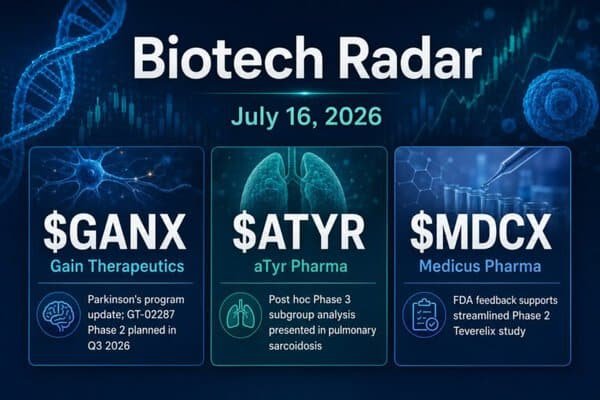
Three biotech updates, three very different evidence problems: an early Parkinson’s disease signal moving toward Phase 2, a post hoc attempt to rescue a pulmonary sarcoidosis program after a missed Phase 3 endpoint, and an FDA-guided protocol optimization that may make a urology study faster and less expensive without yet proving efficacy.
Beyond Nvidia: The Physical AI Infrastructure Chain Behind Defense, Power and Critical Minerals — $BBAI $BE $MP
The AI boom is no longer only a semiconductor and cloud-computing story. It is becoming a race for mission-ready software, deployable electricity and secure magnet supply. This report separates the common narrative from the very different financial realities of BigBear.ai, Bloom Energy and MP Materials.
Cannabis Rescheduling Hearing Final Wrap: What the Record Says for $ACB , $MSOS , $TLRY and $CGC
The July 15 testimony is over. There is no verdict, no vote and no broad Schedule III final rule yet. The hearing nevertheless clarified which parts of the government’s case survived, where the opposition created real legal risk and what investors should watch next.
Biotech Radar — July 15, 2026: Biogen and Ionis — Diranersen Lowers Tau, but CELIA Leaves Clinical Risk Unresolved ($BIIB, $IONS)

Phase 2 CELIA produced one of the most intriguing tau signals yet seen in Alzheimer’s disease, but it did not settle the key issue: why did the lowest dose show the most persuasive cognitive benefit while higher doses failed to produce a stronger response?
$BIIB · $IONS
Alzheimer’s · Tau · Antisense
Biotech Radar July 14, 2026: Biogen ($BIIB), AstraZeneca ($AZN), GSK ($GSK) and Evotec ($EVO)
Merlintrader Biotech Radar Biotech Radar July 14, 2026: Biogen, AstraZeneca, GSK and Evotec — $BIIB, $AZN, $GSK, $EVO A deeper four-company edition covering an FDA delivery breakthrough in Alzheimer’s disease, a $1.5 billion lung-cancer licensing deal, a potentially treatment-changing organ-preservation…
Gravity ($GRVY) Deep Dive 2026: The Ragnarok Cash Machine — One Franchise, 91 Regions, And A Cash Pile Near Its Market Cap
Gravity ($GRVY) deep dive: verified Q1 2026 and FY2025 numbers, ~$400M cash and no debt against a ~$440M market cap, the Ragnarok launch engine, GungHo control, and the bull vs bear case. Educational, not advice.
Outlook Therapeutics ($OTLK): A Story — The World’s Most-Used Eye Drug Is Not Approved for the Eye
Off-label economics explained with Outlook Therapeutics ($OTLK): why the most-used wet AMD treatment costs $50 and is not approved, while approved alternatives cost twenty times more. FDA PDUFA July 29, 2026.
ImmunityBio ($IBRX): A Story — Why FDA Approval Is Only the Starting Line
An accessible three-act explainer using ImmunityBio ($IBRX) and its bladder-cancer drug Anktiva to show why FDA approval is only the starting line: the human stakes, the commercial launch curve, and who controls the company.
Oil Shock Returns: Trump, Iran and the Fed Put Wall Street’s Summer Rally Under Pressure $SPY
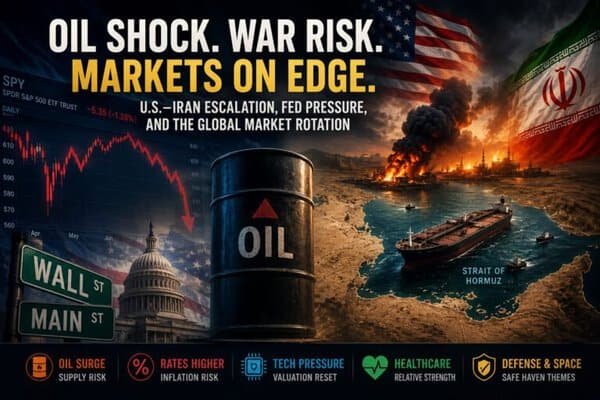
Macro & Markets Editorial Oil Shock Returns: Trump, Iran and the Fed Put Wall Street’s Summer Rally Under Pressure The renewed battle over the Strait of Hormuz is no longer only a geopolitical story. It is an inflation story, a…
Biotech Radar July 13, 2026: Sanofi, Guardant Health and Pharvaris
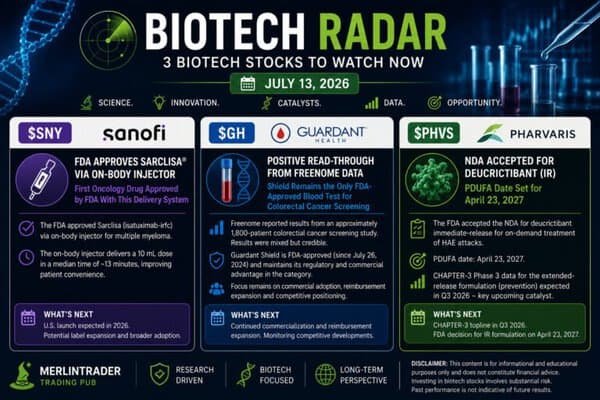
Biotech Radar July 13, 2026 $SNY $GH $PHVS Three-name biotech watch Biotech Radar July 13, 2026: Sanofi ($SNY), Guardant Health ($GH) and Pharvaris ($PHVS) Three distinct healthcare setups define today’s watch: a first-of-its-kind oncology delivery approval, a competitive read-through in…
$MSOS $TLRY $CGC $ACB Cannabis Rescheduling Hearing Week 2 Wrap: Finn, the TBI and the July 15 Schedule III Deadline
Week two of the DEA marijuana rescheduling hearing: Dr. Kenneth Finn's testimony, the Tennessee Bureau of Investigation, the July 13-15 final stretch, and the non-binding path to a Schedule III Final Rule - and what it means for $MSOS, $TLRY, $CGC and $ACB.
Reusable Rockets Explained: The Launch Economics, $RKLB as the Worked Example, and What China’s First Booster Catch Changes
A plain-English guide to the economics of reusable rockets: why refurbishing beats rebuilding, how cost-per-kg collapsed, where SpaceX ($SPCX), Blue Origin, China's Long March 10B and Rocket Lab ($RKLB) sit on the reuse ladder, a reusable triage for launch news, and what China's first booster catch does and doesn't change. Educational, not investment advice.
Why AI Needs Optics: The Optical Interconnect Stack Explained, With POET as the Worked Example

An educational guide to the AI optical interconnect stack - switch silicon, lasers, modulators, optical engines and modules - using POET Technologies (POET) as the highlighted optical-engine example.
Space stocks weakness: the SpaceX rotation, insider selling and the Planet Labs case
Why space stocks pulled back in July 2026: profit-taking after a huge run, capital rotating to the newly public SpaceX, insider selling at Rocket Lab, the Rocket Lab-Iridium deal and the company-specific Planet Labs case. Educational, no recommendations.
Biotech Radar — July 11, 2026: Chemomab, CervoMed and AtaiBeckley — $CMMB $CRVO $ATAI
Today’s radar compares three very different catalyst structures: Chemomab’s proposed merger with Scipher Medicine and shift toward AI-guided rheumatoid arthritis development, CervoMed’s completed Phase 2a enrollment in nonfluent variant primary progressive aphasia, and AtaiBeckley’s completion of dosing in the VLS-01 Phase 2b Elumina trial ahead of a Q4 2026 topline readout.