Merlintrader Trading Pub
Biotech catalyst, news and analysis PDUFA tracker
Merlintrader Trading Pub
Biotech catalyst, news and analysis PDUFA tracker
Merlintrader Blog
AI transparency: articles and reports are produced with the help of artificial intelligence and checked through a process that does not constitute specialist validation. They may contain errors: verify relevant information with independent sources. Read the full disclaimer.
Rare earths after Greenland: what can $CRML, $MP, $USAR and $UUUU actually sell?

A geopolitical agreement does not turn a deposit into a qualified magnet. This detailed comparison follows Critical Metals, MP Materials, USA Rare Earth and Energy Fuels from their actual products through processing, customer acceptance and financing, separating completed milestones from future targets.
Who pays for the AI boom? $CRWV, $NBIS, $IREN and $ORCL from contracts to cash

AI contracts can reach extraordinary sizes while the infrastructure behind them still needs funding. A detailed comparison of CoreWeave, Nebius, IREN and Oracle follows the money from customer commitments through delivery, debt service and the residual available to shareholders.
AI glasses after Connect: where is the value for $META, $QCOM, $GOOGL and $AAPL?

Audio, display and VR glasses are different businesses. A detailed guide to Meta Connect, Qualcomm's silicon, Google's Android XR and Apple's ecosystem explains what is available, what is still planned and where economic evidence remains missing.
Quantum meets NVIDIA: what changes for $IONQ, $NVDA, $QBTS and $RGTI?

IonQ's planned NVIDIA research-center installation makes hybrid quantum computing tangible. A source-led comparison explains what it means for four companies, which milestones remain ahead and how to separate a working application from a compelling announcement.
After ECOC, what evidence matters for $POET, $COHR, $LITE and $AAOI?

From demonstrations to paying customers: how to read PhotonLink, new lasers and AI optics orders without confusing technological promise with commercial results.
Obesity: fewer injections to keep the weight off? $VKTX, $AMGN, $LLY and $NVO
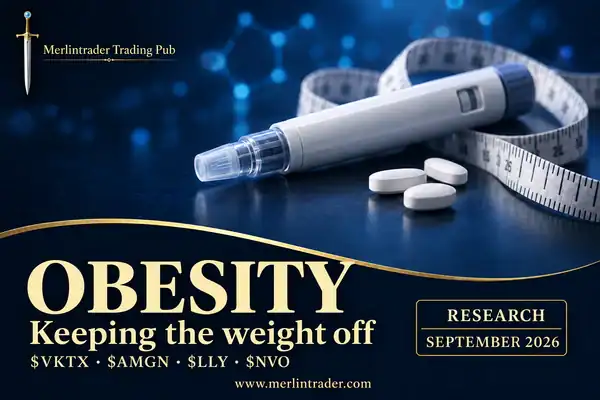
The next frontier in obesity treatment also concerns what happens after weight loss. Viking’s September 22 results sharpen the question: how much of the benefit can be preserved, for how long, and with what burden of treatment and side effects?
What Four Greenland Stocks Own: $CRML, $GRML, $GLND, $VEEE
After the US-Denmark security deal over Greenland, four US-listed names repriced. What Critical Metals, Greenland Mines, Greenland Energy and Twin Vee PowerCats actually own, from their SEC filings.
AI’s New Bottleneck Is Power: What Happens When the Constraint Moves From the GPU to the Megawatt?
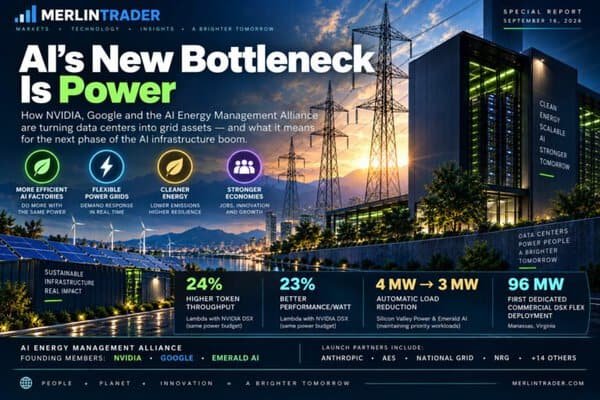
The scarce resource increasingly deciding how much AI capacity can actually be deployed is electricity. GPUs, networking and models still matter, but the new economic question is how efficiently operators can turn secured megawatts into useful, billable compute. NVIDIA’s DSX platform and the newly launched AI Energy Management Alliance are attempts to make power itself programmable — inside the data center and, potentially, at the grid interface.
$MSOS $TLRY $CGC $ACB: Cannabis Reform Holds, but the Sector Splits
From August’s DEA closing briefs to September’s developments: the U.S. medical framework survives a stay request, Congress delays part of the hemp restrictions, Germany raises new questions and Aurora battles Curaleaf. Meanwhile, company accounts are telling increasingly different stories.
Biotech Radar September 15, 2026: CNTB, BIVI, CRBP and ARMP — Asthma, Long COVID, Obesity and Phage Therapy
Biotech Radar: CNTB asthma data, BIVI Long COVID findings, CRBP obesity results and ARMP FDA designation, plus financing, diagnostics and medtech updates.
The Drone War Is Becoming an Industry: $ONDS, $RCAT, $DPRO and $AVAV Enter the Next Phase of Defense Autonomy

How $ONDS, $RCAT, $DPRO and $AVAV are turning defense autonomy into an industry: orders, manufacturing, cash, dilution and the next execution tests.
Bloom Energy, FuelCell and Plug Power: behind the rally, three different approaches to the race for energy

Bloom Energy, FuelCell and Plug Power: the rally, sector outlook, financials, contracts, liquidity and catalysts, with all three Stock Hubs.
Biotech Radar September 9, 2026: $ROIV, $BEAM, $UPB, $BMY
Biotech Radar: $ROIV, $BEAM, $UPB and $BMY report clinical progress. Mosliciguat, BEAM-302, verekitug and arlo-cel: evidence and next steps.
$PL $RKLB $SATL $LUNR: Space Stocks After the Selloff
Compare Planet Labs, Rocket Lab, Satellogic and Intuitive Machines: analyst targets, financial results and the next execution milestones after the selloff.
Biotech Radar: Evaluating $IONS, $STOK, $CLYM, $APVO
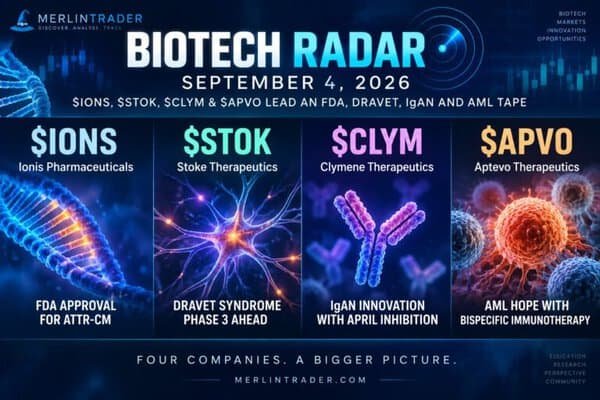
Merlintrader Biotech Radar · September 4, 2026 Biotech Radar — September 4, 2026: $IONS, $STOK, $CLYM & $APVO Lead an FDA, Dravet, IgAN and AML Tape Four companies sit at four different points on the biotech evidence ladder: Ionis has…
Russell Quarterly IPO Additions, September 2026: The Full Preliminary List, With $QNT, $FRVO, $HAWK and $COAG as Worked Examples
FTSE Russell's September 2026 quarterly IPO addition list: 36 new tickers joining the Russell 1000, Russell 2000 and Russell Microcap indexes, with $QNT, $FRVO, $HAWK and $COAG as verified worked examples and primary sources for every name.
Late-Summer 2026 Cruises: Carnival, Royal Caribbean and Norwegian ($CCL $RCL $NCLH)
Carnival, Royal Caribbean and Norwegian at the end of summer 2026: Q2 results, bookings, yields, fuel and fall/winter scenarios.
Late-Summer 2026 Rental Cars & Mobility: Avis, Hertz and Uber ($CAR $HTZ $UBER)

Avis, Hertz and Uber at the end of summer 2026: fleet utilization, pricing, bookings, cash generation and fall/winter scenarios.
Late-Summer 2026 Hotels: Hilton, Marriott and Hyatt ($HLT $MAR $H)

Hilton, Marriott and Hyatt at the end of summer 2026: RevPAR, pipelines, fee growth, openings and the next-season investment setup.
Late-Summer 2026 Airlines: American, Delta and United ($AAL $DAL $UAL)
A late-summer 2026 operating scorecard for American, Delta and United: Q2 results, fuel risk, demand quality and the fall/winter outlook.